

Sex-specific association between gut microbiome and fat distribution
Open accessThe DOI matches its Crossref record; 45 of the 45 references it cites were found in a registry or an index.
Abstract
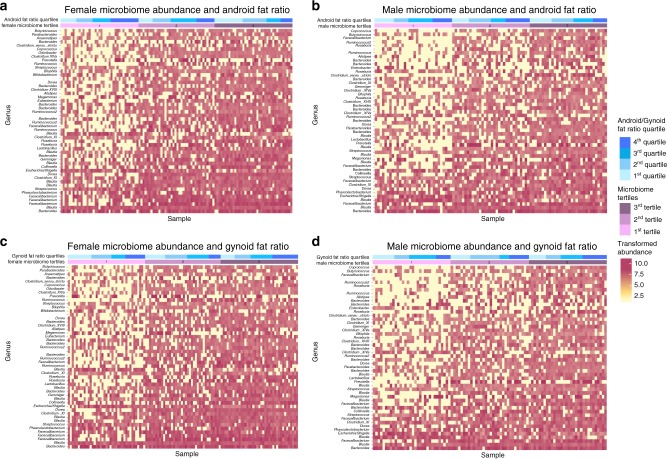
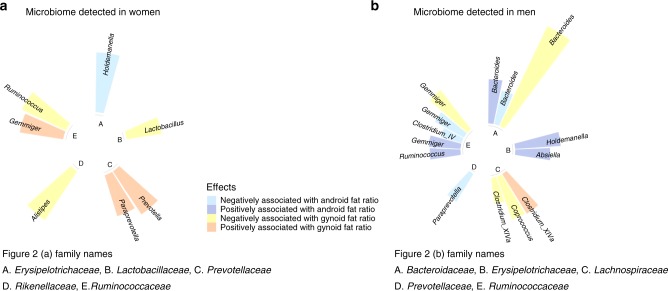
The gut microbiome has been linked to host obesity; however, sex-specific associations between microbiome and fat distribution are not well understood. Here we show sex-specific microbiome signatures contributing to obesity despite both sexes having similar gut microbiome characteristics, including overall abundance and diversity. Our comparisons of the taxa associated with the android fat ratio in men and women found that there is no widespread species-level overlap. We did observe overlap between the sexes at the genus and family levels in the gut microbiome, such as Holdemanella and Gemmiger; however, they had opposite correlations with fat distribution in men and women. Our findings support a role for fat distribution in sex-specific relationships with the composition of the microbiome. Our results suggest that studies of the gut microbiome and abdominal obesity-related disease outcomes should account for sex-specific differences.
Overview
The claims and statistics of this paper haven’t been checked yet.
Free: it reads the open-access text and checks the first 5 claims that cite a source we can check. Create a free account to check every claim.
Integrity signals
Registry
Cites
Statistics
Figures
Verification
Claims the paper makes
The claims and statistics of this paper haven’t been checked yet.
Free: it reads the open-access text and checks the first 5 claims that cite a source we can check. Create a free account to check every claim.
Claims other papers make about this one
Each is checked against this paper’s own text: does it say what the citing paper says it does?
The cited source says what the claim attributes to it.
In the citing paper
“Studies have shown that certain strains of Lactobacillus and Ruminococcus genera exhibit a negative association with the gynoid fat ratio in women but not in men. Meanwhile, different taxa from the Holdemanella genus, Erysipelotrichaceae family, exhibited a negative association with android fat ratio in women but a positive association in men(Min et al., 2019).”
From Impact of probiotics on weight loss, glucose and lipid metabolism in overweight or obese women: A meta-analysis of randomized controlled trials (2024) · cites this paper as Min et al., 2019
Self-check
Percentages, sums and reported differences re-computed from the paper’s own numbers.
The self-check needs the paper’s full text.
Citations
Cites
1 retracted
Million, M., Maraninchi, M., Henry, M., Armougom, F., Richet, H., Carrieri, P., Valero, R., Raccah, D., Vialettes, B., & Raoult, D. (2012) · International Journal of Obesity · doi:10.1038/ijo.2011.153 · Cited by 663
RetractedControlling the False Discovery Rate: A Practical and Powerful Approach to Multiple Testing
Benjamini, Y., & Hochberg, Y. (1995) · Journal of the Royal Statistical Society Series B: Statistical Methodology · doi:10.1111/j.2517-6161.1995.tb02031.x · Cited by 109,482
Moderated estimation of fold change and dispersion for RNA-seq data with DESeq2
Love, M. I., Huber, W., & Anders, S. (2014) · Genome Biology · doi:10.1186/s13059-014-0550-8 · Cited by 95,106
DADA2: High–resolution sample inference from Illumina amplicon data
Callahan, B. J., McMurdie, P. J., Rosen, M. J., Han, A. W., Johnson, A. J. A., & Holmes, S. P. (2016) · Nature Methods · doi:10.1038/nmeth.3869 · Cited by 35,698
Differential expression analysis for sequence count data
Anders, S., & Huber, W. (2010) · Genome Biology · doi:10.1186/gb-2010-11-10-r106 · Cited by 15,581
An obesity-associated gut microbiome with increased capacity for energy harvest
Turnbaugh, P. J., Ley, R. E., Mahowald, M. A., Magrini, V., Mardis, E. R., & Gordon, J. I. (2006) · Nature · doi:10.1038/nature05414 · Cited by 12,444
Yusuf, S., Hawken, S., Ôunpuu, S., Dans, T., Avezum, A., Lanas, F., McQueen, M., Budaj, A., Pais, P., Varigos, J., et al. (2004) · The Lancet · doi:10.1016/s0140-6736(04)17018-9 · Cited by 12,026
Greengenes, a Chimera-Checked 16S rRNA Gene Database and Workbench Compatible with ARB
DeSantis, T. Z., Hugenholtz, P., Larsen, N., Rojas, M., Brodie, E. L., Keller, K., Huber, T., Dalevi, D., Hu, P., & Andersen, G. L. (2006) · Applied and Environmental Microbiology · doi:10.1128/aem.03006-05 · Cited by 10,891
The gut microbiota as an environmental factor that regulates fat storage
Bäckhed, F., Ding, H., Wang, T., Hooper, L. V., Koh, G. Y., Nagy, A., Semenkovich, C. F., & Gordon, J. I. (2004) · Proceedings of the National Academy of Sciences · doi:10.1073/pnas.0407076101 · Cited by 6,245
The Microbial Metabolites, Short-Chain Fatty Acids, Regulate Colonic T reg Cell Homeostasis
Smith, P. M., Howitt, M. R., Panikov, N., Michaud, M., Gallini, C. A., Bohlooly-Y, M., Glickman, J. N., & Garrett, W. S. (2013) · Science · doi:10.1126/science.1241165 · Cited by 5,413
Cited by
Reporting guidelines for human microbiome research: the STORMS checklist
Mirzayi, C., Renson, A., Genomic Standards Consortium, Massive Analysis and Quality Control Society, Furlanello, C., Sansone, S.-A., Zohra, F., Elsafoury, S., Geistlinger, L., Kasselman, L. J., et al. (2021) · Nature Medicine · doi:10.1038/s41591-021-01552-x · Cited by 521
“After the first round of edits, the checklist was then applied to a recent microbiome study 22 by group members.”
MethodMechanisms of sex differences in Alzheimer’s disease
Lopez-Lee, C., Torres, E. R. S., Carling, G., & Gan, L. (2024) · Neuron · doi:10.1016/j.neuron.2024.01.024 · Cited by 376
“133,134 The microbiome also appears to affect processes that have exhibited sex biases and are central to neurodegenerative disease, such as inflammation and phagocytosis 135 (Figure 2).”
Tavella, T., Rampelli, S., Guidarelli, G., Bazzocchi, A., Gasperini, C., Pujos-Guillot, E., Comte, B., Barone, M., Biagi, E., Candela, M., et al. (2021) · Gut Microbes · doi:10.1080/19490976.2021.1880221 · Cited by 298
“Unlike a recent study in a Chinese adult population, which reported a sex-specific association between the gut microbiome layout and fat distribution, using DXA data for android and gynoid fat, the microbial communities defining the three elderly groups in our work are neither sex-related nor age-driven.(28) However,…”
ResultHow biological sex of the host shapes its gut microbiota
Valeri, F., & Endres, K. (2021) · Frontiers in Neuroendocrinology · doi:10.1016/j.yfrne.2021.100912 · Cited by 264
“(Min et al., 2019) associated different fat distribution between male and female with differences in the gut microbiota composition.”
BackgroundCoronary artery disease is associated with an altered gut microbiome composition
Toya, T., Corban, M. T., Marrietta, E., Horwath, I. E., Lerman, L. O., Murray, J. A., & Lerman, A. (2020) · PLOS ONE · doi:10.1371/journal.pone.0227147 · Cited by 130
Metadata
- Authors
- Min, Y., Ma, X., Sankaran, K., Ru, Y., Chen, L., Baiocchi, M., & Zhu, S.
- Affiliations
- Women's Hospital, School of Medicine, Zhejiang University (CN)
- Stanford University (US)
- Corresponding author
- Zhu, Shankuan
- Venue
- Nature Communications
- Published
- 2019-06-03
- Volume
- 10
- Issue
- 1
- Pages
- 2408-2408
- ISSN
- 2041-1723 (ISSN-L)
- PMC
- PMC6546740
- OpenAlex
- W2947986400
- Semantic Scholar
- d21f3dab5e38393f7aacff1b42439dbd96df5516
- Cited by
- 133
- References
- 45
- Citations by year
- 2026: 5 · 2025: 11 · 2024: 19 · 2023: 13 · 2022: 36 · 2021: 26 · 2020: 17 · 2019: 5
- FWCI
- 7.53
- Type
- journal article
- Language
- en
- Open access
- gold
- doi.org
- Licence
- cc-by
- creativecommons.org/licenses/by/4.0 (tdm)
- creativecommons.org/licenses/by/4.0 (vor)
- Locations
- Nature Communications (publishedVersion, cc-by)
- Europe PMC (PubMed Central) (publishedVersion, cc-by)
- PubMed Central (publishedVersion, cc-by)
- PubMed (publishedVersion)
- RePEc: Research Papers in Economics (submittedVersion)
- DOAJ (DOAJ: Directory of Open Access Journals) (submittedVersion)
- DOAJ (DOAJ: Directory of Open Access Journals) (submittedVersion, cc-by-sa)
- Funders
- Cyrus Tang Foundation
- Topics
- Life Sciences › Biochemistry, Genetics and Molecular Biology › Molecular Biology › Gut microbiota and health
- Health Sciences › Dentistry › Periodontics › Oral microbiology and periodontitis research
- Health Sciences › Medicine › Endocrinology, Diabetes and Metabolism › Adipokines, Inflammation, and Metabolic Diseases
- Keywords
- gut microbiota, sex differences, body fat distribution, android fat, obesity, abdominal obesity, microbiota composition, Holdemanella, Gemmiger
- MeSH terms
- Gastrointestinal Microbiome, Adult, Aged, Female, Humans, Male, Middle Aged, RNA, Ribosomal, 16S, Sex Factors, Absorptiometry, Photon, Body Fat Distribution
About these checks
Registry, retraction, Cites and statistics results are computed, not judged, with one exception: a printed reference that no index lists is read once by a model before it counts as a citation error. Claims are extracted by a model and kept only when their quote appears verbatim in the text; each cited source is then checked, with a model’s help, for whether it says what the claim relies on. Those verdicts can be wrong — read the claim’s quote and the cited source before relying on one.
Statistics and arithmetic are recomputed, not judged.
Confidence bands are shown only for fields calibrated on our annotated test set. None is calibrated yet, so no band is shown.
What counts as a claim ›How we measure confidence ›How we check this ›
Are you an author, or do you see a problem with this page? Request a review
How to cite
Cite CoChat for the checks on this page, and the paper for its own findings.
- This page
- CoChat. (2026). Citation check: Sex-specific association between gut microbiome and fat distribution. https://app.cochat.ai/papers/10.1038/s41467-019-10440-5
- The paper
- Min, Y., Ma, X., Sankaran, K., Ru, Y., Chen, L., Baiocchi, M., & Zhu, S. (2019). Sex-specific association between gut microbiome and fat distribution. Nature Communications. https://doi.org/10.1038/s41467-019-10440-5
Data sources
Bibliographic data: Semantic Scholar, OpenAlex, Crossref.
Contains information from the Semantic Scholar Academic Graph Datasets, made available under the ODC Attribution License (ODC-BY 1.0).
Semantic Scholar’s data is described in: Kinney, R., et al. (2023). The Semantic Scholar Open Data Platform. arXiv:2301.10140.
