

Establishing microbial composition measurement standards with reference frames
Open accessThe DOI matches its Crossref record; 58 of the 58 references it cites were found in a registry or an index.
Abstract
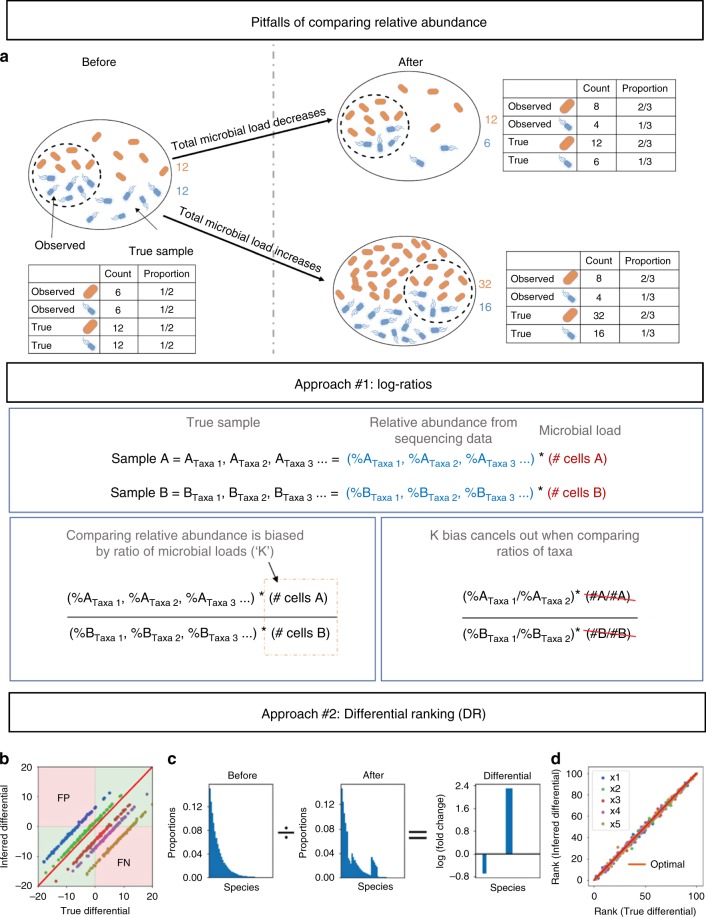
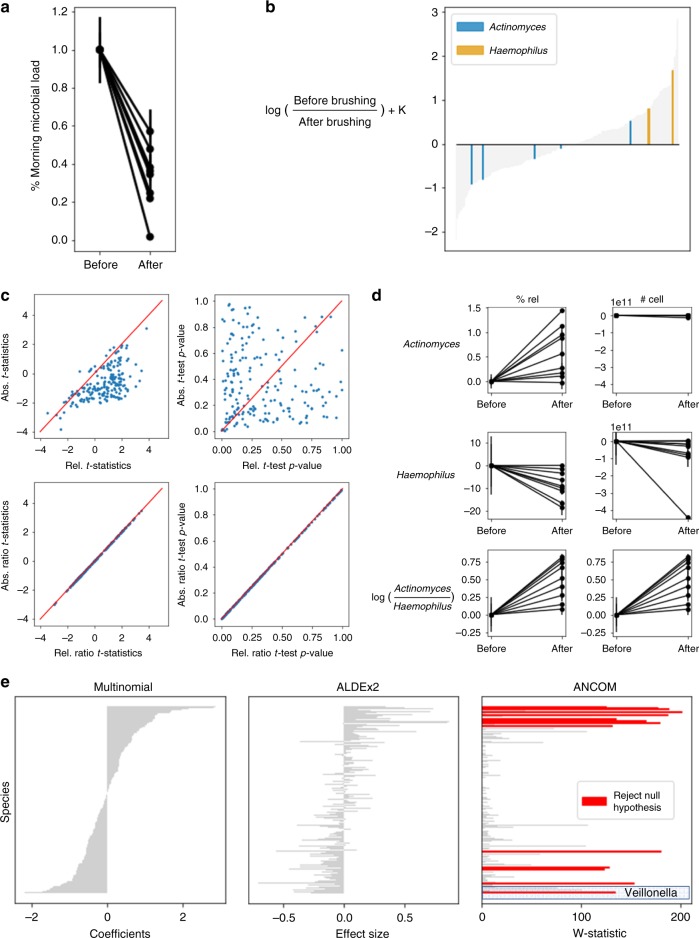
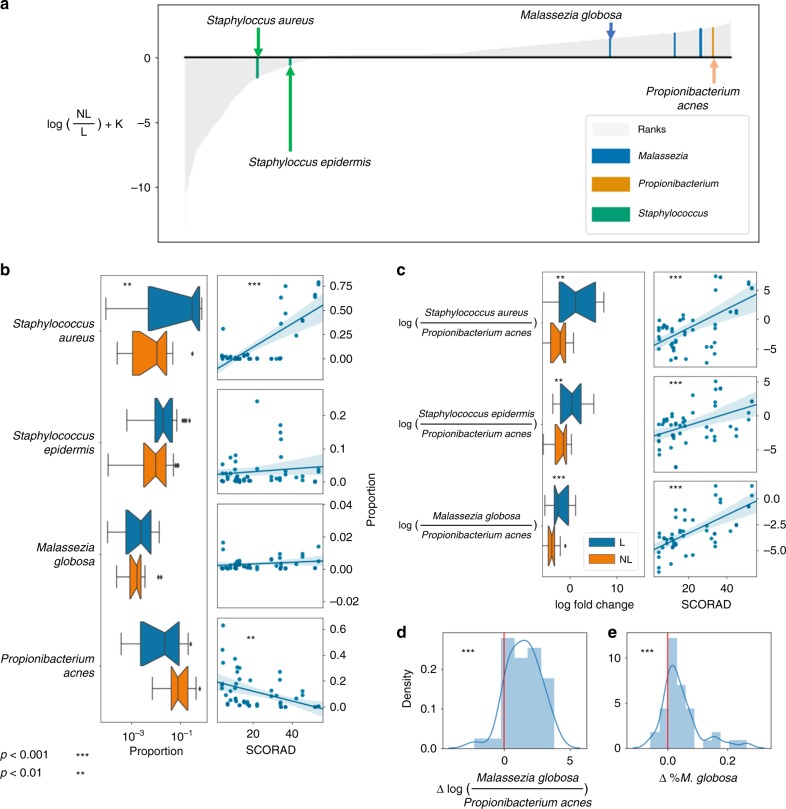
Differential abundance analysis is controversial throughout microbiome research. Gold standard approaches require laborious measurements of total microbial load, or absolute number of microorganisms, to accurately determine taxonomic shifts. Therefore, most studies rely on relative abundance data. Here, we demonstrate common pitfalls in comparing relative abundance across samples and identify two solutions that reveal microbial changes without the need to estimate total microbial load. We define the notion of “reference frames”, which provide deep intuition about the compositional nature of microbiome data. In an oral time series experiment, reference frames alleviate false positives and produce consistent results on both raw and cell-count normalized data. Furthermore, reference frames identify consistent, differentially abundant microbes previously undetected in two independent published datasets from subjects with atopic dermatitis. These methods allow reassessment of published relative abundance data to reveal reproducible microbial changes from standard sequencing output without the need for new assays.
Overview
The claims and statistics of this paper haven’t been checked yet.
Free: it reads the open-access text and checks the first 5 claims that cite a source we can check. Create a free account to check every claim.
Integrity signals
Registry
Cites
Statistics
Figures
Verification
Claims the paper makes
The claims and statistics of this paper haven’t been checked yet.
Free: it reads the open-access text and checks the first 5 claims that cite a source we can check. Create a free account to check every claim.
Claims other papers make about this one
Each is checked against this paper’s own text: does it say what the citing paper says it does?
In the citing paper
“A recent approach called differential ranking is robust to the choice of the alr reference feature, and ranks produced from relative abundances are identical to the ranks of absolute abundances66,67.”
From Longitudinal gut microbiome changes in immune checkpoint blockade-treated advanced melanoma (2024) · cites this paper as [67]
Self-check
Percentages, sums and reported differences re-computed from the paper’s own numbers.
The self-check needs the paper’s full text.
Citations
Cites
Moderated estimation of fold change and dispersion for RNA-seq data with DESeq2
Love, M. I., Huber, W., & Anders, S. (2014) · Genome Biology · doi:10.1186/s13059-014-0550-8 · Cited by 95,106
QIIME allows analysis of high-throughput community sequencing data
Caporaso, J. G., Kuczynski, J., Stombaugh, J., Bittinger, K., Bushman, F. D., Costello, E. K., Fierer, N., Peña, A. G., Goodrich, J. K., Gordon, J. I., et al. (2010) · Nature Methods · doi:10.1038/nmeth.f.303 · Cited by 34,887
Self-citationNaïve Bayesian Classifier for Rapid Assignment of rRNA Sequences into the New Bacterial Taxonomy
Wang, Q., Garrity, G. M., Tiedje, J. M., & Cole, J. R. (2007) · Applied and Environmental Microbiology · doi:10.1128/aem.00062-07 · Cited by 19,885
TensorFlow: A system for large-scale machine learning
Abadi, M., Barham, P., Chen, J., Chen, Z., Davis, A., Dean, J., Devin, M., Ghemawat, S., Irving, G., Isard, M., et al. (2016) · arXiv (Cornell University) · doi:10.48550/arxiv.1605.08695 · Cited by 11,822
Ecological Diversity and Its Measurement
Magurran, A. E. (1988) · Springer eBooks · doi:10.1007/978-94-015-7358-0 · Cited by 10,879
The Statistical Analysis of Compositional Data
Aitchison, J. (1982) · Journal of the Royal Statistical Society Series B: Statistical Methodology · doi:10.1111/j.2517-6161.1982.tb01195.x · Cited by 3,405
Microbiome Datasets Are Compositional: And This Is Not Optional
Gloor, G. B., Macklaim, J. M., Pawlowsky-Glahn, V., & Egozcue, J. J. (2017) · Frontiers in Microbiology · doi:10.3389/fmicb.2017.02224 · Cited by 3,044
Inferring Correlation Networks from Genomic Survey Data
Friedman, J., & Alm, E. J. (2012) · PLoS Computational Biology · doi:10.1371/journal.pcbi.1002687 · Cited by 2,706
Differential abundance analysis for microbial marker-gene surveys
Paulson, J. N., Stine, O. C., Bravo, H. C., & Pop, M. (2013) · Nature Methods · doi:10.1038/nmeth.2658 · Cited by 2,428
Analysis of composition of microbiomes: a novel method for studying microbial composition
Mandal, S., Van Treuren, W., White, R. A., Eggesbø, M., Knight, R., & Peddada, S. D. (2015) · Microbial Ecology in Health & Disease · doi:10.3402/mehd.v26.27663 · Cited by 1,942
Self-citation
Research works printed but not linked: 2
- Lovell D Taylor J Zwart A Helliwell C Caution! compositions! can constraints on omics data lead analyses astray CSIRO 2010 1 44
- Gonzalez A Qiita: rapid, web-enabled microbiome meta-analysis Nat. Methods 2018 15 796 798 10.1038/s41592-018-0141-9 30275573 PMC6235622 · DOI · Paper page
Cited by
Items 601–668 of 668
Kodera, S. M., Sharma, A., Martino, C., Dsouza, M., Grippo, M. A., Lutz, H. L., Knight, R. D., Gilbert, J. A., Negri, C., & Allard, S. M. (2024) · Figshare · doi:10.6084/m9.figshare.26569669
Self-citationKouete, M. T., Bletz, M. C., LaBumbard, B. C., Woodhams, D. C., & Blackburn, D. C. (2024) · Figshare · doi:10.6084/m9.figshare.26589540
Additional file 1 of PhyloMed: a phylogeny-based test of mediation effect in microbiome
Hong, Q., Chen, G., & Tang, Z.-Z. (2023) · Figshare · doi:10.6084/m9.figshare.22621100
Calgaro, M., Romualdi, C., Waldron, L., Risso, D., & Vitulo, N. (2020) · Figshare · doi:10.6084/m9.figshare.12756728
Wong, N. S. T., Malmuthge, N., Gellatly, D., Nordi, W. M., Alexander, T. W., Polo, R. O., Janzen, E., Schwartzkopf-Genswein, K. S., & Jelinski, M. (2024) · Figshare · doi:10.6084/m9.figshare.25045549
Additional file 3 of The gut microbiome mediates adaptation to scarce food in Coleoptera
Moldovan, O. T., Carrell, A. A., Bulzu, P.-A., Levei, E., Năstase-Bucur, R., Sitar, C., Faur, L., Mirea, I. C., Șenilă, M., Cadar, O., et al. (2024) · Figshare · doi:10.6084/m9.figshare.26639410
Additional file 1 of The gut microbiome mediates adaptation to scarce food in Coleoptera
Moldovan, O. T., Carrell, A. A., Bulzu, P.-A., Levei, E., Năstase-Bucur, R., Sitar, C., Faur, L., Mirea, I. C., Șenilă, M., Cadar, O., et al. (2023) · Figshare · doi:10.6084/m9.figshare.24558077
Kouete, M. T., Bletz, M. C., LaBumbard, B. C., Woodhams, D. C., & Blackburn, D. C. (2024) · Figshare · doi:10.6084/m9.figshare.26589543
Miles, A. M., McArt, J. A. A., Lima, S. F., Neves, R. C., & Ganda, E. (2022) · Figshare · doi:10.6084/m9.figshare.21621720
Olekhnovich, E. I., Геннадьевна, Б. Е., Yunes, R. А., Анатольевич, К. В., Poluektova, E. U., Veselovsky, V. A., Ilina, E. N., Даниленко, В. Н., & Klimina, K. M. (2021) · Figshare · doi:10.6084/m9.figshare.17305935
Kouete, M. T., Bletz, M. C., LaBumbard, B. C., Woodhams, D. C., & Blackburn, D. C. (2024) · Figshare · doi:10.6084/m9.figshare.26589534
Additional file 2 of PhyloMed: a phylogeny-based test of mediation effect in microbiome
Hong, Q., Chen, G., & Tang, Z.-Z. (2023) · Figshare · doi:10.6084/m9.figshare.22621103
The Role of the Gut Microbiome in Modulating Arterial Dysfunction With Aging
Greenberg, N. (2024) · CU Scholar (University of Colorado Boulder)
Micro-environmental Influences on Skin Homeostasis
Afghani, J., Traidl-Hoffmann, C., & München, T. U. (2023)
Rahman, G. (2023) · eScholarship (California Digital Library)
Oral microbiome : composition, interactions and shaping factors
Willis, J. R. (2021) · Repositori digital de la UPF (Universitat Pompeu Fabra)
Metabolomics and metagenomics in hypertension
Palmu, J. (2022) · UTUPub (University of Turku)
Kunselman, E. (2024) · eScholarship (California Digital Library)
Bohn, B. (2023) · University of Minnesota Digital Conservancy (University of Minnesota)
Giusti, B. (2021) · Archipel (Université du Québec à Montréal)
Moreno Díaz, A. (2020) · Hispana
(2020) · Illinois Digital Environment for Access to Learning and Scholarship (University of Illinois at Urbana-Champaign)
Optimisation de la viabilité bactérienne pour la transplantation de microbiote fécal chez le chien
Ratté, M. (2022) · Papyrus : Institutional Repository (Université de Montréal) · doi:10.71781/3970
Arghavani, S. (2023) · Papyrus : Institutional Repository (Université de Montréal) · doi:10.71781/3499
Microbiome community and parasitic infections in wild bees
Young, M. (2021) · Digital Commons - Colby (Colby College)
Catarecha Zoido, P. (2023) · Archivo Digital UPM (Universidad Politécnica de Madrid)
Szopinska-Tokov, J. (2025) · Radboud Repository (Radboud University)
Ein bakterielles Mikrobiom ist für die Induktion von dysfunktionalen CD8 T-Zellen nicht erforderlich
Kuhlmann, M. (2025) · mediaTUM (Technical University of Munich)
Mishra, A., Badri, M. H., Coler, E., Liu, Z., Bonneau, R., Morton, J. T., & Aksenov, A. A. (2025) · bioRxiv (Cold Spring Harbor Laboratory) · doi:10.64898/2025.12.26.696613
Self-citationde Castilho, L. V. A., Barreto, A. L., Santaren, K. C. F., Rosenblatt, M. B. F., Taveira, I. N., Cypriano, J. B. S., Abreu, F. D. Á., Godoy, M. G., Jurelevicius, D. D. A., & Seldin, L. (2026) · Frontiers in Microbiology · doi:10.3389/fmicb.2025.1694832
“To estimate the absolute abundance of microbial groups present in each sample, qPCR-derived values for total prokaryote quantification (bacteria/archaea) were considered the total number of bacterial and archaeal cells per sample, following the approach proposed by Morton et al. (2019).”
Sun, J., Cai, L., Li, H., Wang, C., Zhang, M., Wang, Z., & 邵清松 (2026) · Frontiers in Microbiology · doi:10.3389/fmicb.2026.1746815
“…may cause taxa with identical absolute abundances to show significant relative abundance dierences after normalization, leading to misinterpretation of dierential significance and thereby increasing the risk of false negatives and false positives (Mandal et al., 2015; Morton et al., 2019).”
Drought stress effects on soil microbial diversity and function: an integrative review
Namla, D., Oves, M., Al‐Shaeri, M., & Khan, M. S. (2026) · Elsevier eBooks · doi:10.1016/b978-0-443-32932-6.00019-9
UNDERSTANDING DIFFERENTIAL ABUNDANCE IN MICROBIAL ECOLOGY USING COMMUNITY STRUCTURE.
Hossine, Z. (2026) · UNSWorks (University of New South Wales, Sydney, Australia) · doi:10.26190/unsworks/32095
Moreira, B. R. D. A., Bai, J., & Yadav, S. (2026) · Soil and Tillage Research · doi:10.1016/j.still.2026.107193
Integrating microbiome data visualization into FAIRDatabase using edge functions
van Eldijk, R., Kumar, S., & Sheraton, V. M. (2026) · International Journal of Data Science and Analytics · doi:10.1007/s41060-026-01107-8
Vlasovets, O., Schaipp, F., Simpson, L., Bolyen, E., Caporaso, J. G., & Müller, C. L. (2026) · PubMed Central · doi:10.48550/arxiv.2604.15520
“…but does not provide log-contrast regression models tailored to compositional data. q2-longitudinal [3] supports linear mixed-effects models and paired-sample comparisons for low-dimensional time-series. songbird [26] uses multinomial regression specifically for differential abundance testing.”
Understanding the bias of compositional microbiome differential abundance estimationPreprint
Calle, M. L., Pujolassos, M., & Susín, A. (2026) · bioRxiv (Cold Spring Harbor Laboratory) · doi:10.64898/2026.04.28.721392
“The bias introduced when estimating differential abundance from relative abundances has been widely described in the literature (e.g., Morton et al. 2019; Lin and Peddada 2020a).”
Nunzi, E., & Romani, L. R. (2026) · bioRxiv (Cold Spring Harbor Laboratory) · doi:10.64898/2026.05.16.725171
Zhang, H. Y., Yan, S., Tang, X., Wu, W., Shen, W., & Gao, N. (2026) · Journal of soil science and plant nutrition · doi:10.1007/s42729-026-03408-0
“The CLR-transformed data were then used for downstream multivariate analyses, including beta diversity, phylum-and genus-level composition profiling, Per-mutational multivariate analysis of variance (PERMANOVA), and correlation analyses (Gloor et al. 2017; Morton et al. 2019).”
Gaillard, V., Rodiles, A., Mugnier, A., Laxalde, J., Knight, D., Joly, W., & Péron, F. (2026) · Animal Microbiome · doi:10.1186/s42523-026-00574-5
“The Spearman method was selected to correlate Shannon index with relevant taxa and log ratios [56].”
Mikrobioomi genoomipõhine analüüsi: võimalused ja väljakutsed
Pantiukh, K. (2026) · DSpace repository (University of Tartu)
Li, X., Wang, Y., Wang, Z., Deng, M., Zheng, J., Geng, H., Zhao, G., & Wang, Q. (2026) · Poultry Science · doi:10.1016/j.psj.2026.107550
“…reflect differential effects of Salmonella infection on individual species within this genus or a more pronounced reduction in other Faecalibacterium species, suggesting an intragenus compositional restructuring against the background of overall Faecalibacterium depletion (Morton, et al., 2019).”
Lu, Y., Chang, Z., & Peng, K. (2026) · Frontiers in Microbiology · doi:10.3389/fmicb.2026.1874955
Vita, M. M., van Dam, F., Kienhuis, M. V. M., Eefting, D. D., Nierop, K. G. J., Hannula, S. E., Polerecký, L., Peterse, F., & Middelburg, J. J. (2026) · bioRxiv (Cold Spring Harbor Laboratory) · doi:10.64898/2026.08.25.747027
“…pool was divided into multiple density fractions, but not all were sequenced, leaving some DNA unaccounted for and making it challenging to determine whether the observed changes in relative abundances were due to a reduction in M. thermophilus or an increase in A. bisporus (Morton et al. 2019).”
Abdelmalek, N., Meo, C. D., Fiorito, G., Uzzau, S., & Tanca, A. (2026) · bioRxiv (Cold Spring Harbor Laboratory) · doi:10.64898/2026.09.01.748571
IRS: iterative reference selection improves normalization of microbiome sequencing data
Shi, Y., Liu, L., Chen, J., Wylie, K. M., Wylie, T., Park, S. H., Zhou, R., Cao, Y., Fritz, S. A., Stout, M. J., et al. (2026) · Briefings in Bioinformatics · doi:10.1093/bib/bbag495
Robust statistical methods for microbiome abundance data
Shi, Y. (2026) · Digital Commons@Becker (Washington University School of Medicine) · doi:10.48765/sjds-t773
Impact of probiotic intervention on gut microbiota in T2DM patients of Northeastern Ontario
Chaudhari, A. (2025) · Lu Zone Ul (Laurentian University)
Wang, X., Xiong, D., Duan, B., Ding, G., Huang, Y., & Wang, Q. (2026) · iScience · doi:10.1016/j.isci.2026.117697
“118,199,200 The statistical method should match the endpoint and prediction time.”
Métris, A., Guan, R., Ampatzoglou, A., & Murphy, B. (2026) · Journal of Food Protection · doi:10.1016/j.jfp.2026.100933
Din, M. O., Brennan, C., Zhao, J., Oles, R. E., Patel, L., Birmingham, A., Sevilir, D. M., Hansen, L., Wright, G. M., Ambre, M., et al. (2026) · bioRxiv (Cold Spring Harbor Laboratory) · doi:10.64898/2026.09.28.754546
Self-citationMysonhimer, A. R. (2023) · Illinois Digital Environment for Access to Learning and Scholarship (University of Illinois at Urbana-Champaign)
Hou, L., Zhang, X., Huang, K., Wu, W., Xing, L., Shen, W., Zhang, Y., & Dong, Z. (2026) · Journal of Microbiological Methods · doi:10.1016/j.mimet.2026.107758
Kume, M. H., Furlan, B., Boaventura, C. G., Probst, M. A., Peracchi, E., Ribas, C. A. P. M., & Jeyaraman, M. (2026) · Journal of Orthopaedics Study and Sports Medicine · doi:10.52793/jossm.2026.4(1)-39
Zhu, X., Liu, L., Cao, Y., Sheng, Y., Yang, B., Wu, D., Zhang, G., Zhao, G., Jiao, N., & Zhu, R. (2026) · bioRxiv (Cold Spring Harbor Laboratory) · doi:10.64898/2026.10.29.762742
Soil and Water Microbial Informatics for Sustainability
Izah, S. C., Kari, A., & Ogwu, M. C. (2026) · Advances in computational intelligence and robotics book series · doi:10.4018/979-8-2600-5208-2.ch003
Hou, Y., Zhang, M., Jiang, Q., Yang, Y., Liu, J., Yuan, K., Sun, Z., & Liu, X. (2023) · doi:10.3389/fcimb.2023.1169101.s002
Cappellato, M., Baruzzo, G., & Camillo, B. D. (2022) · doi:10.1371/journal.pcbi.1010467.r002
Du, Y., Feng, R., Chang, E. T., Debelius, J. W., Yin, L., Xu, M., Huang, T., Zhou, X., Xiao, X., Li, Y., et al. (2022) · doi:10.3389/fcimb.2022.831409.s001
Giliberti, R., Cavaliere, S., Mauriello, I. E., Ercolini, D., & Pasolli, E. (2022) · doi:10.1371/journal.pcbi.1010066.r003
Montero, B. K., Uddin, W., Schwensow, N., Gillingham, M. A. F., Ratovonamana, Y. R., Rakotondranary, S. J., Corman, V., Drosten, C., Ganzhorn, J. U., & Sommer, S. (2021) · doi:10.1371/journal.ppat.1009675.r005
Stefani, F., Beguin, J., Paré, D., Morency, M.-J., Martineau, C., Fortin, J. A., Thiffault, N., & Séguin, A. (2023) · doi:10.3389/fpls.2023.1122445.s001
Ma, G., Logares, R., Xue, Y., & Yang, J. (2022) · doi:10.3389/fmicb.2022.969799.s001
Jackova, Z., Stepan, J. J., Coufal, S., Kostovcik, M., Galanova, N., Reiss, Z., Pavelka, K., Wenchich, L., Hruskova, H., & Kverka, M. (2023) · doi:10.3389/fendo.2023.1139056.s002
Galeeva, J. S., Starikova, E. V., Fedorov, D. E., Manolov, A. I., Pavlenko, A. V., Konanov, D. N., Krivonos, D. V., Babenko, V. V., Klimina, K. M., Veselovsky, V. A., et al. (2023) · doi:10.3389/frmbi.2023.1067019.s004
Guéneau, V., Rodiles, A., Frayssinet, B., Piard, J.-C., Castex, M., Plateau-Gonthier, J., & Briandet, R. (2022) · doi:10.3389/fmicb.2022.981747.s001
Robeson, M. S., II, Manna, K., Randolph, C., Byrum, S., & Hakkak, R. (2022) · doi:10.3389/fmicb.2022.834776.s005
Myers, T., Bouslimani, A., Huang, S., Hansen, S. T., Clavaud, C., Azouaoui, A., Ott, A., Gueniche, A., Bouez, C., Zheng, Q., et al. (2024) · doi:10.3389/fragi.2023.1304705.s008
Self-citation
Metadata
- Authors
- Morton, J. T., Marotz, C., Washburne, A., Silverman, J., Zaramela, L. S., Edlund, A., Zengler, K., & Knight, R.
- Affiliations
- University of California San Diego (US)
- Montana State University (US)
- Duke University (US)
- J. Craig Venter Institute (US)
- Corresponding author
- Zengler, Karsten
- Knight, Rob
- ORCID
- Venue
- Nature Communications
- Published
- 2019-06-20
- Volume
- 10
- Issue
- 1
- Pages
- 2719-2719
- ISSN
- 2041-1723 (ISSN-L)
- PMC
- PMC6586903
- OpenAlex
- W2951061751
- Cited by
- 613
- References
- 56
- Citations by year
- 2026: 31 · 2025: 60 · 2024: 83 · 2023: 87 · 2022: 124 · 2021: 122 · 2020: 96 · 2019: 10
- FWCI
- 29.77
- Type
- journal article
- Language
- en
- Open access
- gold
- doi.org
- Licence
- cc-by
- creativecommons.org/licenses/by/4.0 (tdm)
- creativecommons.org/licenses/by/4.0 (vor)
- Locations
- Nature Communications (publishedVersion, cc-by)
- PubMed Central (publishedVersion, cc-by)
- PubMed (publishedVersion)
- eScholarship (California Digital Library) (submittedVersion, cc-by)
- RePEc: Research Papers in Economics (submittedVersion)
- DOAJ (DOAJ: Directory of Open Access Journals) (submittedVersion)
- DOAJ (DOAJ: Directory of Open Access Journals) (submittedVersion, cc-by-sa)
- eScholarship (California Digital Library) (submittedVersion)
- Funders
- National Science Foundation (GRFP DGE-1144086, DBI-1565057)
- U.S. Department of Health & Human Services | NIH | National Institute of Dental and Craniofacial Research (1F31DE028478)
- Alfred P. Sloan Foundation (G-2017-9838)
- Janssen Pharmaceuticals (20175015)
- Topics
- Life Sciences › Biochemistry, Genetics and Molecular Biology › Molecular Biology › Gut microbiota and health
- Health Sciences › Dentistry › Periodontics › Oral microbiology and periodontitis research
- Life Sciences › Biochemistry, Genetics and Molecular Biology › Molecular Biology › Genomics and Phylogenetic Studies
- Keywords
- reference frames, relative abundance, differential abundance, microbiota composition, compositional data, oral microbiota, atopic dermatitis, reproducibility, false positives
- MeSH terms
- Data Analysis, Bacteria, Computer Simulation, Dermatitis, Atopic, Feasibility Studies, Humans, Models, Biological, Reference Standards, RNA, Ribosomal, 16S, Saliva, Soil Microbiology, Metagenome, Bacterial Load, High-Throughput Nucleotide Sequencing, Microbiota, Healthy Volunteers, Datasets as Topic
About these checks
Registry, retraction, Cites and statistics results are computed, not judged, with one exception: a printed reference that no index lists is read once by a model before it counts as a citation error. Claims are extracted by a model and kept only when their quote appears verbatim in the text; each cited source is then checked, with a model’s help, for whether it says what the claim relies on. Those verdicts can be wrong — read the claim’s quote and the cited source before relying on one.
Statistics and arithmetic are recomputed, not judged.
Confidence bands are shown only for fields calibrated on our annotated test set. None is calibrated yet, so no band is shown.
What counts as a claim ›How we measure confidence ›How we check this ›
Are you an author, or do you see a problem with this page? Request a review
Data sources
Bibliographic data: Semantic Scholar, OpenAlex, Crossref.
Contains information from the Semantic Scholar Academic Graph Datasets, made available under the ODC Attribution License (ODC-BY 1.0).
Semantic Scholar’s data is described in: Kinney, R., et al. (2023). The Semantic Scholar Open Data Platform. arXiv:2301.10140.
