

The DOI matches its Crossref record; 52 of the 53 references it cites were found in a registry or an index.
Analysis of polygenic risk score usage and performance in diverse human populations
Open accessPublished version of a preprint
Abstract
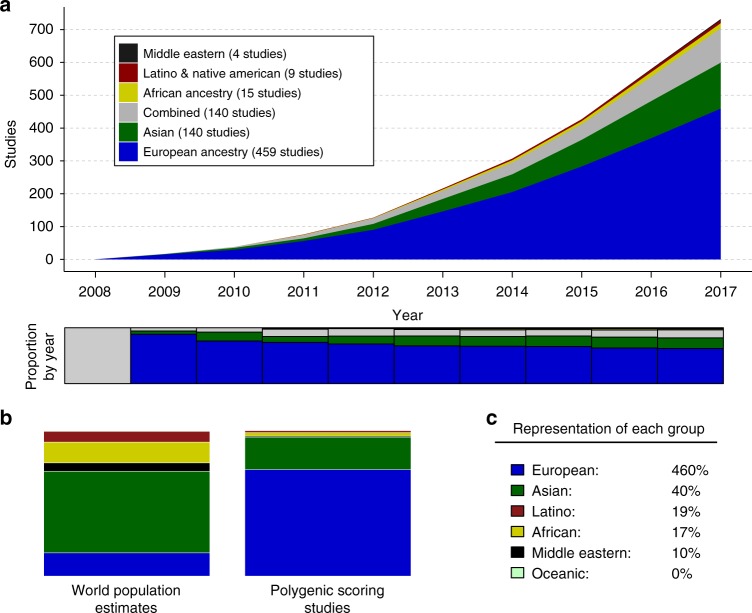
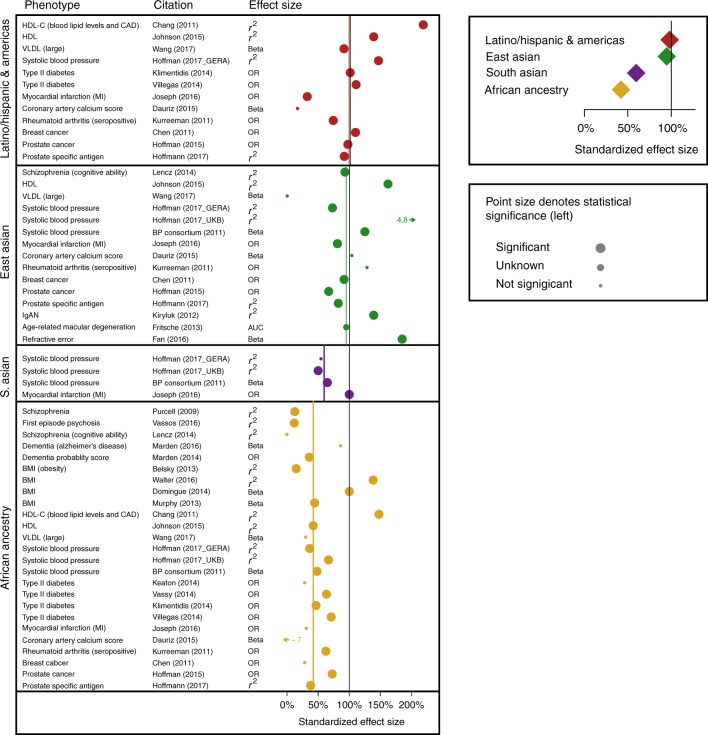
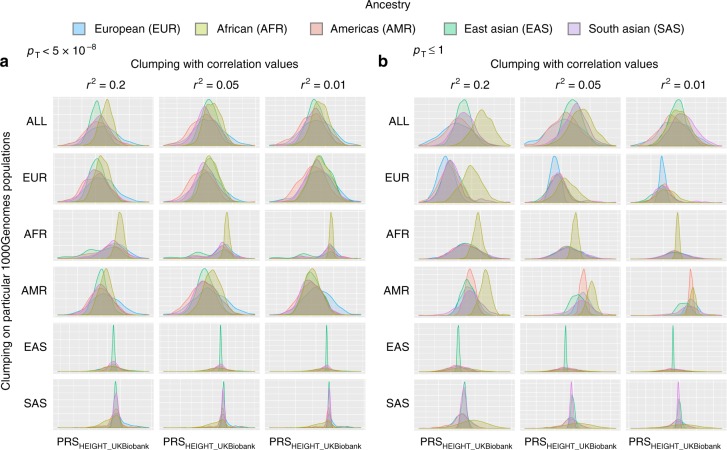
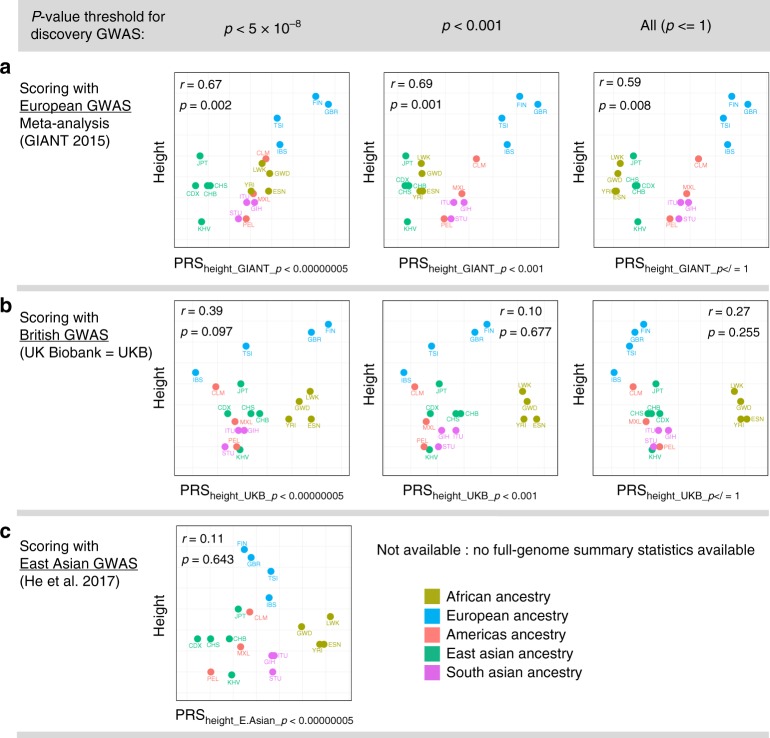
A historical tendency to use European ancestry samples hinders medical genetics research, including the use of polygenic scores, which are individual-level metrics of genetic risk. We analyze the first decade of polygenic scoring studies (2008–2017, inclusive), and find that 67% of studies included exclusively European ancestry participants and another 19% included only East Asian ancestry participants. Only 3.8% of studies were among cohorts of African, Hispanic, or Indigenous peoples. We find that predictive performance of European ancestry-derived polygenic scores is lower in non-European ancestry samples (e.g. African ancestry samples: t = −5.97, df = 24, p = 3.7 × 10 −6 ), and we demonstrate the effects of methodological choices in polygenic score distributions for worldwide populations. These findings highlight the need for improved treatment of linkage disequilibrium and variant frequencies when applying polygenic scoring to cohorts of non-European ancestry, and bolster the rationale for large-scale GWAS in diverse human populations.
Overview
The claims and statistics of this paper haven’t been checked yet.
Run the check — free, no account needed. It reads the open-access text and checks the sources it cites.
Integrity signals
Registry
Cites
Statistics
Figures
Verification
Claims the paper makes
The claims and statistics of this paper haven’t been checked yet.
Run the check — free, no account needed. It reads the open-access text and checks the sources it cites.
Claims other papers make about this one
Each is checked against this paper’s own text: does it say what the citing paper says it does?
The source backs part of the claim, not all of it — or backs it for a different population, condition or comparison.
In the citing paper
“PGIs like ours that are constructed from GWAS in samples of European genetic ancestries are generally found to have much lower predictive power in samples with other genetic ancestries; for example, on average across phenotypes, estimates of relative accuracy (ratio of R2) in African-genetic-ancestry to European-genetic-ancestry samples have been 22%23 and 36%24.”
From Polygenic prediction of educational attainment within and between families from genome-wide association analyses in 3 million individuals (2022) · cites this paper as [24]
Experimental — accuracy not yet measuredIn the citing paper
“Then, each original variable used in the models was put in linear regressions with the 20 first principal components of the SNP genotype data to correct for population stratification (associations of environmental effects with genetic structure due to geographic separation, population mixtures, and migrations that occurred throughout our evolutionary history)91,92, as well as with the age of the”
From The impact of digital media on children’s intelligence while controlling for genetic differences in cognition and socioeconomic background (2022) · cites this paper as [91]
Self-check
Percentages, sums and reported differences re-computed from the paper’s own numbers.
The self-check needs the paper’s full text.
Citations
Cites
PLINK: a tool set for whole-genome association and population-based linkage analyses.
Purcell, S., Neale, B., Todd-Brown, K., Thomas, L., Ferreira, M. A. R., Bender, D., Maller, J., Sklar, P., de Bakker, P. I. W., Daly, M. J., et al. (2007) · The American Journal of Human Genetics · doi:10.1086/519795 · Cited by 34,089
A global reference for human genetic variation
The 1000 Genomes Project Consortium, authors, C., Auton, A., Abecasis, G. R., Steering committee, Altshuler, D. M., Durbin, R. M., Abecasis, G. R., Bentley, D. R., Chakravarti, A., et al. (2015) · Nature · doi:10.1038/nature15393 · Cited by 18,247
Second-generation PLINK: rising to the challenge of larger and richer datasets
Chang, C. C., Chow, C. C., Tellier, L. C., Vattikuti, S., Purcell, S. M., & Lee, J. J. (2015) · Gigascience · doi:10.1186/s13742-015-0047-8 · Cited by 12,709
The UK Biobank resource with deep phenotyping and genomic data
Bycroft, C., Freeman, C., Petkova, D., Band, G., Elliott, L. T., Sharp, K., Motyer, A., Vukcevic, D., Delaneau, O., O’Connell, J., et al. (2018) · Nature · doi:10.1038/s41586-018-0579-z · Cited by 8,876
A map of human genome variation from population-scale sequencing.
The 1000 Genomes Project Consortium (2010) · Nature · doi:10.1038/nature09534 · Cited by 7,877
Biological insights from 108 schizophrenia-associated genetic loci
Schizophrenia Working Group of the Psychiatric Genomics Consortium (2014) · Nature · doi:10.1038/nature13595 · Cited by 7,577
Common polygenic variation contributes to risk of schizophrenia and bipolar disorder
The International Schizophrenia Consortium (2009) · Nature · doi:10.1038/nature08185 · Cited by 4,821 · cited 1×
“2 (see schizophrenia and Purcell 2009 in the citation information for this point).”
BackgroundeQTLGen, Wray, N. R., 23andMe, the Major Depressive Disorder Working Group of the Psychiatric Genomics Consortium, Ripke, S., Mattheisen, M., Trzaskowski, M., Byrne, E. M., Abdellaoui, A., Adams, M. J., et al. (2018) · Nature Genetics · doi:10.1038/s41588-018-0090-3 · Cited by 3,005
Clinical use of current polygenic risk scores may exacerbate health disparities
Martin, A. R., Kanai, M., Kamatani, Y., Okada, Y., Neale, B. M., & Daly, M. J. (2019) · Nature Genetics · doi:10.1038/s41588-019-0379-x · Cited by 2,821
Blundell, J. E., Baker, J. L., Boyland, E. J., Blaak, E. E., Charzewska, J., Henauw, S. D., Frühbeck, G., González‐Gross, M., Hebebrand, J., Holm, L., et al. (2017) · Obesity Facts · doi:10.1159/000455952 · Cited by 1,983
Cited by
Sorted by citations
Items 801–900 of 999
Varma, M., Paskov, K. M., Chrisman, B., Sun, M., Jung, J.-Y., Stockham, N., Washington, P. Y., & Wall, D. P. (2021) · BioData Mining · doi:10.1186/s13040-021-00262-x
He, Q., & Li, J. J. (2021) · doi:10.31234/osf.io/8bz3g
Biological bases of cancer: a proposal of minimum contents for health schools
Leal, J. A. R., Zavala, V. A., Francisco Garrido, C., Zolezzi, J. M., Barake, F., Labbé, T., Roje, D. D., & García‐Bloj, B. (2021) · International Journal of Medical and Surgical Sciences · doi:10.32457/ijmss.v8i3.1606 · Cited by 1
Vrantsidis, D. M. (2021) · ERA: Education and Research Archive (University of Alberta) · doi:10.7939/r3-xgt1-ch23
Estimating genetic correlation jointly using individual-level and summary-level GWAS dataPreprint
Zhao, H., Zhang, Y., Cheng, Y., Ye, Y., Jiang, W., & Lu, Q. (2021) · Research Square · doi:10.21203/rs.3.rs-830770/v1
Patterns, influences and genetic underpinnings of the development of ADHD
Liu, C.-Y. (2021) · UCL Discovery (University College London)
Conceptual Design of Polygenic Risk Score Web Portal
Rahutomo, R., Budiarto, A., & Pardamean, B. (2021) · International Conference on Information Management and Technology (ICIMTech) · doi:10.1109/icimtech53080.2021.9534929
Higgs, E., Dagan‐Rosenfeld, O., & Snyder, M. P. (2021) · Journal of Genetic Counseling · doi:10.1002/jgc4.1509
Toward a methodology for evaluating DNA variants in nuclear families
Miller, D. B., Robison, R. J., & Piccolo, S. (2021) · PLoS ONE · doi:10.1371/journal.pone.0258375
Barry, C.-J. S., Davies, N. M., & Morris, T. (2021) · Research Square · doi:10.21203/rs.3.rs-927102/v1
Introduction to Precision Medicine: Minority Populations and Cardiovascular Health
Landry, L. G. (2021) · Contemporary cardiology · doi:10.1007/978-3-030-81034-4_2
GPCR Patient Drug Interaction—Pharmacogenetics: Genome-Wide Association Studies (GWAS)
Perera, M. A., & Hernandez, W. (2021) · Elsevier eBooks · doi:10.1016/b978-0-12-820472-6.00136-5
バイオマテリアルの機能改変 : ポリエチレングリコール(PEG)及びヒアルロン酸(HA)を用いたバイオコンジュゲート(桜井 勝清) (学位論文の紹介)
稲田, 祐. (1997) · 桐蔭論叢
Competing analytical strategies of combining associated SNPs for estimating genetic risks
Majumdar, A., & Ghosh, S. (2022) · Journal of Genetics · doi:10.1007/s12041-021-01349-4
Bioinformatics and Genomics for Epidemiologists
Bello‐Chavolla, O. Y., Fernández‐Chirino, L., Antonio‐Villa, N. E., Delaye-Martínez, M. A., & Sicilia-Andrade, A. (2022) · Springer eBooks · doi:10.1007/978-3-030-89601-0_12
Angelis, F. D., Zeleznik, O. A., Wendt, F. R., Pathak, G. A., Tylee, D. S., Lillo, A. D., Koller, D., Cabrera‐Mendoza, B., Clifford, R. E., Maihofer, A. X., et al. (2022) · medRxiv · doi:10.1101/2022.01.26.22269898
Association Analysis Using Set-Based Approaches in the Post-GWAS Era
Yasmeen, S. (2021) · eDiss (Georg-August-Universität Göttingen) · doi:10.53846/goediss-9044
Das, A. (2022) · Adaptive Human Behavior and Physiology · doi:10.1007/s40750-022-00189-5 · Cited by 1
Ryan, N., Ormond, C., Brady, P., Heron, E. A., & Corvin, A. P. (2022) · Elsevier eBooks · doi:10.1016/b978-0-12-819602-1.00002-4
Bird, K. A. (2020) · SocArXiv (OSF Preprints) · doi:10.31235/osf.io/2qfkt
Arvanitis, M., Post, W. S., & Battle, A. J. (2021) · Springer eBooks · doi:10.1007/978-3-030-75055-8_3
Investigating the genetic complexity of glaucoma
Faro, V. L. (2022) · University of Groningen research database (University of Groningen / Centre for Information Technology) · doi:10.33612/diss.216689872
Liu, L., Wu, Y., Jing, R., et al. (2022) · Research Square · doi:10.21203/rs.3.rs-1860757/v1
Seviiri, M. (2022) · Queensland University of Technology · doi:10.5204/thesis.eprints.236969
He, Q.-F., Keding, T. J., Zhang, Q., Miao, J.-C., Herringa, R., Lu, Q.-S., Travers, B., & Li, J. J. (2022) · medRxiv · doi:10.1101/2022.12.12.22283356
Chen, S., Tan, A. L., Perry, C., Churchill, S., Vella, M., Mao, J.-F., Viswanadham, V., Kobren, S., & Kohane, I. (2023) · medRxiv · doi:10.1101/2023.02.22.23285773
Topriceanu, C., Chaturvedi, N., Mathur, R., & Garfield, V. (2023) · medRxiv · doi:10.1101/2023.03.20.23287475
Hassanin, E., Maj, C., Krawitz, P., May, P., & Bobbili, D. (2023) · medRxiv · doi:10.1101/2023.03.20.23287470 · Cited by 1
Substance Use and Substance Use Disorders
Sher, K. J., Conlin, W. E., & Pihl, R. O. (2023) · Oxford University Press eBooks · doi:10.1093/med-psych/9780197542521.003.0013
Genomics in reproductive medicine: Current and future applications
Poli, M., & Capalbo, A. (2023) · Elsevier eBooks · doi:10.1016/b978-0-323-91380-5.00026-5
The Co-design Process for Interactive Tools for Predicting Polygenic Risk Scores
Zubairi, A., Aldossary, D., AlEissa, M. M., & Al‐Wabil, A. (2023) · Communications in computer and information science · doi:10.1007/978-3-031-35989-7_25
Trans‐ethnic polygenic risk scores for body mass index
Qu, H., Connolly, J. J., & Hakonarson, H. H. (2023) · Clinical and Translational Discovery · doi:10.1002/ctd2.228
Polygenic Embryo Screening: High Approval Despite Substantial Concerns from the U.S. PublicPreprint
Furrer, R. A., Barlevy, D., Pereira, S., Carmi, S., Lencz, T., & Lázaro‐Muñoz, G. (2023) · medRxiv · doi:10.1101/2023.10.13.23297022
Data Simulation to Optimize the GWAS Framework in Diverse PopulationsPreprint
Mugo, J. W., Chimusa, E. R., & Mulder, N. (2023) · medRxiv · doi:10.1101/2023.10.26.23297606
Psychosis across persons 3: Genes, biology, and neurodevelopment
Segre, G., Iyegbe, C. O., Tosato, S., Busatto, G. F., & Dazzan, P. (2023) · Oxford University Press eBooks · doi:10.1093/med/9780198735588.003.0004
DNA and IQ: Big deal or much ado about nothing? – A Meta-analysisPreprint
Oxley, F. A. R., Wilding, K., & von Stumm, S. (2023) · PsyArXiv (OSF Preprints) · doi:10.31234/osf.io/4uc8g
Alamad, B., Elliott, K., & Knight, J. C. (2023) · Cambridge Prisms Precision Medicine · doi:10.1017/pcm.2023.25.pr5
Knight, J. C. (2023) · Cambridge Prisms Precision Medicine · doi:10.1017/pcm.2023.25.pr1
Alamad, B., Elliott, K., & Knight, J. C. (2023) · Cambridge Prisms Precision Medicine · doi:10.1017/pcm.2023.25.pr8
Knight, J. C. (2023) · Cambridge Prisms Precision Medicine · doi:10.1017/pcm.2023.25.pr6
Alamad, B., Elliott, K., & Knight, J. C. (2023) · Cambridge Prisms Precision Medicine · doi:10.1017/pcm.2023.25.pr9
Alamad, B., Elliott, K., & Knight, J. C. (2023) · Cambridge Prisms Precision Medicine · doi:10.1017/pcm.2023.25.pr3
Alamad, B., Elliott, K., & Knight, J. C. (2023) · Cambridge Prisms Precision Medicine · doi:10.1017/pcm.2023.25.pr2
Alamad, B., Elliott, K., & Knight, J. C. (2023) · Cambridge Prisms Precision Medicine · doi:10.1017/pcm.2023.25.pr7
Alamad, B., Elliott, K., & Knight, J. C. (2023) · Cambridge Prisms Precision Medicine · doi:10.1017/pcm.2023.25.pr4
Multi-ancestry polygenic risk scores using phylogenetic regularizationPreprint
Layne, E., Zabad, S., Li, Y., & Blanchette, M. (2024) · bioRxiv (Cold Spring Harbor Laboratory) · doi:10.1101/2024.02.14.580313
Wilson, S., & Rea‐Sandin, G. (2024) · Elsevier eBooks · doi:10.1016/b978-0-323-96023-6.00116-0 · Cited by 1
Tam, C. H. T., Lim, C. K. P., Luk, A. O. Y., Ng, A. C. W., Lee, H. M., Jiang, G., Lau, E. S. H., Fan, B., Wan, R., Kong, A. P. S., et al. (2021) · Figshare · doi:10.6084/m9.figshare.14068007
Aljumaan, M. A., Chu, H., Al-Sulaiman, A., Camp, S. Y., Han, S., Gillani, R., Marzooq, Y. A., Almulhim, F., Vatte, C., Nemer, A. M. A., et al. (2023) · Figshare · doi:10.6084/m9.figshare.24076959
Lillo, A. D., Wendt, F. R., Pathak, G. A., & Polimanti, R. A. (2023) · Figshare · doi:10.6084/m9.figshare.23722263
Lencz, T. (2024) · Elsevier eBooks · doi:10.1016/b978-0-12-822563-9.00149-9
Shu, N., Chen, H., Dong, X., Wang, K., Feng, G., Wang, Y., Zhang, M., Gan, K., Huang, W., Ma, G., et al. (2024) · Research Square · doi:10.21203/rs.3.rs-4242200/v1
What’s UPDOG? A novel tool for trans-ancestral polygenic score prediction
Howard, D. M., Pain, O., Gillett, A. C., et al. (2024) · Wellcome Open Research · doi:10.12688/wellcomeopenres.21375.1
Ethical implications of disparities in translation genomic medicine: from research to practice
Suleman, M., Parker, M. J., & Qureshi, N. (2024) · Journal of Medical Ethics · doi:10.1136/jme-2024-110151 · Cited by 1
Dự đoán nguy cơ bệnh đái tháo đường típ 2 trên người việt sử dụng chỉ số nguy cơ đa gen
Vo, S. N., Tran, T. H. T., Tran, H. M., et al. (2024) · Vietnam Journal of Diabetes and Endocrinology · doi:10.47122/vjde.2023.65.13
Leveraging Functional Annotations Improves Cross-Population Genetic Risk Prediction
Ye, Y., Xu, L., & Zhao, H. (2024) · ICSA book series in statistics · doi:10.1007/978-3-031-50690-1_18
Dybing, K. M., McAllister, T. W., Wu, Y., McDonald, B. C., Broglio, S. P., Mihalik, J. P., Guskiewicz, K. M., Goldman, J., Jackson, J. C., Risacher, S. L., et al. (2024) · medRxiv · doi:10.1101/2024.07.10.24309042
Towards Personalized Breast Cancer Risk Management: A Thai Cohort Study on Polygenic Risk ScoresPreprint
Nakhonsri, V., Pithukpakorn, M., Eu‐ahsunthornwattana, J., et al. (2024) · medRxiv · doi:10.1101/2024.07.28.24311135
Withdrawn: DNA and IQ: Big deal or much ado about nothing? – A Meta-analysisPreprint
Oxley, F. A. R., Wilding, K., & von Stumm, S. (2024) · PsyArXiv (OSF Preprints) · doi:10.31234/osf.io/fgzdn
BMI-related Genetic Factors and COPD Imaging PhenotypesPreprint
Zhang, J., Moll, M. R., Debban, C. L., Hobbs, B. D., Rijhwani, H., Washko, G. R., Celli, B. R., Silverman, E. K., Bakke, P. S., Oelsner, E. C., et al. (2024) · medRxiv · doi:10.1101/2024.08.16.24312135
Effect of Polygenic Scores on the Relationship Between Psychosis and Cognitive PerformancePreprint
Varney, L., Jedlovszky, K., Wang, B., Murtough, S., Cotic, M., Richards‐Belle, A., Khani, N. S., Lau, R., Abidoph, R., McQuillin, A., et al. (2024) · medRxiv · doi:10.1101/2024.09.10.24313194
Afifah, N. N., Permatasari, L. I., Diantini, A., et al. (2024) · OncoTargets and Therapy · doi:10.2147/ott.s475219
Population-Specific Polygenic Risk Scores Developed for the Han ChinesePreprint
Chen, H., Chen, C.-H., Hou, M., Fu, Y., Li, L., Chou, C.-Y., Yeh, E., Tsai, M.-F., Chen, C., Yang, H., et al. (2024) · medRxiv · doi:10.1101/2024.10.14.24315279
Cataldo‐Ramirez, C. C., Lin, M. H., Mcmahon, A., Gignoux, C. R., Weaver, T. D., & Henn, B. M. (2024) · bioRxiv (Cold Spring Harbor Laboratory) · doi:10.1101/2024.10.28.620716
Computational disease-risk prediction: Tools and statistical approaches
Chimusa, E. R. (2024) · Elsevier eBooks · doi:10.1016/b978-0-443-18546-5.00006-1
Martinez, K. L., Klein, A., Martin, J. R., Sampson, C. U., Giles, J. B., Beck, M. L., Bhakta, K., Quatraro, G., Farol, J., & Karnes, J. H. (2024) · medRxiv · doi:10.1101/2024.02.21.24302372
Update zur Pathophysiologie, Prädiktion und Prävention chronisch-entzündlicher Darmerkrankungen
Fischer, S., & Neurath, M. F. (2025) · Die Innere Medizin · doi:10.1007/s00108-024-01838-5
Latham-Mintus, K., Williams, M. A., & Catt, W. (2025) · Journal of Aging and Health · doi:10.1177/08982643251320426
Freitag, E. W., Kelsey, C. M., Filho, E. J. D. M., Pokhvisneva, I., Patel, S. H., Silveira, P. P., Enlow, M. B., & Nelson, C. A. (2025) · Journal of Child Psychology and Psychiatry · doi:10.1111/jcpp.14140 · Cited by 1
Wang, X., Sofer, T., Frei, O., et al. (2025) · medRxiv · doi:10.1101/2025.03.21.25324423
Henechowicz, T. L., Coleman, P. L., Gustavson, D. E., et al. (2025) · bioRxiv (Cold Spring Harbor Laboratory) · doi:10.1101/2025.03.27.645667
Genetic architecture of Multiple Sclerosis patients in the French national OFSEP-HD cohortPreprint
Paris, J., Silva, N. D. S. B., Faddeenkov, I., Morin, M. E., Boussamet, L., Demuth, S., Barzine, M., Serova-Erard, A., Cornélis, F., Bourguiba, S., et al. (2025) · medRxiv · doi:10.1101/2025.04.28.25326562
Polygenic and Polygene x Trauma Contributions to Alcohol Use and Problems Among Black AmericansPreprint
Benca‐Bachman, C. E., Cassidy, S., Syed, R. A., Barfield, W. L., Jaume-Feliciosi, N., Smith, A. K., Katrinli, Ş., Powers, A. D., Mekawi, Y., & Palmer, R. H. C. (2025) · medRxiv · doi:10.1101/2025.05.13.25327255
Multiple instance fine-mapping: Predicting causal regulatory variants with a deep sequence model
Rakowski, A., & Lippert, C. (2026) · PLoS Genetics · doi:10.1371/journal.pgen.1012208
Kodji, E., Attaoua, R., Haloui, M., Hishmih, C., Seitz, M., Hamet, P., Hussin, J. G., & Tremblay, J. (2025) · medRxiv · doi:10.1101/2025.06.17.25329804
Multimodal Prediction of Psychosis in the Prospective MoBa Birth CohortPreprint
Birkenæs, V., Parekh, P., Shadrin, A. A., Jaholkowski, P. P., Ystaas, L., Makowski, C., Bakken, N. R., Hagen, E., Frei, E., Oliver, D., et al. (2025) · Research Square · doi:10.21203/rs.3.rs-6783339/v1
Ayton, S. G., Pavlicová, M., Robles‐Espinoza, C. D., Fuentes-Aguilar, R. Q., Garza-Hernandez, D., Martínez-Ledesma, E., Tamez‐Peña, J. G., Garcia-Pompermayer, M. R., & Treviño, V. (2025) · npj Health Systems · doi:10.1038/s44401-025-00025-4
Genetics of Concurrent Tobacco Use and Mental Illness
Chenoweth, M. J. (2025) · Current Addiction Reports · doi:10.1007/s40429-025-00678-z
Unlocking Clinical Precision Through Polygenic Risk Prediction
Sathian, B., Iqbal, J., Banerjee, I., et al. (2024) · Nepal Journal of Epidemiology · doi:10.3126/nje.v14i3.82370
Santos, R. D. (2025) · JACC Basic to Translational Science · doi:10.1016/j.jacbts.2025.101315
Squires, S., Katte, J.-C. N., Dabelea, D., Pihoker, C., Divers, J., Sobngwi, E., Nyirenda, M., Kreienkamp, R. J., Liese, A. D., SHAH, A. S., et al. (2025) · medRxiv · doi:10.1101/2025.07.17.25330632
Zhang, J.-F., Liu, X., Zhang, B., & Chen, X.-Y. (2025) · Frontiers in Psychiatry · doi:10.3389/fpsyt.2025.1627629
Jiang, Y., Yuan, F., Li, X., Zheng, X., & Qin, Y. (2025) · SSRN Electronic Journal · doi:10.2139/ssrn.5395609
Polygenic scores for depression are associated with indices of neighborhood adversity.
Feurer, C., McGeary, J. E., Benca‐Bachman, C. E., & Gibb, B. E. (2025) · Journal of Psychopathology and Clinical Science · doi:10.1037/abn0001038
Kleinstern, G., Robinson, D. P., Seir, R. A., Perlman, R., Liu, J., Jebrini, N., Elyan, H., Yehuda, D. B., Slager, S. L., & Paltiel, O. (2025) · British Journal of Haematology · doi:10.1111/bjh.70125
Genetic Influences on Psychological and Subjective Well-being in East AsiansPreprint
Lee, S., Kim, K., Gim, S., Lee, H., Choi, I., & Woo, C. (2025) · SSRN Electronic Journal · doi:10.2139/ssrn.5462916
Cheng, C., Kao, W.-Y., Lin, M., Su, M., Wu, C., Fan, C. C., & Wang, S. (2025) · Neuropsychopharmacology · doi:10.1038/s41386-025-02242-9
Kurniansyah, N., Tasaki, S., Rehman, H., Zhu, C., Farrell, J. J., Sherva, R., Hauger, R., Merritt, V. C., Panizzon, M. S., Zhang, R., et al. (2025) · medRxiv · doi:10.1101/2025.09.24.25336555 · Cited by 1
Lee, E. Y. P., Dinh, B. L., Tang, J., Streicher, S. A., Wang, X., Biswas, S., Tian, H., Yu, X., Tappara, K., Naseri, T., et al. (2026) · Genes & Nutrition · doi:10.1186/s12263-026-00811-1 · Cited by 2
Arthur, K. E., & Martey, C. (2025) · bioRxiv (Cold Spring Harbor Laboratory) · doi:10.1101/2025.10.25.684582
Rhodes, J. A., Bitter, M. C., Berardi, S., Beltz, J., Petrov, D. A., & Schmidt, P. (2025) · bioRxiv (Cold Spring Harbor Laboratory) · doi:10.1101/2025.11.04.686622
The Opioid Crisis Meets Genomics
Koch, V. G. (2025) · Seton Hall Law Review · doi:10.60095/vgnc1212
Choi, E. S., Jung, S., Jung, Y. M., Park, C. W., Park, J. S., Jun, J. K., Kim, J., Kim, B., Cho, C., Shim, I., et al. (2025) · BJOG An International Journal of Obstetrics & Gynaecology · doi:10.1111/1471-0528.70072
A combined genomic arrhythmia propensity score delineates cumulative risk
Monroe, T. O., Puckelwartz, M. J., Pesce, L. L., Kearns, S. D., Page, P., Ibrahim, N., Weber, Z., Ugwor, E. I., Nóbrega, M. A., Kannankeril, P. J., et al. (2025) · Cell Reports Medicine · doi:10.1016/j.xcrm.2025.102455
Barnett, E. J., Zhang‐James, Y., Hess, J., Glatt, S. J., & Faraone, S. V. (2025) · Communications Medicine · doi:10.1038/s43856-025-01189-8 · Cited by 2
Effect of polygenic scores on the relationship between psychosis and cognition
Varney, L., Jedlovszky, K., Wang, B., Murtough, S., Cotic, M., Richards‐Belle, A., Khani, N. S., Lau, R., Abidoph, R., McQuillin, A., et al. (2025) · Translational Psychiatry · doi:10.1038/s41398-025-03666-z
Kim, S., Shin, J.-Y., Kwon, N.-J., et al. (2021) · Figshare · doi:10.6084/m9.figshare.16530069
Rahman, M. S., Takahashi, N., Iwabuchi, T., Nishimura, T., Harada, T., Okumura, A., Takei, N., Nomura, Y., & Tsuchiya, K. J. (2021) · Figshare · doi:10.6084/m9.figshare.16674686
Rahman, M. S., Takahashi, N., Iwabuchi, T., Nishimura, T., Harada, T., Okumura, A., Takei, N., Nomura, Y., & Tsuchiya, K. J. (2021) · Figshare · doi:10.6084/m9.figshare.16674677
Metadata
- Authors
- Duncan, L., Shen, H., Gelaye, B., Meijsen, J., Ressler, K., Feldman, M., Peterson, R., & Domingue, B.
- Affiliations
- Stanford University (US)
- Harvard University (US)
- Virginia Commonwealth University (US)
- Corresponding author
- Duncan, L.
- Venue
- Nature Communications
- Published
- 2019-07-25
- Volume
- 10
- Issue
- 1
- Pages
- 3328-3328
- ISSN
- 2041-1723 (ISSN-L)
- PMC
- PMC6658471
- OpenAlex
- W2963160524
- Semantic Scholar
- 712594d2beca4baa700cc51e92361b74500c6aa8
- Cited by
- 1,038
- References
- 53
- Citations by year
- 2026: 100 · 2025: 126 · 2024: 140 · 2023: 157 · 2022: 186 · 2021: 207 · 2020: 100 · 2019: 19
- FWCI
- 77.29
- Type
- journal article
- Language
- en
- Open access
- gold
- doi.org
- Locations
- Nature Communications (publishedVersion, cc-by)
- PubMed Central (publishedVersion, cc-by)
- PubMed (publishedVersion)
- RePEc: Research Papers in Economics (submittedVersion)
- DOAJ (DOAJ: Directory of Open Access Journals) (submittedVersion)
- DOAJ (DOAJ: Directory of Open Access Journals) (submittedVersion, cc-by-sa)
- SUNY Digital Repository Support (State University of New York System) (submittedVersion, cc-by-nc-nd)
- Funders
- none.
- Topics
- Life Sciences › Biochemistry, Genetics and Molecular Biology › Genetics › Genetic Associations and Epidemiology
- Social Sciences › Anthropology › Race, Genetics, and Society
- Life Sciences › Biochemistry, Genetics and Molecular Biology › Genetics › Forensic and Genetic Research
- Keywords
- polygenic risk score, ancestry bias, genetic ancestry, non-European ancestry populations, predictive performance, linkage disequilibrium, variant frequency, genome-wide association study, underrepresented groups
- MeSH terms
- Human Genetics, Female, Hispanic or Latino, Humans, Male, Linkage Disequilibrium, Multifactorial Inheritance, White People, Asian People, Genome-Wide Association Study
About these checks
Registry, retraction, Cites and statistics results are computed, not judged, with one exception: a printed reference that no index lists is read once by a model before it counts as a citation error. Claims are extracted by a model and kept only when their quote appears verbatim in the text; each cited source is then checked, with a model’s help, for whether it says what the claim relies on. Those verdicts can be wrong — read the claim’s quote and the cited source before relying on one.
Statistics and arithmetic are recomputed, not judged.
Confidence bands are shown only for fields calibrated on our annotated test set. None is calibrated yet, so no band is shown.
What counts as a claim ›How we measure confidence ›How we check this ›
Are you an author, or do you see a problem with this page? Request a review
