

The DOI matches its Crossref record; 52 of the 53 references it cites were found in a registry or an index.
Analysis of polygenic risk score usage and performance in diverse human populations
Open accessPublished version of a preprint
Abstract
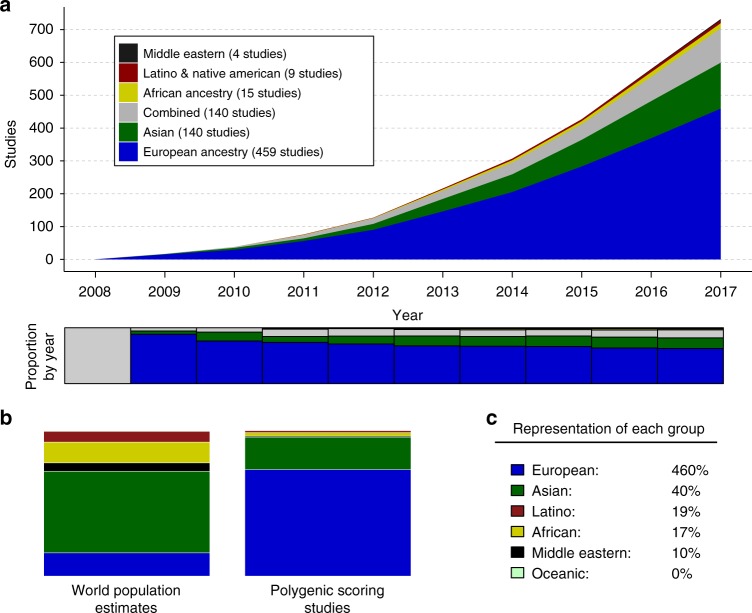
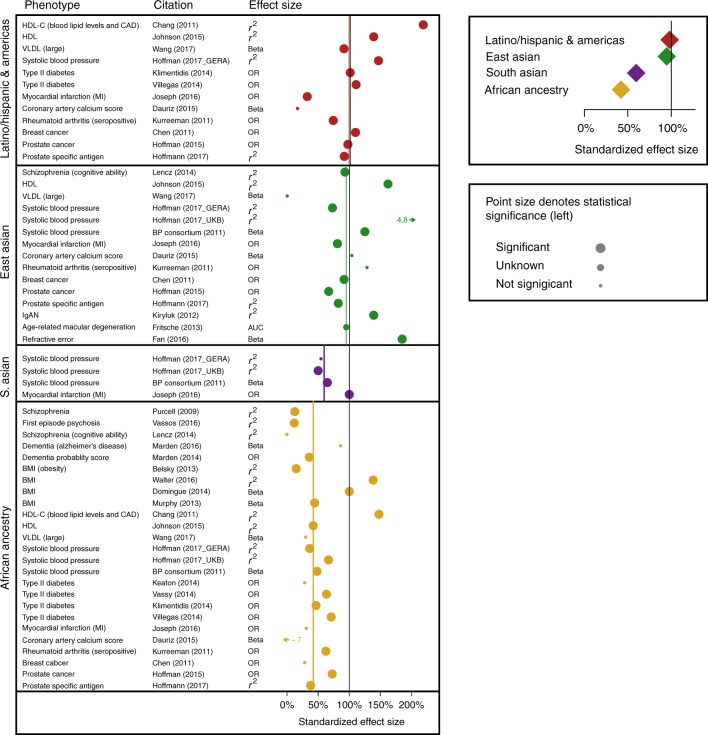
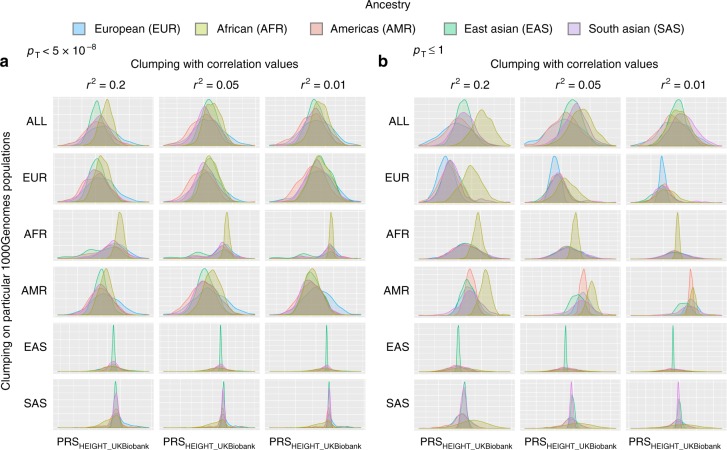
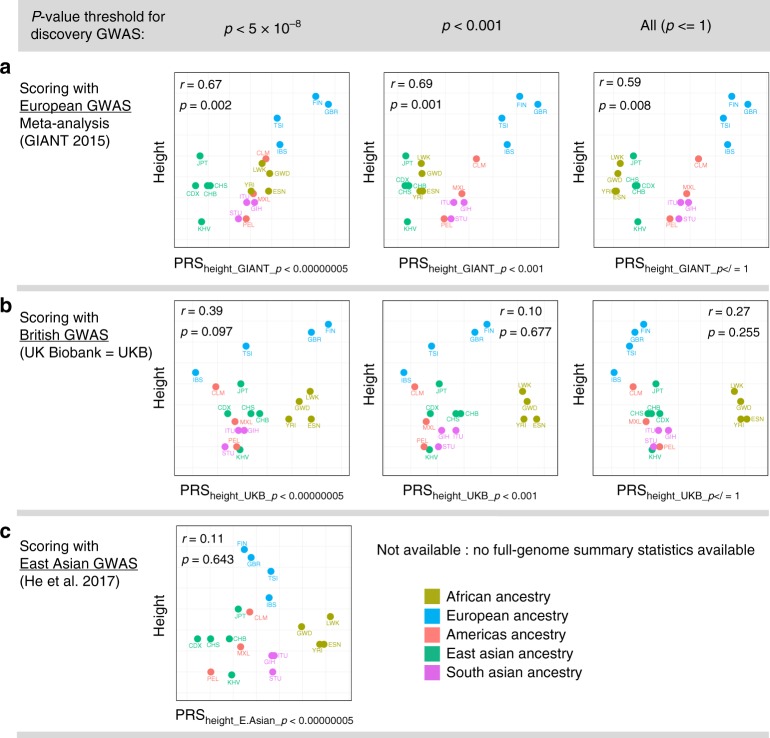
A historical tendency to use European ancestry samples hinders medical genetics research, including the use of polygenic scores, which are individual-level metrics of genetic risk. We analyze the first decade of polygenic scoring studies (2008–2017, inclusive), and find that 67% of studies included exclusively European ancestry participants and another 19% included only East Asian ancestry participants. Only 3.8% of studies were among cohorts of African, Hispanic, or Indigenous peoples. We find that predictive performance of European ancestry-derived polygenic scores is lower in non-European ancestry samples (e.g. African ancestry samples: t = −5.97, df = 24, p = 3.7 × 10 −6 ), and we demonstrate the effects of methodological choices in polygenic score distributions for worldwide populations. These findings highlight the need for improved treatment of linkage disequilibrium and variant frequencies when applying polygenic scoring to cohorts of non-European ancestry, and bolster the rationale for large-scale GWAS in diverse human populations.
Overview
The claims and statistics of this paper haven’t been checked yet.
Run the check — free, no account needed. It reads the open-access text and checks the sources it cites.
Integrity signals
Registry
Cites
Statistics
Figures
Verification
Claims the paper makes
The claims and statistics of this paper haven’t been checked yet.
Run the check — free, no account needed. It reads the open-access text and checks the sources it cites.
Claims other papers make about this one
Each is checked against this paper’s own text: does it say what the citing paper says it does?
The source backs part of the claim, not all of it — or backs it for a different population, condition or comparison.
In the citing paper
“PGIs like ours that are constructed from GWAS in samples of European genetic ancestries are generally found to have much lower predictive power in samples with other genetic ancestries; for example, on average across phenotypes, estimates of relative accuracy (ratio of R2) in African-genetic-ancestry to European-genetic-ancestry samples have been 22%23 and 36%24.”
From Polygenic prediction of educational attainment within and between families from genome-wide association analyses in 3 million individuals (2022) · cites this paper as [24]
Experimental — accuracy not yet measuredIn the citing paper
“Then, each original variable used in the models was put in linear regressions with the 20 first principal components of the SNP genotype data to correct for population stratification (associations of environmental effects with genetic structure due to geographic separation, population mixtures, and migrations that occurred throughout our evolutionary history)91,92, as well as with the age of the”
From The impact of digital media on children’s intelligence while controlling for genetic differences in cognition and socioeconomic background (2022) · cites this paper as [91]
Self-check
Percentages, sums and reported differences re-computed from the paper’s own numbers.
The self-check needs the paper’s full text.
Citations
Cites
PLINK: a tool set for whole-genome association and population-based linkage analyses.
Purcell, S., Neale, B., Todd-Brown, K., Thomas, L., Ferreira, M. A. R., Bender, D., Maller, J., Sklar, P., de Bakker, P. I. W., Daly, M. J., et al. (2007) · The American Journal of Human Genetics · doi:10.1086/519795 · Cited by 34,089
A global reference for human genetic variation
The 1000 Genomes Project Consortium, authors, C., Auton, A., Abecasis, G. R., Steering committee, Altshuler, D. M., Durbin, R. M., Abecasis, G. R., Bentley, D. R., Chakravarti, A., et al. (2015) · Nature · doi:10.1038/nature15393 · Cited by 18,247
Second-generation PLINK: rising to the challenge of larger and richer datasets
Chang, C. C., Chow, C. C., Tellier, L. C., Vattikuti, S., Purcell, S. M., & Lee, J. J. (2015) · Gigascience · doi:10.1186/s13742-015-0047-8 · Cited by 12,709
The UK Biobank resource with deep phenotyping and genomic data
Bycroft, C., Freeman, C., Petkova, D., Band, G., Elliott, L. T., Sharp, K., Motyer, A., Vukcevic, D., Delaneau, O., O’Connell, J., et al. (2018) · Nature · doi:10.1038/s41586-018-0579-z · Cited by 8,876
A map of human genome variation from population-scale sequencing.
The 1000 Genomes Project Consortium (2010) · Nature · doi:10.1038/nature09534 · Cited by 7,877
Biological insights from 108 schizophrenia-associated genetic loci
Schizophrenia Working Group of the Psychiatric Genomics Consortium (2014) · Nature · doi:10.1038/nature13595 · Cited by 7,577
Common polygenic variation contributes to risk of schizophrenia and bipolar disorder
The International Schizophrenia Consortium (2009) · Nature · doi:10.1038/nature08185 · Cited by 4,821 · cited 1×
“2 (see schizophrenia and Purcell 2009 in the citation information for this point).”
BackgroundeQTLGen, Wray, N. R., 23andMe, the Major Depressive Disorder Working Group of the Psychiatric Genomics Consortium, Ripke, S., Mattheisen, M., Trzaskowski, M., Byrne, E. M., Abdellaoui, A., Adams, M. J., et al. (2018) · Nature Genetics · doi:10.1038/s41588-018-0090-3 · Cited by 3,005
Clinical use of current polygenic risk scores may exacerbate health disparities
Martin, A. R., Kanai, M., Kamatani, Y., Okada, Y., Neale, B. M., & Daly, M. J. (2019) · Nature Genetics · doi:10.1038/s41588-019-0379-x · Cited by 2,821
Blundell, J. E., Baker, J. L., Boyland, E. J., Blaak, E. E., Charzewska, J., Henauw, S. D., Frühbeck, G., González‐Gross, M., Hebebrand, J., Holm, L., et al. (2017) · Obesity Facts · doi:10.1159/000455952 · Cited by 1,983
Genomics is failing on diversity
Popejoy, A. B., & Fullerton, S. M. (2016) · Nature · doi:10.1038/538161a · Cited by 1,924
The Electronic Medical Records and Genomics (eMERGE) Consortium, Wood, A. R., The MIGen Consortium, The PAGE Consortium, Study, T. L. C., Esko, T., Yang, J., Vedantam, S., Pers, T. H., Gustafsson, S., et al. (2014) · Nature Genetics · doi:10.1038/ng.3097 · Cited by 1,853
The Type 1 Diabetes Genetics Consortium, Barrett, J. C., Clayton, D. G., Concannon, P., Akolkar, B., Cooper, J. D., Erlich, H. A., Julier, C., Morahan, G., Nerup, J., et al. (2009) · Nature Genetics · doi:10.1038/ng.381 · Cited by 1,746
The personal and clinical utility of polygenic risk scores
Torkamani, A., Wineinger, N. E., & Topol, E. J. (2018) · Nature Reviews Genetics · doi:10.1038/s41576-018-0018-x · Cited by 1,655
Power and predictive accuracy of polygenic risk scores
Dudbridge, F. (2013) · PLoS Genetics · doi:10.1371/journal.pgen.1003348 · Cited by 1,509
Human Demographic History Impacts Genetic Risk Prediction across Diverse Populations
Martin, A. R., Gignoux, C. R., Walters, R. K., Wojcik, G. L., Neale, B. M., Gravel, S., Daly, M. J., Bustamante, C. D., & Kenny, E. E. (2017) · The American Journal of Human Genetics · doi:10.1016/j.ajhg.2017.03.004 · Cited by 1,391
Modeling Linkage Disequilibrium Increases Accuracy of Polygenic Risk Scores
Vilhjálmsson, B. J., Yang, J., Finucane, H. K., Gusev, A., Lindström, S., Ripke, S., Genovese, G., Loh, P.-R., Bhatia, G., Do, R., et al. (2015) · The American Journal of Human Genetics · doi:10.1016/j.ajhg.2015.09.001 · Cited by 1,303
Genetic analyses of diverse populations improves discovery for complex traits
Wojcik, G. L., Graff, M., Nishimura, K. K., Tao, R., Haessler, J., Gignoux, C. R., Highland, H. M., Patel, Y. M., Sorokin, E. P., Avery, C. L., et al. (2019) · Nature · doi:10.1038/s41586-019-1310-4 · Cited by 1,033 · cited 1×
“(6) Random error in the estimation of GWAS betas”
BackgroundSparse whole-genome sequencing identifies two loci for major depressive disorder
CONVERGE consortium, Cai, N., Bigdeli, T. B., Kretzschmar, W., Li, Y., Liang, J., Song, L., Hu, J., Li, Q., Jin, W., et al. (2015) · Nature · doi:10.1038/nature14659 · Cited by 864
Self-citationPrediction of individual genetic risk to disease from genome-wide association studiesPreprint
Wray, N. R., Goddard, M. E., & Visscher, P. M. (2007) · Genome Research · doi:10.1101/gr.6665407 · Cited by 737
Pitfalls of predicting complex traits from SNPs
Wray, N. R., Yang, J., Hayes, B. J., Price, A. L., Goddard, M. E., & Visscher, P. M. (2013) · Nature Reviews Genetics · doi:10.1038/nrg3457 · Cited by 690
Bustamante, C. D., Vega, F. M. D. L., & Burchard, E. G. (2011) · Nature · doi:10.1038/475163a · Cited by 594
A population genetic signal of polygenic adaptation
Berg, J. J., & Coop, G. (2014) · PLoS Genetics · doi:10.1371/journal.pgen.1004412 · Cited by 487
Cultural evolutionary theory: How culture evolves and why it matters
Creanza, N., Kolodny, O., & Feldman, M. W. (2017) · Proceedings of the National Academy of Sciences · doi:10.1073/pnas.1620732114 · Cited by 482
Self-citationA scientometric review of genome-wide association studies
Mills, M. C., & Rahal, C. (2018) · Communications Biology · doi:10.1038/s42003-018-0261-x · Cited by 446
Duncan, L. E., Ratanatharathorn, A., Aiello, A. E., Almli, L. M., Amstadter, A. B., Ashley-Koch, A. E., Baker, D. G., Beckham, J. C., Bierut, L. J., Bisson, J., et al. (2018) · Molecular Psychiatry · doi:10.1038/mp.2017.77 · Cited by 425
Self-citationEhret, G., Ferreira, T. C., Chasman, D. I., Jackson, A., Schmidt, E. M., Johnson, T., Þorleifsson, G., Luan, J., Donnelly, L. A., Kanoni, S., et al. (2016) · Nature Genetics · doi:10.1038/ng.3667 · Cited by 417
Detection of human adaptation during the past 2000 years
Field, Y., Boyle, E. A., Telis, N., Gao, Z., Gaulton, K. J., Golan, D., Yengo, L., Rocheleau, G., Froguel, P., McCarthy, M. I., et al. (2016) · Science · doi:10.1126/science.aag0776 · Cited by 383
Sohail, M., Maier, R. M., Ganna, A., Bloemendal, A., Martin, A. R., Turchin, M. C., Chiang, C. W., Hirschhorn, J., Daly, M. J., Patterson, N., et al. (2019) · eLife · doi:10.7554/elife.39702 · Cited by 359
Reduced signal for polygenic adaptation of height in UK Biobank
Berg, J. J., Harpak, A., Sinnott-Armstrong, N., Joergensen, A. M., Mostafavi, H., Field, Y., Boyle, E. A., Zhang, X., Racimo, F., Pritchard, J. K., et al. (2019) · eLife · doi:10.7554/elife.39725 · Cited by 339
Hoffmann, T. J., Ehret, G., Nandakumar, P., Ranatunga, D. K., Schaefer, C. A., Kwok, P., Iribarren, C., Chakravarti, A., & RISCH, N. J. (2016) · Nature Genetics · doi:10.1038/ng.3715 · Cited by 321
Morris, D. L., Sheng, Y., Zhang, Y., Wang, Y., Zhu, Z., Tombleson, P., Chen, L., Graham, D. S. C., Bentham, J., Roberts, A. L., et al. (2016) · Nature Genetics · doi:10.1038/ng.3603 · Cited by 316
Cognitive Costs of Exposure to Racial Prejudice
Salvatore, J., & Shelton, J. N. (2007) · Psychological Science · doi:10.1111/j.1467-9280.2007.01984.x · Cited by 298
Models for cultural inheritance I. Group mean and within group variation
Cavalli-Sforza, L. L., & Feldman, M. W. (1973) · Theoretical Population Biology · doi:10.1016/0040-5809(73)90005-1 · Cited by 291
Self-citationPetrovski, S., & Goldstein, D. B. (2016) · Genome Biology · doi:10.1186/s13059-016-1016-y · Cited by 255
Population genetic differentiation of height and body mass index across Europe
Robinson, M. R., Hemani, G., Medina‐Gómez, C., Mezzavilla, M., Esko, T., Shakhbazov, K., Powell, J. E., Vinkhuyzen, A. A. E., Berndt, S. I., Gustafsson, S., et al. (2015) · Nature Genetics · doi:10.1038/ng.3401 · Cited by 233
Cardiovascular disease: The rise of the genetic risk score
Knowles, J. W., & Ashley, E. A. (2018) · PLOS Medicine · doi:10.1371/journal.pmed.1002546 · Cited by 182
Regularized Machine Learning in the Genetic Prediction of Complex Traits
Okser, S., Pahikkala, T., Airola, A., Salakoski, T., Ripatti, S., & Aittokallio, T. A. (2014) · PLoS Genetics · doi:10.1371/journal.pgen.1004754 · Cited by 158
Duncan, L. E., Pollastri, A. R., & Smoller, J. W. (2014) · American Psychologist · doi:10.1037/a0036320 · Cited by 145 · cited 1×
“(1) True differences due to drift (2) True differences due to selection (3) True differences in genetic effects due to environmental differences (gene-environment interactions) (4) Bias due to uncorrected population stratification in discovery and/or training samples (5) Bias due to discovery/training population data…”
BackgroundSelf-citationUsing Genetic Distance to Infer the Accuracy of Genomic Prediction
Scutari, M., Mackay, I., & Balding, D. (2016) · PLOS Genetics · doi:10.1371/journal.pgen.1006288 · Cited by 137
Curtis, D. (2018) · Psychiatric Genetics · doi:10.1097/ypg.0000000000000206 · Cited by 132
Detecting Polygenic Adaptation in Admixture Graphs
Racimo, F., Berg, J. J., & Pickrell, J. K. (2018) · Genetics · doi:10.1534/genetics.117.300489 · Cited by 118
He, M., Xu, M., Zhang, B., Liang, J., Chen, P., Lee, J.-Y., Johnson, T. A., Li, H., Yang, X., Dai, J., et al. (2015) · Human Molecular Genetics · doi:10.1093/hmg/ddu583 · Cited by 106
Self-citationGeneralizing polygenic risk scores from Europeans to Hispanics/Latinos
Grinde, K. E., Qi, Q., Thornton, T. A., Liu, S., Shadyab, A. H., Chan, K. H. K., Reiner, A. P., & Sofer, T. (2018) · Genetic Epidemiology · doi:10.1002/gepi.22166 · Cited by 96
Global genetic differentiation of complex traits shaped by natural selection in humans
Guo, J., Wu, Y., Zhu, Z., Zheng, Z., Trzaskowski, M., Zeng, J., Robinson, M. R., Visscher, P. M., & Yang, J. (2018) · Nature Communications · doi:10.1038/s41467-018-04191-y · Cited by 91
A machine-learning heuristic to improve gene score prediction of polygenic traits
Paré, G., Mao, S., & Deng, W. Q. (2017) · Scientific Reports · doi:10.1038/s41598-017-13056-1 · Cited by 85
Qi, Q., Stilp, A. M., Sofer, T., Moon, J., Hidalgo, B., Szpiro, A. A., Wang, T., Ng, M. C. Y., Guo, X., Chen, Y. I., et al. (2017) · Diabetes · doi:10.2337/db16-1150 · Cited by 82
Martschenko, D. O., Trejo, S., & Domingue, B. W. (2019) · AERA Open · doi:10.1177/2332858418810516 · Cited by 70
Self-citationVargas, J. D., Manichaikul, A. W., Wang, X., Rich, S. S., Rotter, J. I., Post, W. S., Polak, J. F., Budoff, M. J., & Bluemke, D. A. (2015) · Atherosclerosis · doi:10.1016/j.atherosclerosis.2015.11.034 · Cited by 65
Population differentiation in allele frequencies of obesity-associated SNPs
Mao, L., Fang, Y., Campbell, M. C., & Southerland, W. M. (2017) · BMC Genomics · doi:10.1186/s12864-017-4262-9 · Cited by 60
Focused Classroom Coaching and Widespread Racial Equity in School Discipline
Gregory, A., Ruzek, E. A., DeCoster, J., Mikami, A. Y., & Allen, J. P. (2019) · AERA Open · doi:10.1177/2332858419897274 · Cited by 55
Large Scale Genetic Research on Neuropsychiatric Disorders in African Populations is Needed
Dalvie, S., Koen, N., Duncan, L. E., Abbo, C., Akena, D. H., Atwoli, L., Chiliza, B., Donald, K. A., Kinyanda, E., Löchner, C., et al. (2015) · EBioMedicine · doi:10.1016/j.ebiom.2015.10.002 · Cited by 38
Self-citation
Cited by
Sorted by citations
Tutorial: a guide to performing polygenic risk score analyses
Choi, S. W., Mak, T. S. H., & O’Reilly, P. F. (2020) · Nature Protocols · doi:10.1038/s41596-020-0353-1 · Cited by 2,058
PRSice-2: Polygenic Risk Score software for biobank-scale data
Choi, S. W., & O’Reilly, P. F. (2019) · GigaScience · doi:10.1093/gigascience/giz082 · Cited by 1,538
Mullins, N., Forstner, A. J., O’Connell, K. S., Coombes, B., Coleman, J. R. I., Qiao, Z., Als, T. D., Bigdeli, T. B., Børte, S., Bryois, J., et al. (2021) · Nature Genetics · doi:10.1038/s41588-021-00857-4 · Cited by 1,517
The power of genetic diversity in genome-wide association studies of lipids
Graham, S. E., Clarke, S. L., Wu, K.-H. H., Kanoni, S., Zajac, G. J. M., Ramdas, S., Surakka, I., Ntalla, I., Vedantam, S., Winkler, T. W., et al. (2021) · Nature · doi:10.1038/s41586-021-04064-3 · Cited by 972
Mendelian Randomization: Concepts and Scope
Richmond, R. C., & Davey Smith, G. (2022) · Cold Spring Harbor Perspectives in Medicine · doi:10.1101/cshperspect.a040501 · Cited by 841
Metadata
- Authors
- Duncan, L., Shen, H., Gelaye, B., Meijsen, J., Ressler, K., Feldman, M., Peterson, R., & Domingue, B.
- Affiliations
- Stanford University (US)
- Harvard University (US)
- Virginia Commonwealth University (US)
- Corresponding author
- Duncan, L.
- Venue
- Nature Communications
- Published
- 2019-07-25
- Volume
- 10
- Issue
- 1
- Pages
- 3328-3328
- ISSN
- 2041-1723 (ISSN-L)
- PMC
- PMC6658471
- OpenAlex
- W2963160524
- Semantic Scholar
- 712594d2beca4baa700cc51e92361b74500c6aa8
- Cited by
- 1,038
- References
- 53
- Citations by year
- 2026: 100 · 2025: 126 · 2024: 140 · 2023: 157 · 2022: 186 · 2021: 207 · 2020: 100 · 2019: 19
- FWCI
- 77.29
- Type
- journal article
- Language
- en
- Open access
- gold
- doi.org
- Locations
- Nature Communications (publishedVersion, cc-by)
- PubMed Central (publishedVersion, cc-by)
- PubMed (publishedVersion)
- RePEc: Research Papers in Economics (submittedVersion)
- DOAJ (DOAJ: Directory of Open Access Journals) (submittedVersion)
- DOAJ (DOAJ: Directory of Open Access Journals) (submittedVersion, cc-by-sa)
- SUNY Digital Repository Support (State University of New York System) (submittedVersion, cc-by-nc-nd)
- Funders
- none.
- Topics
- Life Sciences › Biochemistry, Genetics and Molecular Biology › Genetics › Genetic Associations and Epidemiology
- Social Sciences › Anthropology › Race, Genetics, and Society
- Life Sciences › Biochemistry, Genetics and Molecular Biology › Genetics › Forensic and Genetic Research
- Keywords
- polygenic risk score, ancestry bias, genetic ancestry, non-European ancestry populations, predictive performance, linkage disequilibrium, variant frequency, genome-wide association study, underrepresented groups
- MeSH terms
- Human Genetics, Female, Hispanic or Latino, Humans, Male, Linkage Disequilibrium, Multifactorial Inheritance, White People, Asian People, Genome-Wide Association Study
About these checks
Registry, retraction, Cites and statistics results are computed, not judged, with one exception: a printed reference that no index lists is read once by a model before it counts as a citation error. Claims are extracted by a model and kept only when their quote appears verbatim in the text; each cited source is then checked, with a model’s help, for whether it says what the claim relies on. Those verdicts can be wrong — read the claim’s quote and the cited source before relying on one.
Statistics and arithmetic are recomputed, not judged.
Confidence bands are shown only for fields calibrated on our annotated test set. None is calibrated yet, so no band is shown.
What counts as a claim ›How we measure confidence ›How we check this ›
Are you an author, or do you see a problem with this page? Request a review
