

Cortical reliability amid noise and chaos
Open accessPublished version of a preprint
The DOI matches its Crossref record; 82 of the 82 references it cites were found in a registry or an index.
Abstract
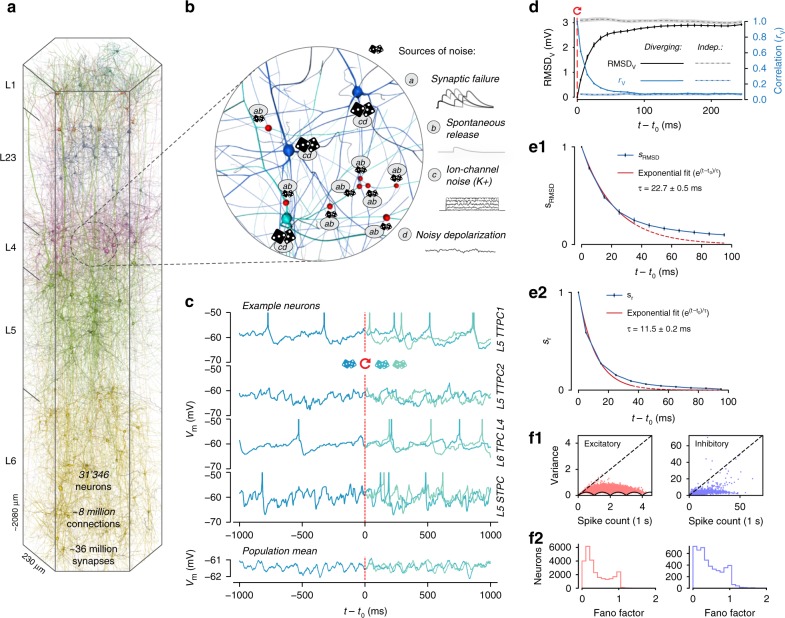
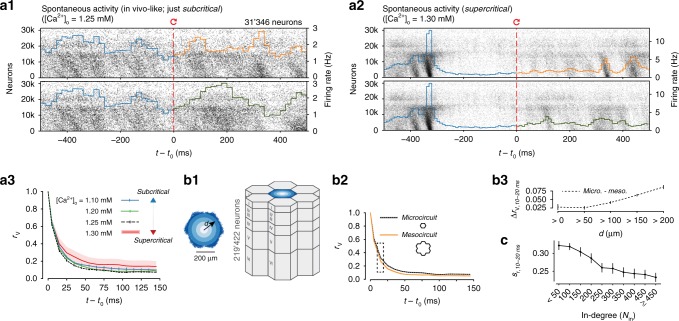
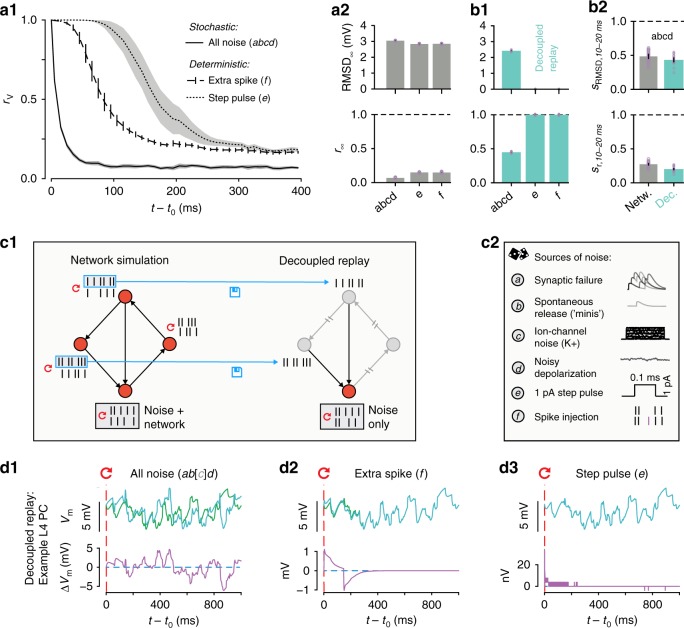
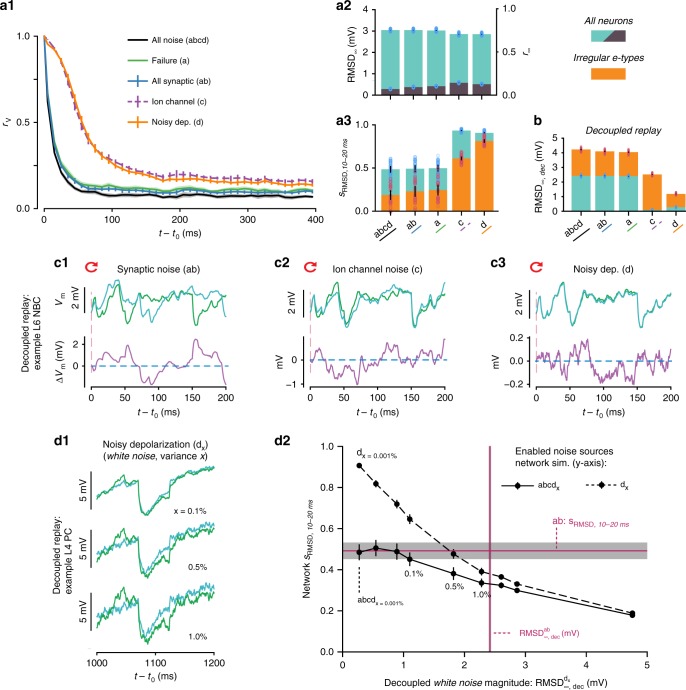
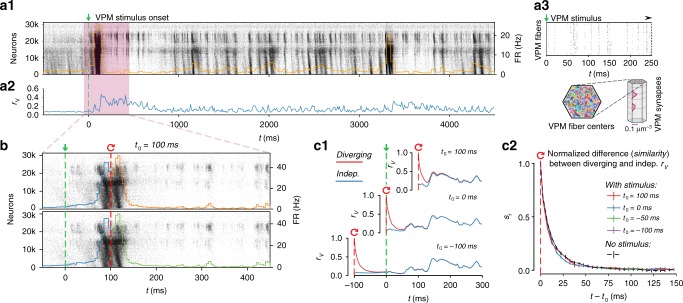
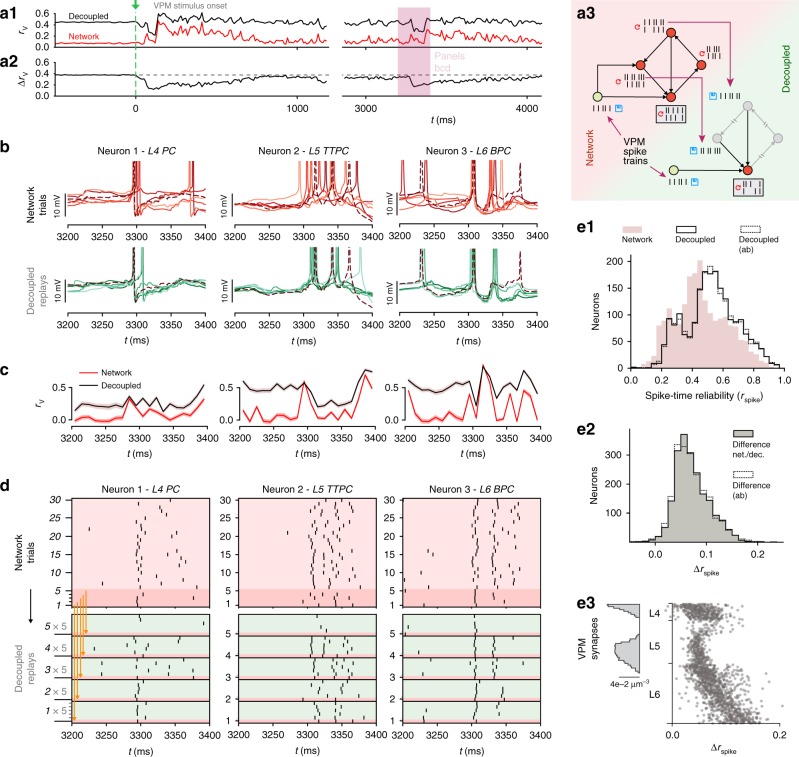
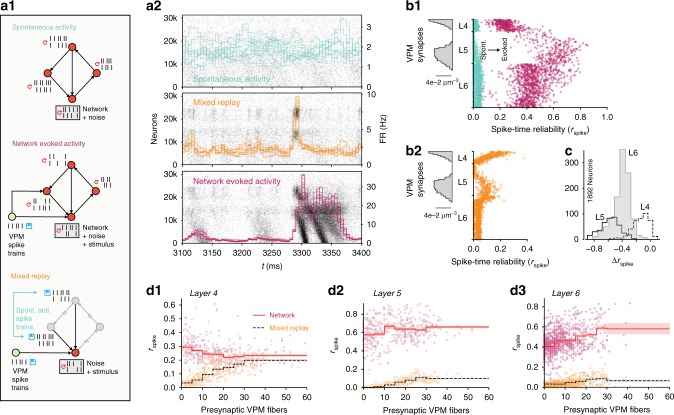
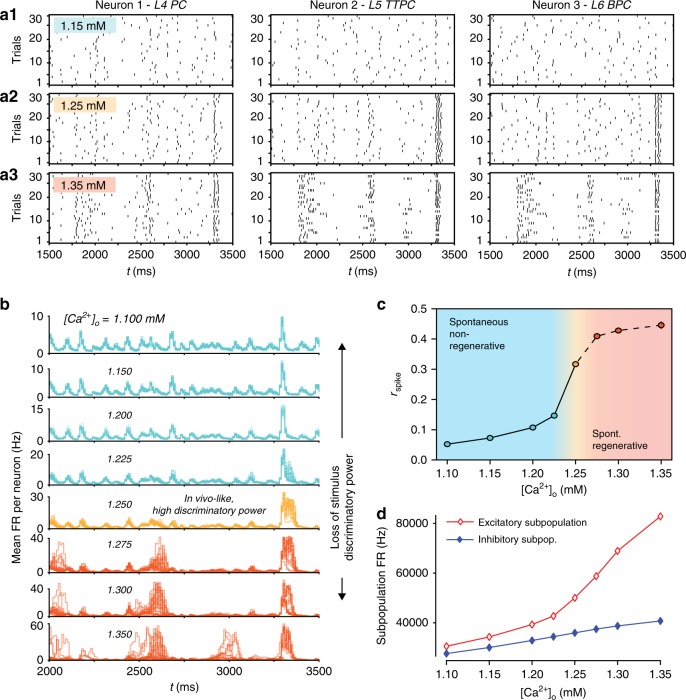
Typical responses of cortical neurons to identical sensory stimuli appear highly variable. It has thus been proposed that the cortex primarily uses a rate code. However, other studies have argued for spike-time coding under certain conditions. The potential role of spike-time coding is directly limited by the internally generated variability of cortical circuits, which remains largely unexplored. Here, we quantify this internally generated variability using a biophysical model of rat neocortical microcircuitry with biologically realistic noise sources. We find that stochastic neurotransmitter release is a critical component of internally generated variability, causing rapidly diverging, chaotic recurrent network dynamics. Surprisingly, the same nonlinear recurrent network dynamics can transiently overcome the chaos in response to weak feed-forward thalamocortical inputs, and support reliable spike times with millisecond precision. Our model shows that the noisy and chaotic network dynamics of recurrent cortical microcircuitry are compatible with stimulus-evoked, millisecond spike-time reliability, resolving a long-standing debate.
Overview
The claims and statistics of this paper haven’t been checked yet.
Free: it reads the open-access text and checks the first 5 claims that cite a source we can check. Create a free account to check every claim.
Integrity signals
Registry
Cites
Statistics
Figures
Verification
Claims the paper makes
The claims and statistics of this paper haven’t been checked yet.
Free: it reads the open-access text and checks the first 5 claims that cite a source we can check. Create a free account to check every claim.
Claims other papers make about this one
Each is checked against this paper’s own text: does it say what the citing paper says it does?
The cited source doesn’t support the claim as written.
In the citing paper
“Moreover, if the background conditions are well controlled, neurons are thought to interact in a highly reliable, nearly deterministic manner [41–43].”
From Integrated information theory (IIT) 4.0: Formulating the properties of phenomenal existence in physical terms (2023) · cites this paper as [43]
Checked by a reasoning model — may be wrong.
Experimental — accuracy not yet measured
Self-check
Percentages, sums and reported differences re-computed from the paper’s own numbers.
The self-check needs the paper’s full text.
Citations
Cites
Faisal, A. A., Selen, L. P. J., & Wolpert, D. M. (2008) · Nature Reviews Neuroscience · doi:10.1038/nrn2258 · Cited by 2,883
The NEURON Simulation Environment
Hines, M. L., & Carnevale, N. T. (1997) · Neural Computation · doi:10.1162/neco.1997.9.6.1179 · Cited by 2,658
Neuronal Avalanches in Neocortical Circuits
Beggs, J. M., & Plenz, D. (2003) · The Journal of Neuroscience · doi:10.1523/jneurosci.23-35-11167.2003 · Cited by 2,325
Shadlen, M. N., & Newsome, W. T. (1998) · The Journal of Neuroscience · doi:10.1523/jneurosci.18-10-03870.1998 · Cited by 2,178
Reliability of spike timing in neocortical neurons
Mainen, Z. F., & Sejnowski, T. J. (1995) · Science · doi:10.1126/science.7770778 · Cited by 1,950
Chaos in Neuronal Networks with Balanced Excitatory and Inhibitory Activity
van Vreeswijk, C., & Sompolinsky, H. (1996) · Science · doi:10.1126/science.274.5293.1724 · Cited by 1,811
Dynamics of Sparsely Connected Networks of Excitatory and Inhibitory Spiking Neurons
Brunel, N. (2000) · Journal of Computational Neuroscience · doi:10.1023/a:1008925309027 · Cited by 1,726
Tsodyks, M. V., & Markram, H. (1997) · Proceedings of the National Academy of Sciences · doi:10.1073/pnas.94.2.719 · Cited by 1,603
Self-citationReconstruction and Simulation of Neocortical Microcircuitry
Markram, H., Muller, E., Ramaswamy, S., Reimann, M. W., Abdellah, M., Sanchez, C. A., Ailamaki, A., Alonso-Nanclares, L., Antille, N., Arsever, S., et al. (2015) · Cell · doi:10.1016/j.cell.2015.09.029 · Cited by 1,557
Self-citationSpontaneous behaviors drive multidimensional, brainwide activity
Stringer, C., Pachitariu, M., Steinmetz, N., Reddy, C. B., Carandini, M., & Harris, K. D. (2019) · Science · doi:10.1126/science.aav7893 · Cited by 1,510
Cited by
Albantakis, L., Barbosa, L., Findlay, G., Grasso, M., Haun, A. M., Marshall, W., Mayner, W. G. P., Zaeemzadeh, A., Boly, M., Juel, B. E., et al. (2023) · PLoS Computational Biology · doi:10.1371/journal.pcbi.1011465 · Cited by 292
Bring the Noise: Reconceptualizing Spontaneous Neural Activity
Uddin, L. Q. (2020) · Trends in Cognitive Sciences · doi:10.1016/j.tics.2020.06.003 · Cited by 166
Consciousness is supported by near-critical slow cortical electrodynamics
Toker, D., Pappas, I., Lendner, J. D., Frohlich, J., Mateos, D. M., Muthukumaraswamy, S., Carhart-Harris, R., Paff, M., Vespa, P. M., Monti, M. M., et al. (2022) · Proceedings of the National Academy of Sciences · doi:10.1073/pnas.2024455119 · Cited by 138
Interstitial ions: A key regulator of state-dependent neural activity?
Rasmussen, R. N., O’Donnell, J., Ding, F., & Nedergaard, M. (2020) · Progress in Neurobiology · doi:10.1016/j.pneurobio.2020.101802 · Cited by 129
Self-Organization Toward Criticality by Synaptic Plasticity
Zeraati, R., Priesemann, V., & Levina, A. (2021) · Frontiers in Physics · doi:10.3389/fphy.2021.619661 · Cited by 91
Schepper, R. D., Geminiani, A., Masoli, S., Rizza, M. F., Antonietti, A., Casellato, C., & D'Angelo, E. U. (2022) · Communications Biology · doi:10.1038/s42003-022-04213-y · Cited by 53
Impact of higher order network structure on emergent cortical activity
Nolte, M., Gal, E., Markram, H., & Reimann, M. (2020) · Network Neuroscience · doi:10.1162/netn_a_00124 · Cited by 43
Self-citationThe Role of Hub Neurons in Modulating Cortical Dynamics
Gal, E., Amsalem, O., Schindel, A., London, M., Schürmann, F., Markram, H., & Segev, I. (2021) · Frontiers in Neural Circuits · doi:10.3389/fncir.2021.718270 · Cited by 38
Self-citationCriticality enhances the multilevel reliability of stimulus responses in cortical neural networks
Liang, J., & Zhou, C. (2022) · PLoS Computational Biology · doi:10.1371/journal.pcbi.1009848 · Cited by 32
Cortical cell assemblies and their underlying connectivity: An in silico study
Ecker, A., Santander, D. E., Bolaños‐Puchet, S., Isbister, J. B., & Reimann, M. (2024) · PLoS Computational Biology · doi:10.1371/journal.pcbi.1011891 · Cited by 35
“3 Robustness of assemblies across simulation instances The results of our simulations are stochastic (Nolte et al., 2019), leading to different outcomes for repetitions of the same experiment, as in biology.”
InfluentialSelf-citationTranscriptomic cell type structures in vivo neuronal activity across multiple timescales
Schneider, A. M., Azabou, M., McDougall-Vigier, L., Parks, D. F., Ensley, S., Bhaskaran‐Nair, K., Nowakowski, T. J., Dyer, E. L., & Hengen, K. B. (2023) · Cell Reports · doi:10.1016/j.celrep.2023.112318 · Cited by 36
“For the V1 k=16 task, the dimensions of the encoder was (128, 64, 64, 32) and for the k=4 task, the dimensions were (32, 16, 16, 16).”
The Hidden Life of the Basal Ganglia: At the Base of Brain and Mind
Bergman, H. (2021) · The MIT Press eBooks · doi:10.7551/mitpress/14075.001.0001 · Cited by 29
Computational roles of plastic probabilistic synapses
Montero, M. L., Sacramento, J., & Costa, R. P. (2018) · Current Opinion in Neurobiology · doi:10.1016/j.conb.2018.09.002 · Cited by 25
Isbister, J. B., Ecker, A., Pokorny, C., Bolaños‐Puchet, S., Santander, D. E., Arnaudon, A., Awile, O., Barros-Zulaica, N., Alonso, J. B., Boci, E., et al. (2026) · eLife · doi:10.1101/2023.05.17.541168 · Cited by 28
Self-citationSantander, D. E., Pokorny, C., Ecker, A., Lazovskis, J., Santoro, M., Smith, J. P., Hess, K. P., Levi, R., & Reimann, M. (2024) · iScience · doi:10.1016/j.isci.2024.111585 · Cited by 31
“30 Finally, we will demonstrate that the BBP network reproduces the same non-random sim-plex-based structural features that are present in biological neural networks.”
InfluentialSelf-citationCassara, A. M., Newton, T., Zhuang, K., Regel, S. J., Achermann, P., Pascual‐Leone, Á., Kuster, N., & Neufeld, E. (2025) · Bioelectromagnetics · doi:10.1002/bem.22542 · Cited by 24
Specific inhibition and disinhibition in the higher-order structure of a cortical connectome
Reimann, M., Santander, D. E., Ecker, A., & Muller, E. B. (2024) · Cerebral Cortex · doi:10.1093/cercor/bhae433 · Cited by 21
Self-citationNon-additive activity modulation during a decision making task involving tactic selection
Braun, W., Matsuzaka, Y., Mushiake, H., Northoff, G., & Longtin, A. (2021) · Cognitive Neurodynamics · doi:10.1007/s11571-021-09702-0 · Cited by 16
In silico voltage-sensitive dye imaging reveals the emergent dynamics of cortical populations
Newton, T., Reimann, M., Abdellah, M., Chevtchenko, G., Muller, E. B., & Markram, H. (2021) · Nature Communications · doi:10.1038/s41467-021-23901-7 · Cited by 19
Self-citationReimann, M., Riihimäki, H., Smith, J. P., Lazovskis, J., Pokorny, C., & Levi, R. (2022) · PLoS ONE · doi:10.1371/journal.pone.0261702 · Cited by 15
Self-citationSafety Recommendations for Temporal Interference Stimulation in the BrainPreprint
Cassara, A. M., Newton, T., Zhuang, K., Regel, S. J., Achermann, P., Kuster, N., & Neufeld, E. (2022) · bioRxiv (Cold Spring Harbor Laboratory) · doi:10.1101/2022.12.15.520077 · Cited by 12
Cremonesi, F., & Schürmann, F. (2020) · Neuroinformatics · doi:10.1007/s12021-019-09451-w · Cited by 12
Microscopic theory of intrinsic timescales in spiking neural networks
van Meegen, A., & van Albada, S. J. (2021) · Physical Review Research · doi:10.1103/physrevresearch.3.043077 · Cited by 18
Recurrence microstates for machine learning classification
Spezzatto, G. S., Flauzino, J. V. V., Corso, G., Boaretto, B. R. R., Macau, E. E. N., Prado, T. D. L., & Lopes, S. R. (2024) · Chaos An Interdisciplinary Journal of Nonlinear Science · doi:10.1063/5.0203801 · Cited by 10
Amsalem, O., King, J. G., Reimann, M., Ramaswamy, S., Muller, E. B., Markram, H., Nelken, I., & Segev, I. (2020) · bioRxiv (Cold Spring Harbor Laboratory) · doi:10.1101/2020.05.31.126466 · Cited by 11
Self-citationNeurobiological Causal Models of Language Processing
Fitz, H., Hagoort, P., & Petersson, K. M. (2024) · Neurobiology of Language · doi:10.1162/nol_a_00133 · Cited by 52
Isbister, J. B., Ecker, A., Pokorny, C., Bolaños‐Puchet, S., Santander, D. E., Arnaudon, A., Awile, O., Barros-Zulaica, N., Alonso, J. B., Boci, E., et al. (2024) · eLife · doi:10.7554/elife.99693.1 · Cited by 13
Self-citationComputational Concepts for Reconstructing and Simulating Brain Tissue
Schürmann, F., Courcol, J.-D., & Ramaswamy, S. (2022) · Advances in experimental medicine and biology · doi:10.1007/978-3-030-89439-9_10 · Cited by 7
Tiroshi, L., Atamna, Y., Gilin, N., Berkowitz, N., & Goldberg, J. A. (2022) · eNeuro · doi:10.1523/eneuro.0315-23.2023 · Cited by 5
Ash, R. T., Palagina, G., Fernández-León, J. A., Park, J., Seilheimer, R. L., Lee, S., Sabharwal, J., Reyes, F., Wang, J., Lu, D., et al. (2022) · Journal of Neuroscience · doi:10.1523/jneurosci.0654-22.2022 · Cited by 5
A Cerebellar Computational Mechanism for Delay Conditioning at Precise Time Intervals
Sanger, T. D., & Kawato, M. (2020) · Neural Computation · doi:10.1162/neco_a_01318 · Cited by 5
Oscillations, Rhythms and Synchronized Time Bases: The Key Signatures of Life
Lloyd, D. (2021) · Understanding complex systems · doi:10.1007/978-3-030-59805-1_14 · Cited by 5
Nakajima, R., Shirakami, A., Tsumura, H., Matsuda, K., Nakamura, E., & Shimono, M. (2023) · Communications Biology · doi:10.1038/s42003-023-05453-2 · Cited by 5
Spatial continuity of neurons explains non-random network architecture
Reimann, M., Santander, D. E., Kanari, L., & Barros-Zulaica, N. (2026) · iScience · doi:10.1016/j.isci.2026.116144 · Cited by 3
Self-citationChaotic resonance in hybrid scale-free neural networks
Çalım, A. (2024) · Physics Letters A · doi:10.1016/j.physleta.2024.129790 · Cited by 2
Taming Complexity from the Interface: Simplifying Neuroscience
Branchi, I. (2024) · Neuroscience · doi:10.1016/j.neuroscience.2024.02.029 · Cited by 2
Yin, L., Zhang, G., & Yin, F. (2021) · Computational Intelligence and Neuroscience · doi:10.1155/2021/9954302 · Cited by 3
Irastorza-Valera, L., Benítez, J. M., Montáns, F. J., & Saucedo‐Mora, L. (2023) · bioRxiv (Cold Spring Harbor Laboratory) · doi:10.1101/2023.12.05.570084 · Cited by 2
Multisensory integration in chaotic networks
Ponzi, A. P. D., & Suzuki, K. (2025) · Neural Networks · doi:10.1016/j.neunet.2025.107766 · Cited by 1
Focal thalamic infrared neural stimulation propagates dynamical transformations in auditory cortex
Coventry, B. S., Luu, C. P., & Bartlett, E. L. (2025) · Journal of Neural Engineering · doi:10.1088/1741-2552/ae1bdb · Cited by 1
Yang, H., Xu, G., Tian, S., Zhu, H., & Shan, Y. (2023) · Fluctuation and Noise Letters · doi:10.1142/s0219477524500093 · Cited by 1
Model-agnostic neural mean field with a data-driven transfer function
Spaeth, A., Haussler, D. H., & Teodorescu, M. (2024) · Neuromorphic Computing and Engineering · doi:10.1088/2634-4386/ad787f · Cited by 4
Deep neural generation of neuronal spikesPreprint
Nakajima, R., Shirakami, A., Tsumura, H., Matsuda, K., Nakamura, E., & Shimono, M. (2023) · bioRxiv (Cold Spring Harbor Laboratory) · doi:10.1101/2023.03.05.531237 · Cited by 1
Isbister, J. B., Ecker, A., Pokorny, C., Bolaños‐Puchet, S., Santander, D. E., Arnaudon, A., Awile, O., Barros-Zulaica, N., Alonso, J. B., Boci, E., et al. (2026) · eLife · doi:10.7554/elife.99693 · Cited by 18
Self-citationIsbister, J. B., Ecker, A., Pokorny, C., Bolaños‐Puchet, S., Santander, D. E., Arnaudon, A., Awile, O., Barros-Zulaica, N., Alonso, J. B., Boci, E., et al. (2025) · eLife · doi:10.7554/elife.99693.2 · Cited by 2
Self-citationTelling neuronal apples from oranges: analytical performance modeling of neural tissue simulationsPreprint
Cremonesi, F., & Schürmann, F. (2019) · arXiv (Cornell University) · doi:10.48550/arxiv.1906.02757
“Although synaptic noise can be considered a primary driver of cortical dynamics [53], we consider the complexity associated with random number generation in performance modeling outside of the scope of this paper.”
Cortical cell assemblies and their underlying connectivity: an in silico studyPreprint
Ecker, A., Santander, D. E., Bolaños‐Puchet, S., Isbister, J. B., & Reimann, M. (2023) · bioRxiv (Cold Spring Harbor Laboratory) · doi:10.1101/2023.02.24.529863
Self-citationThe Determining Role of Covariances in Large Networks of Stochastic Neurons
Painchaud, V., Desrosiers, P., & Doyon, N. (2024) · Neural Computation · doi:10.1162/neco_a_01656 · Cited by 1
Spike reliability is cell type specific and shapes excitation and inhibition in the cortex
Russo, S., Stanley, G. B., & Najafi, F. (2025) · Scientific Reports · doi:10.1038/s41598-024-82536-y
Melanson, A., Fontaine, S., Richard, G. M. A. G. A., & Belliveau, J. G. (2025) · Journal of Neurophysiology · doi:10.1152/jn.00444.2024
An algorithm to model the non-random connectome of cortical circuitryPreprint
Reimann, M., & Santander, D. E. (2025) · bioRxiv (Cold Spring Harbor Laboratory) · doi:10.1101/2025.05.22.655546
Self-citationSelb, D. M., Barreiro, A. K., Gautam, S. H., Shew, W. L., & Ly, C. (2025) · Biological Cybernetics · doi:10.1007/s00422-025-01015-3
The Role of Synchronization of Neural Modules in Pattern Processing in the Visual SystemPreprint
Levashov, O. V., & Сафиулина, В. Ф. (2026) · bioRxiv (Cold Spring Harbor Laboratory) · doi:10.64898/2025.12.29.696937
Physiopathologie des comas isoélectriques : de l’EEG au neurone
Carton‐Leclercq, A. (2023) · theses.fr (ABES) · doi:10.70675/7e9150a6z8959z43baza4b4zcaf0222fc163
Irastorza-Valera, L. (2025) · theses.fr (ABES) · doi:10.70675/b5cbf02fzf833z48f6z9020zed9c2a6d170f
Do we understand orientation selectivity? A simulation studyPreprint
Dictus, H., Arnaudon, A., Mandge, D., Herttuainen, J., Romani, A., & Markram, H. (2026) · bioRxiv (Cold Spring Harbor Laboratory) · doi:10.64898/2026.07.14.732589 · Cited by 1
Self-citation
Metadata
- Authors
- Nolte, M., Reimann, M. W., King, J. G., Markram, H., & Muller, E. B.
- Affiliations
- École Polytechnique Fédérale de Lausanne (CH)
- Corresponding author
- Nolte, Max
- Muller, Eilif B.
- Venue
- Nature Communications
- Published
- 2019-08-22
- Volume
- 10
- Issue
- 1
- Pages
- 3792-3792
- ISSN
- 2041-1723 (ISSN-L)
- PMC
- PMC6706377
- OpenAlex
- W2969778699
- Cited by
- 56
- References
- 80
- Citations by year
- 2026: 4 · 2025: 9 · 2024: 11 · 2023: 8 · 2022: 8 · 2021: 8 · 2020: 6 · 2019: 1
- FWCI
- 3.34
- Type
- journal article
- Language
- en
- Open access
- gold
- doi.org
- Licence
- cc-by
- creativecommons.org/licenses/by/4.0 (tdm)
- creativecommons.org/licenses/by/4.0 (vor)
- Locations
- Nature Communications (publishedVersion, cc-by)
- bioRxiv (Cold Spring Harbor Laboratory) (acceptedVersion)
- PubMed Central (publishedVersion, cc-by)
- PubMed (publishedVersion)
- RePEc: Research Papers in Economics (submittedVersion)
- DOAJ (DOAJ: Directory of Open Access Journals) (submittedVersion)
- DOAJ (DOAJ: Directory of Open Access Journals) (submittedVersion, cc-by-sa)
- Infoscience (Ecole Polytechnique Fédérale de Lausanne) (submittedVersion, cc-by-nc-nd)
- Funders
- École Polytechnique Fédérale de Lausanne
- Board of the Swiss Federal Institutes of Technology
- National Supercomputing Center, Korea Institute of Science and Technology Information
- Topics
- Life Sciences › Neuroscience › Cognitive Neuroscience › Neural dynamics and brain function
- Physical Sciences › Physics and Astronomy › Statistical and Nonlinear Physics › stochastic dynamics and bifurcation
- Life Sciences › Neuroscience › Cellular and Molecular Neuroscience › Neuroscience and Neuropharmacology Research
- Keywords
- spike time coding, rate coding, cortical microcircuitry, chaos, thalamocortical input, biophysical neuron models
- MeSH terms
- Action Potentials, Animals, Cerebral Cortex, Models, Neurological, Nerve Net, Neurons, Thalamus, Time Factors, Reproducibility of Results, Nonlinear Dynamics, Neurotransmitter Agents, Rats, Synaptic Potentials
About these checks
Registry, retraction, Cites and statistics results are computed, not judged, with one exception: a printed reference that no index lists is read once by a model before it counts as a citation error. Claims are extracted by a model and kept only when their quote appears verbatim in the text; each cited source is then checked, with a model’s help, for whether it says what the claim relies on. Those verdicts can be wrong — read the claim’s quote and the cited source before relying on one.
Statistics and arithmetic are recomputed, not judged.
Confidence bands are shown only for fields calibrated on our annotated test set. None is calibrated yet, so no band is shown.
What counts as a claim ›How we measure confidence ›How we check this ›
Are you an author, or do you see a problem with this page? Request a review
Data sources
Bibliographic data: Semantic Scholar, OpenAlex, Crossref.
Contains information from the Semantic Scholar Academic Graph Datasets, made available under the ODC Attribution License (ODC-BY 1.0).
Semantic Scholar’s data is described in: Kinney, R., et al. (2023). The Semantic Scholar Open Data Platform. arXiv:2301.10140.
