

Cortical reliability amid noise and chaos
Open accessPublished version of a preprint
The DOI matches its Crossref record; 82 of the 82 references it cites were found in a registry or an index.
Abstract
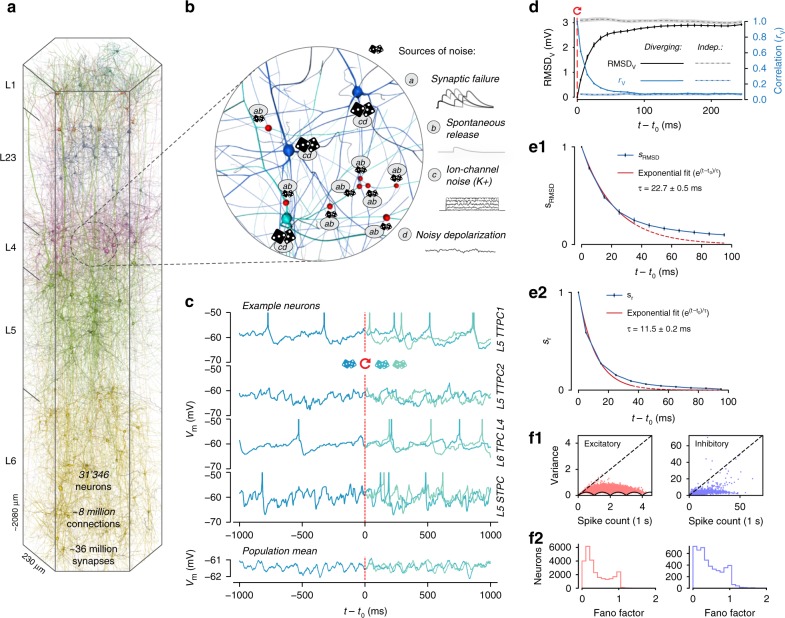
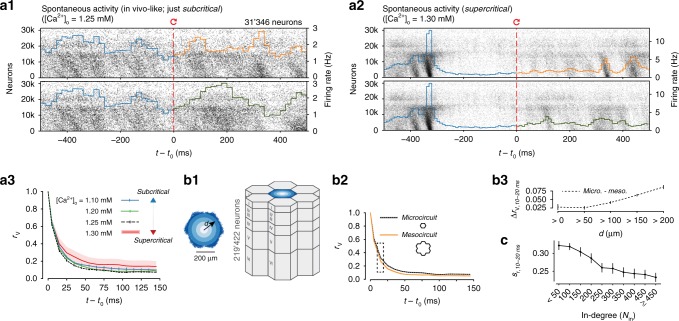
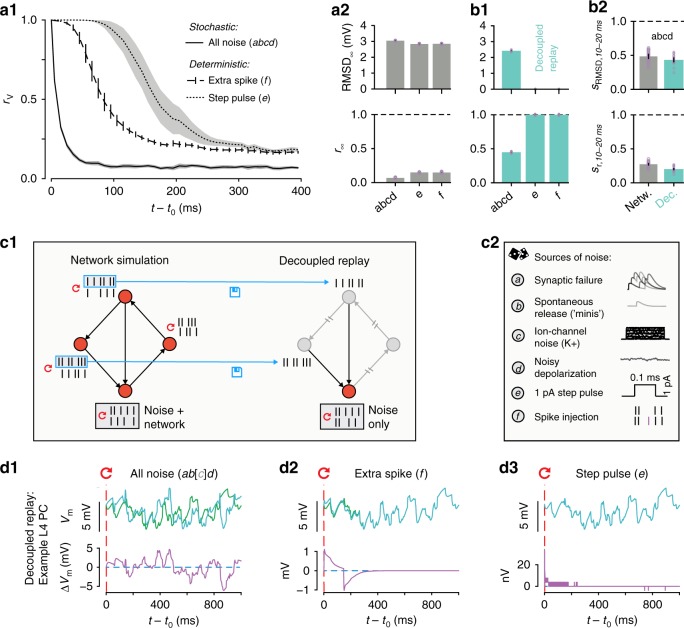
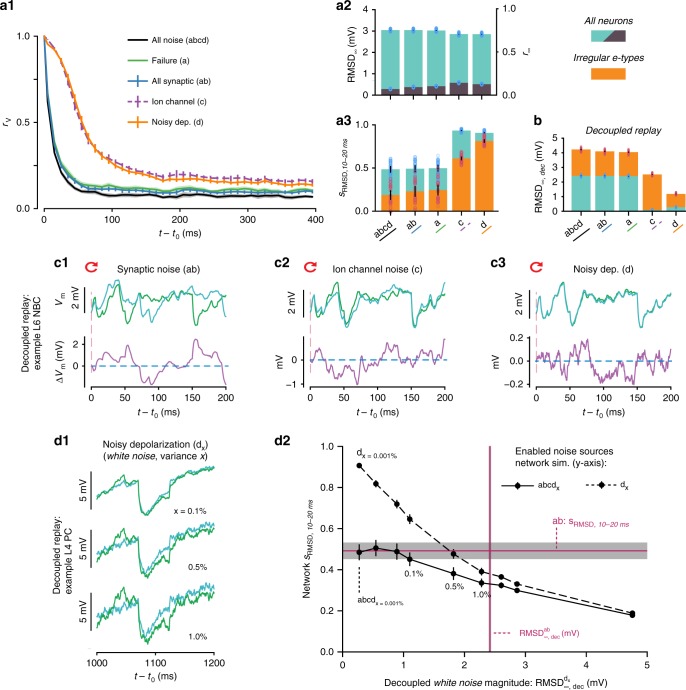
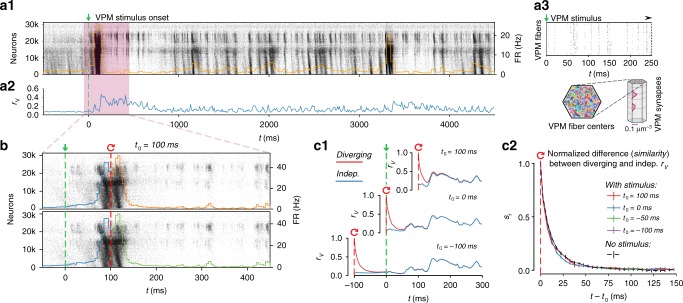
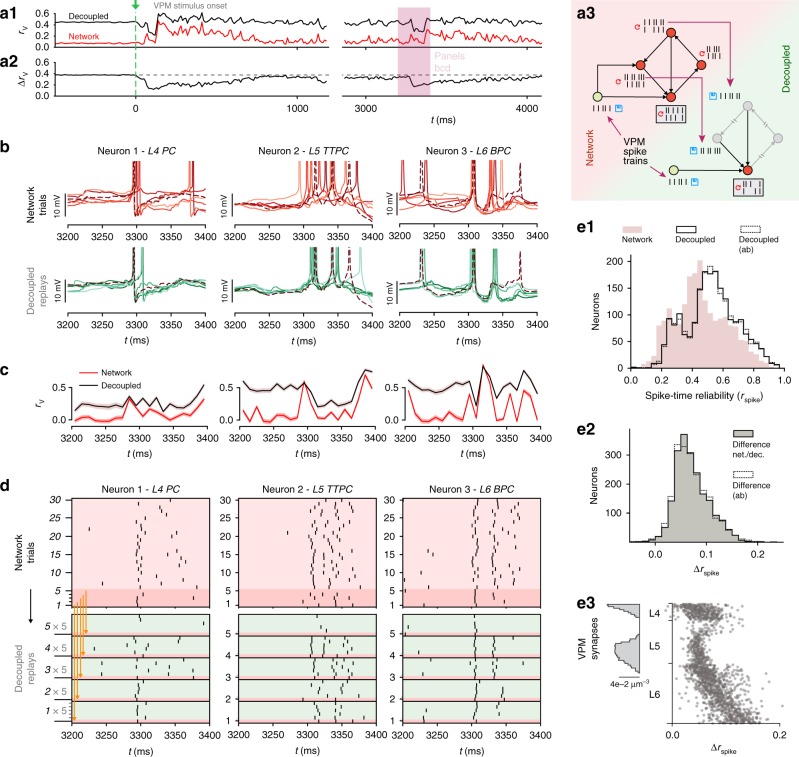
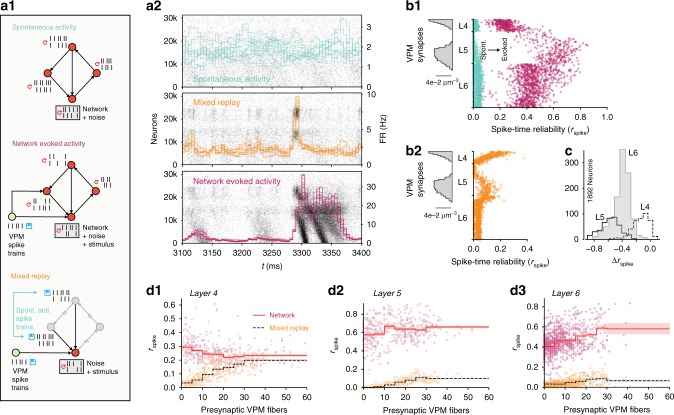
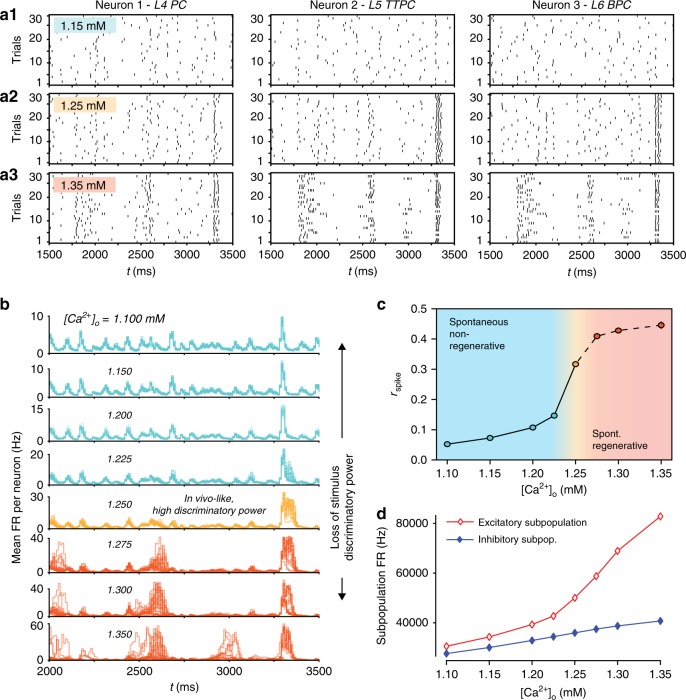
Typical responses of cortical neurons to identical sensory stimuli appear highly variable. It has thus been proposed that the cortex primarily uses a rate code. However, other studies have argued for spike-time coding under certain conditions. The potential role of spike-time coding is directly limited by the internally generated variability of cortical circuits, which remains largely unexplored. Here, we quantify this internally generated variability using a biophysical model of rat neocortical microcircuitry with biologically realistic noise sources. We find that stochastic neurotransmitter release is a critical component of internally generated variability, causing rapidly diverging, chaotic recurrent network dynamics. Surprisingly, the same nonlinear recurrent network dynamics can transiently overcome the chaos in response to weak feed-forward thalamocortical inputs, and support reliable spike times with millisecond precision. Our model shows that the noisy and chaotic network dynamics of recurrent cortical microcircuitry are compatible with stimulus-evoked, millisecond spike-time reliability, resolving a long-standing debate.
Overview
The claims and statistics of this paper haven’t been checked yet.
Free: it reads the open-access text and checks the first 5 claims that cite a source we can check. Create a free account to check every claim.
Integrity signals
Registry
Cites
Statistics
Figures
Verification
Claims the paper makes
The claims and statistics of this paper haven’t been checked yet.
Free: it reads the open-access text and checks the first 5 claims that cite a source we can check. Create a free account to check every claim.
Claims other papers make about this one
Each is checked against this paper’s own text: does it say what the citing paper says it does?
The cited source doesn’t support the claim as written.
In the citing paper
“Moreover, if the background conditions are well controlled, neurons are thought to interact in a highly reliable, nearly deterministic manner [41–43].”
From Integrated information theory (IIT) 4.0: Formulating the properties of phenomenal existence in physical terms (2023) · cites this paper as [43]
Checked by a reasoning model — may be wrong.
Experimental — accuracy not yet measured
Self-check
Percentages, sums and reported differences re-computed from the paper’s own numbers.
The self-check needs the paper’s full text.
Citations
Cites
Faisal, A. A., Selen, L. P. J., & Wolpert, D. M. (2008) · Nature Reviews Neuroscience · doi:10.1038/nrn2258 · Cited by 2,883
The NEURON Simulation Environment
Hines, M. L., & Carnevale, N. T. (1997) · Neural Computation · doi:10.1162/neco.1997.9.6.1179 · Cited by 2,658
Neuronal Avalanches in Neocortical Circuits
Beggs, J. M., & Plenz, D. (2003) · The Journal of Neuroscience · doi:10.1523/jneurosci.23-35-11167.2003 · Cited by 2,325
Shadlen, M. N., & Newsome, W. T. (1998) · The Journal of Neuroscience · doi:10.1523/jneurosci.18-10-03870.1998 · Cited by 2,178
Reliability of spike timing in neocortical neurons
Mainen, Z. F., & Sejnowski, T. J. (1995) · Science · doi:10.1126/science.7770778 · Cited by 1,950
Chaos in Neuronal Networks with Balanced Excitatory and Inhibitory Activity
van Vreeswijk, C., & Sompolinsky, H. (1996) · Science · doi:10.1126/science.274.5293.1724 · Cited by 1,811
Dynamics of Sparsely Connected Networks of Excitatory and Inhibitory Spiking Neurons
Brunel, N. (2000) · Journal of Computational Neuroscience · doi:10.1023/a:1008925309027 · Cited by 1,726
Tsodyks, M. V., & Markram, H. (1997) · Proceedings of the National Academy of Sciences · doi:10.1073/pnas.94.2.719 · Cited by 1,603
Self-citationReconstruction and Simulation of Neocortical Microcircuitry
Markram, H., Muller, E., Ramaswamy, S., Reimann, M. W., Abdellah, M., Sanchez, C. A., Ailamaki, A., Alonso-Nanclares, L., Antille, N., Arsever, S., et al. (2015) · Cell · doi:10.1016/j.cell.2015.09.029 · Cited by 1,557
Self-citationSpontaneous behaviors drive multidimensional, brainwide activity
Stringer, C., Pachitariu, M., Steinmetz, N., Reddy, C. B., Carandini, M., & Harris, K. D. (2019) · Science · doi:10.1126/science.aav7893 · Cited by 1,510
Petilla terminology: nomenclature of features of GABAergic interneurons of the cerebral cortex
The Petilla Interneuron Nomenclature Group (PING) (2008) · Nature Reviews Neuroscience · doi:10.1038/nrn2402 · Cited by 1,491
Modulation of visual responses by behavioral state in mouse visual cortex
Niell, C. M., & Stryker, M. P. (2010) · Neuron · doi:10.1016/j.neuron.2010.01.033 · Cited by 1,483
The Asynchronous State in Cortical Circuits
Renart, A., de la Rocha, J., Bartho, P., Hollender, L., Parga, N., Reyes, A., & Harris, K. D. (2010) · Science · doi:10.1126/science.1179850 · Cited by 1,106
Single-trial neural dynamics are dominated by richly varied movements
Musall, S., Kaufman, M. T., Juavinett, A. L., Gluf, S., & Churchland, A. K. (2019) · Nature Neuroscience · doi:10.1038/s41593-019-0502-4 · Cited by 1,075
Markram, H., Lübke, J., Frotscher, M., Roth, A., & Sakmann, B. (1997) · The Journal of Physiology · doi:10.1113/jphysiol.1997.sp022031 · Cited by 960
Self-citationThe statistical reliability of signals in single neurons in cat and monkey visual cortex
Tolhurst, D. J., Movshon, J. A., & Dean, A. F. (1983) · Vision Research · doi:10.1016/0042-6989(83)90200-6 · Cited by 829
The tempotron: a neuron that learns spike timing–based decisions
Gütig, R., & Sompolinsky, H. (2006) · Nature Neuroscience · doi:10.1038/nn1643 · Cited by 815
Chaotic Balanced State in a Model of Cortical Circuits
Vreeswijk, C. V., & Sompolinsky, H. (1998) · Neural Computation · doi:10.1162/089976698300017214 · Cited by 732
Spike-based strategies for rapid processing
Thorpe, S., Delorme, A., & Van Rullen, R. (2001) · Neural Networks · doi:10.1016/s0893-6080(01)00083-1 · Cited by 731 · cited 1×
“To test the feasibility of models of cortical coding that rely on spike timing (Gütig and Sompolinsky, 2006; Luczak et al., 2015; Thorpe et al., 2001), we need to understand internal variability and how it arises.”
A synaptic organizing principle for cortical neuronal groups
Perin, R., Berger, T. K., & Markram, H. (2011) · Proceedings of the National Academy of Sciences · doi:10.1073/pnas.1016051108 · Cited by 718
Self-citationSpike avalanches in vivo suggest a driven, slightly subcritical brain state
Priesemann, V. (2014) · Frontiers in Systems Neuroscience · doi:10.3389/fnsys.2014.00108 · Cited by 563
Efficient codes and balanced networks
Denève, S., & Machens, C. K. (2016) · Nature Neuroscience · doi:10.1038/nn.4243 · Cited by 471
Sensitivity to perturbations in vivo implies high noise and suggests rate coding in cortex
London, M., Roth, A., Beeren, L., Häusser, M., & Latham, P. E. (2010) · Nature · doi:10.1038/nature09086 · Cited by 436
Diverse coupling of neurons to populations in sensory cortex
Okun, M., Steinmetz, N. A., Cossell, L., Iacaruso, M. F., Ko, H., Barthó, P., Moore, T., Hofer, S. B., Mrsic-Flogel, T. D., Carandini, M., et al. (2015) · Nature · doi:10.1038/nature14273 · Cited by 424 · cited 1×
“Thus, it appears that neurons which are more strongly coupled to the local population (Okun et al., 2015) are also more likely to diverge quickly.”
Cliques of Neurons Bound into Cavities Provide a Missing Link between Structure and Function
Reimann, M. W., Nolte, M., Scolamiero, M., Turner, K., Perin, R., Chindemi, G., Dłotko, P., Levi, R., Hess, K., & Markram, H. (2017) · Frontiers in Computational Neuroscience · doi:10.3389/fncom.2017.00048 · Cited by 404
Self-citationEffects and Mechanisms of Wakefulness on Local Cortical Networks
Constantinople, C. M., & Bruno, R. M. (2011) · Neuron · doi:10.1016/j.neuron.2011.02.040 · Cited by 403
Spontaneous cortical activity alternates between motifs defined by regional axonal projections
Mohajerani, M. H., Chan, A. W., Mohsenvand, M., LeDue, J., Liu, R., McVea, D. A., Boyd, J. D., Wang, Y. T., Reimers, M., & Murphy, T. H. (2013) · Nature Neuroscience · doi:10.1038/nn.3499 · Cited by 388
Stern, E. A., Kincaid, A. E., & Wilson, C. J. (1997) · Journal of Neurophysiology · doi:10.1152/jn.1997.77.4.1697 · Cited by 361
A new correlation-based measure of spike timing reliability
Schreiber, S., Fellous, J. M., Whitmer, D., Tiesinga, P., & Sejnowski, T. J. (2003) · Neurocomputing · doi:10.1016/s0925-2312(02)00838-x · Cited by 327
Gliotransmission: Beyond Black-and-White
Savtchouk, I., & Volterra, A. (2018) · The Journal of Neuroscience · doi:10.1523/jneurosci.0017-17.2017 · Cited by 325
Not Noisy, Just Wrong: The Role of Suboptimal Inference in Behavioral Variability
Beck, J. M., Ma, W. J., Pitkow, X., Latham, P. E., & Pouget, A. (2012) · Neuron · doi:10.1016/j.neuron.2012.03.016 · Cited by 316
Traveling Waves in Visual Cortex
Sato, T. K., Nauhaus, I., & Carandini, M. (2012) · Neuron · doi:10.1016/j.neuron.2012.06.029 · Cited by 287
Orientation selectivity and the functional clustering of synaptic inputs in primary visual cortex
Wilson, D. E., Whitney, D. E., Scholl, B., & Fitzpatrick, D. (2016) · Nature Neuroscience · doi:10.1038/nn.4323 · Cited by 268
Coding of temporal information by activity-dependent synapses.
Fuhrmann, G., Segev, I., Markram, H., & Tsodyks, M. (2002) · Journal of Neurophysiology · doi:10.1152/jn.00258.2001 · Cited by 267
Self-citationRegulation by gastric acid of the processing of progastrin‐derived peptides in rat antral mucosa
Macro, J. A., Bate, G. W., Varro, A., Vaillant, C., Seidah, N. G., Dimaline, R., & Dockray, G. J. (1997) · The Journal of Physiology · doi:10.1111/j.1469-7793.1997.409bk.x · Cited by 257
Population Coding of Stimulus Location in Rat Somatosensory Cortex
Petersen, R. S., Panzeri, S., & Diamond, M. E. (2001) · Neuron · doi:10.1016/s0896-6273(01)00481-0 · Cited by 255
Neural Variability and Sampling-Based Probabilistic Representations in the Visual Cortex
Orbán, G., Berkes, P., Fiser, J., & Lengyel, M. (2016) · Neuron · doi:10.1016/j.neuron.2016.09.038 · Cited by 255 · cited 1×
“Second, variability could carry information and encode signals itself, for example perceptual uncertainty (Orbán et al., 2016).”
High-Probability Uniquantal Transmission at Excitatory Synapses in Barrel Cortex
Silver, R. A., Lübke, J., Sakmann, B., & Feldmeyer, D. (2003) · Science · doi:10.1126/science.1087160 · Cited by 247 · cited 1×
“While some cortical connection types are probably univesicular (Silver et al., 2003), others could have up to ten releasable vesicles per synapse (Loebel et al.”
Surfing a spike wave down the ventral stream
VanRullen, R., & Thorpe, S. J. (2002) · Vision Research · doi:10.1016/s0042-6989(02)00298-5 · Cited by 236
The spatial structure of correlated neuronal variability
Rosenbaum, R., Smith, M. A., Kohn, A., Rubin, J. E., & Doiron, B. (2017) · Nature Neuroscience · doi:10.1038/nn.4433 · Cited by 234 · cited 1×
“Similarly, taking account of other biological details, such as distance dependent connectivity (Rosenbaum et al., 2017), strength of feedback inhibition (Stringer et al.”
Variability in neural activity and behavior
Renart, A., & Machens, C. K. (2014) · Current Opinion in Neurobiology · doi:10.1016/j.conb.2014.02.013 · Cited by 233
From the stochasticity of molecular processes to the variability of synaptic transmission
Ribrault, C., Sekimoto, K., & Triller, A. (2011) · Nature Reviews Neuroscience · doi:10.1038/nrn3025 · Cited by 198
Packet-based communication in the cortex
Luczak, A., McNaughton, B. L., & Harris, K. D. (2015) · Nature Reviews Neuroscience · doi:10.1038/nrn4026 · Cited by 198
Fiacco, T. A., & McCarthy, K. D. (2018) · The Journal of Neuroscience · doi:10.1523/jneurosci.0016-17.2017 · Cited by 194
Synchrony of Thalamocortical Inputs Maximizes Cortical Reliability
Wang, H.-P., Spencer, D., Fellous, J.-M., & Sejnowski, T. J. (2010) · Science · doi:10.1126/science.1183108 · Cited by 179
Functional Characterization of Intrinsic Cholinergic Interneurons in the Cortex
von Engelhardt, J., Eliava, M., Meyer, A. H., Rozov, A., & Monyer, H. (2007) · The Journal of Neuroscience · doi:10.1523/jneurosci.4647-06.2007 · Cited by 177
Rich cell-type-specific network topology in neocortical microcircuitry
Gal, E., London, M., Globerson, A., Ramaswamy, S., Reimann, M. W., Muller, E., Markram, H., & Segev, I. (2017) · Nature Neuroscience · doi:10.1038/nn.4576 · Cited by 176
Self-citationSpike Frequency Adaptation and Neocortical Rhythms
Fuhrmann, G., Markram, H., & Tsodyks, M. (2002) · Journal of Neurophysiology · doi:10.1152/jn.2002.88.2.761 · Cited by 175
Self-citationThe low synaptic release probability in vivo
Borst, J. G. G. (2010) · Trends in Neurosciences · doi:10.1016/j.tins.2010.03.003 · Cited by 174
Action potentials reliably invade axonal arbors of rat neocortical neurons
Cox, C. L., Denk, W., Tank, D. W., & Svoboda, K. (2000) · Proceedings of the National Academy of Sciences · doi:10.1073/pnas.170278697 · Cited by 173 · cited 1×
“neurons reliably invade axonal arbors without failures (Cox et al., 2000).”
Van Geit, W., Gevaert, M., Chindemi, G., Rössert, C., Courcol, J.-D., Muller, E. B., Schürmann, F., Segev, I., & Markram, H. (2016) · Frontiers in Neuroinformatics · doi:10.3389/fninf.2016.00017 · Cited by 166
Self-citationTopological analysis of the connectome of digital reconstructions of neural microcircuitsPreprint
Dotko, P., Hess, K. P., Levi, R., Nolte, M., Reimann, M., Scolamiero, M., Turner, K., Muller, E. B., & Markram, H. (2016) · arXiv (Cornell University) · doi:10.48550/arxiv.1601.01580 · Cited by 161
Self-citationSubthreshold Voltage Noise Due to Channel Fluctuations in Active Neuronal Membranes
Steinmetz, P. N., Manwani, A., Koch, C., London, M., & Segev, I. (2000) · Journal of Computational Neuroscience · doi:10.1023/a:1008967807741 · Cited by 157
The neocortical microcircuit collaboration portal: a resource for rat somatosensory cortex
Ramaswamy, S., Courcol, J.-D., Abdellah, M., Adaszewski, S. R., Antille, N., Arsever, S., Atenekeng, G., Bilgili, A., Brukau, Y., Chalimourda, A., et al. (2015) · Frontiers in Neural Circuits · doi:10.3389/fncir.2015.00044 · Cited by 153
Self-citationStochastic Simulations on the Reliability of Action Potential Propagation in Thin Axons
Faisal, A. A., & Laughlin, S. B. (2007) · PLoS Computational Biology · doi:10.1371/journal.pcbi.0030079 · Cited by 145
State-Dependent Population Coding in Primary Auditory Cortex
Pachitariu, M., Lyamzin, D. R., Sahani, M., & Lesica, N. A. (2015) · The Journal of Neuroscience · doi:10.1523/jneurosci.3318-14.2015 · Cited by 142
Millisecond encoding precision of auditory cortex neurons
Kayser, C., Logothetis, N. K., & Panzeri, S. (2010) · Proceedings of the National Academy of Sciences · doi:10.1073/pnas.1012656107 · Cited by 139
An algorithm to predict the connectome of neural microcircuits
Reimann, M. W., King, J. G., Muller, E. B., Ramaswamy, S., & Markram, H. (2015) · Frontiers in Computational Neuroscience · doi:10.3389/fncom.2015.00120 · Cited by 117
Self-citationInhibitory control of correlated intrinsic variability in cortical networks
Stringer, C., Pachitariu, M., Steinmetz, N. A., Okun, M., Bartho, P., Harris, K. D., Sahani, M., & Lesica, N. A. (2016) · eLife · doi:10.7554/elife.19695 · Cited by 101
Cannon, R. C., O'Donnell, C., & Nolan, M. F. (2010) · PLoS Computational Biology · doi:10.1371/journal.pcbi.1000886 · Cited by 97
The ubiquitous nature of multivesicular release
Rudolph, S., Tsai, M.-C., von Gersdorff, H., & Wadiche, J. I. (2015) · Trends in Neurosciences · doi:10.1016/j.tins.2015.05.008 · Cited by 95
Intracellular, In Vivo , Dynamics of Thalamocortical Synapses in Visual Cortex
Sedigh-Sarvestani, M., Vigeland, L. E., Fernández‐Lamo, I., Taylor, M. M., Palmer, L. A., & Contreras, D. (2017) · Journal of Neuroscience · doi:10.1523/jneurosci.3370-16.2017 · Cited by 88
Low-noise encoding of active touch by layer 4 in the somatosensory cortex
Andrew Hires, S., Gutnisky, D. A., Yu, J., O'Connor, D. H., & Svoboda, K. (2015) · eLife · doi:10.7554/elife.06619 · Cited by 79
Neural variability, or lack thereof
Masquelier, T. (2013) · Frontiers in Computational Neuroscience · doi:10.3389/fncom.2013.00007 · Cited by 71
Operating in a Reverberating Regime Enables Rapid Tuning of Network States to Task Requirements
Wilting, J., Dehning, J., Neto, J. P., Rudelt, L., Wibral, M., Zierenberg, J., & Priesemann, V. (2018) · Frontiers in Systems Neuroscience · doi:10.3389/fnsys.2018.00055 · Cited by 65
Adaptation reduces variability of the neuronal population code
Farkhooi, F., Muller, E. B., & Nawrot, M. P. (2011) · Physical Review E · doi:10.1103/physreve.83.050905 · Cited by 60
Cellular Adaptation Facilitates Sparse and Reliable Coding in Sensory Pathways
Farkhooi, F., Froese, A., Muller, E. B., Menzel, R., & Nawrot, M. P. (2013) · PLoS Computational Biology · doi:10.1371/journal.pcbi.1003251 · Cited by 59
Self-citationMorphological Diversity Strongly Constrains Synaptic Connectivity and Plasticity
Reimann, M. W., Horlemann, A.-L., Ramaswamy, S., Muller, E. B., & Markram, H. (2017) · Cerebral Cortex · doi:10.1093/cercor/bhx150 · Cited by 58
Self-citationPoisson-Like Spiking in Circuits with Probabilistic Synapses
Moreno‐Bote, R. (2014) · PLoS Computational Biology · doi:10.1371/journal.pcbi.1003522 · Cited by 56
Multiquantal release underlies the distribution of synaptic efficacies in the neocortex
Loebel, A. (2009) · Frontiers in Computational Neuroscience · doi:10.3389/neuro.10.027.2009 · Cited by 54
How Do Efficient Coding Strategies Depend on Origins of Noise in Neural Circuits?
Brinkman, B. A. W., Weber, A. I., Rieke, F. M., & Shea‐Brown, E. (2016) · PLoS Computational Biology · doi:10.1371/journal.pcbi.1005150 · Cited by 49
Causal Inference and Explaining Away in a Spiking Network
Moreno-Bote, R., & Drugowitsch, J. (2015) · Scientific Reports · doi:10.1038/srep17531 · Cited by 39
Mendonça, P. R., Vargas-Caballero, M., Erdélyi, F., Szabó, G., Paulsen, O., & Robinson, H. P. (2016) · eLife · doi:10.7554/elife.16475 · Cited by 37
Estimating the Readily-Releasable Vesicle Pool Size at Synaptic Connections in the Neocortex
Barros-Zulaica, N., Rahmon, J., Chindemi, G., Perin, R., Markram, H., Muller, E., & Ramaswamy, S. (2019) · Frontiers in Synaptic Neuroscience · doi:10.3389/fnsyn.2019.00029 · Cited by 33
Self-citationSpike propagation in dendrites with stochastic ion channels
Diba, K., Koch, C., & Segev, I. (2006) · Journal of Computational Neuroscience · doi:10.1007/s10870-006-4770-0 · Cited by 31
Encoding in Balanced Networks: Revisiting Spike Patterns and Chaos in Stimulus-Driven Systems
Lajoie, G., Lin, K. K., Thivierge, J., & Shea‐Brown, E. (2016) · PLoS Computational Biology · doi:10.1371/journal.pcbi.1005258 · Cited by 26
Embedded ensemble encoding hypothesis: The role of the “Prepared” cell
Antic, S. D., Hines, M. L., & Lytton, W. W. (2018) · Journal of Neuroscience Research · doi:10.1002/jnr.24240 · Cited by 23
Bale, M. R., Ince, R. A. A., Santagata, G., & Petersen, R. S. (2015) · Frontiers in Neural Circuits · doi:10.3389/fncir.2015.00050 · Cited by 19
A consensus layer V pyramidal neuron can sustain interpulse-interval coding
Singh, C., & Levy, W. B. (2017) · PLoS ONE · doi:10.1371/journal.pone.0180839 · Cited by 19
The impact of short term synaptic depression and stochastic vesicle dynamics on neuronal variability
Reich, S., & Rosenbaum, R. (2013) · Journal of Computational Neuroscience · doi:10.1007/s10827-012-0438-0 · Cited by 15
Circuit models of low dimensional shared variability in cortical networksPreprint
Huang, C., Ruff, D. A., Pyle, R., Rosenbaum, R., Cohen, M. R., & Doiron, B. (2017) · bioRxiv (Cold Spring Harbor Laboratory) · doi:10.1101/217976 · Cited by 15
Barros-Zulaica, N., Rahmon, J., Chindemi, G., et al. (2019) · bioRxiv (Cold Spring Harbor Laboratory) · doi:10.1101/646497 · Cited by 5
Cited by
Albantakis, L., Barbosa, L., Findlay, G., Grasso, M., Haun, A. M., Marshall, W., Mayner, W. G. P., Zaeemzadeh, A., Boly, M., Juel, B. E., et al. (2023) · PLoS Computational Biology · doi:10.1371/journal.pcbi.1011465 · Cited by 292
Bring the Noise: Reconceptualizing Spontaneous Neural Activity
Uddin, L. Q. (2020) · Trends in Cognitive Sciences · doi:10.1016/j.tics.2020.06.003 · Cited by 166
Consciousness is supported by near-critical slow cortical electrodynamics
Toker, D., Pappas, I., Lendner, J. D., Frohlich, J., Mateos, D. M., Muthukumaraswamy, S., Carhart-Harris, R., Paff, M., Vespa, P. M., Monti, M. M., et al. (2022) · Proceedings of the National Academy of Sciences · doi:10.1073/pnas.2024455119 · Cited by 138
Interstitial ions: A key regulator of state-dependent neural activity?
Rasmussen, R. N., O’Donnell, J., Ding, F., & Nedergaard, M. (2020) · Progress in Neurobiology · doi:10.1016/j.pneurobio.2020.101802 · Cited by 129
Self-Organization Toward Criticality by Synaptic Plasticity
Zeraati, R., Priesemann, V., & Levina, A. (2021) · Frontiers in Physics · doi:10.3389/fphy.2021.619661 · Cited by 91
Metadata
- Authors
- Nolte, M., Reimann, M. W., King, J. G., Markram, H., & Muller, E. B.
- Affiliations
- École Polytechnique Fédérale de Lausanne (CH)
- Corresponding author
- Nolte, Max
- Muller, Eilif B.
- Venue
- Nature Communications
- Published
- 2019-08-22
- Volume
- 10
- Issue
- 1
- Pages
- 3792-3792
- ISSN
- 2041-1723 (ISSN-L)
- PMC
- PMC6706377
- OpenAlex
- W2969778699
- Cited by
- 56
- References
- 80
- Citations by year
- 2026: 4 · 2025: 9 · 2024: 11 · 2023: 8 · 2022: 8 · 2021: 8 · 2020: 6 · 2019: 1
- FWCI
- 3.34
- Type
- journal article
- Language
- en
- Open access
- gold
- doi.org
- Licence
- cc-by
- creativecommons.org/licenses/by/4.0 (tdm)
- creativecommons.org/licenses/by/4.0 (vor)
- Locations
- Nature Communications (publishedVersion, cc-by)
- bioRxiv (Cold Spring Harbor Laboratory) (acceptedVersion)
- PubMed Central (publishedVersion, cc-by)
- PubMed (publishedVersion)
- RePEc: Research Papers in Economics (submittedVersion)
- DOAJ (DOAJ: Directory of Open Access Journals) (submittedVersion)
- DOAJ (DOAJ: Directory of Open Access Journals) (submittedVersion, cc-by-sa)
- Infoscience (Ecole Polytechnique Fédérale de Lausanne) (submittedVersion, cc-by-nc-nd)
- Funders
- École Polytechnique Fédérale de Lausanne
- Board of the Swiss Federal Institutes of Technology
- National Supercomputing Center, Korea Institute of Science and Technology Information
- Topics
- Life Sciences › Neuroscience › Cognitive Neuroscience › Neural dynamics and brain function
- Physical Sciences › Physics and Astronomy › Statistical and Nonlinear Physics › stochastic dynamics and bifurcation
- Life Sciences › Neuroscience › Cellular and Molecular Neuroscience › Neuroscience and Neuropharmacology Research
- Keywords
- spike time coding, rate coding, cortical microcircuitry, chaos, thalamocortical input, biophysical neuron models
- MeSH terms
- Action Potentials, Animals, Cerebral Cortex, Models, Neurological, Nerve Net, Neurons, Thalamus, Time Factors, Reproducibility of Results, Nonlinear Dynamics, Neurotransmitter Agents, Rats, Synaptic Potentials
About these checks
Registry, retraction, Cites and statistics results are computed, not judged, with one exception: a printed reference that no index lists is read once by a model before it counts as a citation error. Claims are extracted by a model and kept only when their quote appears verbatim in the text; each cited source is then checked, with a model’s help, for whether it says what the claim relies on. Those verdicts can be wrong — read the claim’s quote and the cited source before relying on one.
Statistics and arithmetic are recomputed, not judged.
Confidence bands are shown only for fields calibrated on our annotated test set. None is calibrated yet, so no band is shown.
What counts as a claim ›How we measure confidence ›How we check this ›
Are you an author, or do you see a problem with this page? Request a review
Data sources
Bibliographic data: Semantic Scholar, OpenAlex, Crossref.
Contains information from the Semantic Scholar Academic Graph Datasets, made available under the ODC Attribution License (ODC-BY 1.0).
Semantic Scholar’s data is described in: Kinney, R., et al. (2023). The Semantic Scholar Open Data Platform. arXiv:2301.10140.
