

Inhibition of DNA damage response at telomeres improves the detrimental phenotypes of Hutchinson–Gilford Progeria Syndrome
Open accessThe DOI matches its Crossref record; 52 of the 52 references it cites were found in a registry or an index.
Abstract
Hutchinson–Gilford progeria syndrome (HGPS) is a genetic disorder characterized by premature aging features. Cells from HGPS patients express progerin, a truncated form of Lamin A, which perturbs cellular homeostasis leading to nuclear shape alterations, genome instability, heterochromatin loss, telomere dysfunction and premature entry into cellular senescence. Recently, we reported that telomere dysfunction induces the transcription of telomeric non-coding RNAs (tncRNAs) which control the DNA damage response (DDR) at dysfunctional telomeres. Here we show that progerin-induced telomere dysfunction induces the transcription of tncRNAs. Their functional inhibition by sequence-specific telomeric antisense oligonucleotides (tASOs) prevents full DDR activation and premature cellular senescence in various HGPS cell systems, including HGPS patient fibroblasts. We also show in vivo that tASO treatment significantly enhances skin homeostasis and lifespan in a transgenic HGPS mouse model. In summary, our results demonstrate an important role for telomeric DDR activation in HGPS progeroid detrimental phenotypes in vitro and in vivo.
Overview
The claims and statistics of this paper haven’t been checked yet.
Free: it reads the open-access text and checks the first 5 claims that cite a source we can check. Create a free account to check every claim.
Integrity signals
Registry
Cites
Statistics
Figures
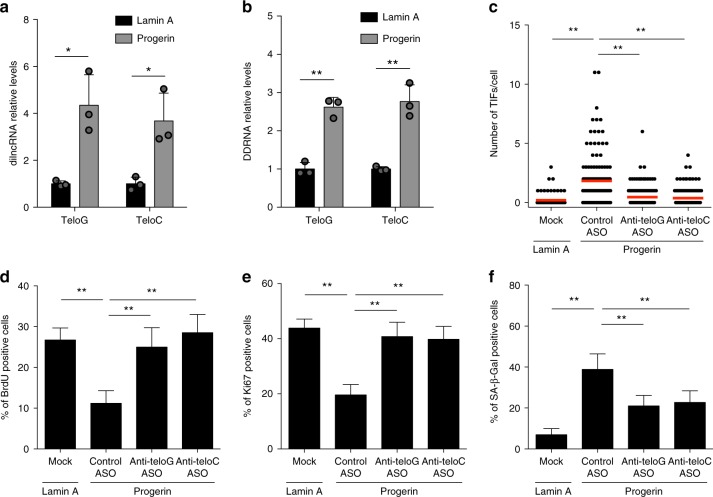
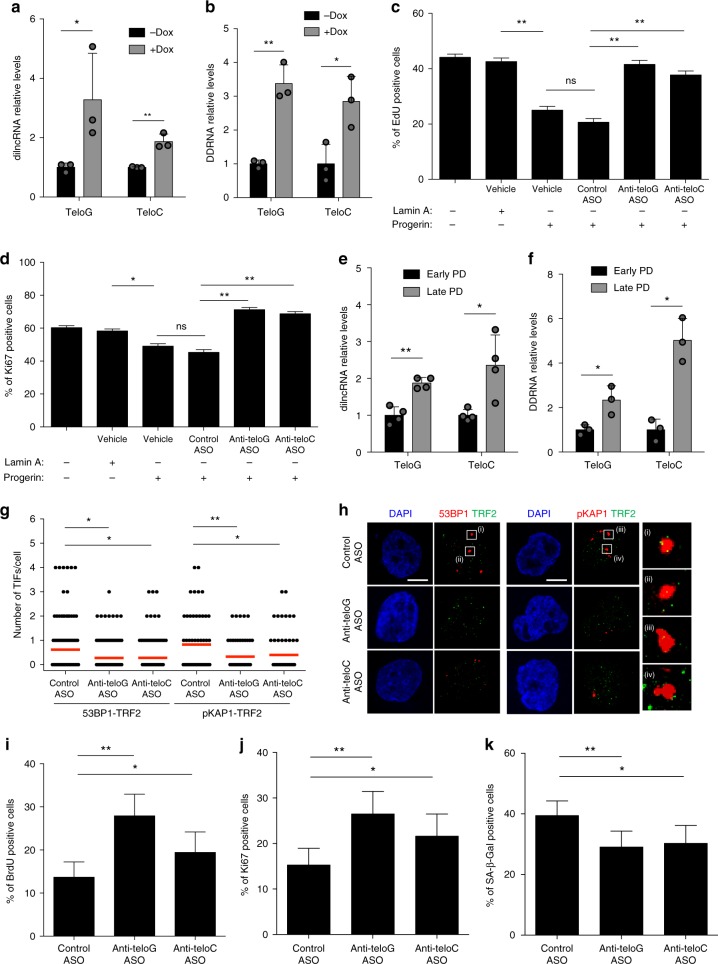
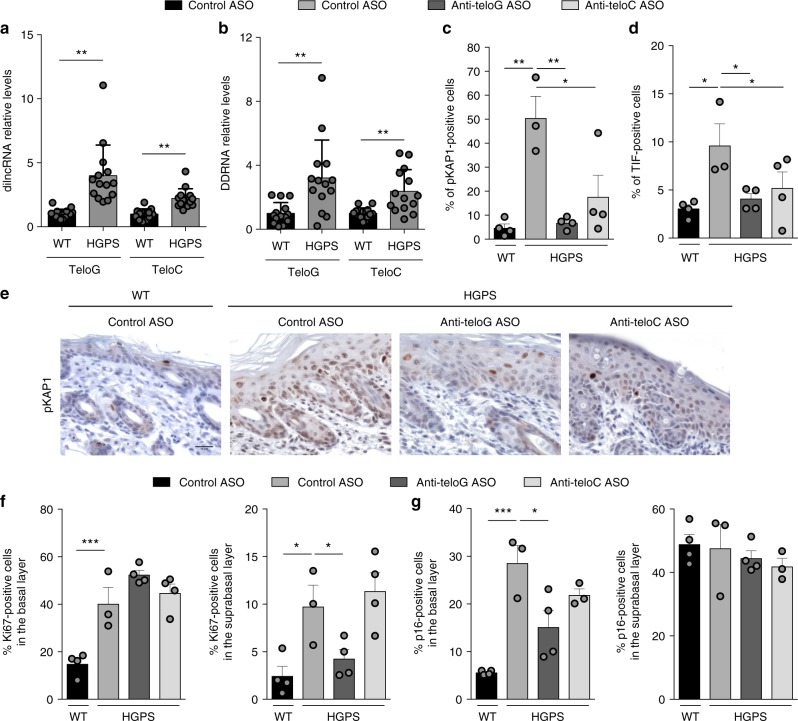
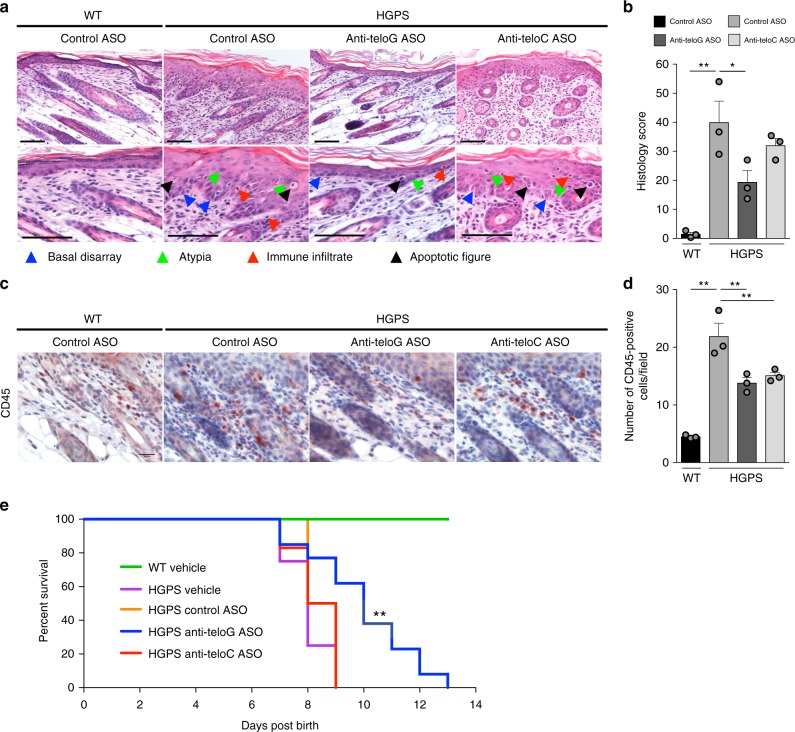
Verification
Claims the paper makes
The claims and statistics of this paper haven’t been checked yet.
Free: it reads the open-access text and checks the first 5 claims that cite a source we can check. Create a free account to check every claim.
Claims other papers make about this one
Each is checked against this paper’s own text: does it say what the citing paper says it does?
The source backs part of the claim, not all of it — or backs it for a different population, condition or comparison.
In the citing paper
“The use of telomeric ASOs in a mouse model of Hutchinson–Gilford progeria syndrome (an accelerated ageing syndrome) effectively reduced DDR activation, the levels of senescence markers and SASP induction, improved tissue homeostasis and extended lifespan251.”
From Cellular senescence in ageing: from mechanisms to therapeutic opportunities (2021) · cites this paper as [251]
Experimental — accuracy not yet measuredThe cited source says what the claim attributes to it.
In the citing paper
“The reported ability of telomeric ASOs (tASOs) to blunt DDR activation specifically at telomeres in vivo in mice72,198,199”
From Telomere dysfunction in ageing and age-related diseases (2022) · cites this paper as [199]
The cited source says what the claim attributes to it.
In the citing paper
“and to improve health span and lifespan in a progeria animal model199”
From Telomere dysfunction in ageing and age-related diseases (2022) · cites this paper as [199]
Self-check
Percentages, sums and reported differences re-computed from the paper’s own numbers.
The self-check needs the paper’s full text.
Citations
Cites
López-Otín, C., Blasco, M. A., Partridge, L., Serrano, M., & Kroemer, G. (2013) · Cell · doi:10.1016/j.cell.2013.05.039 · Cited by 14,982
Cellular senescence: when bad things happen to good cells
Campisi, J., & d'Adda di Fagagna, F. (2007) · Nature Reviews Molecular Cell Biology · doi:10.1038/nrm2233 · Cited by 4,441
A DNA damage checkpoint response in telomere-initiated senescence
Fagagna, F. D. D., Reaper, P. M., Clay-Farrace, L., Fiegler, H., Carr, P., von Zglinicki, T., Saretzki, G., Carter, N. P., & Jackson, S. P. (2003) · Nature · doi:10.1038/nature02118 · Cited by 2,917
Telomere length predicts replicative capacity of human fibroblasts.
Allsopp, R. C., Vaziri, H., Patterson, C., Goldstein, S., Younglai, E. V., Futcher, A. B., Greider, C. W., & Harley, C. B. (1992) · Proceedings of the National Academy of Sciences · doi:10.1073/pnas.89.21.10114 · Cited by 2,200
Telomere Shortening and Tumor Formation by Mouse Cells Lacking Telomerase RNA
Blasco, M. A., Lee, H.-W., Hande, M. P., Samper, E., Lansdorp, P. M., DePinho, R. A., & Greider, C. W. (1997) · Cell · doi:10.1016/s0092-8674(01)80006-4 · Cited by 2,108
Recurrent de novo point mutations in lamin A cause Hutchinson-Gilford progeria syndrome
Eriksson, M., Brown, W. T., Gordon, L. B., Glynn, M. W., Singer, J., Scott, L., Erdos, M. R., Robbins, C. M., Moses, T. Y., Berglund, P., et al. (2003) · Nature · doi:10.1038/nature01629 · Cited by 1,990
Self-citationLongevity, Stress Response, and Cancer in Aging Telomerase-Deficient Mice
Rudolph, K. L., Chang, S., Lee, H.-W., Blasco, M., Gottlieb, G. J., Greider, C., & DePinho, R. A. (1999) · Cell · doi:10.1016/s0092-8674(00)80580-2 · Cited by 1,349
Lamin a truncation in Hutchinson-Gilford progeria
De Sandre-Giovannoli, A., Bernard, R., Cau, P., Navarro, C., Amiel, J., Boccaccio, I., Lyonnet, S., Stewart, C. L., Munnich, A., Le Merrer, M., et al. (2003) · Science · doi:10.1126/science.1084125 · Cited by 1,346
Herbig, U., Jobling, W. A., Chen, B. P. C., Chen, D. J., & Sedivy, J. M. (2004) · Molecular Cell · doi:10.1016/s1097-2765(04)00256-4 · Cited by 1,344
Telomeric Repeat–Containing RNA and RNA Surveillance Factors at Mammalian Chromosome Ends
Azzalin, C. M., Reichenbach, P., Khoriauli, L., Giulotto, E., & Lingner, J. (2007) · Science · doi:10.1126/science.1147182 · Cited by 1,329
Cited by
Items 101–138 of 138
The telomeric DNA damage response as a therapeutic target in idiopathic pulmonary fibrosis
Rossiello, F., Cicio, G., Sepe, S., Mancheno-Ferris, A., Cancila, V., Castellini, A., Rey, F., Bertolazzi, G., Oppezzo, A., Marinelli, E., et al. (2026) · EMBO Molecular Medicine · doi:10.1038/s44321-026-00500-x · Cited by 3
“In these settings, tASOs treatment causes a reduction of several DDR markers, including γ H2AX, a marker that was less impacted upon acute telomere dysfunction reported earlier (Rossiello et al, 2017; Aguado et al, 2019).”
InfluentialSelf-citationSplice-inhibition therapy targets progeria
Revêchon, G., Whisenant, D., & Eriksson, M. (2021) · Nature Medicine · doi:10.1038/s41591-021-01267-z · Cited by 2
Self-citationTerraneo, F., Ceccon, M., Sapkota, O., Zheng, T., Brizioli, M., Stritto, A. D., Cummings, S. R., Codispoti, S., Ossolengo, G., Orsenigo, F., et al. (2026) · bioRxiv (Cold Spring Harbor Laboratory) · doi:10.64898/2026.01.30.702603 · Cited by 2
Orlova, E. A., Abdyev, V. K., Morgunova, V., Schukina, A., Кунгурцева, А. Л., Vasiluev, P. A., Tabakov, V. Y., Vorontsova, E. О., Zinina, E., Izvolskaia, M. S., et al. (2025) · Biogerontology · doi:10.1007/s10522-025-10333-9 · Cited by 1
“Overexpression of telomerase and suppression of the telomeric damage signal leads to improved proliferative capacity and lifespan of cells with progerin expression (Aguado et al. 2019; Li et al. 2019).”
Molecular evolution of animal aging
Nussey, D. H., di Fagagna, F. D., Bardin, A. J., Blau, H. M., Brunet, A., Bulavin, D. V., Guo, L., Hara, E., Junker, J. P., Gorbunova, V. A., et al. (2026) · The EMBO Journal · doi:10.1038/s44318-026-00725-z · Cited by 1
“This results in reduced cellular senescence and, in some progeric mouse models, in lifespan lengthening (Aguado et al, 2019), demonstrating the causative contributing role of telomeric DNA damage signaling to lifespan.”
Toward actionable interventions in human aging (12th ARDD meeting, 2025)
Dekan, A., Lore, S., Yoon, Y. E., Sjöholm, A., Tyshkovskiy, A., Terskikh, A. V., Cuervo, A. M., Georgievskaya, A., Heinz, A., Seluanov, A., et al. (2026) · Aging · doi:10.18632/aging.206368 · Cited by 1
“…Milan, Italy) demonstrated the therapeutic potential of targeting the DNA damage response at telomeres with antisense oligonucleotide designed to inhibit this pathway to reduce senescence, improve hematopoietic stem cell function, and fitness in various mouse models, including geriatric mice [50].”
Emerging pro-arrhythmic mechanisms underlying atrial fibrillation
Moghadam, M. S., Kim, A., Chivers, C., & Collins, M. M. (2026) · Seminars in Cell and Developmental Biology · doi:10.1016/j.semcdb.2026.103675 · Cited by 1
Biomarkers and therapies associated with Hutchinson-Gilford Progeria Syndrome
Ali, R. S., Cao, Z., Zhou, X., Wang, G., He, H., Du, Z., Li, Y., Chen, L., & Hu, L. (2026) · Ageing Research Reviews · doi:10.1016/j.arr.2026.103209 · Cited by 2
Joo, E. Y., Yoon, U., Lee, J., Jeong, K. H., Jeon, M., Park, J. S., Kim, S.-J., Song, Y. S., Lee, J. E., Choi, G.-S., et al. (2026) · Pharmacological Research · doi:10.1016/j.phrs.2026.108476 · Cited by 1
At the crossroads of RNA biology, genome integrity and cancer
Biswas, B., Chaaban, R., Chakraborty, S., Devaux, A., Dian, A. L., Minello, A., Singh, J. K., Vagner, S., Uguen, P., Lambert, S., et al. (2022) · Bulletin du Cancer · doi:10.1016/j.bulcan.2022.02.014 · Cited by 1
Telomere dysfunction in some pediatric congenital and growth-related diseases
Zheng, B., & Fu, J. (2023) · Frontiers in Pediatrics · doi:10.3389/fped.2023.1133102 · Cited by 1
“It was confirmed in a mouse model that telomere ASO can reduce the DNA abrasion caused by telomere abrasion (115, 116).”
BackgroundGadamasetti, K. G. (2024) · Springer eBooks · doi:10.1007/978-3-031-62007-2_1 · Cited by 4
DROSHA and DICER RNA products control BMI1-dependent transcriptional repression at DNA damage sitesPreprint
Francia, S., Capozzo, I., Modafferi, S., Iannelli, F., Gioia, U., & di Fagagna, F. D. (2022) · Research Square · doi:10.21203/rs.3.rs-1214613/v1 · Cited by 1
“Similar events occur at dysfunctional telomeres [20, 21].”
MethodAllavena, G., Rossiello, F., Idilli, A. I., Mione, M., di Fagagna, F. D., Ferreira, M. G., & Lopes-Bastos, B. (2025) · bioRxiv (Cold Spring Harbor Laboratory) · doi:10.1101/2025.05.23.655694 · Cited by 1
“This aligns with the high apoptosis levels reported in G2 tert-/- larvae 9 and our previous work showing that tASOs decrease apoptosis and increases cell proliferation 12 , which can promote normal embryonic development.”
InfluentialSelf-citationAn Update of Molecular Basis of Telomere Biology DiseasesPreprint
Vertecchi, E., Iuzzolino, A., & Salvati, E. (2021) · Preprints.org · doi:10.20944/preprints202102.0351.v1
“Transcription mediated telomere damage is also responsible for the expression of senescence associated cell phenotypes[18].”
BackgroundThe 6th international cell senescence association conference
Kawamoto, S., Matsumoto, T., Takasugi, M., & Hara, E. (2022) · Genes to Cells · doi:10.1111/gtc.12970
“Fabrizio d'Adda di Fagagna (IFOM the FIRC Institute of Molecular Oncology, Italy) presented a method to resolve persistent DNA damage foci using anti-sense oligonucleotide and showed its efficacy in delaying aging in telomere deficient progeroid mouse model (Aguado et al., 2019).”
MethodTelomeres and cell homeostasis in aging
Victorelli, S. G., & Passos, J. F. (2022) · Elsevier eBooks · doi:10.1016/b978-0-12-823761-8.00029-x
Brancato, V., Brentari, I., Tarrero, L. C., Furlan, M., Nicassio, F., & Denti, M. A. (2022) · Biology Open · doi:10.1242/bio.059597
“The work of d’Adda di Fagagna found a natural application in the study of telomeres, where DNA damage accumulates over time, and disclosed a relevant regulatory layer involved in physiological and pathological aging (Aguado et al., 2019; Rossiello et al., 2017).”
BackgroundEriksson, M., Haugaa, K. H., & Revêchon, G. (2023) · Circulation · doi:10.1161/circulationaha.123.064765
Self-citationOlovnikov, telomeres and telomerase. is it possible to prolong a healthy life?
Yegorov, Y. E. (2023) · Biochemistry (Moscow) · doi:10.31857/s0320972523110040
DNA Methylation Control over Aging: A Focus on Repetitive Elements
Barra, V., & Carollo, P. S. (2025) · RNA technologies · doi:10.1007/978-3-031-91072-2_5
Gautier‐Isola, M. (2020) · theses.fr (ABES) · doi:10.70675/b7e26a71za1e0z48e7za416z5e837ae7e8ef · Cited by 1
Cardoso, D. (2022) · theses.fr (ABES) · doi:10.70675/e5ce6d96z7253z4119zb119zc07f3977425d
How Somatic Mutations cause Aging without Causing AgingPreprint
Wolf, A. M. (2026) · SSRN Electronic Journal · doi:10.2139/ssrn.6431458
Effet de position télomérique : implications dans la régulation du génome et les maladies rares
Chevalier, R. (2022) · theses.fr (ABES) · doi:10.70675/89769afeza443z495cz9933z31ab8621510e
The RNA-binding activity of glycolytic enzymes in melanoma
Dian, A. L. (2024) · theses.fr (ABES) · doi:10.70675/87c266aez3679z44a0zbaf9zd2d96fcdb106
Minello, A. (2023) · theses.fr (ABES) · doi:10.70675/a617053fz0e2dz45d2z9937zf00d8c266a6a
Deciphering the role of the telomere-mitochondria connections during senescence
Lin, P. (2024) · theses.fr (ABES) · doi:10.70675/5437405ez9ab8z4656zab11z024ef945decd
The impact of 3D chromatin remodeling on cellular senescence and aging
Chen, W., Zhan, Q., Xiao, F., Ju, Z., & Chen, Z. (2025) · Aging Research · doi:10.26599/agr.2025.9340072
Discovery of a selective and effective CRBN-recruiting ATR degrader with strong antitumor activity
Huang, L., Shu, C., Lai, W., Qiu, Y., Wang, X., Wei, P., Xia, J., Zou, Y., Zhu, Q., & Shi, S. (2026) · European Journal of Medicinal Chemistry · doi:10.1016/j.ejmech.2026.118976
Wang, Z.-P., Zhang, H.-W., Xiyun, Z., Li, Y.-Z., Zhang, X., Zhao, R., & Qin, D.-P. (2026) · World Journal of Orthopedics · doi:10.5312/wjo.120800
Hutchinson-Gilford Progeria Sendromu: Moleküler Patogenezi ve Tedavi Stratejileri
Canpolat, E. (2026) · Özgür Yayınları eBooks · doi:10.58830/ozgur.pub1358.c5475
From cell to disease: Regulatory networks and mechanisms of super‑enhancers in aging (Review)
Wang, X., Deng, W., Tu, S., Tang, H., Yin, K., & Zhu, X. (2026) · Molecular Medicine Reports · doi:10.3892/mmr.2026.13964
“…and clearance of premature aging proteins (5), intermittent treatment with the combination of aging scavengers dasatinib and quercetin (6), treatment with antisense oligonucleotides to inhibit dna damage signal transduction (7) and metformin therapy (8,9), further research is still required.”
Positioning TERT at the apex of aging
DePinho, R. A. (2026) · Nature Aging · doi:10.1038/s43587-026-01179-y
“Telomeric antisense oligonucleotides, developed to inhibit telomeric noncoding RNAs and dampen telomere-associated DNA damage signaling, improved phenotypes in Hutchinson–Gilford progeria models and have more recently shown neuroprotective activity in Alzheimer’s disease-related systems 43,44 .”
Long non-coding RNAs: allies and enemies of HIV infection
Kikhai, T. F., Mashkovskaia, A. V., Oretskaya, T. S., Agapkina, Y. Y., & Gottikh, M. (2026) · Acta Naturae · doi:10.32607/actanaturae.27881
“An increase in IL-6 levels was found in the supernatant of microglial cells on day 4 post-infection, which may be due to NEAT1 translocation to the cytoplasm [94], where it can promote activation of the NLRP3 inflammasome and subsequent production of IL-6 [98, 99].”
High-order chromatin structures mediated by phase separation in cell senescence
Sun, W., Li, B., Xu, Z., Wang, J., Cao, J., Yangzhong, W., Wang, J., Gu, W., Xu, P., Wang, L., et al. (2026) · Frontiers in Molecular Biosciences · doi:10.3389/fmolb.2026.1896884
TERRA: an induced responder to telomere dysfunction
Bento, F., Andolfato, M., Luke, B., & Azzalin, C. M. (2026) · EMBO Reports · doi:10.1038/s44319-026-00978-z
Ruiz‐Fajardo, K., Sánchez-López, J. M., García‐Aguirre, I., Ita, M. D., Magaña, J. J., Rosas‐Vargas, H., & Cisneros, B. (2026) · Research Square · doi:10.21203/rs.3.rs-11547490/v1
Metadata
- Authors
- Aguado, J., Sola-Carvajal, A., Cancila, V., Revêchon, G., Ong, P. F., Jones-Weinert, C. W., Wallén Arzt, E., Lattanzi, G., Dreesen, O., Tripodo, C., Rossiello, F., Eriksson, M., & d’Adda di Fagagna, F.
- Affiliations
- The University of Queensland (AU)
- University of Palermo (IT)
- Karolinska Institutet (SE)
- Skin Research Institute of Singapore (SG)
- IFOM (IT)
- Istituto Ortopedico Rizzoli (IT)
- ORCID
- Venue
- Nature Communications
- Published
- 2019-11-18
- Volume
- 10
- Issue
- 1
- Pages
- 4990-4990
- ISSN
- 2041-1723 (ISSN-L)
- PMC
- PMC6861280
- OpenAlex
- W2985319725
- Semantic Scholar
- 01d4122f51cc39d64b97fc5198f6fd9085e727ec
- Cited by
- 133
- References
- 51
- Citations by year
- 2026: 17 · 2025: 15 · 2024: 12 · 2023: 22 · 2022: 24 · 2021: 22 · 2020: 20 · 2019: 1
- FWCI
- 11.49
- Type
- journal article
- Language
- en
- Open access
- gold
- doi.org
- Licence
- cc-by
- creativecommons.org/licenses/by/4.0 (tdm)
- creativecommons.org/licenses/by/4.0 (vor)
- Locations
- Nature Communications (publishedVersion, cc-by)
- Europe PMC (PubMed Central) (publishedVersion, cc-by)
- PubMed Central (publishedVersion, cc-by)
- PubMed (publishedVersion)
- RePEc: Research Papers in Economics (submittedVersion)
- Archivio Istituzionale della Ricerca (Universita Degli Studi Di Milano) (submittedVersion, other-oa)
- DOAJ (DOAJ: Directory of Open Access Journals) (submittedVersion)
- DOAJ (DOAJ: Directory of Open Access Journals) (submittedVersion, cc-by-sa)
- Nova Science Publishers (Nova Science Publishers, Inc.) (submittedVersion, other-oa)
- Funders
- Fondazione Telethon (GGP17111, 21091)
- Fondazione Cariplo (2014-0812)
- Karolinska Institutet
- Vetenskapsrådet
- Associazione Italiana per la Ricerca sul Cancro (12971, 21091)
- Regione Lombardia
- Center for Innovative Medicine
- FP7 Ideas: European Research Council (322726)
- FP7 People: Marie-Curie Actions (316354)
- Topics
- Life Sciences › Biochemistry, Genetics and Molecular Biology › Cell Biology › Telomeres, Telomerase, and Senescence
- Life Sciences › Biochemistry, Genetics and Molecular Biology › Molecular Biology › Nuclear Structure and Function
- Life Sciences › Biochemistry, Genetics and Molecular Biology › Aging › Genetics, Aging, and Longevity in Model Organisms
- Keywords
- Hutchinson-Gilford progeria syndrome, progerin, lamin A, telomere dysfunction, DNA damage response, antisense oligonucleotides, premature aging, skin homeostasis, lifespan extension, fibroblasts
- MeSH terms
- Animals, Cell Line, Disease Models, Animal, DNA Damage, DNA Repair, Homeostasis, Mutation, Phenotype, Progeria, Skin, Oligonucleotides, Antisense, Telomere, Cellular Senescence, RNA, Untranslated, Lamin Type A, Cell Proliferation, Mice
About these checks
Registry, retraction, Cites and statistics results are computed, not judged, with one exception: a printed reference that no index lists is read once by a model before it counts as a citation error. Claims are extracted by a model and kept only when their quote appears verbatim in the text; each cited source is then checked, with a model’s help, for whether it says what the claim relies on. Those verdicts can be wrong — read the claim’s quote and the cited source before relying on one.
Statistics and arithmetic are recomputed, not judged.
Confidence bands are shown only for fields calibrated on our annotated test set. None is calibrated yet, so no band is shown.
What counts as a claim ›How we measure confidence ›How we check this ›
Are you an author, or do you see a problem with this page? Request a review
Data sources
Bibliographic data: Semantic Scholar, OpenAlex, Crossref.
Contains information from the Semantic Scholar Academic Graph Datasets, made available under the ODC Attribution License (ODC-BY 1.0).
Semantic Scholar’s data is described in: Kinney, R., et al. (2023). The Semantic Scholar Open Data Platform. arXiv:2301.10140.
