

Inhibition of DNA damage response at telomeres improves the detrimental phenotypes of Hutchinson–Gilford Progeria Syndrome
Open accessThe DOI matches its Crossref record; 52 of the 52 references it cites were found in a registry or an index.
Abstract
Hutchinson–Gilford progeria syndrome (HGPS) is a genetic disorder characterized by premature aging features. Cells from HGPS patients express progerin, a truncated form of Lamin A, which perturbs cellular homeostasis leading to nuclear shape alterations, genome instability, heterochromatin loss, telomere dysfunction and premature entry into cellular senescence. Recently, we reported that telomere dysfunction induces the transcription of telomeric non-coding RNAs (tncRNAs) which control the DNA damage response (DDR) at dysfunctional telomeres. Here we show that progerin-induced telomere dysfunction induces the transcription of tncRNAs. Their functional inhibition by sequence-specific telomeric antisense oligonucleotides (tASOs) prevents full DDR activation and premature cellular senescence in various HGPS cell systems, including HGPS patient fibroblasts. We also show in vivo that tASO treatment significantly enhances skin homeostasis and lifespan in a transgenic HGPS mouse model. In summary, our results demonstrate an important role for telomeric DDR activation in HGPS progeroid detrimental phenotypes in vitro and in vivo.
Overview
The claims and statistics of this paper haven’t been checked yet.
Free: it reads the open-access text and checks the first 5 claims that cite a source we can check. Create a free account to check every claim.
Integrity signals
Registry
Cites
Statistics
Figures
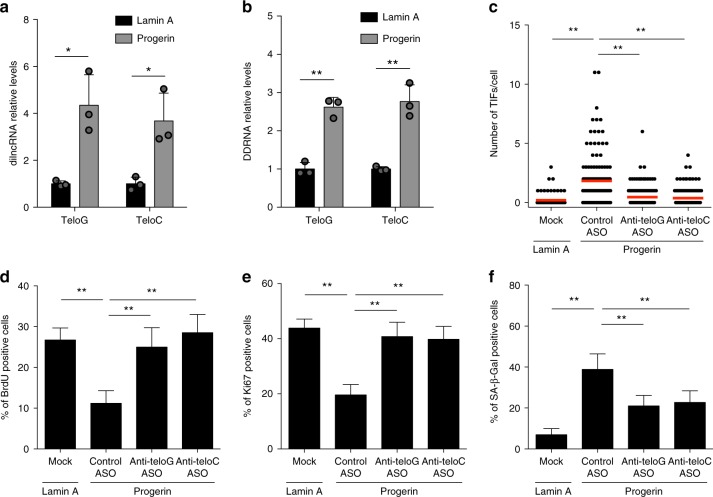
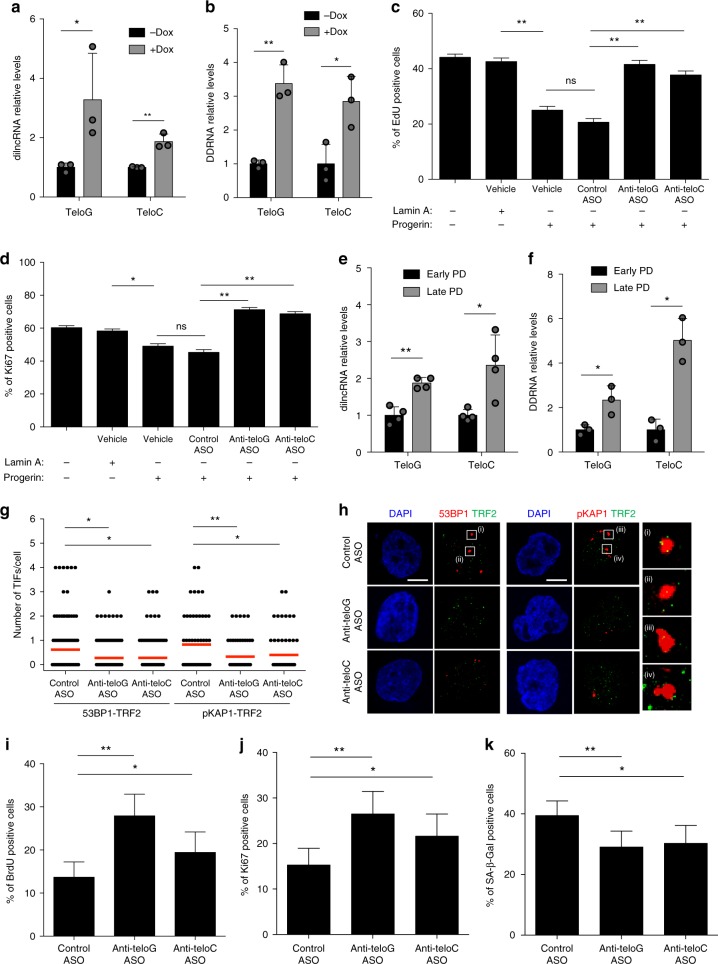
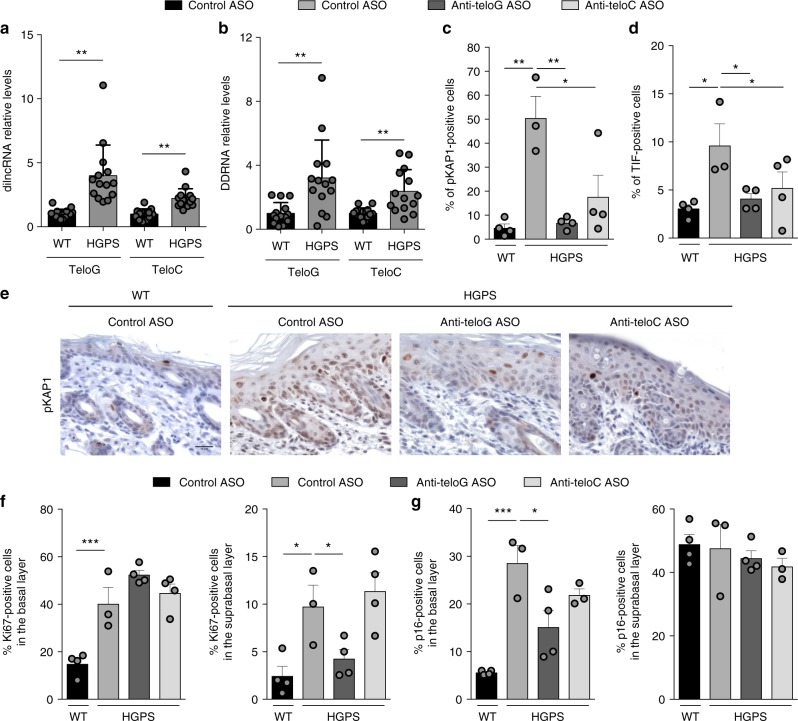
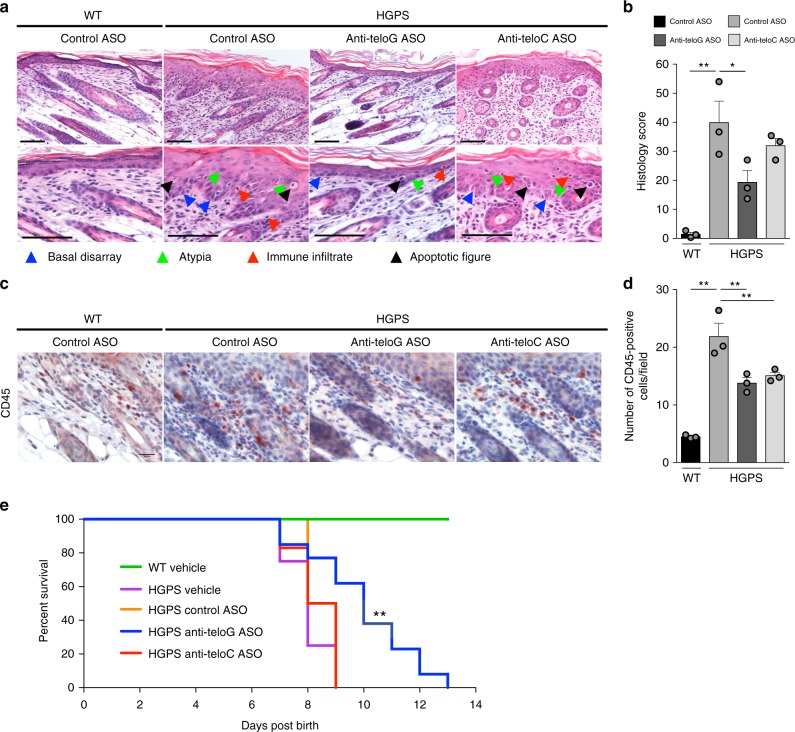
Verification
Claims the paper makes
The claims and statistics of this paper haven’t been checked yet.
Free: it reads the open-access text and checks the first 5 claims that cite a source we can check. Create a free account to check every claim.
Claims other papers make about this one
Each is checked against this paper’s own text: does it say what the citing paper says it does?
The source backs part of the claim, not all of it — or backs it for a different population, condition or comparison.
In the citing paper
“The use of telomeric ASOs in a mouse model of Hutchinson–Gilford progeria syndrome (an accelerated ageing syndrome) effectively reduced DDR activation, the levels of senescence markers and SASP induction, improved tissue homeostasis and extended lifespan251.”
From Cellular senescence in ageing: from mechanisms to therapeutic opportunities (2021) · cites this paper as [251]
Experimental — accuracy not yet measuredThe cited source says what the claim attributes to it.
In the citing paper
“The reported ability of telomeric ASOs (tASOs) to blunt DDR activation specifically at telomeres in vivo in mice72,198,199”
From Telomere dysfunction in ageing and age-related diseases (2022) · cites this paper as [199]
The cited source says what the claim attributes to it.
In the citing paper
“and to improve health span and lifespan in a progeria animal model199”
From Telomere dysfunction in ageing and age-related diseases (2022) · cites this paper as [199]
Self-check
Percentages, sums and reported differences re-computed from the paper’s own numbers.
The self-check needs the paper’s full text.
Citations
Cites
López-Otín, C., Blasco, M. A., Partridge, L., Serrano, M., & Kroemer, G. (2013) · Cell · doi:10.1016/j.cell.2013.05.039 · Cited by 14,982
Cellular senescence: when bad things happen to good cells
Campisi, J., & d'Adda di Fagagna, F. (2007) · Nature Reviews Molecular Cell Biology · doi:10.1038/nrm2233 · Cited by 4,441
A DNA damage checkpoint response in telomere-initiated senescence
Fagagna, F. D. D., Reaper, P. M., Clay-Farrace, L., Fiegler, H., Carr, P., von Zglinicki, T., Saretzki, G., Carter, N. P., & Jackson, S. P. (2003) · Nature · doi:10.1038/nature02118 · Cited by 2,917
Telomere length predicts replicative capacity of human fibroblasts.
Allsopp, R. C., Vaziri, H., Patterson, C., Goldstein, S., Younglai, E. V., Futcher, A. B., Greider, C. W., & Harley, C. B. (1992) · Proceedings of the National Academy of Sciences · doi:10.1073/pnas.89.21.10114 · Cited by 2,200
Telomere Shortening and Tumor Formation by Mouse Cells Lacking Telomerase RNA
Blasco, M. A., Lee, H.-W., Hande, M. P., Samper, E., Lansdorp, P. M., DePinho, R. A., & Greider, C. W. (1997) · Cell · doi:10.1016/s0092-8674(01)80006-4 · Cited by 2,108
Recurrent de novo point mutations in lamin A cause Hutchinson-Gilford progeria syndrome
Eriksson, M., Brown, W. T., Gordon, L. B., Glynn, M. W., Singer, J., Scott, L., Erdos, M. R., Robbins, C. M., Moses, T. Y., Berglund, P., et al. (2003) · Nature · doi:10.1038/nature01629 · Cited by 1,990
Self-citationLongevity, Stress Response, and Cancer in Aging Telomerase-Deficient Mice
Rudolph, K. L., Chang, S., Lee, H.-W., Blasco, M., Gottlieb, G. J., Greider, C., & DePinho, R. A. (1999) · Cell · doi:10.1016/s0092-8674(00)80580-2 · Cited by 1,349
Lamin a truncation in Hutchinson-Gilford progeria
De Sandre-Giovannoli, A., Bernard, R., Cau, P., Navarro, C., Amiel, J., Boccaccio, I., Lyonnet, S., Stewart, C. L., Munnich, A., Le Merrer, M., et al. (2003) · Science · doi:10.1126/science.1084125 · Cited by 1,346
Herbig, U., Jobling, W. A., Chen, B. P. C., Chen, D. J., & Sedivy, J. M. (2004) · Molecular Cell · doi:10.1016/s1097-2765(04)00256-4 · Cited by 1,344
Telomeric Repeat–Containing RNA and RNA Surveillance Factors at Mammalian Chromosome Ends
Azzalin, C. M., Reichenbach, P., Khoriauli, L., Giulotto, E., & Lingner, J. (2007) · Science · doi:10.1126/science.1147182 · Cited by 1,329
Senescent cells: an emerging target for diseases of ageing
Childs, B. G., Gluscevic, M., Baker, D. J., Laberge, R.-M., Marquess, D., Dananberg, J., & van Deursen, J. M. (2017) · Nature Reviews Drug Discovery · doi:10.1038/nrd.2017.116 · Cited by 1,284
Goldman, R. D., Shumaker, D. K., Erdos, M. R., Eriksson, M., Goldman, A. E., Gordon, L. B., Gruenbaum, Y., Khuon, S., Mendez, M., Varga, R., et al. (2004) · Proceedings of the National Academy of Sciences · doi:10.1073/pnas.0402943101 · Cited by 1,103
Self-citationDynamics of DNA damage response proteins at DNA breaks: a focus on protein modifications
Polo, S. E., & Jackson, S. P. (2011) · Genes & Development · doi:10.1101/gad.2021311 · Cited by 1,092
Armanios, M., & Blackburn, E. H. (2012) · Nature Reviews Genetics · doi:10.1038/nrg3246 · Cited by 982
Telomerase reactivation reverses tissue degeneration in aged telomerase-deficient mice
Jaskelioff, M., Muller, F. L., Paik, J.-H., Thomas, E., Jiang, S., Adams, A. C., Sahin, E., Kost-Alimova, M., Protopopov, A., Cadiñanos, J., et al. (2011) · Nature · doi:10.1038/nature09603 · Cited by 857
Telomeric DNA damage is irreparable and causes persistent DNA-damage-response activation
Fumagalli, M., Rossiello, F., Clerici, M., Barozzi, S., Cittaro, D., Kaplunov, J. M., Bucci, G., Dobreva, M., Matti, V., Beausejour, C. M., et al. (2012) · Nature Cell Biology · doi:10.1038/ncb2466 · Cited by 851
Self-citationDevelopmentally regulated transcription of mammalian telomeres by DNA-dependent RNA polymerase II
Schoeftner, S., & Blasco, M. A. (2008) · Nature Cell Biology · doi:10.1038/ncb1685 · Cited by 791
Phenotype and Course of Hutchinson–Gilford Progeria Syndrome
Merideth, M. A., Gordon, L. B., Clauss, S., Sachdev, V., Smith, A. C. M., Perry, M. B., Brewer, C. C., Zalewski, C., Kim, H. J., Solomon, B., et al. (2008) · New England Journal of Medicine · doi:10.1056/nejmoa0706898 · Cited by 743
Genomic instability in laminopathy-based premature aging
Liu, B., Wang, J., Chan, K. M., Tjia, W. M., Deng, W., Guan, X., Huang, J.-D., Li, K. M., Chau, P. Y., Chen, D. J., et al. (2005) · Nature Medicine · doi:10.1038/nm1266 · Cited by 650
Accumulation of senescent cells in Mitotic tissue of aging primates
Jeyapalan, J. C., Ferreira, M., Sedivy, J. M., & Herbig, U. (2007) · Mechanisms of Ageing and Development · doi:10.1016/j.mad.2006.11.008 · Cited by 571
Site-specific DICER and DROSHA RNA products control the DNA-damage response
Francia, S., Michelini, F., Saxena, A., Tang, D., de Hoon, M., Anelli, V., Mione, M., Carninci, P., & d’Adda di Fagagna, F. (2012) · Nature · doi:10.1038/nature11179 · Cited by 544
Lamin A-dependent misregulation of adult stem cells associated with accelerated ageing
Scaffidi, P., & Misteli, T. (2008) · Nature Cell Biology · doi:10.1038/ncb1708 · Cited by 502
Repression of the Antioxidant NRF2 Pathway in Premature Aging
Kubben, N., Zhang, W., Wang, L., Voss, T. C., Yang, J., Qu, J., Liu, G.-H., & Misteli, T. (2016) · Cell · doi:10.1016/j.cell.2016.05.017 · Cited by 489
Olive, M., Harten, I., Mitchell, R., Beers, J. K., Djabali, K., Cao, K., Erdos, M. R., Blair, C., Funke, B., Smoot, L., et al. (2010) · Arteriosclerosis, Thrombosis, and Vascular Biology · doi:10.1161/atvbaha.110.209460 · Cited by 433
Michelini, F., Pitchiaya, S., Vitelli, V., Sharma, S., Gioia, U., Pessina, F., Cabrini, M., Wang, Y., Capozzo, I., Iannelli, F., et al. (2017) · Nature Cell Biology · doi:10.1038/ncb3643 · Cited by 392
McClintock, D., Ratner, D., Lokuge, M., Owens, D. M., Gordon, L. B., Collins, F. S., & Djabali, K. (2007) · PLoS ONE · doi:10.1371/journal.pone.0001269 · Cited by 367
Functional characterization of the TERRA transcriptome at damaged telomeres
Porro, A., Feuerhahn, S., Delafontaine, J., Riethman, H., Rougemont, J., & Lingner, J. (2014) · Nature Communications · doi:10.1038/ncomms6379 · Cited by 271
Cao, K., Capell, B. C., Erdos, M. R., Djabali, K., & Collins, F. S. (2007) · Proceedings of the National Academy of Sciences · doi:10.1073/pnas.0611640104 · Cited by 259
DNA damage responses in progeroid syndromes arise from defective maturation of prelamin A
Liu, Y., Rusinol, A., Sinensky, M., Wang, Y., & Zou, Y. (2006) · Journal of Cell Science · doi:10.1242/jcs.03263 · Cited by 228
Spatiotemporal regulation of posttranslational modifications in the DNA damage response
Dantuma, N. P., & van Attikum, H. (2016) · The EMBO Journal · doi:10.15252/embj.201592595 · Cited by 200
McClintock, D., Gordon, L. B., & Djabali, K. (2006) · Proceedings of the National Academy of Sciences · doi:10.1073/pnas.0511133103 · Cited by 198
Defining the cellular lineage hierarchy in the interfollicular epidermis of adult skin
Sada, A., Jacob, F., Leung, E., Wang, S., White, B. S., Shalloway, D., & Tumbar, T. (2016) · Nature Cell Biology · doi:10.1038/ncb3359 · Cited by 192
Telomere length in Hutchinson-Gilford Progeria Syndrome
Decker, M. L., Chavez, E., Vulto, I., & Lansdorp, P. M. (2009) · Mechanisms of Ageing and Development · doi:10.1016/j.mad.2009.03.001 · Cited by 182
Role of progerin-induced telomere dysfunction in HGPS premature cellular senescence
Benson, E. K., Lee, S. W., & Aaronson, S. A. (2010) · Journal of Cell Science · doi:10.1242/jcs.067306 · Cited by 182
Bridger, J. M., & Kill, I. R. (2004) · Experimental Gerontology · doi:10.1016/j.exger.2004.02.002 · Cited by 176
Mice with bad ends: mouse models for the study of telomeres and telomerase in cancer and aging
Blasco, M. A. (2005) · The EMBO Journal · doi:10.1038/sj.emboj.7600598 · Cited by 166
Telomere-associated aging disorders
Opresko, P. L., & Shay, J. W. (2017) · Ageing Research Reviews · doi:10.1016/j.arr.2016.05.009 · Cited by 159
Rossiello, F., Herbig, U., Longhese, M. P., Fumagalli, M., & d’Adda di Fagagna, F. (2014) · Current Opinion in Genetics & Development · doi:10.1016/j.gde.2014.06.009 · Cited by 156
Self-citationProgerin reduces LAP2α-telomere association in Hutchinson-Gilford progeria
Chojnowski, A., Ong, P. F., Wong, E. S., Lim, J. S., Mutalif, R. A., Navasankari, R., Dutta, B., Yang, H., Liow, Y. Y., Sze, S. K., et al. (2015) · eLife · doi:10.7554/elife.07759 · Cited by 147
Self-citationA direct role for small non-coding RNAs in DNA damage response
di Fagagna, F. D. (2013) · Trends in Cell Biology · doi:10.1016/j.tcb.2013.09.008 · Cited by 144
Rodríguez, S., Coppedè, F., Sagelius, H., & Eriksson, M. (2009) · European Journal of Human Genetics · doi:10.1038/ejhg.2008.270 · Cited by 141
Self-citationFrancia, S., Cabrini, M., Matti, V., Oldani, A., & d'Adda di Fagagna, F. (2016) · Journal of Cell Science · doi:10.1242/jcs.182188 · Cited by 141
Kudlow, B. A., Stanfel, M. N., Burtner, C. R., Johnston, E. D., & Kennedy, B. K. (2008) · Molecular Biology of the Cell · doi:10.1091/mbc.e08-05-0492 · Cited by 120
Rossiello, F., Aguado, J., Sepe, S., Iannelli, F., Nguyen, Q., Pitchiaya, S., Carninci, P., & d’Adda di Fagagna, F. (2017) · Nature Communications · doi:10.1038/ncomms13980 · Cited by 105
Self-citationStem cell depletion in Hutchinson–Gilford progeria syndrome
Rosengardten, Y., McKenna, T., Grochová, D., & Eriksson, M. (2011) · Aging Cell · doi:10.1111/j.1474-9726.2011.00743.x · Cited by 99
Self-citationSagelius, H., Rosengardten, Y., Hanif, M., Erdos, M. R., Rozell, B., Collins, F. S., & Eriksson, M. (2008) · Journal of Cell Science · doi:10.1242/jcs.022913 · Cited by 88
Self-citationFrom “Cellular” RNA to “Smart” RNA: Multiple Roles of RNA in Genome Stability and Beyond
Michelini, F., Jalihal, A. P., Francia, S., Meers, C., Neeb, Z. T., Rossiello, F., Gioia, U., Aguado, J., Jones-Weinert, C., Luke, B., et al. (2018) · Chemical Reviews · doi:10.1021/acs.chemrev.7b00487 · Cited by 85
Self-citationA practical qPCR approach to detect TERRA, the elusive telomeric repeat-containing RNA
Feretzaki, M., & Lingner, J. (2017) · Methods · doi:10.1016/j.ymeth.2016.08.004 · Cited by 82
Paradisi, M., McClintock, D., Boguslavsky, R. L., Pedicelli, C., Worman, H. J., & Djabali, K. (2005) · BMC Cell Biology · doi:10.1186/1471-2121-6-27 · Cited by 77
McKenna, T., Rosengardten, Y., Viceconte, N., Baek, J., Grochová, D., & Eriksson, M. (2014) · Aging Cell · doi:10.1111/acel.12173 · Cited by 38
Self-citationGiordano, M., Infantino, L., Biggiogera, M., Montecucco, A., & Biamonti, G. (2020) · International Journal of Molecular Sciences · doi:10.3390/ijms21082812 · Cited by 19
Target-enrichment sequencing for detailed characterization of small RNAs
Nguyen, Q. H., Aguado, J., Iannelli, F., Suzuki, A. M., Rossiello, F., di Fagagna, F. D., & Carninci, P. (2018) · Nature Protocols · doi:10.1038/nprot.2018.001 · Cited by 13
Self-citation
Cited by
Cellular senescence in ageing: from mechanisms to therapeutic opportunities
Di Micco, R., Krizhanovsky, V., Baker, D., & d’Adda di Fagagna, F. (2021) · Nature Reviews Molecular Cell Biology · doi:10.1038/s41580-020-00314-w · Cited by 2,277
Telomere dysfunction in ageing and age-related diseases
Rossiello, F., Jurk, D., Passos, J. F., & d’Adda di Fagagna, F. (2022) · Nature Cell Biology · doi:10.1038/s41556-022-00842-x · Cited by 754
Self-citationStress and telomere shortening: Insights from cellular mechanisms
Lin, J., & Epel, E. (2022) · Ageing Research Reviews · doi:10.1016/j.arr.2021.101507 · Cited by 376
“, 2013) and tdilncRNAs is upregulated in HGPS (Aguado et al., 2019).”
BackgroundInfluentialSenescence as a therapeutic target in cancer and age-related diseases
McHugh, D., Durán, I., & Gil, J. (2025) · Nature Reviews Drug Discovery · doi:10.1038/s41573-024-01074-4 · Cited by 197
“Treatment with tASOs improved age-related phenotypes in a mouse model of progeria 174 .”
Gavia-García, G., Rosado-Pérez, J., Arista-Ugalde, T. L., Aguíñiga-Sánchez, I., Santiago‐Osorio, E., & Mendoza-Núñez, V. M. (2021) · Biology · doi:10.3390/biology10040253 · Cited by 168
Metadata
- Authors
- Aguado, J., Sola-Carvajal, A., Cancila, V., Revêchon, G., Ong, P. F., Jones-Weinert, C. W., Wallén Arzt, E., Lattanzi, G., Dreesen, O., Tripodo, C., Rossiello, F., Eriksson, M., & d’Adda di Fagagna, F.
- Affiliations
- The University of Queensland (AU)
- University of Palermo (IT)
- Karolinska Institutet (SE)
- Skin Research Institute of Singapore (SG)
- IFOM (IT)
- Istituto Ortopedico Rizzoli (IT)
- ORCID
- Venue
- Nature Communications
- Published
- 2019-11-18
- Volume
- 10
- Issue
- 1
- Pages
- 4990-4990
- ISSN
- 2041-1723 (ISSN-L)
- PMC
- PMC6861280
- OpenAlex
- W2985319725
- Cited by
- 133
- References
- 51
- Citations by year
- 2026: 17 · 2025: 15 · 2024: 12 · 2023: 22 · 2022: 24 · 2021: 22 · 2020: 20 · 2019: 1
- FWCI
- 11.49
- Type
- journal article
- Language
- en
- Open access
- gold
- doi.org
- Licence
- cc-by
- creativecommons.org/licenses/by/4.0 (tdm)
- creativecommons.org/licenses/by/4.0 (vor)
- Locations
- Nature Communications (publishedVersion, cc-by)
- Europe PMC (PubMed Central) (publishedVersion, cc-by)
- PubMed Central (publishedVersion, cc-by)
- PubMed (publishedVersion)
- RePEc: Research Papers in Economics (submittedVersion)
- Archivio Istituzionale della Ricerca (Universita Degli Studi Di Milano) (submittedVersion, other-oa)
- DOAJ (DOAJ: Directory of Open Access Journals) (submittedVersion)
- DOAJ (DOAJ: Directory of Open Access Journals) (submittedVersion, cc-by-sa)
- Nova Science Publishers (Nova Science Publishers, Inc.) (submittedVersion, other-oa)
- Funders
- Fondazione Telethon (GGP17111, 21091)
- Fondazione Cariplo (2014-0812)
- Karolinska Institutet
- Vetenskapsrådet
- Associazione Italiana per la Ricerca sul Cancro (12971, 21091)
- Regione Lombardia
- Center for Innovative Medicine
- FP7 Ideas: European Research Council (322726)
- FP7 People: Marie-Curie Actions (316354)
- Topics
- Life Sciences › Biochemistry, Genetics and Molecular Biology › Cell Biology › Telomeres, Telomerase, and Senescence
- Life Sciences › Biochemistry, Genetics and Molecular Biology › Molecular Biology › Nuclear Structure and Function
- Life Sciences › Biochemistry, Genetics and Molecular Biology › Aging › Genetics, Aging, and Longevity in Model Organisms
- Keywords
- Hutchinson-Gilford progeria syndrome, progerin, lamin A, telomere dysfunction, DNA damage response, antisense oligonucleotides, premature aging, skin homeostasis, lifespan extension, fibroblasts
- MeSH terms
- Animals, Cell Line, Disease Models, Animal, DNA Damage, DNA Repair, Homeostasis, Mutation, Phenotype, Progeria, Skin, Oligonucleotides, Antisense, Telomere, Cellular Senescence, RNA, Untranslated, Lamin Type A, Cell Proliferation, Mice
About these checks
Registry, retraction, Cites and statistics results are computed, not judged, with one exception: a printed reference that no index lists is read once by a model before it counts as a citation error. Claims are extracted by a model and kept only when their quote appears verbatim in the text; each cited source is then checked, with a model’s help, for whether it says what the claim relies on. Those verdicts can be wrong — read the claim’s quote and the cited source before relying on one.
Statistics and arithmetic are recomputed, not judged.
Confidence bands are shown only for fields calibrated on our annotated test set. None is calibrated yet, so no band is shown.
What counts as a claim ›How we measure confidence ›How we check this ›
Are you an author, or do you see a problem with this page? Request a review
Data sources
Bibliographic data: Semantic Scholar, OpenAlex, Crossref.
Contains information from the Semantic Scholar Academic Graph Datasets, made available under the ODC Attribution License (ODC-BY 1.0).
Semantic Scholar’s data is described in: Kinney, R., et al. (2023). The Semantic Scholar Open Data Platform. arXiv:2301.10140.
