

Inhibition of DNA damage response at telomeres improves the detrimental phenotypes of Hutchinson–Gilford Progeria Syndrome
Open accessThe DOI matches its Crossref record; 52 of the 52 references it cites were found in a registry or an index.
Abstract
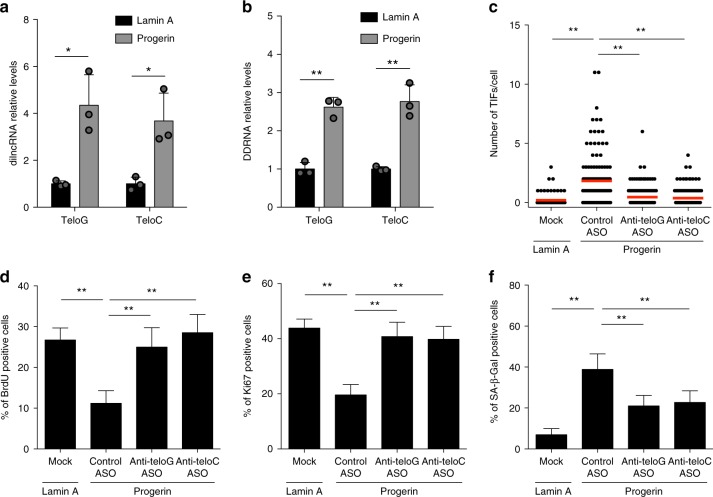
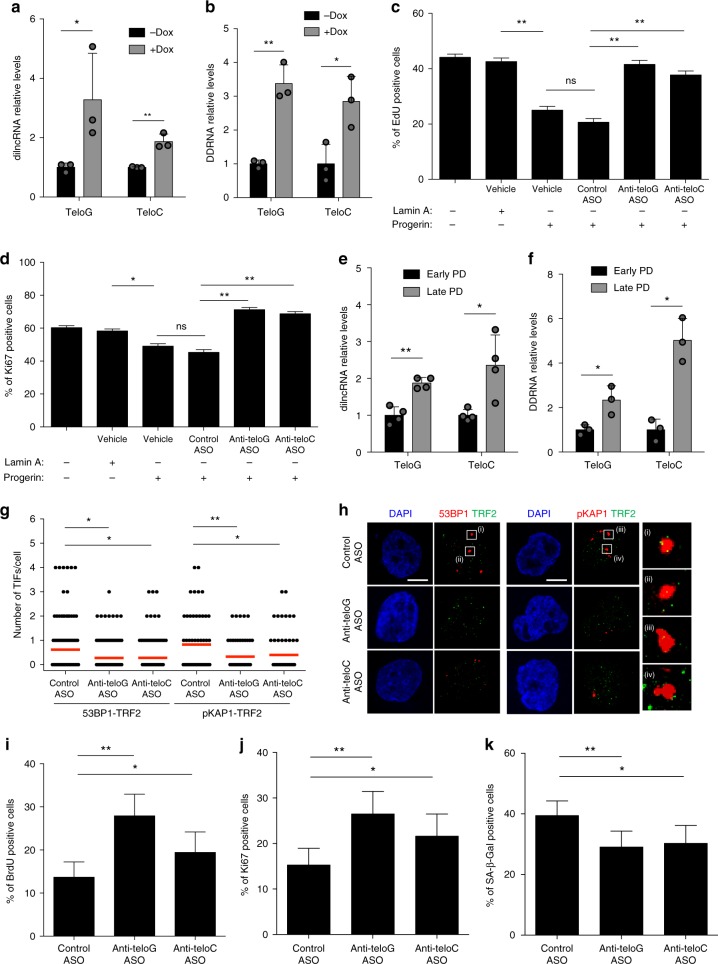
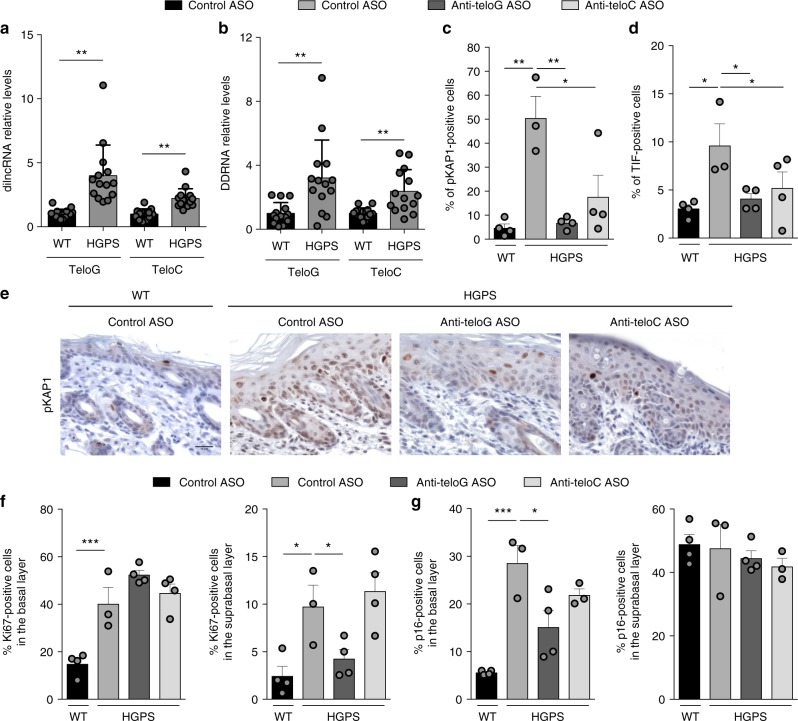
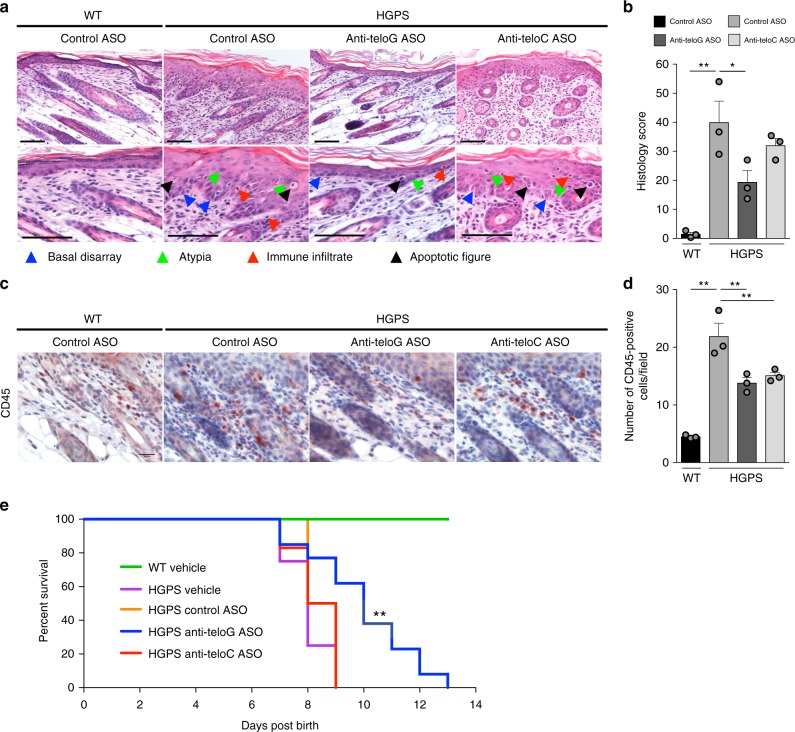
Hutchinson–Gilford progeria syndrome (HGPS) is a genetic disorder characterized by premature aging features. Cells from HGPS patients express progerin, a truncated form of Lamin A, which perturbs cellular homeostasis leading to nuclear shape alterations, genome instability, heterochromatin loss, telomere dysfunction and premature entry into cellular senescence. Recently, we reported that telomere dysfunction induces the transcription of telomeric non-coding RNAs (tncRNAs) which control the DNA damage response (DDR) at dysfunctional telomeres. Here we show that progerin-induced telomere dysfunction induces the transcription of tncRNAs. Their functional inhibition by sequence-specific telomeric antisense oligonucleotides (tASOs) prevents full DDR activation and premature cellular senescence in various HGPS cell systems, including HGPS patient fibroblasts. We also show in vivo that tASO treatment significantly enhances skin homeostasis and lifespan in a transgenic HGPS mouse model. In summary, our results demonstrate an important role for telomeric DDR activation in HGPS progeroid detrimental phenotypes in vitro and in vivo.
Overview
The claims and statistics of this paper haven’t been checked yet.
Free: it reads the open-access text and checks the first 5 claims that cite a source we can check. Create a free account to check every claim.
Integrity signals
Registry
Cites
Statistics
Figures
Verification
Claims the paper makes
The claims and statistics of this paper haven’t been checked yet.
Free: it reads the open-access text and checks the first 5 claims that cite a source we can check. Create a free account to check every claim.
Claims other papers make about this one
Each is checked against this paper’s own text: does it say what the citing paper says it does?
The source backs part of the claim, not all of it — or backs it for a different population, condition or comparison.
In the citing paper
“The use of telomeric ASOs in a mouse model of Hutchinson–Gilford progeria syndrome (an accelerated ageing syndrome) effectively reduced DDR activation, the levels of senescence markers and SASP induction, improved tissue homeostasis and extended lifespan251.”
From Cellular senescence in ageing: from mechanisms to therapeutic opportunities (2021) · cites this paper as [251]
Experimental — accuracy not yet measuredThe cited source says what the claim attributes to it.
In the citing paper
“The reported ability of telomeric ASOs (tASOs) to blunt DDR activation specifically at telomeres in vivo in mice72,198,199”
From Telomere dysfunction in ageing and age-related diseases (2022) · cites this paper as [199]
The cited source says what the claim attributes to it.
In the citing paper
“and to improve health span and lifespan in a progeria animal model199”
From Telomere dysfunction in ageing and age-related diseases (2022) · cites this paper as [199]
Self-check
Percentages, sums and reported differences re-computed from the paper’s own numbers.
The self-check needs the paper’s full text.
Citations
Cites
López-Otín, C., Blasco, M. A., Partridge, L., Serrano, M., & Kroemer, G. (2013) · Cell · doi:10.1016/j.cell.2013.05.039 · Cited by 14,982
Cellular senescence: when bad things happen to good cells
Campisi, J., & d'Adda di Fagagna, F. (2007) · Nature Reviews Molecular Cell Biology · doi:10.1038/nrm2233 · Cited by 4,441
A DNA damage checkpoint response in telomere-initiated senescence
Fagagna, F. D. D., Reaper, P. M., Clay-Farrace, L., Fiegler, H., Carr, P., von Zglinicki, T., Saretzki, G., Carter, N. P., & Jackson, S. P. (2003) · Nature · doi:10.1038/nature02118 · Cited by 2,917
Telomere length predicts replicative capacity of human fibroblasts.
Allsopp, R. C., Vaziri, H., Patterson, C., Goldstein, S., Younglai, E. V., Futcher, A. B., Greider, C. W., & Harley, C. B. (1992) · Proceedings of the National Academy of Sciences · doi:10.1073/pnas.89.21.10114 · Cited by 2,200
Telomere Shortening and Tumor Formation by Mouse Cells Lacking Telomerase RNA
Blasco, M. A., Lee, H.-W., Hande, M. P., Samper, E., Lansdorp, P. M., DePinho, R. A., & Greider, C. W. (1997) · Cell · doi:10.1016/s0092-8674(01)80006-4 · Cited by 2,108
Recurrent de novo point mutations in lamin A cause Hutchinson-Gilford progeria syndrome
Eriksson, M., Brown, W. T., Gordon, L. B., Glynn, M. W., Singer, J., Scott, L., Erdos, M. R., Robbins, C. M., Moses, T. Y., Berglund, P., et al. (2003) · Nature · doi:10.1038/nature01629 · Cited by 1,990
Self-citationLongevity, Stress Response, and Cancer in Aging Telomerase-Deficient Mice
Rudolph, K. L., Chang, S., Lee, H.-W., Blasco, M., Gottlieb, G. J., Greider, C., & DePinho, R. A. (1999) · Cell · doi:10.1016/s0092-8674(00)80580-2 · Cited by 1,349
Lamin a truncation in Hutchinson-Gilford progeria
De Sandre-Giovannoli, A., Bernard, R., Cau, P., Navarro, C., Amiel, J., Boccaccio, I., Lyonnet, S., Stewart, C. L., Munnich, A., Le Merrer, M., et al. (2003) · Science · doi:10.1126/science.1084125 · Cited by 1,346
Herbig, U., Jobling, W. A., Chen, B. P. C., Chen, D. J., & Sedivy, J. M. (2004) · Molecular Cell · doi:10.1016/s1097-2765(04)00256-4 · Cited by 1,344
Telomeric Repeat–Containing RNA and RNA Surveillance Factors at Mammalian Chromosome Ends
Azzalin, C. M., Reichenbach, P., Khoriauli, L., Giulotto, E., & Lingner, J. (2007) · Science · doi:10.1126/science.1147182 · Cited by 1,329
Cited by
Cellular senescence in ageing: from mechanisms to therapeutic opportunities
Di Micco, R., Krizhanovsky, V., Baker, D., & d’Adda di Fagagna, F. (2021) · Nature Reviews Molecular Cell Biology · doi:10.1038/s41580-020-00314-w · Cited by 2,277
Telomere dysfunction in ageing and age-related diseases
Rossiello, F., Jurk, D., Passos, J. F., & d’Adda di Fagagna, F. (2022) · Nature Cell Biology · doi:10.1038/s41556-022-00842-x · Cited by 754
Self-citationStress and telomere shortening: Insights from cellular mechanisms
Lin, J., & Epel, E. (2022) · Ageing Research Reviews · doi:10.1016/j.arr.2021.101507 · Cited by 376
“, 2013) and tdilncRNAs is upregulated in HGPS (Aguado et al., 2019).”
BackgroundInfluentialSenescence as a therapeutic target in cancer and age-related diseases
McHugh, D., Durán, I., & Gil, J. (2025) · Nature Reviews Drug Discovery · doi:10.1038/s41573-024-01074-4 · Cited by 197
“Treatment with tASOs improved age-related phenotypes in a mouse model of progeria 174 .”
Gavia-García, G., Rosado-Pérez, J., Arista-Ugalde, T. L., Aguíñiga-Sánchez, I., Santiago‐Osorio, E., & Mendoza-Núñez, V. M. (2021) · Biology · doi:10.3390/biology10040253 · Cited by 168
The Broad Spectrum of LMNA Cardiac Diseases: From Molecular Mechanisms to Clinical Phenotype
Crasto, S., My, I., & Pasquale, E. D. (2020) · Frontiers in Physiology · doi:10.3389/fphys.2020.00761 · Cited by 138
How good is the evidence that cellular senescence causes skin ageing?
Low, E., Alimohammadiha, G., Smith, L. A., Costello, L. F., Przyborski, S. A., von Zglinicki, T., & Miwa, S. (2021) · Ageing Research Reviews · doi:10.1016/j.arr.2021.101456 · Cited by 106
“Skin ageing may also be driven by damage to nuclear DNA, especially to telomeres (Aguado et al., 2019; Victorelli and Passos, 2020).”
BackgroundSilva, B. D. R., Arora, R., Bione, S., & Azzalin, C. M. (2021) · Nature Communications · doi:10.1038/s41467-021-24097-6 · Cited by 125
Telomerase therapy reverses vascular senescence and extends lifespan in progeria mice
Mojiri, A., Walther, B. K., Jiang, C., Matrone, G., Holgate, R., Xu, Q., Morales, E., Wang, G., Gu, J., Wang, R., et al. (2021) · European Heart Journal · doi:10.1093/eurheartj/ehab547 · Cited by 97
Aguado, J., Chaggar, H. K., Gómez‐Inclán, C., Shaker, M. R., Leeson, H. C., Mackay‐Sim, A., & Wolvetang, E. J. (2021) · Aging Cell · doi:10.1111/acel.13468 · Cited by 92
“Indeed, this family of senomorphic approaches designed to reduce or alter the SASP have shown promise in vivo (Aguado et al., 2019; Dai et al., 2019; Haag et al., 2018; Milanovic et al., 2018), suggesting that novel therapeutic compounds targeting the drivers of SASP, including cGAS and STING,…”
BackgroundSelf-citationLamin A involvement in ageing processes
Cenni, V., Capanni, C., Mattioli, E., Schena, E., Squarzoni, S., Bacalini, M. G., Garagnani, P., Salvioli, S., Franceschi, C., & Lattanzi, G. (2020) · Ageing Research Reviews · doi:10.1016/j.arr.2020.101073 · Cited by 95
Self-citationTelomere transcription in ageing
Aguado, J., di Fagagna, F. D., & Wolvetang, E. J. (2020) · Ageing Research Reviews · doi:10.1016/j.arr.2020.101115 · Cited by 88
Self-citationSenolytic therapy alleviates physiological human brain aging and COVID-19 neuropathology
Aguado, J., Amarilla, A. A., Taherian Fard, A., Albornoz, E. A., Tyshkovskiy, A., Schwabenland, M., Chaggar, H. K., Modhiran, N., Gómez-Inclán, C., Javed, I., et al. (2023) · Nature Aging · doi:10.1038/s43587-023-00519-6 · Cited by 80
Self-citationSenolytic therapy alleviates physiological human brain aging and COVID-19 neuropathology
Aguado, J., Amarilla, A. A., Taherian Fard, A., Albornoz, E. A., Tyshkovskiy, A., Schwabenland, M., Chaggar, H. K., Modhiran, N., Gómez-Inclán, C., Javed, I., et al. (2023) · doi:10.1101/2023.01.17.524329 · Cited by 80
Self-citationSharma, S., Anand, R., Zhang, X., Francia, S., Michelini, F., Galbiati, A., Williams, H., Ronato, D. A., Masson, J., Rothenberg, E., et al. (2021) · Cell Reports · doi:10.1016/j.celrep.2020.108565 · Cited by 82
Interleukin‐6 neutralization ameliorates symptoms in prematurely aged mice
Squarzoni, S., Schena, E., Sabatelli, P., Mattioli, E., Capanni, C., Cenni, V., D'Apice, M. R., Andrenacci, D., Sarli, G., Pellegrino, V., et al. (2021) · Aging Cell · doi:10.1111/acel.13285 · Cited by 72
Self-citationTelomeres, cellular senescence, and aging: past and future
Eppard, M., Passos, J. F., & Victorelli, S. G. (2023) · Biogerontology · doi:10.1007/s10522-023-10085-4 · Cited by 71
“( 1234567890) Hutchinson-Gilford progeria syndrome (HGPS) (Aguado et al. 2019).”
DNA Damage Triggers a New Phase in Neurodegeneration
Pessina, F., Gioia, U., Brandi, O., Farina, S., Ceccon, M., Francia, S., & di Fagagna, F. D. (2020) · Trends in Genetics · doi:10.1016/j.tig.2020.09.006 · Cited by 64
Chang, A. C. Y., Pardon, G., Chang, A. C. H., Wu, H., Ong, S., Eguchi, A., Ancel, S., Holbrook, C., Ramunas, J., Ribeiro, A. J. S., et al. (2021) · Stem Cell Reports · doi:10.1016/j.stemcr.2021.04.018 · Cited by 58
The complex interplay between aging and cancer
Trastus, L. A., & di Fagagna, F. D. (2025) · Nature Aging · doi:10.1038/s43587-025-00827-z · Cited by 65
Klotho inhibits neuronal senescence in human brain organoids
Shaker, M. R., Aguado, J., Chaggar, H. K., & Wolvetang, E. J. (2021) · npj Aging and Mechanisms of Disease · doi:10.1038/s41514-021-00070-x · Cited by 58
Self-citationPremature aging syndromes: From patients to mechanism
Foo, M. X. R., Ong, P. F., & Dreesen, O. (2019) · Journal of Dermatological Science · doi:10.1016/j.jdermsci.2019.10.003 · Cited by 56
Self-citationCellular senescence in cancer: molecular mechanisms and therapeutic targets
Jin, P., Duan, X., Li, L., Zhou, P., Zou, C., & Xie, K. (2024) · MedComm · doi:10.1002/mco2.542 · Cited by 57
“The 323–325 Altogether, senomorphics or similar agents that do not eliminate senescent cells but rather inhibit their attributes may offer a viable alternative to senolysis.”
BackgroundThe hallmarks of aging in Ataxia-Telangiectasia
Aguado, J., Gómez‐Inclán, C., Leeson, H. C., Lavin, M. F., Shiloh, Y., & Wolvetang, E. J. (2022) · Ageing Research Reviews · doi:10.1016/j.arr.2022.101653 · Cited by 49
Self-citationThe Molecular and Cellular Basis of Hutchinson–Gilford Progeria Syndrome and Potential Treatments
Batista, N. J., Desai, S. G., Perez, A. M., Finkelstein, A., Radigan, R., Singh, M., Landman, A., Drittel, B., Abramov, D., Ahsan, M., et al. (2023) · Genes · doi:10.3390/genes14030602 · Cited by 51
“DDR causes telomeres to express telomeric non-coding RNAs (tncRNA), contributing to the detrimental phenotype; inhibition of the tncRNAs improved cellular manifestations and lifespan in a transgenic HGPS mouse model [81].”
BackgroundDNA damage response at telomeres boosts the transcription of SARS‐CoV‐2 receptor ACE2 during aging
Sepe, S., Rossiello, F., Cancila, V., Iannelli, F., Matti, V., Cicio, G., Cabrini, M., Marinelli, E., Alabi, B. R., di Lillo, A., et al. (2022) · The EMBO Reports · doi:10.15252/embr.202153658 · Cited by 42
“…we took advantage of telomeric antisense oligonucleotides (tASOs), which allow the specific inhibition of telomeric DDR by targeting tncRNA generated at dysfunctional telomeres and necessary for full DDR activation at telomeres (Michelini et al , 2017; Rossiello et al , 2017; Aguado et al , 2019).”
Self-citationDNA damage response at telomeres boosts the transcription of SARS-CoV-2 receptor ACE2 during aging
(2021) · doi:10.1101/2021.06.09.447484 · Cited by 42
The mechanisms, hallmarks, and therapies for brain aging and age-related dementia
Jin, S., Lü, W., Zhang, J., Zhang, L., Tao, F., Zhang, Y., Hu, X., & Liu, Q. (2024) · Science Bulletin · doi:10.1016/j.scib.2024.09.005 · Cited by 44
Bashir, S., Sherazi, S. A. M., Abbasi, A., Jamil, A., Uzair, M., Ikram, A., Qamar, S., Olamide, A., Arshad, M. A., Fried, P., et al. (2022) · Neural Regeneration Research · doi:10.4103/1673-5374.355751 · Cited by 44
“TERRA is also reported to be upregulated in a premature aging syndrome, including immunodeficiency, centromeric instability, facial anomalies syndrome type I, and Hitchinson-Gilford progeria syndrome (Aguado et al., 2019).”
BackgroundAl-Turki, T. M., & Griffith, J. D. (2023) · Proceedings of the National Academy of Sciences · doi:10.1073/pnas.2221529120 · Cited by 42
“…RNA polymerase II to promoters within the subtelomeric sequences at multiple chromosomes ends where it initiates transcription of TERRA (6, 15, 59–61), and Feretzaki et al. (15) reported their failure to efficiently suppress TERRA levels utilizing Crispr/Cas9 technology due to TERRA being…”
Genomic Aging, Clonal Hematopoiesis, and Cardiovascular Disease
Natarajan, P. (2022) · Arteriosclerosis Thrombosis and Vascular Biology · doi:10.1161/atvbaha.122.318181 · Cited by 37
Choudhury, A., Mohammad, T., Samarth, N. H., Hussain, A., Rehman, M. T., Islam, A., Alajmi, M. F., Singh, S., & Hassan, M. I. (2021) · Scientific Reports · doi:10.1038/s41598-021-89450-7 · Cited by 35
Du, H., Xiao, N., Zhang, S., Zhou, X., Zhang, Y., Lu, Z., Fu, Y., Huang, M., Xu, S., & Chen, Q. (2023) · iScience · doi:10.1016/j.isci.2023.107090 · Cited by 35
“Antisense oligonucleotides (ASOs) specifically inhibit DDR-stimulating sequences; ASOs effectively reduced DDR activation and SASP factor release in a mouse model of Hutchinson-Gilford progeria syndrome.(58) Of note, activation of the DDR pathway correlates with SASP, with ATM/ATR, CHK2, and p53 as the main activated…”
BackgroundHutchinson-Gilford progeria syndrome: Rejuvenating old drugs to fight accelerated ageing
Guilbert, S. M., Cardoso, D., Lévy, N., Muchir, A., & Nissan, X. (2020) · Methods · doi:10.1016/j.ymeth.2020.04.005 · Cited by 32
Alternative lengthening of telomeres (ALT) cells viability is dependent on C-rich telomeric RNAs
Rosso, I., Jones-Weinert, C. W., Rossiello, F., Cabrini, M., Brambillasca, S., Muñoz‐Sagredo, L., Lavagnino, Z., Martini, E., Tedone, E., Garrè, M., et al. (2023) · Nature Communications · doi:10.1038/s41467-023-42831-0 · Cited by 33
“We previously demonstrated roles of dilncRNAs in supporting telomeric DDR and repair 57,58 .”
BackgroundMethodInfluentialSelf-citationIskandar, M., Barbero, M. X., Jaber, M. T., Chen, R., Gomez-Guevara, R., Cruz, E., & Westerheide, S. D. (2025) · Cancers · doi:10.3390/cancers17020257 · Cited by 35
The role of extracellular DNA in COVID-19: Clues from inflamm-aging
Storci, G., Bonifazi, F., Garagnani, P., Olivieri, F., & Bonafè, M. (2020) · Ageing Research Reviews · doi:10.1016/j.arr.2020.101234 · Cited by 32
Progerin impairs 3D genome organization and induces fragile telomeres by limiting the dNTP pools
Kychygina, A., Dall’Osto, M., Allen, J. A. M., Cadoret, J., Piras, V., Pickett, H. A., & Crabbé, L. (2021) · Scientific Reports · doi:10.1038/s41598-021-92631-z · Cited by 31
Progress and trends in the development of therapies for Hutchinson–Gilford progeria syndrome
Lai, W., & Wong, W. (2020) · Aging Cell · doi:10.1111/acel.13175 · Cited by 29
“…mice expressing progerin with a FLAG epitope tag in epidermal keratinocytes (Wang, Ostlund, & Worman, 2010), whereas another study has used a tetracycline-inducible transgenic mouse line in which progerin is expressed in the keratin 5 (K5)-positive compartment of the skin (Aguado et al., 2019).”
BackgroundInfluentialRevolutionizing Diabetic Foot Ulcer Care: The Senotherapeutic Approach
Zhang, G., Samarawickrama, P. N., Gui, L., Ma, Y., Cao, M., Zhu, H., Li, W., Yang, H., Li, K., Yang, Y., et al. (2024) · Aging and Disease · doi:10.14336/ad.2024.0065 · Cited by 32
Telomere Targeting Approaches in Cancer: Beyond Length Maintenance
Vertecchi, E., Rizzo, A., & Salvati, E. (2022) · International Journal of Molecular Sciences · doi:10.3390/ijms23073784 · Cited by 33
“TERRAs binding to telome s have been hown to be critical for telomere prot ct and stability, hete ochromatin formation, telomerase regulation, homologous combina ion, a d length homeostas s in ALT cells (Figu 3) [41,42].”
BackgroundWhisenant, D., Lim, K., Revêchon, G., Yao, H., Bergö, M. O., Machtel, P., Kim, J., & Eriksson, M. (2022) · Nature Communications · doi:10.1038/s41467-022-30800-y · Cited by 31
Self-citationTelomere Attrition in Chronic Kidney Diseases
Levstek, T., & Podkrajšek, K. T. (2023) · Antioxidants · doi:10.3390/antiox12030579 · Cited by 30
“Namely, it has been observed that the inhibition of TERRA by antisense oligonucleotides prevents the activation of the DNA damage response and cellular senescence, both in vivo and in vitro [87,89].”
BackgroundExploiting the telomere machinery to put the brakes on inflamm-aging
Bonafè, M., Sabbatinelli, J., & Olivieri, F. (2020) · Ageing Research Reviews · doi:10.1016/j.arr.2020.101027 · Cited by 31
Murdocca, M., Spitalieri, P., Masi, C. D., Udroiu, I., Marinaccio, J., Sanchez, M., Talarico, R. V., Fiorillo, C., D’Adamo, M., Sbraccia, P., et al. (2021) · Aging · doi:10.18632/aging.202680 · Cited by 28
“Moreover, telomere dysfunction in HGPS cells induces the transcription of telomeric non coding RNA (tncRNA) which usually control the DNA damage response, increasing cellular senescence [32].”
Coll-Bonfill, N., Mahajan, U., Shashkova, E. V., Lin, C.-J., Mecham, R. P., & Gonzalo, S. (2022) · GeroScience · doi:10.1007/s11357-022-00694-1 · Cited by 30
“As testament of the importance of telomere dysfunction driving HGPS phenotype, ectopic expression of telomerase rescues telomere damage, inhibits the DNA damage response at telomeres, improves HGPS cellular phenotypes, and extends lifespan in progeria mice [23, 29, 36, 52].”
BackgroundTelomere Checkpoint in Development and Aging
Kalmykova, A. I. (2023) · International Journal of Molecular Sciences · doi:10.3390/ijms242115979 · Cited by 29
“This point of view is supported by studies of a mouse model of Hutchinson–Gilford syndrome where it was shown that the selective inhibition of the DDR on the telomeres improves tissue homeostasis, reduces inflammation, and prolongs the lifespan of the model animals [139].”
ResultDreesen, O. (2020) · Biochemical Society Transactions · doi:10.1042/bst20190882 · Cited by 30
Self-citationA Link between Replicative Stress, Lamin Proteins, and Inflammation
Willaume, S., Rass, E., Fontanilla-Ramirez, P., Moussa, A., Wanschoor, P., & Bertrand, P. (2021) · Genes · doi:10.3390/genes12040552 · Cited by 30
Role of Telomeres Shortening in Atherogenesis: An Overview
Yegorov, Y. E., Poznyak, A. V., Nikiforov, N. G., Starodubova, A. V., & Orekhov, A. N. (2021) · Cells · doi:10.3390/cells10020395 · Cited by 28
Li, J., Du, S., Shi, Y., Han, J., Niu, Z., Li, W., Yang, P., Chen, L., Tian, H., & Gao, L. (2020) · Experimental Eye Research · doi:10.1016/j.exer.2020.108399 · Cited by 28
Premature aging and metabolic diseases: the impact of telomere attrition
Jinesh, S., Özüpek, B., & Aditi, P. (2025) · Frontiers in Aging · doi:10.3389/fragi.2025.1541127 · Cited by 28
Targeting the redox system for cardiovascular regeneration in aging
Allemann, M., Lee, P., Beer, J. H., & Saravi, S. S. S. (2023) · Aging Cell · doi:10.1111/acel.14020 · Cited by 25
SerpinE1 drives a cell-autonomous pathogenic signaling in Hutchinson–Gilford progeria syndrome
Catarinella, G., Nicoletti, C., Bracaglia, A., Procopio, P., Salvatori, I., Taggi, M., Valle, C., Ferri, A., Canipari, R., Puri, P., et al. (2022) · Cell Death and Disease · doi:10.1038/s41419-022-05168-y · Cited by 25
“At cellular level, HGPS patients exhibit abnormal nuclear shape [10], loss of peripheral heterochromatin [11, 12], DNA damage accumulation [13, 14], telomere shortening [14, 15], genomic instability [16] and acquisition of senescence phenotype [17] leading to altered patterns of gene expression [18].”
BackgroundThe Role of Small Noncoding RNA in DNA Double-Strand Break Repair
Rzeszutek, I., & Betlej, G. (2020) · International Journal of Molecular Sciences · doi:10.3390/ijms21218039 · Cited by 24
“These sncRNAs are transcribed from both strands of deprotected telomeres, hence are called telomeric DDRNAs (tDDRNAs) and telomeric dilncRNAs (tdilncRNAs) [78,84,85].”
BackgroundFard, A. T., Leeson, H. C., Aguado, J., Pietrogrande, G., Power, D., Gómez‐Inclán, C., Zheng, H., Nelson, C. B., Soheilmoghaddam, M., Glass, N. R., et al. (2023) · GeroScience · doi:10.1007/s11357-023-00829-y · Cited by 24
Self-citationPremature aging in genetic diseases: what conclusions can be drawn for physiological aging
Milosic, F., Hengstschläger, M., & Osmanagic‐Myers, S. (2024) · Frontiers in Aging · doi:10.3389/fragi.2023.1327833 · Cited by 25
Giordano, M., Infantino, L., Biggiogera, M., Montecucco, A., & Biamonti, G. (2020) · International Journal of Molecular Sciences · doi:10.3390/ijms21082812 · Cited by 19
Martin, R. S., Das, P., Sanders, J. T., Hill, A. M., & McCord, R. P. (2022) · eLife · doi:10.7554/elife.81290 · Cited by 21
Genetic Determinants of Wound Healing: Monogenic Disorders and Polygenic Influence
Mueller, S. M., Miller, N., Gill, J., Yu, L. C., PIKE, M. M., & Orgill, D. P. (2026) · Cells · doi:10.3390/cells15010074 · Cited by 18
“This results in genome instability, DNA damage, telomere dysfunction, and premature cellular senescence [100].”
Characterization of Induction and Targeting of Senescent Mesenchymal Stromal Cells
Gresham, R. C. H., Kumar, D., Copp, J., Lee, M., & Leach, J. K. (2022) · Tissue Engineering Part C Methods · doi:10.1089/ten.tec.2022.0048 · Cited by 19
“38 p21 is a downstream target of p53 activation, halting the cell cycle in the G0 phase.”
Close Ties between the Nuclear Envelope and Mammalian Telomeres: Give Me Shelter
Pennarun, G., Picotto, J., & Bertrand, P. (2023) · Genes · doi:10.3390/genes14040775 · Cited by 18
Habib, R., Kim, R., Neitzel, H., Demuth, I., Chrzańowska, K., Seemanová, E., Faber, R., Digweed, M., Voß, R., Jäger, K., et al. (2020) · Aging · doi:10.18632/aging.103453 · Cited by 16
“It is assumed that telomere dysfunction in Hutchinson Gilford progeria and likely other telomere syndromes is a causative molecular mechanism of pathogenesis [64].”
BackgroundCellular Senescence and Ageing
Reed, R., & Miwa, S. (2023) · Sub-cellular biochemistry/Subcellular biochemistry · doi:10.1007/978-3-031-21410-3_7 · Cited by 16
Recurrent somatic mutation and progerin expression in early vascular aging of chronic kidney disease
Revêchon, G., Witasp, A., Viceconte, N., Helgadottir, H. T., Machtel, P., Stefani, F., Whisenant, D., Sola-Carvajal, A., McGuinness, D., Abutaleb, N. O., et al. (2025) · Nature Aging · doi:10.1038/s43587-025-00882-6 · Cited by 16
“Persistent DDR activation is a known down-stream effect of progerin expression 37 .”
Self-citationThe Quest for Eternal Youth: Hallmarks of Aging and Rejuvenating Therapeutic Strategies
Nunkoo, V. S., Cristian, A., Jurcău, A., Diaconu, R. G., & Jurcău, M. C. (2024) · Biomedicines · doi:10.3390/biomedicines12112540 · Cited by 19
Sande, C. M., Chen, S., Mitchell, D. V., Lin, P., Abraham, D. M., Cheng, J. M., Gebhard, T., Deolikar, R. J., Freeman, C. M., Zhou, M., et al. (2025) · Journal of Clinical Investigation · doi:10.1172/jci181659 · Cited by 19
Telomere dysfunction in chronic liver disease: The link from aging
Penrice, D. D., Jalan‐Sakrikar, N., Jurk, D., Passos, J. F., & Simonetto, D. A. (2023) · Hepatology · doi:10.1097/hep.0000000000000426 · Cited by 17
“[141] Other promising options are therapies designed to halt the senescence pathway when critical telomere shortening occurs.”
Telomeric repeat-containing RNA increases in aged human cells
Hsieh, Y.-H., Tai, C.-H., Yeh, M.-T., Chen, Y., Yang, P.-C., Yen, C.-P., Shen, H.-J., Yeh, C.-H., Kuo, H., Han, D., et al. (2025) · Nucleic Acids Research · doi:10.1093/nar/gkaf597 · Cited by 17
“Bidirectional telomeric transcription is induced by DNA damage at telomeres in Hutchinson–Gilford progeria syndrome (HGPS) fibroblasts [ 33 ].”
Huang, H., Zhang, W., Su, J., Zhou, B., & Han, Q. (2023) · Stem Cells International · doi:10.1155/2023/9672658 · Cited by 15
Insights into the therapeutic strategies for aging and aging-associated diseases
Dong, R., Wu, Q., Kan, J., Fu, C., Sorrentino, V., Chow, A., Lei, Y., Wu, D., Xu, Z., Du, J., et al. (2026) · Signal Transduction and Targeted Therapy · doi:10.1038/s41392-026-02662-z · Cited by 17
“43 In addition, genetic defects in DNA repair pathways may directly lead to the development of premature aging syndromes, including Werner syndrome, 44 Bloom syndrome, 45 Hutchinson-Gilford progeria syndrome 46 , and Cockayne syndrome.”
Georgakopoulou, E. A., Valsamidi, C., Veroutis, D., & Havaki, S. (2020) · Mechanisms of Ageing and Development · doi:10.1016/j.mad.2020.111409 · Cited by 13
Breaking the aging epigenetic barrier
Sikder, S., Arunkumar, G., Melters, D. P., & Dalal, Y. (2022) · Frontiers in Cell and Developmental Biology · doi:10.3389/fcell.2022.943519 · Cited by 12
“Sequence specific inhibition of these lncRNAs through antisense oligonucleotides ameliorated the aging effects in HGPS mouse model (Aguado et al., 2019).”
BackgroundSTAT1 Drives the Interferon-Like Response and Aging Hallmarks in Progeria
Gonzalo, S., de Faria, R. C., Shashkova, E. V., Flaveny, C. A., Baldán, Á., & McCommis, K. S. (2023) · doi:10.59368/agingbio.20230009 · Cited by 12
Canale, P., Campolo, J., Borghini, A., & Andreassi, M. G. (2023) · Biomedicines · doi:10.3390/biomedicines11123211 · Cited by 14
“…antisense oligonucleotide has been recently shown to selectively inhibit the DNA damage response in telomeres in both cells and mice, reducing the markers of cellular senescence apoptosis and the expression of SASP cytokines, as well as improving health and lifespan in an animal model [63,64].”
BackgroundProgerin and Its Role in Accelerated and Natural Aging
Mosevitsky, M. I. (2022) · Molecular Biology · doi:10.1134/s0026893322020091 · Cited by 10
“This leads to early termination of the cell cycle and possible cell death [77, 78].”
BackgroundTrani, J. P., Chevalier, R., Caron, L., Yazidi, C. E., Broucqsault, N., Toury, L., Thomas, M., Annab, K., Binétruy, B., Sandre‐Giovannoli, A. D., et al. (2022) · Life Science Alliance · doi:10.26508/lsa.202201501 · Cited by 10
“Previous works performed in HGPS fibroblasts highlighted defects in mitochondria, DNA repair, and telomeres (9, 29, 30, 31), all”
BackgroundAn Expanding Toolkit for Heterochromatin Repair Studies
Rawal, C. C., Butova, N. L., Mitra, A., & Chiolo, I. (2022) · Genes · doi:10.3390/genes13030529 · Cited by 8
Burbano, M. S. J., Robin, J. D., Bauwens, S., Martin, M., Donati, E., Martínez, L., Lin, P., Sacconi, S., Magdinier, F., & Gilson, É. (2023) · Communications Biology · doi:10.1038/s42003-023-04903-1 · Cited by 11
Esposito, F., Capozzo, I., Riccardi, A., Gioia, U., Modafferi, S., Manfredi, L., Colantoni, A., Tavella, S., Cabrini, M., Iannelli, F., et al. (2025) · Cell Reports · doi:10.1016/j.celrep.2025.116605 · Cited by 9
Telomeric DNA damage response mediates neurotoxicity of Aβ42 oligomers in Alzheimer’s disease
Sepe, S., Rey, F., Mancheno-Ferris, A., Bigi, A., Fani, G., Damiani, D., Cabrini, M., Marinelli, E., Aguado, J., Contu, L., et al. (2025) · The EMBO Journal · doi:10.1038/s44318-025-00521-1 · Cited by 8
“Inhibition of tdincRNAs by sequence-speci fi c telomeric antisense oligonucleotides (tASOs) impedes full DDR activation preventing DDR foci formation selectively at telomeres, as demonstrated in cultured cells and in vivo in mice (Rossiello et al, 2017; Aguado et al, 2019; Sepe et al, 2022).”
Self-citationRajeev, M., Ratan, C., Krishnan, K., & Vijayan, M. (2021) · Recent Patents on Biotechnology · doi:10.2174/1872208315666210928114720 · Cited by 7
Tavares-Marcos, C., Correia, M., & de Jesus, B. B. (2025) · Ageing Research Reviews · doi:10.1016/j.arr.2025.102773 · Cited by 7
“Telomerase-targeted therapies hold promise for various diseases (Aguado et al., 2019; B ¨ ar et al., 2014; Bernardes de Jesus et al., 2012; Eguchi et al., 2023; Jaskelioff et al., 2011; Rossiello et al., 2017).”
Traffic light at DSB –transit regulation between gene transcription and DNA repair
Modafferi, S., Esposito, F., Tavella, S., Gioia, U., & Francia, S. (2024) · FEBS Letters · doi:10.1002/1873-3468.15024 · Cited by 6
Dong, Z., Wang, X., Wang, P., Bai, M., Wang, T., Chu, Y., & Qin, Y. (2024) · Advanced Biology · doi:10.1002/adbi.202400297 · Cited by 6
Fontanilla-Ramirez, P., Willaume, S., Thezé, B., Moussa, A., Pennarun, G., & Bertrand, P. (2020) · médecine/sciences · doi:10.1051/medsci/2020241 · Cited by 6
How studies on inflamm-aging may help to understand and combat COVID-19 pandemic.Preprint
Storci, G., Bonifazi, F., Garagnani, P., Olivieri, F., & Bonafè, M. (2020) · Preprints.org · doi:10.20944/preprints202004.0158.v1 · Cited by 7
Telomeres: an organized string linking plants and mammals
Pietro, E. D., Burla, R., Torre, M. L., González‐García, M. P., Ioio, R. D., & Saggio, I. (2024) · Biology Direct · doi:10.1186/s13062-024-00558-y · Cited by 5
The impact of alterations in lamin A on genome integrity
DiCintio, A. J., & Waldman, A. S. (2025) · Mutation Research/Reviews in Mutation Research · doi:10.1016/j.mrrev.2025.108577 · Cited by 6
Hautalterung – zelluläre Seneszenz: Wohin geht die Reise?
Scharffetter‐Kochanek, K., Wang, Y., Makrantonaki, E., Crișan, D., Wlaschek, M., Geiger, H., & Maity, P. (2023) · Die Dermatologie · doi:10.1007/s00105-023-05201-x · Cited by 5
Investigational New Drug ‐enabling studies in a human vessel‐chip: Are we there yet?
Kumar, A., Maringanti, R., Mathur, T., Abe, J., Le, N., Xiao, Y., Wang, G., Mojiri, A., Cooke, J. P., & Jain, A. (2026) · Bioengineering & Translational Medicine · doi:10.1002/btm2.70129 · Cited by 4
Oppezzo, A., Sepe, S., Cicio, G., Cancila, V., Sasso, E., Conti, A., Marinelli, E., Cabrini, M., Pallavi, R., Iacomino, N., et al. (2026) · Nature Aging · doi:10.1038/s43587-026-01136-9 · Cited by 5
“Consistent with our previous reports 7,12,13 , both anti-TeloG and anti-TeloC ASO effectively inhibited tDDR, senescence and inflammation, restoring tissue homeostasis and improving HSPC fitness in vitro.”
InfluentialSelf-citationFirst progeria monkey model generated using base editor
Reddy, P., Shao, Y., Hernández‐Benítez, R., Núñez‐Delicado, E., & Belmonte, J. C. I. (2020) · Protein & Cell · doi:10.1007/s13238-020-00765-z · Cited by 4
Fard, A. T., Leeson, H., Perez, J. A., Pietrogrande, G., Power, D., Inclan, C. L. G., Zheng, H., Nelson, C., Soheilmoghaddam, F., Glass, N., et al. (2022) · doi:10.1101/2022.01.24.476823 · Cited by 3
Liu, X., Yang, S., Jiang, J., Dong, S., & Zhang, Y. (2025) · Oral Science and Homeostatic Medicine · doi:10.26599/oshm.2025.9610013 · Cited by 3
Klinaki, E., & Ogrodnik, M. B. (2024) · Mechanisms of Ageing and Development · doi:10.1016/j.mad.2024.111929 · Cited by 3
Detection of Telomeric DNA:RNA Hybrids Using TeloDRIP-qPCR
Rosso, I., & di Fagagna, F. D. (2020) · International Journal of Molecular Sciences · doi:10.3390/ijms21249774 · Cited by 3
“In addition, we have reported on the synthesis of dilncRNAs from both strands, both at double strand breaks and at damaged telomeres, including in fibroblasts from Hutchinson–Gilford progeria syndrome (HGPS) patients and in a mouse model [38,39].”
BackgroundChild to adulthood clinical description of MDPL syndrome due to a novel variant in POLD1
Battisti, G., Wintjens, R. T., Decottignies, A., Merhi, A., Fervaille, C., Etienne, S., Karadurmus, D., Benoît, V., Anick, C., Jean-Paul, M., et al. (2021) · European Journal of Medical Genetics · doi:10.1016/j.ejmg.2021.104333 · Cited by 3
Clinical manifestations and gene analysis of Hutchinson-Gilford progeria syndrome: A case report
Zhang, S., Lin, S.-Z., Zhou, Y. R., Wang, W., Li, J.-Y., Wang, C., & Pang, Q.-M. (2022) · World Journal of Clinical Cases · doi:10.12998/wjcc.v10.i15.5018 · Cited by 3
Olovnikov, Telomeres, and Telomerase. Is It Possible to Prolong a Healthy Life?
Yegorov, Y. E. (2023) · Biochemistry (Moscow) · doi:10.1134/s0006297923110032 · Cited by 5
Metadata
- Authors
- Aguado, J., Sola-Carvajal, A., Cancila, V., Revêchon, G., Ong, P. F., Jones-Weinert, C. W., Wallén Arzt, E., Lattanzi, G., Dreesen, O., Tripodo, C., Rossiello, F., Eriksson, M., & d’Adda di Fagagna, F.
- Affiliations
- The University of Queensland (AU)
- University of Palermo (IT)
- Karolinska Institutet (SE)
- Skin Research Institute of Singapore (SG)
- IFOM (IT)
- Istituto Ortopedico Rizzoli (IT)
- ORCID
- Venue
- Nature Communications
- Published
- 2019-11-18
- Volume
- 10
- Issue
- 1
- Pages
- 4990-4990
- ISSN
- 2041-1723 (ISSN-L)
- PMC
- PMC6861280
- OpenAlex
- W2985319725
- Semantic Scholar
- 01d4122f51cc39d64b97fc5198f6fd9085e727ec
- Cited by
- 133
- References
- 51
- Citations by year
- 2026: 17 · 2025: 15 · 2024: 12 · 2023: 22 · 2022: 24 · 2021: 22 · 2020: 20 · 2019: 1
- FWCI
- 11.49
- Type
- journal article
- Language
- en
- Open access
- gold
- doi.org
- Licence
- cc-by
- creativecommons.org/licenses/by/4.0 (tdm)
- creativecommons.org/licenses/by/4.0 (vor)
- Locations
- Nature Communications (publishedVersion, cc-by)
- Europe PMC (PubMed Central) (publishedVersion, cc-by)
- PubMed Central (publishedVersion, cc-by)
- PubMed (publishedVersion)
- RePEc: Research Papers in Economics (submittedVersion)
- Archivio Istituzionale della Ricerca (Universita Degli Studi Di Milano) (submittedVersion, other-oa)
- DOAJ (DOAJ: Directory of Open Access Journals) (submittedVersion)
- DOAJ (DOAJ: Directory of Open Access Journals) (submittedVersion, cc-by-sa)
- Nova Science Publishers (Nova Science Publishers, Inc.) (submittedVersion, other-oa)
- Funders
- Fondazione Telethon (GGP17111, 21091)
- Fondazione Cariplo (2014-0812)
- Karolinska Institutet
- Vetenskapsrådet
- Associazione Italiana per la Ricerca sul Cancro (12971, 21091)
- Regione Lombardia
- Center for Innovative Medicine
- FP7 Ideas: European Research Council (322726)
- FP7 People: Marie-Curie Actions (316354)
- Topics
- Life Sciences › Biochemistry, Genetics and Molecular Biology › Cell Biology › Telomeres, Telomerase, and Senescence
- Life Sciences › Biochemistry, Genetics and Molecular Biology › Molecular Biology › Nuclear Structure and Function
- Life Sciences › Biochemistry, Genetics and Molecular Biology › Aging › Genetics, Aging, and Longevity in Model Organisms
- Keywords
- Hutchinson-Gilford progeria syndrome, progerin, lamin A, telomere dysfunction, DNA damage response, antisense oligonucleotides, premature aging, skin homeostasis, lifespan extension, fibroblasts
- MeSH terms
- Animals, Cell Line, Disease Models, Animal, DNA Damage, DNA Repair, Homeostasis, Mutation, Phenotype, Progeria, Skin, Oligonucleotides, Antisense, Telomere, Cellular Senescence, RNA, Untranslated, Lamin Type A, Cell Proliferation, Mice
About these checks
Registry, retraction, Cites and statistics results are computed, not judged, with one exception: a printed reference that no index lists is read once by a model before it counts as a citation error. Claims are extracted by a model and kept only when their quote appears verbatim in the text; each cited source is then checked, with a model’s help, for whether it says what the claim relies on. Those verdicts can be wrong — read the claim’s quote and the cited source before relying on one.
Statistics and arithmetic are recomputed, not judged.
Confidence bands are shown only for fields calibrated on our annotated test set. None is calibrated yet, so no band is shown.
What counts as a claim ›How we measure confidence ›How we check this ›
Are you an author, or do you see a problem with this page? Request a review
Data sources
Bibliographic data: Semantic Scholar, OpenAlex, Crossref.
Contains information from the Semantic Scholar Academic Graph Datasets, made available under the ODC Attribution License (ODC-BY 1.0).
Semantic Scholar’s data is described in: Kinney, R., et al. (2023). The Semantic Scholar Open Data Platform. arXiv:2301.10140.
