

The DOI matches its Crossref record; 126 of the 126 references it cites were found in a registry or an index.
A neural network for information seeking
Open accessPublished version of a preprint
Abstract
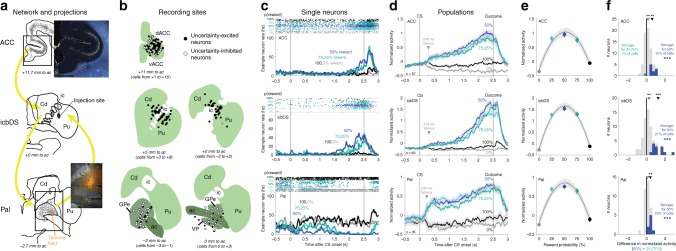
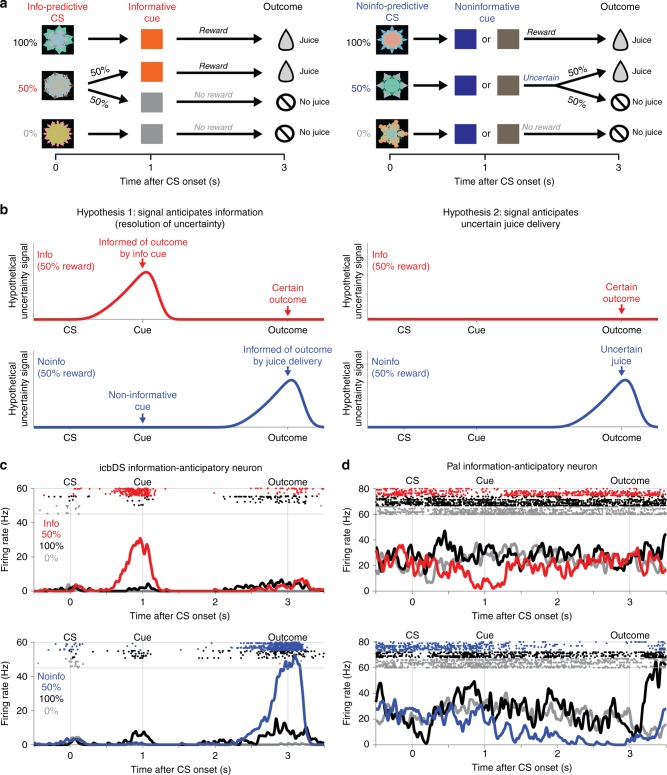
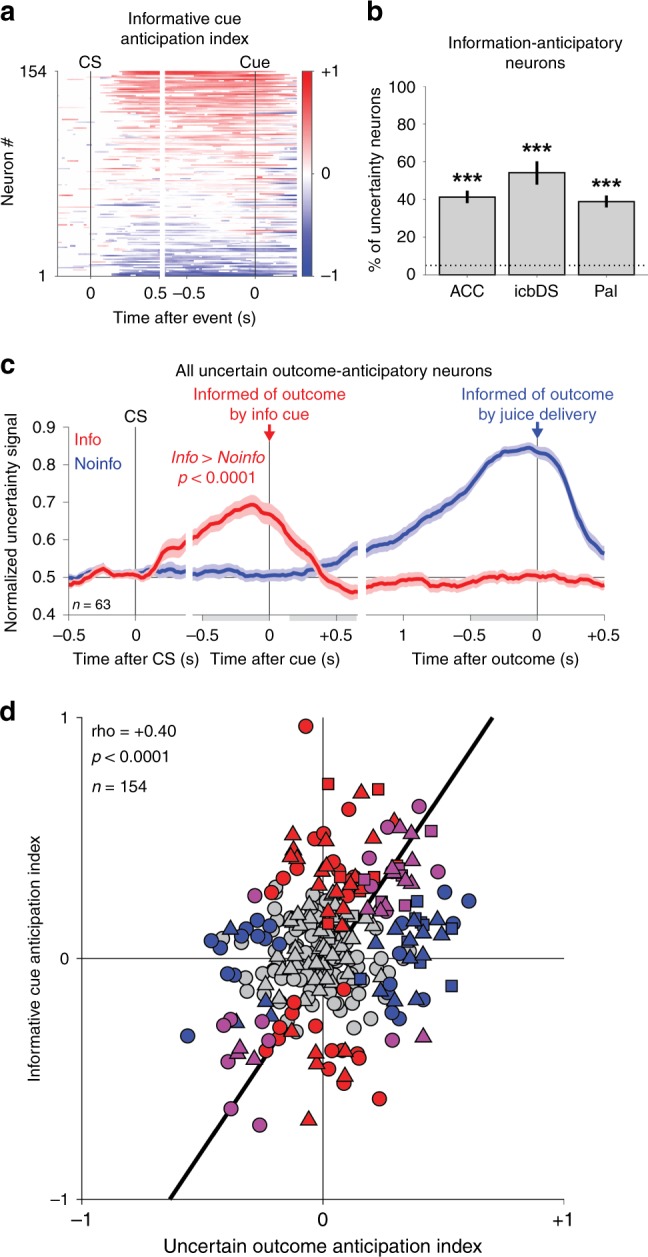
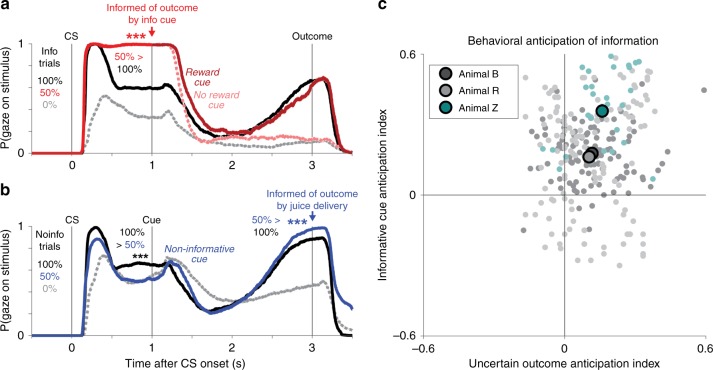
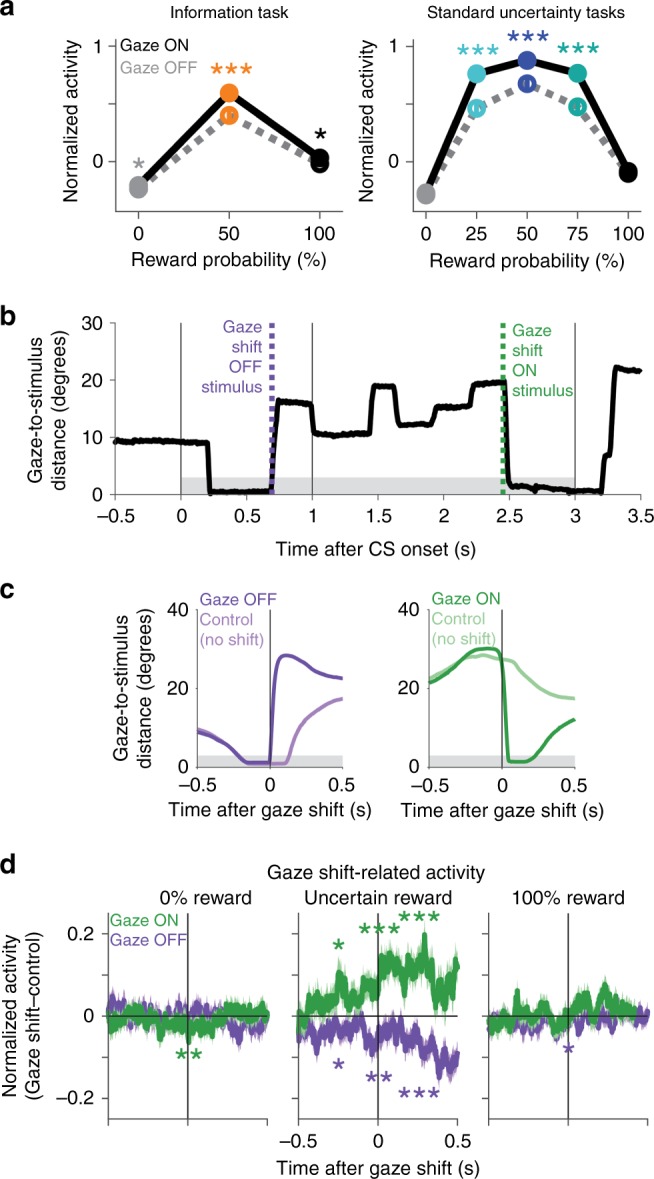
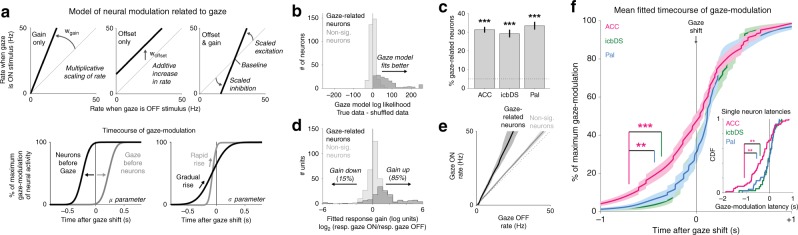
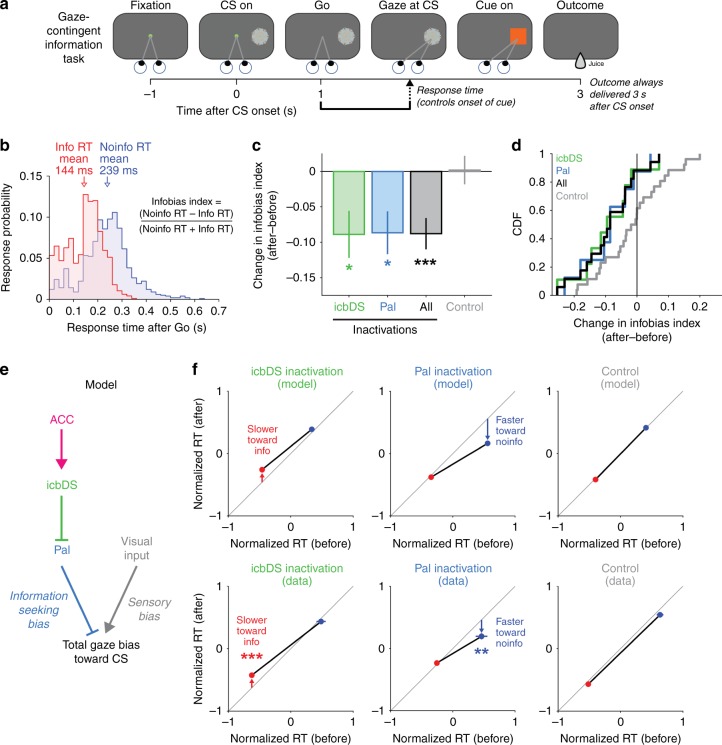
Humans and other animals often show a strong desire to know the uncertain rewards their future has in store, even when they cannot use this information to influence the outcome. However, it is unknown how the brain predicts opportunities to gain information and motivates this information-seeking behavior. Here we show that neurons in a network of interconnected subregions of primate anterior cingulate cortex and basal ganglia predict the moment of gaining information about uncertain rewards. Spontaneous increases in their information prediction signals are followed by gaze shifts toward objects associated with resolving uncertainty, and pharmacologically disrupting this network reduces the motivation to seek information. These findings demonstrate a cortico-basal ganglia mechanism responsible for motivating actions to resolve uncertainty by seeking knowledge about the future.
Overview
The claims and statistics of this paper haven’t been checked yet.
Run the check — free, no account needed. It reads the open-access text and checks the sources it cites.
Integrity signals
Registry
Cites
Statistics
Figures
Verification
Claims the paper makes
The claims and statistics of this paper haven’t been checked yet.
Run the check — free, no account needed. It reads the open-access text and checks the sources it cites.
Claims other papers make about this one
Each is checked against this paper’s own text: does it say what the citing paper says it does?
The check wasn’t confident either way, so it gives no verdict — never disputed.
In the citing paper
“which project to or are adjacent to VTA and SN3,22,29–33,54,55 (with multisynaptic routes via habenula56,57)”
From Interpretable abstractions of artificial neural networks predict behavior and neural activity during human information gathering (2026) · cites this paper as [22]
Experimental — accuracy not yet measuredIn the citing paper
“all the neuromodulatory systems with their origins in the ventral tegmental area (VTA), substantia nigra (SN), dorsal raphe nucleus (DRN), locus coeruleus (LC) and ventral septal nucleus (VSN) have at one time or another been proposed to reflect uncertainty or the potential for information gain3,21–27”
From Interpretable abstractions of artificial neural networks predict behavior and neural activity during human information gathering (2026) · cites this paper as [22]
In the citing paper
“All major neuromodulatory systems have at one time or another been linked to uncertainty processing3,21–27, but identifying a specific or preeminent contribution has been difficult.”
From Interpretable abstractions of artificial neural networks predict behavior and neural activity during human information gathering (2026) · cites this paper as [22]
In the citing paper
“Activity in individual neurons in both habenula and VTA reflects both the value of a stimulus in terms of the reward that it predicts58–60 as well as VoI21,22,27,61”
From Interpretable abstractions of artificial neural networks predict behavior and neural activity during human information gathering (2026) · cites this paper as [22]
In the citing paper
“Activity in ACC has also been linked to information seeking and initiation of behavioral change14,17,22,62–66”
From Interpretable abstractions of artificial neural networks predict behavior and neural activity during human information gathering (2026) · cites this paper as [22]
Self-check
Percentages, sums and reported differences re-computed from the paper’s own numbers.
The self-check needs the paper’s full text.
Citations
Cites
Parallel organization of functionally segregated circuits linking basal ganglia and cortex
Alexander, G. E., DeLong, M. R., & Strick, P. L. (1986) · Annual Review of Neuroscience · doi:10.1146/annurev.ne.09.030186.002041 · Cited by 8,527
Pearce, J. M., & Hall, G. (1980) · Psychological Review · doi:10.1037/0033-295x.87.6.532 · Cited by 3,023
Dopamine in motivational control: rewarding, aversive, and alerting
Bromberg-Martin, E. S., Matsumoto, M., & Hikosaka, O. (2010) · Neuron · doi:10.1016/j.neuron.2010.11.022 · Cited by 2,396
Self-citationLearning the value of information in an uncertain world
Behrens, T. E. J., Woolrich, M. W., Walton, M. E., & Rushworth, M. F. S. (2007) · Nature Neuroscience · doi:10.1038/nn1954 · Cited by 2,053
By Carrot or by Stick: Cognitive Reinforcement Learning in Parkinsonism
Frank, M. J., Seeberger, L. C., & O'Reilly, R. C. (2004) · Science · doi:10.1126/science.1102941 · Cited by 1,964
Basal ganglia and cerebellar loops: motor and cognitive circuits
Middleton, F. (2000) · Brain Research Reviews · doi:10.1016/s0165-0173(99)00040-5 · Cited by 1,940
Temporal Resolution of Uncertainty and Dynamic Choice Theory
Kreps, D. M., & Porteus, E. L. (1978) · Econometrica · doi:10.2307/1913656 · Cited by 1,753
Primate frontal eye fields. I. Single neurons discharging before saccades
Bruce, C. J., & Goldberg, M. E. (1985) · Journal of Neurophysiology · doi:10.1152/jn.1985.53.3.603 · Cited by 1,415
Joshi, S., Li, Y., Kalwani, R. M., & Gold, J. I. (2016) · Neuron · doi:10.1016/j.neuron.2015.11.028 · Cited by 1,387
Multiple reward signals in the brain
Schultz, W. (2000) · Nature Reviews Neuroscience · doi:10.1038/35044563 · Cited by 1,303
Cited by
Sorted by citations
Items 101–125 of 125
Singletary, N. M., Horga, G., & Gottlieb, J. P. (2024) · Communications Biology · doi:10.1038/s42003-024-06927-7 · Cited by 1
A rational information gathering account of infant habituation.
Karni, G., Mattar, M. G., Emberson, L. L., & Daw, N. D. (2025) · Behavioral Neuroscience · doi:10.1037/bne0000635 · Cited by 1
Covert attention for uncertainty reduction during sequential inferencePreprint
Domínguez-Zamora, F. J., Horga, G., & Gottlieb, J. P. (2023) · bioRxiv (Cold Spring Harbor Laboratory) · doi:10.1101/2023.11.28.569036 · Cited by 1
Liang, X., Zhu, Q., Zhang, Z., Hu, Z., Liang, Z., Li, L., Zhang, L., Xiao, X., & Huang, G. (2023) · bioRxiv (Cold Spring Harbor Laboratory) · doi:10.1101/2023.12.27.573480 · Cited by 1
Vissani, M., Tafreshi, A., Neudorfer, C., Nanda, P., Bush, A., Babapoor-Farrokhran, S., Horn, A., Camprodon, J. A., Dougherty, D. D., Cusin, C., et al. (2026) · Research Square · doi:10.21203/rs.3.rs-9316385/v1 · Cited by 1
Hassam, A. (1997) · TLS, the Times literary supplement/Times literary supplement on CD-ROM/TLS. Times literary supplement
A causal role for the parietal cortex in ambiguity computations in humansPreprint
Valdebenito-Oyarzo, G., Martínez-Molina1, M. P., Soto‐Icaza, P., Zamorano, F. J., Figueroa-Vargas, A., Larraín-Valenzuela, J., Stecher, X., Salinas, C., Valero-Cabré, A., Polanía, R. H., et al. (2022) · Research Square · doi:10.21203/rs.3.rs-1362283/v1
Author response: Pallidal neuromodulation of the explore/exploit trade-off in decision-making
Marcelino, A. L. D. A., Gray, O., Al‐Fatly, B., Gilmour, W., Steele, J. D., Kühn, A. A., & Gilbertson, T. (2023) · eLife · doi:10.7554/elife.79642.sa2
A causal role for the parietal cortex in ambiguity computations in humansPreprint
Valdebenito-Oyarzo, G., Martínez-Molina1, M. P., Soto‐Icaza, P., Zamorano, F. J., Figueroa-Vargas, A., Larraín-Valenzuela, J., Stecher, X., Salinas, C., Valero-Cabré, A., Polanía, R. H., et al. (2023) · Research Square · doi:10.21203/rs.3.rs-1362283/v2
A causal role for the parietal cortex in ambiguity computations in humansPreprint
Valdebenito-Oyarzo, G., Martínez-Molina1, M. P., Soto‐Icaza, P., Zamorano, F. J., Figueroa-Vargas, A., Larraín-Valenzuela, J., Stecher, X., Salinas, C., Valero-Cabré, A., Polanía, R. H., et al. (2023) · Research Square · doi:10.21203/rs.3.rs-1362283/v3
Dey, S., Slight, J., Aitken, S., Joseph, I., Bhore, U., von Kriegsheim, A., Petrovich, G., Charlton, J., Stancheva, V. G., Mohapatra, D., et al. (2025) · bioRxiv (Cold Spring Harbor Laboratory) · doi:10.1101/2025.01.05.631347
Probing the role of anterior cingulate cortex in sustained reward seeking
Zhang, Q., & Zhou, J. (2025) · Trends in Neurosciences · doi:10.1016/j.tins.2025.04.002
Neural dynamics reveal foraging-like computations in the frontal cortexPreprint
Ungvarszki, Z., Goussi-Denjean, C., Székely, A., Orbán, G., di Volo, M., & Procyk, E. (2025) · bioRxiv (Cold Spring Harbor Laboratory) · doi:10.1101/2025.09.29.679289
Du, Y., Chi, J., Meng, Y., Wu, H., Li, Z., & Gong, Y. (2025) · Chinese Control Conference (CCC) · doi:10.23919/ccc64809.2025.11178383
Human infants appreciate that information bears value for other individuals
Varga, B., & Kovács, Á. M. (2025) · Scientific Reports · doi:10.1038/s41598-025-29952-w
Visual Simulation Is Supported by Sequential Monitoring in the Lateral Prefrontal Cortex
Ahuja, A., Rodriguez, N. Y., Sheinberg, D. L., & Desrochers, T. M. (2026) · Journal of Cognitive Neuroscience · doi:10.1162/jocn.a.2584
Goussi-Denjean, C. (2022) · theses.fr (ABES) · doi:10.70675/6b1c8a4azddaaz4316z805ez00f4a7232467
Linking visual and spatial exploration dynamics during free navigation in a large–scale virtual cityPreprint
Schmidt, V., Nolte, D., Walter, J. L., Pacheco, T. S., & Peter König, B. (2026) · bioRxiv (Cold Spring Harbor Laboratory) · doi:10.64898/2026.04.06.714750
Boasen, J., Giroux, F., Duchesneau, M.-O., Roy, X., Sénécal, S., & Léger, P. (2026) · Scientific Reports · doi:10.1038/s41598-026-56620-4
A dimensional link between gain–loss economic preferences and psychopathologyPreprint
Feng, Y.-Y., & Monosov, I. E. (2026) · bioRxiv (Cold Spring Harbor Laboratory) · doi:10.64898/2026.09.09.750300
Self-citationEffort-based decision-making: A value-guided dissection and arousal-focused synthesis
Clairis, N., & Tobler, P. N. (2026) · Neuroscience & Biobehavioral Reviews · doi:10.1016/j.neubiorev.2026.107062
Metadata
- Authors
- White, J. K., Bromberg-Martin, E. S., Heilbronner, S. R., Zhang, K., Pai, J., Haber, S. N., & Monosov, I. E.
- Affiliations
- Washington University in St. Louis (US)
- University of Minnesota (US)
- University of Rochester (US)
- Corresponding author
- Monosov, Ilya E.
- ORCID
- Venue
- Nature Communications
- Published
- 2019-11-14
- Volume
- 10
- Issue
- 1
- Pages
- 5168-5168
- ISSN
- 2041-1723 (ISSN-L)
- PMC
- PMC6856099
- OpenAlex
- W2984095784
- Cited by
- 129
- References
- 126
- Citations by year
- 2026: 12 · 2025: 17 · 2024: 17 · 2023: 17 · 2022: 16 · 2021: 28 · 2020: 20 · 2019: 1
- FWCI
- 9.45
- Type
- journal article
- Language
- en
- Open access
- gold
- doi.org
- Locations
- Nature Communications (publishedVersion, cc-by)
- bioRxiv (Cold Spring Harbor Laboratory) (acceptedVersion, cc-by-nc-nd)
- Europe PMC (PubMed Central) (publishedVersion, cc-by)
- PubMed Central (publishedVersion, cc-by)
- PubMed (publishedVersion)
- Digital Commons@Becker (Washington University School of Medicine) (submittedVersion, cc-by)
- RePEc: Research Papers in Economics (submittedVersion)
- DOAJ (DOAJ: Directory of Open Access Journals) (submittedVersion, cc-by-sa)
- DOAJ (DOAJ: Directory of Open Access Journals) (submittedVersion)
- Funders
- Edward Mallinckrodt, Jr. Foundation
- Topics
- Life Sciences › Neuroscience › Cognitive Neuroscience › Neural and Behavioral Psychology Studies
- Life Sciences › Neuroscience › Cellular and Molecular Neuroscience › Neurotransmitter Receptor Influence on Behavior
- Life Sciences › Neuroscience › Cognitive Neuroscience › Memory and Neural Mechanisms
- Keywords
- information seeking, uncertainty, anterior cingulate cortex, basal ganglia, cortico-basal ganglia network, reward prediction, gaze shifts, motivation, primate behavior
- MeSH terms
- Animals, Basal Ganglia, Fixation, Ocular, Macaca mulatta, Male, Nerve Net, Neurons, Reward, Uncertainty, Information Seeking Behavior
About these checks
Registry, retraction, Cites and statistics results are computed, not judged, with one exception: a printed reference that no index lists is read once by a model before it counts as a citation error. Claims are extracted by a model and kept only when their quote appears verbatim in the text; each cited source is then checked, with a model’s help, for whether it says what the claim relies on. Those verdicts can be wrong — read the claim’s quote and the cited source before relying on one.
Statistics and arithmetic are recomputed, not judged.
Confidence bands are shown only for fields calibrated on our annotated test set. None is calibrated yet, so no band is shown.
What counts as a claim ›How we measure confidence ›How we check this ›
Are you an author, or do you see a problem with this page? Request a review
