

Senescent cell turnover slows with age providing an explanation for the Gompertz law
Open accessThe DOI matches its Crossref record; 73 of the 74 references it cites were found in a registry or an index.
Abstract
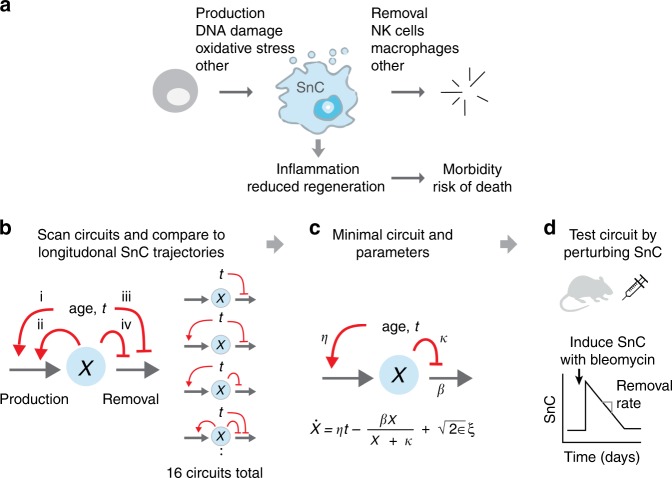
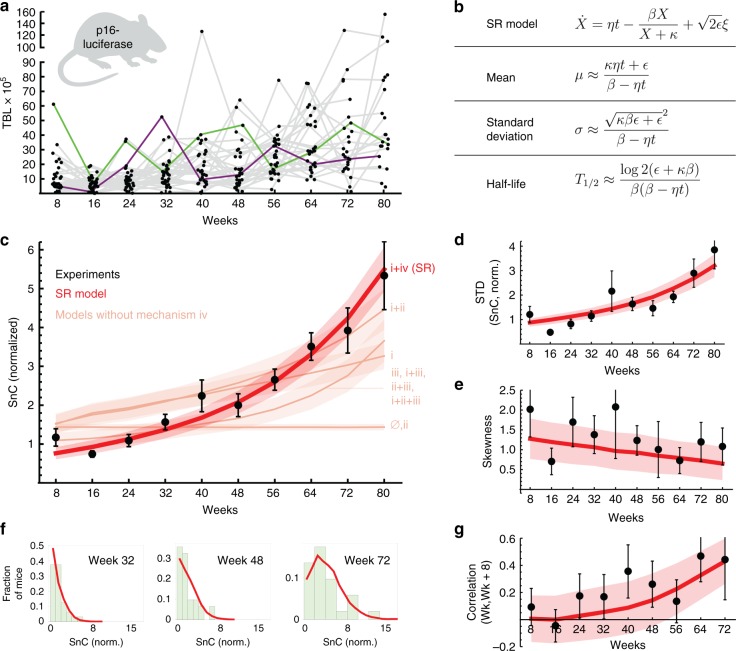
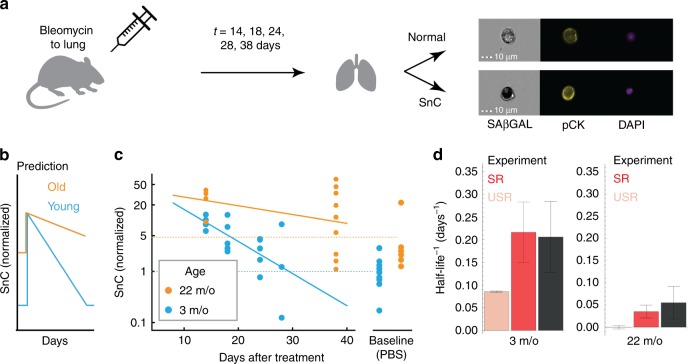
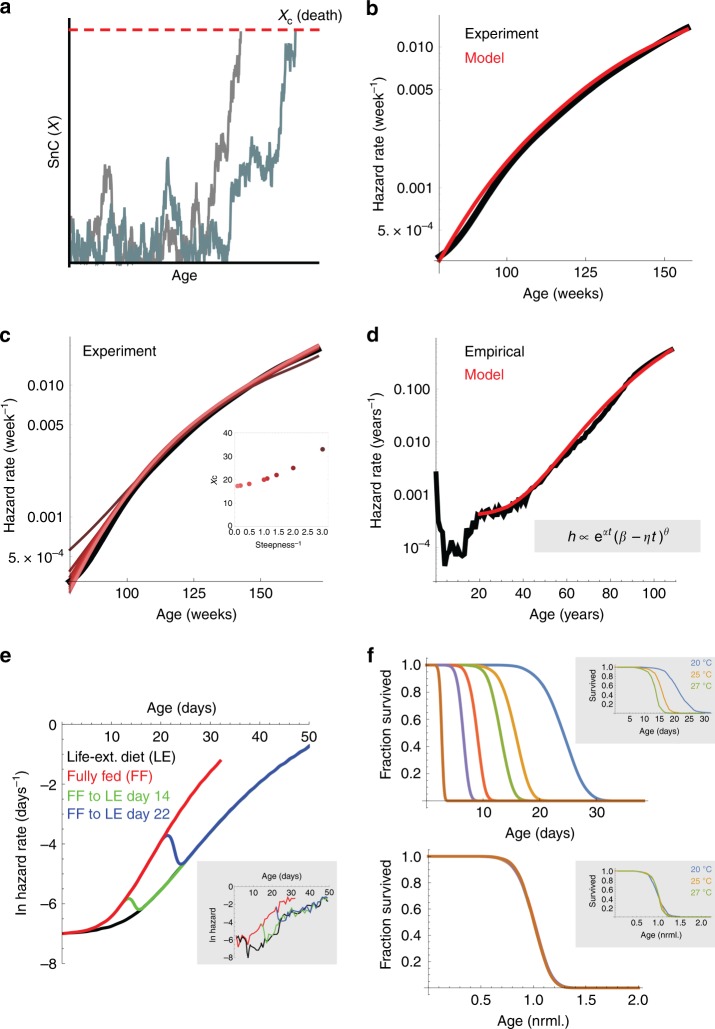
A causal factor in mammalian aging is the accumulation of senescent cells (SnCs). SnCs cause chronic inflammation, and removing SnCs decelerates aging in mice. Despite their importance, turnover rates of SnCs are unknown, and their connection to aging dynamics is unclear. Here we use longitudinal SnC measurements and induction experiments to show that SnCs turn over rapidly in young mice, with a half-life of days, but slow their own removal rate to a half-life of weeks in old mice. This leads to a critical-slowing-down that generates persistent SnC fluctuations. We further demonstrate that a mathematical model, in which death occurs when fluctuating SnCs cross a threshold, quantitatively recapitulates the Gompertz law of mortality in mice and humans. The model can go beyond SnCs to explain the effects of lifespan-modulating interventions in Drosophila and C. elegans , including scaling of survival-curves and rapid effects of dietary shifts on mortality.
Overview
The claims and statistics of this paper haven’t been checked yet.
Free: it reads the open-access text and checks the first 5 claims that cite a source we can check. Create a free account to check every claim.
Integrity signals
Registry
Cites
Statistics
Figures
Verification
Claims the paper makes
The claims and statistics of this paper haven’t been checked yet.
Free: it reads the open-access text and checks the first 5 claims that cite a source we can check. Create a free account to check every claim.
Claims other papers make about this one
Each is checked against this paper’s own text: does it say what the citing paper says it does?
The source backs part of the claim, not all of it — or backs it for a different population, condition or comparison.
In the citing paper
“It is clear that the immune system has the capacity to eliminate senescent cells in certain contexts; however, the clearance process seems to become dysfunctional with age and in disease, possibly explaining the accumulation of senescent cells with age273.”
From Cellular senescence in ageing: from mechanisms to therapeutic opportunities (2021) · cites this paper as [273]
Experimental — accuracy not yet measuredThe source backs part of the claim, not all of it — or backs it for a different population, condition or comparison.
In the citing paper
“Based on studies in salamander limb regeneration [61] and in bleomycin-induced senescence in young mice [62], turnover of senescent cells is estimated to be about four weeks.”
From Reducing Senescent Cell Burden in Aging and Disease (2020) · cites this paper as [62]
Experimental — accuracy not yet measuredThe source backs part of the claim, not all of it — or backs it for a different population, condition or comparison.
In the citing paper
“senescent cells accumulate in aged tissues,31,32,33 including the brain.34,35,36”
From Uncovering the signatures of aging and senescence in the human dorsolateral prefrontal cortex (2026) · cites this paper as [31]
Experimental — accuracy not yet measuredThe source backs part of the claim, not all of it — or backs it for a different population, condition or comparison.
In the citing paper
“Mathematically, if damage did not saturate, that is, if removal was −βx, the steady-state damage would rise linearly with age, whereas experiments indicate that damage accelerates with age2,19,20.”
From A damage accumulation model identifies distinct aging regimes across species (2026) · cites this paper as [19]
Experimental — accuracy not yet measuredThe source backs part of the claim, not all of it — or backs it for a different population, condition or comparison.
In the citing paper
“The SR model explains many quantitative patterns of aging including Gompertz and Weibull hazard curves19, distributions of human frailty index2, disease incidence curves31 and heritability of lifespan32.”
From A damage accumulation model identifies distinct aging regimes across species (2026) · cites this paper as [19]
Experimental — accuracy not yet measured
8 more claims about this paper
Create a free account to see every claim other papers make about this one.
Self-check
Percentages, sums and reported differences re-computed from the paper’s own numbers.
The self-check needs the paper’s full text.
Citations
Cites
López-Otín, C., Blasco, M. A., Partridge, L., Serrano, M., & Kroemer, G. (2013) · Cell · doi:10.1016/j.cell.2013.05.039 · Cited by 14,982
A biomarker that identifies senescent human cells in culture and in aging skin in vivo.
Dimri, G. P., Lee, X., Basile, G., Acosta, M., Scott, G., Roskelley, C., Medrano, E. E., Linskens, M., Rubelj, I., & Pereira-Smith, O. (1995) · Proceedings of the National Academy of Sciences · doi:10.1073/pnas.92.20.9363 · Cited by 7,477
Revised Estimates for the Number of Human and Bacteria Cells in the Body
Sender, R., Fuchs, S., & Milo, R. (2016) · PLOS Biology · doi:10.1371/journal.pbio.1002533 · Cited by 5,425
Early-warning signals for critical transitions
Scheffer, M., Bascompte, J., Brock, W. A., Brovkin, V., Carpenter, S. R., Dakos, V., Held, H., van Nes, E. H., Rietkerk, M., & Sugihara, G. (2009) · Nature · doi:10.1038/nature08227 · Cited by 4,854
Cellular senescence: when bad things happen to good cells
Campisi, J., & d'Adda di Fagagna, F. (2007) · Nature Reviews Molecular Cell Biology · doi:10.1038/nrm2233 · Cited by 4,441
Chronic Inflammation (Inflammaging) and Its Potential Contribution to Age-Associated Diseases
Franceschi, C., & Campisi, J. (2014) · The Journals of Gerontology Series A: Biological Sciences and Medical Sciences · doi:10.1093/gerona/glu057 · Cited by 3,891
Gompertz, B. (1825) · Philosophical Transactions of the Royal Society of London · doi:10.1098/rstl.1825.0026 · Cited by 3,816
A C. elegans mutant that lives twice as long as wild type
Kenyon, C., Chang, J., Gensch, E., Rudner, A., & Tabtiang, R. (1993) · Nature · doi:10.1038/366461a0 · Cited by 3,387
Naturally occurring p16Ink4a-positive cells shorten healthy lifespan
Baker, D. J., Childs, B. G., Durik, M., Wijers, M. E., Sieben, C. J., Zhong, J., A. Saltness, R., Jeganathan, K. B., Verzosa, G. C., Pezeshki, A., et al. (2016) · Nature · doi:10.1038/nature16932 · Cited by 2,876
Cellular senescence: from physiology to pathology
Muñoz-Espín, D., & Serrano, M. (2014) · Nature Reviews Molecular Cell Biology · doi:10.1038/nrm3823 · Cited by 2,818
Research works printed but not linked: 1
- Flindt, R. Amazing Numbers in Biology (Springer-Verlag, 2006).
Cited by
Items 101–152 of 152
Guinn, L., Lo, E., & Balázsi, G. (2022) · Communications Biology · doi:10.1038/s42003-022-03228-9 · Cited by 7
Pridham, G., & Rutenberg, A. D. (2024) · The Journals of Gerontology Series A · doi:10.1093/gerona/glae021 · Cited by 8
Senescence as a therapeutic target
Meyer, K. R., Lopez-Dominguez, J. A., Maus, M., Kovatcheva, M., & Serrano, M. (2021) · Elsevier eBooks · doi:10.1016/b978-0-12-822514-1.00014-6 · Cited by 6
Design principles of gene circuits for longevity
Godoy, P., & Hao, N. (2025) · Trends in Cell Biology · doi:10.1016/j.tcb.2025.02.006 · Cited by 6
Demographic consequences of damage dynamics in single-cell aging
Tuğrul, M., & Steiner, U. K. (2025) · Physical Review Research · doi:10.1103/physrevresearch.7.013327 · Cited by 7
p16-dependent upregulation of PD-L1 impairs immunosurveillance of senescent cellsPreprint
Majewska, J., Agrawal, A., Mayo, A., Roitman, L., Chatterjee, R., Kralova, J. S., Landsberger, T., Katzenelenbogen, Y., Meir-Salame, T., Hagai, E., et al. (2023) · bioRxiv (Cold Spring Harbor Laboratory) · doi:10.1101/2023.01.30.524522 · Cited by 5
“Raw data were processed with the User-friendly Transcriptome Analysis Pipeline (UTAP) (6).”
BackgroundMethodSelf-citationThe emerging role of cellular senescence in amyotrophic lateral sclerosis
Tan, X., & Gao, N. (2025) · Frontiers in Neuroscience · doi:10.3389/fnins.2025.1599492 · Cited by 8
“The threshold theory of senescent cell accumulation (Chaib et al., 2022) posits that once the quantity of senescent cells in the body exceeds a certain threshold, the immune system and other organs become more susceptible to aging-related diseases (Karin et al., 2019).”
What sets the mutation rate of a cell type in an animal species?
de Manuel, M., Przeworski, M., Spisak, N., & Stolyarova, A. V. (2026) · PLoS Biology · doi:10.1371/journal.pbio.3003799 · Cited by 8
“A recent theory [77,83] proposes that the Gompertz law of mortality (Box 1) results from saturation in the removal of damage with age.”
Senolytic Vaccines from the Central and Peripheral Tolerance Perspective
Vasilieva, M. I., Shatalova, R., Matveeva, K., Shindyapin, V., Minskaia, E., Ivanov, R., & Shevyrev, D. (2024) · Vaccines · doi:10.3390/vaccines12121389 · Cited by 5
“A number of studies have shown that aging of the body is accompanied by the accumulation of senescent cells in various tissues and organs [50,51].”
Su, H., & Hao, N. (2025) · Quantitative Biology · doi:10.1002/qub2.70007 · Cited by 4
Cellular senescence: mechanisms and clinical implications
Михайловна, М. А., Pashenkov, M. V., & Pinegin, B. V. (2024) · Immunologiya · doi:10.33029/1816-2134-2024-45-2-221-234 · Cited by 11
Golubev, A. G. (2024) · Biogerontology · doi:10.1007/s10522-024-10123-9 · Cited by 5
“Some authors strive for understanding why increases in mortality rate associated with aging are exponential (Strehler and Mildvan 1960; Gavrilov and Gavrilova 2001; Golubev 2009, 2019; Karin et al. 2019; Liu et al. 2023; Nielsen et al. 2024).”
Sharma, R., & Sharma, A. (2024) · Translational Medicine of Aging · doi:10.1016/j.tma.2024.09.001 · Cited by 3
Metabolic slowdown as the proximal cause of ageing and deathPreprint
Wordsworth, J., Yde, P., Fielder, E., Chandrasegaran, S., & Shanley, D. P. (2023) · bioRxiv (Cold Spring Harbor Laboratory) · doi:10.1101/2023.08.01.551537 · Cited by 7
Uncovering the signatures of aging and senescence in the human dorsolateral prefrontal cortex
Sloan, N. X., Mares, J., Daly, A. C., Grier, S., Haq, I., Jackson, C. A., Barretto, N., Casel, O., Kang, K., Khiste, S., et al. (2026) · Cell Genomics · doi:10.1016/j.xgen.2025.101127 · Cited by 2
Damage dynamics in single E. coli and the role of chance in the timing of cell deathPreprint
Yang, Y., Karin, O., Mayo, A., Bar, A., Song, X., Chen, P., Santos, A. L., Lindner, A. B., & Alon, U. S. (2022) · bioRxiv (Cold Spring Harbor Laboratory) · doi:10.1101/2022.10.17.512406 · Cited by 2
Self-citationUncovering the Signatures of Cellular Senescence in the Human Dorsolateral Prefrontal CortexPreprint
Sloan, N., Mares, J. A., Daly, A. C., Coie, L. A., Grier, S., Barretto, N., Casel, O., Kang, K., Jackson, C., Pedersen, M., et al. (2025) · bioRxiv (Cold Spring Harbor Laboratory) · doi:10.1101/2025.02.19.639091 · Cited by 3
“Senescent cells accumulate in aged tissues 25-27 including the brain 28-30 .”
Somatic mutations impose an entropic upper bound on human lifespan
Efimov, E., Fedotov, V., Malaev, L. G., Khrameeva, E. E., & Kriukov, D. V. (2026) · npj Aging · doi:10.1038/s41514-026-00421-6 · Cited by 2
“Existing models capture only speci fi c molecular aspects (e.g., senescent cell accumulation 64 ) or omit detailed mechanisms in favor of phenomenological perspectives, treating organisms as systems that accumulate abstract damage 17,65,66 .”
Ringel, M. S. (2025) · Biological reviews/Biological reviews of the Cambridge Philosophical Society · doi:10.1002/brv.70109 · Cited by 2
The therapeutic potential of natural killer (NK) cells to combat aging and age-related diseases
Bari, R., Kang, L., Gosiewska, A., & HARIRI, R. J. (2026) · Discover Immunity. · doi:10.1007/s44368-026-00021-2 · Cited by 2
Unfried, M., Huai, W., Pabis, K., Jose, S., Lim, Z. M., Alon, U., Cvijović, M., Eynon, N., Fedichev, P. O., Kim, Y., et al. (2026) · Aging · doi:10.18632/aging.206378 · Cited by 1
“Phenomenological, coarse-grained theories such as the minimal model [10] and the saturated removal model [1] can help to distill aging into a small set of variables that explain regimes across species, including the striking case of negligible senescence.”
Self-citationKoning, M., Kovynev, A., Fondevila, M. F., Ruhé, E. J. M., Mommersteeg, M. C., Ramakers, C. R. B., Hutten, B. A., Verwer, B. J., Vlug, M. S., Kuiper, T., et al. (2026) · Nature Metabolism · doi:10.1038/s42255-026-01643-4 · Cited by 1
Stress-induced senescence as a forme fruste of chronic kidney disease—A case for failed regeneration
Goligorsky, M. S. (2021) · Elsevier eBooks · doi:10.1016/b978-0-12-823318-4.00001-9 · Cited by 1
Immunesenescence and Compromised Removal of Senescent Cells: Implications for Health in Old Age
Hazeldine, J., & Lord, J. M. (2021) · Healthy ageing and longevity · doi:10.1007/978-3-030-87532-9_3 · Cited by 1
Stimulation of epidermal hyperplasia and tumorigenesis by resident p16INK4a-expressing cells
Azazmeh, N., & Ben‐Porath, I. (2020) · Molecular & Cellular Oncology · doi:10.1080/23723556.2020.1819752 · Cited by 1
Yde, P., Jensen, M. K., Mitarai, N., & Bhatt, S. (2023) · bioRxiv (Cold Spring Harbor Laboratory) · doi:10.1101/2023.06.20.545709 · Cited by 1
“, the exponential increase in mortality rate emerges naturally from the model structure and the architecture of dynamic interactions between model variables [11, 20, 23, 24, 18, 14].”
BackgroundMaximal human lifespan in light of a mechanistic model of agingPreprint
Shenhar, B., Frenkel, S., Levy, T., & Alon, U. (2025) · bioRxiv (Cold Spring Harbor Laboratory) · doi:10.64898/2025.12.22.695887 · Cited by 2
“We used the saturating-removal (SR) mathematical model( 10 ) of aging dynamics, and expanded it here to simulate heterogeneous cohorts.”
InfluentialSelf-citationFrom networked SIS model to the Gompertz function
Estrada, E., & Bartesaghi, P. (2021) · Applied Mathematics and Computation · doi:10.1016/j.amc.2021.126882
“[8] found that senescent cell turnover slows with age which gives an explanation for the Gompertz law.”
BackgroundBirth and death of cellular senescence
Wang, B. (2020) · University of Groningen research database (University of Groningen / Centre for Information Technology) · doi:10.33612/diss.131223530
Loureiro, B., Ito, Y., & Favoreto, M. G. (2025) · European journal of medical research · doi:10.1186/s40001-025-02832-9
“Cell turnover in the epidermis decreases, which leads to a thinner outer skin layer and slower wound healing [27–29].”
Bridging Physics and Aging Biology: Insights from the First Physics in Aging Biology Workshop
Unfried, M., Scheibye‐Knudsen, M., Alon, U. S., Gruber, J., Jensen, M. H., Johnson, J., Karin, O., Kedlian, V. R., Kennedy, B. K., Rutenberg, A. D., et al. (2025) · doi:10.59368/agingbio.20250042
Self-citationRyou, I. S., Lee, S. W., Mun, H., Lee, J. K., Chun, S., & Cho, K. (2024) · Figshare · doi:10.6084/m9.figshare.26652519
Ryou, I. S., Lee, S. W., Mun, H., Lee, J. K., Chun, S., & Cho, K. (2024) · Figshare · doi:10.6084/m9.figshare.26652510
Ryou, I. S., Lee, S. W., Mun, H., Lee, J. K., Chun, S., & Cho, K. (2023) · Figshare · doi:10.6084/m9.figshare.24797909
Ryou, I. S., Lee, S. W., Mun, H., Lee, J. K., Chun, S., & Cho, K. (2024) · Figshare · doi:10.6084/m9.figshare.26652513
Ryou, I. S., Lee, S. W., Mun, H., Lee, J. K., Chun, S., & Cho, K. (2024) · Figshare · doi:10.6084/m9.figshare.24798082
Ryou, I. S., Lee, S. W., Mun, H., Lee, J. K., Chun, S., & Cho, K. (2024) · Figshare · doi:10.6084/m9.figshare.26652516
Ryou, I. S., Lee, S. W., Mun, H., Lee, J. K., Chun, S., & Cho, K. (2024) · Figshare · doi:10.6084/m9.figshare.26652522
How and why does aging occur? Updating evolutionary theory to meet a new era of data
Metcalf, C., Anderson, R. M., Hochberg, M. E., Masel, J., Moorad, J., Promislow, D., Tuljapurkar, S., & Snyder-Mackler, N. (2025) · Evolution, Medicine and Public Health · doi:10.1093/emph/eoaf040 · Cited by 1
“The resulting tradeoff between negative outcomes from somatic mutation and negative outcomes from reduced organ function could also shape the evolution of cell senescence [53, 54].”
Hematopoietic stem cell senescence and opportunities for intervention
Barve, A., Dabas, P., Cain, T. L., & McKinney‐Freeman, S. (2026) · Experimental Hematology · doi:10.1016/j.exphem.2026.105425 · Cited by 1
de Freitas, J. A. N. L. F. (2020) · theses.fr (ABES) · doi:10.70675/0e6e3614z3915z4fb8za2cdz24b40b9679b2
Dissecting the impact of cellular senescence on muscle regeneration
Cazin, C. (2020) · theses.fr (ABES) · doi:10.70675/42a7ff38zb338z4eb8za925z2ce0a01ee74e
Senolytic drug discovery and mechanisms of action in BRAF-V600E oncogene-induced senescence
L’Hôte, V. (2022) · theses.fr (ABES) · doi:10.70675/acd5f426zc1b2z446fz8404z0f8f121081f8 · Cited by 1
Bonnefous, H. (2025) · theses.fr (ABES) · doi:10.70675/67742b4az1242z4d30z964ezd8bf9300d4ac · Cited by 1
Dynamics of the end-of-life phase explained by the saturating removal modelPreprint
Raz, N., Pridham, G., Rera, M., Rockwood, K. J., & Alon, U. (2026) · bioRxiv (Cold Spring Harbor Laboratory) · doi:10.64898/2026.04.20.719588 · Cited by 1
“The SR model captures the Gompertz law in humans and other organisms, and the Weibull hazard in invertebrates 1,12,14 .”
Self-citationProstate cancer and cellular senescence: focusing on the tumor microenvironment
Zhang, D., Yan, J., Jin, Q., Lv, X., & Ma, Y. (2026) · ONCOLOGIE · doi:10.1515/oncologie-2026-0025
“These factors also act on neighboring fi broblasts through a bystander e ff ect, inducing senescence-induced senescence (SIS) and promoting the spread of the senescent phenotype within the tissue micro-environment [68].”
Old worms, new tricks: Dynamical instability explains late-life rejuvenation in C. elegans
Latumalea, D., Molière, A., Fedichev, P. O., Ewald, C. Y., & Gruber, J. (2026) · Geromedicine · doi:10.64898/2026.05.01.722260
A unified framework links infant vulnerability with aging-related mortality dynamicsPreprint
Shenhar, B., Strauss, T., & Alon, U. (2026) · bioRxiv (Cold Spring Harbor Laboratory) · doi:10.64898/2026.05.05.722841
“The SR model is a biologically-calibrated equation for damage production and removal with stochastic noise 7 (Methods).”
Self-citationEnergetically constrained turnover drives the emergence of agingPreprint
Yao, M., & Deguchi, S. (2026) · bioRxiv (Cold Spring Harbor Laboratory) · doi:10.64898/2026.05.19.726278
“However, many of these studies have focused on specific aging-related phenomena (Karin et al., 2019; Nelson & Masel, 2017; Wodarz, 2007), leaving open the question of whether aging can be explained from more general principles.”
Two modes of aging to explain why lifespans differ across species
(2026) · Nature Aging · doi:10.1038/s43587-026-01141-y
The multifaceted inducers of cellular senescence
Gal, H., & Krizhanovsky, V. (2026) · Aging · doi:10.18632/aging.206391
“With advancing age, however, declining immune surveillance and impaired turnover lead to the progressive accumulation of senescent cells in tissues [12].”
Self-citationThe role of senescence in kidney ageing, injury and fibrosis
Janas, P. P., Mason, T., & Ferenbach, D. A. (2026) · Nature Reviews Nephrology · doi:10.1038/s41581-026-01123-8
Metadata
- Authors
- Karin, O., Agrawal, A., Porat, Z., Krizhanovsky, V., & Alon, U.
- Affiliations
- Weizmann Institute of Science (IL)
- Corresponding author
- Krizhanovsky, Valery
- Alon, Uri
- Venue
- Nature Communications
- Published
- 2019-12-02
- Volume
- 10
- Issue
- 1
- Pages
- 5495-5495
- ISSN
- 2041-1723 (ISSN-L)
- PMC
- PMC6889273
- OpenAlex
- W2991063431
- Semantic Scholar
- d2e4f00faca0d24ed2bcc8dbeb216da3eacdac23
- Cited by
- 151
- References
- 61
- Citations by year
- 2026: 17 · 2025: 20 · 2024: 25 · 2023: 23 · 2022: 18 · 2021: 26 · 2020: 22
- FWCI
- 6.00
- Type
- journal article
- Language
- en
- Open access
- gold
- doi.org
- Licence
- cc-by
- creativecommons.org/licenses/by/4.0 (tdm)
- creativecommons.org/licenses/by/4.0 (vor)
- Locations
- Nature Communications (publishedVersion, cc-by)
- PubMed Central (publishedVersion, cc-by)
- PubMed (publishedVersion)
- RePEc: Research Papers in Economics (submittedVersion)
- DOAJ (DOAJ: Directory of Open Access Journals) (submittedVersion)
- DOAJ (DOAJ: Directory of Open Access Journals) (submittedVersion, cc-by-sa)
- Funders
- European Commission (H2020)
- Israel Science Foundation
- Horizon 2020 Framework Programme
- Topics
- Life Sciences › Biochemistry, Genetics and Molecular Biology › Aging › Genetics, Aging, and Longevity in Model Organisms
- Life Sciences › Biochemistry, Genetics and Molecular Biology › Cell Biology › Telomeres, Telomerase, and Senescence
- Social Sciences › Demography › Insurance, Mortality, Demography, Risk Management
- Keywords
- senescent cells, cellular senescence, aging, critical slowing down, dietary restriction, survival curves, chronic inflammation, mice, Drosophila, Caenorhabditis elegans
- MeSH terms
- Age Factors, Aging, Animals, Drosophila, Female, Longevity, Male, Mice, Inbred C57BL, Models, Biological, Models, Theoretical, Cellular Senescence, Caenorhabditis elegans, Mice
About these checks
Registry, retraction, Cites and statistics results are computed, not judged, with one exception: a printed reference that no index lists is read once by a model before it counts as a citation error. Claims are extracted by a model and kept only when their quote appears verbatim in the text; each cited source is then checked, with a model’s help, for whether it says what the claim relies on. Those verdicts can be wrong — read the claim’s quote and the cited source before relying on one.
Statistics and arithmetic are recomputed, not judged.
Confidence bands are shown only for fields calibrated on our annotated test set. None is calibrated yet, so no band is shown.
What counts as a claim ›How we measure confidence ›How we check this ›
Are you an author, or do you see a problem with this page? Request a review
Data sources
Bibliographic data: Semantic Scholar, OpenAlex, Crossref.
Contains information from the Semantic Scholar Academic Graph Datasets, made available under the ODC Attribution License (ODC-BY 1.0).
Semantic Scholar’s data is described in: Kinney, R., et al. (2023). The Semantic Scholar Open Data Platform. arXiv:2301.10140.
