

Senescent cell turnover slows with age providing an explanation for the Gompertz law
Open accessThe DOI matches its Crossref record; 73 of the 74 references it cites were found in a registry or an index.
Abstract
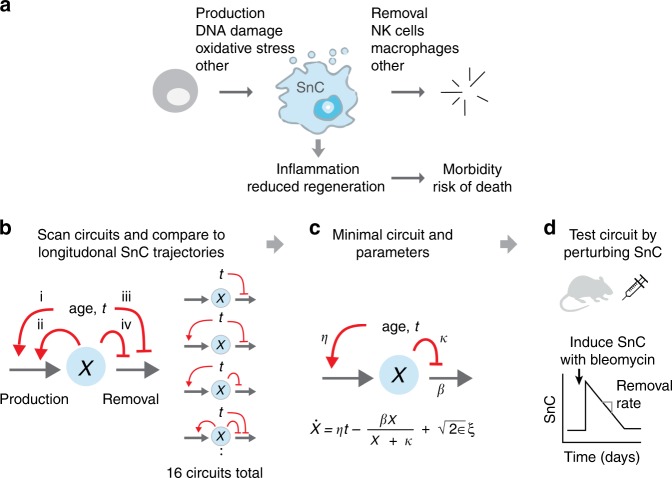
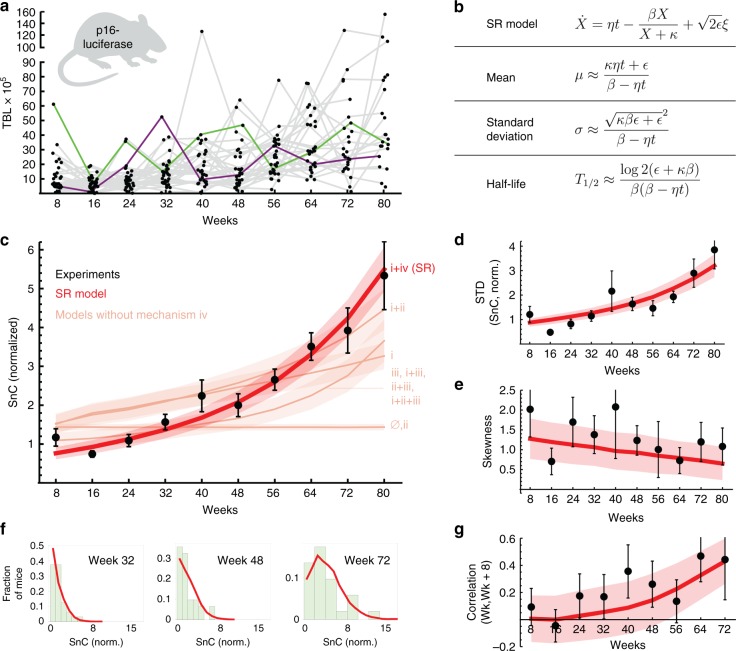
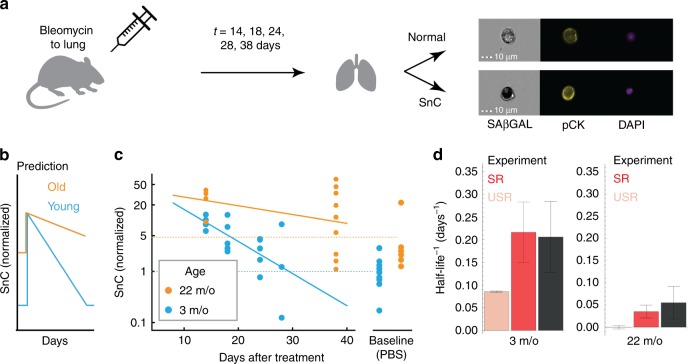
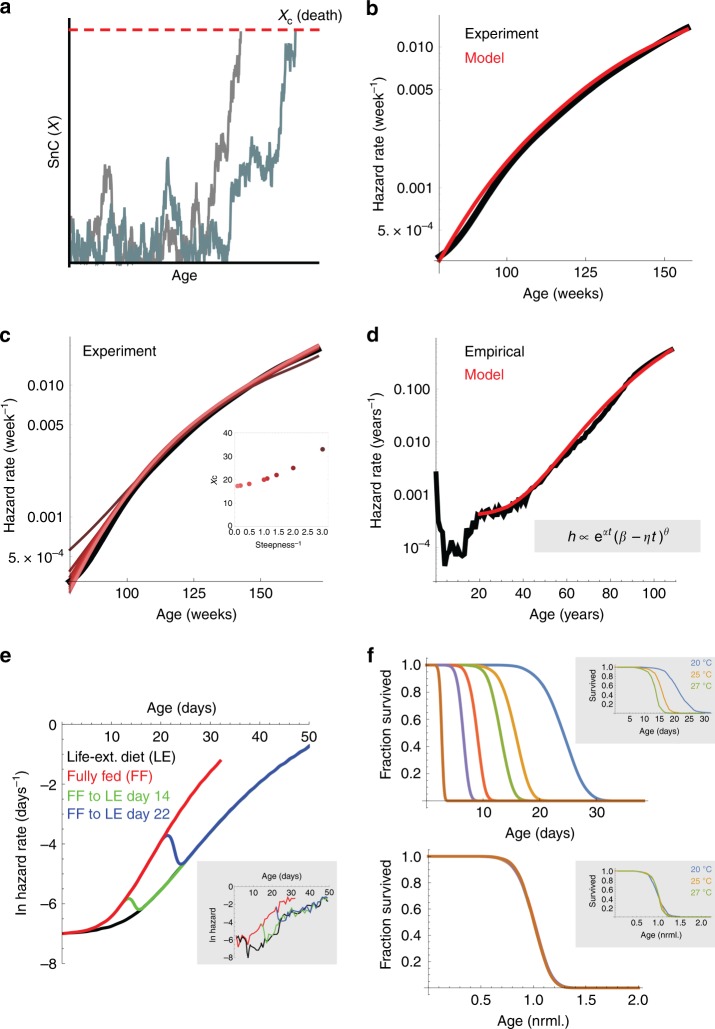
A causal factor in mammalian aging is the accumulation of senescent cells (SnCs). SnCs cause chronic inflammation, and removing SnCs decelerates aging in mice. Despite their importance, turnover rates of SnCs are unknown, and their connection to aging dynamics is unclear. Here we use longitudinal SnC measurements and induction experiments to show that SnCs turn over rapidly in young mice, with a half-life of days, but slow their own removal rate to a half-life of weeks in old mice. This leads to a critical-slowing-down that generates persistent SnC fluctuations. We further demonstrate that a mathematical model, in which death occurs when fluctuating SnCs cross a threshold, quantitatively recapitulates the Gompertz law of mortality in mice and humans. The model can go beyond SnCs to explain the effects of lifespan-modulating interventions in Drosophila and C. elegans , including scaling of survival-curves and rapid effects of dietary shifts on mortality.
Overview
The claims and statistics of this paper haven’t been checked yet.
Free: it reads the open-access text and checks the first 5 claims that cite a source we can check. Create a free account to check every claim.
Integrity signals
Registry
Cites
Statistics
Figures
Verification
Claims the paper makes
The claims and statistics of this paper haven’t been checked yet.
Free: it reads the open-access text and checks the first 5 claims that cite a source we can check. Create a free account to check every claim.
Claims other papers make about this one
Each is checked against this paper’s own text: does it say what the citing paper says it does?
The source backs part of the claim, not all of it — or backs it for a different population, condition or comparison.
In the citing paper
“It is clear that the immune system has the capacity to eliminate senescent cells in certain contexts; however, the clearance process seems to become dysfunctional with age and in disease, possibly explaining the accumulation of senescent cells with age273.”
From Cellular senescence in ageing: from mechanisms to therapeutic opportunities (2021) · cites this paper as [273]
Experimental — accuracy not yet measuredThe source backs part of the claim, not all of it — or backs it for a different population, condition or comparison.
In the citing paper
“Based on studies in salamander limb regeneration [61] and in bleomycin-induced senescence in young mice [62], turnover of senescent cells is estimated to be about four weeks.”
From Reducing Senescent Cell Burden in Aging and Disease (2020) · cites this paper as [62]
Experimental — accuracy not yet measuredThe source backs part of the claim, not all of it — or backs it for a different population, condition or comparison.
In the citing paper
“senescent cells accumulate in aged tissues,31,32,33 including the brain.34,35,36”
From Uncovering the signatures of aging and senescence in the human dorsolateral prefrontal cortex (2026) · cites this paper as [31]
Experimental — accuracy not yet measuredThe source backs part of the claim, not all of it — or backs it for a different population, condition or comparison.
In the citing paper
“Mathematically, if damage did not saturate, that is, if removal was −βx, the steady-state damage would rise linearly with age, whereas experiments indicate that damage accelerates with age2,19,20.”
From A damage accumulation model identifies distinct aging regimes across species (2026) · cites this paper as [19]
Experimental — accuracy not yet measuredThe source backs part of the claim, not all of it — or backs it for a different population, condition or comparison.
In the citing paper
“The SR model explains many quantitative patterns of aging including Gompertz and Weibull hazard curves19, distributions of human frailty index2, disease incidence curves31 and heritability of lifespan32.”
From A damage accumulation model identifies distinct aging regimes across species (2026) · cites this paper as [19]
Experimental — accuracy not yet measured
8 more claims about this paper
Create a free account to see every claim other papers make about this one.
Self-check
Percentages, sums and reported differences re-computed from the paper’s own numbers.
The self-check needs the paper’s full text.
Citations
Cites
López-Otín, C., Blasco, M. A., Partridge, L., Serrano, M., & Kroemer, G. (2013) · Cell · doi:10.1016/j.cell.2013.05.039 · Cited by 14,982
A biomarker that identifies senescent human cells in culture and in aging skin in vivo.
Dimri, G. P., Lee, X., Basile, G., Acosta, M., Scott, G., Roskelley, C., Medrano, E. E., Linskens, M., Rubelj, I., & Pereira-Smith, O. (1995) · Proceedings of the National Academy of Sciences · doi:10.1073/pnas.92.20.9363 · Cited by 7,477
Revised Estimates for the Number of Human and Bacteria Cells in the Body
Sender, R., Fuchs, S., & Milo, R. (2016) · PLOS Biology · doi:10.1371/journal.pbio.1002533 · Cited by 5,425
Early-warning signals for critical transitions
Scheffer, M., Bascompte, J., Brock, W. A., Brovkin, V., Carpenter, S. R., Dakos, V., Held, H., van Nes, E. H., Rietkerk, M., & Sugihara, G. (2009) · Nature · doi:10.1038/nature08227 · Cited by 4,854
Cellular senescence: when bad things happen to good cells
Campisi, J., & d'Adda di Fagagna, F. (2007) · Nature Reviews Molecular Cell Biology · doi:10.1038/nrm2233 · Cited by 4,441
Chronic Inflammation (Inflammaging) and Its Potential Contribution to Age-Associated Diseases
Franceschi, C., & Campisi, J. (2014) · The Journals of Gerontology Series A: Biological Sciences and Medical Sciences · doi:10.1093/gerona/glu057 · Cited by 3,891
Gompertz, B. (1825) · Philosophical Transactions of the Royal Society of London · doi:10.1098/rstl.1825.0026 · Cited by 3,816
A C. elegans mutant that lives twice as long as wild type
Kenyon, C., Chang, J., Gensch, E., Rudner, A., & Tabtiang, R. (1993) · Nature · doi:10.1038/366461a0 · Cited by 3,387
Naturally occurring p16Ink4a-positive cells shorten healthy lifespan
Baker, D. J., Childs, B. G., Durik, M., Wijers, M. E., Sieben, C. J., Zhong, J., A. Saltness, R., Jeganathan, K. B., Verzosa, G. C., Pezeshki, A., et al. (2016) · Nature · doi:10.1038/nature16932 · Cited by 2,876
Cellular senescence: from physiology to pathology
Muñoz-Espín, D., & Serrano, M. (2014) · Nature Reviews Molecular Cell Biology · doi:10.1038/nrm3823 · Cited by 2,818
Kenyon, C. J. (2010) · Nature · doi:10.1038/nature08980 · Cited by 2,739
The role of senescent cells in ageing
van Deursen, J. M. (2014) · Nature · doi:10.1038/nature13193 · Cited by 2,623
Senescence and tumour clearance is triggered by p53 restoration in murine liver carcinomas
Xue, W., Zender, L., Miething, C., Dickins, R. A., Hernando, E., Krizhanovsky, V., Cordon-Cardo, C., & Lowe, S. W. (2007) · Nature · doi:10.1038/nature05529 · Cited by 2,473
Self-citationSenolytics improve physical function and increase lifespan in old age
Xu, M., Pirtskhalava, T., Farr, J. N., Weigand, B. M., Palmer, A. K., Weivoda, M. M., Inman, C. L., Ogrodnik, M. B., Hachfeld, C. M., Fraser, D. G., et al. (2018) · Nature Medicine · doi:10.1038/s41591-018-0092-9 · Cited by 2,287
A complex secretory program orchestrated by the inflammasome controls paracrine senescence
Acosta, J. C., Banito, A., Wuestefeld, T., Georgilis, A., Janich, P., Morton, J. P., Athineos, D., Kang, T.-W., Lasitschka, F., Andrulis, M., et al. (2013) · Nature Cell Biology · doi:10.1038/ncb2784 · Cited by 2,278
Hoeijmakers, J. H. J. (2009) · New England Journal of Medicine · doi:10.1056/nejmra0804615 · Cited by 2,239
An Essential Role for Senescent Cells in Optimal Wound Healing through Secretion of PDGF-AA
Demaria, M., Ohtani, N., Youssef, S. A., Rodier, F., Toussaint, W., Mitchell, J. R., Laberge, R.-M., Vijg, J., Van Steeg, H., Dollé, M. E. T., et al. (2014) · Developmental Cell · doi:10.1016/j.devcel.2014.11.012 · Cited by 2,045
Senescence of Activated Stellate Cells Limits Liver Fibrosis
Krizhanovsky, V., Yon, M., Dickins, R. A., Hearn, S., Simon, J., Miething, C., Yee, H., Zender, L., & Lowe, S. W. (2008) · Cell · doi:10.1016/j.cell.2008.09.015 · Cited by 2,027
Self-citationClearance of senescent cells by ABT263 rejuvenates aged hematopoietic stem cells in mice
Chang, J., Wang, Y., Shao, L., Laberge, R.-M., Demaria, M., Campisi, J., Janakiraman, K., Sharpless, N. E., Ding, S., Feng, W., et al. (2016) · Nature Medicine · doi:10.1038/nm.4010 · Cited by 1,819
Senescence in Health and Disease
He, S., & Sharpless, N. E. (2017) · Cell · doi:10.1016/j.cell.2017.05.015 · Cited by 1,766
Debacq-Chainiaux, F., Erusalimsky, J. D., Campisi, J., & Toussaint, O. (2009) · Nature Protocols · doi:10.1038/nprot.2009.191 · Cited by 1,668
Senescence surveillance of pre-malignant hepatocytes limits liver cancer development
Kang, T.-W., Yevsa, T., Woller, N., Hoenicke, L., Wuestefeld, T., Dauch, D., Hohmeyer, A., Gereke, M., Rudalska, R., Potapova, A., et al. (2011) · Nature · doi:10.1038/nature10599 · Cited by 1,621
Cellular senescence mediates fibrotic pulmonary disease
Schafer, M. J., White, T. A., Iijima, K., Haak, A. J., Ligresti, G., Atkinson, E. J., Oberg, A. L., Birch, J., Salmonowicz, H., Zhu, Y., et al. (2017) · Nature Communications · doi:10.1038/ncomms14532 · Cited by 1,613
Jeon, O. H., Kim, C., Laberge, R.-M., Demaria, M., Rathod, S., Vasserot, A. P., Chung, J. W., Kim, D. H., Poon, Y., David, N., et al. (2017) · Nature Medicine · doi:10.1038/nm.4324 · Cited by 1,515
Baar, M. P., Brandt, R. M. C., Putavet, D. A., Klein, J. D. D., Derks, K. W. J., Bourgeois, B. R. M., Stryeck, S., Rijksen, Y., van Willigenburg, H., Feijtel, D. A., et al. (2017) · Cell · doi:10.1016/j.cell.2017.02.031 · Cited by 1,454
Extension of Life-Span by Loss of CHICO, a Drosophila Insulin Receptor Substrate Protein
Clancy, D. J., Gems, D., Harshman, L. G., Oldham, S., Stocker, H., Hafen, E., Leevers, S. J., & Partridge, L. (2001) · Science · doi:10.1126/science.1057991 · Cited by 1,436
Inflammatory networks during cellular senescence: causes and consequences.
Freund, A., Orjalo, A. V., Desprez, P.-Y., & Campisi, J. (2010) · Trends in Molecular Medicine · doi:10.1016/j.molmed.2010.03.003 · Cited by 1,354
Senescent intimal foam cells are deleterious at all stages of atherosclerosis
Childs, B. G., Baker, D. J., Wijshake, T., Conover, C. A., Campisi, J., & van Deursen, J. M. (2016) · Science · doi:10.1126/science.aaf6659 · Cited by 1,195
Living on a break: cellular senescence as a DNA-damage response
d'Adda di Fagagna, F. (2008) · Nature Reviews Cancer · doi:10.1038/nrc2440 · Cited by 1,170
Zhu, Y., Tchkonia, T., Fuhrmann‐Stroissnigg, H., Dai, H. M., Ling, Y. Y., Stout, M. B., Pirtskhalava, T., Giorgadze, N., Johnson, K. O., Giles, C. B., et al. (2016) · Aging Cell · doi:10.1111/acel.12445 · Cited by 1,148
Cellular Senescence in Aging Primates
Herbig, U., Ferreira, M., Condel, L., Carey, D., & Sedivy, J. M. (2006) · Science · doi:10.1126/science.1122446 · Cited by 1,101
Cellular senescence drives age-dependent hepatic steatosis
Ogrodnik, M., Miwa, S., Tchkonia, T., Tiniakos, D., Wilson, C. L., Lahat, A., Day, C. P., Burt, A., Palmer, A., Anstee, Q. M., et al. (2017) · Nature Communications · doi:10.1038/ncomms15691 · Cited by 1,044
Directed elimination of senescent cells by inhibition of BCL-W and BCL-XL
Yosef, R., Pilpel, N., Tokarsky-Amiel, R., Biran, A., Ovadya, Y., Cohen, S., Vadai, E., Dassa, L., Shahar, E., Condiotti, R., et al. (2016) · Nature Communications · doi:10.1038/ncomms11190 · Cited by 1,032
Self-citationp16INK4a induces an age-dependent decline in islet regenerative potential
Krishnamurthy, J., Ramsey, M. R., Ligon, K. L., Torrice, C., Koh, A., Bonner-Weir, S., & Sharpless, N. E. (2006) · Nature · doi:10.1038/nature05092 · Cited by 1,003
Immunosenescence: emerging challenges for an ageing population
Aw, D., Silva, A. B., & Palmer, D. B. (2007) · Immunology · doi:10.1111/j.1365-2567.2007.02555.x · Cited by 880
Zhou, S., Greenberger, J. S., Epperly, M. W., Goff, J. P., Adler, C., LeBoff, M. S., & Glowacki, J. (2008) · Aging Cell · doi:10.1111/j.1474-9726.2008.00377.x · Cited by 785
A senescent cell bystander effect: senescence‐induced senescence
Nelson, G., Wordsworth, J., Wang, C., Jurk, D., Lawless, C., Martin‐Ruiz, C., & von Zglinicki, T. (2012) · Aging Cell · doi:10.1111/j.1474-9726.2012.00795.x · Cited by 755
Hart, R. W., & Setlow, R. B. (1974) · Proceedings of the National Academy of Sciences · doi:10.1073/pnas.71.6.2169 · Cited by 739
Roos, C. M., Zhang, B., Palmer, A. K., Ogrodnik, M. B., Pirtskhalava, T., Thalji, N. M., Hagler, M., Jurk, D., Smith, L. A., Casaclang‐Verzosa, G., et al. (2016) · Aging Cell · doi:10.1111/acel.12458 · Cited by 738
Identification of HSP90 inhibitors as a novel class of senolytics
Fuhrmann-Stroissnigg, H., Ling, Y. Y., Zhao, J., McGowan, S. J., Zhu, Y., Brooks, R. W., Grassi, D., Gregg, S. Q., Stripay, J. L., Dorronsoro, A., et al. (2017) · Nature Communications · doi:10.1038/s41467-017-00314-z · Cited by 701
Kirkwood, T. B. L. (2015) · Philosophical Transactions of the Royal Society B: Biological Sciences · doi:10.1098/rstb.2014.0379 · Cited by 608
Targeting senescent cells enhances adipogenesis and metabolic function in old age
Xu, M., Palmer, A. K., Ding, H., Weivoda, M. M., Pirtskhalava, T., White, T. A., Sepe, A., Johnson, K. O., Stout, M. B., Giorgadze, N., et al. (2015) · eLife · doi:10.7554/elife.12997 · Cited by 604
Tau protein aggregation is associated with cellular senescence in the brain
Musi, N., Valentine, J. M., Sickora, K. R., Baeuerle, E., Thompson, C. S., Shen, Q., & Orr, M. E. (2018) · Aging Cell · doi:10.1111/acel.12840 · Cited by 595
Enge, M., Arda, H. E., Mignardi, M., Beausang, J., Bottino, R., Kim, S. K., & Quake, S. R. (2017) · Cell · doi:10.1016/j.cell.2017.09.004 · Cited by 568
The Clinical potential of Senolytic Drugs
Kirkland, J. L., Tchkonia, T., Zhu, Y., Niedernhofer, L. J., & Robbins, P. D. (2017) · Journal of the American Geriatrics Society · doi:10.1111/jgs.14969 · Cited by 539
Demography of Dietary Restriction and Death in Drosophila
Mair, W., Goymer, P., Pletcher, S. D., & Partridge, L. (2003) · Science · doi:10.1126/science.1086016 · Cited by 530
Expression of p16 INK4a in peripheral blood T‐cells is a biomarker of human aging
Liu, Y., Sanoff, H. K., Cho, H., Burd, C. E., Torrice, C., Ibrahim, J. G., Thomas, N. E., & Sharpless, N. E. (2009) · Aging Cell · doi:10.1111/j.1474-9726.2009.00489.x · Cited by 509
Genetics of longevity in model organisms: debates and paradigm shifts
Gems, D., & Partridge, L. (2013) · Annual Review of Physiology · doi:10.1146/annurev-physiol-030212-183712 · Cited by 499
p53-dependent release of Alarmin HMGB1 is a central mediator of senescent phenotypes
Davalos, A. R., Kawahara, M., Malhotra, G. K., Schaum, N., Huang, J., Ved, U., Beausejour, C. M., Coppe, J.-P., Rodier, F., & Campisi, J. (2013) · Journal of Cell Biology · doi:10.1083/jcb.201206006 · Cited by 439
Monitoring Tumorigenesis and Senescence In Vivo with a p16INK4a-Luciferase Model
Burd, C. E., Sorrentino, J. A., Clark, K. S., Darr, D. B., Krishnamurthy, J., Deal, A. M., Bardeesy, N., Castrillon, D. H., Beach, D. H., & Sharpless, N. E. (2013) · Cell · doi:10.1016/j.cell.2012.12.010 · Cited by 419
Human cell senescence as a DNA damage response
Zglinicki, T. V., Saretzki, G., Ladhoff, J., Fagagna, F. D. D., & Jackson, S. P. (2005) · Mechanisms of Ageing and Development · doi:10.1016/j.mad.2004.09.034 · Cited by 419
A stress-sensitive reporter predicts longevity in isogenic populations of Caenorhabditis elegans
Rea, S. L., Wu, D., Cypser, J. R., Vaupel, J. W., & Johnson, T. E. (2005) · Nature Genetics · doi:10.1038/ng1608 · Cited by 414
Increased Life-Span of age -1 Mutants in Caenorhabditis elegans and Lower Gompertz Rate of Aging
Johnson, T. E. (1990) · Science · doi:10.1126/science.2392681 · Cited by 410
Quantitative identification of senescent cells in aging and disease
Biran, A., Zada, L., Abou Karam, P., Vadai, E., Roitman, L., Ovadya, Y., Porat, Z., & Krizhanovsky, V. (2017) · Aging Cell · doi:10.1111/acel.12592 · Cited by 402
Self-citationMelk, A., Schmidt, B. M. W., Takeuchi, O., Sawitzki, B., Rayner, D. C., & Halloran, P. F. (2004) · Kidney International · doi:10.1111/j.1523-1755.2004.00438.x · Cited by 362
p16Ink4a-induced senescence of pancreatic beta cells enhances insulin secretion
Helman, A., Klochendler, A., Azazmeh, N., Gabai, Y., Horwitz, E., Anzi, S., Swisa, A., Condiotti, R., Granit, R. Z., Nevo, Y., et al. (2016) · Nature Medicine · doi:10.1038/nm.4054 · Cited by 351
Ruby, J. G., Wright, K. M., Rand, K. A., Kermany, A., Noto, K., Curtis, D., Varner, N., Garrigan, D., Slinkov, D., Dorfman, I., et al. (2018) · Genetics · doi:10.1534/genetics.118.301613 · Cited by 263
Quantitative analysis of population-scale family trees with millions of relatives
Kaplanis, J., Gordon, A., Shor, T., Weissbrod, O., Geiger, D., Wahl, M., Gershovits, M., Markus, B., Sheikh, M., Gymrek, M., et al. (2018) · Science · doi:10.1126/science.aam9309 · Cited by 245
Grubb, S. C., Bult, C. J., & Bogue, M. A. (2014) · Nucleic Acids Research · doi:10.1093/nar/gkt1159 · Cited by 200
Strategies targeting cellular senescence
Ovadya, Y., & Krizhanovsky, V. (2018) · Journal of Clinical Investigation · doi:10.1172/jci95149 · Cited by 200
Self-citationBleomycin induces cellular senescence in alveolar epithelial cells
Aoshiba, K., Tsuji, T., & Nagai, A. (2003) · European Respiratory Journal · doi:10.1183/09031936.03.00011903 · Cited by 197
The temporal scaling of Caenorhabditis elegans ageing
Stroustrup, N., Anthony, W. E., Nash, Z. M., Gowda, V., Gomez, A., López-Moyado, I. F., Apfeld, J., & Fontana, W. (2016) · Nature · doi:10.1038/nature16550 · Cited by 196
Protein Homeostasis in Models of Aging and Age-Related Conformational Disease
Kikis, E. A., Gidalevitz, T., & Morimoto, R. I. (2010) · Advances in Experimental Medicine and Biology · doi:10.1007/978-1-4419-7002-2_11 · Cited by 185
Ogrodnik, M., Salmonowicz, H., & Gladyshev, V. N. (2019) · Aging Cell · doi:10.1111/acel.12841 · Cited by 184
Real-time in vivo imaging of p16Ink4a reveals cross talk with p53
Yamakoshi, K., Takahashi, A., Hirota, F., Nakayama, R., Ishimaru, N., Kubo, Y., Mann, D. J., Ohmura, M., Hirao, A., Saya, H., et al. (2009) · Journal of Cell Biology · doi:10.1083/jcb.200904105 · Cited by 172
Data resource profile: the Human Mortality Database (HMD)
Barbieri, M., Wilmoth, J. R., Shkolnikov, V. M., Glei, D., Jasilionis, D., Jdanov, D., Boe, C., Riffe, T., Grigoriev, P., & Winant, C. (2015) · International Journal of Epidemiology · doi:10.1093/ije/dyv105 · Cited by 168
Fitness Trade-Offs and Environmentally Induced Mutation Buffering in Isogenic C. elegans
Casanueva, M. O., Burga, A., & Lehner, B. (2012) · Science · doi:10.1126/science.1213491 · Cited by 146
Visualizing hidden heterogeneity in isogenic populations of C. elegans
WU, D., Rea, S. L., Yashin, A. I., & JOHNSON, T. (2006) · Experimental Gerontology · doi:10.1016/j.exger.2006.01.003 · Cited by 84
Real-time in vivo imaging of P16[INK]⁴[a] reveals cross talk with p53
Hara, E. (2010) · 細胞科学研究財団助成研究報告集 · Cited by 72
p53 in Bronchial Club Cells Facilitates Chronic Lung Inflammation by Promoting Senescence
Sagiv, A., Bar-Shai, A., Levi, N., Hatzav, M., Zada, L., Ovadya, Y., Roitman, L., Manella, G., Regev, O., Majewska, J., et al. (2018) · Cell Reports · doi:10.1016/j.celrep.2018.03.009 · Cited by 55
Self-citationMorange, M. (2011) · Biological Theory · doi:10.1007/s13752-011-0010-6 · Cited by 32
Dynamics of Senescent Cell Formation and Retention Revealed by p14ARF Induction in the Epidermis
Tokarsky-Amiel, R., Azazmeh, N., Helman, A., Stein, Y., Hassan, A., Maly, A., & Ben-Porath, I. (2013) · Cancer Research · doi:10.1158/0008-5472.can-12-3730 · Cited by 21
Critical dynamics of gene networks is a mechanism behind ageing and Gompertz law
Podolsky, D., Molodtcov, I., Zenin, A., Kogan, V., Men’shikov, L. I., Gladyshev, V. N., Reis, R. J. S., & Fedichev, P. O. (2015) · arXiv (Cornell University) · doi:10.48550/arxiv.1502.04307 · Cited by 12
Sofue, T., Kushida, Y., Ozaki, T., Moritoki, M., Nishijima, Y., Ohsaki, H., Ueda, N., Kakehi, Y., Nishiyama, A., & Minamino, T. (2017) · American Journal of Nephrology · doi:10.1159/000485845 · Cited by 12
Research works printed but not linked: 1
- Flindt, R. Amazing Numbers in Biology (Springer-Verlag, 2006).
Cited by
Cellular senescence in ageing: from mechanisms to therapeutic opportunities
Di Micco, R., Krizhanovsky, V., Baker, D., & d’Adda di Fagagna, F. (2021) · Nature Reviews Molecular Cell Biology · doi:10.1038/s41580-020-00314-w · Cited by 2,277
Self-citationCellular senescence and senolytics: the path to the clinic
Chaib, S., Tchkonia, T., & Kirkland, J. L. (2022) · Nature Medicine · doi:10.1038/s41591-022-01923-y · Cited by 1,134
SenNet recommendations for detecting senescent cells in different tissues
Suryadevara, V., Hudgins, A. D., Rajesh, A., Pappalardo, A., Karpova, A., Dey, A. K., Hertzel, A., Agudelo, A., Rocha, A., Soygur, B., et al. (2024) · Nature Reviews Molecular Cell Biology · doi:10.1038/s41580-024-00738-8 · Cited by 408
Immune ageing at single-cell resolution
Mogilenko, D. A., Shchukina, I., & Artyomov, M. N. (2022) · Nature Reviews Immunology · doi:10.1038/s41577-021-00646-4 · Cited by 381
The heterogeneity of cellular senescence: insights at the single-cell level
Cohn, R. L., Gasek, N. S., Kuchel, G. A., & Xu, M. (2023) · Trends in Cell Biology · doi:10.1016/j.tcb.2022.04.011 · Cited by 294
Metadata
- Authors
- Karin, O., Agrawal, A., Porat, Z., Krizhanovsky, V., & Alon, U.
- Affiliations
- Weizmann Institute of Science (IL)
- Corresponding author
- Krizhanovsky, Valery
- Alon, Uri
- Venue
- Nature Communications
- Published
- 2019-12-02
- Volume
- 10
- Issue
- 1
- Pages
- 5495-5495
- ISSN
- 2041-1723 (ISSN-L)
- PMC
- PMC6889273
- OpenAlex
- W2991063431
- Cited by
- 151
- References
- 61
- Citations by year
- 2026: 17 · 2025: 20 · 2024: 25 · 2023: 23 · 2022: 18 · 2021: 26 · 2020: 22
- FWCI
- 6.00
- Type
- journal article
- Language
- en
- Open access
- gold
- doi.org
- Licence
- cc-by
- creativecommons.org/licenses/by/4.0 (tdm)
- creativecommons.org/licenses/by/4.0 (vor)
- Locations
- Nature Communications (publishedVersion, cc-by)
- PubMed Central (publishedVersion, cc-by)
- PubMed (publishedVersion)
- RePEc: Research Papers in Economics (submittedVersion)
- DOAJ (DOAJ: Directory of Open Access Journals) (submittedVersion)
- DOAJ (DOAJ: Directory of Open Access Journals) (submittedVersion, cc-by-sa)
- Funders
- European Commission (H2020)
- Israel Science Foundation
- Horizon 2020 Framework Programme
- Topics
- Life Sciences › Biochemistry, Genetics and Molecular Biology › Aging › Genetics, Aging, and Longevity in Model Organisms
- Life Sciences › Biochemistry, Genetics and Molecular Biology › Cell Biology › Telomeres, Telomerase, and Senescence
- Social Sciences › Demography › Insurance, Mortality, Demography, Risk Management
- Keywords
- senescent cells, cellular senescence, aging, critical slowing down, dietary restriction, survival curves, chronic inflammation, mice, Drosophila, Caenorhabditis elegans
- MeSH terms
- Age Factors, Aging, Animals, Drosophila, Female, Longevity, Male, Mice, Inbred C57BL, Models, Biological, Models, Theoretical, Cellular Senescence, Caenorhabditis elegans, Mice
About these checks
Registry, retraction, Cites and statistics results are computed, not judged, with one exception: a printed reference that no index lists is read once by a model before it counts as a citation error. Claims are extracted by a model and kept only when their quote appears verbatim in the text; each cited source is then checked, with a model’s help, for whether it says what the claim relies on. Those verdicts can be wrong — read the claim’s quote and the cited source before relying on one.
Statistics and arithmetic are recomputed, not judged.
Confidence bands are shown only for fields calibrated on our annotated test set. None is calibrated yet, so no band is shown.
What counts as a claim ›How we measure confidence ›How we check this ›
Are you an author, or do you see a problem with this page? Request a review
Data sources
Bibliographic data: Semantic Scholar, OpenAlex, Crossref.
Contains information from the Semantic Scholar Academic Graph Datasets, made available under the ODC Attribution License (ODC-BY 1.0).
Semantic Scholar’s data is described in: Kinney, R., et al. (2023). The Semantic Scholar Open Data Platform. arXiv:2301.10140.
