

Senescent cell turnover slows with age providing an explanation for the Gompertz law
Open accessThe DOI matches its Crossref record; 73 of the 74 references it cites were found in a registry or an index.
Abstract
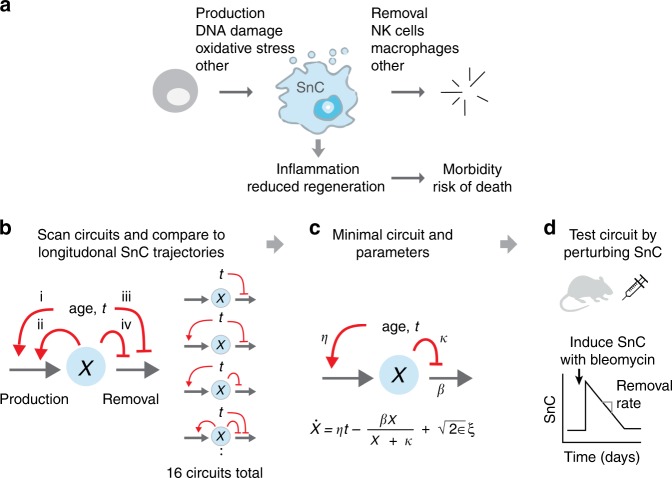
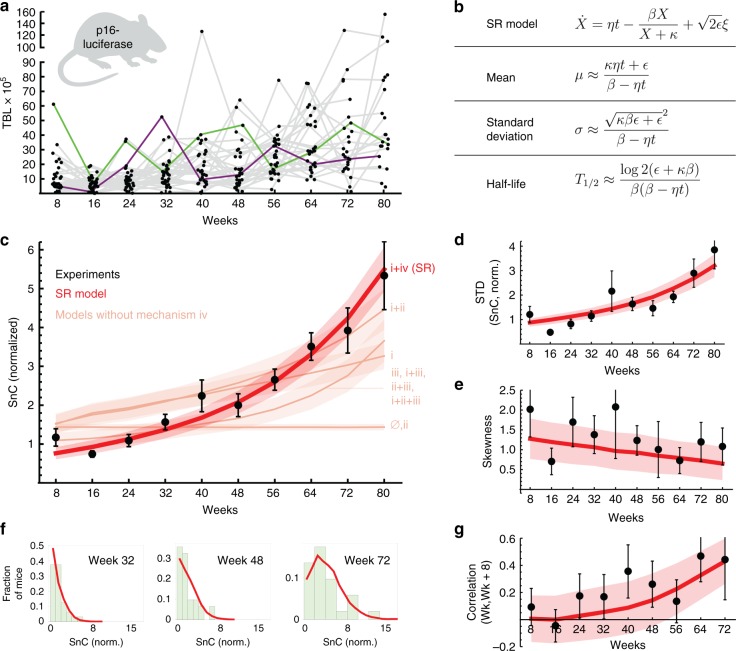
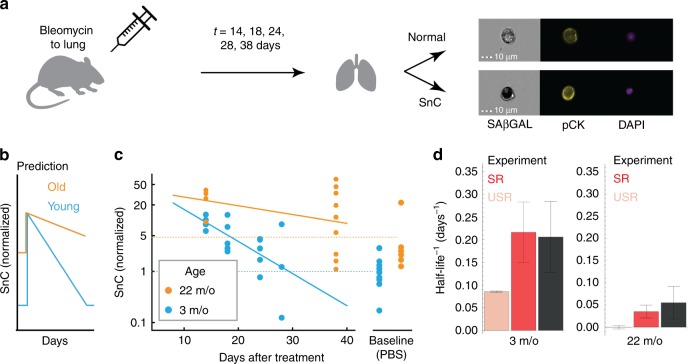
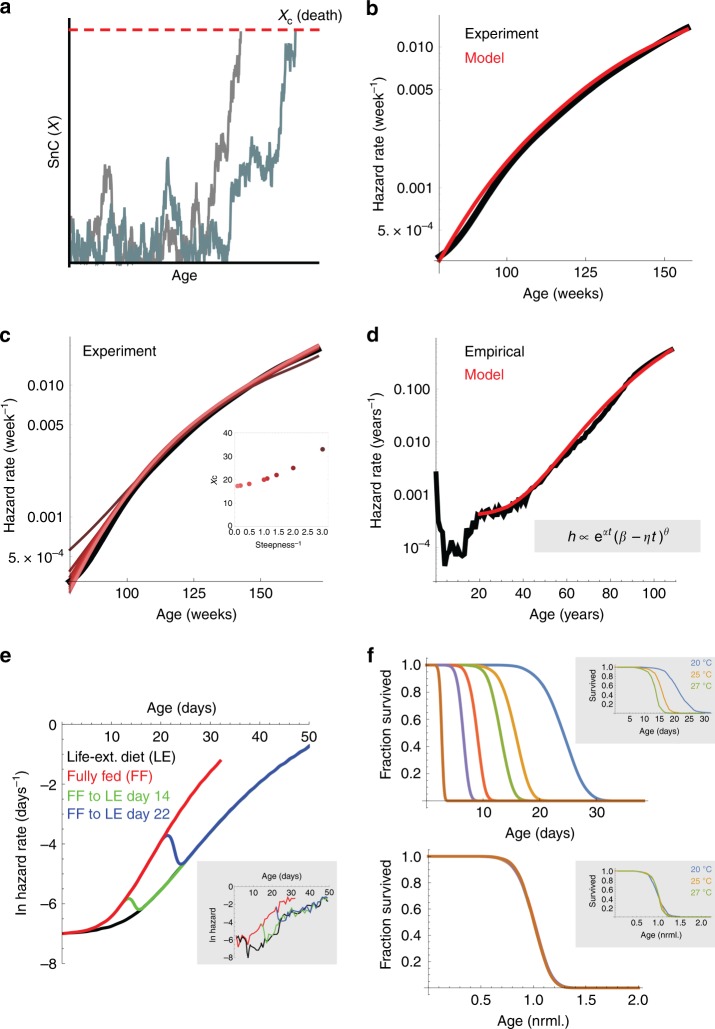
A causal factor in mammalian aging is the accumulation of senescent cells (SnCs). SnCs cause chronic inflammation, and removing SnCs decelerates aging in mice. Despite their importance, turnover rates of SnCs are unknown, and their connection to aging dynamics is unclear. Here we use longitudinal SnC measurements and induction experiments to show that SnCs turn over rapidly in young mice, with a half-life of days, but slow their own removal rate to a half-life of weeks in old mice. This leads to a critical-slowing-down that generates persistent SnC fluctuations. We further demonstrate that a mathematical model, in which death occurs when fluctuating SnCs cross a threshold, quantitatively recapitulates the Gompertz law of mortality in mice and humans. The model can go beyond SnCs to explain the effects of lifespan-modulating interventions in Drosophila and C. elegans , including scaling of survival-curves and rapid effects of dietary shifts on mortality.
Overview
The claims and statistics of this paper haven’t been checked yet.
Free: it reads the open-access text and checks the first 5 claims that cite a source we can check. Create a free account to check every claim.
Integrity signals
Registry
Cites
Statistics
Figures
Verification
Claims the paper makes
The claims and statistics of this paper haven’t been checked yet.
Free: it reads the open-access text and checks the first 5 claims that cite a source we can check. Create a free account to check every claim.
Claims other papers make about this one
Each is checked against this paper’s own text: does it say what the citing paper says it does?
The source backs part of the claim, not all of it — or backs it for a different population, condition or comparison.
In the citing paper
“It is clear that the immune system has the capacity to eliminate senescent cells in certain contexts; however, the clearance process seems to become dysfunctional with age and in disease, possibly explaining the accumulation of senescent cells with age273.”
From Cellular senescence in ageing: from mechanisms to therapeutic opportunities (2021) · cites this paper as [273]
Experimental — accuracy not yet measuredThe source backs part of the claim, not all of it — or backs it for a different population, condition or comparison.
In the citing paper
“Based on studies in salamander limb regeneration [61] and in bleomycin-induced senescence in young mice [62], turnover of senescent cells is estimated to be about four weeks.”
From Reducing Senescent Cell Burden in Aging and Disease (2020) · cites this paper as [62]
Experimental — accuracy not yet measuredThe source backs part of the claim, not all of it — or backs it for a different population, condition or comparison.
In the citing paper
“senescent cells accumulate in aged tissues,31,32,33 including the brain.34,35,36”
From Uncovering the signatures of aging and senescence in the human dorsolateral prefrontal cortex (2026) · cites this paper as [31]
Experimental — accuracy not yet measuredThe source backs part of the claim, not all of it — or backs it for a different population, condition or comparison.
In the citing paper
“Mathematically, if damage did not saturate, that is, if removal was −βx, the steady-state damage would rise linearly with age, whereas experiments indicate that damage accelerates with age2,19,20.”
From A damage accumulation model identifies distinct aging regimes across species (2026) · cites this paper as [19]
Experimental — accuracy not yet measuredThe source backs part of the claim, not all of it — or backs it for a different population, condition or comparison.
In the citing paper
“The SR model explains many quantitative patterns of aging including Gompertz and Weibull hazard curves19, distributions of human frailty index2, disease incidence curves31 and heritability of lifespan32.”
From A damage accumulation model identifies distinct aging regimes across species (2026) · cites this paper as [19]
Experimental — accuracy not yet measured
8 more claims about this paper
Create a free account to see every claim other papers make about this one.
Self-check
Percentages, sums and reported differences re-computed from the paper’s own numbers.
The self-check needs the paper’s full text.
Citations
Cites
López-Otín, C., Blasco, M. A., Partridge, L., Serrano, M., & Kroemer, G. (2013) · Cell · doi:10.1016/j.cell.2013.05.039 · Cited by 14,982
A biomarker that identifies senescent human cells in culture and in aging skin in vivo.
Dimri, G. P., Lee, X., Basile, G., Acosta, M., Scott, G., Roskelley, C., Medrano, E. E., Linskens, M., Rubelj, I., & Pereira-Smith, O. (1995) · Proceedings of the National Academy of Sciences · doi:10.1073/pnas.92.20.9363 · Cited by 7,477
Revised Estimates for the Number of Human and Bacteria Cells in the Body
Sender, R., Fuchs, S., & Milo, R. (2016) · PLOS Biology · doi:10.1371/journal.pbio.1002533 · Cited by 5,425
Early-warning signals for critical transitions
Scheffer, M., Bascompte, J., Brock, W. A., Brovkin, V., Carpenter, S. R., Dakos, V., Held, H., van Nes, E. H., Rietkerk, M., & Sugihara, G. (2009) · Nature · doi:10.1038/nature08227 · Cited by 4,854
Cellular senescence: when bad things happen to good cells
Campisi, J., & d'Adda di Fagagna, F. (2007) · Nature Reviews Molecular Cell Biology · doi:10.1038/nrm2233 · Cited by 4,441
Chronic Inflammation (Inflammaging) and Its Potential Contribution to Age-Associated Diseases
Franceschi, C., & Campisi, J. (2014) · The Journals of Gerontology Series A: Biological Sciences and Medical Sciences · doi:10.1093/gerona/glu057 · Cited by 3,891
Gompertz, B. (1825) · Philosophical Transactions of the Royal Society of London · doi:10.1098/rstl.1825.0026 · Cited by 3,816
A C. elegans mutant that lives twice as long as wild type
Kenyon, C., Chang, J., Gensch, E., Rudner, A., & Tabtiang, R. (1993) · Nature · doi:10.1038/366461a0 · Cited by 3,387
Naturally occurring p16Ink4a-positive cells shorten healthy lifespan
Baker, D. J., Childs, B. G., Durik, M., Wijers, M. E., Sieben, C. J., Zhong, J., A. Saltness, R., Jeganathan, K. B., Verzosa, G. C., Pezeshki, A., et al. (2016) · Nature · doi:10.1038/nature16932 · Cited by 2,876
Cellular senescence: from physiology to pathology
Muñoz-Espín, D., & Serrano, M. (2014) · Nature Reviews Molecular Cell Biology · doi:10.1038/nrm3823 · Cited by 2,818
Research works printed but not linked: 1
- Flindt, R. Amazing Numbers in Biology (Springer-Verlag, 2006).
Cited by
Cellular senescence in ageing: from mechanisms to therapeutic opportunities
Di Micco, R., Krizhanovsky, V., Baker, D., & d’Adda di Fagagna, F. (2021) · Nature Reviews Molecular Cell Biology · doi:10.1038/s41580-020-00314-w · Cited by 2,277
Self-citationCellular senescence and senolytics: the path to the clinic
Chaib, S., Tchkonia, T., & Kirkland, J. L. (2022) · Nature Medicine · doi:10.1038/s41591-022-01923-y · Cited by 1,134
SenNet recommendations for detecting senescent cells in different tissues
Suryadevara, V., Hudgins, A. D., Rajesh, A., Pappalardo, A., Karpova, A., Dey, A. K., Hertzel, A., Agudelo, A., Rocha, A., Soygur, B., et al. (2024) · Nature Reviews Molecular Cell Biology · doi:10.1038/s41580-024-00738-8 · Cited by 408
Immune ageing at single-cell resolution
Mogilenko, D. A., Shchukina, I., & Artyomov, M. N. (2022) · Nature Reviews Immunology · doi:10.1038/s41577-021-00646-4 · Cited by 381
The heterogeneity of cellular senescence: insights at the single-cell level
Cohn, R. L., Gasek, N. S., Kuchel, G. A., & Xu, M. (2023) · Trends in Cell Biology · doi:10.1016/j.tcb.2022.04.011 · Cited by 294
Bone Aging, Cellular Senescence, and Osteoporosis
Pignolo, R. J., Law, S. F., & Chandra, A. (2021) · JBMR Plus · doi:10.1002/jbm4.10488 · Cited by 201
“Senolytic agents can likely be given once or consecutive times over a few days every 4–6 weeks based on estimations of senescent cell turnover and thus the time to reaccumulation of senescent cells.((205,206)) Senomodulators would need to be given more frequently, probably daily, increasing the likelihood of adverse d…”
BackgroundSenescence as a therapeutic target in cancer and age-related diseases
McHugh, D., Durán, I., & Gil, J. (2025) · Nature Reviews Drug Discovery · doi:10.1038/s41573-024-01074-4 · Cited by 197
“…of SnCs during ageing are not well understood but likely relate to increased damage (including telomeric damage, DNA damage, mitochondrial mutations and oxidative stress), the activation of immune suppressive responses 52 and the reduced clearance of SnCs by the immune system with age 61 .”
Generation of a p16 Reporter Mouse and Its Use to Characterize and Target p16high Cells In Vivo
Omori, S., Wang, T.-W., Johmura, Y., Kanai, T., Nakano, Y., Kido, T., Susaki, E. A., Nakajima, T., Shichino, S., Ueha, S., et al. (2020) · Cell Metabolism · doi:10.1016/j.cmet.2020.09.006 · Cited by 194
Fracture Healing in the Setting of Endocrine Diseases, Aging, and Cellular Senescence
Saul, D., & Khosla, S. (2022) · Endocrine Reviews · doi:10.1210/endrev/bnac008 · Cited by 185
A genome-wide CRISPR-based screen identifies KAT7 as a driver of cellular senescence
Wang, W., Zheng, Y., Sun, S., Li, W., Song, M., Ji, Q., Wu, Z., Liu, Z., Fan, Y., Liu, F., et al. (2021) · Science Translational Medicine · doi:10.1126/scitranslmed.abd2655 · Cited by 178
On the evolution of cellular senescence
Kowald, A., Passos, J. F., & Kirkwood, T. B. L. (2020) · Aging Cell · doi:10.1111/acel.13270 · Cited by 179
“Furthermore, in our favored model new senescent cells are generated at a fixed rate (k) plus a feedback based on the bystander mechanism, while in the model of Karin et al. (2019) the generation depends explicitly on time (η * t).”
BackgroundInfluentialReducing Senescent Cell Burden in Aging and Disease
Pignolo, R. J., Passos, J. F., Khosla, S., Tchkonia, T., & Kirkland, J. L. (2020) · Trends in Molecular Medicine · doi:10.1016/j.molmed.2020.03.005 · Cited by 177
Proteostasis collapse is a driver of cell aging and death
Santra, M., Dill, K. A., & de Graff, A. M. R. (2019) · Proceedings of the National Academy of Sciences · doi:10.1073/pnas.1906592116 · Cited by 175
Cellular Senescence: From Mechanisms to Current Biomarkers and Senotherapies
Lucas, V., Cavadas, C., & Aveleira, C. A. (2023) · Pharmacological Reviews · doi:10.1124/pharmrev.122.000622 · Cited by 160
Wang, B., Wang, L., Gasek, N. S., Zhou, Y., Kim, T., Guo, C., Jellison, E. R., Haynes, L., Yadav, S., Tchkonia, T., et al. (2021) · Nature Aging · doi:10.1038/s43587-021-00107-6 · Cited by 145
Emerging role of senescent microglia in brain aging-related neurodegenerative diseases
Rim, C., You, M., Nahm, M., & Kwon, M. (2024) · Translational Neurodegeneration · doi:10.1186/s40035-024-00402-3 · Cited by 174
“According to the threshold theory of senescent cell accumulation [54], when the number of senescent cells in the body rises to surpass a threshold, the immune system and other organs would be more prone to aging-related diseases [55].”
BackgroundAge Related Osteoporosis: Targeting Cellular Senescence
Föger‐Samwald, U., Kerschan‐Schindl, K., Butylina, M., & Pietschmann, P. (2022) · International Journal of Molecular Sciences · doi:10.3390/ijms23052701 · Cited by 133
“Taken together, an aging immune system fails to clear tissues from senescent cells, which, in turn, promotes a state of chronic inflammation [4,33,34].”
BackgroundCellular Senescence as the Pathogenic Hub of Diabetes-Related Wound Chronicity
Berlanga‐Acosta, J., Guillén, G. E., Rodríguez-Rodríguez, N., Mendoza‐Marí, Y., Bringas-Vega, M. L., Berlanga-Saez, J. O., Herrera, D. G. D. B., Martínez-Jiménez, I., Hernandez-Gutierrez, S., & Valdes-Sosa, P. A. (2020) · Frontiers in Endocrinology · doi:10.3389/fendo.2020.573032 · Cited by 132
p16-dependent increase of PD-L1 stability regulates immunosurveillance of senescent cells
Majewska, J., Agrawal, A., Mayo, A., Roitman, L., Chatterjee, R., Sekeresova Kralova, J., Landsberger, T., Katzenelenbogen, Y., Meir-Salame, T., Hagai, E., et al. (2024) · Nature Cell Biology · doi:10.1038/s41556-024-01465-0 · Cited by 114
“In each experiment, the number of animals was chosen to have sufficient statistical power on the basis of the literature and experience 6,7,15 .”
Self-citationPolyphenols as Caloric-Restriction Mimetics and Autophagy Inducers in Aging Research
Yessenkyzy, A., Saliev, T. M., Zhanaliyeva, M., Masoud, A., Umbayev, B. A., Sergazy, S., Кривых, Е. А., Gulyayev, A., & Nurgozhin, T. S. (2020) · Nutrients · doi:10.3390/nu12051344 · Cited by 121
Senescent cells suppress macrophage-mediated corpse removal via upregulation of the CD47-QPCT/L axis
Schloesser, D., Lindenthal, L., Sauer, J., Chung, K.-J., Chavakis, T., Griesser, E., Baskaran, P., Maier-Habelsberger, U., Fundel-Clemens, K., Schlotthauer, I., et al. (2023) · Journal of Cell Biology · doi:10.1083/jcb.202207097 · Cited by 108
Tripathi, U., Misra, A., Tchkonia, T., & Kirkland, J. L. (2021) · Mechanisms of Ageing and Development · doi:10.1016/j.mad.2021.111548 · Cited by 104
“1) Senescent cell turnover slows with age in mice, and this correlates with mortality [79].”
Principles of the Molecular and Cellular Mechanisms of Aging
da Silva, P. F. L., & Schumacher, B. (2021) · Journal of Investigative Dermatology · doi:10.1016/j.jid.2020.11.018 · Cited by 100
The role of senescent T cells in immunopathology
Covre, L. P., De Maeyer, R. P. H., Gomes, D. C. O., & Akbar, A. N. (2020) · Aging Cell · doi:10.1111/acel.13272 · Cited by 93
“Despite the evidence for senescent cell clearance by the immune system, it is not yet clear why senescent cells accumulate during ageing and persist at sites of age-related pathology (Karin et al., 2019; Ovadya et al., 2018; Sharpless & Sherr, 2015).”
BackgroundCan blocking inflammation enhance immunity during aging?
Chambers, E. S., & Akbar, A. N. (2020) · Journal of Allergy and Clinical Immunology · doi:10.1016/j.jaci.2020.03.016 · Cited by 92
“However a recent paper showed that there is reduced elimination of senescent cells during ageing that would also account for their accumulation (59).”
BackgroundSenescent cells and the incidence of age‐related diseases
Katzir, I., Adler, M., Karin, O., Mendelsohn‐Cohen, N., Mayo, A., & Alon, U. (2021) · Aging Cell · doi:10.1111/acel.13314 · Cited by 85
“The parameters of the SR model for the senescent cells stochastic process are considered to be fixed and are taken from ref (Karin et al., 2019).”
BackgroundMethodInfluentialSelf-citationDissecting primary and secondary senescence to enable new senotherapeutic strategies
Admasu, T. D., Rae, M. J., & Stolzing, A. (2021) · Ageing Research Reviews · doi:10.1016/j.arr.2021.101412 · Cited by 103
Elyahu, Y., & Monsonego, A. (2020) · Ageing Research Reviews · doi:10.1016/j.arr.2020.101231 · Cited by 103
“1–2 decades before the appearance of clinical symptoms, an early intervention in the low-grade inflammation and senescence processes appears to be therapeutically promising (Baker et al., 2016; Karin et al., 2019).”
The redox-senescence axis and its therapeutic targeting
Ngoi, N. Y., Liew, A. Q., Chong, S. J. F., Davids, M. S., Clement, M.-V., & Pervaiz, S. (2021) · Redox Biology · doi:10.1016/j.redox.2021.102032 · Cited by 88
The aged extracellular matrix and the profibrotic role of senescence-associated secretory phenotype
Mebratu, Y. A., Soni, S., Rosas, L., Rojas, M. M., Horowitz, J. C., & Nho, R. S. (2023) · American Journal of Physiology-Cell Physiology · doi:10.1152/ajpcell.00124.2023 · Cited by 103
Cellular Senescence: Mechanisms and Therapeutic Potential
Liao, Z., Yeo, H. L., Wong, S. W., & Zhao, Y. X. (2021) · Biomedicines · doi:10.3390/biomedicines9121769 · Cited by 94
Musson, R., Gąsior, Ł., Bisogno, S., & Ptak, G. (2022) · Human Reproduction Update · doi:10.1093/humupd/dmab046 · Cited by 106
“However, some authors argue that senescence only contributes to ageing because old organisms lack a sufficient cell-replacement mechanism to compensate for cell functionality lost via senescence (López-Ot ın et al., 2013; Karin et al., 2019).”
Discovering small-molecule senolytics with deep neural networks
Wong, F., Omori, S., Donghia, N. M., Zheng, E. J., & Collins, J. J. (2023) · Nature Aging · doi:10.1038/s43587-023-00415-z · Cited by 82
“Indeed, the phenotypic and network-based approaches used to discover and model the effects of senolytics have had more in common with those used for antibiotics than typical one-target–one-drug–one-disease approaches 16,81 .”
Cellular senescence in asthma: from pathogenesis to therapeutic challenges
Wan, R., Srikaram, P., Guntupalli, V., Hu, C., Chen, Q., & Gao, P. (2023) · EBioMedicine · doi:10.1016/j.ebiom.2023.104717 · Cited by 92
Senescent cells as promising targets to tackle age-related diseases
Prašnikar, E., Borišek, J., & Perdih, A. (2021) · Ageing Research Reviews · doi:10.1016/j.arr.2020.101251 · Cited by 73
Narzt, M.-S., Pils, V., Kremslehner, C., Nagelreiter, I.-M., Schosserer, M., Bessonova, E., Bayer, A., Reifschneider, R., Terlecki-Zaniewicz, L., Waidhofer-Söllner, P., et al. (2021) · Journal of Investigative Dermatology · doi:10.1016/j.jid.2020.11.020 · Cited by 73
The senescence journey in cancer immunoediting
Zingoni, A., Antonangeli, F., Sozzani, S., Santoni, A., Cippitelli, M., & Soriani, A. (2024) · Molecular Cancer · doi:10.1186/s12943-024-01973-5 · Cited by 84
“However, during cancer progression or in older individuals, this control is less efficient or partially inhibited, leading to the accumulation of SnCs [6].”
BackgroundCellular senescence in lymphoid organs and immunosenescence
Budamagunta, V., Foster, T. C., & Zhou, D. (2021) · Aging · doi:10.18632/aging.203405 · Cited by 67
“leads to the accumulation of SnCs [34].”
Senescent stromal cells: roles in the tumor microenvironment
Gabai, Y., Assouline, B., & Ben‐Porath, I. (2022) · Trends in cancer · doi:10.1016/j.trecan.2022.09.002 · Cited by 69
Senescence under appraisal: hopes and challenges revisited
Davan-Wetton, C. S. A., Pessolano, E., Perretti, M., & Montero‐Melendez, T. (2021) · Cellular and Molecular Life Sciences · doi:10.1007/s00018-020-03746-x · Cited by 64
“In a bleomycin model, it has been shown that senescent cell turnover can take from days in young mice to weeks in old animals [50], and that the reduced CD8+ T cell cytotoxic activity associated with age accelerates the accumulation of senescent cells [51].”
BackgroundWhat if there’s no such thing as “aging”?
Cohen, A. A., Legault, V., & Fülöp, T. (2020) · Mechanisms of Ageing and Development · doi:10.1016/j.mad.2020.111344 · Cited by 58
“Gavrilov and Gavrilova, 2001), or emerge from simple underlying processes (Karin et al., 2019).”
Elevated skin senescence in young mice causes delayed wound healing
Thanapaul, R. J. R. S., Shvedova, M., Shin, G. H., Crouch, J. D., & Roh, D. S. (2022) · GeroScience · doi:10.1007/s11357-022-00551-1 · Cited by 52
“2A, B) which also have increased baseline skin senescence [24, 25].”
BackgroundThe complex interplay between aging and cancer
Trastus, L. A., & di Fagagna, F. D. (2025) · Nature Aging · doi:10.1038/s43587-025-00827-z · Cited by 65
“Therefore, the exponential increase of senescent cells with aging fits a model that combines their linear accumulation due to senescence-inducing stimuli and a slowdown in their removal dependent on their abundance 119 .”
Senescent cell accumulation mechanisms inferred from parabiosis
Karin, O., & Alon, U. (2021) · GeroScience · doi:10.1007/s11357-020-00286-x · Cited by 48
“The drop in senescent cells in OY is seen within about a month, which corresponds to the lifetime of senescent cells in old mice, experimentally determined in Karin 2019.”
BackgroundSelf-citationAgeing, immune fitness and cancer
Dolan, M., Libby, K. A., Ringel, A. E., van Galen, P., & McAllister, S. S. (2025) · Nature reviews. Cancer · doi:10.1038/s41568-025-00858-z · Cited by 62
“Fibroblasts can undergo senescence with increasing age 233 , acquiring a senescence-associated secretory phenotype 234 that modulates immune cell recruitment and activity with context-dependent effects on antitumour immunity 235–237 (Fig.”
Sharma, R. (2021) · Biogerontology · doi:10.1007/s10522-021-09936-9 · Cited by 55
Iwasaki, K., Abarca, C., & Aguayo‐Mazzucato, C. (2023) · Diabetes & Metabolism Journal · doi:10.4093/dmj.2022.0416 · Cited by 52
“org Diabetes Metab J 2023;47:441-453 444 immune function declines with age, resulting in an increased load of senescent cells [41].”
BackgroundThe purpose and ubiquity of turnover
Reddien, P. W. (2024) · Cell · doi:10.1016/j.cell.2024.04.034 · Cited by 48
“30 Similarly, cells can become senescent, secrete damaging factors, and become hard to remove, 31 or they could become cancerous.”
Telomere Shortening and Its Association with Cell Dysfunction in Lung Diseases
Ruíz, A., Flores‐González, J., Buendía-Roldán, I., & Chávez‐Galán, L. (2021) · International Journal of Molecular Sciences · doi:10.3390/ijms23010425 · Cited by 49
“Moreover, these molecules are identified at a different cellular level, from the genetic to protein level, and they provide information regarding signaling pathways of senescence [44,45].”
BackgroundImmune surveillance of senescent cells in aging and disease
Majewska, J., & Krizhanovsky, V. (2025) · Nature Aging · doi:10.1038/s43587-025-00910-5 · Cited by 58
“The immune system maintains the normal turnover of senescent cells in young organisms, a process that is disrupted in aging 20 .”
Self-citationRecent insights into the crosstalk between senescent cells and CD8 T lymphocytes
Marin, I., Serrano, M., & Pietrocola, F. (2023) · npj Aging · doi:10.1038/s41514-023-00105-5 · Cited by 36
Damage dynamics and the role of chance in the timing of E. coli cell death
Yang, Y., Karin, O., Mayo, A., Song, X., Chen, P., Santos, A. L., Lindner, A. B., & Alon, U. (2023) · Nature Communications · doi:10.1038/s41467-023-37930-x · Cited by 36
Self-citationTransplanting old organs promotes senescence in young recipients
Iske, J., Roesel, M. J., Martin, F., Schroeter, A., Matsunaga, T., Maenosono, R., Tripathi, U., Xiao, Y., Nian, Y., Caldarone, B. J., et al. (2023) · American Journal of Transplantation · doi:10.1016/j.ajt.2023.10.013 · Cited by 37
Diwan, B., & Sharma, R. (2022) · Food Science and Biotechnology · doi:10.1007/s10068-022-01114-y · Cited by 40
Heritability of intrinsic human life span is about 50% when confounding factors are addressed
Shenhar, B., Pridham, G., Oliveira, T. L. D., Yang, Y., Raz, N., Deelen, J., Hägg, S., & Alon, U. (2026) · Science · doi:10.1126/science.adz1187 · Cited by 54
Self-citationEffect of Aging on Homeostasis in the Soft Tissue of the Periodontium: A Narrative Review
Kim, Y. G., Lee, S. M., Bae, S., Park, T., Kim, H.-J., Jang, Y., Moon, K., Kim, H., Lee, K.-M., Park, J., et al. (2021) · Journal of Personalized Medicine · doi:10.3390/jpm11010058 · Cited by 42
“Accumulation of senescent cells is also observed in humans in several tissues [20].”
BackgroundSalamander Insights Into Ageing and Rejuvenation
Yun, M. H. (2021) · Frontiers in Cell and Developmental Biology · doi:10.3389/fcell.2021.689062 · Cited by 36
Prognostic and therapeutic potential of senescent stromal fibroblasts in prostate cancer
Mori, J., Elhussin, I. A., Brennen, W. N., Graham, M. K., Lotan, T. L., Yates, C. C., Marzo, A. M. D., Denmeade, S. R., Yegnasubramanian, S., Nelson, W. G., et al. (2023) · Nature Reviews Urology · doi:10.1038/s41585-023-00827-x · Cited by 35
“IL-6 and other factors can also act in a paracrine manner to induce senescence in neighbouring cells, termed (bystander effects) 101,130 .”
InfluentialMajor depression, physical health and molecular senescence markers abnormalities
Seitz‐Holland, J., Mulsant, B. H., Reynolds, C. F., Blumberger, D. M., Karp, J. F., Butters, M. A., Mendes‐Silva, A. P., Vieira, É. L. M., Tseng, G. C., Lenze, E. J., et al. (2023) · Nature Mental Health · doi:10.1038/s44220-023-00033-z · Cited by 33
“However, the accumulation of senescent cells and the increased secretion of SASP proteins with age is linked to tissue deterioration and the emergence of physical disorders prevalent in older adults 16 .”
BackgroundWang, J., Zhou, X., Yu, P., Yao, J., Guo, P., Xu, Q., Zhao, Y., Wang, G., Li, Q., Zhu, X., et al. (2025) · Nature Aging · doi:10.1038/s43587-025-00886-2 · Cited by 28
“Consistent with age-related accumulation of cellular senescence 131,132 The distribution of cell lines and senescence types is shown in pie charts (lower left and lower right, respectively).”
Counteracting Immunosenescence—Which Therapeutic Strategies Are Promising?
Hieber, C., Grabbe, S., & Bros, M. (2023) · Biomolecules · doi:10.3390/biom13071085 · Cited by 30
“Senescent cells that are characterized by replicative arrest express p16Ink4a and accumulate in the elderly due to an impaired turnover [11] caused in part by upregulation of the non-classical MHC receptor human leukocyte antigen (HLA)-E in a SASP-dependent manner [448].”
BackgroundA hierarchical process model links behavioral aging and lifespan in C. elegans
Oswal, N., Martin, O. M. F., Stroustrup, S., Bruckner, M. A. M., & Stroustrup, N. (2022) · PLOS Computational Biology · doi:10.1371/journal.pcbi.1010415 · Cited by 27
Raynard, C., Ma, X., Huna, A., Tessier, N., Massemin, A., Zhu, K., Flaman, J., Moulin, F., Goehrig, D., Médard, J., et al. (2022) · Aging Cell · doi:10.1111/acel.13632 · Cited by 26
“This is in line with our results showing that the secretome of senescent cells can induce NED as senescent cells and their secretome accumulate with aging (Karin et al., 2019; van Deursen, 2014).”
BackgroundResultAggregates of fluorescent gels assembled by interfacial dynamic bonds
Hu, Z., Xu, S., Zhang, H., & Ji, X. (2022) · Aggregate · doi:10.1002/agt2.283 · Cited by 27
The potential for complex computational models of aging
Farrell, S., Stubbings, G., Rockwood, K. J., Mitnitski, A., & Rutenberg, A. D. (2020) · Mechanisms of Ageing and Development · doi:10.1016/j.mad.2020.111403 · Cited by 28
“Particular aspects of the aging process, such as cellular senescence (Karin et al., 2019), can be similarly detailed.”
BackgroundCellular and molecular features of senescence in acute lung injury
Huidobro, C., Martín-Vicente, P., López‐Martínez, C., López-Alonso, I., Amado‐Rodríguez, L., Crespo, I., & Albaiceta, G. M. (2020) · Mechanisms of Ageing and Development · doi:10.1016/j.mad.2020.111410 · Cited by 20
Sharma, R. (2021) · PharmaNutrition · doi:10.1016/j.phanu.2021.100281 · Cited by 23
Nagaraj, K., Sarfstein, R., Laron, Z., & Werner, H. (2022) · Cells · doi:10.3390/cells11203260 · Cited by 22
Liu, Y., Hong, T., Lv, M., Guo, X., Zhang, P. Y., Yan, A., & Wei, W. (2025) · Alzheimer s Research & Therapy · doi:10.1186/s13195-025-01783-x · Cited by 29
“However, with aging, the efficiency of this clearance process declines, leading to an accumulation of senescent cells within tissues, including the brain [10, 11].”
The crosstalk between cellular reprogramming and senescence in aging and regeneration
Chiche, A., Chen, C., & Li, H. (2020) · Experimental Gerontology · doi:10.1016/j.exger.2020.111005 · Cited by 22
Parvizi, M., Ryan, Z. C., Ebtehaj, S., Arendt, B. K., & Lanza, I. R. (2020) · Biochimica et Biophysica Acta (BBA) - Molecular Basis of Disease · doi:10.1016/j.bbadis.2020.165983 · Cited by 20
Principles of bacteriostatic and bactericidal antibiotics at subinhibitory concentrations
Vaisbourd, E., Glass, D. S., Yang, Y., Mayo, A., Bren, A., & Alon, U. (2025) · mBio · doi:10.1128/mbio.02066-25 · Cited by 24
“…onset depends on the duration of treatment, we posit that cidal antibiotics generate intracellular damage, y , which stops rapid growth when it crosses a threshold y c (43, 44). assume We that the damage production rate depends on the growth rate r , and that damage is diluted by biomass growth.”
Self-citationCompression of morbidity by interventions that steepen the survival curve
Yang, Y., Mayo, A., Levy, T., Raz, N., Shenhar, B., Jarosz, D. F., & Alon, U. (2025) · Nature Communications · doi:10.1038/s41467-025-57807-5 · Cited by 18
Self-citationOmote, N., & Sauler, M. (2020) · Frontiers in Medicine · doi:10.3389/fmed.2020.603047 · Cited by 17
“However, the accumulation of senescent cells with age also causes chronic inflammation, extracellular matrix alterations, a decline in tissue regeneration, and an increased risk for many aging-related disorders (16).”
BackgroundFleyshman, D. I., Wakshlag, J. J., Huson, H. J., Loftus, J. P., Olby, N. J., Brodsky, L., Gudkov, A. V., & Andrianova, E. L. (2021) · Aging · doi:10.18632/aging.203600 · Cited by 19
“Finally, we will evaluate biomarkers of senescent cells since their accumulation in somatic tissues has been linked to mammalian aging [79, 137, 138].”
MethodImmune Checkpoint Inhibitors in Geriatric Oncology
Cook, S. L., Amin, M. A., Bari, S., Poonnen, P. J., Khasraw, M., & Johnson, M. O. (2024) · Current Oncology Reports · doi:10.1007/s11912-024-01528-3 · Cited by 19
“Senescent cells accumulate in aging, with mouse models showing the half-life of senescent cells more than quadruples as mice age from 3 to 22 months [10], and transplant of senescent cells from old to young mice can induce physical dysfunctions in the recipients [11].”
Arai, Y., Chavkin, N. W., Arai, Y., Halvardson, J., Bjurling, J., Doviak, H., Cochran, J. D., Evans, M. A., Horitani, K., Yura, Y., et al. (2025) · Science Translational Medicine · doi:10.1126/scitranslmed.adv4071 · Cited by 17
Recent Advances in Senolysis for Age-Related Diseases
Aratani, S., & Nakanishi, M. (2023) · Physiology · doi:10.1152/physiol.00003.2023 · Cited by 19
Insulin-like growth factors and aging: lessons from Laron syndrome
Werner, H., & Laron, Z. (2023) · Frontiers in Endocrinology · doi:10.3389/fendo.2023.1291812 · Cited by 19
Yde, P., Jensen, M. K., Mitarai, N., & Bhatt, S. (2024) · Scientific Reports · doi:10.1038/s41598-024-51669-5 · Cited by 30
Cellular senescence as a source of SARS‐CoV‐2 quasispecies
Karakasiliοtis, I., Lаgopati, N., Evangelou, K., & Gorgoulis, V. G. (2021) · FEBS Journal · doi:10.1111/febs.16230 · Cited by 15
The Role of PGC-1α in Aging Skin Barrier Function
Luo, Y., & Bollag, W. B. (2024) · Cells · doi:10.3390/cells13131135 · Cited by 17
Enhanced cellular longevity arising from environmental fluctuations
Liu, Y., Zhou, Z., Su, H., Wu, S., Ni, G., Zhang, A., Tsimring, L. S., Hasty, J., & Hao, N. (2024) · Cell Systems · doi:10.1016/j.cels.2024.07.007 · Cited by 16
“…of glucose alterations on lifespan, we linked the Sir2-HAP circuit to cell death using a paradigmatic model framework, recently developed by Uri Alon’s group, 59,60 in which the aging process is described as a competition be-tween accelerating damage accumulation and saturating damage removal.”
MethodTargeting senescent cells in atherosclerosis: Pathways to novel therapies
Tian, Y., Shao, S., Feng, H., Zeng, R., Li, S., & Zhang, Q. (2024) · Ageing Research Reviews · doi:10.1016/j.arr.2024.102502 · Cited by 16
Teulière, J., Bernard, C., Bonnefous, H., Martens, J., Lopez, P., & Bapteste, E. P. (2023) · Molecular Biology and Evolution · doi:10.1093/molbev/msad012 · Cited by 15
“…et al. 2020), as it induces dysregulation of the host homeostasis, for example, when senescent cells accumulate faster than they are removed, and/or due to an aggravation of immunosenescence, caused by the known bystander effect exerted by senescent cells on their neighbors (Karin et al. 2019).”
BackgroundRyou, I. S., Lee, S. W., Mun, H., Lee, J. K., Chun, S.-Y., & Cho, K. (2023) · BMC Geriatrics · doi:10.1186/s12877-023-04578-7 · Cited by 13
“Assuming that death occurs when senescent cells exceed the threshold, the SR model can explain the distribution of death time [26, 27].”
BackgroundTeulière, J., Bernard, C., & Bapteste, E. P. (2021) · Ageing Research Reviews · doi:10.1016/j.arr.2021.101375 · Cited by 13
“…dysregulation of the host homeostasis, e.g. when senescent cells accumulate faster than they are removed from an ageing host due to a viral AD, and/or due to an aggravation of immunosenescence, caused by the known bystander effect exerted by senescent cells on their neighbours (Karin et al., 2019).”
BackgroundTargeting immunosenesence promotes clearance of senescent cells
Tizazu, A. M., Tessema, E. A., & Cexus, O. (2025) · Immunity & Ageing · doi:10.1186/s12979-025-00518-8 · Cited by 15
“Furthermore, the persistent generation of senescent cells beyond the clearance capacities of the increasingly compromised immune system with age could be linked with the observed increased number of senescent cells with age, with potentially detrimental consequences [61].”
A Cellular Senescence-Centric Integrated Approach to Understanding Organismal Aging
Sharma, R., & Diwan, B. (2022) · Current Aging Science · doi:10.2174/1874609815666220914104548 · Cited by 9
Targeting cellular senescence: A promising approach in respiratory diseases
Sugimoto, M. (2023) · Geriatrics and gerontology international/Geriatrics & gerontology international · doi:10.1111/ggi.14653 · Cited by 9
“6,7 This is attributed to the increased expression of PD-L1, which allows senescent cells to evade immune surveillance.”
BackgroundSizek, H., Deritei, D., Fleig, K., Harris, M., Regan, P., Glass, K., & Regan, E. R. (2024) · Translational Oncology · doi:10.1016/j.tranon.2024.102084 · Cited by 11
“Ideally done after deep senescence is accounted for, this project could bring together the conceptual clarity of population-only tissue aging models [123,124] with the predictive power displayed by earlier efforts at such multi-scale integration based on the models of mitochondrial dysfunction that…”
Transcriptional drift in aging cells: A global decontroller
Matsuzaki, T., Weistuch, C., de Graff, A. M. R., Dill, K. A., & Balázsi, G. (2024) · Proceedings of the National Academy of Sciences · doi:10.1073/pnas.2401830121 · Cited by 9
Network of extracellular vesicles surrounding senescent cells
Okawa, H., Tanaka, Y., & Takahashi, A. (2024) · Archives of Biochemistry and Biophysics · doi:10.1016/j.abb.2024.109953 · Cited by 8
Postmus, A. C., Kruit, J. K., Eilers, R. E., Havinga, R., Koster, M. H., Johmura, Y., Nakanishi, M., van de Sluis, B., & Jonker, J. W. (2023) · Toxicology and Applied Pharmacology · doi:10.1016/j.taap.2023.116531 · Cited by 8
The skin of the naked mole-rat and its resilience against aging and cancer
Wlaschek, M., Singh, K., Maity, P., & Scharffetter‐Kochanek, K. (2023) · Mechanisms of Ageing and Development · doi:10.1016/j.mad.2023.111887 · Cited by 8
Pridham, G., & Rutenberg, A. D. (2023) · Scientific Reports · doi:10.1038/s41598-023-49129-7 · Cited by 14
“Univariate dynamical modelling of senescent cell count in mice 6 and E. coli membrane integrity 26 supports the existence of such critical values, where repair mechanisms saturate and decline accelerates.”
InfluentialBreathe it in – Spotlight on senescence and regeneration in the lung
Majewska, J., & Krizhanovsky, V. (2021) · Mechanisms of Ageing and Development · doi:10.1016/j.mad.2021.111550 · Cited by 7
Self-citationSharma, R., & Diwan, B. (2022) · Human Nutrition & Metabolism · doi:10.1016/j.hnm.2022.200149 · Cited by 11
A damage accumulation model identifies distinct aging regimes across species
Raz, N., Yang, Y., Pridham, G., Shenhar, B., Frenkel, S., Levy, T., Tlusty, T., Mayo, A., & Alon, U. (2026) · Nature Aging · doi:10.1038/s43587-026-01138-7 · Cited by 7
“Senescent cells are removed by the immune system, so that a damage half-life of days is plausible and supported experimentally in mice 19 .”
InfluentialSelf-citationGuinn, L., Lo, E., & Balázsi, G. (2022) · Communications Biology · doi:10.1038/s42003-022-03228-9 · Cited by 7
Metadata
- Authors
- Karin, O., Agrawal, A., Porat, Z., Krizhanovsky, V., & Alon, U.
- Affiliations
- Weizmann Institute of Science (IL)
- Corresponding author
- Krizhanovsky, Valery
- Alon, Uri
- Venue
- Nature Communications
- Published
- 2019-12-02
- Volume
- 10
- Issue
- 1
- Pages
- 5495-5495
- ISSN
- 2041-1723 (ISSN-L)
- PMC
- PMC6889273
- OpenAlex
- W2991063431
- Cited by
- 151
- References
- 61
- Citations by year
- 2026: 17 · 2025: 20 · 2024: 25 · 2023: 23 · 2022: 18 · 2021: 26 · 2020: 22
- FWCI
- 6.00
- Type
- journal article
- Language
- en
- Open access
- gold
- doi.org
- Licence
- cc-by
- creativecommons.org/licenses/by/4.0 (tdm)
- creativecommons.org/licenses/by/4.0 (vor)
- Locations
- Nature Communications (publishedVersion, cc-by)
- PubMed Central (publishedVersion, cc-by)
- PubMed (publishedVersion)
- RePEc: Research Papers in Economics (submittedVersion)
- DOAJ (DOAJ: Directory of Open Access Journals) (submittedVersion)
- DOAJ (DOAJ: Directory of Open Access Journals) (submittedVersion, cc-by-sa)
- Funders
- European Commission (H2020)
- Israel Science Foundation
- Horizon 2020 Framework Programme
- Topics
- Life Sciences › Biochemistry, Genetics and Molecular Biology › Aging › Genetics, Aging, and Longevity in Model Organisms
- Life Sciences › Biochemistry, Genetics and Molecular Biology › Cell Biology › Telomeres, Telomerase, and Senescence
- Social Sciences › Demography › Insurance, Mortality, Demography, Risk Management
- Keywords
- senescent cells, cellular senescence, aging, critical slowing down, dietary restriction, survival curves, chronic inflammation, mice, Drosophila, Caenorhabditis elegans
- MeSH terms
- Age Factors, Aging, Animals, Drosophila, Female, Longevity, Male, Mice, Inbred C57BL, Models, Biological, Models, Theoretical, Cellular Senescence, Caenorhabditis elegans, Mice
About these checks
Registry, retraction, Cites and statistics results are computed, not judged, with one exception: a printed reference that no index lists is read once by a model before it counts as a citation error. Claims are extracted by a model and kept only when their quote appears verbatim in the text; each cited source is then checked, with a model’s help, for whether it says what the claim relies on. Those verdicts can be wrong — read the claim’s quote and the cited source before relying on one.
Statistics and arithmetic are recomputed, not judged.
Confidence bands are shown only for fields calibrated on our annotated test set. None is calibrated yet, so no band is shown.
What counts as a claim ›How we measure confidence ›How we check this ›
Are you an author, or do you see a problem with this page? Request a review
Data sources
Bibliographic data: Semantic Scholar, OpenAlex, Crossref.
Contains information from the Semantic Scholar Academic Graph Datasets, made available under the ODC Attribution License (ODC-BY 1.0).
Semantic Scholar’s data is described in: Kinney, R., et al. (2023). The Semantic Scholar Open Data Platform. arXiv:2301.10140.
