

Oxidation and alkylation stresses activate ribosome-quality control
Open accessThe DOI matches its Crossref record; 97 of the 97 references it cites were found in a registry or an index.
Abstract
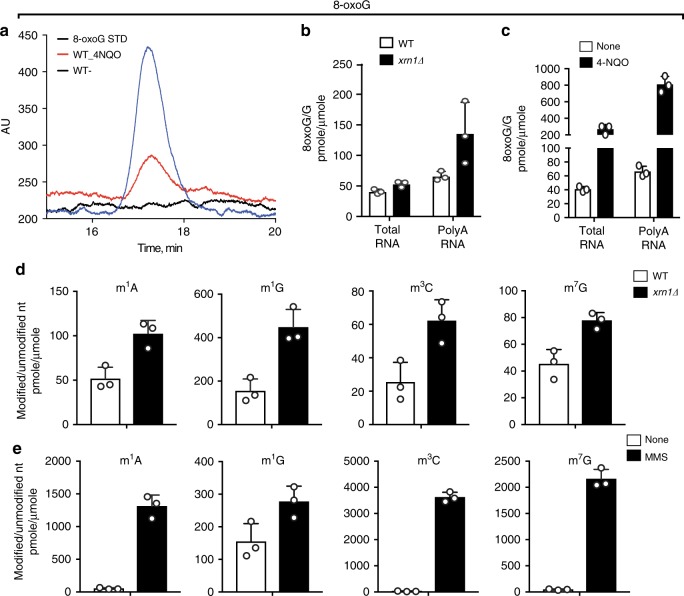
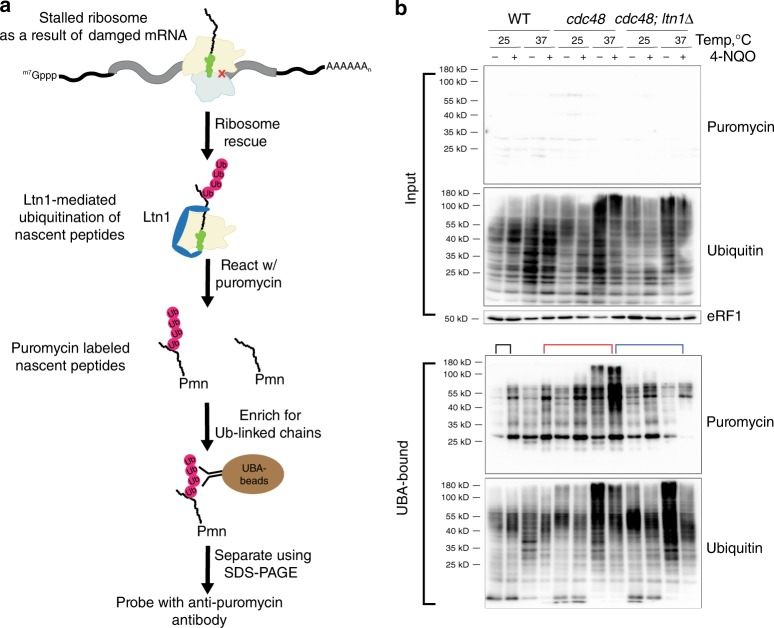
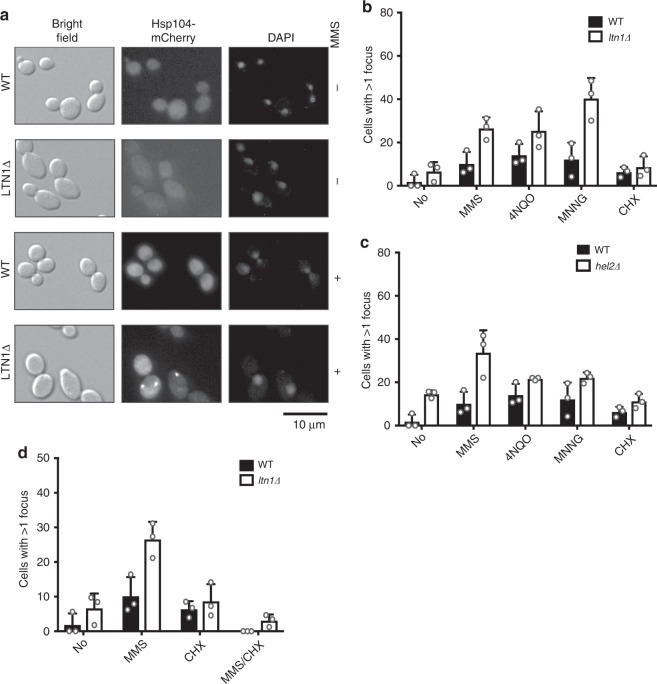
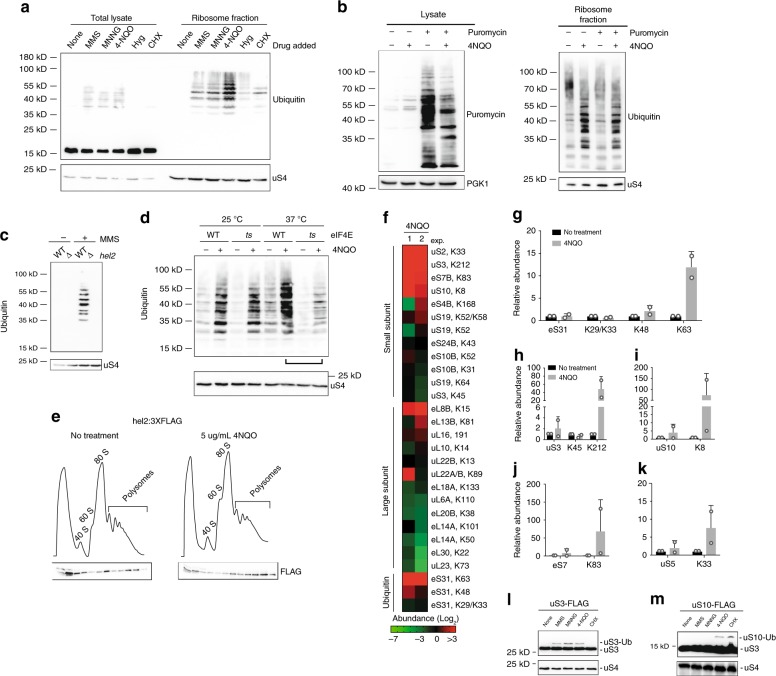
Oxidation and alkylation of nucleobases are known to disrupt their base-pairing properties within RNA. It is, however, unclear whether organisms have evolved general mechanism(s) to deal with this damage. Here we show that the mRNA-surveillance pathway of no-go decay and the associated ribosome-quality control are activated in response to nucleobase alkylation and oxidation. Our findings reveal that these processes are important for clearing chemically modified mRNA and the resulting aberrant-protein products. In the absence of Xrn1, the level of damaged mRNA significantly increases. Furthermore, deletion of LTN1 results in the accumulation of protein aggregates in the presence of oxidizing and alkylating agents. This accumulation is accompanied by Hel2-dependent regulatory ubiquitylation of ribosomal proteins. Collectively, our data highlight the burden of chemically damaged mRNA on cellular homeostasis and suggest that organisms evolved mechanisms to counter their accumulation.
Overview
The claims and statistics of this paper haven’t been checked yet.
Free: it reads the open-access text and checks the first 5 claims that cite a source we can check. Create a free account to check every claim.
Integrity signals
Registry
Cites
Statistics
Figures
Verification
Claims the paper makes
The claims and statistics of this paper haven’t been checked yet.
Free: it reads the open-access text and checks the first 5 claims that cite a source we can check. Create a free account to check every claim.
Claims other papers make about this one
Each is checked against this paper’s own text: does it say what the citing paper says it does?
The source backs part of the claim, not all of it — or backs it for a different population, condition or comparison.
In the citing paper
“Alkylated mRNAs likely induce various RNA degradation pathways, particularly RQC”
From Aberrant RNA methylation triggers recruitment of an alkylation repair complex (2021) · cites this paper as Yan et al., 2019
Experimental — accuracy not yet measured
Self-check
Percentages, sums and reported differences re-computed from the paper’s own numbers.
The self-check needs the paper’s full text.
Citations
Cites
How mitochondria produce reactive oxygen species
Murphy, M. P. (2009) · Biochemical Journal · doi:10.1042/bj20081386 · Cited by 8,207
Eng, J. K., McCormack, A. L., & Yates, J. R. (1994) · Journal of the American Society for Mass Spectrometry · doi:10.1016/1044-0305(94)80016-2 · Cited by 6,484
Oxidative Stress, Caloric Restriction, and Aging
Sohal, R. S., & Weindruch, R. (1996) · Science · doi:10.1126/science.273.5271.59 · Cited by 3,131
MODOMICS: a database of RNA modification pathways. 2017 update
Boccaletto, P., Machnicka, M. A., Purta, E., Piątkowski, P., Bagiński, B., Wirecki, T. K., de Crécy-Lagard, V., Ross, R., Limbach, P. A., Kotter, A., et al. (2018) · Nucleic Acids Research · doi:10.1093/nar/gkx1030 · Cited by 1,782
Systematic and Quantitative Assessment of the Ubiquitin-Modified Proteome
Kim, W., Bennett, E. J., Huttlin, E. L., Guo, A., Li, J., Possemato, A., Sowa, M. E., Rad, R., Rush, J., Comb, M. J., et al. (2011) · Molecular Cell · doi:10.1016/j.molcel.2011.08.025 · Cited by 1,613
Absolute Quantification of Proteins by LCMSE
Silva, J. C., Gorenstein, M. V., Li, G.-Z., Vissers, J. P. C., & Geromanos, S. J. (2006) · Molecular & Cellular Proteomics · doi:10.1074/mcp.m500230-mcp200 · Cited by 1,529
Watts, G. D. J., Wymer, J., Kovach, M. J., Mehta, S. G., Mumm, S., Darvish, D., Pestronk, A., Whyte, M. P., & Kimonis, V. E. (2004) · Nature Genetics · doi:10.1038/ng1332 · Cited by 1,391
Chemical and molecular mechanisms of antioxidants: experimental approaches and model systems
Lü, J., Lin, P. H., Yao, Q., & Chen, C. (2010) · Journal of Cellular and Molecular Medicine · doi:10.1111/j.1582-4934.2009.00897.x · Cited by 1,308
DNA Base Damage by Reactive Oxygen Species, Oxidizing Agents, and UV Radiation
Cadet, J., & Wagner, J. R. (2013) · Cold Spring Harbor Perspectives in Biology · doi:10.1101/cshperspect.a012559 · Cited by 903
Endonucleolytic cleavage of eukaryotic mRNAs with stalls in translation elongation
Doma, M. K., & Parker, R. (2006) · Nature · doi:10.1038/nature04530 · Cited by 760
Cited by
Items 101–132 of 132
Quantitative profiling of basal and stress-induced ribosome collisionsPreprint
Marks, J., Ayres-Galhardo, P. H., Tamilselvam, B., Roberson, A. B., Pitts, R., Guydosh, N. R., & Meydan, S. (2026) · bioRxiv (Cold Spring Harbor Laboratory) · doi:10.64898/2026.07.21.739814 · Cited by 2
“Translation elongation can be obstructed, and eukaryotic ribosomes can be stalled due to problematic codon sequences 1-5 , exposure to stress conditions that cause RNA damage 6,7 or limitation of charged tRNAs 8,9 , or pharmacological inhibition of translation 10-13 .”
5-Azacytidine incorporation into mRNAs disrupts translation and induces ribosome collisions
Roberson, A. B., Marks, J., Pitts, R., Tamilselvam, B., Britt, G. D., Grieb, B., Tansey, W. P., & Meydan, S. (2026) · Cell Reports · doi:10.64898/2026.03.30.714548 · Cited by 1
Transcripts enriched in codons that trigger P‐site tRNA ‐mediated mRNA decay possess stable mRNA
Carneiro, R. L., & Palhano, F. L. (2026) · FEBS Open Bio · doi:10.1002/2211-5463.70277 · Cited by 1
Requião, R. D., Silva, L. F. L., Estevão, P., Costa, W., Zani, N. C., Vasconcelos, I. C., Silva, I., Xu, T. T., Massirer, K. B., Steigenberger, B. A., et al. (2026) · Journal of Biological Chemistry · doi:10.1016/j.jbc.2026.113452 · Cited by 1
“High levels of reactive oxygen species (ROS) have been reported to induce ribosome collisions, leading to inhibition of global protein synthesis and activation of RQC pathways and ZAK α in other cellular systems (43, 44).”
Chemistry and biology of oxidatively damaged RNA nucleotides
Raorane, K., Weber, M., Marchand, V., Helm, M., & Motorin, Y. (2026) · RSC Chemical Biology · doi:10.1039/d6cb00143b · Cited by 1
“45,46,78,79 A comprehensive review on oxo 8 G in DNA and RNA including its in vivo occurrence, biological effects and mechanisms for elimination of oxo 8 G-containing mRNA has been recently published.”
Parissenti, A. M., Noubir, S., Pritzker, L. B., Kovala, A. T., Lannér, C., Lemon, J. A., Onayemi, T., Pk, S., Thériault, G., Trudeau, M., et al. (2025) · Cancers · doi:10.3390/cancers17172769 · Cited by 1
“Evidence indicates that low-level oxidative stress drives primarily reversible modifications in rRNA and RPs [67,72].”
Unveiling the RNA Modification Landscape Through Bioanalytical and Biochemical Analyses
Jones, J. (2023) · Deep Blue (University of Michigan) · doi:10.7302/8279 · Cited by 1
Gcn1 inhibits initiation of ribosome-associated quality controlPreprint
Chan, T. Y. K., Choo, W. Y. X., Yoon, M.-J., & Choe, Y. (2026) · bioRxiv (Cold Spring Harbor Laboratory) · doi:10.64898/2026.05.04.722640 · Cited by 1
Non-enzymatic RNA Glycation is a Metabolic Sensor of Cellular StressPreprint
Knörlein, A., Nishikawa, K., Kitamura, N., Kumari, R., Murakami, S., Shrivastava, A., Doynova, M., Ciobu, N., Walker, N. S., Mei, X., et al. (2026) · bioRxiv (Cold Spring Harbor Laboratory) · doi:10.64898/2026.05.18.725511 · Cited by 1
“9,48,49 To investigate whether elevated levels of MGO induce ribosome impairment, we first followed RPS3 monoubiquitination, which accumulates upon ribosome collision on cytosolic mRNAs.”
Eukaryotic tRNA ligases mediate RNA break repairPreprint
Wirth, A. N., Vries, I. S. N., Pinnen, A. M., Gopal, A., Righetti, A., Leppek, K., Dieterich, C., & Peschek, J. (2026) · bioRxiv (Cold Spring Harbor Laboratory) · doi:10.64898/2026.05.26.727988 · Cited by 2
Yan, L. L. (2021) · Open Scholarship Institutional Repository (Washington University in St. Louis) · doi:10.7936/tmky-z553
Self-citationSmith, T. (2022) · Deep Blue (University of Michigan) · doi:10.7302/6017
Not just a garbage truck: No-go decay plays a role during embryo development in zebrafish
Plastrik, A., & Zaher, H. S. (2024) · PLoS Biology · doi:10.1371/journal.pbio.3002925
“Although it has been well established that NGD targets defective mRNAs, including those damaged by alkylation and oxidizing agents [8], and UV irradiation [7]; studies on its role in regulating endogenous mRNAs have been limited.”
Self-citationBurroughs, M. R., Quiñones-Díaz, B. I., Grismore, K. B., & Contreras, L. M. (2026) · RNA Biology · doi:10.1101/2025.10.14.682464
Kumar, A. (2024) · cIRcle (University of British Columbia) · doi:10.14288/1.0438642
Boopathy, L. R. A. (2024) · eScholarship@McGill (McGill) · doi:10.82308/51705
Engineered Extracellular Blebs for Molecular Therapy
Thone, M. N. (2020) · eScholarship (California Digital Library)
Chemical RNA damage in neurodegenerative-related pathologies
Raorane, K. (2024) · theses.fr (ABES) · doi:10.70675/0fb3d90dz7d78z4082zb92ez0dbc9eec5880
Ribonucleobase Oxidation and Ribonucleases Involved in the Degradation of Oxidized RNA
Grijalva-Flores, D., & Resendiz, M. J. E. (2026) · Biomolecules · doi:10.3390/biom16040564
“Some examples include those involving microRNA (miRNA—[72–75]), ribosomal RNA (rRNA—[38,76]) that can lead to strand breaks [77], messenger RNA (mRNA—[41,78–80]), mRNA in plants [81], or mitochondrial RNA (mtRNA—[82]), as well as those in processes involved with viral RNA (vRNA—[83,84]).”
Wanted and unwanted modifications of mRNA and their effect on gene expression and signaling
Urs, A. N. N., Dali, A., & Zaher, H. S. (2026) · Journal of Biological Chemistry · doi:10.1016/j.jbc.2026.113314
“Indeed, alkylated and oxidized bases accumulate in RNA to much higher levels than in DNA (7, 8).”
InfluentialSelf-citationZhang, H., Wang, Z., He, X., Mu, Y., Fan, X., Wei, X., Mao, H., Chi, S., Li, Z., Pang, X., et al. (2026) · Cell Death and Disease · doi:10.1038/s41419-026-09125-x
“Ribosome stalling and collision are considered key stress perception events triggered by various types of cell damage, including UV [12] and genotoxic damage [13], and their mechanisms of action are being increasingly emphasized.”
Göktas, G., Tiku, V., Kvasov, N. A., Makhon, A., Breker, M., den Brave, F., Räschle, M., Štorchová, Z., & Bykov, Y. S. (2026) · bioRxiv (Cold Spring Harbor Laboratory) · doi:10.64898/2026.07.22.740037
Epitranscriptomic regulation in cholangiocarcinoma: mechanisms and therapeutic implications
Liu, M., Dai, F., Wang, S., Wang, Y., Zhang, C., 薛玉芹, Shen, A., Wang, H., Li, D., & Li, H. (2026) · Journal of Translational Medicine · doi:10.1186/s12967-026-08740-8
Pat1 Couples mRNA Decay with Ribosome-associated Quality ControlPreprint
Ferrand, G., BOUEZ, T., Torchet, C., & Bénard, L. (2026) · Research Square · doi:10.21203/rs.3.rs-10510622/v1
Temozolomide Induces Aberrant RNA Alkylation and Widespread Translational RepressionPreprint
Rhodes, J., Johnston, A. G., Marlow, K., Liu, X., Hartman, J. L., & Su, Z. (2026) · bioRxiv (Cold Spring Harbor Laboratory) · doi:10.64898/2026.09.01.748722
Tomomatsu, S. (2024) · Institutional Repositories DataBase (IRDB) · doi:10.15083/0002013133
USP9X promotes the degradation of trapped translation factors on collided ribosomes
Teodorowicz, W., Gurzeler, L.-A., & Mühlemann, O. (2026) · Cell Reports · doi:10.1016/j.celrep.2026.118125
All Roads Lead to Rome: Non-canonical Modulators of RNA Metabolism in ALS Pathogenesis
Chen, X., Cao, Z., Zhao, T., Liang, X., & Wang, Y. (2026) · ACS Chemical Neuroscience · doi:10.1021/acschemneuro.6c00600
Phillips, C. N., Schowe, S., Langeberg, C. J., Siddique, N., Chapman, E. G., & Resendiz, M. J. E. (2021) · doi:10.3389/fmolb.2021.780315.s001
Ishibashi, K., Shichino, Y., Han, P., Wakabayashi, K., Mito, M., Inada, T., Kimura, S., Iwasaki, S., & Mishima, Y. (2024) · doi:10.1371/journal.pbio.3002887.r003
Metadata
- Authors
- Yan, L. L., Simms, C. L., McLoughlin, F., Vierstra, R. D., & Zaher, H. S.
- Affiliations
- Washington University in St. Louis (US)
- Corresponding author
- Zaher, Hani S.
- Venue
- Nature Communications
- Published
- 2019-12-09
- Volume
- 10
- Issue
- 1
- Pages
- 5611-5611
- ISSN
- 2041-1723 (ISSN-L)
- PMC
- PMC6901537
- OpenAlex
- W2993298108
- Semantic Scholar
- 6f09f2ed77a7a4e2ecce85dcebcad872cd0414e5
- Cited by
- 123
- References
- 96
- Citations by year
- 2026: 16 · 2025: 19 · 2024: 31 · 2023: 21 · 2022: 9 · 2021: 14 · 2020: 12 · 2019: 1
- FWCI
- 2.98
- Type
- journal article
- Language
- en
- Open access
- gold
- doi.org
- Licence
- cc-by
- creativecommons.org/licenses/by/4.0 (tdm)
- creativecommons.org/licenses/by/4.0 (vor)
- Locations
- Nature Communications (publishedVersion, cc-by)
- PubMed Central (publishedVersion, cc-by)
- PubMed (publishedVersion)
- RePEc: Research Papers in Economics (submittedVersion)
- DOAJ (DOAJ: Directory of Open Access Journals) (submittedVersion)
- DOAJ (DOAJ: Directory of Open Access Journals) (submittedVersion, cc-by-sa)
- Funders
- U.S. Department of Health & Human Services | NIH | National Institute of General Medical Sciences (R01GM112641)
- Topics
- Life Sciences › Biochemistry, Genetics and Molecular Biology › Molecular Biology › RNA and protein synthesis mechanisms
- Life Sciences › Biochemistry, Genetics and Molecular Biology › Molecular Biology › RNA Research and Splicing
- Life Sciences › Biochemistry, Genetics and Molecular Biology › Cell Biology › Endoplasmic Reticulum Stress and Disease
- Keywords
- ribosome-associated quality control, no-go decay, mRNA surveillance, nucleobase oxidation, chemically modified mRNA, Xrn1, Ltn1, protein aggregates
- MeSH terms
- Alkylation, DNA Damage, Humans, Methyl Methanesulfonate, Mutation, Oxidation-Reduction, Peptides, Polyribosomes, Ribosomal Proteins, Ribosomes, RNA, Messenger, Saccharomyces cerevisiae, 4-Nitroquinoline-1-oxide, Quinolones, Oxidative Stress, DNA Adducts, RNA Stability, Ubiquitin, Saccharomyces cerevisiae Proteins, Ubiquitin-Protein Ligases, Ubiquitination, HEK293 Cells, Protein Aggregates
About these checks
Registry, retraction, Cites and statistics results are computed, not judged, with one exception: a printed reference that no index lists is read once by a model before it counts as a citation error. Claims are extracted by a model and kept only when their quote appears verbatim in the text; each cited source is then checked, with a model’s help, for whether it says what the claim relies on. Those verdicts can be wrong — read the claim’s quote and the cited source before relying on one.
Statistics and arithmetic are recomputed, not judged.
Confidence bands are shown only for fields calibrated on our annotated test set. None is calibrated yet, so no band is shown.
What counts as a claim ›How we measure confidence ›How we check this ›
Are you an author, or do you see a problem with this page? Request a review
Data sources
Bibliographic data: Semantic Scholar, OpenAlex, Crossref.
Contains information from the Semantic Scholar Academic Graph Datasets, made available under the ODC Attribution License (ODC-BY 1.0).
Semantic Scholar’s data is described in: Kinney, R., et al. (2023). The Semantic Scholar Open Data Platform. arXiv:2301.10140.
