

The DOI matches its Crossref record; 54 of the 55 references it cites were found in a registry or an index.
Confidence controls perceptual evidence accumulation
Open accessAbstract
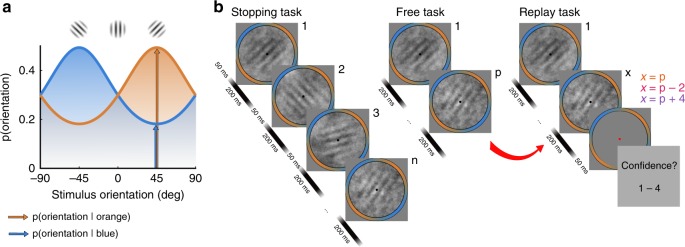
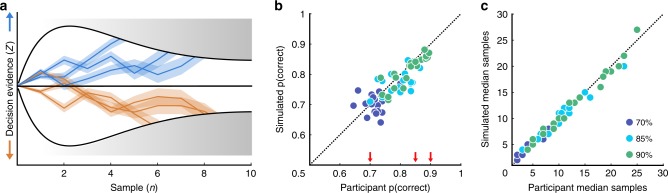
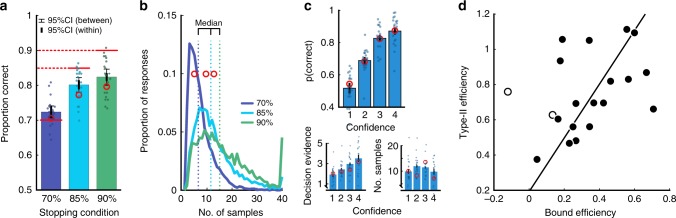
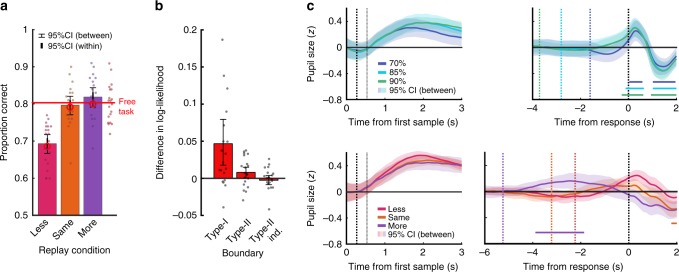
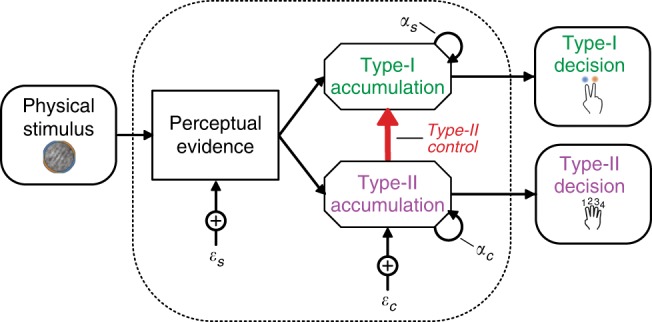
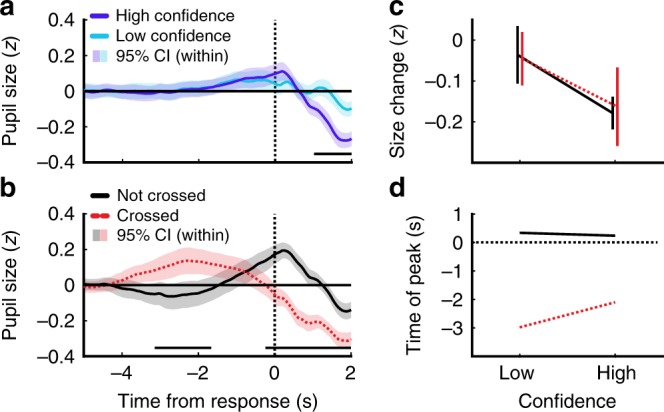
Perceptual decisions are accompanied by feelings of confidence that reflect the likelihood that the decision was correct. Here we aim to clarify the relationship between perception and confidence by studying the same perceptual task across three different confidence contexts. Human observers were asked to categorize the source of sequentially presented visual stimuli. Each additional stimulus provided evidence for making more accurate perceptual decisions, and better confidence judgements. We show that observers' ability to set appropriate evidence accumulation bounds for perceptual decisions is strongly predictive of their ability to make accurate confidence judgements. When observers were not permitted to control their exposure to evidence, they imposed covert bounds on their perceptual decisions but not on their confidence decisions. This partial dissociation between decision processes is reflected in behaviour and pupil dilation. Together, these findings suggest a confidence-regulated accumulation-to-bound process that controls perceptual decision-making even in the absence of explicit speed-accuracy trade-offs.
Overview
The claims and statistics of this paper haven’t been checked yet.
Run the check — free, no account needed. It reads the open-access text and checks the sources it cites.
Integrity signals
Registry
Cites
Statistics
Figures
Verification
Claims the paper makes
The claims and statistics of this paper haven’t been checked yet.
Run the check — free, no account needed. It reads the open-access text and checks the sources it cites.
Claims other papers make about this one
Each is checked against this paper’s own text: does it say what the citing paper says it does?
The cited source says what the claim attributes to it.
In the citing paper
“Interestingly, propositional confidence may emerge in parallel to the decision (or proposition) itself and may be used to shape the ongoing decision process-for instance, controlling the termination of evidence accumulation (Balsdon et al. 2020) or guiding the next step in a sequential decision (van den Berg et al. 2016b).”
From Metacognition and Confidence: A Review and Synthesis (2024) · cites this paper as Balsdon et al. 2020
The cited source says what the claim attributes to it.
In the citing paper
“For instance, evidence may be accumulated about particular sensory features (world-centered frame of reference) and, simultaneously, about (future or past) choice correctness (self-centered frame of reference), with the latter feeding back to set the bound on current or future sensory evidence accumulation (Balsdon et al. 2020).”
From Metacognition and Confidence: A Review and Synthesis (2024) · cites this paper as Balsdon et al. 2020
Self-check
Percentages, sums and reported differences re-computed from the paper’s own numbers.
The self-check needs the paper’s full text.
Citations
Cites
Brainard, D. H. (1997) · Spatial Vision · doi:10.1163/156856897x00357 · Cited by 20,012
The VideoToolbox software for visual psychophysics: transforming numbers into movies
Pelli, D. G. (1997) · Spatial Vision · doi:10.1163/156856897x00366 · Cited by 11,110
Nonparametric statistical testing of EEG- and MEG-data
Maris, E., & Oostenveld, R. (2007) · Journal of Neuroscience Methods · doi:10.1016/j.jneumeth.2007.03.024 · Cited by 8,496
Conflict monitoring and cognitive control
Botvinick, M. M., Braver, T. S., Barch, D. M., Carter, C. S., & Cohen, J. D. (2001) · Psychological Review · doi:10.1037/0033-295x.108.3.624 · Cited by 7,351
Ratcliff, R. (1978) · Psychological Review · doi:10.1037/0033-295x.85.2.59 · Cited by 4,513
Aston-Jones, G., & Cohen, J. D. (2005) · Annual Review of Neuroscience · doi:10.1146/annurev.neuro.28.061604.135709 · Cited by 4,472
Kleiner, M., Brainard, D. H., & Pelli, D. G. (2007) · MPG.PuRe (Max Planck Society) · Cited by 3,602
Treatise on Physiological Optics
von Helmholtz, H., & Southall, P. C. (1962) · Medical Entomology and Zoology · Cited by 2,196
A neostriatal habit learning system in humans
Knowlton, B. J., Mangels, J. A., & Squire, L. R. (1996) · Science · doi:10.1126/science.273.5280.1399 · Cited by 1,777
Bayesian model selection for group studies
Stephan, K. E., Penny, W. D., Daunizeau, J., Moran, R. J., & Friston, K. J. (2009) · NeuroImage · doi:10.1016/j.neuroimage.2009.03.025 · Cited by 1,423
Fleming, S. M., & Lau, H. C. (2014) · Frontiers in Human Neuroscience · doi:10.3389/fnhum.2014.00443 · Cited by 1,408
Errors and error correction in choice-response tasks.
Rabbitt, P. (1966) · Journal of Experimental Psychology · doi:10.1037/h0022853 · Cited by 1,024
Pupillometry: A Window to the Preconscious?
Laeng, B., Sirois, S., & Gredebäck, G. (2012) · Perspectives on Psychological Science · doi:10.1177/1745691611427305 · Cited by 921
The neural basis of the speed–accuracy tradeoff
Bogacz, R., Wagenmakers, E., Forstmann, B. U., & Nieuwenhuis, S. (2009) · Trends in Neurosciences · doi:10.1016/j.tins.2009.09.002 · Cited by 754
The neural basis of metacognitive ability
Fleming, S. M., & Dolan, R. J. (2012) · Philosophical Transactions of the Royal Society B: Biological Sciences · doi:10.1098/rstb.2011.0417 · Cited by 747
Two-stage dynamic signal detection: A theory of choice, decision time, and confidence.
Pleskac, T. J., & Busemeyer, J. R. (2010) · Psychological Review · doi:10.1037/a0019737 · Cited by 722
Models for choice-reaction time
Stone, M. (1960) · Psychometrika · doi:10.1007/bf02289729 · Cited by 696
Changes of mind in decision-making
Resulaj, A., Kiani, R., Wolpert, D. M., & Shadlen, M. N. (2009) · Nature · doi:10.1038/nature08275 · Cited by 678
Bayesian model selection for group studies — Revisited
Rigoux, L., Stephan, K. E., Friston, K. J., & Jean Daunizeau, A. (2013) · NeuroImage · doi:10.1016/j.neuroimage.2013.08.065 · Cited by 659
Post-error slowing: An orienting account
Notebaert, W., Houtman, F., Filip Van Opstal, A., Gevers, W., Fias, W., & Verguts, T. (2009) · Cognition · doi:10.1016/j.cognition.2009.02.002 · Cited by 539
Pupil dilation signals surprise: evidence for noradrenaline’s role in decision making
Preuschoff, K. (2011) · Frontiers in Neuroscience · doi:10.3389/fnins.2011.00115 · Cited by 538
Galvin, S. J., Podd, J. V., Drga, V., & Whitmore, J. (2003) · Psychonomic Bulletin & Review · doi:10.3758/bf03196546 · Cited by 405
Evidence for an Accumulator Model of Psychophysical Discrimination
VICKERS, D. (1970) · Ergonomics · doi:10.1080/00140137008931117 · Cited by 369
The construction of confidence in a perceptual decision
Zylberberg, A., Barttfeld, P., & Sigman, M. (2012) · Frontiers in Integrative Neuroscience · doi:10.3389/fnint.2012.00079 · Cited by 297
Subjective Confidence Predicts Information Seeking in Decision Making
Desender, K., Boldt, A., & Yeung, N. (2018) · Psychological Science · doi:10.1177/0956797617744771 · Cited by 296
Fleck, M. S. (2005) · Cerebral Cortex · doi:10.1093/cercor/bhj097 · Cited by 239
Phasic Activation of Monkey Locus Ceruleus Neurons by Simple Decisions in a Forced-Choice Task
Clayton, E. C., Rajkowski, J., Cohen, J. D., & Aston‐Jones, G. (2004) · Journal of Neuroscience · doi:10.1523/jneurosci.2446-04.2004 · Cited by 226
The Neural and Computational Basis of Controlled Speed-Accuracy Tradeoff during Task Performance
van Veen, V., Krug, M. K., & Carter, C. S. (2008) · Journal of Cognitive Neuroscience · doi:10.1162/jocn.2008.20146 · Cited by 213
Do congenital prosopagnosia and the other-race effect affect the same face recognition mechanisms?
Esins, J., Schultz, J., Wallraven, C., & lthoff, I. B. ⁄. (2014) · Frontiers in Human Neuroscience · doi:10.3389/fnhum.2014.00759 · Cited by 212
Practical Bayesian Optimization for Model Fitting with Bayesian Adaptive Direct SearchPreprint
Acerbi, L., & Ma, W. J. (2017) · arXiv (Cornell University) · doi:10.48550/arxiv.1705.04405 · Cited by 211
Global gain modulation generates time-dependent urgency during perceptual choice in humans
Murphy, P. R., Boonstra, E., & Nieuwenhuis, S. (2016) · Nature Communications · doi:10.1038/ncomms13526 · Cited by 206
A Recruitment Theory of Simple Behavior
LaBerge, D. (1962) · Psychometrika · doi:10.1007/bf02289645 · Cited by 194
Computational Precision of Mental Inference as Critical Source of Human Choice Suboptimality
Drugowitsch, J., Wyart, V., Devauchelle, A.-D., & Koechlin, É. (2016) · Neuron · doi:10.1016/j.neuron.2016.11.005 · Cited by 192
Self-citationUnexpected arousal modulates the influence of sensory noise on confidence
Allen, M., Frank, D., Schwarzkopf, D. S., Fardo, F., Winston, J. S., Hauser, T. U., & Rees, G. (2016) · eLife · doi:10.7554/elife.18103 · Cited by 182
fMRI Evidence for a Dual Process Account of the Speed-Accuracy Tradeoff in Decision-Making
Ivanoff, J., Branning, P., & Marois, R. (2008) · PLoS ONE · doi:10.1371/journal.pone.0002635 · Cited by 177
Probing the locus of confidence judgments: Experiments on the time to determine confidence.
Baranski, J. V., & Petrusic, W. M. (1998) · Journal of Experimental Psychology Human Perception & Performance · doi:10.1037//0096-1523.24.3.929 · Cited by 163
Satterthwaite, T. D., Green, L., Myerson, J., Parker, J. B., Ramaratnam, M., & Buckner, R. L. (2007) · NeuroImage · doi:10.1016/j.neuroimage.2007.04.066 · Cited by 160
Measures of metacognition on signal-detection theoretic models
Barrett, A. B., Dienes, Z., & Seth, A. K. (2013) · Psychological Methods · doi:10.1037/a0033268 · Cited by 155
Mamassian, P. (2016) · Annual Review of Vision Science · doi:10.1146/annurev-vision-111815-114630 · Cited by 154
Self-citationPupil dilation betrays the timing of decisions
Einhäuser, W. (2010) · Frontiers in Human Neuroscience · doi:10.3389/fnhum.2010.00018 · Cited by 149
The signal processing architecture underlying subjective reports of sensory awareness
Maniscalco, B., & Lau, H. (2016) · Neuroscience of Consciousness · doi:10.1093/nc/niw002 · Cited by 133
Doubly Bayesian Analysis of Confidence in Perceptual Decision-Making
Aitchison, L., Bang, D., Bahrami, B., & Latham, P. E. (2015) · PLOS Computational Biology · doi:10.1371/journal.pcbi.1004519 · Cited by 131
Implicit knowledge of visual uncertainty guides decisions with asymmetric outcomes
Whiteley, L., & Sahani, M. (2008) · Journal of Vision · doi:10.1167/8.3.2 · Cited by 120
Variance misperception explains illusions of confidence in simple perceptual decisions
Zylberberg, A., Roelfsema, P. R., & Sigman, M. (2014) · Consciousness and Cognition · doi:10.1016/j.concog.2014.05.012 · Cited by 97
Processing a Display Even after you Make a Response to it. How Perceptual Errors can be Corrected
Rabbitt, P., & Vyas, S. (1981) · The Quarterly Journal of Experimental Psychology Section A · doi:10.1080/14640748108400790 · Cited by 97
Relating Pupil Dilation and Metacognitive Confidence during Auditory Decision-Making
Lempert, K. M., Chen, Y. L., & Fleming, S. M. (2015) · PLoS ONE · doi:10.1371/journal.pone.0126588 · Cited by 94
Evaluation of Objective Uncertainty in the Visual System
Barthelmé, S., & Mamassian, P. (2009) · PLoS Computational Biology · doi:10.1371/journal.pcbi.1000504 · Cited by 92
Self-citationLi, H.-H., & Ma, W. J. (2020) · Nature Communications · doi:10.1038/s41467-020-15581-6 · Cited by 92
Weighting Mean and Variability during Confidence Judgments
de Gardelle, V., & Mamassian, P. (2015) · PLoS ONE · doi:10.1371/journal.pone.0120870 · Cited by 82
Self-citationShared Mechanisms for Confidence Judgements and Error Detection in Human Decision Making
Yeung, N., & Summerfield, C. (2014) · Springer eBooks · doi:10.1007/978-3-642-45190-4_7 · Cited by 38
Dynamic sources of evidence supporting confidence judgments and error detection.
Charles, L., & Yeung, N. (2018) · Journal of Experimental Psychology Human Perception & Performance · doi:10.1037/xhp0000583 · Cited by 38
Human noise blindness drives suboptimal cognitive inference
Castañón, S. H., Moran, R., Ding, J., Egner, T., Bang, D., & Summerfield, C. (2019) · Nature Communications · doi:10.1038/s41467-019-09330-7 · Cited by 34
A comparison of bounded diffusion models for choice in time controlled tasks
Zhang, J., Bogacz, R., & Holmes, P. J. (2009) · Journal of Mathematical Psychology · doi:10.1016/j.jmp.2009.03.001 · Cited by 25
Time-domain analysis for extracting fast-paced pupil responses
Zénon, A. (2017) · Scientific Reports · doi:10.1038/srep41484 · Cited by 22
Cited by
Sorted by citations
Metacognition and Confidence: A Review and Synthesis
Fleming, S. M. (2024) · Annual Review of Psychology · doi:10.1146/annurev-psych-022423-032425 · Cited by 256
“…confidence may emerge in parallel to the decision (or proposition) itself, and be used to shape the ongoing decision process, for instance, controlling the termination of evidence accumulation (Balsdon et al., 2020) or guiding the next step in a sequential decision (van den Berg et al., 2016b).”
Respiratory rhythms of the predictive mind.
Allen, M., Varga, S., & Heck, D. H. (2023) · Psychological Review · doi:10.1037/rev0000391 · Cited by 114
Perceptual reality monitoring: Neural mechanisms dissociating imagination from reality
Dijkstra, N., Kok, P., & Fleming, S. M. (2022) · Neuroscience & Biobehavioral Reviews · doi:10.1016/j.neubiorev.2022.104557 · Cited by 116
Said, N., Potinteu, A. E., Brich, I. R., Buder, J., Schumm, H., & Huff, M. (2023) · Computers in Human Behavior · doi:10.1016/j.chb.2023.107855 · Cited by 103
Neurobehavioral meaning of pupil size
Grujic, N., Polanía, R., & Burdakov, D. (2024) · Neuron · doi:10.1016/j.neuron.2024.05.029 · Cited by 108
Metadata
- Authors
- Balsdon, T., Wyart, V., & Mamassian, P.
- Affiliations
- Centre National de la Recherche Scientifique (FR)
- Inserm (FR)
- Corresponding author
- Balsdon, Tarryn
- Venue
- Nature Communications
- Published
- 2020-04-09
- Volume
- 11
- Issue
- 1
- Pages
- 1753-1753
- ISSN
- 2041-1723 (ISSN-L)
- PMC
- PMC7145794
- OpenAlex
- W3015873723
- Cited by
- 137
- References
- 55
- Citations by year
- 2026: 14 · 2025: 28 · 2024: 25 · 2023: 24 · 2022: 24 · 2021: 15 · 2020: 7
- FWCI
- 9.41
- Type
- journal article
- Language
- en
- Open access
- gold
- doi.org
- Locations
- Nature Communications (publishedVersion, cc-by)
- PubMed Central (publishedVersion, cc-by)
- PubMed (publishedVersion)
- HAL (submittedVersion, other-oa)
- RePEc: Research Papers in Economics (submittedVersion)
- DOAJ (DOAJ: Directory of Open Access Journals) (submittedVersion, cc-by-sa)
- Funders
- Agence Nationale de la Recherche (ANR-18-CE28-0015, ANR-10-IDEX-0001, ANR18, ANR-10-LABX-0087, ANR-18-CE28, ANR-10, ANR-10-LABX)
- Institut National de la Santé et de la Recherche Médicale (ANR-10-LABX-0087)
- Centre National de la Recherche Scientifique (UMR 8248)
- Topics
- Life Sciences › Neuroscience › Cognitive Neuroscience › Visual perception and processing mechanisms
- Life Sciences › Neuroscience › Cognitive Neuroscience › Neural and Behavioral Psychology Studies
- Social Sciences › Decision Sciences › General Decision Sciences › Decision-Making and Behavioral Economics
- Keywords
- perceptual confidence, perceptual decision making, evidence accumulation, confidence judgments, pupil dilation, speed-accuracy trade-off
- MeSH terms
- Adult, Algorithms, Computer Simulation, Decision Making, Female, Humans, Male, Models, Psychological, Photic Stimulation, Psychomotor Performance, Visual Perception
About these checks
Registry, retraction, Cites and statistics results are computed, not judged, with one exception: a printed reference that no index lists is read once by a model before it counts as a citation error. Claims are extracted by a model and kept only when their quote appears verbatim in the text; each cited source is then checked, with a model’s help, for whether it says what the claim relies on. Those verdicts can be wrong — read the claim’s quote and the cited source before relying on one.
Statistics and arithmetic are recomputed, not judged.
Confidence bands are shown only for fields calibrated on our annotated test set. None is calibrated yet, so no band is shown.
What counts as a claim ›How we measure confidence ›How we check this ›
Are you an author, or do you see a problem with this page? Request a review
