

Immunotherapy with engineered bacteria by targeting the STING pathway for anti-tumor immunity
Open accessThe DOI matches its Crossref record; 50 of the 50 references it cites were found in a registry or an index.
Abstract
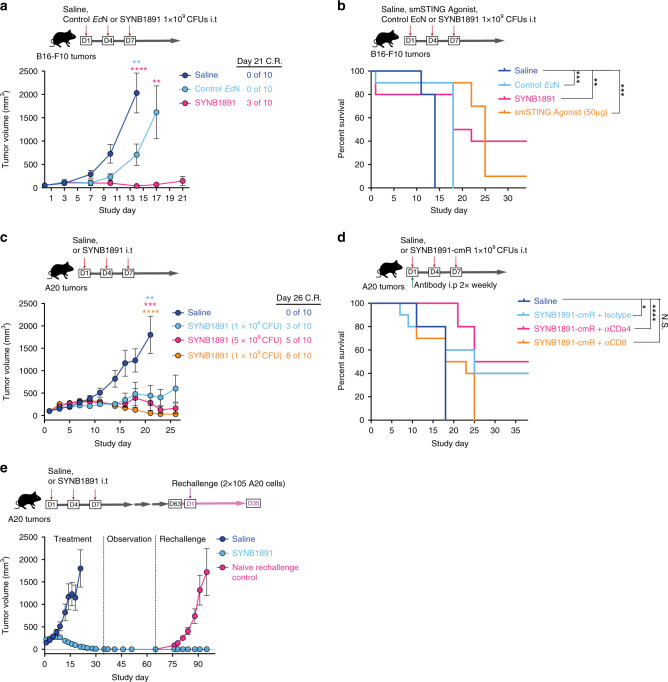
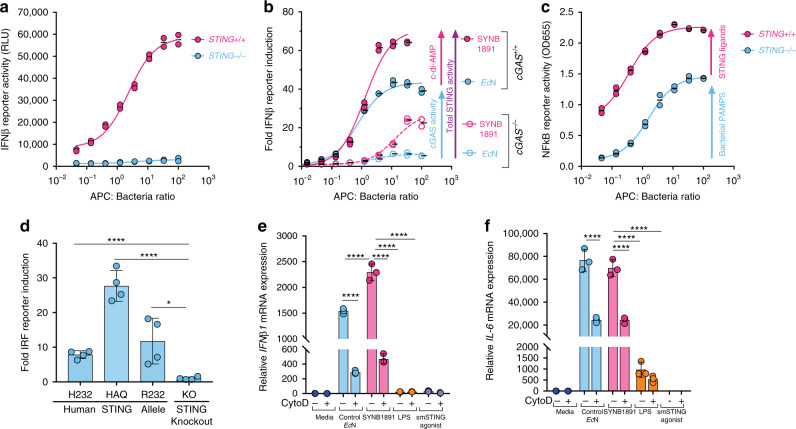
Synthetic biology is a powerful tool to create therapeutics which can be rationally designed to enable unique and combinatorial functionalities. Here we utilize non-pathogenic E coli Nissle as a versatile platform for the development of a living biotherapeutic for the treatment of cancer. The engineered bacterial strain, referred to as SYNB1891, targets STING-activation to phagocytic antigen-presenting cells (APCs) in the tumor and activates complementary innate immune pathways. SYNB1891 treatment results in efficacious antitumor immunity with the formation of immunological memory in murine tumor models and robust activation of human APCs. SYNB1891 is designed to meet manufacturability and regulatory requirements with built in biocontainment features which do not compromise its efficacy. This work provides a roadmap for the development of future therapeutics and demonstrates the transformative potential of synthetic biology for the treatment of human disease when drug development criteria are incorporated into the design process for a living medicine.
Overview
The claims and statistics of this paper haven’t been checked yet.
Free: it reads the open-access text and checks the first 5 claims that cite a source we can check. Create a free account to check every claim.
Integrity signals
Registry
Cites
Statistics
Figures
Verification
Claims the paper makes
The claims and statistics of this paper haven’t been checked yet.
Free: it reads the open-access text and checks the first 5 claims that cite a source we can check. Create a free account to check every claim.
Claims other papers make about this one
Each is checked against this paper’s own text: does it say what the citing paper says it does?
In the citing paper
“SYNB1891 has been modified to express the STING agonist cyclic adenosine diphosphate ribose (CADPR), which can stimulate expression of IFNs and achieve antitumor effects [151].”
From Gut microbiota influence immunotherapy responses: mechanisms and therapeutic strategies (2022) · doi:10.1186/s13045-022-01273-9 · cites this paper as [151]
Self-check
Percentages, sums and reported differences re-computed from the paper’s own numbers.
The self-check needs the paper’s full text.
Citations
Cites
Zou, W., Wolchok, J. D., & Chen, L. (2016) · Science Translational Medicine · doi:10.1126/scitranslmed.aad7118 · Cited by 2,400
Immune checkpoint inhibitors: recent progress and potential biomarkers
Darvin, P., Toor, S. M., Sasidharan Nair, V., & Elkord, E. (2018) · Experimental & Molecular Medicine · doi:10.1038/s12276-018-0191-1 · Cited by 2,035
STING-Dependent Cytosolic DNA Sensing Mediates Innate Immune Recognition of Immunogenic Tumors
Woo, S.-R., Fuertes, M. B., Corrales, L., Spranger, S., Furdyna, M. J., Leung, M. Y. K., Duggan, R., Wang, Y., Barber, G. N., Fitzgerald, K. A., et al. (2014) · Immunity · doi:10.1016/j.immuni.2014.10.017 · Cited by 1,917
Corrales, L., Glickman, L. H., McWhirter, S. M., Kanne, D. B., Sivick, K. E., Katibah, G. E., Woo, S.-R., Lemmens, E., Banda, T., Leong, J. J., et al. (2015) · Cell Reports · doi:10.1016/j.celrep.2015.04.031 · Cited by 1,560
Tumour-targeting bacteria engineered to fight cancer
Zhou, S., Gravekamp, C., Bermudes, D., & Liu, K. (2018) · Nature Reviews Cancer · doi:10.1038/s41568-018-0070-z · Cited by 821
Diner, E. J., Burdette, D. L., Wilson, S. C., Monroe, K. M., Kellenberger, C. A., Hyodo, M., Hayakawa, Y., Hammond, M. C., & Vance, R. E. (2013) · Cell Reports · doi:10.1016/j.celrep.2013.05.009 · Cited by 767
The toxins of William B. Coley and the treatment of bone and soft-tissue sarcomas.
McCarthy, E. F. (2006) · Europe PMC (PubMed Central) · Cited by 747
STING agonist formulated cancer vaccines can cure established tumors resistant to PD-1 blockade
Fu, J., Kanne, D. B., Leong, M., Glickman, L. H., McWhirter, S. M., Lemmens, E., Mechette, K., Leong, J. J., Lauer, P., Liu, W., et al. (2015) · Science Translational Medicine · doi:10.1126/scitranslmed.aaa4306 · Cited by 720
Engineered probiotics for local tumor delivery of checkpoint blockade nanobodies
Gurbatri, C. R., Lia, I., Vincent, R., Coker, C., Castro, S., Treuting, P. M., Hinchliffe, T. E., Arpaia, N., & Danino, T. (2020) · Science Translational Medicine · doi:10.1126/scitranslmed.aax0876 · Cited by 647
Isabella, V. M., Ha, B. N., Castillo, M. J., Lubkowicz, D. J., Rowe, S. E., Millet, Y. A., Anderson, C. L., Li, N., Fisher, A. B., West, K. A., et al. (2018) · Nature Biotechnology · doi:10.1038/nbt.4222 · Cited by 605
Self-citation
Cited by
Items 401–456 of 456
Biological Sensors for Microbiome Diagnostics
Breedon, A. M. E., Beabout, K., Coia, H. G., Davis, C. M., Harbaugh, S. V., Mauzy, C. A., Nelson, M., Saldanha, R., Stamps, B. W., & Goodson, M. S. (2022) · Wiley eBooks · doi:10.1002/9783527825462.ch6
Hu, J., Xiao, Y., Wang, D., Luo, B., Chen, X., Yao, Y., Song, C., Li, P., Li, X., Zhang, H., et al. (2022) · SSRN Electronic Journal · doi:10.2139/ssrn.4167847
Novel Therapies in Clinical Development for Advanced Disease
Arraez, Á. S., Maciá, S., & Castañón, E. (2023) · IntechOpen eBooks · doi:10.5772/intechopen.107089
Modern Medicine Relies on the Help of Microorganisms – From Vaccine Production to Cancer Medication
Parizotto, L., Brumano, L. P., Kleingesinds, E. K., & Pessoa, A. (2022) · doi:10.1002/9781119762621.ch1
How has microbiology changed 200 years after Pasteur’s birth?
Bikard, D. (2022) · Comptes Rendus Biologies · doi:10.5802/crbiol.85
[Advances in Research on the Role of Bacterial c-di-AMP in Host Immunity].
Wu, Q.-R., Peng, X., & Zhou, X. (2022) · PubMed Central · doi:10.12182/20220860102 · Cited by 1
Adriani, R. R., Gargari, S. L. M., & Bakherad, H. (2023) · Research Square · doi:10.21203/rs.3.rs-2656358/v1
Park, J. H., Holló, G., & Schaerli, Y. (2024) · bioRxiv (Cold Spring Harbor Laboratory) · doi:10.1101/2024.03.28.586779
Bacteria-Based Approach to Cancer Therapy
Bình, T. D., Bokorová, R., & Yamada, T. (2024) · Interdisciplinary cancer research · doi:10.1007/16833_2024_337 · Cited by 1
Designer Probiotics and Postbiotics
Singh, B., Mal, G., Kalra, R. S., & Marotta, F. (2024) · Springer eBooks · doi:10.1007/978-3-031-65459-6_25
Synthetic Microbes to Modulate the Gut Ecosystem
Singh, B., Mal, G., Kalra, R. S., & Marotta, F. (2024) · Springer eBooks · doi:10.1007/978-3-031-65459-6_23
Engineering Microbes for Health and Therapeutic Applications
Singh, B., Mal, G., Kalra, R. S., & Marotta, F. (2024) · Springer eBooks · doi:10.1007/978-3-031-65459-6_21
Chen, G., Jiang, Y., Xu, H., Song, B., Chu, B., He, Y., & Wang, H. (2024) · Nano Research · doi:10.26599/nr.2025.94907077 · Cited by 1
Cancer and microbiome-targeted therapies
Meena, A. S., Singh, P., & Shukla, P. K. (2025) · International review of cytology · doi:10.1016/bs.ircmb.2024.12.006 · Cited by 5
Applications of Nanomaterial‐Microorganism Hybrid Systems in the Treatment of Tumor
Khan, M. S., Baig, M. A., Tian, M., Li, B., Feng, G., Yang, R., Bai, Y., & Zheng, B. (2025) · Advanced Therapeutics · doi:10.1002/adtp.202400425 · Cited by 2
Research progress on ultrasound in bacteria-mediated tumor treatment
Li, M., Kuang, C., Guo, Z., Du, M., & Chen, Z. (2025) · Critical Reviews in Microbiology · doi:10.1080/1040841x.2025.2489476
Mousa, W. K., Ali, A., Abdelmoteleb, R. W. A., Shami, R. A., Alramadan, N., Moutraji, S. A., & Ghemrawi, R. (2025) · Targeted Cancer Therapy Connect · doi:10.69709/ciconnect.2025.154988
Othman, E. M. (2025) · Research Square · doi:10.21203/rs.3.rs-6990456/v1
Bai, L., & Zhu, A. (2025) · Advanced Biology · doi:10.1002/adbi.202400823
Synthetic biology and genetic engineering in pharmaceutical bioprospecting
Kant, S., Roy, S., & Sarkar, N. (2025) · Elsevier eBooks · doi:10.1016/b978-0-443-33032-2.00019-8
Genetically encoded biosensors in microbes for Tumor targeting
Chen, X., Zhou, Y., Han, X., Xiao, T., & Lyu, X. (2025) · Biosensors and Bioelectronics · doi:10.1016/j.bios.2025.118244
Rodrigues, L. R., Feng, J., Liu, Y., Zheng, X., Gao, M., Wang, L., Wen, Y., Pan, H., Li, G., Zhang, L., et al. (2024) · Portuguese National Funding Agency for Science, Research and Technology (RCAAP Project by FCT)
Xu, M., Sun, T., Liang, H., Feng, G., Hu, Q., Du, Y., & Fang, J. (2026) · Biochemical Pharmacology · doi:10.1016/j.bcp.2026.117747
Huang, Y., Piao, L., Zhang, H., & Liu, X. (2026) · Molecular Therapy Oncology · doi:10.1016/j.omton.2026.201185
Bacteriobots: Bacterial Microrobots and Their Potential in Cancer Diagnosis and Therapy
Ikryannikova, L. N. (2026) · Biomedical Chemistry Research and Methods · doi:10.18097/bmcrm00301
Fungi and colorectal cancer: from dysregulation to clinical translation
Wu, Y., Han, S., Jing, Z., & Min, F. (2026) · Gut Pathogens · doi:10.1186/s13099-026-00835-3
Synthetic Biology and Genetic Circuits for Personalised Medicine
Brandl, E. (2026) · The British Journal of Translational Global Health · doi:10.5005/bjotgh-11016-0032
Leveraging the bacteria for enhanced cancer immunotherapy: from a perspective of synthetic biology
Liu, X., Zhang, H., Du, R., Liu, Z., Ren, Y., & Yang, X. S. (2026) · Cancer Biology & Therapy · doi:10.1080/15384047.2026.2683171 · Cited by 1
Development strategies for engineered live biotherapeutic products for metabolic diseases
Yun, S., Choi, K.-S., Min, H., Jo, Y. K., & Jang, S. (2026) · Critical Reviews in Biotechnology · doi:10.1080/07388551.2026.2653692 · Cited by 1
Wang, Y., Zhang, C., Zhu, Z., Wu, H., Feng, K., Su, X., Chen, Y., Wan, M., & Zong, Y. (2026) · Ultrasonics · doi:10.1016/j.ultras.2026.108211
Lin, J., Liu, Y., Chen, Y., & Zhang, X. (2026) · Cell & Bioscience · doi:10.1186/s13578-026-01622-y
Bekere, I., Hubarzhevska, Y., Egender, S. V., Quoika, P. K., Öllinger, R., Schrimpf, M. R., Rad, R., Zacharias, M., & Mann, C. C. D. O. (2026) · iScience · doi:10.1016/j.isci.2026.117179
Jinhu, G., Li, Y., Yang, Y., & Wang, B. (2026) · Frontiers in Immunology · doi:10.3389/fimmu.2026.1878878
Kong, Z., & Wang, J. (2026) · Frontiers in Immunology · doi:10.3389/fimmu.2026.1891408 · Cited by 2
Lee, J., Glazier, J., Weichselbaum, R. R., & Mimee, M. (2026) · bioRxiv (Cold Spring Harbor Laboratory) · doi:10.64898/2026.08.12.744520
Shen, H., Zhang, W., Niu, G., Wang, L., Li, R., Fan, Y., Lu, F., Xu, L., Ji, X., & Kang, Y. (2026) · BMEMat · doi:10.1002/bmm2.70130
Sun, Y., Zhao, Y., Han, K., Hu, W., Peng, G., Yi, S., Zhou, J., & Zheng, J. H. (2026) · Cell Reports Medicine · doi:10.1016/j.xcrm.2026.102913 · Cited by 4
Metabolic shifts driven by host‐microbial interactions
Nair, T., Stuhr, N. L., Weathers, B. A., & Curran, S. P. (2026) · FEBS Journal · doi:10.1111/febs.70704
Context-Dependent cGAS-STING Activation Shapes Metastatic Progression and Dormancy
Akter-Yasuoka, E., 이탁, Murayama, T., & Nakayama, J. (2026) · Cells · doi:10.3390/cells15171619
Deeb, N., Otinov, G. D., & Koshel, E. I. (2026) · Russian Journal of Bioorganic Chemistry · doi:10.1134/s1068162026602120
Chen, Z., Xu, R., Tong, H., Xiang, D., Wang, T., & Xu, Z. (2026) · Research Square · doi:10.21203/rs.3.rs-10823750/v1
Perspective Chapter: Microbiome Predictive Value for Immunotherapy Response
Gales, L. N., Ghencea, I. A., Serban, E. C., & Trifanescu, O. G. (2026) · Pharmaceutical science. · doi:10.5772/intechopen.1017715
Xu, J., Qi, Q., & Wang, Q. (2026) · Synthetic and Systems Biotechnology · doi:10.1016/j.synbio.2026.09.006
Active micro- and nanorobots for controlled immune modulation in protected pathological niches
Wu, D., Liu, Y., & Hu, Y. (2026) · Journal of Controlled Release · doi:10.1016/j.jconrel.2026.115397
Bacterial metabolic–immune reprogramming in cancer: from living vectors to engineered biofactories
Wu, J., Xu, L., Chen, Q., Yu, L., Liu, Z., & Xia, A. (2026) · Journal of Controlled Release · doi:10.1016/j.jconrel.2026.115394
Screening strong anaerobic E. coli promoters to enhance therapeutical protein expression in tumors
Cui, T., Yu, G., Jiang, C., Li, L., Mu, Q., Luan, J., & Wang, H. (2026) · Journal of Controlled Release · doi:10.1016/j.jconrel.2026.115407
Intratumoral Microbiota in Fueling Cancer and Steering Treatment Response
Xu, M., Yu, J., Chen, Y., Ge, S., Ye, L., Wang, Y., 周一雄, & Jia, R. (2026) · MedComm · doi:10.1002/mco2.71052
Александрович, Ч. А., Sokolyanskaya, L. O., Lukina, A. P., & Karnachuk, O. V. (2026) · Frontiers in Nutrition · doi:10.3389/fnut.2026.1964473
Dunga, K. E., Izah, S. C., Aseibai, E. R., Ogwu, M. C., Promise, V. I., Etim, N. G., & Ohanusi, I. N. (2026) · Frontiers in Oncology · doi:10.3389/fonc.2026.1966586
Shi, X., Wang, S., & Ouyang, W. (2026) · Frontiers in Immunology · doi:10.3389/fimmu.2026.1947330
Sun, S., Hu, R., Zhai, X., Bai, R., Guo, J., Zhou, T., Yang, T., Zeng, Q., Zhang, Y., Yu, J., et al. (2026) · Journal of Controlled Release · doi:10.1016/j.jconrel.2026.115459
Liang, Y., Ning, Z., Su, B., Liang, N., Zhu, F., & Sun, T. (2026) · Pharmaceutics · doi:10.3390/pharmaceutics18111354
Khan, A., Tareen, A., Farid, A. A. M., Amin, A., Khan, H. N., Hadi, D. K., Khan, S. R., & Raza, A. (2026) · Frontiers in Oncology · doi:10.3389/fonc.2026.1985675
Chauhan, M. K., Kumar, S., Yi, J., & Chen, Y. (2026) · ACS Nano Medicine · doi:10.1021/acsnanomed.6c00203
Wang, J., Qi, R., Chang, T., & Zhang, Y. (2026) · Engineering Microbiology · doi:10.1016/j.engmic.2026.100311
Metadata
- Authors
- Leventhal, D. S., Sokolovska, A., Li, N., Plescia, C., Kolodziej, S. A., Gallant, C. W., Christmas, R., Gao, J.-R., James, M. J., Abin-Fuentes, A., Momin, M., Bergeron, C., Fisher, A., Miller, P. F., West, K. A., & Lora, J. M.
- Affiliations
- Synlogic (United States) (US)
- Corresponding author
- Leventhal, Daniel S.
- Sokolovska, Anna
- ORCID
- Venue
- Nature Communications
- Published
- 2020-06-01
- Volume
- 11
- Issue
- 1
- Pages
- 2739-2739
- ISSN
- 2041-1723 (ISSN-L)
- PMC
- PMC7264239
- OpenAlex
- W3030200736
- Cited by
- 458
- References
- 50
- Citations by year
- 2026: 71 · 2025: 101 · 2024: 96 · 2023: 71 · 2022: 61 · 2021: 50 · 2020: 5
- FWCI
- 24.20
- Type
- journal article
- Language
- en
- Open access
- gold
- doi.org
- Licence
- cc-by
- creativecommons.org/licenses/by/4.0 (tdm)
- creativecommons.org/licenses/by/4.0 (vor)
- Locations
- Nature Communications (publishedVersion, cc-by)
- PubMed Central (publishedVersion, cc-by)
- PubMed (publishedVersion)
- RePEc: Research Papers in Economics (submittedVersion)
- DOAJ (DOAJ: Directory of Open Access Journals) (submittedVersion, cc-by-sa)
- Topics
- Life Sciences › Biochemistry, Genetics and Molecular Biology › Biotechnology › Bacterial Cancer Therapy
- Life Sciences › Immunology and Microbiology › Immunology › Immunotherapy and Immune Responses
- Health Sciences › Medicine › Oncology › Cancer Immunotherapy and Biomarkers
- Keywords
- STING pathway, engineered bacteria, cancer immunotherapy, antigen-presenting cells, innate immune activation, immunological memory, biocontainment, synthetic biology, tumor immunology
- MeSH terms
- STING Protein, Animals, Antigen-Presenting Cells, Escherichia coli, Genetic Engineering, Humans, Immunotherapy, Interferon Type I, Membrane Proteins, Mice, Inbred BALB C, Mice, Inbred C57BL, Neoplasms, Phagocytes, Signal Transduction, Mice, Knockout, Cell Line, Tumor, Mice, Synthetic Biology
About these checks
Registry, retraction, Cites and statistics results are computed, not judged, with one exception: a printed reference that no index lists is read once by a model before it counts as a citation error. Claims are extracted by a model and kept only when their quote appears verbatim in the text; each cited source is then checked, with a model’s help, for whether it says what the claim relies on. Those verdicts can be wrong — read the claim’s quote and the cited source before relying on one.
Statistics and arithmetic are recomputed, not judged.
Confidence bands are shown only for fields calibrated on our annotated test set. None is calibrated yet, so no band is shown.
What counts as a claim ›How we measure confidence ›How we check this ›
Are you an author, or do you see a problem with this page? Request a review
Data sources
Bibliographic data: Semantic Scholar, OpenAlex, Crossref.
Contains information from the Semantic Scholar Academic Graph Datasets, made available under the ODC Attribution License (ODC-BY 1.0).
Semantic Scholar’s data is described in: Kinney, R., et al. (2023). The Semantic Scholar Open Data Platform. arXiv:2301.10140.
