

Modular gateway-ness connectivity and structural core organization in maritime network science
Open accessThe DOI matches its Crossref record; 57 of the 57 references it cites were found in a registry or an index.
Abstract
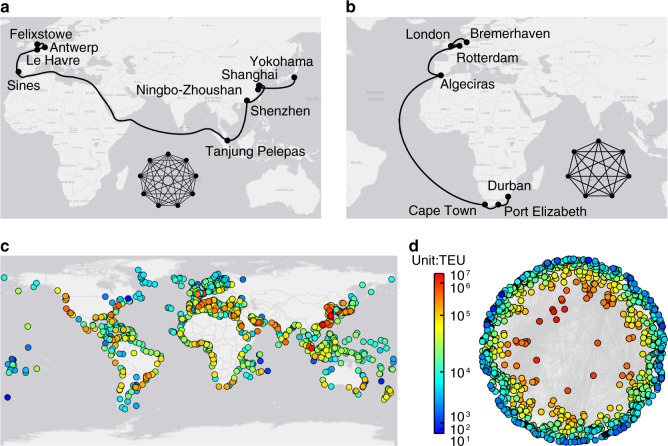
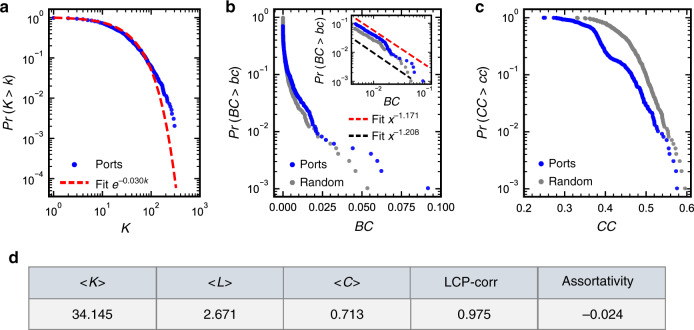
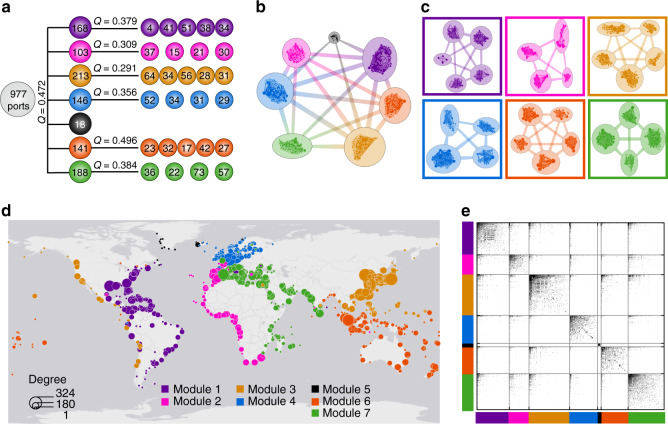
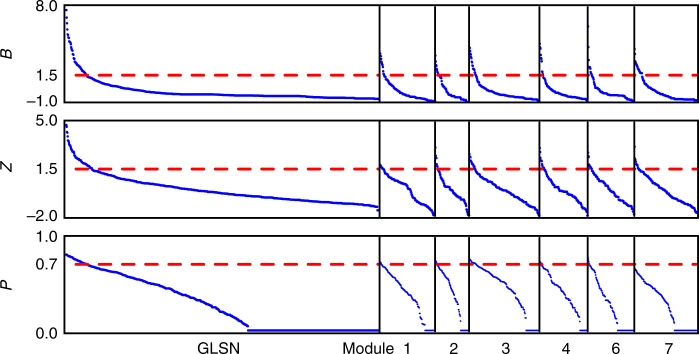
Around 80% of global trade by volume is transported by sea, and thus the maritime transportation system is fundamental to the world economy. To better exploit new international shipping routes, we need to understand the current ones and their complex systems association with international trade. We investigate the structure of the global liner shipping network (GLSN), finding it is an economic small-world network with a trade-off between high transportation efficiency and low wiring cost. To enhance understanding of this trade-off, we examine the modular segregation of the GLSN; we study provincial-, connector-hub ports and propose the definition of gateway-hub ports, using three respective structural measures. The gateway-hub structural-core organization seems a salient property of the GLSN, which proves importantly associated to network integration and function in realizing the cargo transportation of international trade. This finding offers new insights into the GLSN’s structural organization complexity and its relevance to international trade.
Overview
The claims and statistics of this paper haven’t been checked yet.
Free: it reads the open-access text and checks the first 5 claims that cite a source we can check. Create a free account to check every claim.
Integrity signals
Registry
Cites
Statistics
Figures
Verification
Claims the paper makes
The claims and statistics of this paper haven’t been checked yet.
Free: it reads the open-access text and checks the first 5 claims that cite a source we can check. Create a free account to check every claim.
Self-check
Percentages, sums and reported differences re-computed from the paper’s own numbers.
The self-check needs the paper’s full text.
Citations
Cites
Collective dynamics of ‘small-world’ networks
Watts, D. J., & Strogatz, S. H. (1998) · Nature · doi:10.1038/30918 · Cited by 43,060
Emergence of Scaling in Random Networks
Barabási, A.-L., & Albert, R. (1999) · Science · doi:10.1126/science.286.5439.509 · Cited by 36,135
Fast unfolding of communities in large networks
Blondel, V. D., Guillaume, J.-L., Lambiotte, R., & Lefebvre, E. (2008) · Journal of Statistical Mechanics: Theory and Experiment · doi:10.1088/1742-5468/2008/10/p10008 · Cited by 21,424
The Structure and Function of Complex Networks
Newman, M. E. J. (2003) · SIAM Review · doi:10.1137/s003614450342480 · Cited by 18,719 · cited 1×
“����� ) is characterized by evaluating for each 24 individual node i the efficiency of 𝐺�, the subgraph consisting of the neighbors of i. It is defined as follows: 𝐸�����= 1 � ∑ 𝐸 (𝐺�) �∈𝐺𝐸 (𝐺����𝑎�) (7) where 𝐸 (𝐺�) is the efficiency of the subgraph of the neighbors of i, and 𝐸 (𝐺������) that of the ideal case for th…”
Centrality in social networks conceptual clarification
Freeman, L. C. (1978) · Social Networks · doi:10.1016/0378-8733(78)90021-7 · Cited by 17,062
Finding and evaluating community structure in networks
Newman, M. E. J., & Girvan, M. (2004) · Physical Review E · doi:10.1103/physreve.69.026113 · Cited by 13,931
Modularity and community structure in networks
Newman, M. E. J. (2006) · Proceedings of the National Academy of Sciences · doi:10.1073/pnas.0601602103 · Cited by 12,256
Complex networks: structure and dynamics
BOCCALETTI, S., LATORA, V, MORENO, Y., CHAVEZ, M., & HWANG, D. (2006) · Physics Reports · doi:10.1016/j.physrep.2005.10.009 · Cited by 11,010
A Set of Measures of Centrality Based on Betweenness
Freeman, L. C. (1977) · Sociometry · doi:10.2307/3033543 · Cited by 10,295
Burt, R. S. (1992) · doi:10.4159/9780674029095 · Cited by 9,093
Power-Law Distributions in Empirical Data
Clauset, A., Shalizi, C. R., & Newman, M. E. J. (2009) · SIAM Review · doi:10.1137/070710111 · Cited by 8,019
Efficient behavior of small-world networks
Latora, V., & Marchiori, M. (2001) · Physical Review Letters · doi:10.1103/physrevlett.87.198701 · Cited by 5,119
Assortative Mixing in Networks
Newman, M. E. J. (2002) · Physical Review Letters · doi:10.1103/physrevlett.89.208701 · Cited by 4,988
Network Analysis in the Social Sciences
Borgatti, S. P., Mehra, A., Brass, D. J., & Labianca, G. (2009) · Science · doi:10.1126/science.1165821 · Cited by 4,254 · cited 1×
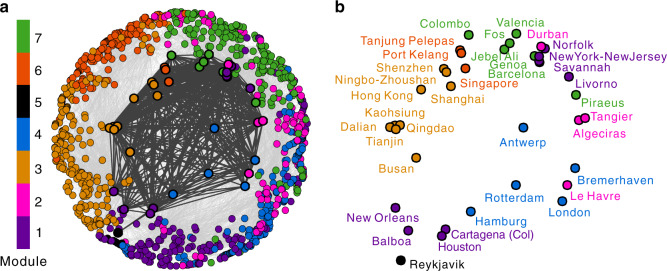
“r the method of modularity maximization, each partition of a network into several disjoint modules is given a score Q, called the modularity. It is defined as20: �=1 2� ∑ @��,�− �� � 2� �,� A𝛿(�,�) (10) where ��,� equals 1 if a link exists between node i and node j, and 0 otherwise; L is the total number of network li…”
The architecture of complex weighted networks
Barrat, A., Barthélemy, M., Pastor-Satorras, R., & Vespignani, A. (2004) · Proceedings of the National Academy of Sciences · doi:10.1073/pnas.0400087101 · Cited by 4,218
Functional cartography of complex metabolic networks
Guimerà, R., & Nunes Amaral, L. A. (2005) · Nature · doi:10.1038/nature03288 · Cited by 3,983
Comparing community structure identification
Danon, L., Díaz-Guilera, A., Duch, J., & Arenas, A. (2005) · Journal of Statistical Mechanics: Theory and Experiment · doi:10.1088/1742-5468/2005/09/p09008 · Cited by 2,872
Community detection in networks: a user guide
Fortunato, S., & Hric, D. (2016) · Physics Reports · doi:10.1016/j.physrep.2016.09.002 · Cited by 2,086
Infrastructure, Geographical Disadvantage, Transport Costs, and Trade
Limao, N. (2001) · The World Bank Economic Review · doi:10.1093/wber/15.3.451 · Cited by 1,899 · cited 1×
“of all the node pairs in the network, normalized by that in an ideal case of network configuration where all nodes are connected with each other. It is calculated as follows: 𝐸𝑔�����= 𝐸 (𝐺) 𝐸(𝐺���𝑎�) (4) 𝐸 (𝐺)= ∑�≠�∈𝐺ϵ�� �(�−1) = 1 �(�−1) ∑ ��� �≠�∈𝐺 (5) 𝐸(𝐺�����)= ∑�≠�∈𝐺ϵ�� �(�−1) = 1 �(�−1) ∑ ��� �≠�∈𝐺 (6) where 𝐸 (…”
Guimerà, R., Mossa, S., Turtschi, A., & Amaral, L. A. N. (2005) · Proceedings of the National Academy of Sciences · doi:10.1073/pnas.0407994102 · Cited by 1,762
Borgatti, S. P., & Halgin, D. S. (2011) · Organization Science · doi:10.1287/orsc.1100.0641 · Cited by 1,596
Network ‘Small-World-Ness’: A Quantitative Method for Determining Canonical Network Equivalence
Humphries, M. D., & Gurney, K. (2008) · PLoS ONE · doi:10.1371/journal.pone.0002051 · Cited by 1,442
Identification and classification of hubs in brain networks
Sporns, O., Honey, C. J., & Kötter, R. (2007) · PLoS ONE · doi:10.1371/journal.pone.0001049 · Cited by 1,165
Modular and hierarchically modular organization of brain networks
Meunier, D., Lambiotte, R., & Bullmore, E. T. (2010) · Frontiers in Neuroscience · doi:10.3389/fnins.2010.00200 · Cited by 1,156
Network attributes for segregation and integration in the human brain
Sporns, O. (2013) · Current Opinion in Neurobiology · doi:10.1016/j.conb.2012.11.015 · Cited by 1,067
Detecting rich-club ordering in complex networks
Colizza, V., Flammini, A., Serrano, M. A., & Vespignani, A. (2006) · Nature Physics · doi:10.1038/nphys209 · Cited by 1,001
The complex network of global cargo ship movements
Kaluza, P., Kölzsch, A., Gastner, M. T., & Blasius, B. (2010) · Journal of The Royal Society Interface · doi:10.1098/rsif.2009.0495 · Cited by 967 · cited 1×
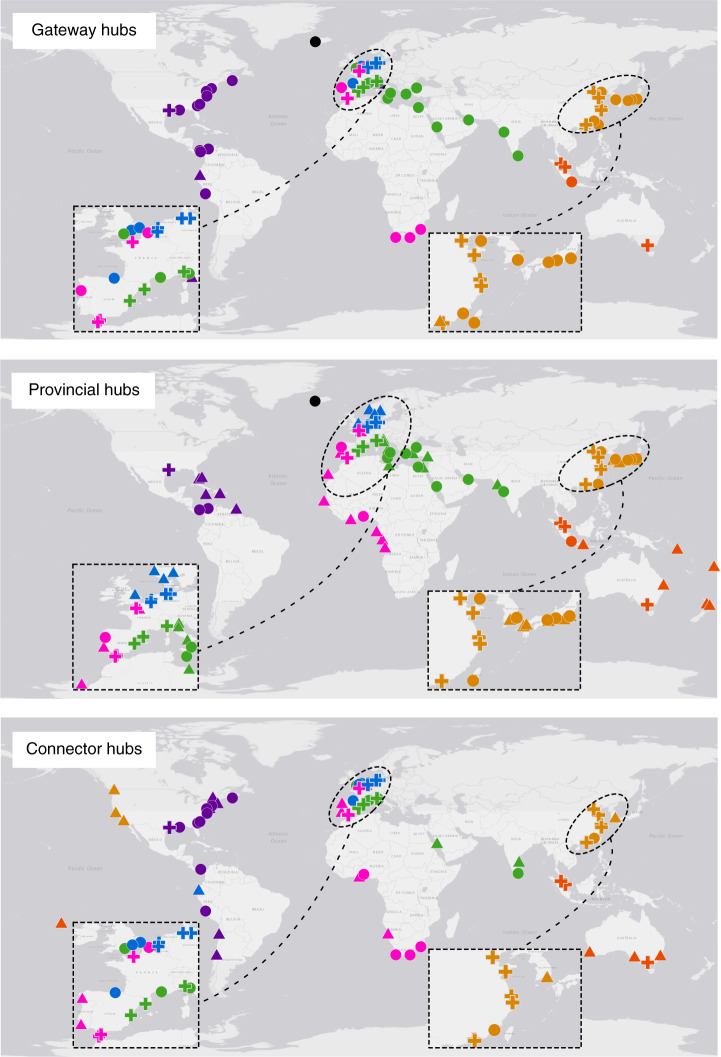
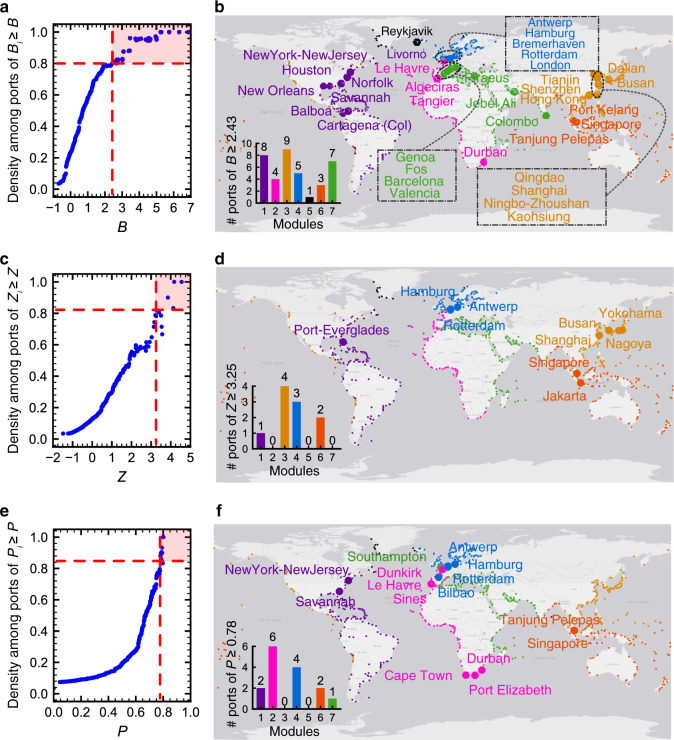
“s with ports outside its own community, reflecting the extent of gateway-ness of port i in realizing the interaction between its host community and the outside world. It is defined as: ��= ��𝑇−�𝑇 𝜎�𝑇 (12) where ��𝑇 is the number of connections of port i to other ports out of its own module T (i.e. outmodule connection…”
BackgroundNetwork hub location problems: The state of the art
Alumur, S., & Kara, B. Y. (2008) · European Journal of Operational Research · doi:10.1016/j.ejor.2007.06.008 · Cited by 931
Economic small-world behavior in weighted networks
Latora, V., & Marchiori, M. (2003) · The European Physical Journal B - Condensed Matter and Complex Systems · doi:10.1140/epjb/e2003-00095-5 · Cited by 772
Cartography of complex networks: modules and universal roles
Guimerà, R., & Amaral, L. A. N. (2005) · Journal of Statistical Mechanics: Theory and Experiment · doi:10.1088/1742-5468/2005/02/p02001 · Cited by 749
Port efficiency, maritime transport costs, and bilateral trade
Clark, X., Dollar, D., & Micco, A. (2004) · Journal of Development Economics · doi:10.1016/j.jdeveco.2004.06.005 · Cited by 734 · cited 1×
“that in an ideal case of network configuration where all nodes are connected with each other. It is calculated as follows: 𝐸𝑔�����= 𝐸 (𝐺) 𝐸(𝐺���𝑎�) (4) 𝐸 (𝐺)= ∑�≠�∈𝐺ϵ�� �(�−1) = 1 �(�−1) ∑ ��� �≠�∈𝐺 (5) 𝐸(𝐺�����)= ∑�≠�∈𝐺ϵ�� �(�−1) = 1 �(�−1) ∑ ��� �≠�∈𝐺 (6) where 𝐸 (𝐺) and E(𝐺�����) represent the efficiency of the rea…”
Rethinking segregation and integration: contributions of whole-brain modelling
Deco, G., Tononi, G., Boly, M., & Kringelbach, M. L. (2015) · Nature reviews. Neuroscience · doi:10.1038/nrn3963 · Cited by 658
The Rich-Club Phenomenon in the Internet Topology
Zhou, S., & Mondragon, R. J. (2004) · IEEE Communications Letters · doi:10.1109/lcomm.2004.823426 · Cited by 611
Small-world properties of the Indian railway network
Sen, P., Dasgupta, S., Chatterjee, A., Sreeram, P. A., Mukherjee, G., & Manna, S. S. (2003) · Physical Review E · doi:10.1103/physreve.67.036106 · Cited by 592
The Ubiquity of Small-World Networks
Telesford, Q. K., Joyce, K. E., Hayasaka, S., Burdette, J. H., & Laurienti, P. J. (2011) · Brain Connectivity · doi:10.1089/brain.2011.0038 · Cited by 515
Wang, J., Mo, H., Wang, F., & Jin, F. (2011) · Journal of Transport Geography · doi:10.1016/j.jtrangeo.2010.08.012 · Cited by 511
The worldwide maritime network of container shipping: spatial structure and regional dynamics
DUCRUET, C., & NOTTEBOOM, T. (2012) · Global Networks · doi:10.1111/j.1471-0374.2011.00355.x · Cited by 441 · cited 1×
“he extent of the provincial-ness of port i in its modular community. The higher inside-module degree, the more significant status of being a provincial hub. It is defined as follows43: ��= ��𝑇−�𝑇 𝜎�𝑇 (11) where ��𝑇 is the number of connections of port i to other ports in its own module T (i.e. intramodule connections)…”
BackgroundStatistical analysis of 22 public transport networks in Poland
Sienkiewicz, J., & Hołyst, J. A. (2005) · Physical Review E · doi:10.1103/physreve.72.046127 · Cited by 434
Cannistraci, C. V., Alanis-Lobato, G., & Ravasi, T. (2013) · Scientific Reports · doi:10.1038/srep01613 · Cited by 401
Self-citationEmpirical evidence on induced traffic: A review and synthesis
Goodwin, P. (1996) · Transportation · doi:10.1007/bf00166218 · Cited by 362
Kim, S., & Shin, E.-H. (2002) · Social Forces · doi:10.1353/sof.2003.0014 · Cited by 316
Estimating the effects of the container revolution on world trade
Bernhofen, D. M., El-Sahli, Z., & Kneller, R. (2016) · Journal of International Economics · doi:10.1016/j.jinteco.2015.09.001 · Cited by 284 · cited 1×
“red to 𝐿���� of an equivalent random network and the average clustering coefficient C is compared to ����� of an equivalent lattice network, obtaining the small-world coefficient: 𝜔=��𝑎�� � − 𝐶 𝐶�𝑎�� (3) Note that ����� is not considered, therefore this measure neglects its fluctuations. Since the boundary conditions…”
Empirical analysis of the worldwide maritime transportation network
Hu, Y., & Zhu, D. (2009) · Physica A: Statistical Mechanics and its Applications · doi:10.1016/j.physa.2008.12.016 · Cited by 276
Machine learning meets complex networks via coalescent embedding in the hyperbolic space
Muscoloni, A., Thomas, J. M., Ciucci, S., Bianconi, G., & Cannistraci, C. V. (2017) · Nature Communications · doi:10.1038/s41467-017-01825-5 · Cited by 187
Self-citationLiner shipping hub network design in a competitive environment
Gelareh, S., Nickel, S., & Pisinger, D. (2010) · Transportation Research Part E: Logistics and Transportation Review · doi:10.1016/j.tre.2010.05.005 · Cited by 183
Voitalov, I., van der Hoorn, P., van der Hofstad, R., & Krioukov, D. (2019) · Physical Review Research · doi:10.1103/physrevresearch.1.033034 · Cited by 162
Daminelli, S., Thomas, J. M., Durán, C., & Cannistraci, C. V. (2015) · New Journal of Physics · doi:10.1088/1367-2630/17/11/113037 · Cited by 154
Self-citationLiner hub-and-spoke shipping network design
Zheng, J., Meng, Q., & Sun, Z. (2015) · Transportation Research Part E Logistics and Transportation Review · doi:10.1016/j.tre.2014.12.014 · Cited by 102
Maritime Networks. Spatial Structures and Time Dynamics
Ducruet, C. (2015) · HAL · Cited by 88
A study of the temporal robustness of the growing global container-shipping network
Wang, N., Wu, N., Dong, L.-L., Yan, H.-K., & Wu, D. (2016) · Scientific Reports · doi:10.1038/srep34217 · Cited by 82 · cited 1×
“port’s connections distribute over the more modules, the more significant role of connector hub of the port in the structure of the GLSN. It is mathematically defined as43: ��=1−∑ ( ��� �� �� )2 �=1 (13) where �� is the total connections (degree) of port i, ��� is the number of connections of port i to 27 ports in mod…”
BackgroundDensity-based and transport-based core-periphery structures in networks
Lee, S. H., Cucuringu, M., & Porter, M. A. (2014) · Physical Review E · doi:10.1103/physreve.89.032810 · Cited by 80
Chang, X., Xu, T., Li, Y., & Wang, K. (2013) · Scientific Reports · doi:10.1038/srep01691 · Cited by 69
Multiscale core-periphery structure in a global liner shipping network
Kojaku, S., Xu, M., Xia, H., & Masuda, N. (2019) · Scientific Reports · doi:10.1038/s41598-018-35922-2 · Cited by 42
Self-citationNavigability evaluation of complex networks by greedy routing efficiency
Muscoloni, A., & Cannistraci, C. V. (2019) · Proceedings of the National Academy of Sciences · doi:10.1073/pnas.1817880116 · Cited by 33
Self-citationNarula, V., Zippo, A. G., Muscoloni, A., Biella, G. E. M., & Cannistraci, C. V. (2017) · Applied Network Science · doi:10.1007/s41109-017-0048-x · Cited by 27
Self-citationMuscoloni, A., & Cannistraci, C. V. (2019) · arXiv (Cornell University) · doi:10.48550/arxiv.1907.00025 · Cited by 14
Self-citationRich-clubness test: how to determine whether a complex network has or doesn't have a rich-club?Preprint
Muscoloni, A., & Cannistraci, C. V. (2017) · arXiv (Cornell University) · doi:10.48550/arxiv.1704.03526 · Cited by 10
Self-citation
Research works printed but not linked: 4
- UNCTAD. Review of Maritime Transport 2017. https://unctad.org/en/pages/publicationwebflyer.aspx?publicationid=1890 (2017).
- Bar-Yam Y Dynamics of Complex Systems 1997 Cambridge, MA Westview Press
- Deng W-B Guo L Li W Cai X Worldwide marine transportation network: efficiency and container throughput Chin. Phys. Lett. 2009 26 242 245
- Fujita M Krugman PR Venables AJ The Spatial Economy: Cities, Regions, and International Trade 2001 Cambridge, MA The MIT Press
Cited by
Ports’ criticality in international trade and global supply-chains
Verschuur, J., Koks, E. E., & Hall, J. W. (2022) · Nature Communications · doi:10.1038/s41467-022-32070-0 · Cited by 229
Tracking the global reduction of marine traffic during the COVID-19 pandemic
March, D., Metcalfe, K., Tintoré, J., & Godley, B. J. (2021) · Nature Communications · doi:10.1038/s41467-021-22423-6 · Cited by 237
Research topics and trends in the maritime transport: A structural topic model
Bai, X., Zhang, X., Li, K. X., Zhou, Y., & Yuen, K. F. (2020) · Transport Policy · doi:10.1016/j.tranpol.2020.12.013 · Cited by 160
Data-driven static and dynamic resilience assessment of the global liner shipping network
Bai, X., Ma, Z., & Zhou, Y. (2023) · Transportation Research Part E Logistics and Transportation Review · doi:10.1016/j.tre.2023.103016 · Cited by 171
Wen, T., Gao, Q., Chen, Y., & Cheong, K. H. (2022) · Reliability Engineering & System Safety · doi:10.1016/j.ress.2022.108578 · Cited by 106
Metadata
- Authors
- Xu, M., Pan, Q., Muscoloni, A., Xia, H., & Cannistraci, C. V.
- Affiliations
- Dalian University of Technology (CN)
- Center for Systems Biology Dresden (DE)
- Corresponding author
- Xu, Mengqiao
- Xia, Haoxiang
- Cannistraci, Carlo Vittorio
- Venue
- Nature Communications
- Published
- 2020-06-05
- Volume
- 11
- Issue
- 1
- Pages
- 2849-2849
- ISSN
- 2041-1723 (ISSN-L)
- PMC
- PMC7275034
- OpenAlex
- W3033381188
- Cited by
- 103
- References
- 54
- Citations by year
- 2026: 25 · 2025: 32 · 2024: 21 · 2023: 11 · 2022: 9 · 2021: 4 · 2020: 1
- FWCI
- 2.64
- Type
- journal article
- Language
- en
- Open access
- gold
- doi.org
- Licence
- cc-by
- creativecommons.org/licenses/by/4.0 (tdm)
- creativecommons.org/licenses/by/4.0 (vor)
- Locations
- Nature Communications (publishedVersion, cc-by)
- PubMed Central (publishedVersion, cc-by)
- PubMed (publishedVersion)
- arXiv (Cornell University) (submittedVersion)
- DOAJ (DOAJ: Directory of Open Access Journals) (submittedVersion, cc-by-sa)
- arXiv (Cornell University)
- Funders
- National Natural Science Foundation of China (71421001], 2018J11CY009, 71871042, 71533001)
- China Postdoctoral Science Foundation (2017M621141)
- Technische Universität Dresden
- Topics
- Physical Sciences › Physics and Astronomy › Statistical and Nonlinear Physics › Complex Network Analysis Techniques
- Physical Sciences › Engineering › Industrial and Manufacturing Engineering › Maritime Ports and Logistics
- Social Sciences › Urban Studies › Global Urban Networks and Dynamics
- Keywords
- maritime transport, modular network architecture, small-world networks, wiring cost, transport efficiency, international trade, freight transport
About these checks
Registry, retraction, Cites and statistics results are computed, not judged, with one exception: a printed reference that no index lists is read once by a model before it counts as a citation error. Claims are extracted by a model and kept only when their quote appears verbatim in the text; each cited source is then checked, with a model’s help, for whether it says what the claim relies on. Those verdicts can be wrong — read the claim’s quote and the cited source before relying on one.
Statistics and arithmetic are recomputed, not judged.
Confidence bands are shown only for fields calibrated on our annotated test set. None is calibrated yet, so no band is shown.
What counts as a claim ›How we measure confidence ›How we check this ›
Are you an author, or do you see a problem with this page? Request a review
Data sources
Bibliographic data: Semantic Scholar, OpenAlex, Crossref.
Contains information from the Semantic Scholar Academic Graph Datasets, made available under the ODC Attribution License (ODC-BY 1.0).
Semantic Scholar’s data is described in: Kinney, R., et al. (2023). The Semantic Scholar Open Data Platform. arXiv:2301.10140.
