

Mechano-modulatory synthetic niches for liver organoid derivation
Open accessPublished version of a preprint
The DOI matches its Crossref record; 55 of the 55 references it cites were found in a registry or an index.
Abstract
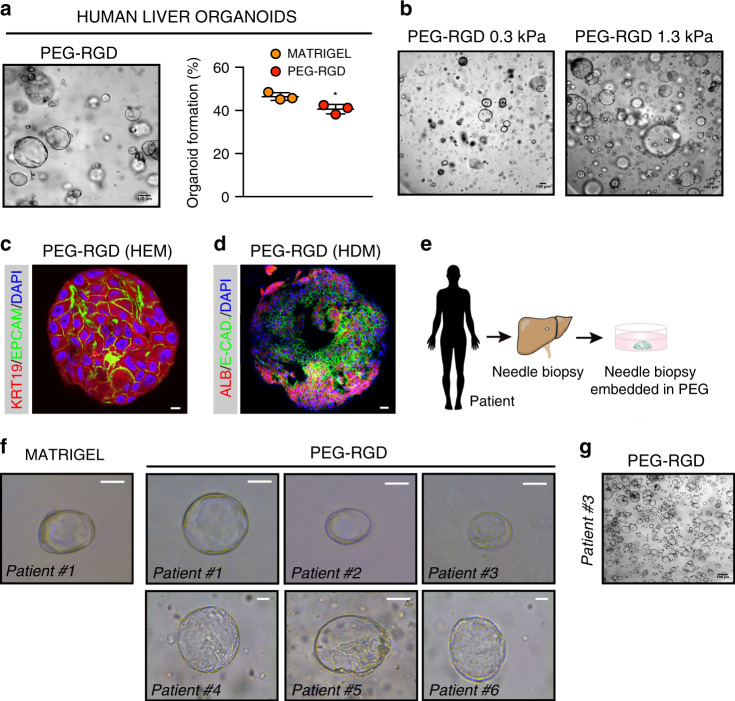
The recent demonstration that primary cells from the liver can be expanded in vitro as organoids holds enormous promise for regenerative medicine and disease modelling. The use of three-dimensional (3D) cultures based on ill-defined and potentially immunogenic matrices, however, hampers the translation of liver organoid technology into real-life applications. We here use chemically defined hydrogels for the efficient derivation of both mouse and human hepatic organoids. Organoid growth is found to be highly stiffness-sensitive, a mechanism independent of acto-myosin contractility and requiring instead activation of the Src family of kinases (SFKs) and yes-associated protein 1 (YAP). Aberrant matrix stiffness, on the other hand, results in compromised proliferative capacity. Finally, we demonstrate the establishment of biopsy-derived human liver organoids without the use of animal components at any step of the process. Our approach thus opens up exciting perspectives for the establishment of protocols for liver organoid-based regenerative medicine.
Overview
The claims and statistics of this paper haven’t been checked yet.
Free: it reads the open-access text and checks the first 5 claims that cite a source we can check. Create a free account to check every claim.
Integrity signals
Registry
Cites
Statistics
Figures
Verification
Claims the paper makes
The claims and statistics of this paper haven’t been checked yet.
Free: it reads the open-access text and checks the first 5 claims that cite a source we can check. Create a free account to check every claim.
Claims other papers make about this one
Each is checked against this paper’s own text: does it say what the citing paper says it does?
The source backs part of the claim, not all of it — or backs it for a different population, condition or comparison.
In the citing paper
“To overcome the limitations of these 2D in vitro models, three-dimensional (3D) cell cultures-especially organoids-have been proposed for mimicking the architecture and genetic expression of native human liver tissue (Akbari et al., 2019;Sorrentino et al., 2020).”
From Fast formation and maturation enhancement of human liver organoids using a liver-organoid-on-a-chip (2024) · cites this paper as Sorrentino et al., 2020
Experimental — accuracy not yet measured
Self-check
Percentages, sums and reported differences re-computed from the paper’s own numbers.
The self-check needs the paper’s full text.
Citations
Cites
Molecular Mechanisms of Stress-Responsive Changes in Collagen and Elastin Networks in Skin
Aziz, J., Shezali, H., Radzi, Z., Yahya, N. A., Abu Kassim, N. H., Czernuszka, J., & Rahman, M. T. (2016) · Skin Pharmacology and Physiology · doi:10.1159/000447017 · Cited by 7,323
Role of YAP/TAZ in mechanotransduction
Dupont, S., Morsut, L., Aragona, M., Enzo, E., Giulitti, S., Cordenonsi, M., Zanconato, F., Le Digabel, J., Forcato, M., Bicciato, S., et al. (2011) · Nature · doi:10.1038/nature10137 · Cited by 5,979
Organoid Models and Applications in Biomedical Research
Xinaris, C., Brizi, V., & Remuzzi, G. (2015) · Nephron · doi:10.1159/000433566 · Cited by 3,515
Mechanotransduction and extracellular matrix homeostasis
Humphrey, J. D., Dufresne, E. R., & Schwartz, M. A. (2014) · Nature Reviews Molecular Cell Biology · doi:10.1038/nrm3896 · Cited by 2,124
Long-Term Culture of Genome-Stable Bipotent Stem Cells from Adult Human Liver
Huch, M., Gehart, H., van Boxtel, R., Hamer, K., Blokzijl, F., Verstegen, M. M. A., Ellis, E., van Wenum, M., Fuchs, S. A., de Ligt, J., et al. (2015) · Cell · doi:10.1016/j.cell.2014.11.050 · Cited by 1,619
In vitro expansion of single Lgr5+ liver stem cells induced by Wnt-driven regeneration
Huch, M., Dorrell, C., Boj, S. F., van Es, J. H., Li, V. S. W., van de Wetering, M., Sato, T., Hamer, K., Sasaki, N., Finegold, M. J., et al. (2013) · Nature · doi:10.1038/nature11826 · Cited by 1,555
Calvo, F., Ege, N., Grande-Garcia, A., Hooper, S., Jenkins, R. P., Chaudhry, S. I., Harrington, K., Williamson, P., Moeendarbary, E., Charras, G., et al. (2013) · Nature Cell Biology · doi:10.1038/ncb2756 · Cited by 1,478
Liu-Chittenden, Y., Huang, B., Shim, J. S., Chen, Q., Lee, S.-J., Anders, R. A., Liu, J. O., & Pan, D. (2012) · Genes & Development · doi:10.1101/gad.192856.112 · Cited by 1,452
Designer matrices for intestinal stem cell and organoid culture
Gjorevski, N., Sachs, N., Manfrin, A., Giger, S., Bragina, M. E., Ordóñez-Morán, P., Clevers, H., & Lutolf, M. P. (2016) · Nature · doi:10.1038/nature20168 · Cited by 1,426
Michalopoulos, G. K. (2007) · Journal of Cellular Physiology · doi:10.1002/jcp.21172 · Cited by 1,384
Cited by
Items 201–225 of 225
Kong, D., Smith‐Cortinez, N., Heegsma, J., Blokzijl, H., de Meijer, V. E., & Faber, K. N. (2023) · Research Square · doi:10.21203/rs.3.rs-2613542/v1
Decellularized Tissue-Derived Materials for Organoid Culture
Willemse, J., & Verstegen, M. M. A. (2023) · Springer eBooks · doi:10.1007/978-3-030-92090-6_50-1
Author Response: Hepatic lipid overload potentiates biliary epithelial cell activation via E2Fs
Yıldız, E., Alam, G. E., Perino, A., Jalil, A., Denechaud, P., Huber, K., Fajas, L., Auwerx, J. H., Sorrentino, G., & Schoonjans, K. (2022) · doi:10.7554/elife.81926.1.sa3
Self-citationEngineering Nanocellulose-based Matrices for 3D Cell Cultures
Curvello, R., Raghuwanshi, V. S., & Garnier, G. (2022) · Pulp and Paper Fundamental Research Symposium · doi:10.15376/frc.2022.1.291
Modeling Steatohepatitis with Human Adult Stem Cell-Derived Liver OrganoidsPreprint
Zhu, L., Liu, S., Tong, W., Yang, Y., Han, P., Wang, Z., Zhao, T., Wang, L., Cui, T., Yang, L., et al. (2024) · SSRN Electronic Journal · doi:10.2139/ssrn.4848267
Decellularized Tissue-Derived Materials for Organoid Culture
Willemse, J., & Verstegen, M. M. A. (2024) · Springer eBooks · doi:10.1007/978-3-031-56363-8_50
Cui, J. (2024) · Journal of Biosciences and Medicines · doi:10.4236/jbm.2024.1211035
Organ-Chips und Visualisierung biologischer Systeme
Tian, T., Liu, J., & Zhu, H. (2025) · Springer eBooks · doi:10.1007/978-981-97-9693-9_8
Application of Inorganic Bioactive Materials in Organoid Research
Ma, W., Yahui, H. A. N., Wu, C., & Lu, H. (2025) · Journal of Inorganic Materials · doi:10.15541/jim20250007
Hepatobiliary organoids and large-scale expansion for regenerative therapies
Schneeberger, K., Morini, S., & Spee, B. (2025) · Elsevier eBooks · doi:10.1016/b978-0-12-823524-9.00021-6
Bioscaffold Guidance Drives Liver Periportal Area Tubulogenesis in hIPSC OrganoidsPreprint
Rajendiran, H., Sahni, G., Arora, A., Hepburn, M. S., Luciani, F., Ting, O. H., Zhu, J., Marchand, M. F., Serhrouchni, S., Monet, A., et al. (2025) · SSRN Electronic Journal · doi:10.1101/2025.08.28.672864
“Human liver organoid models have focused either on the generation of complex liver bud surrogates that reproduce the diversity of cell types [9-11], irrespective of their spatial organization, or on the development of bile duct organoids from induced or primary cholangiocytes [12-18].”
Marcos, L. F., Hall, C., Hill, E. J., Wilson, S. L., & Roach, P. (2025) · Advanced NanoBiomed Research · doi:10.1002/anbr.202500189
(2025) · doi:10.1016/j.biomaterials.2025.123870
Wang, S., Li, Y. D., Ma, J. H., Li, J., Huang, D., Wa, X., Zhou, Y., & Liu, Y. (2026) · Journal of Ethnopharmacology · doi:10.1016/j.jep.2026.121742
Current Cell/Organoid and Animal Models for Primary Sclerosing Cholangitis
Yao, Q., Cheng, S., Pan, Q., Yu, J., & Hongcui, C. (2026) · Portal hypertension & cirrhosis · doi:10.1002/poh2.70048
Guchhait, B., Tiwari, V., Yadav, R., Pal, S., Roy, S., & Tripathi, D. M. (2026) · Journal of Controlled Release · doi:10.1016/j.jconrel.2026.115080 · Cited by 1
A human liver organoid platform for hepatotoxicity assessment: evaluation using reference compounds
Kim, M. J., Choi, S. Y., Youn, S. M., Kim, T. G., Oh, I. U., Park, S. A., Oh, J. H., Son, M. J., & Lee, J. H. (2026) · Frontiers in Toxicology · doi:10.3389/ftox.2026.1805474
“The 3D holotomography imaging effectively demonstrated that organoids morphologically recapitulated the key features of hepatic differentiation (Figure 1C) (Sorrentino et al., 2020; StemCell Technologies, 2024; Ye et al., 2020).”
Synthetic developmental engineering of human liver organogenesis
Taheri, M. N., Xiang, Y., & Ebrahimkhani, M. R. (2026) · Development · doi:10.1242/dev.205040
The Application of 3D Cell Culture in Thyroid Cancer
Jiang, H., Zhou, D., Li, Z., Jiang, H., Zhu, G., Xu, K., & Sun, J. (2026) · Annals of Biomedical Engineering · doi:10.1007/s10439-026-04299-z
Sun, S., Chen, S., Ma, W., Xu, J., Lu, M., & Lu, H. (2026) · Organoids · doi:10.3390/organoids5030026
Spatiotemporal instrumentation of in vitro tissues: Toward understanding human disease
Brenden, C. K., Williams, J. T., Rivas, D., Forró, C., & Choi, S. (2026) · Cell Biomaterials · doi:10.1016/j.celbio.2026.100576
Kamei, K. (2026) · Communications Biology · doi:10.1038/s42003-026-10887-5
“…include staged presentation of developmental morphogens 28,31 , temporally controlled oxygen or perfusion gradients 87 , progressive programming of matrix mechanics or viscoelasticity 93 – 95 , and timed endothelial/angiocrine induction during hepatoblastexpansionand early tissueassembly 71,72 .”
Viscoelasticity-regulated engineered hydrogel matrix for sustained organoid culturePreprint
Zhang, R., Meng, F., Pang, R., Zhu, J., Liu, X., Mi, C., Duan, H., & Huang, J. (2026) · SSRN Electronic Journal · doi:10.2139/ssrn.7611635
Bayaraa, O., Lee, N., Kim, S.-H., Lee, H., Li, C., Fu, X., Hyun, J., Choi, G., Choy, J., Kim, H. S., et al. (2026) · Bioactive Materials · doi:10.1016/j.bioactmat.2026.09.042
“As spheroids compact, diffusion limitations drive metabolic quiescence that often progresses to core necrosis, while cadherin-dominated cell-cell adhesion suppresses integrin engagement and activates the Hippo pathway [25, 27,28].”
Kanso, H., Di Cio, S., Rose, R., Palacios, I., & Gautrot, J. E. (2025) · doi:10.1101/2025.06.13.659497
Metadata
- Authors
- Sorrentino, G., Rezakhani, S., Yildiz, E., Nuciforo, S., Heim, M. H., Lutolf, M. P., & Schoonjans, K.
- Affiliations
- École Polytechnique Fédérale de Lausanne (CH)
- University of Basel (CH)
- Corresponding author
- Schoonjans, Kristina
- ORCID
- Venue
- Nature Communications
- Published
- 2020-07-10
- Volume
- 11
- Issue
- 1
- Pages
- 3416-3416
- ISSN
- 2041-1723 (ISSN-L)
- PMC
- PMC7351772
- OpenAlex
- W3041739049
- Cited by
- 224
- References
- 55
- Citations by year
- 2026: 27 · 2025: 42 · 2024: 35 · 2023: 34 · 2022: 40 · 2021: 40 · 2020: 5
- FWCI
- 27.17
- Type
- journal article
- Language
- en
- Open access
- gold
- doi.org
- Licence
- cc-by
- creativecommons.org/licenses/by/4.0 (tdm)
- creativecommons.org/licenses/by/4.0 (vor)
- Locations
- Nature Communications (publishedVersion, cc-by)
- bioRxiv (Cold Spring Harbor Laboratory) (acceptedVersion)
- PubMed Central (publishedVersion, cc-by)
- PubMed (publishedVersion)
- ArTS Archivio della ricerca di Trieste (University of Trieste https://www.units.it/) (submittedVersion, cc-by)
- Infoscience (Ecole Polytechnique Fédérale de Lausanne) (submittedVersion, cc-by-nc-nd)
- RePEc: Research Papers in Economics (submittedVersion)
- DOAJ (DOAJ: Directory of Open Access Journals) (submittedVersion, cc-by-sa)
- Funders
- National Science Foundation
- Stiftelsen Kristian Gerhard Jebsen
- European Commission (HORIZON2020, 668294)
- École Polytechnique Fédérale de Lausanne (31003A_166695)
- Schweizerischer Nationalfonds zur Förderung der Wissenschaftlichen Forschung (160798, 125487, 179447, 166695, 310030)
- Vienna Science and Technology Fund
- Board of the Swiss Federal Institutes of Technology
- Topics
- Health Sciences › Medicine › Surgery › Tissue Engineering and Regenerative Medicine
- Life Sciences › Biochemistry, Genetics and Molecular Biology › Cell Biology › Cellular Mechanics and Interactions
- Physical Sciences › Engineering › Biomedical Engineering › 3D Printing in Biomedical Research
- Keywords
- liver organoids, extracellular matrix stiffness, mechanotransduction, Src family kinases, YAP, actomyosin contractility, 3D cell culture, disease modeling
- MeSH terms
- Humans, Liver, Organoids, Transcription Factors, src-Family Kinases, Hydrogels, Tissue Engineering
About these checks
Registry, retraction, Cites and statistics results are computed, not judged, with one exception: a printed reference that no index lists is read once by a model before it counts as a citation error. Claims are extracted by a model and kept only when their quote appears verbatim in the text; each cited source is then checked, with a model’s help, for whether it says what the claim relies on. Those verdicts can be wrong — read the claim’s quote and the cited source before relying on one.
Statistics and arithmetic are recomputed, not judged.
Confidence bands are shown only for fields calibrated on our annotated test set. None is calibrated yet, so no band is shown.
What counts as a claim ›How we measure confidence ›How we check this ›
Are you an author, or do you see a problem with this page? Request a review
Data sources
Bibliographic data: Semantic Scholar, OpenAlex, Crossref.
Contains information from the Semantic Scholar Academic Graph Datasets, made available under the ODC Attribution License (ODC-BY 1.0).
Semantic Scholar’s data is described in: Kinney, R., et al. (2023). The Semantic Scholar Open Data Platform. arXiv:2301.10140.
