

The DOI matches its Crossref record; 21 of the 21 references it cites were found in a registry or an index.
Self-amplifying RNA SARS-CoV-2 lipid nanoparticle vaccine candidate induces high neutralizing antibody titers in mice
Open accessAbstract
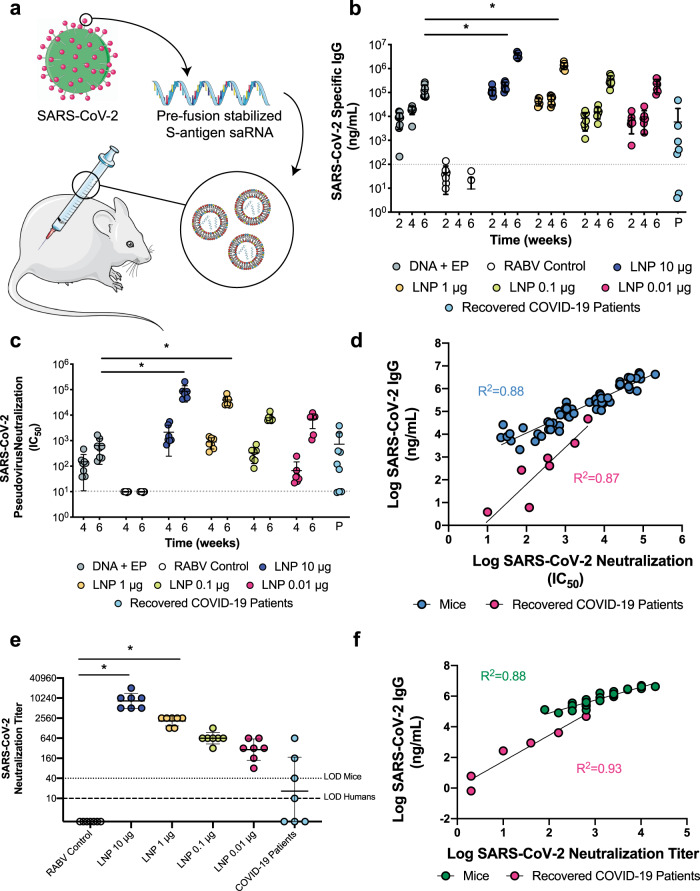
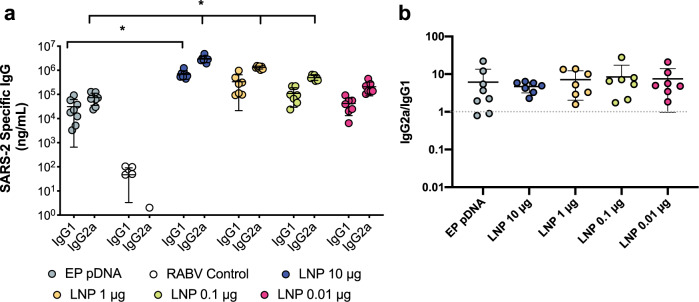
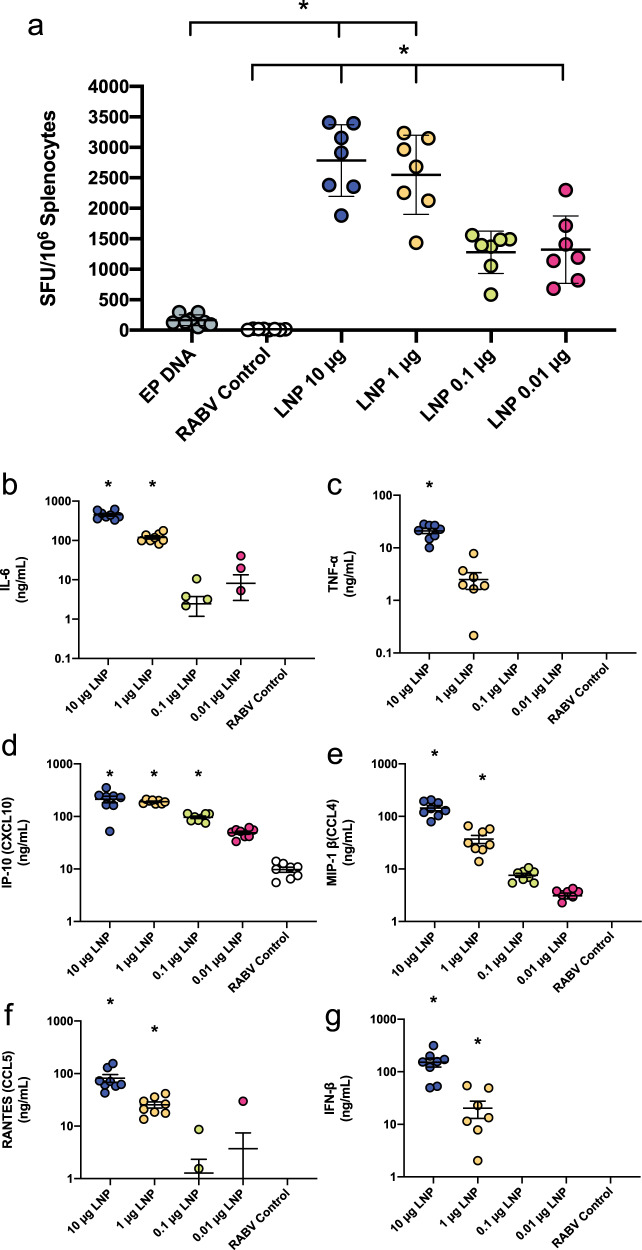
The spread of the SARS-CoV-2 into a global pandemic within a few months of onset motivates the development of a rapidly scalable vaccine. Here, we present a self-amplifying RNA encoding the SARS-CoV-2 spike protein encapsulated within a lipid nanoparticle (LNP) as a vaccine. We observe remarkably high and dose-dependent SARS-CoV-2 specific antibody titers in mouse sera, as well as robust neutralization of both a pseudo-virus and wild-type virus. Upon further characterization we find that the neutralization is proportional to the quantity of specific IgG and of higher magnitude than recovered COVID-19 patients. saRNA LNP immunizations induce a Th1-biased response in mice, and there is no antibody-dependent enhancement (ADE) observed. Finally, we observe high cellular responses, as characterized by IFN-γ production, upon re-stimulation with SARS-CoV-2 peptides. These data provide insight into the vaccine design and evaluation of immunogenicity to enable rapid translation to the clinic.
Overview
The claims and statistics of this paper haven’t been checked yet.
Run the check — free, no account needed. It reads the open-access text and checks the sources it cites.
Integrity signals
Registry
Cites
Statistics
Figures
Verification
Claims the paper makes
The claims and statistics of this paper haven’t been checked yet.
Run the check — free, no account needed. It reads the open-access text and checks the sources it cites.
Claims other papers make about this one
Each is checked against this paper’s own text: does it say what the citing paper says it does?
In the citing paper
“Recently, two different saRNA vaccines developed independently by Arcturus Therapeutics and Imperial College London have shown favorable immune responses against SARS-CoV-2, and have entered clinical trials.211–213”
From Advances in COVID-19 mRNA vaccine development (2022) · cites this paper as [211]
In the citing paper
“In mice, 10 ng primer and booster doses injected 28 days apart into muscle yielded a robust T cell response and IgG titres similar to those in plasma from patients who had recovered from COVID-19 (ref.136).”
From mRNA vaccines for infectious diseases: principles, delivery and clinical translation (2021) · cites this paper as [136]
Self-check
Percentages, sums and reported differences re-computed from the paper’s own numbers.
The self-check needs the paper’s full text.
Citations
Cites
A new coronavirus associated with human respiratory disease in China
Wu, F., Zhao, S., Yu, B., Chen, Y.-M., Wang, W., Song, Z.-G., Hu, Y., Tao, Z.-W., Tian, J.-H., Pei, Y.-Y., et al. (2020) · Nature · doi:10.1038/s41586-020-2008-3 · Cited by 11,688
Isolation of a Novel Coronavirus from a Man with Pneumonia in Saudi Arabia
Zaki, A. M., van Boheemen, S., Bestebroer, T. M., Osterhaus, A. D. M. E., & Fouchier, R. A. M. (2012) · New England Journal of Medicine · doi:10.1056/nejmoa1211721 · Cited by 5,677
A Novel Coronavirus Associated with Severe Acute Respiratory Syndrome
Tg, K., Erdman, D. D., Cs, G., Zaki, Peret, T. C. T., Emery, S. L., Tong, S., Urbani, C., Comer, J. A., Lim, W., et al. (2003) · New England Journal of Medicine · doi:10.1056/nejmoa030781 · Cited by 4,353
Maximizing the potency of siRNA lipid nanoparticles for hepatic gene silencing in vivo
Jayaraman, M., Ansell, S. M., Mui, B. L., Tam, Y. K., Chen, J., Du, X., Butler, D., Eltepu, L., Matsuda, S., Narayanannair, J. K., et al. (2012) · Angewandte Chemie International Edition · doi:10.1002/anie.201203263 · Cited by 1,267
Pardi, N., Tuyishime, S., Muramatsu, H., Kariko, K., Mui, B. L., Tam, Y. K., Madden, T. D., Hope, M. J., & Weissman, D. (2015) · Journal of Controlled Release · doi:10.1016/j.jconrel.2015.08.007 · Cited by 1,014
Pre-fusion structure of a human coronavirus spike protein
Kirchdoerfer, R. N., Cottrell, C. A., Wang, N., Pallesen, J., Yassine, H. M., Turner, H. L., Corbett, K. S., Graham, B. S., McLellan, J. S., & Ward, A. B. (2016) · Nature · doi:10.1038/nature17200 · Cited by 765
Nonviral delivery of self-amplifying RNA vaccines
Geall, A. J., Verma, A., Otten, G. R., Shaw, C. A., Hekele, A., Banerjee, K., Cu, Y., Beard, C. W., Brito, L. A., Krucker, T., et al. (2012) · Proceedings of the National Academy of Sciences · doi:10.1073/pnas.1209367109 · Cited by 675
Maier, M. A., Jayaraman, M., Matsuda, S., Liu, J., Barros, S., Querbes, W., Tam, Y. K., Ansell, S. M., Kumar, V., Qin, J., et al. (2013) · Molecular Therapy · doi:10.1038/mt.2013.124 · Cited by 625
Vogel, A. B., Lambert, L., Kinnear, E., Busse, D., Erbar, S., Reuter, K. C., Wicke, L., Perkovic, M., Beissert, T., Haas, H., et al. (2018) · Molecular Therapy · doi:10.1016/j.ymthe.2017.11.017 · Cited by 501
Kirchdoerfer, R. N., Wang, N., Pallesen, J., Wrapp, D., Turner, H. L., Cottrell, C. A., Corbett, K. S., Graham, B. S., McLellan, J. S., & Ward, A. B. (2018) · Scientific Reports · doi:10.1038/s41598-018-34171-7 · Cited by 466
Cited by
Sorted by citations
Items 401–464 of 464
Structural evolution of ionizable lipids for nucleic acid delivery
Xue, L., Ang, M. J. Y., Swingle, K. L., Fitzgerald, E., Chalom, O. Z., Gu, N., & Mitchell, M. J. (2026) · Nature Reviews Chemistry · doi:10.1038/s41570-026-00865-0 · Cited by 2
Nanotechnology-Driven Delivery Systems in Inoculation Therapies
Pereira, G. C. (2022) · Methods in molecular biology · doi:10.1007/978-1-0716-2716-7_3 · Cited by 1
Applications of Spray-Dried Vaccines
Arpagaus, C. (2023) · Springer eBooks · doi:10.1007/978-3-031-24323-3_6 · Cited by 2
RNA therapeutics for infectious diseases
Tu, L. M. T. P. P. L. M., Pham, T. T. D., & Than, V. T. (2024) · Progress in molecular biology and translational science · doi:10.1016/bs.pmbts.2024.01.002 · Cited by 1
Nanomaterial for Adjuvants Vaccine: Practical Applications and Prospects
Tran, V. A., Vo, V., Dang, V. Q., Vo, G. N. L., Đôn, T. N., Doan, V., & Le, V. T. (2024) · Indonesian Journal of Chemistry · doi:10.22146/ijc.87940 · Cited by 2
Potential use of CRISPR/Cas13 system for vaccine development against various RNA-viral infections
Mohanty, B., Mir, R. A., Priyadarshini, A., Bhat, K. A., Barati, S., Asl, E. R., Choi, J. R., & Rasmi, Y. (2024) · Future Virology · doi:10.1080/17460794.2024.2403253 · Cited by 1
Lipid-based vaccines against viruses including COVID-19
Gholap, A. D., Khuspe, P. R., Faiyazuddin, M., Uddin, M. J., Bhowmik, D. D., Said, R. P., Sonawane, K. S., Parit, S., & Hatvate, N. T. (2025) · Elsevier eBooks · doi:10.1016/b978-0-443-22374-7.00019-0 · Cited by 1
Comparative Function Analysis of Self‐Amplifying mRNA and Self‐Amplifying DNA
Li, W., Wang, Y., Wang, C., Huo, Y., & Lu, Y. (2025) · ChemBioChem · doi:10.1002/cbic.202500110 · Cited by 1
Therapeutic and prophylactic applications of self-replicating RNA viruses
Lundstrom, K. H. (2022) · Exploration of Immunology · doi:10.37349/ei.2022.00050 · Cited by 1
A Comprehensive Review of Vaccines against Covid-19
Minh, P. H., Linh, V. K., Hải, N. T., & Tùng, B. T. (2021) · VNU Journal of Science Medical and Pharmaceutical Sciences · doi:10.25073/2588-1132/vnumps.4365 · Cited by 1
Application of Synthetic Biology in SARS-CoV-2 Vaccine Development
Zhang, Y. (2023) · Theoretical and Natural Science · doi:10.54254/2753-8818/3/20220261 · Cited by 1
Mapping the Non-Structural Transmembrane Proteins of SARS-CoV-2Preprint
Thomas, S. (2020) · Preprints.org · doi:10.20944/preprints202012.0366.v1 · Cited by 1
Kelleni, M. T. (2021) · doi:10.22541/au.160677062.20686503/v3 · Cited by 1
Styles, C. T., Oever, M. V., Brown, J. C., Rai, S., Walsh, S., Ryan, F. M., Barclay, W., & Edgar, R. S. (2021) · medRxiv · doi:10.1101/2021.02.12.21251419 · Cited by 1
A Common TMPRSS2 Variant Protects Against Severe COVID-19Preprint
David, A., Parkinson, N., Peacock, T. P., Pairo‐Castineira, E., Khanna, T., Cobat, A., Tenesa, A., Sancho‐Shimizu, V., GenOMICC Investigators Group, GenOMICC Investigators Group, et al. (2021) · SSRN Electronic Journal · doi:10.2139/ssrn.3803364 · Cited by 1
Design and Development of mRNA Vaccines to Combat the COVID ‐19 Pandemic
Tombácz, I. (2024) · Wiley eBooks · doi:10.1002/9783527838394.ch8 · Cited by 1
SARS-CoV-2 antibody responses in patients with aggressive haematological malignanciesPreprint
O’Nions, J., Muir, L., Zheng, J., Rees-Spear, C., Rosa, A., Earl, C. P., Cherepanov, P., Gupta, R., Khwaja, A., Jolly, C. L., et al. (2020) · medRxiv · doi:10.1101/2020.09.29.20202846
Mohammadi, A., & Jebali, A. (2021) · Research Square · doi:10.21203/rs.3.rs-753957/v1
Introduction to the Virus and Its Infection Stages
Abolhassani, H., Bashiri, G., Montazeri, M., Kouchakzadeh, H., Shojaosadati, S. A., & Siadat, S. E. R. (2021) · Springer eBooks · doi:10.1007/978-981-16-3108-5_1
Khedri, M., Maleki, R., Dahri, M., Sadeghi, M. M., Rezvantalab, S., Santos, H. A., & Shahbazi, M. (2021) · Research Square · doi:10.21203/rs.3.rs-637614/v1
Novel Strategies of Immunization against COVID-19
Sen, A., Aggarwal, S., Sehgal, S., Nagpal, N., Aayushi, Joshi, A., Saini, P., & Chawla, R. (2022) · Journal of Pure and Applied Microbiology · doi:10.22207/jpam.16.1.37
Lundstrom, K. H. (2022) · Elsevier eBooks · doi:10.1016/b978-0-323-89837-9.00014-0
Lipid Nanoparticles to Harness the Therapeutic Potential of mRNA for Cancer Treatment
Guevara, M. L., Persano, F., & Persano, S. (2022) · RNA technologies · doi:10.1007/978-3-031-08415-7_14
SARS-COV-2 and Other mRNA Vaccines
Jackson, N. (2022) · RNA technologies · doi:10.1007/978-3-031-08415-7_6
Basic biotechnology applications in viral diseases
Ilahi, N. E., & Bhatti, A. (2022) · Elsevier eBooks · doi:10.1016/b978-0-323-90042-3.00007-4
Self-replicating RNA viruses in vaccine development
Lundstrom, K. H. (2023) · Exploration of Medicine · doi:10.37349/emed.2023.00168
Development of attenuated coxsackievirus B3 vectored intranasal pre-emptive pan-coronavirus vaccinePreprint
Deng, H., He, X., Li, Y., Wang, H., Wang, S., Gu, L., Zhang, H., Zhu, J., Li, R., & Wang, G. (2023) · bioRxiv (Cold Spring Harbor Laboratory) · doi:10.1101/2023.11.22.568225
RNA-Based vaccine manufacturing: infrastructure, regulations, and global implications
Fonseca, L. M. D. S., Junior, V., Santos, H. M., Ferreira, C. V., Ferreira, C. V., Moret, M. A., Mascarenhas, L., Andrade, L. P. C. D. S., Minafra, C., & Machado, B. A. S. (2024) · Concilium · doi:10.53660/clm-3202-24g02 · Cited by 1
Unveiling Fundamentals and Research Opportunities of mRNA Technology
Kumar, D., Singh, A., Kaviraj, S., & Singh, S. (2024) · Springer eBooks · doi:10.1007/978-981-97-0896-3_5
Nanomedicine’s Role in the COVID-19 Vaccine Development and Optimization
Kumar, J., Malhotra, J., Yadav, A. S., & Bhati, A. S. (2024) · Nanotechnology in the life sciences · doi:10.1007/978-3-031-72467-1_3
Nanotherapeutics in COVID-19 and associated pulmonary infections
Mir, Z. M., Thakur, P., Arora, R., Kanwar, N., & Baldi, A. (2025) · Elsevier eBooks · doi:10.1016/b978-0-443-28836-4.00016-0 · Cited by 1
Keikha, R., Balali, E., Khadivi, R., & Jebali, A. (2025) · Viral Immunology · doi:10.1089/vim.2024.0099
RNA Viruses and Vaccine Development
Lundstrom, K. H. (2025) · Springer eBooks · doi:10.1007/978-3-031-77911-4_8
Biernat, A. K., Floriańczyk, A., Romanowicz, E., Kołdyj, A., Ozdarska, A., Lampart, M., Rupińska, A., Krzewska, K., & Skarakhodava, H. (2025) · International Journal of Innovative Technologies in Social Science · doi:10.31435/ijitss.3(47).2025.3510
Investigation of in vitro delivery conditions for self-amplifying mRNA
Li, W., Wang, Y., Huo, Y., & Lu, Y. (2025) · Bioprocess and Biosystems Engineering · doi:10.1007/s00449-025-03215-4
Nanotechnology-based approaches for wound healing and tissue regeneration
Kassuha, D., Noriega, S. E., Gaitán, A., Garro, G. A., Costa, A. P. T., Mallea, J. A. F., Ravetti, S., & Palma, S. D. (2025) · Elsevier eBooks · doi:10.1016/b978-0-443-36326-9.00012-5
Specialization of ubiquitin ligases to distinct nucleic acid sensorsPreprint
Syed, I., Chen, S., Peeler, D. J., McKay, P. F., Briones-Orta, M. A., Bohn, J. A., Shattock, R. J., & Gonçalves-Carneiro, D. (2025) · bioRxiv (Cold Spring Harbor Laboratory) · doi:10.1101/2025.10.01.678329
Baculovirus-Displayed ASFV Epitope-Composite Protein Elicits Potent Immune Responses
Zhang, W., Yang, X., Chen, X., Jin, J., Zhang, Y., Gong, L., Zhang, S., Zhao, X., Du, Y., Wu, Y., et al. (2025) · Microorganisms · doi:10.3390/microorganisms13112468
Liposomes mediated drug delivery approaches for treatment of COVID-19 and other viral diseases
Ramarao, E. V. V. S., Abishek, K. G., Pawar, N., Gupta, G., Karwasra, R., Kesharwani, P., Sarangi, P. K., & Dandela, R. (2025) · Elsevier eBooks · doi:10.1016/b978-0-443-33548-8.00016-1
Zhang, Y., Zhai, S., Huang, H., Qin, S., Sun, M., Chen, Y., Lan, X., Li, G., Huang, Z., Wang, D., et al. (2024) · Figshare · doi:10.6084/m9.figshare.26726785
Wang, S., Ding, P., Shen, L., Fan, D., Cheng, H., Huo, J., Wei, X., He, H., & Zhang, G. (2024) · Figshare · doi:10.6084/m9.figshare.25302884
Nanomaterials for Gene Therapy in Animal Health
Bathla, S. (2026) · Smart nanomaterials technology · doi:10.1007/978-981-95-4542-1_6
Introduction to RNAi therapeutics
Bunekar, N. (2026) · Elsevier eBooks · doi:10.1016/b978-0-443-45006-8.00013-6
Kumar, S. (2026) · Springer eBooks · doi:10.1007/978-981-95-7688-3_5
Strategies of HIV-1 Vaccines Based on mRNA Platforms
Liu, P. C., Zhong-Yue, F. A. N. G., Chen, X., Shao-Wei, L. I., & Ying, G. U. (2026) · PROGRESS IN BIOCHEMISTRY AND BIOPHYSICS · doi:10.3724/j.pibb.2025.0511
Shu, J., Zhang, H., Wang, F., Zhang, H., Liu, X., Liu, K., Zha, Y., Chai, W., Yao, J., Lin, Y., et al. (2026) · Transboundary and Emerging Diseases · doi:10.1155/tbed/3115893
Lundstrom, K. I. (2026) · Molecular Therapy — Nucleic Acids · doi:10.1016/j.omtn.2026.102940
Nanoparticle-Based Antigen Delivery: Advancing Immunization Strategies against Infectious Pathogens
Patra, S., Pathan, N. S., Karpe, Y. A., & Gajbhiye, V. (2026) · Biomaterials Research · doi:10.34133/bmr.0385
Towards controllable self-amplifying RNA
Opsomer, L., & Blakney, A. K. (2026) · Nature Biomedical Engineering · doi:10.1038/s41551-026-01726-3
Pulmonary Delivery of Self-Amplifying RNA: Balancing Inflammation and Durable Transgene Expression
Sun, Q., Cui, X., Li, H., Vervaeke, P., Lienenklaus, S., Gillon, O., Sutter, E. D., Helsmoortel, C., Devriendt, B., Snoeck, J., et al. (2026) · ACS Nano · doi:10.1021/acsnano.6c00709
Vaccine efficacy—the biggest challenge today
Lundstrom, K. H. (2026) · Exploration of Immunology · doi:10.37349/ei.2026.1003260
Kim, B. K., Park, J.-H., Choi, W.-S., Oh, S., An, S. H., Lee, G. C., Chokkakula, S., Kim, C.-U., Jeong, J. H., Min, S. C., et al. (2026) · Molecular Therapy · doi:10.1016/j.ymthe.2026.07.047
Niazi, S. K. (2026) · Pharmaceutics · doi:10.3390/pharmaceutics18080941
Nanotechnology-based self-amplifying RNA
Deng, Q., Zhou, H., Zhao, S., Zhu, J., Xie, Z., Li, L., Xu, Y., Huang, Y., Dong, P., Cao, T., et al. (2026) · iPharma · doi:10.1016/j.iphar.2026.100006
Guérin, M., Saorin, A., & Martinez‐Serra, A. (2026) · Health Nanotechnology · doi:10.1186/s44301-026-00036-6 · Cited by 2
Advances and Challenges in Nanodelivery Systems for RNA Vaccines
Li, H., Zhao, Y., Yang, J., Guo, J., Cai, H., & Tong, A. (2026) · ACS Nano · doi:10.1021/acsnano.6c10327 · Cited by 2
Enitan, S. S., Ugochi, C.-M. J., Ofodile, C. A., Enitan, C. B., Akele, R. Y., Olayanju, A., Itodo, G. E., Okafor, C. J., & Ogunniyi, T. J. (2026) · Clinical Immunology Communications · doi:10.1016/j.clicom.2026.100138
Mutha, D., Vedula, C. P., Bhagavatula, S., Grinstaff, M. W., Wong, W. W., Lu, D., Ganem, N. J., & Flynn, R. L. (2026) · Pharmaceutical Research · doi:10.1007/s11095-026-04174-5
pSIM: A next generation in vitro mRNA potency assay
Fox, M. K., Cao, Z., Sapa, H., Wang, Z., Schutt, W. R., Rathnasinghe, R., Zhang, Y., & Qian, J. (2026) · Molecular Therapy Advances · doi:10.1016/j.omta.2026.201850
Wang, Y., Ge, Y., Chen, Y., 杨永峰, & Li, J. (2026) · Journal of Hematology & Oncology · doi:10.1186/s13045-026-01857-9
Yi, S., Seo, E., Hong, K., & Park, P. (2026) · International Journal of Molecular Sciences · doi:10.3390/ijms27219457
LNP vs LION multivalent in NHPs
Kimura, T. (2026) · ImmPort · doi:10.21430/m32e3x1j9n
Metadata
- Authors
- McKay, P. F., Hu, K., Blakney, A. K., Samnuan, K., Brown, J. C., Penn, R., Zhou, J., Bouton, C. R., Rogers, P., Polra, K., Lin, P. J. C., Barbosa, C., Tam, Y. K., Barclay, W. S., & Shattock, R. J.
- Affiliations
- Imperial College London (GB)
- Acuitas Therapeutics (Canada) (CA)
- Corresponding author
- Shattock, Robin J.
- ORCID
- Venue
- Nature Communications
- Published
- 2020-07-09
- Volume
- 11
- Issue
- 1
- Pages
- 3523-3523
- ISSN
- 2041-1723 (ISSN-L)
- PMC
- PMC7347890
- OpenAlex
- W3041318796
- Cited by
- 462
- References
- 21
- Citations by year
- 2026: 36 · 2025: 48 · 2024: 48 · 2023: 59 · 2022: 102 · 2021: 132 · 2020: 37
- FWCI
- 10.83
- Type
- journal article
- Language
- en
- Open access
- gold
- doi.org
- Locations
- Nature Communications (publishedVersion, cc-by)
- PubMed Central (publishedVersion, cc-by)
- PubMed (publishedVersion)
- RePEc: Research Papers in Economics (submittedVersion)
- DOAJ (DOAJ: Directory of Open Access Journals) (submittedVersion, cc-by-sa)
- Spiral (Imperial College London) (submittedVersion, cc-by)
- Funders
- European Commission (794059)
- RCUK | Engineering and Physical Sciences Research Council (EP/R013764/1)
- Topics
- Health Sciences › Medicine › Infectious Diseases › SARS-CoV-2 and COVID-19 Research
- Life Sciences › Biochemistry, Genetics and Molecular Biology › Molecular Biology › RNA Interference and Gene Delivery
- Health Sciences › Medicine › Infectious Diseases › SARS-CoV-2 detection and testing
- Keywords
- SARS-CoV-2, COVID-19 vaccines, self-amplifying RNA, lipid nanoparticle vaccine, spike protein, neutralizing antibodies, Th1 response, antibody-dependent enhancement, interferon-gamma, cell-mediated immunity, vaccine immunogenicity
- MeSH terms
- Betacoronavirus, COVID-19, SARS-CoV-2, COVID-19 Vaccines, Animals, Antibodies, Viral, Disease Models, Animal, Humans, Immunoglobulin G, Immunity, Cellular, Mice, Inbred BALB C, Pneumonia, Viral, RNA, Viral, Vaccines, Synthetic, Viral Vaccines, Cytokines, Coronavirus Infections, Antibody-Dependent Enhancement, Mice, Nanoparticles, Antibodies, Neutralizing, Pandemics, Spike Glycoprotein, Coronavirus
About these checks
Registry, retraction, Cites and statistics results are computed, not judged, with one exception: a printed reference that no index lists is read once by a model before it counts as a citation error. Claims are extracted by a model and kept only when their quote appears verbatim in the text; each cited source is then checked, with a model’s help, for whether it says what the claim relies on. Those verdicts can be wrong — read the claim’s quote and the cited source before relying on one.
Statistics and arithmetic are recomputed, not judged.
Confidence bands are shown only for fields calibrated on our annotated test set. None is calibrated yet, so no band is shown.
What counts as a claim ›How we measure confidence ›How we check this ›
Are you an author, or do you see a problem with this page? Request a review
