

The DOI matches its Crossref record; 73 of the 73 references it cites were found in a registry or an index.
Turn-on chemiluminescence probes and dual-amplification of signal for detection of amyloid beta species in vivo
Open accessPublished version of a preprint
Abstract
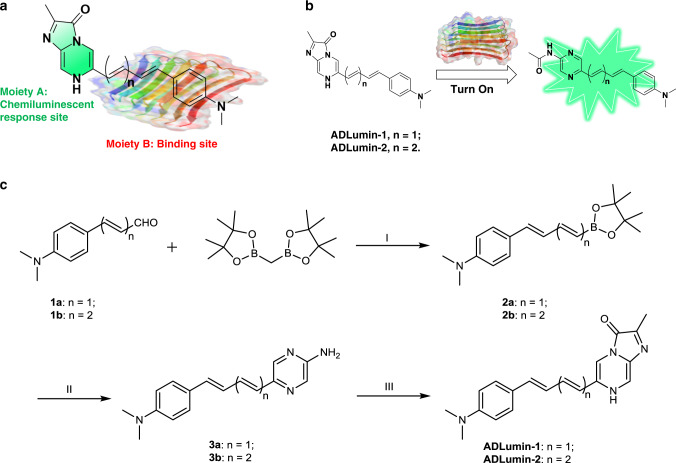
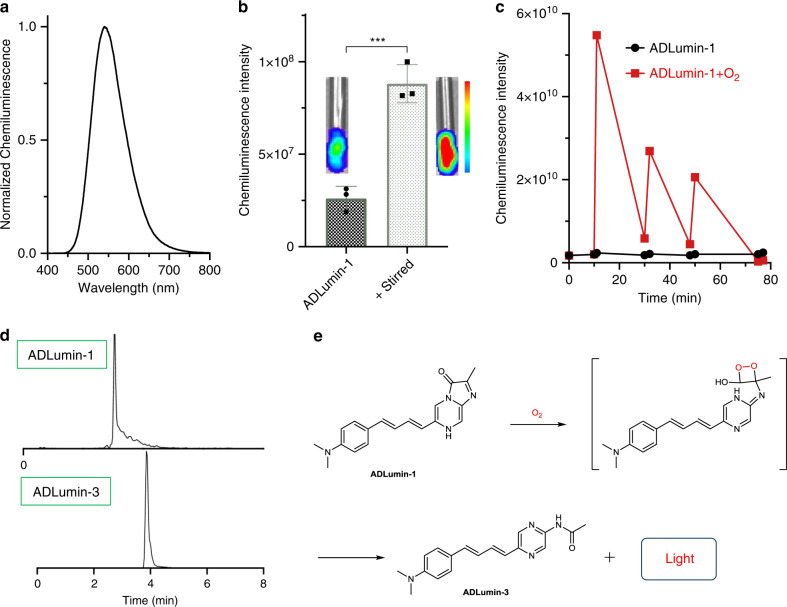
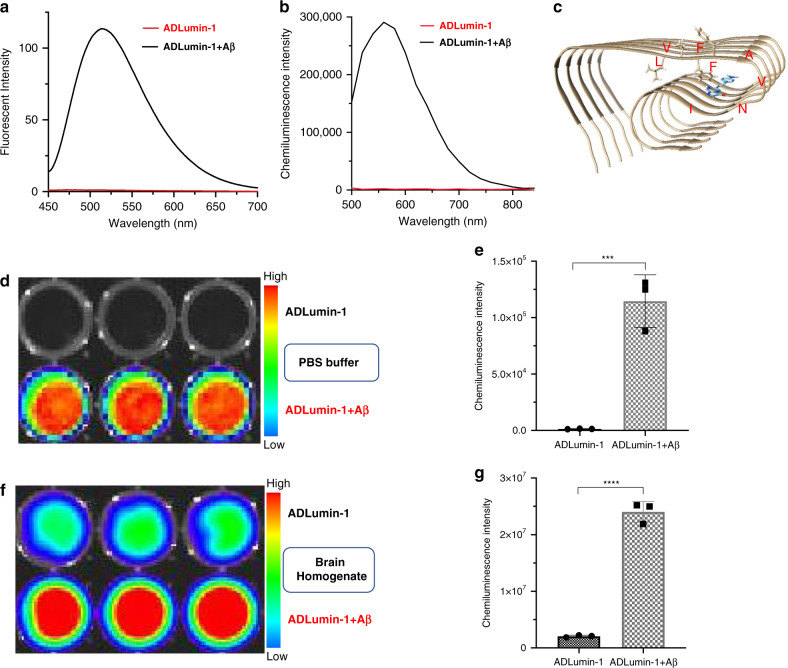
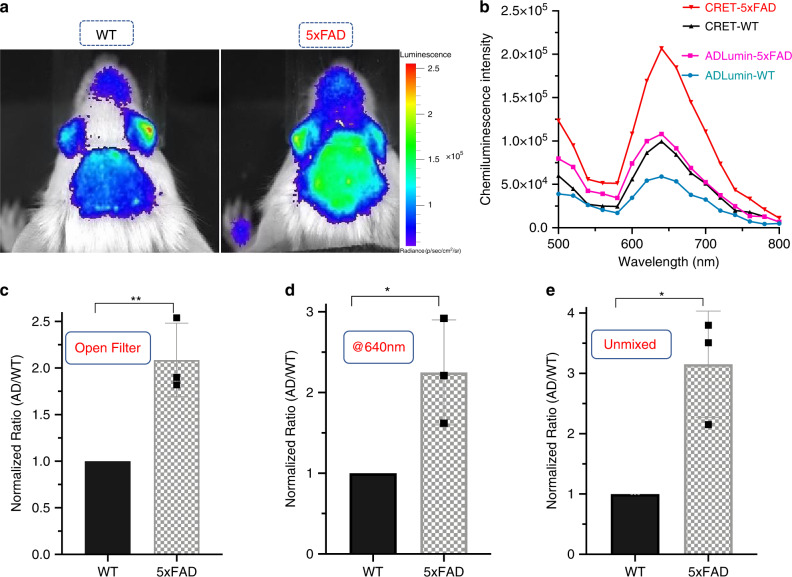
Turn-on fluorescence imaging is routinely studied; however, turn-on chemiluminescence has been rarely explored for in vivo imaging. Herein, we report the design and validation of chemiluminescence probe ADLumin-1 as a turn-on probe for amyloid beta (Aβ) species. Two-photon imaging indicates that ADLumin-1 can efficiently cross the blood–brain barrier and provides excellent contrast for Aβ plaques and cerebral amyloid angiopathy. In vivo brain imaging shows that the chemiluminescence signal of ADLumin-1 from 5-month-old transgenic 5xFAD mice is 1.80-fold higher than that from the age-matched wild-type mice. Moreover, we demonstrate that it is feasible to further d ually- a mplify s ignal via c hemiluminescence r esonance e nergy t ransfer (DAS-CRET) using two non-conjugated smart probes (ADLumin-1 and CRANAD-3) in solutions, brain homogenates, and in vivo whole brain imaging. Our results show that DAS-CRET can provide a 2.25-fold margin between 5-month-old 5xFAD mice and wild type mice. We believe that our strategy could be extended to other aggregating-prone proteins.
Overview
The claims and statistics of this paper haven’t been checked yet.
Run the check — free, no account needed. It reads the open-access text and checks the sources it cites.
Integrity signals
Registry
Cites
Statistics
Figures
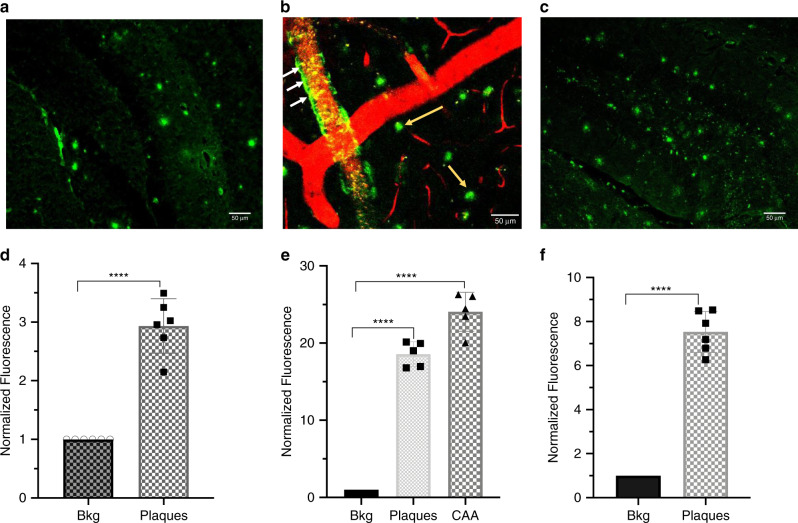
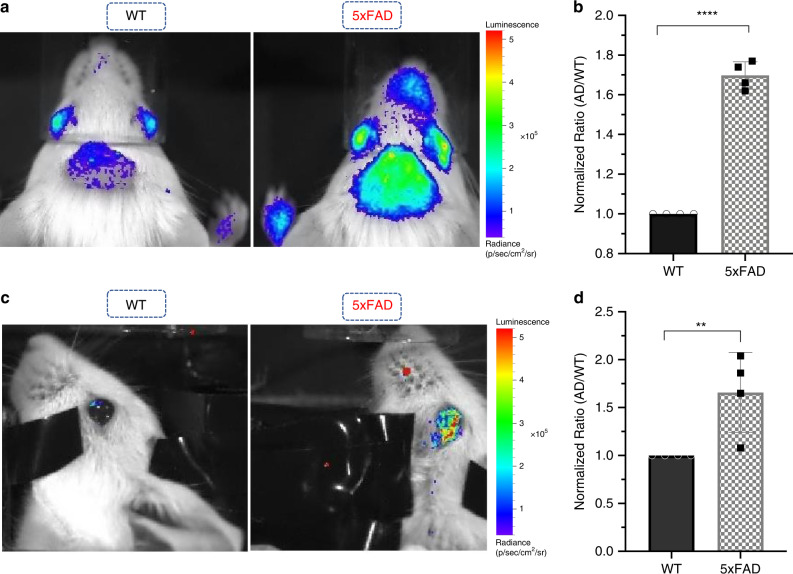
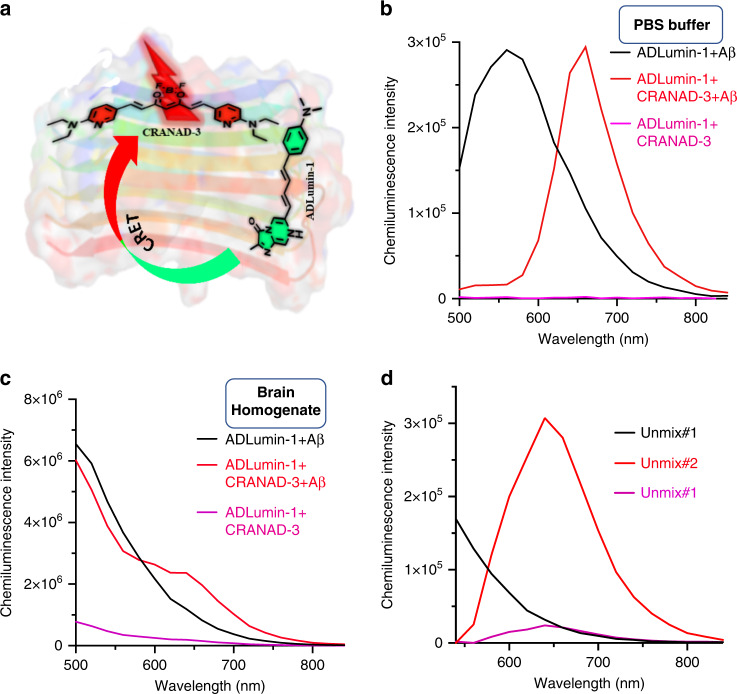
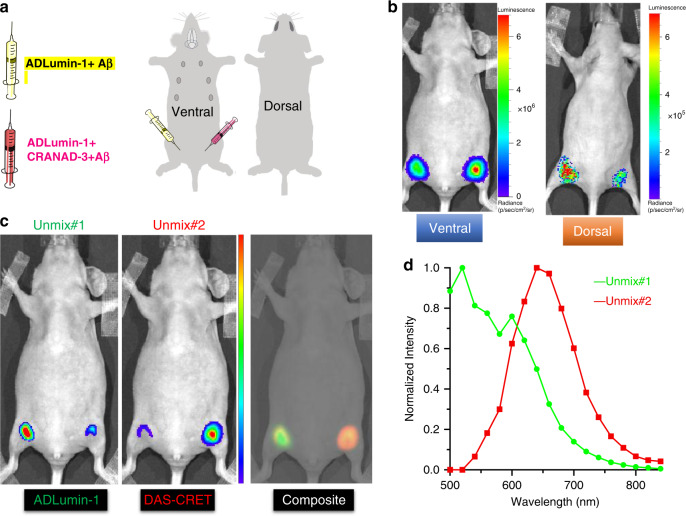
Verification
Claims the paper makes
The claims and statistics of this paper haven’t been checked yet.
Run the check — free, no account needed. It reads the open-access text and checks the sources it cites.
Claims other papers make about this one
Each is checked against this paper’s own text: does it say what the citing paper says it does?
The source backs part of the claim, not all of it — or backs it for a different population, condition or comparison.
In the citing paper
“Cinnamic derivatives can cross the BBB and insert into the beta sheet of amyloid β proteins41.”
From Blood–brain-barrier-crossing lipid nanoparticles for mRNA delivery to the central nervous system (2025) · cites this paper as [41]
Experimental — accuracy not yet measured
Self-check
Percentages, sums and reported differences re-computed from the paper’s own numbers.
The self-check needs the paper’s full text.
Citations
Cites
Principles of Fluorescence Spectroscopy
Lakowicz, J. R. (1999) · Springer eBooks · doi:10.1007/978-1-4757-3061-6 · Cited by 26,948
Grabowski, Z. R., Rotkiewicz, K., & Rettig, W. (2003) · Chemical Reviews · doi:10.1021/cr940745l · Cited by 3,714
Oakley, H., Cole, S. L., Logan, S., Maus, E., Shao, P., Craft, J., Guillozet-Bongaarts, A., Ohno, M., Disterhoft, J., Van Eldik, L., et al. (2006) · The Journal of Neuroscience · doi:10.1523/jneurosci.1202-06.2006 · Cited by 3,530
New Strategies for Fluorescent Probe Design in Medical Diagnostic Imaging
Kobayashi, H., Ogawa, M., Alford, R. E., Choyke, P. L., & Urano, Y. (2009) · Chemical Reviews · doi:10.1021/cr900263j · Cited by 2,205
Molecular imaging in living subjects: seeing fundamental biological processes in a new lightPreprint
Massoud, T. F., & Gambhir, S. S. (2003) · Genes & Development · doi:10.1101/gad.1047403 · Cited by 2,205
Sapsford, K. E., Berti, L., & Medintz, I. L. (2006) · Angewandte Chemie International Edition · doi:10.1002/anie.200503873 · Cited by 1,563
Molecular afterglow imaging with bright, biodegradable polymer nanoparticles
Miao, Q., Xie, C., Xu, Z. J., Lyu, Y., Duan, H., Liu, X., Jokerst, J. V., & Pu, K. (2017) · Nature Biotechnology · doi:10.1038/nbt.3987 · Cited by 980
Fluorescence imaging in vivo: recent advances
Rao, J., Dragulescu‐Andrasi, A., & Yao, H. (2007) · Current Opinion in Biotechnology · doi:10.1016/j.copbio.2007.01.003 · Cited by 780
Fluorescent probes for sensing and imaging
Ueno, T., & Nagano, T. (2011) · Nature Methods · doi:10.1038/nmeth.1663 · Cited by 634
Alzheimer's Disease: From Pathology to Therapeutic Approaches
Jakob‐Roetne, R., & Jacobsen, H. (2009) · Angewandte Chemie International Edition · doi:10.1002/anie.200802808 · Cited by 626
Cited by
Sorted by citations
Huang, J., Jiang, Y., Li, J., Huang, J., & Pu, K. (2020) · Angewandte Chemie International Edition · doi:10.1002/anie.202013531 · Cited by 197
Zheng, M., Wang, X., Yue, O., Hou, M., Zhang, H., Beyer, S., Blocki, A. M., Wang, Q., Gong, G., Liu, X., et al. (2021) · Biomaterials · doi:10.1016/j.biomaterials.2021.121026 · Cited by 176
Blood–brain-barrier-crossing lipid nanoparticles for mRNA delivery to the central nervous system
Wang, C., Xue, Y., Markovic, T., Li, H., Wang, S., Zhong, Y., Du, S., Zhang, Y., Hou, X., Yu, Y., et al. (2025) · Nature Materials · doi:10.1038/s41563-024-02114-5 · Cited by 171
“Cinnamic derivatives can cross the BBB and insert into the beta sheet of amyloid β proteins 41 .”
Hou, X. H., Gao, S., Li, Q., Kang, Y., Chen, N., Chen, K., Rao, J., Ellenberg, J. S., & Patz, J. A. (2021) · Proceedings of the National Academy of Sciences · doi:10.1073/pnas.2020524118 · Cited by 142
An Activatable NIR‐II Fluorescent Reporter for In Vivo Imaging of Amyloid‐β Plaques
Miao, J., Miao, M., Jiang, Y., Zhao, M., Li, Q., Zhang, Y., An, Y., Pu, K., & Miao, Q. (2022) · Angewandte Chemie International Edition · doi:10.1002/anie.202216351 · Cited by 119
Metadata
- Authors
- Yang, J., Yin, W., Van, R., Yin, K., Wang, P., Zheng, C., Zhu, B., Ran, K., Zhang, C., Kumar, M., Shao, Y., & Ran, C.
- Affiliations
- Harvard University (US)
- University of Oklahoma (US)
- Massachusetts Institute of Technology (US)
- Corresponding author
- Ran, Chongzhao
- ORCID
- Venue
- Nature Communications
- Published
- 2020-08-13
- Volume
- 11
- Issue
- 1
- Pages
- 4052-4052
- ISSN
- 2041-1723 (ISSN-L)
- PMC
- PMC7426431
- OpenAlex
- W3048903908
- Cited by
- 123
- References
- 73
- Citations by year
- 2026: 16 · 2025: 16 · 2024: 24 · 2023: 24 · 2022: 13 · 2021: 27 · 2020: 3
- FWCI
- 10.07
- Type
- journal article
- Language
- en
- Open access
- gold
- doi.org
- Locations
- Nature Communications (publishedVersion, cc-by)
- ChemRxiv (acceptedVersion, cc-by-nc-nd)
- PubMed Central (publishedVersion, cc-by)
- PubMed (publishedVersion)
- RePEc: Research Papers in Economics (submittedVersion)
- DOAJ (DOAJ: Directory of Open Access Journals) (submittedVersion, cc-by-sa)
- Figshare (submittedVersion, cc-by-nc-nd)
- Funders
- U.S. Department of Health & Human Services | NIH | National Institute on Aging (R21AG059134, R01AG055413)
- Topics
- Life Sciences › Neuroscience › Cellular and Molecular Neuroscience › Alzheimer's disease research and treatments
- Physical Sciences › Chemistry › Spectroscopy › Molecular Sensors and Ion Detection
- Physical Sciences › Materials Science › Materials Chemistry › Luminescence and Fluorescent Materials
- Keywords
- chemiluminescence probe, amyloid-beta detection, chemiluminescence resonance energy transfer, two-photon imaging, blood-brain barrier penetration, cerebral amyloid angiopathy, amyloid plaques, 5xFAD mice, in vivo brain imaging
- MeSH terms
- Animals, Luminescent Measurements, Amyloid beta-Peptides, Luminescence, Mice, Molecular Imaging, Optical Imaging, Protein Aggregates
About these checks
Registry, retraction, Cites and statistics results are computed, not judged, with one exception: a printed reference that no index lists is read once by a model before it counts as a citation error. Claims are extracted by a model and kept only when their quote appears verbatim in the text; each cited source is then checked, with a model’s help, for whether it says what the claim relies on. Those verdicts can be wrong — read the claim’s quote and the cited source before relying on one.
Statistics and arithmetic are recomputed, not judged.
Confidence bands are shown only for fields calibrated on our annotated test set. None is calibrated yet, so no band is shown.
What counts as a claim ›How we measure confidence ›How we check this ›
Are you an author, or do you see a problem with this page? Request a review
