

Widespread transfer of mobile antibiotic resistance genes within individual gut microbiomes revealed through bacterial Hi-C
Open accessPublished version of a preprint
The DOI matches its Crossref record; 75 of the 75 references it cites were found in a registry or an index.
Abstract
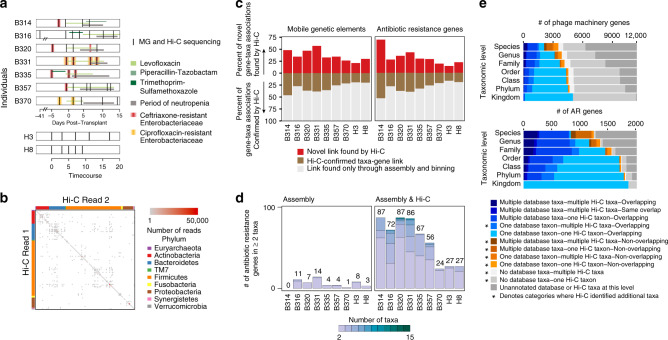
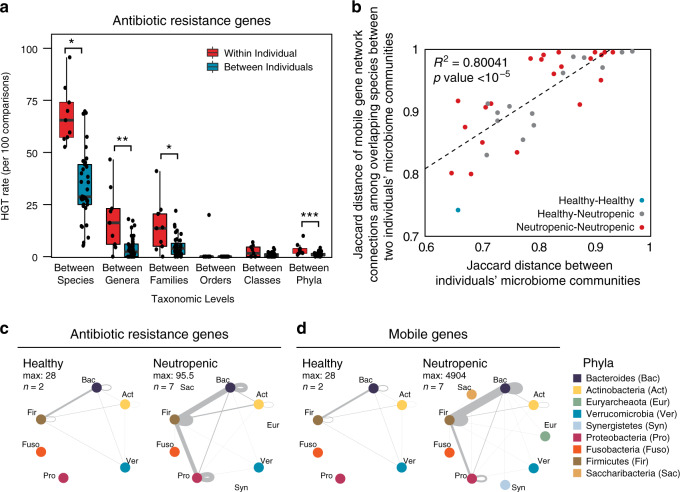
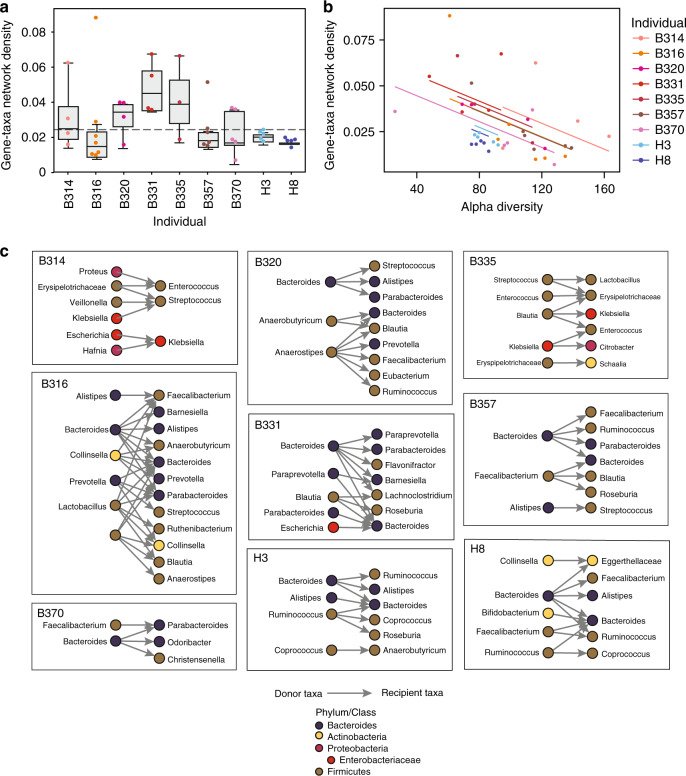
The gut microbiome harbors a ‘silent reservoir’ of antibiotic resistance (AR) genes that is thought to contribute to the emergence of multidrug-resistant pathogens through horizontal gene transfer (HGT). To counteract the spread of AR, it is paramount to know which organisms harbor mobile AR genes and which organisms engage in HGT. Despite methods that characterize the overall abundance of AR genes in the gut, technological limitations of short-read sequencing have precluded linking bacterial taxa to specific mobile genetic elements (MGEs) encoding AR genes. Here, we apply Hi-C, a high-throughput, culture-independent method, to surveil the bacterial carriage of MGEs. We compare two healthy individuals with seven neutropenic patients undergoing hematopoietic stem cell transplantation, who receive multiple courses of antibiotics, and are acutely vulnerable to the threat of multidrug-resistant infections. We find distinct networks of HGT across individuals, though AR and mobile genes are associated with more diverse taxa within the neutropenic patients than the healthy subjects. Our data further suggest that HGT occurs frequently over a several-week period in both cohorts. Whereas most efforts to understand the spread of AR genes have focused on pathogenic species, our findings shed light on the role of the human gut microbiome in this process.
Overview
The claims and statistics of this paper haven’t been checked yet.
Free: it reads the open-access text and checks the first 5 claims that cite a source we can check. Create a free account to check every claim.
Integrity signals
Registry
Cites
Statistics
Figures
Verification
Claims the paper makes
The claims and statistics of this paper haven’t been checked yet.
Free: it reads the open-access text and checks the first 5 claims that cite a source we can check. Create a free account to check every claim.
Claims other papers make about this one
Each is checked against this paper’s own text: does it say what the citing paper says it does?
The source backs part of the claim, not all of it — or backs it for a different population, condition or comparison.
In the citing paper
“These genes can potentially be transferred via horizontal gene transfer to bacteria in the gut environment, whether they are commensal or potentially pathogenic.”
From Exploring the resistome of probiotics, starter cultures, and cheeses via metagenomic analysis (2025) · cites this paper as Kent, Vill, Shi, Satlin, & Brito, 2020
Experimental — accuracy not yet measuredThe cited source says what the claim attributes to it.
In the citing paper
“Under selective pressure from antibiotics, bacteria that acquire resistance can proliferate, posing a significant health threat due to the reduced effectiveness of antibiotic treatments.”
From Exploring the resistome of probiotics, starter cultures, and cheeses via metagenomic analysis (2025) · cites this paper as Kent, Vill, Shi, Satlin, & Brito, 2020
The check wasn’t confident either way, so it gives no verdict — never disputed.
In the citing paper
“Antibiotic resistance genes (ARGs) present in the food microbiota can reach the gut when consumed.”
From Exploring the resistome of probiotics, starter cultures, and cheeses via metagenomic analysis (2025) · cites this paper as Kent, Vill, Shi, Satlin, & Brito, 2020
Experimental — accuracy not yet measured
Self-check
Percentages, sums and reported differences re-computed from the paper’s own numbers.
The self-check needs the paper’s full text.
Citations
Cites
Trimmomatic: a flexible trimmer for Illumina sequence data
Bolger, A. M., Lohse, M., & Usadel, B. (2014) · Bioinformatics · doi:10.1093/bioinformatics/btu170 · Cited by 65,548 · cited 1×
“An ANOVA showed that gene–taxa network density was related to alpha diversity (F(1,39), p= 3.”
MethodFast and accurate short read alignment with Burrows-Wheeler transform
Li, H., & Durbin, R. (2009) · Bioinformatics · doi:10.1093/bioinformatics/btp324 · Cited by 58,607
Prodigal: prokaryotic gene recognition and translation initiation site identification
Hyatt, D., Chen, G.-L., LoCascio, P. F., Land, M. L., Larimer, F. W., & Hauser, L. J. (2010) · BMC Bioinformatics · doi:10.1186/1471-2105-11-119 · Cited by 12,587
Cd-hit: a fast program for clustering and comparing large sets of protein or nucleotide sequences
Li, W., & Godzik, A. (2006) · Bioinformatics · doi:10.1093/bioinformatics/btl158 · Cited by 11,410
The Pfam protein families database: towards a more sustainable future
Finn, R. D., Coggill, P., Eberhardt, R. Y., Eddy, S. R., Mistry, J., Mitchell, A. L., Potter, S. C., Punta, M., Qureshi, M., Sangrador-Vegas, A., et al. (2016) · Nucleic Acids Research · doi:10.1093/nar/gkv1344 · Cited by 5,975
Quality control and preprocessing of metagenomic datasets
Schmieder, R., & Edwards, R. (2011) · Bioinformatics · doi:10.1093/bioinformatics/btr026 · Cited by 5,072
Carattoli, A., Zankari, E., García-Fernández, A., Voldby Larsen, M., Lund, O., Villa, L., Møller Aarestrup, F., & Hasman, H. (2014) · Antimicrobial Agents and Chemotherapy · doi:10.1128/aac.02412-14 · Cited by 4,877
metaSPAdes: a new versatile metagenomic assembler
Nurk, S., Meleshko, D., Korobeynikov, A., & Pevzner, P. A. (2017) · Genome Research · doi:10.1101/gr.213959.116 · Cited by 4,496
Kang, D. D., Li, F., Kirton, E., Thomas, A., Egan, R., An, H., & Wang, Z. (2019) · PeerJ · doi:10.7717/peerj.7359 · Cited by 3,750
PHASTER: a better, faster version of the PHAST phage search tool
Arndt, D., Grant, J. R., Marcu, A., Sajed, T., Pon, A., Liang, Y., & Wishart, D. S. (2016) · Nucleic Acids Research · doi:10.1093/nar/gkw387 · Cited by 3,557
Research works printed but not linked: 2
- 55. Paterson, D. L. & Bonomo, R. A. Extended-spectrum beta-lactamases: a clinical update. Clin. Microbiol. Rev. 18, 657-686 (2005). · DOI · Paper page
- 62. Krawczyk, P. S., Lipinski, L. & Dziembowski, A. PlasFlow: predicting plasmid sequences in metagenomic data using genome signatures. Nucleic Acids Res. 46, e35 (2018). · DOI · Paper page
Cited by
Items 101–200 of 244
Jin, L., Wu, H., Guo, L., Yang, S., Wei, R., Huang, Y., Penttinen, P., Deng, W., Chen, J., Han, X., et al. (2023) · The Science of The Total Environment · doi:10.1016/j.scitotenv.2023.165671 · Cited by 15
Joseph, S. J., Bommana, S., Ziklo, N., Kama, M., Dean, D., & Read, T. D. (2023) · Frontiers in Microbiology · doi:10.3389/fmicb.2023.1154664 · Cited by 14
“Genomic approaches that resolve the potential subpopulations, such as single-cell sequencing (Zheng et al., 2022) and Hi-C (Kent et al., 2020), are hampered by C. trachomatis being only a minor component of the DNA in the clinical metagenomic sample.”
BackgroundBarcan, A. S., Humble, J. L., Kasaragod, S., Sajib, M. S. I., Barcan, R. A., McGinnity, P., Welch, T. J., Robertson, B., Vamanu, E., Bacigalupo, A., et al. (2025) · Animal Microbiome · doi:10.1186/s42523-025-00377-0 · Cited by 15
Leveraging strain competition to address antimicrobial resistance with microbiota therapies
Steed, D. B., Koundakjian, D., Harris, A. D., Rosato, A. E., Konstantinidis, K. T., & Woodworth, M. H. (2025) · Gut Microbes · doi:10.1080/19490976.2025.2488046 · Cited by 15
Horizontal gene transfer of molecular weapons can reshape bacterial competition
Granato, E. T., Palmer, J. D., Kirk, C., Sharp, C., Shillcock, G., & Foster, K. R. (2025) · PLoS Biology · doi:10.1371/journal.pbio.3003095 · Cited by 14
Long-read metagenomics for strain tracking after faecal microbiota transplant
Fan, Y., Ni, M., Aggarwala, V., Mead, E. A., Ksiezarek, M., Cao, L., Kamm, M. A., Borody, T. J., Paramsothy, S., Kaakoush, N. O., et al. (2025) · Nature Microbiology · doi:10.1038/s41564-025-02164-8 · Cited by 16
“However, none of the seven plasmids was correctly binned with their matching chromosomes, highlighting that plasmid binning remains a challenge and need more specialized methods such as Hi-C 41 .”
Nothing makes sense in drug resistance except in the light of evolution
Gabaldón, T. (2023) · Current Opinion in Microbiology · doi:10.1016/j.mib.2023.102350 · Cited by 14
Prevotella copri variants among a single host diverge in sphingolipid production
Xiao, X., Le, H. H., Lee, M.-T., Lamm, D., Johnson, E. L., & Brito, I. (2024) · mBio · doi:10.1128/mbio.02409-23 · Cited by 14
“The paired-end raw reads were processed based on a standard quality control (QC) pipeline established in the lab (48).”
MethodSelf-citationZhang, L., Guo, H., Gu, J., Hu, T., Wang, X., Sun, Y., Li, H., Sun, W., Qian, X., Song, Z., et al. (2023) · The Science of The Total Environment · doi:10.1016/j.scitotenv.2023.162006 · Cited by 13
Promotion of plasmid maintenance by heterogeneous partitioning of microbial communities
Weiss, A., Wang, T., & You, L. (2023) · Cell Systems · doi:10.1016/j.cels.2023.09.002 · Cited by 13
Rao, R. S. P., Ghate, S. D., Shastry, R. P., Kurthkoti, K., Suravajhala, P., Patil, P., & Shetty, P. K. (2022) · Microbial Pathogenesis · doi:10.1016/j.micpath.2022.105953 · Cited by 13
Determinants of synergistic cell-cell interactions in bacteria
Pauli, B., Ajmera, S., & Kost, C. (2023) · Biological Chemistry · doi:10.1515/hsz-2022-0303 · Cited by 13
Incorporating plasmid biology and metagenomics into a holistic model of the human gut microbiome
Stockdale, S. R., & Hill, C. (2023) · Current Opinion in Microbiology · doi:10.1016/j.mib.2023.102307 · Cited by 13
Tarnawska, P., Walczak, M., & Burkowska-But, A. (2023) · Environmental Chemistry Letters · doi:10.1007/s10311-023-01651-w · Cited by 13
Exploring the resistome of probiotics, starter cultures, and cheeses via metagenomic analysis
Rozman, V., Stopnišek, N., Lorbeg, P. M., Obermajer, T., Kušar, D., & Matijašić, B. B. (2025) · Food Control · doi:10.1016/j.foodcont.2025.111173 · Cited by 12
“Additionally, these resistant bacteria are excreted into the environment, where they can re-enter the food chain, further spreading antibiotic resistance (Kent, Vill, Shi, Satlin, & Brito, 2020; Fernandez--Trapote, Oliveira, Cobo-Diaz, & Alvarez-Ordonez, 2024).”
Leveraging the microbiome to combat antibiotic resistant gynecological infections
Kumar, T., Rekhi, A., Lee, Y., Tran, J., Nagtalon, A. G. D., Rohatgi, S., & Cyphert, E. L. (2025) · npj Antimicrobials and Resistance · doi:10.1038/s44259-025-00106-2 · Cited by 12
“However, at this time Hi-C techniques have primarily been applied to study the gut and environmental resistome 59 – 62 .”
Genome-Centric Dynamics Shape the Diversity of Oral Bacterial Populations
Utter, D. R., Cavanaugh, C. M., & Borisy, G. G. (2022) · mBio · doi:10.1128/mbio.02414-22 · Cited by 13
Basiry, D., Kommedal, R., & Kaster, K. M. (2024) · Frontiers in Antibiotics · doi:10.3389/frabi.2024.1351999 · Cited by 12
Cheng, Z., Li, X., Palomo, A., Yang, Q. Y., Han, L., Wu, Z., Li, Z., Zhang, M., Chen, L., Zhao, B., et al. (2023) · Journal of Hazardous Materials · doi:10.1016/j.jhazmat.2023.131944 · Cited by 12
The Gut Resistome Atlas in Preterm Infants Enables Prediction of Necrotizing Enterocolitis Onset
Zeng, S., Wang, H., Zhang, L., Li, S., Yuan, Y., Tian, M., Qu, Y., Ying, J., Zhou, M., Hu, Y., et al. (2025) · Advanced Science · doi:10.1002/advs.202505154 · Cited by 10
Toxin-linked mobile genetic elements in major enteric bacterial pathogens
Panwar, S., Kumari, S., Verma, J., Bakshi, S., Narendrakumar, L., Paul, D., & Das, B. (2023) · Gut Microbiome · doi:10.1017/gmb.2023.2 · Cited by 10
Inter-phylum circulation of a beta-lactamase-encoding gene: a rare but observable event
Gschwind, R., Petitjean, M., Fournier, C., Lao, J., Clermont, O., Nordmann, P., Mellmann, A., Denamur, É., Poirel, L., & Ruppé, É. (2024) · Antimicrobial Agents and Chemotherapy · doi:10.1128/aac.01459-23 · Cited by 10
“Inter-phylum transfer of DNA, including conjugation between Bacteroidota and Pseudomonadota, was shown to be possible within complex bacterial communities (8, 28, 29).”
BackgroundIs there a role for intestinal sporobiota in the antimicrobial resistance crisis?
Romero-Rodríguez, A., Ruiz‐Villafán, B., Sánchez, S., & Paredes‐Sabja, D. (2024) · Microbiological Research · doi:10.1016/j.micres.2024.127870 · Cited by 10
Cellular Stress Affects the Fate of Microbial Resistance to Folate Inhibitors in Treatment Wetlands
Knecht, C. A., Krüger, M., Kellmann, S., Mäusezahl, I., Möder, M., Adelowo, O. O., Vollmers, J., Kaster, A., Nivala, J., & Müller, J. A. (2022) · The Science of The Total Environment · doi:10.1016/j.scitotenv.2022.157318 · Cited by 10
Industrialization drives the gut microbiome and resistome of the Chinese populations
Chen, T., Zhang, T., Zhuang, D., Luo, Y., Li, T., Zhao, F., Sang, J., Tang, Z., Jiang, P., Zhang, T., et al. (2025) · mSystems · doi:10.1128/msystems.01372-24 · Cited by 9
Tanner, W. D., Mathew, T. A., Roberts, S. C., Dieter, L., Healy, H. G., Peaper, D. R., Peccia, J., HIPSTER Team, Martinello, R. A., Blake, E., et al. (2025) · Clinical Microbiology Reviews · doi:10.1128/cmr.00061-24 · Cited by 8
Tigabu, A., & Leung, P. H. M. (2026) · Gut Pathogens · doi:10.1186/s13099-026-00795-8 · Cited by 8
“For example, in neutropenic patients who received multiple courses of antibiotics, V. parvula , F. prausnitzii , and R. intestinalis shared their genes with E. faecium [22].”
Gates, K., Rai, S., Kolawole, O. P., Kundu, S., Pramanik, A., Singh, S., Bandari, P., Pandey, V., Morehead, D., Alamgir, R., et al. (2025) · ACS Applied Bio Materials · doi:10.1021/acsabm.4c01948 · Cited by 8
Liang, C., Wagstaff, J., Aharony, N., Schmit, V. L., & Manheim, D. (2023) · Health Security · doi:10.1089/hs.2022.0029 · Cited by 8
Hariharan, J., Andam, C. P., & Buckley, D. H. (2025) · Microbiology Spectrum · doi:10.1128/spectrum.02958-25 · Cited by 7
“…for evidence of mobile elements, including plasmids, integra tive and conjugative elements, insertion sequences, as well as gene annotations that indicated the presence of transposons, phage elements, plasmids, conjugation elements, and integrons using the approach described in Kent et al. (4).”
Li, L., Zhu, J., Yan, Y., Li, Z., & Du, H. (2026) · Microorganisms · doi:10.3390/microorganisms14030634 · Cited by 7
Predicting antimicrobial resistance for precision medicine
Fink, T., Rybniker, J., & Bollenbach, T. (2026) · Cell Host & Microbe · doi:10.1016/j.chom.2026.05.031 · Cited by 7
Zhang, L., Adyari, B., Ma, C., Cao, M., Gad, M. A., Abdel‐Gawad, F. K., & Hu, A. (2024) · Journal of Hazardous Materials · doi:10.1016/j.jhazmat.2024.136767 · Cited by 7
Schubert, K., Shosanya, T., & García-Bayona, L. (2025) · Current Opinion in Microbiology · doi:10.1016/j.mib.2025.102675 · Cited by 7
The gut–heart axis in atrial fibrillation: Pathophysiology, evidence, and therapeutic potential
Awashra, A., Neiroukh, H., AbuBaha, M., Shehadeh, W., Jallad, H., Emara, A., Abu-Khazneh, O., Zahran, A., Elgendy, M. S., Fkheideh, T., et al. (2025) · Heart Rhythm O2 · doi:10.1016/j.hroo.2025.10.013 · Cited by 7
“60 Concerns over cumulative effects on gut flora are further raised by the polypharmacy that is typical in patients with AF (Table 1).”
García-Bayona, L., Said, N., Coyne, M. J., Flores, K., Elmekki, N. M., Sheahan, M. L., Gutiérrez-Camacho, A., Hutt, K., Yildiz, F. H., Kovács, Á. T., et al. (2024) · bioRxiv (Cold Spring Harbor Laboratory) · doi:10.1101/2024.04.29.590671 · Cited by 7
Zhang, L., Xu, T., Chen, W., Chai, Y., Wu, Y., & Du, X. (2025) · Frontiers in Cellular and Infection Microbiology · doi:10.3389/fcimb.2025.1674534 · Cited by 5
Hi-C sequencing deciphers phage and plasmid host networks in wastewater biofilms
Wang, D., Xu, X., Liu, L., Wang, C., Deng, Y., Polz, M. F., & Zhang, T. (2026) · Environmental Science and Ecotechnology · doi:10.1016/j.ese.2026.100683 · Cited by 5
“Recently, Hi-C sequencing has emerged as a powerful technique for capturing chromatin proximity within intact microbial communities, enabling the direct physical linkage of MGEs to their host chromosomes without prior cultivation [22 – 24].”
Antibiotic resistance gene analyses in microbial communities: challenges and opportunities
Larsson, D. G. J., Flach, C., & Kristiansson, E. (2026) · Nature Communications · doi:10.1038/s41467-026-71462-4 · Cited by 5
Zhao, R., Si-yuan, C. H. E. N., Tong, C., Hao, J., Pei-si, L. I., Xie, L., Xiao, D., Zeng, Z., & Xiong, W. (2022) · Journal of Integrative Agriculture · doi:10.1016/j.jia.2022.11.006 · Cited by 5
Zhou, J., Wu, H., Wang, H., Wu, Z., Shi, L., Tian, S., & Hou, L.-A. (2022) · Journal of Environmental Sciences · doi:10.1016/j.jes.2024.01.030 · Cited by 5
DeepMobilome: predicting mobile genetic elements using sequencing reads of microbiomes
Cho, Y., Kim, E. J., Kim, M., & Rho, M. (2025) · Briefings in Bioinformatics · doi:10.1093/bib/bbaf450 · Cited by 4
Applications of Oxford Nanopore Technology in the analysis of antibiotic resistance genes: A review
Wang, W., Yang, W., Jiang, L., Yao, C., Zhang, Z., Xu, M., Yan, X., & Qian, X. (2025) · Journal of Hazardous Materials · doi:10.1016/j.jhazmat.2025.139824 · Cited by 4
Puente, A., Cordero-García, R., Fernández‐Trapote, E., Crespo-Torbado, V., Oliveira, M., López, M., Maradona, M. P., Álvarez‐Ordóñez, A., & Cobo-Díaz, J. F. (2026) · Foods · doi:10.3390/foods15071243 · Cited by 4
“Remarkably, the occurrence of antimicrobial-resistant bacteria in meat may constitute a possible risk to consumers through the transfer of ARGs to commensal and/or pathogenic human gut bacteria through horizontal gene transfer [9].”
Antibiotic-induced gut microbiome dysbiosis: risks and strategies for mitigation
Müller, K., Gillard, J., Typas, A., Knopp, M. R., & Goemans, C. (2026) · The EMBO Journal · doi:10.1038/s44318-026-00796-y · Cited by 4
“…contain opportunistic pathogens and frequently encounter antibiotics, such as the human gastrointestinal tract, serve as problematic melting pots for the transfer of antibiotic-resistant genes to bacteria that can subsequently cause hard-to-treat infections (Gumpert et al, 2017; Kent et al, 2020).”
Antimicrobial resistance and the human gut microbiome—a food safety perspective
Diaz‐Amigo, C., Pino, L. E. B. D., Lejeune, J., Ferreira, J. P., & Bessy, C. (2026) · Critical Reviews in Food Science and Nutrition · doi:10.1080/10408398.2026.2629533 · Cited by 5
“” The other component of the definition can vary and include: • A reference to antimicrobials in general or focus on specific types or groups of antimicrobials, often anti-biotics, but also antiseptics, heavy metals, etc. • A reference to the location of genes, e.g., plasmid, bacterial strain (e.g., E. coli resistome)…”
InfluentialThe role of the gut microbiome in antibiotic-driven antimicrobial resistance
Joshi, G., Rani, S., Bharti, D., Panda, N., Chavan, P., Mathpal, S., Ramaiah, S., & Anbarasu, A. (2026) · Frontiers in Microbiology · doi:10.3389/fmicb.2026.1856738 · Cited by 5
“3 The gut as a major reservoir of antimicrobial resistance genes Metagenomic studies consistently demonstrate that the human gut serves as a significant reservoir of antimicrobial resistance genes (ARGs), collectively referred to as the gut resistome (Kent et al., 2020).”
InfluentialTrueba, G. A., Cárdenas, P., Romo, G., & Gutiérrez, B. (2024) · Biosystems · doi:10.1016/j.biosystems.2024.105283 · Cited by 3
Du, Y., Zuo, W., & Sun, F. (2024) · Journal of Computational Biology · doi:10.1089/cmb.2024.0663 · Cited by 3
“…serve as fundamental prerequisites for downstream analyses, such as the elucidation of the metabolic potentials and functional roles of diverse microorganisms, as well as the exploration of virus-host interactions (Chen et al., 2021; Gounot et al., 2022; Kent et al., 2020; Stalder et al., 2019).”
Cifuentes, S. G., Graham, J. P., Trueba, G. A., & Cárdenas, P. (2025) · mBio · doi:10.1128/mbio.01134-25 · Cited by 3
“Hi-C Hi-C overcomes some of the limitations of shotgun sequencing and culture-based methods (7, 8), but few longitudinal studies have evaluated the temporal dynamics of mobile ARGs in human populations (9).”
Russell, M. M., Sosa-Moreno, A., Zhang, L., & Comstock, S. S. (2025) · mSphere · doi:10.1128/msphere.00445-25 · Cited by 3
“Other proposed methodologies, such as utilizing Hi-C technology, could provide further insights in linking strain-specific bacteria to ARG (61).”
Kitano, T., Matsunaga, N., Akiyama, T., Azuma, T., Fujii, N., Tsukada, A., Hibino, H., Kuroda, M., & Ohmagari, N. (2026) · Antibiotics · doi:10.3390/antibiotics15010099 · Cited by 3
Bloemen, B., Delvoye, M., Hoffman, S., Marchal, K., Vanneste, K., Fraiture, M., Roosens, N. H. C., & Keersmaecker, S. C. J. D. (2026) · mSystems · doi:10.1128/msystems.01282-25 · Cited by 3
“This has been applied in various environments, including gut microbiomes and wastewater, to comprehensively study MGE host range and transmission (5, 18, 26).”
Modelling the role of the microbiome in antimicrobial resistance across scales
Pagani, L., León‐Sampedro, R., Amicone, M., Tepekule, B., Witzany, C., Brugger, S. D., de Vos, M. G. J., Mitri, S., Bakkeren, E., Bottery, M. J., et al. (2026) · Nature Microbiology · doi:10.1038/s41564-026-02390-8 · Cited by 3
“…IncF and IncI plasmids carrying bla CTX-M genes, or IncL plasmids carrying bla OXA48 , which encode extended-spectrum β-lactamases that confer resistance to certain antibiotics, persist through pervasive conjugation among Enterobacteriaceae in both clinical and community settings 15,19,55 .”
InfluentialFullmer, M. S., van Dijk, B., & Takeuchi, N. (2026) · Proceedings of the Royal Society B Biological Sciences · doi:10.1098/rspb.2026.0911 · Cited by 3
Rosa, C. J. D., & Rivera, W. L. (2024) · Journal of Applied and Natural Science · doi:10.31018/jans.v16i1.5335 · Cited by 2
“Also, several studies have reported that Bacteroides exhibit extensive horizontal gene transfer (HGT) of ARGs, thereby contributing to AMR (Shoemaker et al., 2001; Husain et al., 2017; Boto et al., 2019; Kent et al., 2020).”
BackgroundMobile genetic elements: the hidden puppet masters underlying infant gut microbiome assembly?
Kreuze, K., Friman, V., & Vatanen, T. (2024) · Microbiome Research Reports · doi:10.20517/mrr.2024.51 · Cited by 2
Gupta, M., Patanvadia, D., Bhavsar, R. A., & Rajak, V. S. (2025) · Cureus · doi:10.7759/cureus.97542 · Cited by 2
“Studies utilizing advanced molecular techniques, such as bacterial Hi-C sequencing, have further demonstrated the frequent occurrence of HGT among gut microorganisms, mediated by mobile genetic elements (MGEs), including plasmids, integrons, and transposons [4].”
Liu, Y., Zhong, L., Zhou, C., Zhang, Y., Zhang, K., Gan, Y., Wang, J., Lin, S., Xie, G., Zhong, W., et al. (2026) · Ecotoxicology and Environmental Safety · doi:10.1016/j.ecoenv.2025.119669 · Cited by 2
Maier, J. L., Gin, C., Rabasco, J. T., Yang, Y., Bass, A. M., Spencer, W., Duerkop, B. A., Callahan, B. J., & Kleiner, M. (2026) · Microbiome · doi:10.1186/s40168-026-02546-y · Cited by 2
Toh, S.-I., Keisha, J. E., Wang, Y., Pan, Y.-C., Jhu, Y.-H., Hsiao, P., Liao, W., Chen, P.-Y., Ko, T., & Chang, C. (2023) · Communications Biology · doi:10.1038/s42003-023-05681-6 · Cited by 2
Orak, F., Yalçınkaya, K. T., Aydın, F., Karakaya, E., Doğaner, A., Müştak, İ. B., Aral, M., & Ipek, S. (2024) · Journal of Clinical Practice and Research · doi:10.14744/cpr.2024.03419 · Cited by 2
“3,20 The identification of the gene responsible for this spread in both infection and colonization isolates indicates that colonizing isolates also possess the potential to cause infection.”
BackgroundVirome and Microbiome Interaction and Their Implication in the Human Gut Health
AboNahas, H. H., El‐Maradny, Y. A., Gezaf, S. A., Nouh, F. A. A., AboNahas, Y. H., Landa‐Acuña, D., Gil-Polo, A., Saied, E. M., & Abdel-Azeem, A. M. (2022) · Springer eBooks · doi:10.1007/978-981-16-1626-6_4 · Cited by 2
Probiotics and their Application in Tilapia Culture
Doan, H. V. (2023) · Applied environmental science and engineering for a sustainable future · doi:10.1007/978-3-031-38321-2_5 · Cited by 2
RNA-DNA interactomes of three prokaryotes uncovered by proximity ligation
Gavrilov, A. A., Evko, G. S., Galitsyna, A. A., Ulianov, S. V., Kochetkova, T. V., Merkel, A. Y., Tyakht, A., & Razin, S. V. (2023) · Communications Biology · doi:10.1038/s42003-023-04853-8 · Cited by 2
Mapping the spread of antibiotic resistance genes in the coastal microbiome
Hagan, J. (2024) · BioTechniques · doi:10.1080/07366205.2024.2416379 · Cited by 2
Chowdhury, N. N., Forry, S. P., Servetas, S. L., Hunter, M. E., Dootz, J. N., Dunkers, J. P., & Jackson, S. A. (2024) · bioRxiv (Cold Spring Harbor Laboratory) · doi:10.1101/2024.11.26.625464 · Cited by 2
METAHICT enables comprehensive genome-resolved microbiome analysis with metagenomic Hi-CPreprint
Wang, S., Qin, Z., Yu, H., Liu, R., Ge, Y., Dutta, M., Vu, L. D., & Du, Y. (2025) · bioRxiv (Cold Spring Harbor Laboratory) · doi:10.1101/2025.10.12.681839 · Cited by 2
“The minimum raw-contact requirement follows previous Hi-C-based MGE-linking studies [6, 9, 71], whereas the default Z-score threshold was selected based on the synthetic-community benchmarking reported by Shatadru et al. [72].”
Extent of Virulence and Antibiotic Resistance Genes in Helicobacter pylori and Campylobacteria
Rao, R. S. P., Ghate, S. D., Pinto, L., Suravajhala, P., Patil, P., Shetty, P. K., & Ahsan, N. (2024) · Current Microbiology · doi:10.1007/s00284-024-03653-5 · Cited by 1
Sankaranarayanan, G., & Muthukaliannan, G. K. (2024) · Molecular Biotechnology · doi:10.1007/s12033-024-01249-9 · Cited by 1
“The entry of antibiotics into the gut forces some microorganisms within the microbiome to accept antibiotic resistance genes (ARGs), which leads to the selection of particular organisms in the presence of antibiotics while depleting other susceptible organisms [6].”
MetaHiCNet: a web server for normalizing and visualizing microbial Hi-C interaction networks
Sun, C., Qin, Z., Liu, R., Guo, Y., Ge, Y., & Du, Y. (2025) · Nucleic Acids Research · doi:10.1093/nar/gkaf340 · Cited by 1
Detection of antimicrobial peptides from fecal samples of FMT donors using deep learning
Wei, S., Yin, H., Hu, X., Chi, Y., Zhang, L., Zhang, B., Qian, K., & Xu, W. (2025) · Frontiers in Veterinary Science · doi:10.3389/fvets.2025.1689589 · Cited by 1
“The gut microbiome encodes highly diverse genes, being one of the largest reservoirs for antibiotic-resistant genes (44).”
Human lifestyle-associated factors modulate the gut resistome
Poopalarajah, R., & Jha, A. R. (2026) · mSystems · doi:10.1128/msystems.01458-25 · Cited by 1
“High-throughput chromatin conformation capture (Hi-C) and network-based approaches show that ARG exchange is concentrated among co-occurring taxa within individual gut communities, spanning both commensal and opportunistic bacteria (13).”
Gut Hi-C metagenomes of severe COVID-19 patients: bacteria and yeast involved in gut-lung axis
Revel-Muroz, A., Sonets, I. V., Chistyakov, A. S., Vasiluev, P. A., Surovoy, Y. A., Ivanova, V. A., Kozlovskaya, L. I., Khokhlova, O. E., Fursov, M. V., Fursova, N. K., et al. (2026) · mSphere · doi:10.1128/msphere.00139-26 · Cited by 1
“Similar difficulties were encountered in previous studies (26), though others have documented rapid selection for resistance following antibiotic exposure (25).”
InfluentialErdem, E. D., Li, B. J., Berendonk, T. U., & Klümper, U. (2026) · ISME Communications · doi:10.1093/ismeco/ycag140 · Cited by 1
“Future studies incorporating long-read metagenomics, Hi-C sequencing [ 74], epicPCR [ 75], or multiplex-ddPCR linkage analysis [ 76] will enable host-and MGE-resolved ARG trajectories.”
Li, X., Guan, Z., Zhang, J., Wang, Y., Guo, T., Fan, R., Jiang, H., Han, R., & Yang, Y. (2026) · Food Research International · doi:10.1016/j.foodres.2026.120415 · Cited by 1
Ecological memory of prolonged plasmid persistence after transient antibiotic exposure
Zhou, Z., Weiss, A., Yao, Z.-Y., Chen, X., Qian, J.-M., Lok, K., Hamrick, G. S., Son, H.-I., & You, L. (2026) · Nature Communications · doi:10.1038/s41467-026-78240-2 · Cited by 1
Lysis‐Hi‐C as a method to study polymicrobial communities and eDNA
Hill, B. M., Bisht, K., Atkins, G. R., Gomez, A. A., Rumbaugh, K. P., Wakeman, C. A., & Brown, A. M. V. (2021) · Molecular Ecology Resources · doi:10.1111/1755-0998.13535 · Cited by 1
“This result is consistent with past studies (Kent et al., 2020; Marbouty et al., 2017; Ramani et al., 2017; Stalder et al., 2019), showing the utility of conventional Hi-C for assignment of extrachromosomal DNA.”
Guo, J., Duan, R., Zhang, D., Zhang, P., Qin, S., Fang, Y., Sun, Y., Lu, L., Jing, H., Wang, X., et al. (2023) · China CDC Weekly · doi:10.46234/ccdcw2023.110 · Cited by 1
Zhao, Y., Dai, Z., Zhang, W., Lei, Z., Wang, A., Fan, L., & Gao, S.-H. (2024) · Elsevier eBooks · doi:10.1016/b978-0-443-14170-6.00034-2 · Cited by 1
Grube, A. (2021) · Carolina Digital Repository (University of North Carolina at Chapel Hill) · doi:10.17615/m6ka-mh67 · Cited by 1
Antimicrobial resistance genes predict plasmid generalism and network structure in wastewaterPreprint
Risely, A., Stalder, T., Simmons, B. I., Top, E. M., Buckling, A., & Sanders, D. (2022) · bioRxiv (Cold Spring Harbor Laboratory) · doi:10.1101/2022.05.11.491481 · Cited by 1
“Recently, proximity-ligation methods such as Hi-C allow us to overcome previous sampling limitations and have been used to detect associations between DNA molecules originating in the same cell within microbial communities (Stalder et al. 2019; Kent et al. 2020; Yaffe & Relman 2020).”
MethodColonisation of the gut microbiome by Escherichia coli during international travel
Davies, M. A. (2024) · Research Publications (Maastricht University) · doi:10.26481/dis.20240417md · Cited by 1
Identificação de elementos genéticos móveis no microbioma ruminal de bovinos Nelore
Faleiros, C. A. (2024) · Digital Library of Theses and Dissertations (Universidade de São Paulo) · doi:10.11606/d.74.2024.tde-24092024-145036 · Cited by 1
Segatella clades adopt distinct roles within a single individual’s gut
Xiao, X. (2024) · eCommons (Cornell University) · doi:10.7298/ah4v-4h12 · Cited by 1
Kawooya, A., Anyanwu, C. N., Eilu, E., Kafeero, H. M., Adam, A. A., Oyedeji-Amusa, M. O., Makeri, D., Odoki, M., Adeyemo, R. O., Okon, M. B., et al. (2026) · Data in Brief · doi:10.1016/j.dib.2026.113094 · Cited by 1
“While traditionally recognized as a nosocomial pathogen, K. pneumoniae is increasingly isolated from RTE salads, serving as a reservoir for antimicrobial resistance (AMR) genes and virulence factors that can be transmitted to humans via the fecal-oral route [ 4 , 5 ].”
The Missing System Theorem: The Limits of Welfare Recovery from Payoff-Space InformationPreprint
Postnieks, E. (2026) · SSRN Electronic Journal · doi:10.2139/ssrn.7234138 · Cited by 1
McKeithen-Mead, S. A., Tripathi, S., Thu, T. T., Higginbottom, S. K., Deutschbauer, A. M., Sonnenburg, J. L., & Huang, K. C. (2026) · bioRxiv (Cold Spring Harbor Laboratory) · doi:10.64898/2026.10.01.756045 · Cited by 1
The evolving microbial taxonomy
Jia, H. (2022) · Elsevier eBooks · doi:10.1016/b978-0-323-91369-0.00004-2
Pramanik, A., Kolawole, O. P., Gates, K., Kundu, S., Shukla, M. K., Moser, R. D., Ucak‐Astarlioglu, M. G., Al‐Ostaz, A., & Ray, P. C. (2024) · US Army Corps of Engineers: Engineer Research and Development Center (Knowledge Core) · doi:10.21079/11681/48232
Mao, C., Huang, J., Logares, R., Li, Q., & Li, T. (2024) · doi:10.22541/au.172983625.50349848/v1
Bordoloi, A., & Andaluri, G. (2024) · Earth and environmental sciences library · doi:10.1007/978-3-031-74515-7_17
Organisation et dynamique des génomes bactériens et viraux dans les populations microbiennes
Bignaud, A. (2023) · theses.fr (ABES) · doi:10.70675/ce570299z1714z4dbazb7daz7357e0747b31
PEMBE, B., Orak, F., Erdem, T. K., Yalçınkaya, K. T., & Doğaner, A. (2025) · Microbial Pathogenesis · doi:10.1016/j.micpath.2025.107285
Revealing AIEC Virulence Genes Behind the Mask of Antimicrobial Resistance
Yang, J. H. (2025) · Cellular and Molecular Gastroenterology and Hepatology · doi:10.1016/j.jcmgh.2025.101465
“23 Thus, AMR is prevalent in clinical isolates derived from fecal samples from patients with IBD.”
Les couverts végétaux : un levier de façonnement des communautés microbiennes du sol ?
Jugan, A. (2024) · theses.fr (ABES) · doi:10.70675/dff06c9dz3a9fz4a83za02bz6ad6191183ab
RESISTOME ANALYSIS OF BACTERIAL COMMUNITIES IN FOOD PRODUCTS
PURICE, S.-F., Bostănaru, A.-C., Capotă, R., Ciaușu-Sliwa, D., ȘURUBARU, M. M., BĂLINIȘTEANU, M., Paula, C. U. C. U., MOȚCO, O. A., & Mareș, M. (2024) · Lucrări Ştiinţifice - Medicină Veterinară, Universitatea de Ştiinţe Agricole şi Medicină Veterinară "Ion Ionescu de la Brad" Iaşi · doi:10.61900/spjvs.2024.04.20
Genetic Diversity of Culturable Plant Growth-Promoting Rhizobacteria
Elsheikh, S., & Eltanahy, E. (2025) · Springer eBooks · doi:10.1007/978-3-031-84939-8_5
Comparative metagenomics using pan-metagenomic graphsPreprint
Coleman, I., Mametyarova, N., Zaznaev, A., Cai, P., Yu, L. X., Meydan, Y., Litman, A., Sharma, A., He, L., Simkhovich, A., et al. (2025) · bioRxiv (Cold Spring Harbor Laboratory) · doi:10.1101/2025.11.24.690211
Cross-scale effect of microbiota dynamics on resistancePreprint
Pagani, L., Gloor, S., Brugger, S. D., Bonhoeffer, S., & Kouyos, R. D. (2025) · bioRxiv (Cold Spring Harbor Laboratory) · doi:10.64898/2025.12.04.692100
“The gut harbors high microbial diversity and density, and it facilitates horizontal gene transfer (HGT), including plasmid exchange of resistance genes [14, 15].”
Metadata
- Authors
- Kent, A. G., Vill, A. C., Shi, Q., Satlin, M. J., & Brito, I. L.
- Affiliations
- Cornell University (US)
- Weill Cornell Medicine (US)
- Corresponding author
- Brito, Ilana Lauren
- Venue
- Nature Communications
- Published
- 2020-09-01
- Volume
- 11
- Issue
- 1
- Pages
- 4379-4379
- ISSN
- 2041-1723 (ISSN-L)
- PMC
- PMC7463002
- OpenAlex
- W3082729799
- Semantic Scholar
- b948bee636200b5e9ab913f71d05fdb7bb883ded
- Cited by
- 216
- References
- 72
- Citations by year
- 2026: 27 · 2025: 42 · 2024: 46 · 2023: 42 · 2022: 44 · 2021: 15
- FWCI
- 8.42
- Type
- journal article
- Language
- en
- Open access
- gold
- doi.org
- Licence
- cc-by
- creativecommons.org/licenses/by/4.0 (tdm)
- creativecommons.org/licenses/by/4.0 (vor)
- Locations
- Nature Communications (publishedVersion, cc-by)
- bioRxiv (Cold Spring Harbor Laboratory) (acceptedVersion, cc-by-nc-nd)
- PubMed Central (publishedVersion, cc-by)
- PubMed (publishedVersion)
- RePEc: Research Papers in Economics (submittedVersion)
- DOAJ (DOAJ: Directory of Open Access Journals) (submittedVersion, cc-by-sa)
- Funders
- Alfred P. Sloan Foundation
- Topics
- Health Sciences › Medicine › Microbiology (medical) › Antibiotic Resistance in Bacteria
- Life Sciences › Biochemistry, Genetics and Molecular Biology › Molecular Biology › Gut microbiota and health
- Physical Sciences › Environmental Science › Pollution › Pharmaceutical and Antibiotic Environmental Impacts
- Keywords
- antibiotic resistance genes, horizontal gene transfer, mobile genetic elements, gut microbiota, Hi-C, multidrug resistance, hematopoietic stem cell transplantation, neutropenic patients, antibiotic exposure
- MeSH terms
- Gastrointestinal Microbiome, Adult, Aged, Anti-Bacterial Agents, DNA, Bacterial, Genes, Bacterial, Humans, Middle Aged, Interspersed Repetitive Sequences, Gene Transfer, Horizontal, Drug Resistance, Bacterial, High-Throughput Nucleotide Sequencing
About these checks
Registry, retraction, Cites and statistics results are computed, not judged, with one exception: a printed reference that no index lists is read once by a model before it counts as a citation error. Claims are extracted by a model and kept only when their quote appears verbatim in the text; each cited source is then checked, with a model’s help, for whether it says what the claim relies on. Those verdicts can be wrong — read the claim’s quote and the cited source before relying on one.
Statistics and arithmetic are recomputed, not judged.
Confidence bands are shown only for fields calibrated on our annotated test set. None is calibrated yet, so no band is shown.
What counts as a claim ›How we measure confidence ›How we check this ›
Are you an author, or do you see a problem with this page? Request a review
Data sources
Bibliographic data: Semantic Scholar, OpenAlex, Crossref.
Contains information from the Semantic Scholar Academic Graph Datasets, made available under the ODC Attribution License (ODC-BY 1.0).
Semantic Scholar’s data is described in: Kinney, R., et al. (2023). The Semantic Scholar Open Data Platform. arXiv:2301.10140.
