

Widespread transfer of mobile antibiotic resistance genes within individual gut microbiomes revealed through bacterial Hi-C
Open accessPublished version of a preprint
The DOI matches its Crossref record; 75 of the 75 references it cites were found in a registry or an index.
Abstract
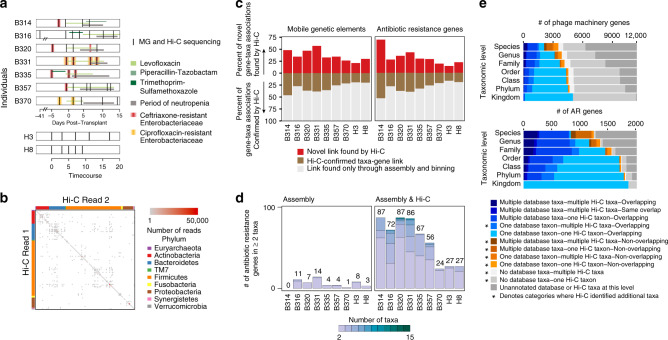
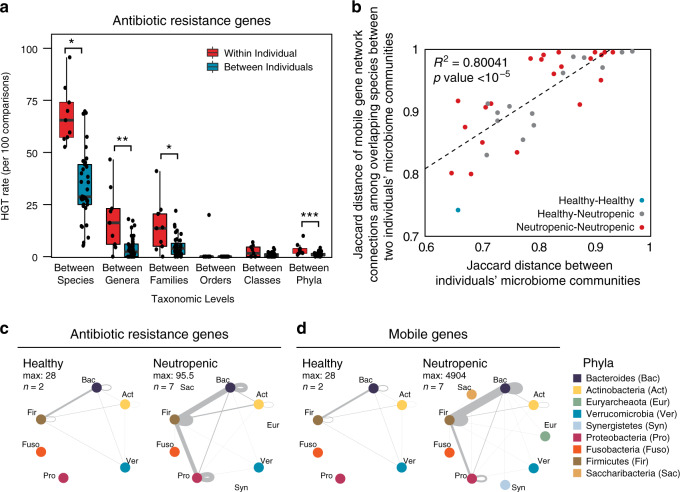
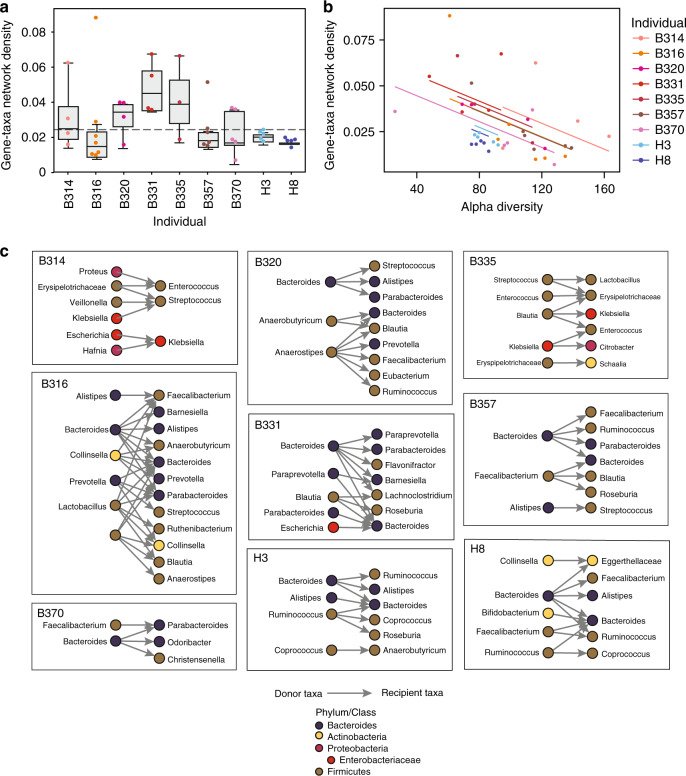
The gut microbiome harbors a ‘silent reservoir’ of antibiotic resistance (AR) genes that is thought to contribute to the emergence of multidrug-resistant pathogens through horizontal gene transfer (HGT). To counteract the spread of AR, it is paramount to know which organisms harbor mobile AR genes and which organisms engage in HGT. Despite methods that characterize the overall abundance of AR genes in the gut, technological limitations of short-read sequencing have precluded linking bacterial taxa to specific mobile genetic elements (MGEs) encoding AR genes. Here, we apply Hi-C, a high-throughput, culture-independent method, to surveil the bacterial carriage of MGEs. We compare two healthy individuals with seven neutropenic patients undergoing hematopoietic stem cell transplantation, who receive multiple courses of antibiotics, and are acutely vulnerable to the threat of multidrug-resistant infections. We find distinct networks of HGT across individuals, though AR and mobile genes are associated with more diverse taxa within the neutropenic patients than the healthy subjects. Our data further suggest that HGT occurs frequently over a several-week period in both cohorts. Whereas most efforts to understand the spread of AR genes have focused on pathogenic species, our findings shed light on the role of the human gut microbiome in this process.
Overview
The claims and statistics of this paper haven’t been checked yet.
Free: it reads the open-access text and checks the first 5 claims that cite a source we can check. Create a free account to check every claim.
Integrity signals
Registry
Cites
Statistics
Figures
Verification
Claims the paper makes
The claims and statistics of this paper haven’t been checked yet.
Free: it reads the open-access text and checks the first 5 claims that cite a source we can check. Create a free account to check every claim.
Claims other papers make about this one
Each is checked against this paper’s own text: does it say what the citing paper says it does?
The source backs part of the claim, not all of it — or backs it for a different population, condition or comparison.
In the citing paper
“These genes can potentially be transferred via horizontal gene transfer to bacteria in the gut environment, whether they are commensal or potentially pathogenic.”
From Exploring the resistome of probiotics, starter cultures, and cheeses via metagenomic analysis (2025) · cites this paper as Kent, Vill, Shi, Satlin, & Brito, 2020
Experimental — accuracy not yet measuredThe cited source says what the claim attributes to it.
In the citing paper
“Under selective pressure from antibiotics, bacteria that acquire resistance can proliferate, posing a significant health threat due to the reduced effectiveness of antibiotic treatments.”
From Exploring the resistome of probiotics, starter cultures, and cheeses via metagenomic analysis (2025) · cites this paper as Kent, Vill, Shi, Satlin, & Brito, 2020
The check wasn’t confident either way, so it gives no verdict — never disputed.
In the citing paper
“Antibiotic resistance genes (ARGs) present in the food microbiota can reach the gut when consumed.”
From Exploring the resistome of probiotics, starter cultures, and cheeses via metagenomic analysis (2025) · cites this paper as Kent, Vill, Shi, Satlin, & Brito, 2020
Experimental — accuracy not yet measured
Self-check
Percentages, sums and reported differences re-computed from the paper’s own numbers.
The self-check needs the paper’s full text.
Citations
Cites
Trimmomatic: a flexible trimmer for Illumina sequence data
Bolger, A. M., Lohse, M., & Usadel, B. (2014) · Bioinformatics · doi:10.1093/bioinformatics/btu170 · Cited by 65,548 · cited 1×
“An ANOVA showed that gene–taxa network density was related to alpha diversity (F(1,39), p= 3.”
MethodFast and accurate short read alignment with Burrows-Wheeler transform
Li, H., & Durbin, R. (2009) · Bioinformatics · doi:10.1093/bioinformatics/btp324 · Cited by 58,607
Prodigal: prokaryotic gene recognition and translation initiation site identification
Hyatt, D., Chen, G.-L., LoCascio, P. F., Land, M. L., Larimer, F. W., & Hauser, L. J. (2010) · BMC Bioinformatics · doi:10.1186/1471-2105-11-119 · Cited by 12,587
Cd-hit: a fast program for clustering and comparing large sets of protein or nucleotide sequences
Li, W., & Godzik, A. (2006) · Bioinformatics · doi:10.1093/bioinformatics/btl158 · Cited by 11,410
The Pfam protein families database: towards a more sustainable future
Finn, R. D., Coggill, P., Eberhardt, R. Y., Eddy, S. R., Mistry, J., Mitchell, A. L., Potter, S. C., Punta, M., Qureshi, M., Sangrador-Vegas, A., et al. (2016) · Nucleic Acids Research · doi:10.1093/nar/gkv1344 · Cited by 5,975
Quality control and preprocessing of metagenomic datasets
Schmieder, R., & Edwards, R. (2011) · Bioinformatics · doi:10.1093/bioinformatics/btr026 · Cited by 5,072
Carattoli, A., Zankari, E., García-Fernández, A., Voldby Larsen, M., Lund, O., Villa, L., Møller Aarestrup, F., & Hasman, H. (2014) · Antimicrobial Agents and Chemotherapy · doi:10.1128/aac.02412-14 · Cited by 4,877
metaSPAdes: a new versatile metagenomic assembler
Nurk, S., Meleshko, D., Korobeynikov, A., & Pevzner, P. A. (2017) · Genome Research · doi:10.1101/gr.213959.116 · Cited by 4,496
Kang, D. D., Li, F., Kirton, E., Thomas, A., Egan, R., An, H., & Wang, Z. (2019) · PeerJ · doi:10.7717/peerj.7359 · Cited by 3,750
PHASTER: a better, faster version of the PHAST phage search tool
Arndt, D., Grant, J. R., Marcu, A., Sajed, T., Pon, A., Liang, Y., & Wishart, D. S. (2016) · Nucleic Acids Research · doi:10.1093/nar/gkw387 · Cited by 3,557
Research works printed but not linked: 2
- 55. Paterson, D. L. & Bonomo, R. A. Extended-spectrum beta-lactamases: a clinical update. Clin. Microbiol. Rev. 18, 657-686 (2005). · DOI · Paper page
- 62. Krawczyk, P. S., Lipinski, L. & Dziembowski, A. PlasFlow: predicting plasmid sequences in metagenomic data using genome signatures. Nucleic Acids Res. 46, e35 (2018). · DOI · Paper page
Cited by
Horizontal Gene Transfer of Antibiotic Resistance Genes in Biofilms
Michaelis, C., & Grohmann, E. (2023) · Antibiotics · doi:10.3390/antibiotics12020328 · Cited by 612
Identification of antimicrobial peptides from the human gut microbiome using deep learning
Ma, Y., Guo, Z., Xia, B., Zhang, Y., Liu, X., Yu, Y., Tang, N., Tong, X., Wang, M., Ye, X., et al. (2022) · Nature Biotechnology · doi:10.1038/s41587-022-01226-0 · Cited by 490
“The gut microbiome encodes highly diverse genes, being one of the largest reservoirs for antibiotic-resistant genes 13 .”
BackgroundExamining horizontal gene transfer in microbial communities
Brito, I. L. (2021) · Nature Reviews Microbiology · doi:10.1038/s41579-021-00534-7 · Cited by 442
Self-citationAntibiotic perturbations to the gut microbiome
Fishbein, S. R. S., Mahmud, B., & Dantas, G. (2023) · Nature Reviews Microbiology · doi:10.1038/s41579-023-00933-y · Cited by 440
“These limitations can be addressed through Hi-C, a technique in which crosslinking before cell lysis preserves interacting DNA molecules and the information regarding the MGE–bacterial host associations 138 .”
BackgroundMethodInfluentialPlasmids, a molecular cornerstone of antimicrobial resistance in the One Health era
Castañeda-Barba, S., Top, E. M., & Stalder, T. (2024) · Nature Reviews Microbiology · doi:10.1038/s41579-023-00926-x · Cited by 379
“These methods have been successfully used to reconstruct the reservoirs of ARGs in wastewater, as well as in human and pig guts 47,189–191 .”
MethodGenomic analysis of sewage from 101 countries reveals global landscape of antimicrobial resistance
Munk, P., Brinch, C., Møller, F. D., Petersen, T. N., Hendriksen, R. S., Seyfarth, A. M., Kjeldgaard, J. S., Svendsen, C. A., van Bunnik, B., Berglund, F., et al. (2022) · Nature Communications · doi:10.1038/s41467-022-34312-7 · Cited by 304
“Indeed, the former has pre-viouslybeenusedtoshowdiscreteARGtransfernetworksinindividual patients over merely weeks of antimicrobial therapy 48 .”
Antimicrobial Resistance and Its Spread Is a Global Threat
Aljeldah, M. M. (2022) · Antibiotics · doi:10.3390/antibiotics11081082 · Cited by 247
“Studies have documented gut microbiota to be a rich reserve of antibiotic resistance (AR) which contributes to the emergence of multidrug resistance by horizontal gene transfer (HGT), which is also triggered during use of antibiotics as vital prophylaxis [25].”
BackgroundAntibiotic resistance: A key microbial survival mechanism that threatens public health
Abbas, A., Barkhouse, A., Hackenberger, D., & Wright, G. D. (2024) · Cell Host & Microbe · doi:10.1016/j.chom.2024.05.015 · Cited by 223
Bengtsson-Palme, J., Abramova, A., Berendonk, T. U., Coelho, L. P., Forslund, S. K., Gschwind, R., Heikinheimo, A., Jarquín-Díaz, V. H., Khan, A. A., Klümper, U., et al. (2023) · Environment International · doi:10.1016/j.envint.2023.108089 · Cited by 188
Forster, S. C., Liu, J., Kumar, N., Gulliver, E. L., Gould, J. A., Escobar-Zepeda, A., Mkandawire, T., Pike, L. J., Shao, Y., Stares, M. D., et al. (2022) · Nature Communications · doi:10.1038/s41467-022-29096-9 · Cited by 187
Horizontal gene transfer among host-associated microbes
Moura de Sousa, J., Lourenço, M., & Gordo, I. (2023) · Cell Host & Microbe · doi:10.1016/j.chom.2023.03.017 · Cited by 166
Genetic innovations in animal–microbe symbioses
Perreau, J. M., & Moran, N. A. (2021) · Nature Reviews Genetics · doi:10.1038/s41576-021-00395-z · Cited by 161
Population-level impacts of antibiotic usage on the human gut microbiome
Lee, K., Raguideau, S., Sirén, K., Asnicar, F., Cumbo, F., Hildebrand, F., Segata, N., Cha, C., & Quince, C. (2023) · Nature Communications · doi:10.1038/s41467-023-36633-7 · Cited by 162
Antimicrobial Peptides: From Design to Clinical Application
Zhang, C., & Yang, M. J. (2022) · Antibiotics · doi:10.3390/antibiotics11030349 · Cited by 158
“In addition, a high-throughput chromatin conformation capture method has been applied to reconstruct each genome in the mixed microbial sample [61] and to study the process of horizontal gene transfer in human microbiome [62].”
MethodGood microbes, bad genes? The dissemination of antimicrobial resistance in the human microbiome
Crits-Christoph, A., Hallowell, H. A., Koutouvalis, K., & Suez, J. (2022) · Gut Microbes · doi:10.1080/19490976.2022.2055944 · Cited by 156
“Hi-C has recently been used to specifically interrogate the sharing of ARGs in the guts of healthy and immunodeficient patients, identifying putative HGT transmission events in the guts of all studied subjects on a timescale of less than two weeks.(106) Specifically, many ARG transmission events were observed both wit…”
BackgroundAntibiotic resistance in the commensal human gut microbiota
Lamberte, L. E., & van Schaik, W. (2022) · Current Opinion in Microbiology · doi:10.1016/j.mib.2022.102150 · Cited by 128
The landscape of lysogeny across microbial community density, diversity and energetics
Silveira, C. B., Luque, A., & Rohwer, F. L. (2021) · Environmental Microbiology · doi:10.1111/1462-2920.15640 · Cited by 122
“Virulence and antibiotic resistance genes provide obvious adaptive traits to the bacterial host under specific selective pressures, although the frequency in which phages transfer these groups of genes has been debated (Enault et al., 2017; Kent et al., 2020).”
BackgroundDisentangling host–microbiota complexity through hologenomics
Alberdi, A., Andersen, S. B., Limborg, M. T., Dunn, R. R., & Gilbert, M. T. P. (2021) · Nature Reviews Genetics · doi:10.1038/s41576-021-00421-0 · Cited by 120
Functions predict horizontal gene transfer and the emergence of antibiotic resistance
Zhou, H., Beltrán, J. F., & Brito, I. L. (2021) · Science Advances · doi:10.1126/sciadv.abj5056 · Cited by 106
“The rate of HGT varied significantly between datasets: The highest was within the human gut (17.92%), as has been observed previously ( 9 , 20 , 49 ), the marine and soil datasets were over 60-fold lower (at 0.279 and 0.237%, respectively), and only 26 HGT events were observed in the plant root…”
InfluentialSelf-citationAssociation of Diet and Antimicrobial Resistance in Healthy U.S. Adults
Oliver, A. S., Xue, Z., Villanueva, Y., Durbin-Johnson, B. P., Alkan, Z., Taft, D. H., Liu, J., Korf, I. F., Laugero, K. D., Stephensen, C. B., et al. (2022) · mBio · doi:10.1128/mbio.00101-22 · Cited by 120
“work has shown that the density of an antibiotic gene network increases as microbiome diversity decreases (26).”
BackgroundMicrobiome Dynamics: A Paradigm Shift in Combatting Infectious Diseases
Kamel, M. S., Aleya, S., Alsubih, M., & Aleya, L. (2024) · Journal of Personalized Medicine · doi:10.3390/jpm14020217 · Cited by 114
“Certain bacteria within the microbiome can harbor resistance genes and transfer them to pathogenic bacteria, contributing to the development of resistance [246].”
BackgroundAn engineered live biotherapeutic for the prevention of antibiotic-induced dysbiosis
Cubillos-Ruiz, A., Alcantar, M. A., Donghia, N. M., Cárdenas, P., Ávila-Pacheco, J., & Collins, J. J. (2022) · Nature Biomedical Engineering · doi:10.1038/s41551-022-00871-9 · Cited by 109
Roodgar, M., Good, B. H., Garud, N. R., Martis, S., Avula, M., Zhou, W., Lancaster, S. M., Lee, H., Babveyh, A., Nesamoney, S., et al. (2021) · Genome Research · doi:10.1101/gr.265058.120 · Cited by 99
“This suggests that alternative approaches like chromatin conformation capture (Hi-C) (Kent et al. 2020) or linked-read sequencing of single cells (Lan et al.”
Hall, J. P. J., Botelho, J., Cazares, A., & Baltrus, D. A. (2021) · Philosophical Transactions of the Royal Society B Biological Sciences · doi:10.1098/rstb.2020.0472 · Cited by 101
Moore, J. A. M., Abraham, P. E., Michener, J. K., Muchero, W., & Cregger, M. A. (2022) · New Phytologist · doi:10.1111/nph.18010 · Cited by 99
“Establishment and persistence can occur through at least two mechanisms: augmentation and displacement (Kurkjian et al., 2021).”
BackgroundInfluentialLund, D., Parras-Moltó, M., Inda-Díaz, J. S., Ebmeyer, S., Larsson, D. G. J., Johnning, A., & Kristiansson, E. (2025) · Nature Communications · doi:10.1038/s41467-025-57825-3 · Cited by 100
“Indeed, previous studies have hypothesized that distinct HGT networks are associated with the gut microbiomesof differentindividuals 46 ,whichcouldfurtherexplainthe lower generalizability of the human samples.”
Intrahost evolution of the gut microbiota
Barreto, H. C., & Gordo, I. (2023) · Nature Reviews Microbiology · doi:10.1038/s41579-023-00890-6 · Cited by 94
Singh, R. P., Shadan, A., & Ma, Y. (2022) · Probiotics and Antimicrobial Proteins · doi:10.1007/s12602-022-09992-8 · Cited by 75
Hutinel, M., Larsson, D. G. J., & Flach, C. (2021) · The Science of The Total Environment · doi:10.1016/j.scitotenv.2021.151433 · Cited by 90
Diebold, P. J., Rhee, M. W., Shi, Q., Trung, N. V., Umrani, F. A., Ahmed, S., Kulkarni, V., Deshpande, P., Alexander, M., Hoa, N. T., et al. (2023) · Nature Communications · doi:10.1038/s41467-023-42998-6 · Cited by 84
Self-citationTan, R., Jin, M., Shao, Y., Yin, J., Li, H., Chen, T., Shi, D., Zhou, S., Lǐ, J., & Yang, D. (2022) · Gut Microbes · doi:10.1080/19490976.2021.2022442 · Cited by 82
“Gene exchange is most frequent among bacteria of the same phylum, and most HGT (60%) occurs between closely related members of the same phylum.(41) In this process, interactions between donor bacteria, receptor bacteria, and plasmids affect the transfer efficiency.”
BackgroundResistome expansion in disease-associated human gut microbiomes
Fredriksen, S., de Warle, S., van Baarlen, P., Boekhorst, J., & Wells, J. M. (2023) · Microbiome · doi:10.1186/s40168-023-01610-1 · Cited by 78
The resistance within: antibiotic disruption of the gut microbiome and resistome dynamics in infancy
Thänert, R., Sawhney, S. S., Schwartz, D. J., & Dantas, G. (2022) · Cell Host & Microbe · doi:10.1016/j.chom.2022.03.013 · Cited by 76
“Future genome resolved-studies at the strain level that link ARGs to their bacterial host—for example using Hi-C technology (Kent et al., 2020)—can resolve this open question.”
BackgroundEncapsulation and delivery of phage as a novel method for gut flora manipulation in situ: A review
Yang, Y., Du, H., Zou, G., Song, Z., Zhou, Y., Li, H., Tan, C. S., Chen, H., Fischetti, V. A., & Li, J. (2022) · Journal of Controlled Release · doi:10.1016/j.jconrel.2022.11.048 · Cited by 75
Evolution of horizontal transmission in antimicrobial resistance plasmids
Dimitriu, T. (2022) · Microbiology · doi:10.1099/mic.0.001214 · Cited by 72
Host- plasmid network structure in wastewater is linked to antimicrobial resistance genes
Risely, A., Newbury, A., Stalder, T., Simmons, B. I., Top, E. M., Buckling, A., & Sanders, D. (2024) · Nature Communications · doi:10.1038/s41467-024-44827-w · Cited by 68
Zoonotic and antibiotic-resistant Campylobacter: a view through the One Health lens
Zhang, Q., Beyi, A. F., & Yin, Y. (2023) · One Health Advances · doi:10.1186/s44280-023-00003-1 · Cited by 63
Brief antibiotic use drives human gut bacteria towards low-cost resistance
Yaffe, E., Dethlefsen, L., Patankar, A. V., Gui, C., Holmes, S., & Relman, D. A. (2025) · Nature · doi:10.1038/s41586-025-08781-x · Cited by 66
“Additionally, studying other forms of evolution, such as horizontal gene transfer, will necessitate complementary methods, such as Hi-C 36,62 or long-read sequencing technology 37,63–65 .”
Development of the oral resistome during the first decade of life
Sukumar, S., Wang, F., Simpson, C. A., Willet, C. E., Chew, T., Hughes, T. E., Bockmann, M. R., Sadsad, R., Martin, F. E., Lydecker, H. W., et al. (2023) · Nature Communications · doi:10.1038/s41467-023-36781-w · Cited by 62
Phages with a broad host range are common across ecosystems
Bignaud, A., Conti, D. E., Thierry, A., Serizay, J., Labadie, K., Poulain, J., Chény, O., Colón‐González, M., Debarbieux, L., Guerrero‐Osornio, M. G., et al. (2025) · Nature Microbiology · doi:10.1038/s41564-025-02108-2 · Cited by 57
Emerging Contaminants in Streams of Doce River Watershed, Minas Gerais, Brazil
Gomes, M. P., Brito, J. C. M., Vieira, F., Kitamura, R. S. A., & Juneau, P. (2022) · Frontiers in Environmental Science · doi:10.3389/fenvs.2021.801599 · Cited by 56
“Antimicrobial resistance is an emerging concern, as the spread of resistance genes is a global problemwith direct detrimental effects on the economy and public health (Kent et al., 2020).”
BackgroundThe extended mobility of plasmids
Garcillán-Barcia, M. P., de la Cruz, F., & Rocha, E. P. C. (2025) · Nucleic Acids Research · doi:10.1093/nar/gkaf652 · Cited by 59
“These technologies were shown to be capable of identifying plasmid transfers in nature during serial sampling [ 394 ].”
Approaches for characterizing and tracking hospital-associated multidrug-resistant bacteria
Blake, K. S., Choi, J., & Dantas, G. A. (2021) · Cellular and Molecular Life Sciences · doi:10.1007/s00018-020-03717-2 · Cited by 55
Zheng, D., Yin, G., Liu, M., Hou, L., Yang, Y., Liu, X., Jiang, Y., Chen, C., & Wu, H. (2022) · Environmental Pollution · doi:10.1016/j.envpol.2022.119015 · Cited by 51
Massively parallel single-cell sequencing of diverse microbial populations
Lan, F., Saba, J., Ross, T. D., Zhou, Z., Krauska, K., Anantharaman, K., Landick, R. C., & Venturelli, O. S. (2024) · Nature Methods · doi:10.1038/s41592-023-02157-7 · Cited by 53
Ferrer Florensa, A., Almagro Armenteros, J. J., Kaas, R. S., Clausen, P. T. L. C., Nielsen, H., Rost, B., & Aarestrup, F. M. (2026) · Bioinformatics · doi:10.1093/bioinformatics/btag129 · Cited by 50
Introduction: the secret lives of microbial mobile genetic elements
Hall, J. P. J., Harrison, E., & Baltrus, D. A. (2021) · Philosophical Transactions of the Royal Society B Biological Sciences · doi:10.1098/rstb.2020.0460 · Cited by 50
Hyun, J. H., Lee, S. K., Cheon, J. H., Yong, D., Koh, H., Kang, Y., Kim, M. H., Sohn, Y., Cho, Y., Baek, Y. J., et al. (2022) · Antimicrobial Resistance and Infection Control · doi:10.1186/s13756-022-01064-4 · Cited by 47
“This exacerbates the dissemination of resistance genes by horizontal gene transfer in the presence of a basal gene level, leading to a vicious cycle and an increase in the number of resistant organisms [6, 26, 27].”
BackgroundUnraveling the tempo and mode of horizontal gene transfer in bacteria
Good, B. H., Bhatt, A. S., & McDonald, M. J. (2025) · Trends in Microbiology · doi:10.1016/j.tim.2025.03.009 · Cited by 44
ViralCC retrieves complete viral genomes and virus-host pairs from metagenomic Hi-C data
Du, Y., Fuhrman, J. A., & Sun, F. (2023) · Nature Communications · doi:10.1038/s41467-023-35945-y · Cited by 44
The prototypic crAssphage is a linear phage-plasmid
Schmidtke, D. T., Hickey, A. S.-M., Wirbel, J., Lin, J. D., Liachko, I., Sherlock, G., & Bhatt, A. S. (2025) · Cell Host & Microbe · doi:10.1016/j.chom.2025.07.004 · Cited by 43
Dissecting microbial communities with single-cell transcriptome analysis
Pountain, A. W., & Yanai, I. (2025) · Science · doi:10.1126/science.adp6252 · Cited by 43
Kalmár, L., Gupta, S., Kean, I. R. L., Ba, X., Hadjirin, N. F., Lay, E. M., de Vries, S. P. W., Bateman, M., Bartlett, H., Hernandez-Garcia, J., et al. (2022) · PLoS Genetics · doi:10.1371/journal.pgen.1009776 · Cited by 43
Liu, H., Li, Z., Liu, C., Qiang, Z., Karanfil, T., & Yang, M. (2022) · ACS ES&T Water · doi:10.1021/acsestwater.2c00286 · Cited by 42
Ivanova, V. A., Chernevskaya, E., Vasiluev, P. A., Ivanov, A. B., Tolstoganov, I., Shafranskaya, D. D., Игоревич, У. В., Korobeynikov, A., Razin, S. V., Nv, B., et al. (2022) · Frontiers in Microbiology · doi:10.3389/fmicb.2021.770323 · Cited by 43
“It revealed pronounced dysbiosis, particularly, with the levels of Proteobacteria 1–2 orders higher than observed from NGS microbiome surveys for the general Russian population (Tyakht et al., 2013; Klimenko et al., 2018; Volokh et al., 2019).”
BackgroundSegatella clades adopt distinct roles within a single individual’s gut
Xiao, X., Singh, A., Giometto, A., & Brito, I. (2024) · npj Biofilms and Microbiomes · doi:10.1038/s41522-024-00590-w · Cited by 43
“(3) The third method is a pipeline established in the lab combining several previously used and proved pipelines 29 .”
InfluentialSelf-citationLinking plasmid-based beta-lactamases to their bacterial hosts using single-cell fusion PCR
Diebold, P. J., New, F. N., Hovan, M., Satlin, M. J., & Brito, I. (2021) · eLife · doi:10.7554/elife.66834 · Cited by 41
Self-citationEmerging frontiers of antibiotics use and their impacts on the human gut microbiome
Kumari, R., Yadav, Y., Misra, R., Das, U., Adhikari, U. D., Malakar, P., & Dubey, G. P. (2022) · Microbiological Research · doi:10.1016/j.micres.2022.127127 · Cited by 41
Dynamics of bacterial recombination in the human gut microbiome
Liu, Z., & Good, B. H. (2024) · PLoS Biology · doi:10.1371/journal.pbio.3002472 · Cited by 40
Cui, G., Liu, Z., Xu, W., Gao, Y., Yang, S., Grossart, H., Li, M., & Luo, Z.-H. (2022) · The Science of The Total Environment · doi:10.1016/j.scitotenv.2022.155784 · Cited by 40
Fresh produce as a reservoir of antimicrobial resistance genes: A case study of Switzerland
Kläui, A., Bütikofer, U., Naskova, J., Wagner, E., & Marti, E. (2023) · The Science of The Total Environment · doi:10.1016/j.scitotenv.2023.167671 · Cited by 38
Fang, M., Zhang, R., Wang, C., Liu, Z.-Z., Fei, M., Tang, B., Yang, H., & Sun, D. (2024) · Applied and Environmental Microbiology · doi:10.1128/aem.00811-24 · Cited by 37
“Previous studies showed that EcN received ARGs on plasmids in the gut microbiome (54), whereas rates of plasmid transfer into EcN vary largely, in a range from an undetectable level to 10 −1 , depending on the type of mobilizable plasmid carrying ARGs, donor strain, and experimental systems (55–58).”
van den Broek, S., Nybom, I., Hartmann, M., Döetterl, S., & Garland, G. (2024) · The Science of The Total Environment · doi:10.1016/j.scitotenv.2024.177306 · Cited by 37
The resistome of the food chain: A one health perspective
Fernández‐Trapote, E., Oliveira, M., Cobo‐Díaz, J. F., & Alvarez‐Ordóñez, A. (2024) · Microbial Biotechnology · doi:10.1111/1751-7915.14530 · Cited by 36
“Bacteria can enter the human gut through food and share ARGs with gut commensal and/or pathogenic species through horizontal gene transfer (Kent et al., 2020), which may result in the selection of (pathogenic) strains that are resistant or multidrug-resistant, limiting the therapeutic options for…”
BackgroundZhao, J., Duan, G., Zhu, Y., & Zhu, D. (2022) · Journal of Environmental Sciences · doi:10.1016/j.jes.2022.07.033 · Cited by 36
Souque, C., Ojeda, I. G., & Baym, M. (2024) · Annual Review of Microbiology · doi:10.1146/annurev-micro-041522-102707 · Cited by 34
“For example, successful treatment in a pig model of implant infection by S. aureus required more than 100 times the planktonic MIC (71), and E. coli was found to survive in the bladder at concentrations higher than the MIC (11).”
BackgroundSaak, C. C., Pierce, E. C., Dinh, C. B., Portik, D. M., Hall, R. J., Ashby, M., & Dutton, R. J. (2023) · mSystems · doi:10.1128/msystems.00701-22 · Cited by 35
Rooney, A. M., Raphenya, A. R., Melano, R. G., Seah, C., Yee, N., MacFadden, D. R., McArthur, A. G., Schneeberger, P. H. H., & Coburn, B. A. (2022) · mSystems · doi:10.1128/msystems.00022-22 · Cited by 33
“to the bacterial hosts (49), but this method would require further validation.”
MethodMills, M. C., Lee, S., Piperata, B. A., Garabed, R. B., Choi, B., & Lee, J. (2023) · Microbiome · doi:10.1186/s40168-023-01636-5 · Cited by 33
Zhao, Y., Huang, F., Wang, W., Gao, R. C., Fan, L., Wang, A., & Gao, S.-H. (2023) · The Science of The Total Environment · doi:10.1016/j.scitotenv.2023.165867 · Cited by 32
Advancements in synthetic biology-based bacterial cancer therapy: A modular design approach
Arboleda-García, A., Alarcon‐Ruiz, I., Boada-Acosta, L., Boada, Y., Vignoni, A., & Lewintre, E. J. (2023) · Critical Reviews in Oncology/Hematology · doi:10.1016/j.critrevonc.2023.104088 · Cited by 29
Integrative genomics would strengthen AMR understanding through ONE health approach
Liu, C. S. C., & Pandey, R. (2024) · Heliyon · doi:10.1016/j.heliyon.2024.e34719 · Cited by 29
“While healthy individuals showed background level of genetic exchange; inflammation and neutropenia resulted in higher pathogen abundance and consequently denser HGT networks associated with diverse microbial community [85].”
InfluentialSeasonal hydrological dynamics govern lifestyle preference of aquatic antibiotic resistome
Adyari, B., Hou, L., Zhang, L., Chen, N., Ju, F., Zhu, L., Yu, C., & Hu, A. (2022) · Environmental Science and Ecotechnology · doi:10.1016/j.ese.2022.100223 · Cited by 31
“Extensive antibiotic use has increased antibiotic resistance bacteria (ARB) and enhanced the spread of antibiotic resistance genes (ARGs) in human/animal guts [1,2].”
BackgroundLee, K., Kim, D., & Cha, C. (2021) · The Journal of Microbiology · doi:10.1007/s12275-021-0652-4 · Cited by 28
Antibiotic resistance genes in anaerobic digestion: Unresolved challenges and potential solutions
Wang, C., Yin, X., Xu, X., Wang, D., Wang, Y., & Zhang, T. (2025) · Bioresource Technology · doi:10.1016/j.biortech.2025.132075 · Cited by 27
Experimental evolution in an era of molecular manipulation
Ascensao, J. A., & Desai, M. M. (2025) · Nature Reviews Genetics · doi:10.1038/s41576-025-00867-6 · Cited by 27
“For example, although some natural microbial populations evolve asexually (often over short timescales), it has become increasingly clear that horizontal gene transfer has a substantial role in natural microbial evolution 113–116 , which is scarcely studied in laboratory evolution.”
Blasey, N., Rehrmann, D., Riebisch, A. K., & Mühlen, S. (2023) · Frontiers in Cellular and Infection Microbiology · doi:10.3389/fcimb.2022.1065561 · Cited by 27
“With the microbiota serving as a reservoir for resistance genes that can be passed on to pathogens via horizontal gene transfer, multi-resistant pathogens emerge in ever greater numbers (Kent et al., 2020; Hofer, 2022).”
BackgroundCalderón-Franco, D., van Loosdrecht, M. C. M., Abeel, T., & Weissbrodt, D. G. (2023) · Antonie van Leeuwenhoek · doi:10.1007/s10482-023-01834-z · Cited by 27
“2019) and stem cell transplantation patients (Kent et al. 2020), highlighting the diversity of microorganisms potentially able to transfer resistance determinant fragments.”
BackgroundDu, Y., & Sun, F. (2023) · Nature Communications · doi:10.1038/s41467-023-41209-6 · Cited by 27
“3.2) 55 to estimate the number of genomes in the metagenomic data, denoted by k (Supplementary Note 6).”
InfluentialWang, D., Shang, J., Lin, H., Liang, J., Wang, C., Sun, Y., Bai, Y., & Qu, J. (2023) · Water Research · doi:10.1016/j.watres.2023.120859 · Cited by 25
Lee, I., Jo, J.-W., Woo, H., Suk, K. T., Lee, S. S., & Kim, B. S. (2024) · Gut Microbes · doi:10.1080/19490976.2024.2341635 · Cited by 25
Genetic and ecological inheritance of plant growth-promoting rhizobacteria
Khanghahi, M. Y., Spagnuolo, M., Filannino, P., Minervini, F., & Crecchio, C. (2024) · Plant and Soil · doi:10.1007/s11104-024-06852-y · Cited by 28
“The occurrence of genetic transformations within communities may be traced to areas of high microbial density (e.g., the rhizosphere) that support quick and pervasive horizontal gene transfer (Kent et al. 2020).”
Kawano-Sugaya, T., Arikawa, K., Saeki, T., Endoh, T., Kamata, K., Matsuhashi, A., & Hosokawa, M. (2024) · Microbiome · doi:10.1186/s40168-024-01903-z · Cited by 23
“Recognizing the spread of antimicrobial resistance, it is vital to understand the reservoirs and the transmission of ARGs [3, 46, 47, 52].”
BackgroundMahmud, Z., Manik, M. R. K., Rahman, A., Karim, M. M., & Islam, L. N. (2024) · Scientific Reports · doi:10.1038/s41598-024-71472-6 · Cited by 22
Manik, M. R. K., Mahmud, Z., Mishu, I. D., Hossen, M. S., Howlader, M. Z. H., & Nabi, A. N. (2023) · Current Issues in Molecular Biology · doi:10.3390/cimb45080409 · Cited by 23
“The mechanisms of resistance involve a variety of strategies, such as upregulating the genes of efflux proteins [2], downregulating the genes of influx proteins [2], acquiring antibiotic-resistant genes via horizontal gene transfer from already resistant bacteria [3,4], and mutating antibiotic resistance genes such as…”
BackgroundBernabeu, M., Cabello-Yeves, E., Ventura, E. F., Samarra, A., Summers, J. K., Marina, A., & Collado, M. C. (2024) · Current Opinion in Microbiology · doi:10.1016/j.mib.2023.102424 · Cited by 22
Hu, Z., Xu, W., Sun, Y., Xu, H., Xu, J., Huang, L., Yao, W., Yu, Z., & Xie, Y. (2024) · Chemical Engineering Journal · doi:10.1016/j.cej.2024.148627 · Cited by 20
Embracing Metagenomic Complexity with a Genome-Free Approach
Coleman, I., & Korem, T. (2021) · mSystems · doi:10.1128/msystems.00816-21 · Cited by 20
“occurs over relatively short timescales (4, 6).”
High-fat and low-fiber diet elevates the gut resistome: a comparative metagenomic study
Shen, Y., Sun, D., Chen, K., Jiang, J., Shao, D., Yang, L., Sun, C., Liu, D., Ke, Y., Wu, C., et al. (2025) · npj Biofilms and Microbiomes · doi:10.1038/s41522-025-00799-3 · Cited by 19
Environmental resistomes and antimicrobial resistance: integrating the One Health framework
Raziq, K., Saleem, R., Zafar, S., Sanaullah, T., Nazir, M. M., Ummara, U. E., & Abbasi, A. (2025) · Naunyn-Schmiedeberg s Archives of Pharmacology · doi:10.1007/s00210-025-04639-1 · Cited by 19
A low-cost genomics workflow enables isolate screening and strain-level analyses within microbiomes
Sanders, J. G., Yan, W., Mjungu, D. C., Lonsdorf, E. V., Hart, J. A. L., Sanz, C., Morgan, D., Peeters, M., Hahn, B. H., & Moeller, A. H. (2022) · Genome biology · doi:10.1186/s13059-022-02777-w · Cited by 18
“S6), consistent with horizontal gene transfer (HGT) within microbiota [13, 23, 24].”
Backgroundvan Dijk, B., Buffard, P., Farr, A. D., Giersdorf, F., Meijer, J., Dutilh, B. E., & Rainey, P. B. (2023) · ISME Communications · doi:10.1038/s43705-023-00294-w · Cited by 18
“A number of annotation-free methods to track HGT in microbial ecosystems have recently been developed, relying for example on differential read coverage [104], assembly graphs [105, 106], discordant read pair mapping [107], or Hi-C metagenomics [88, 108, 109].”
Worku, M. C., Getie, M., Moges, F., & Getaneh, A. (2022) · Interdisciplinary Perspectives on Infectious Diseases · doi:10.1155/2022/7905350 · Cited by 17
“To counteract the spread of antimicrobial resistance, it is paramount to know which organisms harbor mobile antimicrobial resistance genes and which organisms engage in horizontal gene transfer [26].”
BackgroundMcCallum, G. E., Rossiter, A. E., Quraishi, M. N., Iqbal, T. H., Kuehne, S. A., & van Schaik, W. (2023) · Microbial Genomics · doi:10.1099/mgen.0.001030 · Cited by 17
“K_HiC (average*) K_HiC 2×150 41 021 508 37 984 239 nd nd nd [22]”
BackgroundMethodInfluentialPramanik, A., Kolawole, O. P., Gates, K., Kundu, S., Shukla, M. K., Moser, R. D., Ucak‐Astarlioglu, M. G., Al‐Ostaz, A., & Ray, P. C. (2023) · ACS Omega · doi:10.1021/acsomega.3c06360 · Cited by 17
Detection of rare plasmid hosts using a targeted hi-C approach
Castañeda-Barba, S., Ridenhour, B. J., Top, E. M., & Stalder, T. (2025) · ISME Communications · doi:10.1093/ismeco/ycae161 · Cited by 19
Sydow, K., Eger, E., Schwabe, M., Heiden, S. E., Bohnert, J. A., Franzenburg, S., Jurischka, C., Schierack, P., & Schaufler, K. (2022) · Microorganisms · doi:10.3390/microorganisms10102063 · Cited by 17
“It is well known that ABR can spread through mobile genetic elements and that commensal microorganisms acquire such traits in the intestinal tract [93].”
BackgroundLaconi, A., Tolosi, R., Mughini‐Gras, L., Cuccato, M., Cannizzo, F. T., & Piccirillo, A. (2022) · Scientific Reports · doi:10.1038/s41598-022-24927-7 · Cited by 16
Cutting-edge tools for unveiling the dynamics of plasmid–host interactions
Yang, Q., Gao, J. T., Zhou, S. G., & Walsh, T. R. (2025) · Trends in Microbiology · doi:10.1016/j.tim.2024.12.013 · Cited by 15
Metagenomic co-assembly uncovers mobile antibiotic resistance genes in airborne microbiomes
Erkorkmaz, B. A., Zeevi, D., & Rudich, Y. (2025) · Communications Earth & Environment · doi:10.1038/s43247-025-02381-3 · Cited by 15
“This approach is consistent with previous studies 83,84 .”
Metadata
- Authors
- Kent, A. G., Vill, A. C., Shi, Q., Satlin, M. J., & Brito, I. L.
- Affiliations
- Cornell University (US)
- Weill Cornell Medicine (US)
- Corresponding author
- Brito, Ilana Lauren
- Venue
- Nature Communications
- Published
- 2020-09-01
- Volume
- 11
- Issue
- 1
- Pages
- 4379-4379
- ISSN
- 2041-1723 (ISSN-L)
- PMC
- PMC7463002
- OpenAlex
- W3082729799
- Semantic Scholar
- b948bee636200b5e9ab913f71d05fdb7bb883ded
- Cited by
- 216
- References
- 72
- Citations by year
- 2026: 27 · 2025: 42 · 2024: 46 · 2023: 42 · 2022: 44 · 2021: 15
- FWCI
- 8.42
- Type
- journal article
- Language
- en
- Open access
- gold
- doi.org
- Licence
- cc-by
- creativecommons.org/licenses/by/4.0 (tdm)
- creativecommons.org/licenses/by/4.0 (vor)
- Locations
- Nature Communications (publishedVersion, cc-by)
- bioRxiv (Cold Spring Harbor Laboratory) (acceptedVersion, cc-by-nc-nd)
- PubMed Central (publishedVersion, cc-by)
- PubMed (publishedVersion)
- RePEc: Research Papers in Economics (submittedVersion)
- DOAJ (DOAJ: Directory of Open Access Journals) (submittedVersion, cc-by-sa)
- Funders
- Alfred P. Sloan Foundation
- Topics
- Health Sciences › Medicine › Microbiology (medical) › Antibiotic Resistance in Bacteria
- Life Sciences › Biochemistry, Genetics and Molecular Biology › Molecular Biology › Gut microbiota and health
- Physical Sciences › Environmental Science › Pollution › Pharmaceutical and Antibiotic Environmental Impacts
- Keywords
- antibiotic resistance genes, horizontal gene transfer, mobile genetic elements, gut microbiota, Hi-C, multidrug resistance, hematopoietic stem cell transplantation, neutropenic patients, antibiotic exposure
- MeSH terms
- Gastrointestinal Microbiome, Adult, Aged, Anti-Bacterial Agents, DNA, Bacterial, Genes, Bacterial, Humans, Middle Aged, Interspersed Repetitive Sequences, Gene Transfer, Horizontal, Drug Resistance, Bacterial, High-Throughput Nucleotide Sequencing
About these checks
Registry, retraction, Cites and statistics results are computed, not judged, with one exception: a printed reference that no index lists is read once by a model before it counts as a citation error. Claims are extracted by a model and kept only when their quote appears verbatim in the text; each cited source is then checked, with a model’s help, for whether it says what the claim relies on. Those verdicts can be wrong — read the claim’s quote and the cited source before relying on one.
Statistics and arithmetic are recomputed, not judged.
Confidence bands are shown only for fields calibrated on our annotated test set. None is calibrated yet, so no band is shown.
What counts as a claim ›How we measure confidence ›How we check this ›
Are you an author, or do you see a problem with this page? Request a review
Data sources
Bibliographic data: Semantic Scholar, OpenAlex, Crossref.
Contains information from the Semantic Scholar Academic Graph Datasets, made available under the ODC Attribution License (ODC-BY 1.0).
Semantic Scholar’s data is described in: Kinney, R., et al. (2023). The Semantic Scholar Open Data Platform. arXiv:2301.10140.
