

Abiraterone acetate preferentially enriches for the gut commensal Akkermansia muciniphila in castrate-resistant prostate cancer patients
Open accessThe DOI matches its Crossref record; 60 of the 60 references it cites were found in a registry or an index.
Abstract
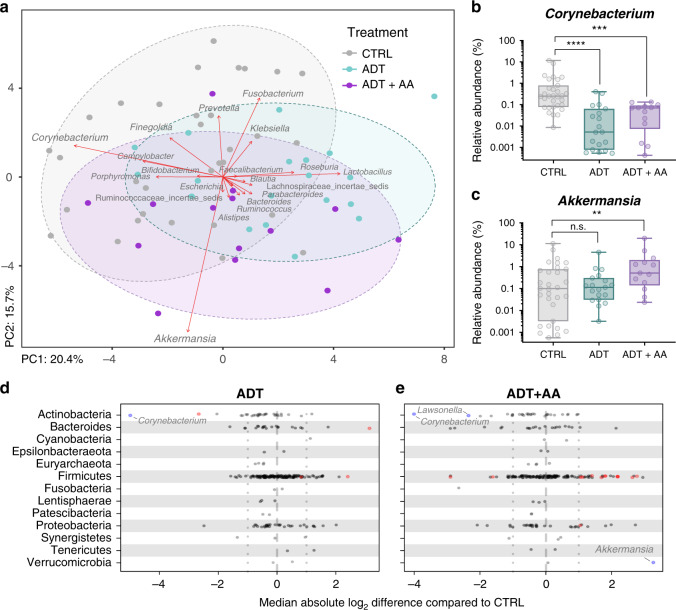
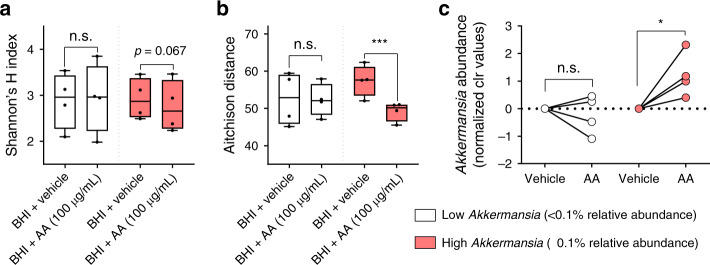
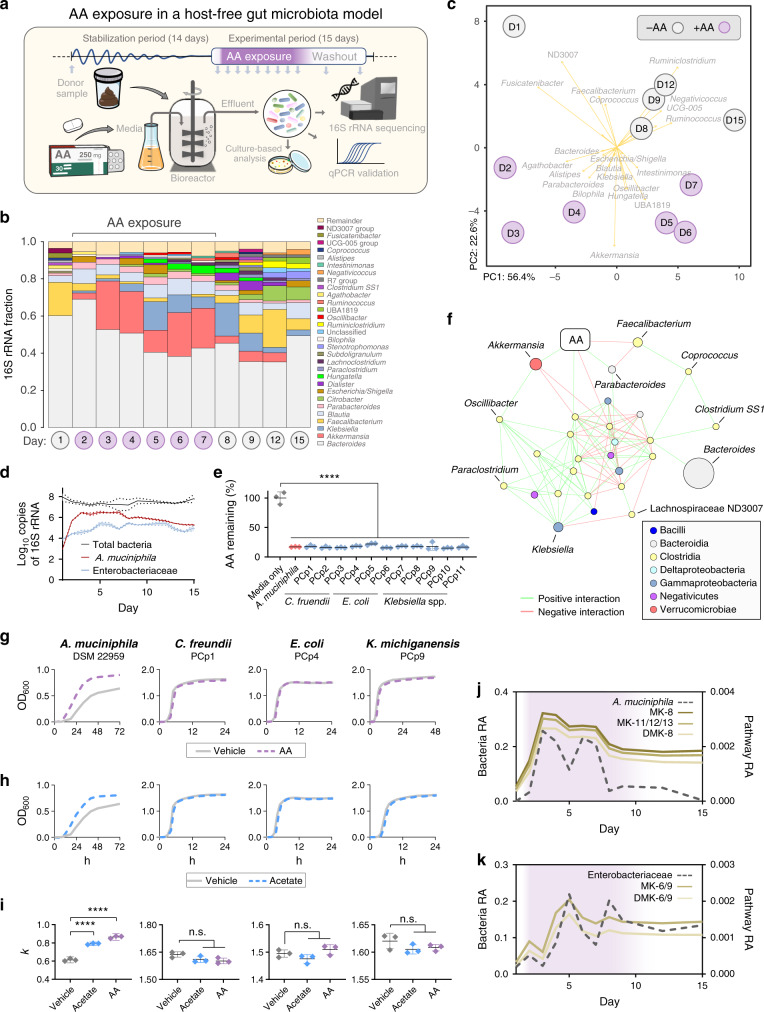
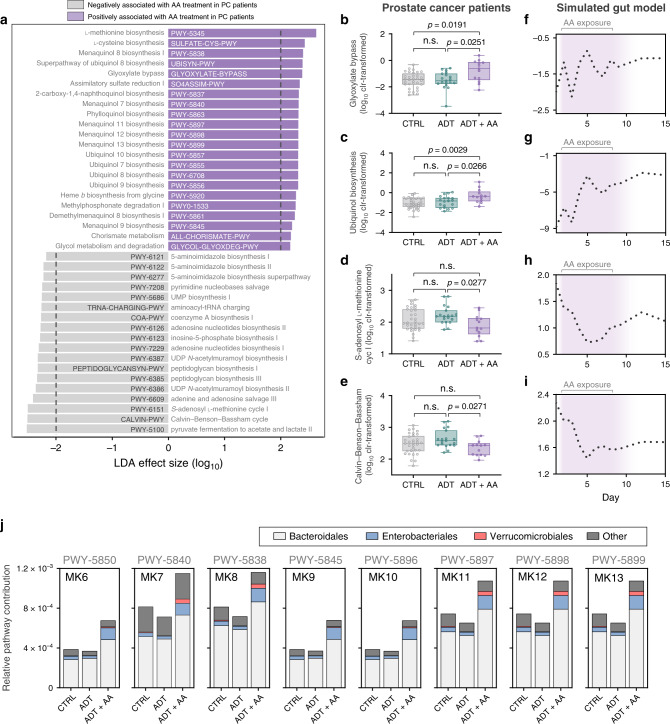
Abiraterone acetate (AA) is an inhibitor of androgen biosynthesis, though this cannot fully explain its efficacy against androgen-independent prostate cancer. Here, we demonstrate that androgen deprivation therapy depletes androgen-utilizing Corynebacterium spp. in prostate cancer patients and that oral AA further enriches for the health-associated commensal, Akkermansia muciniphila. Functional inferencing elucidates a coinciding increase in bacterial biosynthesis of vitamin K2 (an inhibitor of androgen dependent and independent tumor growth). These results are highly reproducible in a host-free gut model, excluding the possibility of immune involvement. Further investigation reveals that AA is metabolized by bacteria in vitro and that breakdown components selectively impact growth. We conclude that A. muciniphila is a key regulator of AA-mediated restructuring of microbial communities, and that this species may affect treatment response in castrate-resistant cohorts. Ongoing initiatives aimed at modulating the colonic microbiota of cancer patients may consider targeted delivery of poorly absorbed selective bacterial growth agents.
Overview
The claims and statistics of this paper haven’t been checked yet.
Free: it reads the open-access text and checks the first 5 claims that cite a source we can check. Create a free account to check every claim.
Integrity signals
Registry
Cites
Statistics
Figures
Verification
Claims the paper makes
The claims and statistics of this paper haven’t been checked yet.
Free: it reads the open-access text and checks the first 5 claims that cite a source we can check. Create a free account to check every claim.
Claims other papers make about this one
Each is checked against this paper’s own text: does it say what the citing paper says it does?
The source backs part of the claim, not all of it — or backs it for a different population, condition or comparison.
In the citing paper
“This observation was confirmed in prospective trials and large meta-analyses, suggesting that gut microbiota may be instrumental for the immunostimulatory mode of action of ICI 23,24 .”
From Intestinal Akkermansia muciniphila predicts clinical response to PD-1 blockade in patients with advanced non-small-cell lung cancer (2022) · cites this paper as [24]
Experimental — accuracy not yet measuredIn the citing paper
“For example, in prostate cancer, abiraterone acetate (AA) was used as an energy source by A. muciniphila and inhibited Corynebacterium species relying on AA-inhibited androgens for growth (100).”
From The microbiome and human cancer (2021) · cites this paper as [100]
Self-check
Percentages, sums and reported differences re-computed from the paper’s own numbers.
The self-check needs the paper’s full text.
Citations
Cites
Reproducible, interactive, scalable and extensible microbiome data science using QIIME 2
Bolyen, E., Rideout, J. R., Dillon, M. R., Bokulich, N. A., Abnet, C. C., Al-Ghalith, G. A., Alexander, H., Alm, E. J., Arumugam, M., Asnicar, F., et al. (2019) · Nature Biotechnology · doi:10.1038/s41587-019-0209-9 · Cited by 23,742 · cited 1×
“…distances (clr-transformed Euclidian distance) as input values using the “ prcomp ” function in R. Alpha and beta diversities for each sample were determined by calculating Shannon ’ s H index and Aitchison ’ s distance (within and between samples), respectively, using the QIIME2 software 50 .”
Self-citationUltra-high-throughput microbial community analysis on the Illumina HiSeq and MiSeq platforms
Caporaso, J. G., Lauber, C. L., Walters, W. A., Berg-Lyons, D., Huntley, J., Fierer, N., Owens, S. M., Betley, J., Fraser, L., Bauer, M., et al. (2012) · The ISME Journal · doi:10.1038/ismej.2012.8 · Cited by 8,839 · cited 1×
“…CTCTTCCGATCTNNNNxxxxxxxxxxxxGTGCCAGCMGCCGCGGTAA and (5 ′ – 3 ′ ) CGGTCTCGGCATTCCTGCTGAACCGCTCTTCCGATCTNNNNxxxxxx xxxxxxGGACTACHVGGGTWTCTAAT, wherein “ xxxxxxxxxxxx ” represents the sample-speci fi c 12-mer barcode following the Illumina adaptor sequence used for downstream library construction 48 .”
Gut microbiome influences efficacy of PD-1-based immunotherapy against epithelial tumors
Routy, B., Le Chatelier, E., Derosa, L., Duong, C. P. M., Alou, M. T., Daillère, R., Fluckiger, A., Messaoudene, M., Rauber, C., Roberti, M. P., et al. (2018) · Science · doi:10.1126/science.aan3706 · Cited by 5,671
Gut microbiome modulates response to anti-PD-1 immunotherapy in melanoma patients
Gopalakrishnan, V., Spencer, C. N., Nezi, L., Reuben, A., Andrews, M. C., Karpinets, T. V., Prieto, P. A., Vicente, D., Hoffman, K., Wei, S. C., et al. (2018) · Science · doi:10.1126/science.aan4236 · Cited by 4,812 · cited 1×
“The three PC patient groups examined included (1) patients not receiving any active treatment, (2) patients receiving ADT alone, and (3) patients receiving both ADT and treatment with orally administered AA.”
Exact sequence variants should replace operational taxonomic units in marker-gene data analysis
Callahan, B. J., McMurdie, P. J., & Holmes, S. P. (2017) · The ISME Journal · doi:10.1038/ismej.2017.119 · Cited by 3,300
The commensal microbiome is associated with anti-PD-1 efficacy in metastatic melanoma patients
Matson, V., Fessler, J., Bao, R., Chongsuwat, T., Zha, Y., Alegre, M.-L., Luke, J. J., & Gajewski, T. F. (2018) · Science · doi:10.1126/science.aao3290 · Cited by 3,107 · cited 1×
“The three PC patient groups examined included (1) patients not receiving any active treatment, (2) patients receiving ADT alone, and (3) patients receiving both ADT and treatment with orally administered AA.”
Microbiome Datasets Are Compositional: And This Is Not Optional
Gloor, G. B., Macklaim, J. M., Pawlowsky-Glahn, V., & Egozcue, J. J. (2017) · Frontiers in Microbiology · doi:10.3389/fmicb.2017.02224 · Cited by 3,044
Plovier, H., Everard, A., Druart, C., Depommier, C., Van Hul, M., Geurts, L., Chilloux, J., Ottman, N., Duparc, T., Lichtenstein, L., et al. (2017) · Nature Medicine · doi:10.1038/nm.4236 · Cited by 2,204
Akkermansia muciniphila gen. nov., sp. nov., a human intestinal mucin-degrading bacterium
Derrien, M., Vaughan, E. E., Plugge, C. M., & de Vos, W. M. (2004) · International Journal of Systematic and Evolutionary Microbiology · doi:10.1099/ijs.0.02873-0 · Cited by 2,094
Dao, M. C., Everard, A., Aron-Wisnewsky, J., Sokolovska, N., Prifti, E., Verger, E. O., Kayser, B. D., Levenez, F., Chilloux, J., Hoyles, L., et al. (2016) · Gut · doi:10.1136/gutjnl-2014-308778 · Cited by 1,931 · cited 2×
“This species has also been inversely correlated with in fl ammation, obesity, and a variety of metabolic disorders in mice and humans 4,5 .”
Research works printed but not linked: 1
- Snyder, J. W., Atlas, R. M. & Atlas, R. M. Handbook of Media for Clinical Microbiology (CRC Press, 2006).
Cited by
Items 101–140 of 140
The interplay of microbiota and hormone regulation in men with prostate cancer
Markowski, M. C., & Sfanos, K. S. (2021) · Prostate Cancer and Prostatic Diseases · doi:10.1038/s41391-021-00385-6 · Cited by 3
Next-generation probiotics: Health-promoting bacteria of the human gut
Golić, N., Đokić, J., Tolinački, M., & Živković, M. (2023) · Arhiv za farmaciju · doi:10.5937/arhfarm73-46921 · Cited by 2
Keathley, J., White, J., & Reid, G. (2023) · Life · doi:10.3390/life13051124 · Cited by 2
Self-citationHuman microbiome, cancer and cancer therapy
Veerasamy, R., Karunakaran, R., & Vasu, S. (2024) · Elsevier eBooks · doi:10.1016/b978-0-443-15435-5.00007-4 · Cited by 1
Wang, J., Guo, H., Qi, W., & Qiao, Z. (2025) · Journal of Microbiology and Biotechnology · doi:10.4014/jmb.2504.04011 · Cited by 1
Hu, J., Liang, Y., Wu, X., Huang, J., & Jiang, H. (2026) · Cancers · doi:10.3390/cancers18050804 · Cited by 1
Gupta, S., Agrawal, N., Siddiqui, M. A., Jaiswal, M., & Lanjhiyana, S. K. (2026) · Journal of Human Nutrition and Probiotics · doi:10.2174/0126666499397170251204233934 · Cited by 1
朱正勤, Yang, Y., Pan, L., Ma, L., & Fang, L. (2026) · Cancers · doi:10.3390/cancers18081218 · Cited by 1
Microecological modulators—new perspectives for treating sex hormone disorders
Li, X., Yu, X., Zhong, Y., Zhou, G., & Zhou, G. (2026) · Frontiers in Microbiology · doi:10.3389/fmicb.2026.1795152 · Cited by 1
Gut microbial metabolism of Flutamide attenuates its therapeutic efficacy against prostate cancer
Li, S., Ding, H., Wang, J., Yuan, L., Zhou, Y., Xu, W., Yin, H., Ye, M., Sha, Y., Li, F., et al. (2026) · Gut Microbes · doi:10.1080/19490976.2026.2682803 · Cited by 1
Microbiome as Cancer Biomarkers
Bakadia, B. M., Manan, S., Ul‐Islam, M., Mukole, B. M., Shahzad, A., Abdalla, A. M. E., Ullah, M. W., & Yang, G. (2022) · Springer eBooks · doi:10.1007/978-981-16-5759-7_5 · Cited by 1
Lakshmanan, A. P., Murugesan, S., & Bangarusamy, D. K. (2022) · Springer eBooks · doi:10.1007/978-981-16-6226-3_4 · Cited by 1
Zhou, M., Song, C., Gu, J., Wang, T., Shi, L., Li, C., Zhu, L., Li, H., Qi, S., & Lu, Y. (2023) · bioRxiv (Cold Spring Harbor Laboratory) · doi:10.1101/2023.01.19.524836 · Cited by 1
Supplementary Data from Microbiota-Centered Interventions: The Next Breakthrough in Immuno-Oncology?
(2023) · doi:10.1158/2159-8290.22540051.v1
Microbiome of Genitourinary Tumors: Especially in Prostate Cancer and Kidney Cancer
Min, K., Yun, S. J., Park, H., & Ha, Y. (2021) · Journal of Urologic Oncology · doi:10.22465/kjuo.2021.19.3.136
Supplementary Data from Microbiota-Centered Interventions: The Next Breakthrough in Immuno-Oncology?
Derosa, L., Routy, B., Desîlets, A., Daillère, R., Terrisse, S. A., Kroemer, G., & Zitvogel, L. (2023) · doi:10.1158/2159-8290.22540051
The gut microbiota—as an endocrine organ
Kumar, P., & McEwan, I. J. (2024) · Elsevier eBooks · doi:10.1016/b978-0-323-91141-2.00009-x
Zhong, W., Wu, K., Long, Z., Zhou, X., Zhong, C., Wang, S., Lai, H., Guo, Y., Lv, D., Lü, J., et al. (2022) · Figshare · doi:10.6084/m9.figshare.20088203
Zhong, W., Wu, K., Long, Z., Zhou, X., Zhong, C., Wang, S., Lai, H., Guo, Y., Lv, D., Lü, J., et al. (2022) · Figshare · doi:10.6084/m9.figshare.20088200
THEORETICAL AND PRACTICAL JUSTIFICATION OF THE SAPROPHYTIC THEORY OF CANCER
Sabadyshyn, R. O. (2024) · Health & Education · doi:10.32782/health-2024.2.11
Pérez‐Castro, S., Quintá, M. C., Rodríguez, A. F., Daviña‐Núñez, C., Pereira, A. B., Cabrera, J. J., Schoch, M. P., Costas, N. R., Arteaga, C. L., García, J. F. S., et al. (2025) · Research Square · doi:10.21203/rs.3.rs-5837549/v1
Gut microbiota and prostate cancer: mechanisms, effects and future perspectives
Wang, R., Chen, M., Liu, Y., Zhang, W., & Shi, T. (2025) · Scientia Sinica Vitae · doi:10.1360/ssv-2024-0368
Xie, F., Zhou, B., Hao, Y., Pan, S., Han, Z., Song, X., Luo, W., Zhao, Y., Shen, J., Ruo, X., et al. (2025) · International Journal of Surgery · doi:10.1097/js9.0000000000004449 · Cited by 1
Zhong, W., Wu, K., Long, Z., Zhou, X., Zhong, C., Wang, S., Lai, H., Guo, Y., Lv, D., Lu, J., et al. (2022) · Figshare · doi:10.6084/m9.figshare.20088194
Zhong, W., Wu, K., Long, Z., Zhou, X., Zhong, C., Wang, S., Lai, H., Guo, Y., Lv, D., Lu, J., et al. (2022) · Figshare · doi:10.6084/m9.figshare.20088188
Zhong, W., Wu, K., Long, Z., Zhou, X., Zhong, C., Wang, S., Lai, H., Guo, Y., Lv, D., Lu, J., et al. (2022) · Figshare · doi:10.6084/m9.figshare.20088185
Zhong, W., Wu, K., Long, Z., Zhou, X., Zhong, C., Wang, S., Lai, H., Guo, Y., Lv, D., Lu, J., et al. (2022) · Figshare · doi:10.6084/m9.figshare.20088191
Zhong, W., Wu, K., Long, Z., Zhou, X., Zhong, C., Wang, S., Lai, H., Guo, Y., Lv, D., Lu, J., et al. (2022) · Figshare · doi:10.6084/m9.figshare.20088206
Zhong, W., Wu, K., Long, Z., Zhou, X., Zhong, C., Wang, S., Lai, H., Guo, Y., Lv, D., Lu, J., et al. (2022) · Figshare · doi:10.6084/m9.figshare.20088197
The Ability of Lactobacillus spp. to Limit Extracellular ATP Release by Urogenital Bacteria
Wilcox, H. (2021) · Scholarship@Western (Western University)
Self-citationDinu, L.-D., Vamanu, E., & Avram, I. (2025) · Interdisciplinary biotechnological advances · doi:10.1007/978-981-95-2104-3_7
Xie, Y., Zhao, X., Liu, G., Tao, H., Zhao, H., Kang, X., Yu, B., & Cui, B. (2026) · Food Bioscience · doi:10.1016/j.fbio.2026.108671
Guo, J., Guo, J., Yang, S. J., Guo, Y., Huang, J., Li, P., Tang, Y., Yang, Y., Zheng, W., & He, H. (2026) · Frontiers in Nutrition · doi:10.3389/fnut.2026.1827331
Li, J., Hou, J. Y., Liu, H., Fan, S., Wang, Y., Liang, P., Qin, J., Gu, P., Liu, X. J., & Wen, X. (2026) · Dose-Response · doi:10.1177/15593258261444912
Wang, K., Tang, Q., Fan, W., & Su, Q. (2026) · Frontiers in Cellular and Infection Microbiology · doi:10.3389/fcimb.2026.1882172
3-hydroxy-3-methylbutyrate (3H3MB) suppresses glioma growth and extends survival in mice
Khan, R., Lin, X., Marrocco, F., Giampaoli, O., Reccagni, A., Maqbool, J., Sciubba, F., Patriarca, A., Rosa, M. D., Miccheli, A., et al. (2026) · Frontiers in Molecular Neuroscience · doi:10.3389/fnmol.2026.1917452
Pérez‐Castro, S., Carballo, M., Rodríguez-Costas, N., Freire-Rodríguez, A., Daviña‐Núñez, C., Pereira, A. B., Taboada-Rodríguez, P., Pérez-Schoch, M., Cabrera, J. J., Müller‐Arteaga, C., et al. (2026) · International Journal of Molecular Sciences · doi:10.3390/ijms27198454
Ragavendra, M. (2026) · Journal of chemical health risks
Cappellato, M., Baruzzo, G., & Camillo, B. D. (2022) · doi:10.1371/journal.pcbi.1010467.r002
Chmiel, J. A., Carr, C., Stuivenberg, G. A., Venema, R., Chanyi, R. M., Al, K. F., Giguere, D., Say, H., Akouris, P. P., Romero, S. A. D., et al. (2022) · doi:10.3389/fmicb.2022.1011102.s002
Self-citation
Metadata
- Authors
- Daisley, B. A., Chanyi, R. M., Abdur-Rashid, K., Al, K. F., Gibbons, S., Chmiel, J. A., Wilcox, H., Reid, G., Anderson, A., Dewar, M., Nair, S. M., Chin, J., & Burton, J. P.
- Affiliations
- Western University (CA)
- Corresponding author
- Burton, Jeremy P.
- ORCID
- Venue
- Nature Communications
- Published
- 2020-09-24
- Volume
- 11
- Issue
- 1
- Pages
- 4822-4822
- ISSN
- 2041-1723 (ISSN-L)
- PMC
- PMC7515896
- OpenAlex
- W3088710714
- Semantic Scholar
- e3f86fca154a8b0fd7b5ea2de86bed96ff079fe3
- Cited by
- 128
- References
- 60
- Citations by year
- 2026: 12 · 2025: 22 · 2024: 16 · 2023: 27 · 2022: 33 · 2021: 16 · 2020: 2
- FWCI
- 6.48
- Type
- journal article
- Language
- en
- Update notices
- correction (2020-12-09)
- Open access
- gold
- doi.org
- Licence
- cc-by
- creativecommons.org/licenses/by/4.0 (tdm)
- creativecommons.org/licenses/by/4.0 (vor)
- Locations
- Nature Communications (publishedVersion, cc-by)
- PubMed Central (publishedVersion, cc-by)
- PubMed (publishedVersion)
- RePEc: Research Papers in Economics (submittedVersion)
- DOAJ (DOAJ: Directory of Open Access Journals) (submittedVersion, cc-by-sa)
- Scholarship@Western (Western University) (submittedVersion)
- Funders
- Gouvernement du Canada | National Research Council Canada (CGSD-519379-2018)
- Topics
- Life Sciences › Biochemistry, Genetics and Molecular Biology › Molecular Biology › Gut microbiota and health
- Life Sciences › Biochemistry, Genetics and Molecular Biology › Cancer Research › Prostate Cancer Treatment and Research
- Life Sciences › Agricultural and Biological Sciences › Food Science › Probiotics and Fermented Foods
- Keywords
- abiraterone, Akkermansia muciniphila, castration-resistant prostate cancer, gut microbiota, androgen deprivation therapy, Corynebacterium, vitamin K2 biosynthesis, androgen biosynthesis inhibition, treatment response
- MeSH terms
- Gastrointestinal Microbiome, Abiraterone Acetate, Akkermansia, Androgen Antagonists, Androgens, Bacteria, Feces, Humans, Male, Prostatic Neoplasms, RNA, Ribosomal, 16S, Vitamin K 2, Verrucomicrobia, Prostatic Neoplasms, Castration-Resistant
About these checks
Registry, retraction, Cites and statistics results are computed, not judged, with one exception: a printed reference that no index lists is read once by a model before it counts as a citation error. Claims are extracted by a model and kept only when their quote appears verbatim in the text; each cited source is then checked, with a model’s help, for whether it says what the claim relies on. Those verdicts can be wrong — read the claim’s quote and the cited source before relying on one.
Statistics and arithmetic are recomputed, not judged.
Confidence bands are shown only for fields calibrated on our annotated test set. None is calibrated yet, so no band is shown.
What counts as a claim ›How we measure confidence ›How we check this ›
Are you an author, or do you see a problem with this page? Request a review
Data sources
Bibliographic data: Semantic Scholar, OpenAlex, Crossref.
Contains information from the Semantic Scholar Academic Graph Datasets, made available under the ODC Attribution License (ODC-BY 1.0).
Semantic Scholar’s data is described in: Kinney, R., et al. (2023). The Semantic Scholar Open Data Platform. arXiv:2301.10140.
