

Identification of a myotropic AAV by massively parallel in vivo evaluation of barcoded capsid variants
Open accessThe DOI matches its Crossref record; 44 of the 44 references it cites were found in a registry or an index.
Abstract
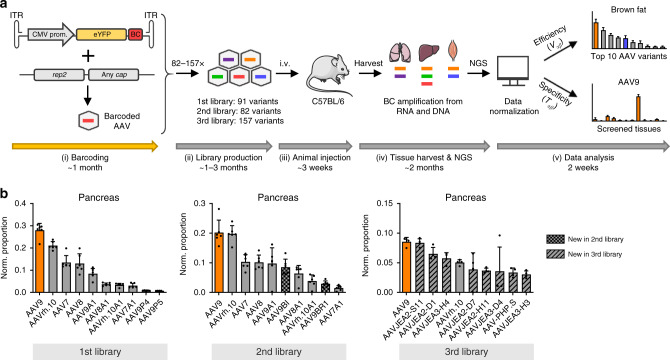
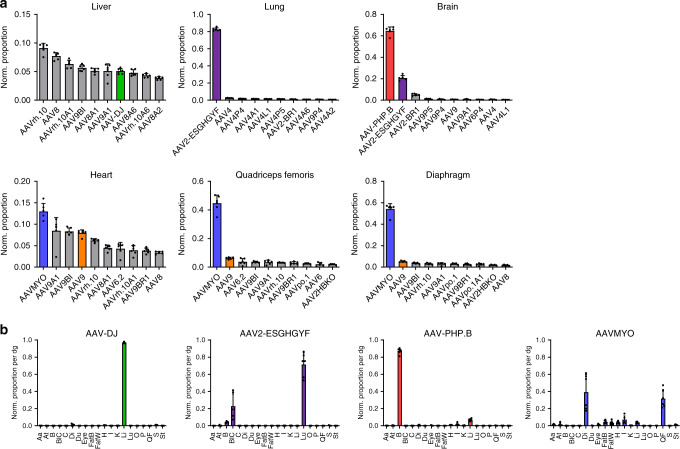
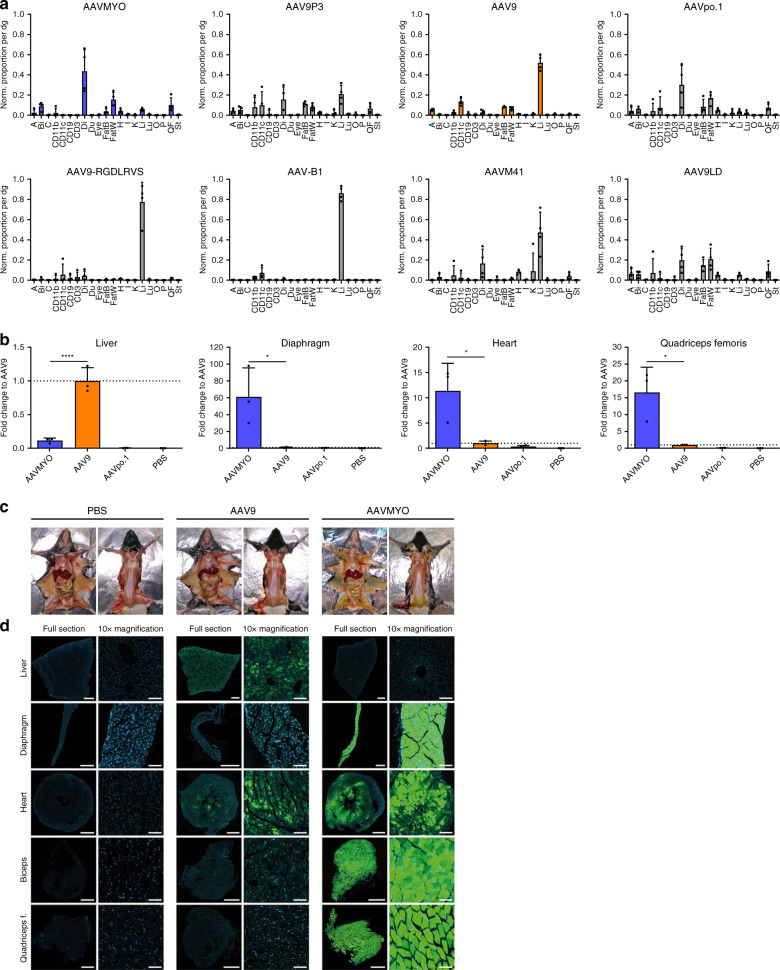
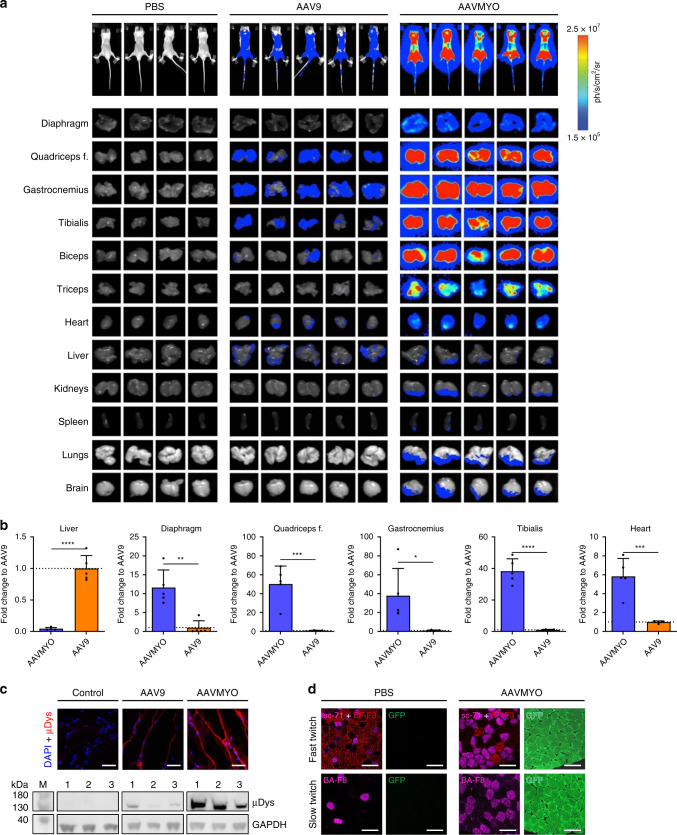
Adeno-associated virus (AAV) forms the basis for several commercial gene therapy products and for countless gene transfer vectors derived from natural or synthetic viral isolates that are under intense preclinical evaluation. Here, we report a versatile pipeline that enables the direct side-by-side comparison of pre-selected AAV capsids in high-throughput and in the same animal, by combining DNA/RNA barcoding with multiplexed next-generation sequencing. For validation, we create three independent libraries comprising 183 different AAV variants including widely used benchmarks and screened them in all major tissues in adult mice. Thereby, we discover a peptide-displaying AAV9 mutant called AAVMYO that exhibits superior efficiency and specificity in the musculature including skeletal muscle, heart and diaphragm following peripheral delivery, and that holds great potential for muscle gene therapy. Our comprehensive methodology is compatible with any capsids, targets and species, and will thus facilitate and accelerate the stratification of optimal AAV vectors for human gene therapy.
Overview
The claims and statistics of this paper haven’t been checked yet.
Free: it reads the open-access text and checks the first 5 claims that cite a source we can check. Create a free account to check every claim.
Integrity signals
Registry
Cites
Statistics
Figures
Verification
Claims the paper makes
The claims and statistics of this paper haven’t been checked yet.
Free: it reads the open-access text and checks the first 5 claims that cite a source we can check. Create a free account to check every claim.
Claims other papers make about this one
Each is checked against this paper’s own text: does it say what the citing paper says it does?
In the citing paper
“AAVMYO was also 9-fold detargeted from liver than AAV9 after intravenous administration in mice.”
From A versatile toolkit for overcoming AAV immunity (2022) · cites this paper as [115]
In the citing paper
“AAVMYO, a novel capsid with improved muscle tropism, was generated through random peptide display (115).”
From A versatile toolkit for overcoming AAV immunity (2022) · cites this paper as [115]
Self-check
Percentages, sums and reported differences re-computed from the paper’s own numbers.
The self-check needs the paper’s full text.
Citations
Cites
Error Detecting and Error Correcting Codes
Hamming, R. W. (1950) · Bell System Technical Journal · doi:10.1002/j.1538-7305.1950.tb00463.x · Cited by 5,377
ERROR DETECTING AND ERROR CORRECTING CODES
Chauhan, N., Yadav, P., & Kumari, P. (2014) · Cited by 3,270
RGD AND OTHER RECOGNITION SEQUENCES FOR INTEGRINS
Ruoslahti, E. (1996) · Annual Review of Cell and Developmental Biology · doi:10.1146/annurev.cellbio.12.1.697 · Cited by 3,191
Analysis of AAV Serotypes 1–9 Mediated Gene Expression and Tropism in Mice After Systemic Injection
Zincarelli, C., Soltys, S., Rengo, G., & Rabinowitz, J. E. (2008) · Molecular Therapy · doi:10.1038/mt.2008.76 · Cited by 1,490
Cre-dependent selection yields AAV variants for widespread gene transfer to the adult brain
Deverman, B. E., Pravdo, P. L., Simpson, B. P., Kumar, S. R., Chan, K. Y., Banerjee, A., Wu, W.-L., Yang, B., Huber, N., Pasca, S. P., et al. (2016) · Nature Biotechnology · doi:10.1038/nbt.3440 · Cited by 1,061
Dalkara, D., Byrne, L. C., Klimczak, R. R., Visel, M., Yin, L., Merigan, W. H., Flannery, J. G., & Schaffer, D. V. (2013) · Science Translational Medicine · doi:10.1126/scitranslmed.3005708 · Cited by 734
Grimm, D., Lee, J. S., Wang, L., Desai, T., Akache, B., Storm, T. A., & Kay, M. A. (2008) · Journal of Virology · doi:10.1128/jvi.00254-08 · Cited by 696
Self-citationSelection and evaluation of clinically relevant AAV variants in a xenograft liver model
Lisowski, L., Dane, A. P., Chu, K., Zhang, Y., Cunningham, S. C., Wilson, E. M., Nygaard, S., Grompe, M., Alexander, I. E., & Kay, M. A. (2014) · Nature · doi:10.1038/nature12875 · Cited by 450
Opie, S. R., Warrington, Agbandje-McKenna, M., Zolotukhin, S., & Muzyczka, N. (2003) · Journal of Virology · doi:10.1128/jvi.77.12.6995-7006.2003 · Cited by 364
Leborgne, C., Barbon, E., Alexander, J. M., Hanby, H., Delignat, S., Cohen, D. M., Collaud, F., Muraleetharan, S., Lupo, D., Silverberg, J., et al. (2020) · Nature Medicine · doi:10.1038/s41591-020-0911-7 · Cited by 336
In Silico Reconstruction of the Viral Evolutionary Lineage Yields a Potent Gene Therapy Vector
Zinn, E., Pacouret, S., Khaychuk, V., Turunen, H. T., Carvalho, L. S., Andres-Mateos, E., Shah, S., Shelke, R., Maurer, A. C., Plovie, E., et al. (2015) · Cell Reports · doi:10.1016/j.celrep.2015.07.019 · Cited by 310
Gene Therapy With Adeno-Associated Virus Vector 5-Human Factor IX in Adults With Hemophilia B
Miesbach, W., Meijer, K., Coppens, M., Kampmann, P., Klamroth, R., Schutgens, R., Tangelder, M., Castaman, G., Schwäble, J., Bonig, H., et al. (2018) · Blood · doi:10.1182/blood-2017-09-804419 · Cited by 301
Körbelin, J., Dogbevia, G., Michelfelder, S., Ridder, D. A., Hunger, A., Wenzel, J., Seismann, H., Lampe, M., Bannach, J., Pasparakis, M., et al. (2016) · EMBO Molecular Medicine · doi:10.15252/emmm.201506078 · Cited by 252
The GPI-Linked Protein LY6A Drives AAV-PHP.B Transport across the Blood-Brain Barrier
Hordeaux, J., Yuan, Y., Clark, P. M., Wang, Q., Martino, R. A., Sims, J. J., Bell, P., Raymond, A., Stanford, W. L., & Wilson, J. M. (2019) · Molecular Therapy · doi:10.1016/j.ymthe.2019.02.013 · Cited by 217
A myocardium tropic adeno-associated virus (AAV) evolved by DNA shuffling and in vivo selection
Yang, L., Jiang, J., Drouin, L. M., Agbandje-Mckenna, M., Chen, C., Qiao, C., Pu, D., Hu, X., Wang, D.-Z., Li, J., et al. (2009) · Proceedings of the National Academy of Sciences · doi:10.1073/pnas.0813207106 · Cited by 210
Preclinical in vivo evaluation of pseudotyped adeno-associated virus vectors for liver gene therapy
Grimm, D., Zhou, S., Nakai, H., Thomas, C. E., Storm, T. A., Fuess, S., Matsushita, T., Allen, J., Surosky, R., Lochrie, M., et al. (2003) · Blood · doi:10.1182/blood-2003-02-0495 · Cited by 208
Self-citationLimberis, M. P., Vandenberghe, L. H., Zhang, L., Pickles, R. J., & Wilson, J. M. (2009) · Molecular Therapy · doi:10.1038/mt.2008.261 · Cited by 184
Yue, Y., Ghosh, A., Long, C., Bostick, B., Smith, B. F., Kornegay, J. N., & Duan, D. (2008) · Molecular Therapy · doi:10.1038/mt.2008.207 · Cited by 173
Paulk, N. K., Pekrun, K., Zhu, E., Nygaard, S., Li, B., Xu, J., Chu, K., Leborgne, C., Dane, A. P., Haft, A., et al. (2018) · Molecular Therapy · doi:10.1016/j.ymthe.2017.09.021 · Cited by 161
Varadi, K., Michelfelder, S., Korff, T., Hecker, M., Trepel, M., Katus, H. A., Kleinschmidt, J. A., & Müller, O. J. (2011) · Gene Therapy · doi:10.1038/gt.2011.143 · Cited by 155
Self-citationAdachi, K., Enoki, T., Kawano, Y., Veraz, M., & Nakai, H. (2014) · Nature Communications · doi:10.1038/ncomms4075 · Cited by 147
Phase I open label liver-directed gene therapy clinical trial for acute intermittent porphyria
D’Avola, D., López-Franco, E., Sangro, B., Pañeda, A., Grossios, N., Gil-Farina, I., Benito, A., Twisk, J., Paz, M., Ruiz, J., et al. (2016) · Journal of Hepatology · doi:10.1016/j.jhep.2016.05.012 · Cited by 143
Davidsson, M., Wang, G., Aldrin-Kirk, P., Cardoso, T., Nolbrant, S., Hartnor, M., Mudannayake, J., Parmar, M., & Björklund, T. (2019) · Proceedings of the National Academy of Sciences · doi:10.1073/pnas.1910061116 · Cited by 142
Morandi, E. M., Verstappen, R., Zwierzina, M., Geley, S., Pierer, G., & Ploner, C. (2016) · Scientific Reports · doi:10.1038/srep28889 · Cited by 138
In Vivo Selection Yields AAV-B1 Capsid for Central Nervous System and Muscle Gene Therapy
Choudhury, S. R., Fitzpatrick, Z., Harris, A. F., Maitland, S. A., Ferreira, J. S., Zhang, Y., Ma, S., Sharma, R. B., Gray-Edwards, H. L., Johnson, J. A., et al. (2016) · Molecular Therapy · doi:10.1038/mt.2016.84 · Cited by 113
Earley, L. F., Powers, J. M., Adachi, K., Baumgart, J. T., Meyer, N. L., Xie, Q., Chapman, M. S., & Nakai, H. (2017) · Journal of Virology · doi:10.1128/jvi.01980-16 · Cited by 108
Grimm, D., & Zolotukhin, S. (2015) · Molecular Therapy · doi:10.1038/mt.2015.173 · Cited by 106
Self-citationWesthaus, A., Cabanes-Creus, M., Rybicki, A., Baltazar, G., Navarro, R. G., Zhu, E., Drouyer, M., Knight, M., Albu, R. F., Ng, B. H., et al. (2020) · Human Gene Therapy · doi:10.1089/hum.2019.264 · Cited by 102
A muscle-targeting peptide displayed on AAV2 improves muscle tropism on systemic delivery
Yu, C.-Y., Yuan, Z., Cao, Z., Wang, B., Qiao, C., Li, J., & Xiao, X. (2009) · Gene Therapy · doi:10.1038/gt.2009.59 · Cited by 88
Körbelin, J., Sieber, T., Michelfelder, S., Lunding, L., Spies, E., Hunger, A., Alawi, M., Rapti, K., Indenbirken, D., Müller, O. J., et al. (2016) · Molecular Therapy · doi:10.1038/mt.2016.62 · Cited by 87
Self-citationMichelfelder, S., Kohlschütter, J., Skorupa, A., Pfennings, S., Müller, O., Kleinschmidt, J. A., & Trepel, M. (2009) · PLoS ONE · doi:10.1371/journal.pone.0005122 · Cited by 75
Self-citationPre-arrayed Pan-AAV Peptide Display Libraries for Rapid Single-Round Screening
Börner, K., Kienle, E., Huang, L.-Y., Weinmann, J., Sacher, A., Bayer, P., Stüllein, C., Fakhiri, J., Zimmermann, L., Westhaus, A., et al. (2020) · Molecular Therapy · doi:10.1016/j.ymthe.2020.02.009 · Cited by 70
Self-citationLi, M., Jayandharan, G. R., Li, B., Ling, C., Ma, W., Srivastava, A., & Zhong, L. (2010) · Human Gene Therapy · doi:10.1089/hum.2010.005 · Cited by 67
Next-generation muscle-directed gene therapy by in silico vector design
Sarcar, S., Tulalamba, W., Rincón, M. Y., Tipanee, J., Pham, H. Q., Evens, H., Boon, D., Samara-Kuko, E., Keyaerts, M., Loperfido, M., et al. (2019) · Nature Communications · doi:10.1038/s41467-018-08283-7 · Cited by 62
Self-citationBörner, K., Niopek, D., Cotugno, G., Kaldenbach, M., Pankert, T., Willemsen, J., Zhang, X., Schürmann, N., Mockenhaupt, S., Serva, A., et al. (2013) · Nucleic Acids Research · doi:10.1093/nar/gkt836 · Cited by 61
Self-citationGene Delivery for Limb-Girdle Muscular Dystrophy Type 2D by Isolated Limb Infusion
Mendell, J. R., Chicoine, L. G., Al-Zaidy, S. A., Sahenk, Z., Lehman, K. J., Lowes, L. P., Miller, N. F., Alfano, L. N., Galliers, B., Lewis, S., et al. (2019) · Human Gene Therapy · doi:10.1089/hum.2019.006 · Cited by 54
Schinkel, S., Bauer, R., Bekeredjian, R., Stucka, R., Rutschow, D., Lochmüller, H., Kleinschmidt, J. A., Katus, H. A., & Müller, O. J. (2012) · Human Gene Therapy · doi:10.1089/hum.2011.017 · Cited by 45
Self-citationA Robust and All-Inclusive Pipeline for Shuffling of Adeno-Associated Viruses
Herrmann, A.-K., Bender, C., Kienle, E., Große, S., Andari, J. E., Botta, J., Schürmann, N., Wiedtke, E., Niopek, D., & Grimm, D. (2018) · ACS Synthetic Biology · doi:10.1021/acssynbio.8b00373 · Cited by 40
Self-citationMarsic, D., Méndez‐Gómez, H. R., & Zolotukhin, S. (2015) · Molecular Therapy — Methods & Clinical Development · doi:10.1038/mtm.2015.41 · Cited by 33
Davidsson, M., Díaz-Fernández, P., Schwich, O. D., Torroba, M., Wang, G., & Björklund, T. (2016) · Scientific Reports · doi:10.1038/srep37563 · Cited by 29
Tracking Adeno-Associated Virus Capsid Evolution by High-Throughput Sequencing
de Alencastro, G., Pekrun, K., Valdmanis, P., Tiffany, M., Xu, J., & Kay, M. A. (2020) · Human Gene Therapy · doi:10.1089/hum.2019.339 · Cited by 21
The heart in Duchenne muscular dystrophy: early detection of contractile performance alteration
Wagner, S., Knipp, S. C., Weber, C., Hein, S. J., Schinkel, S., Walther, A., Bekeredjian, R., Müller, O. J., & Friedrich, O. (2012) · Journal of Cellular and Molecular Medicine · doi:10.1111/j.1582-4934.2012.01630.x · Cited by 17
Self-citationSimultaneous Visualization of Myosin Heavy Chain Isoforms in Single Muscle Sections
Ribarič, S., & Čebašek, V. (2013) · Cells Tissues Organs · doi:10.1159/000345424 · Cited by 11
Xu, M., Li, J., Xie, J., He, R., Su, Q., Gao, G., & Tai, P. W. L. (2019) · Human Gene Therapy · doi:10.1089/hum.2018.253 · Cited by 11
Cited by
Tabebordbar, M., Lagerborg, K. A., Stanton, A., King, E. M., Ye, S., Tellez, L., Krunnfusz, A., Tavakoli, S., Widrick, J. J., Messemer, K. A., et al. (2021) · Cell · doi:10.1016/j.cell.2021.08.028 · Cited by 506
“While this paper was under peer review, Weinmann et al. (2020) reported identification of a muscle-tropic capsid variant containing an RGD motif in mice.”
BackgroundAAV vectors: The Rubik’s cube of human gene therapy
Pupo, A., Fernández, A., Low, S. H., François, A., Suárez-Amarán, L., & Samulski, R. J. (2022) · Molecular Therapy · doi:10.1016/j.ymthe.2022.09.015 · Cited by 360
Base editing correction of hypertrophic cardiomyopathy in human cardiomyocytes and humanized mice
Chai, A. C., Cui, M., Chemello, F., Li, H., Chen, K., Tan, W., Atmanli, A., McAnally, J. R., Zhang, Y., Xu, L., et al. (2023) · Nature Medicine · doi:10.1038/s41591-022-02176-5 · Cited by 184
Adeno-Associated Virus Toolkit to Target Diverse Brain Cells
Challis, R. C., Ravindra Kumar, S., Chen, X., Goertsen, D., Coughlin, G. M., Hori, A. M., Chuapoco, M. R., Otis, T. S., Miles, T. F., & Gradinaru, V. (2022) · Annual Review of Neuroscience · doi:10.1146/annurev-neuro-111020-100834 · Cited by 148
CRISPR Modeling and Correction of Cardiovascular Disease
Liu, N., & Olson, E. N. (2022) · Circulation Research · doi:10.1161/circresaha.122.320496 · Cited by 117
Metadata
- Authors
- Weinmann, J., Weis, S., Sippel, J., Tulalamba, W., Remes, A., El Andari, J., Herrmann, A.-K., Pham, Q. H., Borowski, C., Hille, S., Schönberger, T., Frey, N., Lenter, M., VandenDriessche, T., Müller, O. J., Chuah, M. K., Lamla, T., & Grimm, D.
- Affiliations
- Heidelberg University (DE)
- Vrije Universiteit Brussel (BE)
- University Hospital Schleswig-Holstein (DE)
- Boehringer Ingelheim (Germany) (DE)
- Corresponding author
- Grimm, Dirk
- ORCID
- Venue
- Nature Communications
- Published
- 2020-10-28
- Volume
- 11
- Issue
- 1
- Pages
- 5432-5432
- ISSN
- 2041-1723 (ISSN-L)
- PMC
- PMC7595228
- OpenAlex
- W3097033736
- Cited by
- 259
- References
- 44
- Citations by year
- 2026: 44 · 2025: 65 · 2024: 54 · 2023: 50 · 2022: 34 · 2021: 12
- FWCI
- 14.07
- Type
- journal article
- Language
- en
- Open access
- gold
- doi.org
- Licence
- cc-by
- creativecommons.org/licenses/by/4.0 (tdm)
- creativecommons.org/licenses/by/4.0 (vor)
- Locations
- Nature Communications (publishedVersion, cc-by)
- PubMed Central (publishedVersion, cc-by)
- PubMed (publishedVersion)
- Lirias (KU Leuven) (submittedVersion, other-oa)
- RePEc: Research Papers in Economics (submittedVersion)
- DOAJ (DOAJ: Directory of Open Access Journals) (submittedVersion, cc-by-sa)
- VUBIR (Vrije Universiteit Brussel) (submittedVersion)
- Funders
- Association Belge contre les Maladies Neuro-Musculaires
- Deutsches Zentrum für Infektionsforschung (TRR179, 04.815, 272983813, TTU.HIV 04.815, TTU-HIV 04.803)
- European Commission (667751, HORIZON2020)
- Deutsche Forschungsgemeinschaft (EXC 81, 240245660, SFB1129, 272983813, TRR179)
- Bundesministerium für Bildung und Forschung (04.803, TTU-HIV 04.815, TTU HIV 04 803)
- Fonds Wetenschappelijk Onderzoek
- Universitätsklinikum Heidelberg
- Heidelberg Biosciences International Graduate School
- Topics
- Life Sciences › Biochemistry, Genetics and Molecular Biology › Genetics › Virus-based gene therapy research
- Life Sciences › Biochemistry, Genetics and Molecular Biology › Molecular Biology › RNA Interference and Gene Delivery
- Health Sciences › Medicine › Genetics (clinical) › Neurogenetic and Muscular Disorders Research
- Keywords
- adeno-associated virus, DNA barcoding, skeletal muscle, heart, diaphragm, gene therapy vectors
- MeSH terms
- Dependovirus, Animals, Capsid, Female, Genetic Vectors, Humans, Mice, Inbred C57BL, Muscles, Mutation, Organ Specificity, Genetic Variation, Genetic Therapy, Gene Library, Capsid Proteins, Mice, DNA Barcoding, Taxonomic, High-Throughput Nucleotide Sequencing
About these checks
Registry, retraction, Cites and statistics results are computed, not judged, with one exception: a printed reference that no index lists is read once by a model before it counts as a citation error. Claims are extracted by a model and kept only when their quote appears verbatim in the text; each cited source is then checked, with a model’s help, for whether it says what the claim relies on. Those verdicts can be wrong — read the claim’s quote and the cited source before relying on one.
Statistics and arithmetic are recomputed, not judged.
Confidence bands are shown only for fields calibrated on our annotated test set. None is calibrated yet, so no band is shown.
What counts as a claim ›How we measure confidence ›How we check this ›
Are you an author, or do you see a problem with this page? Request a review
Data sources
Bibliographic data: Semantic Scholar, OpenAlex, Crossref.
Contains information from the Semantic Scholar Academic Graph Datasets, made available under the ODC Attribution License (ODC-BY 1.0).
Semantic Scholar’s data is described in: Kinney, R., et al. (2023). The Semantic Scholar Open Data Platform. arXiv:2301.10140.
