

Bifurcation in brain dynamics reveals a signature of conscious processing independent of report
Open accessThe DOI matches its Crossref record; 87 of the 89 references it cites were found in a registry or an index.
Abstract
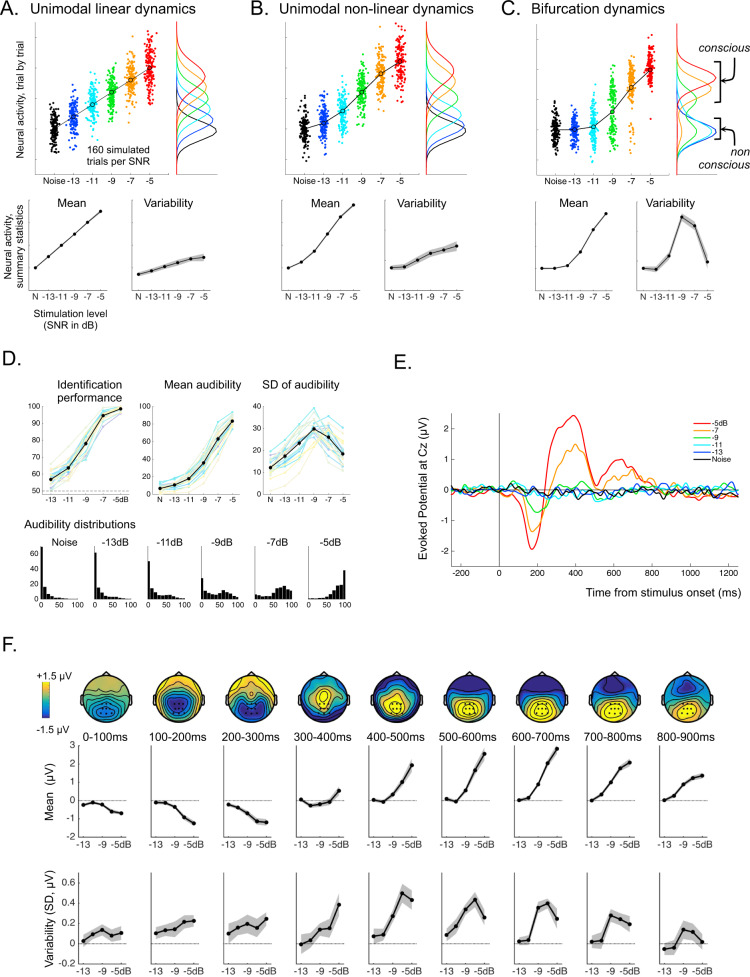
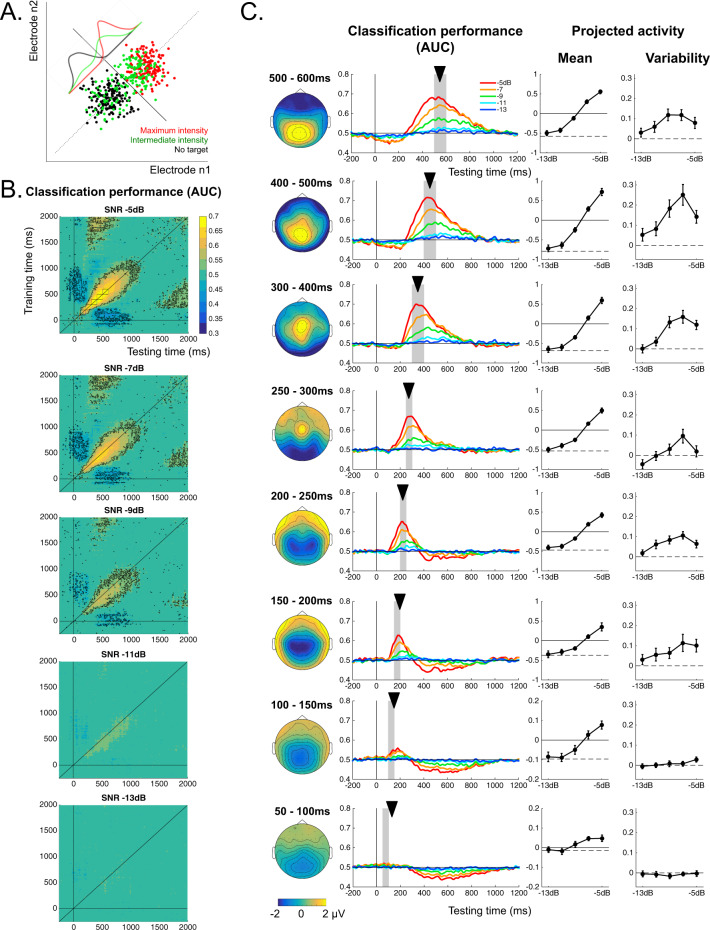
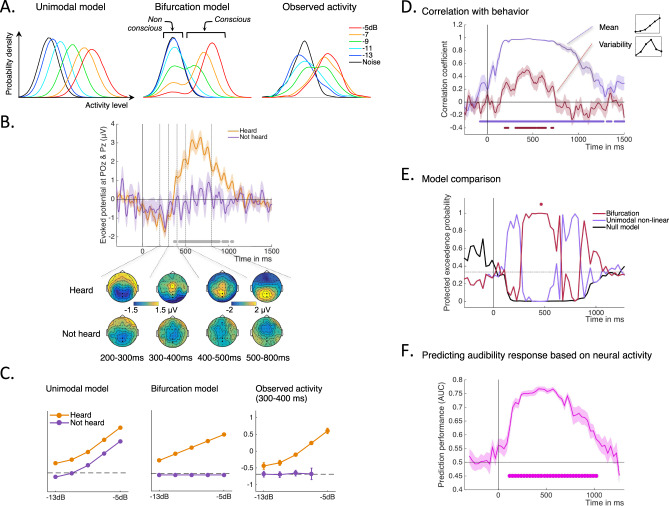
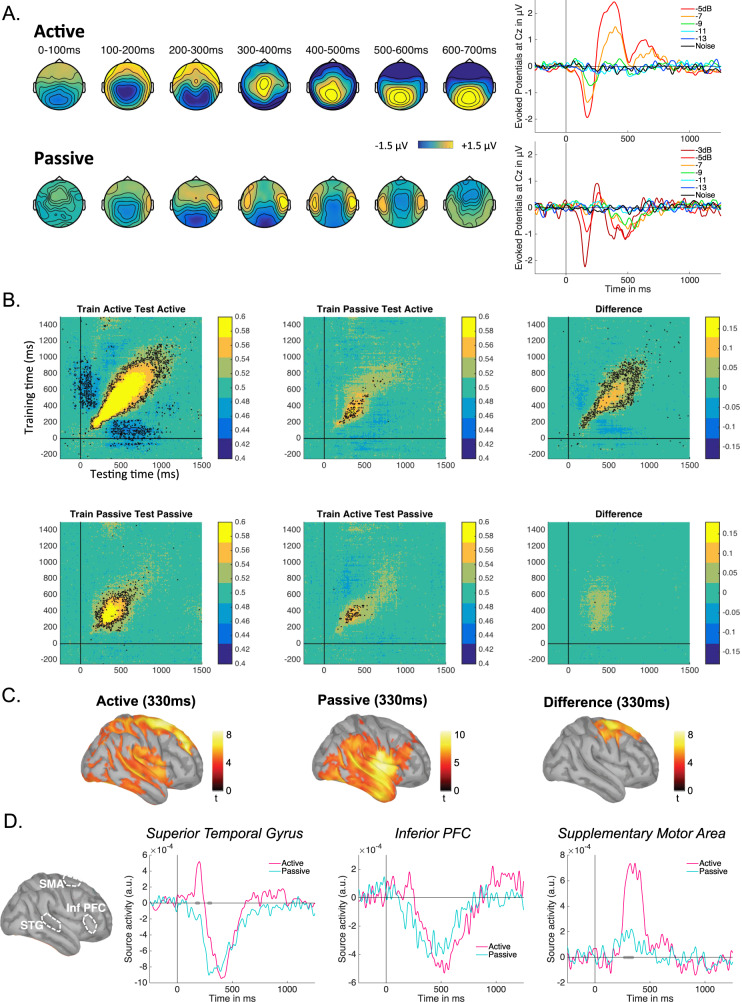
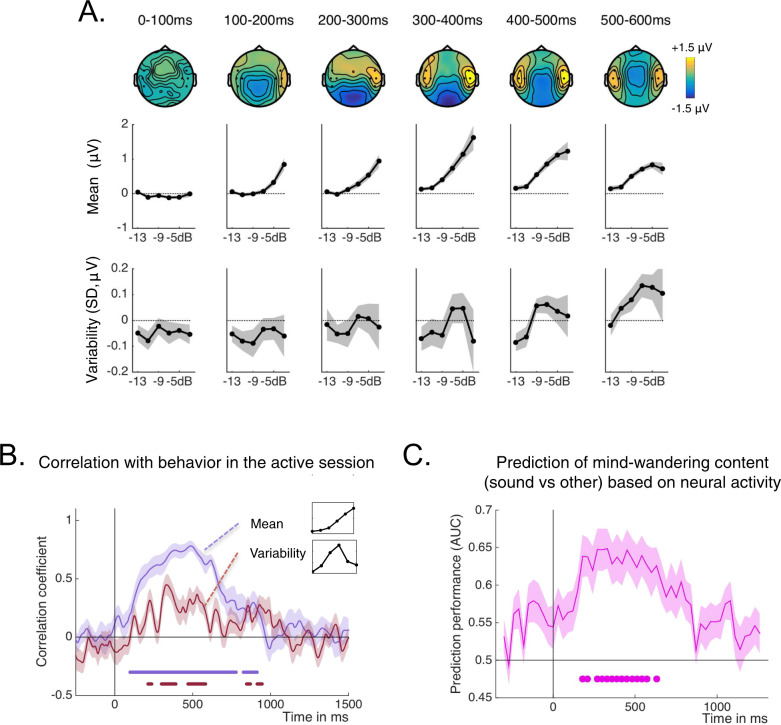
An outstanding challenge for consciousness research is to characterize the neural signature of conscious access independently of any decisional processes. Here we present a model-based approach that uses inter-trial variability to identify the brain dynamics associated with stimulus processing. We demonstrate that, even in the absence of any task or behavior, the electroencephalographic response to auditory stimuli shows bifurcation dynamics around 250–300 milliseconds post-stimulus. Namely, the same stimulus gives rise to late sustained activity on some trials, and not on others. This late neural activity is predictive of task-related reports, and also of reports of conscious contents that are randomly sampled during task-free listening. Source localization further suggests that task-free conscious access recruits the same neural networks as those associated with explicit report, except for frontal executive components. Studying brain dynamics through variability could thus play a key role for identifying the core signatures of conscious access, independent of report.
Overview
The claims and statistics of this paper haven’t been checked yet.
Free: it reads the open-access text and checks the first 5 claims that cite a source we can check. Create a free account to check every claim.
Integrity signals
Registry
Cites
Statistics
Figures
Verification
Claims the paper makes
The claims and statistics of this paper haven’t been checked yet.
Free: it reads the open-access text and checks the first 5 claims that cite a source we can check. Create a free account to check every claim.
Claims other papers make about this one
Each is checked against this paper’s own text: does it say what the citing paper says it does?
The cited source doesn’t support the claim as written.
In the citing paper
“Human intracerebral (stereo-EEG) recordings led to the identification of tonic activity patterns, 41 i.e., prolonged low-amplitude gamma-band responses to sensory stimulation, likely corresponding to the intracranial correlate of previously reported late EEG components reflecting perceptual awareness.42,43”
From An integrative, multiscale view on neural theories of consciousness (2024) · cites this paper as [42]
Checked by a reasoning model — may be wrong.
Experimental — accuracy not yet measuredThe cited source says what the claim attributes to it.
In the citing paper
“Interestingly, empirical evidence for early versus late signatures is currently hotly debated (compare, for example, Dembski et al. 2021; Sergent et al. 2021).”
From An academic survey on theoretical foundations, common assumptions and the current state of consciousness science (2022) · cites this paper as Sergent et al. 2021
Self-check
Percentages, sums and reported differences re-computed from the paper’s own numbers.
The self-check needs the paper’s full text.
Citations
Cites
Controlling the False Discovery Rate: A Practical and Powerful Approach to Multiple Testing
Benjamini, Y., & Hochberg, Y. (1995) · Journal of the Royal Statistical Society Series B: Statistical Methodology · doi:10.1111/j.2517-6161.1995.tb02031.x · Cited by 109,482
A Simplex Method for Function Minimization
Nelder, J. A., & Mead, R. (1965) · The Computer Journal · doi:10.1093/comjnl/7.4.308 · Cited by 28,905
Gelman, A., Carlin, J. B., Stern, H. S., & Rubin, D. B. (2003) · doi:10.1201/9780429258480 · Cited by 27,276
Brainard, D. H. (1997) · Spatial Vision · doi:10.1163/156856897x00357 · Cited by 19,702
The VideoToolbox software for visual psychophysics: transforming numbers into movies
Pelli, D. G. (1997) · Spatial Vision · doi:10.1163/156856897x00366 · Cited by 11,098
The control of the false discovery rate in multiple testing under dependency
Benjamini, Y., & Yekutieli, D. (2001) · The Annals of Statistics · doi:10.1214/aos/1013699998 · Cited by 10,490
Oostenveld, R., Fries, P., Maris, E., & Schoffelen, J.-M. (2011) · Computational Intelligence and Neuroscience · doi:10.1155/2011/156869 · Cited by 10,323
(1966) · Medical Entomology and Zoology · Cited by 10,293
Convergence Properties of the Nelder--Mead Simplex Method in Low Dimensions
Lagarias, J. C., Reeds, J. A., Wright, M. H., & Wright, P. E. (1998) · SIAM Journal on Optimization · doi:10.1137/s1052623496303470 · Cited by 7,447
Kleiner, M., Brainard, D. H., & Pelli, D. G. (2007) · MPG.PuRe (Max Planck Society) · Cited by 6,195
Research works printed but not linked: 1
- Luck, S. J. An Introduction to the event-related Potential Technique. Second Edition, pp. x, 406 (The MIT Press, 2014).
Cited by
Items 201–227 of 227
Nouveaux modèles d’exploration de la conscience et applications thérapeutiques
Musat, E. M. (2023) · theses.fr (ABES) · doi:10.70675/dcd52cbfz09d3z4292z9f12zce26457d5230
Temporal and Spectral Neural Complexity Reveal Graded Auditory AwarenessPreprint
Liardi, A., Bor, D., Rosas, F. E., & Mediano, P. A. M. (2026) · bioRxiv (Cold Spring Harbor Laboratory) · doi:10.64898/2026.04.20.719685
“We analysed EEG data originally reported by Sergent et al. [52].”
InfluentialDecision-making through irruption theory: how to use and interpret the Haken-Kelso-Bunz model
Cañizares, J. S. (2026) · Phenomenology and the Cognitive Sciences · doi:10.1007/s11097-026-10164-0
Northoff, G., Çatal, Y., & Abbasi, S. (2026) · Philosophical Transactions of the Royal Society A Mathematical Physical and Engineering Sciences · doi:10.1098/rsta.2025.0005
Kuske, N., & VanRullen, R. (2026) · Synthese Library/Synthese library · doi:10.1007/978-3-032-10073-3_19
He, L., Zhang, Z., Wang, Y., Meng, Q., Jiang, Y., Xu, W., Wu, J., Sheng, J., Ye, Z., & Ding, X. (2026) · Consciousness and Cognition · doi:10.1016/j.concog.2026.104075 · Cited by 1
Sergent, C., & de Vignemont, F. (2026) · doi:10.21428/e2759450.0aea8c7d
Self-citationA human intracranial map of consciousness returning from anesthesiaPreprint
Chen, X., Zhang, H., Deng, X., Ren, Y., Liu, Y., Wang, J., Xu, S., Ji, Y., Yang, Z., Jia, W., et al. (2026) · bioRxiv (Cold Spring Harbor Laboratory) · doi:10.64898/2026.06.17.732807
Looking ahead: Sensory horizons and the science of consciousness
Fleming, S. M., & Michel, M. (2026) · Behavioral and Brain Sciences · doi:10.1017/s0140525x26104543
Neural mechanisms and circuit foundations of conscious and unconscious dysfunction in schizophrenia
Zhang, J.-Z., Wang, T.-T., Zhang, J., Xin-yu, W. A. N. G., Liu, X.-H., Wang, J., & Zhou, Z.-H. (2026) · World Journal of Psychiatry · doi:10.5498/wjp.120999
Wang, L., Zhou, H. J., Fang, W., Fu, G., Zhang, Y., Min, B., & Dehaene, S. (2026) · Research Square · doi:10.21203/rs.3.rs-10130477/v1
Modulation of Somatosensory Evoked Potentials During Music and Pink Noise Exposure
Cebolla, A. M., Ruiz, P. F. A., Colot, M., Simar, C., Vitkova, V., Hove, O. V., Hashemi, S.-I., & Chéron, G. (2026) · Brain Sciences · doi:10.3390/brainsci16080802
“…indicates that these modulations do not extend to the earliest cortical stage indexed by the N20 component, but rather involve later processing stages, potentially reflecting top-down influences such as attentional allocation or changes in cortical excitability induced by the auditory context [41].”
Stockart, F., Robin, A., Blumenfeld, H., Brázdil, M., Kahane, P., Mudrik, L., Thum, J., Pereira, M., & Faivre, N. (2026) · eLife · doi:10.7554/elife.109604.4.sa4
Self-citationBonhomme, V., Alnagger, N., Cecconi, B., Montupil, J., Annen, J., Martial, C., Staquet, C., Thibaut, A., Vanhaudenhuyse, A., & Gosseries, O. (2026) · Elsevier eBooks · doi:10.1016/b978-0-443-29258-3.00072-0
Gnodde, S., Aslanov, V., Hogan, A., Francken, J. C., Olcese, U., & Stein, T. (2026) · Journal of Cognitive Neuroscience · doi:10.1162/jocn.a.2691
Huang, Y., Liu, M., & Ke, Y. (2026) · Journal of intelligent medicine. · doi:10.1002/jim4.70056
Bassler, M., & Pennartz, C. M. A. (2026) · Neuroscience of Consciousness · doi:10.1093/nc/niag069
Conscious Awareness Across the Visual Field
Cohen, M. A. (2026) · Annual Review of Vision Science · doi:10.1146/annurev-vision-111025-084618
Parra, A. L. (2026) · Frontiers in Integrative Neuroscience · doi:10.3389/fnint.2026.1841714
Grigoryan, G. A., & Balaban, P. M. (2026) · Biosystems · doi:10.1016/j.biosystems.2026.105967
Ellinghorst, A., Dellert, T., Zhu, Y., Straube, T., Dykstra, A. R., & Schloßmacher, I. (2026) · bioRxiv (Cold Spring Harbor Laboratory) · doi:10.64898/2026.10.05.755932
“…comparatively limited, existing work is consistent with visual findings: both early and late correlates of awareness are observed in event-related potentials (ERPs; Dykstra, Shaw, et al., 2017; Eklund et al., 2019a, 2020; Eklund & Wiens, 2019; Filimonov et al., 2022, 2024; Sergent et al., 2021).”
InfluentialThe Unconscious Self How the brain encodes bodily-self visual cues in the absence of awareness
Ciorli, T. (2025) · Institutional Research Information System University of Turin (University of Turin)
Beyond Cortical Signatures: Measurement Gaps Across Theories of Consciousness
Svet, M., & Arachchige, A. S. P. M. (2026) · Brain Sciences · doi:10.3390/brainsci16101087
“The programmatic statement [152] and the isolation of perceptual from report-related correlates [153] extend to a report-independent bifurcation signature [154], large-scale networks in a no-report visual paradigm [155] and audition [156].”
Hense, A., Peters, A., Dellert, T., Bruchmann, M., & Straube, T. (2026) · iScience · doi:10.1016/j.isci.2026.117853
“74,75 Alternatively, the late positivities may reflect global cognitive accessibility, analogous to Sergent et al.’s ‘‘‘global play-ground,’’ 66 in which information becomes available to higher-level cognitive processes without triggering full frontoparietal broadcasting.”
Sinmez, Ç. Ç., van den HOVEN, R., Karan, T., Onmaz, A. C., & Özek, K. İ. (2026) · Animals · doi:10.3390/ani16213376
From rest to task: temporal mechanisms of self-association
Northoff, G., Xinyu, S., Avramescu, A., & Sui, J. (2026) · Philosophical Transactions of the Royal Society B Biological Sciences · doi:10.1098/rstb.2025.0346 · Cited by 1
Metadata
- Authors
- Sergent, C., Corazzol, M., Labouret, G., Stockart, F., Wexler, M., King, J.-R., Meyniel, F., & Pressnitzer, D.
- Affiliations
- Centre National de la Recherche Scientifique (FR)
- Université Paris-Sud (FR)
- Corresponding author
- Sergent, Claire
- ORCID
- Venue
- Nature Communications
- Published
- 2021-02-19
- Volume
- 12
- Issue
- 1
- Pages
- 1149-1149
- ISSN
- 2041-1723 (ISSN-L)
- PMC
- PMC7895979
- OpenAlex
- W3131701397
- Semantic Scholar
- 6850d04a917110a956ef51b4f12ce433c071a4df
- Cited by
- 200
- References
- 89
- Citations by year
- 2026: 29 · 2025: 41 · 2024: 57 · 2023: 38 · 2022: 26 · 2021: 9
- FWCI
- 17.09
- Type
- journal article
- Language
- en
- Open access
- gold
- doi.org
- Licence
- cc-by
- creativecommons.org/licenses/by/4.0 (tdm)
- creativecommons.org/licenses/by/4.0 (vor)
- Locations
- Nature Communications (publishedVersion, cc-by)
- PubMed Central (publishedVersion, cc-by)
- PubMed (publishedVersion)
- HAL (submittedVersion, other-oa)
- RePEc: Research Papers in Economics (submittedVersion)
- DOAJ (DOAJ: Directory of Open Access Journals) (submittedVersion, cc-by-sa)
- Funders
- Agence Nationale de la Recherche (ANR-17-CE37-0004-01, ANR-17-EURE-0017, ANR-10-IDEX-0001-02)
- Topics
- Life Sciences › Neuroscience › Cognitive Neuroscience › Neural dynamics and brain function
- Social Sciences › Arts and Humanities › Philosophy › Philosophy and Theoretical Science
- Social Sciences › Arts and Humanities › Philosophy › Free Will and Agency
- Keywords
- conscious access, bifurcation dynamics, trial-to-trial variability, EEG, source localization, model-based analysis
- MeSH terms
- Cognitive Neuroscience, Acoustic Stimulation, Adolescent, Adult, Auditory Perception, Behavior, Brain, Consciousness, Electroencephalography, Female, Humans, Male, Visual Perception, Young Adult
About these checks
Registry, retraction, Cites and statistics results are computed, not judged, with one exception: a printed reference that no index lists is read once by a model before it counts as a citation error. Claims are extracted by a model and kept only when their quote appears verbatim in the text; each cited source is then checked, with a model’s help, for whether it says what the claim relies on. Those verdicts can be wrong — read the claim’s quote and the cited source before relying on one.
Statistics and arithmetic are recomputed, not judged.
Confidence bands are shown only for fields calibrated on our annotated test set. None is calibrated yet, so no band is shown.
What counts as a claim ›How we measure confidence ›How we check this ›
Are you an author, or do you see a problem with this page? Request a review
Data sources
Bibliographic data: Semantic Scholar, OpenAlex, Crossref.
Contains information from the Semantic Scholar Academic Graph Datasets, made available under the ODC Attribution License (ODC-BY 1.0).
Semantic Scholar’s data is described in: Kinney, R., et al. (2023). The Semantic Scholar Open Data Platform. arXiv:2301.10140.
