

Type I interferons affect the metabolic fitness of CD8+ T cells from patients with systemic lupus erythematosus
Open accessThe DOI matches its Crossref record; 64 of the 64 references it cites were found in a registry or an index.
Abstract
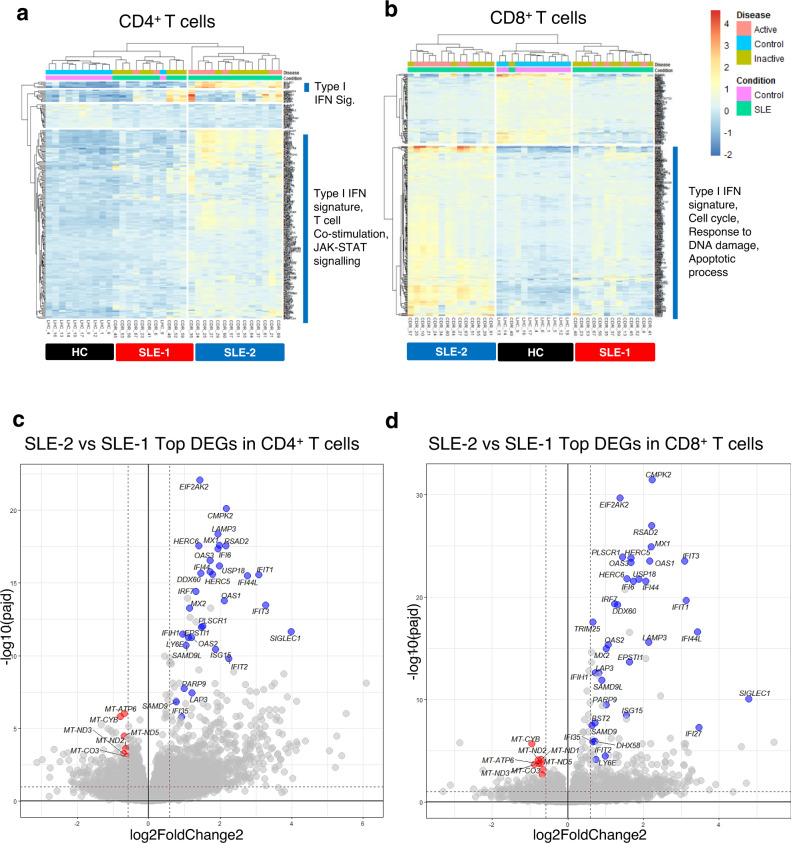
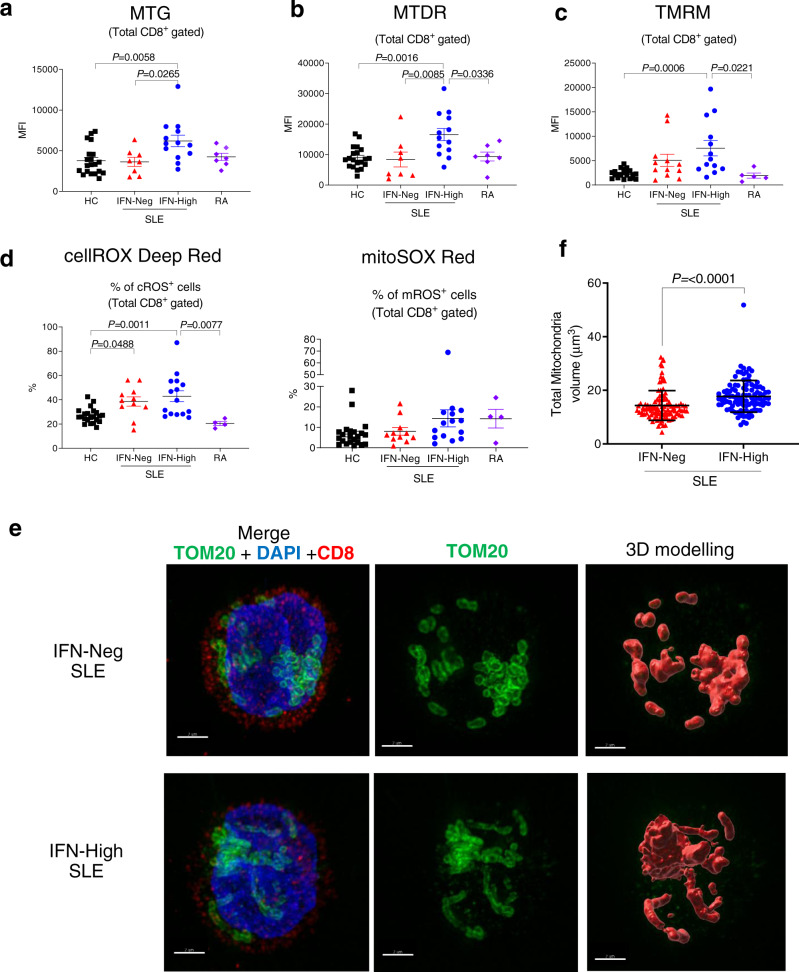
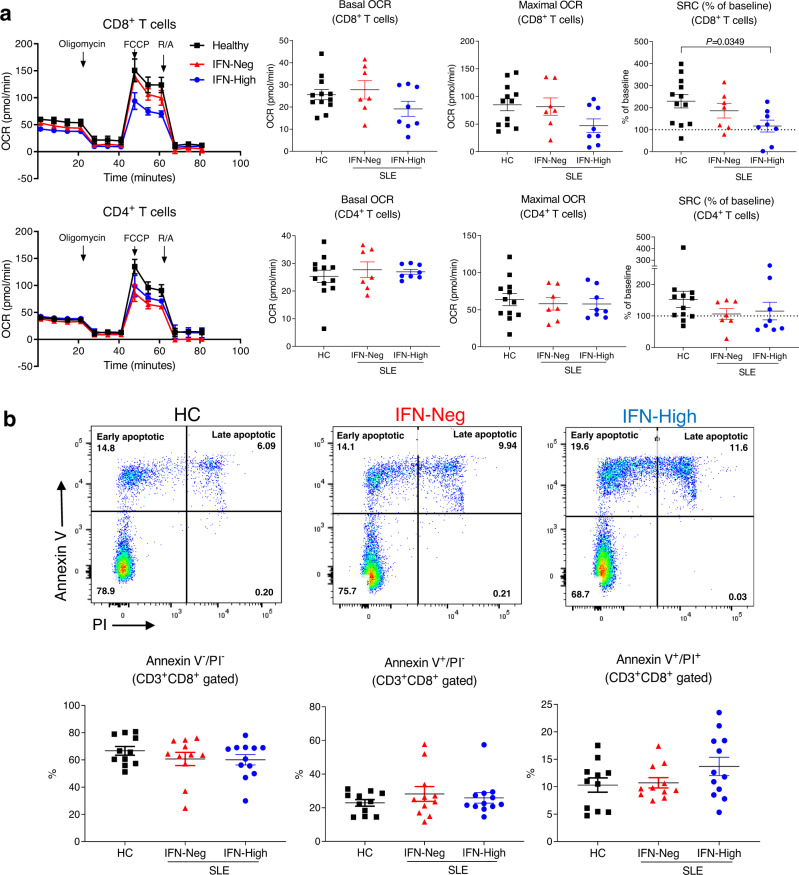
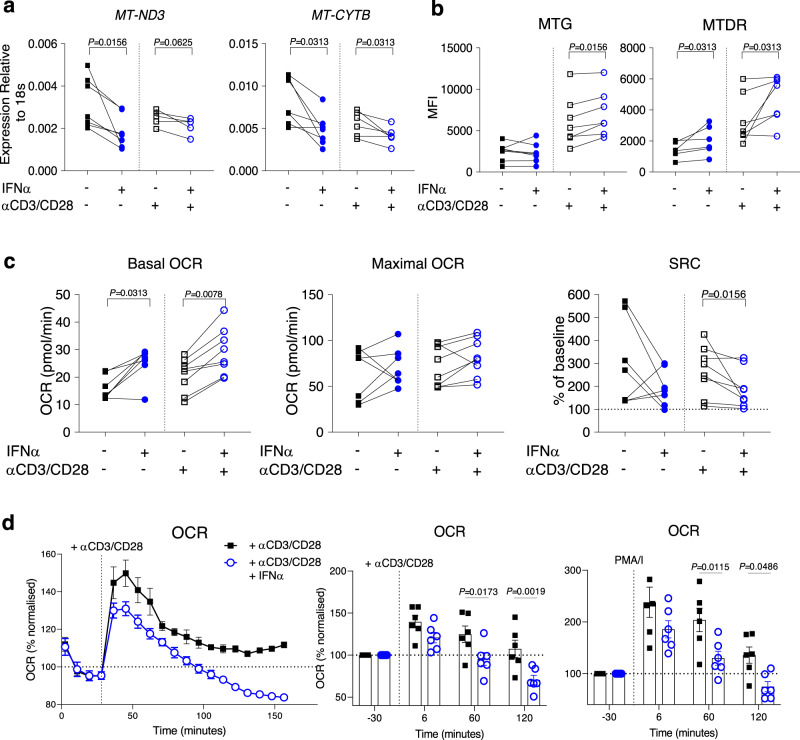
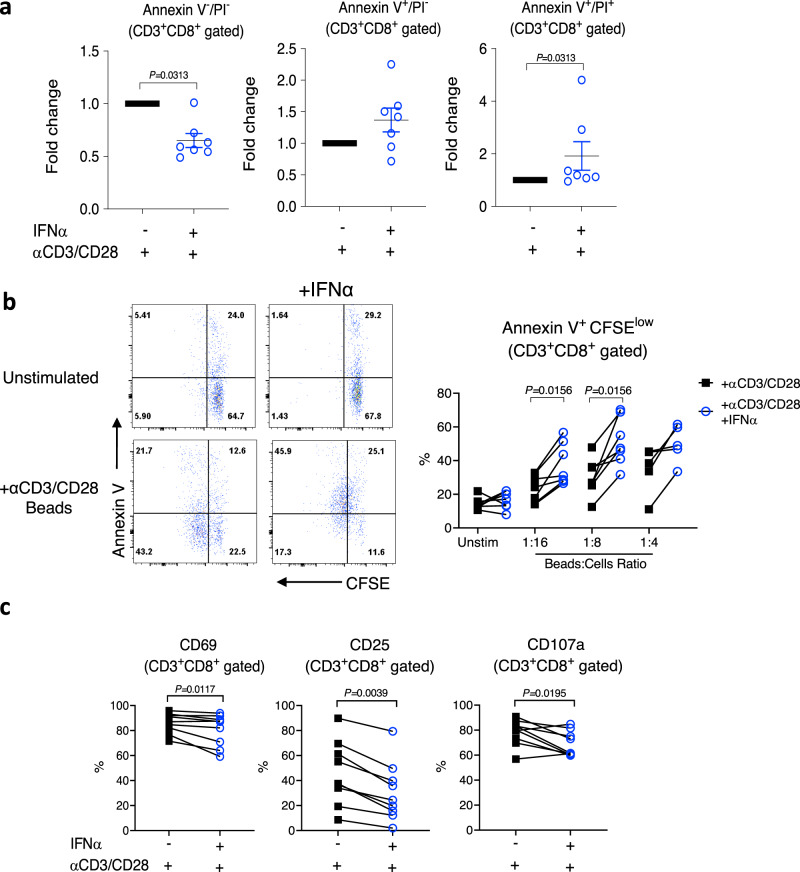
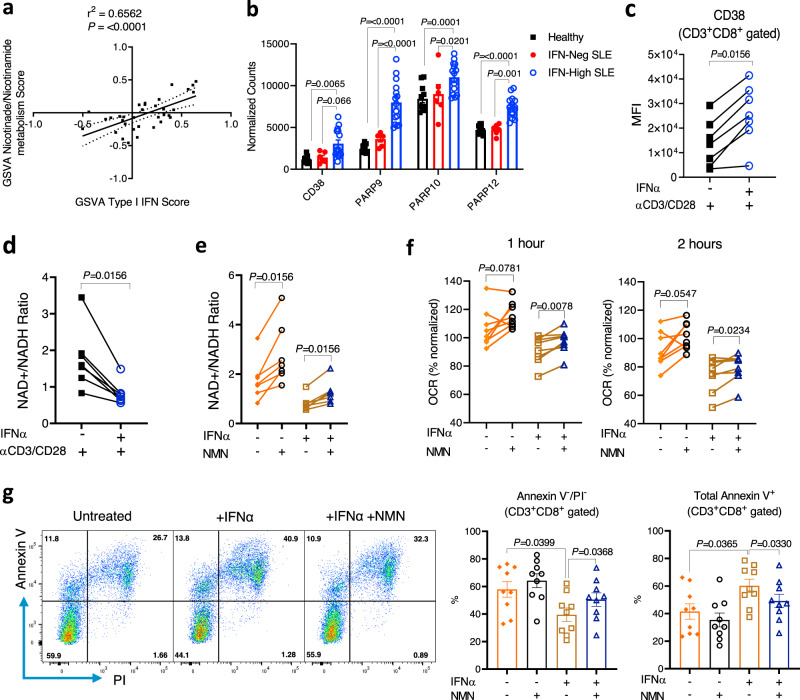
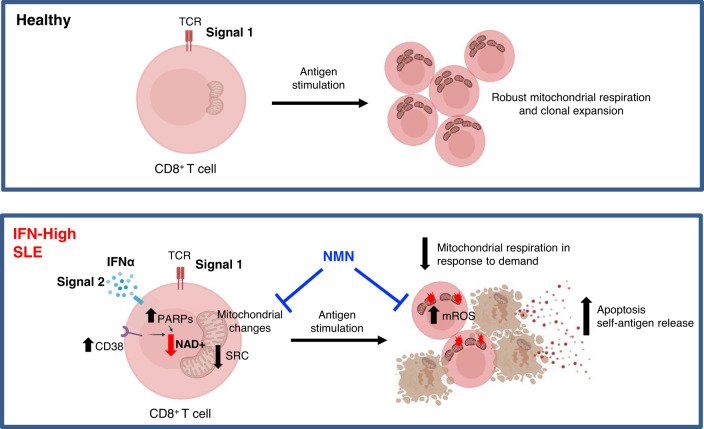
The majority of patients with systemic lupus erythematosus (SLE) have high expression of type I IFN-stimulated genes. Mitochondrial abnormalities have also been reported, but the contribution of type I IFN exposure to these changes is unknown. Here, we show downregulation of mitochondria-derived genes and mitochondria-associated metabolic pathways in IFN-High patients from transcriptomic analysis of CD4 + and CD8 + T cells. CD8 + T cells from these patients have enlarged mitochondria and lower spare respiratory capacity associated with increased cell death upon rechallenge with TCR stimulation. These mitochondrial abnormalities can be phenocopied by exposing CD8 + T cells from healthy volunteers to type I IFN and TCR stimulation. Mechanistically these ‘SLE-like’ conditions increase CD8 + T cell NAD+ consumption resulting in impaired mitochondrial respiration and reduced cell viability, both of which can be rectified by NAD+ supplementation. Our data suggest that type I IFN exposure contributes to SLE pathogenesis by promoting CD8 + T cell death via metabolic rewiring.
Overview
The claims and statistics of this paper haven’t been checked yet.
Free: it reads the open-access text and checks the first 5 claims that cite a source we can check. Create a free account to check every claim.
Integrity signals
Registry
Cites
Statistics
Figures
Verification
Claims the paper makes
The claims and statistics of this paper haven’t been checked yet.
Free: it reads the open-access text and checks the first 5 claims that cite a source we can check. Create a free account to check every claim.
Claims other papers make about this one
Each is checked against this paper’s own text: does it say what the citing paper says it does?
The source backs part of the claim, not all of it — or backs it for a different population, condition or comparison.
In the citing paper
“exposure of isolated healthy T cells to type I interferon leads to impaired mitochondrial respiration74, pointing to a role for type I interferon in mediating mitochondrial metabolic defects”
From The role of mitochondria in rheumatic diseases (2022) · cites this paper as [74]
Experimental — accuracy not yet measuredThe source backs part of the claim, not all of it — or backs it for a different population, condition or comparison.
In the citing paper
“numerous metabolic pathways are downregulated in CD8+ T cells in patients with SLE”
From The role of mitochondria in rheumatic diseases (2022) · cites this paper as [74]
Experimental — accuracy not yet measuredThe source backs part of the claim, not all of it — or backs it for a different population, condition or comparison.
In the citing paper
“Mitochondria from CD8+ T cells of patients with SLE and a high interferon-stimulated gene signature are morphologically distinct from those of patients who do not have this gene signature, with the increased mitochondrial mass hindering mitochondrial metabolism in these cells74”
From The role of mitochondria in rheumatic diseases (2022) · cites this paper as [74]
Experimental — accuracy not yet measuredThe cited source says what the claim attributes to it.
In the citing paper
“these cells express higher levels of interferon-stimulated genes compared with those of healthy individuals”
From The role of mitochondria in rheumatic diseases (2022) · cites this paper as [74]
The cited source says what the claim attributes to it.
In the citing paper
“chronic exposure to high doses of IFNα and TCR stimulation, a combination probably unique to patients with SLE, leads to increased consumption of NAD+ and a decreased NAD+ to NADH ratio in these cells, resulting in mitochondrial dysfunction and cell death”
From The role of mitochondria in rheumatic diseases (2022) · cites this paper as [74]
3 more claims about this paper
Create a free account to see every claim other papers make about this one.
Self-check
Percentages, sums and reported differences re-computed from the paper’s own numbers.
The self-check needs the paper’s full text.
Citations
Cites
Robinson, M. D., McCarthy, D. J., & Smyth, G. K. (2010) · Bioinformatics · doi:10.1093/bioinformatics/btp616 · Cited by 41,364
WGCNA: an R package for weighted correlation network analysis
Langfelder, P., & Horvath, S. (2008) · BMC Bioinformatics · doi:10.1186/1471-2105-9-559 · Cited by 27,252
HTSeq—a Python framework to work with high-throughput sequencing data
Anders, S., Pyl, P. T., & Huber, W. (2015) · Bioinformatics · doi:10.1093/bioinformatics/btu638 · Cited by 21,464
GSVA: gene set variation analysis for microarray and RNA-Seq data
Hänzelmann, S., Castelo, R., & Guinney, J. (2013) · BMC Bioinformatics · doi:10.1186/1471-2105-14-7 · Cited by 15,440
The 1982 revised criteria for the classification of systemic lupus erythematosus
Tan, E. M., Cohen, A. S., Fries, J. F., Masi, A. T., Mcshane, D. J., Rothfield, N. F., Schaller, J. G., Talal, N., & Winchester, R. J. (1982) · Arthritis & Rheumatism · doi:10.1002/art.1780251101 · Cited by 14,519
Petri, M., Orbai, A., Alarcón, G. S., Gordon, C., Merrill, J. T., Fortin, P. R., Bruce, I. N., Isenberg, D., Wallace, D. J., Nived, O., et al. (2012) · Arthritis & Rheumatism · doi:10.1002/art.34473 · Cited by 5,322
The Subread aligner: fast, accurate and scalable read mapping by seed-and-vote
Liao, Y., Smyth, G. K., & Shi, W. (2013) · Nucleic Acids Research · doi:10.1093/nar/gkt214 · Cited by 3,064
Baechler, E. C., Batliwalla, F. M., Karypis, G., Gaffney, P. M., Ortmann, W. A., Espe, K. J., Shark, K. B., Grande, W. J., Hughes, K. M., Kapur, V., et al. (2003) · Proceedings of the National Academy of Sciences · doi:10.1073/pnas.0337679100 · Cited by 2,240
Immunometabolism governs dendritic cell and macrophage function
O’Neill, L. A. J., & Pearce, E. J. (2016) · Journal of Experimental Medicine · doi:10.1084/jem.20151570 · Cited by 1,694
Trial of Anifrolumab in Active Systemic Lupus Erythematosus
Morand, E. F., Furie, R., Tanaka, Y., Bruce, I. N., Askanase, A. D., Richez, C., Bae, S.-C., Brohawn, P. Z., Pineda, L., Berglind, A., et al. (2020) · New England Journal of Medicine · doi:10.1056/nejmoa1912196 · Cited by 1,379
Cited by
Items 101–124 of 124
Zhao, X. G., Liu, J. Q., Huang, H. N., Lu, Z. M., Bai, Z., Li, X., & Qi, J. (2023) · PubMed Central · doi:10.19723/j.issn.1671-167x.2023.06.004 · Cited by 1
Tolerogenic pDCs Turn the Inflammatory Tide and Protect Against Acute Liver Failure
Ling, G. S. (2024) · Cellular and Molecular Gastroenterology and Hepatology · doi:10.1016/j.jcmgh.2024.101370
Self-citationNeto, J. H. D. C. L., Correa, R. L., Fernandes, A. L. L., & de Oliveira, R. C. (2024) · Peer Review · doi:10.53660/prw-2446-4438
Huang, Y., Ji, J., Wei, Y., Wang, Y., Xu, Y., Yang, N., Gu, Z., Xia, Y., & Yang, M. (2024) · Research Square · doi:10.21203/rs.3.rs-5622204/v1
Inherently inapt: the role of innate immunity in systemic lupus erythematosus pathogenesis
Macêdo, M. B., & Vital, E. M. J. (2025) · Rare Disease and Orphan Drugs Journal · doi:10.20517/rdodj.2025.06 · Cited by 1
Abdelmaogood, A. K. K., Tawfik, M. G., Khattab, S., Attea, H. A., Abdellatif, H. A. A., Hosny, N., & Askar, A. M. (2025) · Immuno · doi:10.3390/immuno5040056
Grimaldos, A. P., Pacella, I., Giacomelli, T., Bini, S., Costanzo, A. D., Minicocci, I., D’Erasmo, L., Pietropaolo, G., Licursi, V., Arca, M., et al. (2025) · Journal of Translational Medicine · doi:10.1186/s12967-025-07448-5
“These data are consistent with previous evidence showing that IFN enhances CD38 expression in various cell types [44, 45] and suppresses CD14 expression via the ISG Ly6E [46].”
Anticorps monoclonaux et immunothérapie : théorie et applications
Adam, A. A. (2023) · Papyrus : Institutional Repository (Université de Montréal)
Mitochondrial fission and fusion: immunologic approach
Naghiloo, H., Sadaghian, S., Athari, S. S., & Jafari, D. (2025) · Elsevier eBooks · doi:10.1016/b978-0-443-24836-8.00003-1
Wu, T., & Cheow, L. F. (2026) · bioRxiv (Cold Spring Harbor Laboratory) · doi:10.64898/2026.03.26.714656
“5b), potentially reflecting a mechanism of enhanced tolerance to interferon stimulation to preserve their long-term effector function 28-30 .”
N-glycosylation is essential for aberrant Tfh cells differentiation in systemic lupus erythematosus
Wu, Y., Li, X. P., Jia, S., Wang, Q., & Zhao, M. (2026) · International Immunopharmacology · doi:10.1016/j.intimp.2026.116635
Vital, E. M. J., Amoura, Z., KALUNIAN, K. C., Bruce, I. N., Tanaka, Y., Manzi, S., Hupka, I., Knagenhjelm, J., Al‐Mossawi, H., & Lindholm, C. (2026) · ACR Open Rheumatology · doi:10.1002/acr2.90065
“30 Determining whether hematologic involvement is disease related or due to treatment side effects in patients with SLE may be challenging, because standard immunosuppressives and GC therapies have been associated with lymphopenia, anemia, and/or neutropenia.”
InfluentialWang, Q., Zhang, C., Dang, X., Su, H., Lei, Y., Guo, Y., Chen, X. Y., & Yang, W. (2026) · Briefings in Bioinformatics · doi:10.1093/bib/bbag366
“For instance, an interferon signature detected in bulk data may arise from activated monocytes, expanded memory T cells, or a mixture of cell types, each with distinct mechanistic and therapeutic implications [ 10, 11].”
Enteshari-Moghaddam, A., Abolhasan, R., Motevasseli, M., Fouladi, N., Eterafi, M., Samemaleki, S., Kianfar, H., & Safarzadeh, E. (2026) · Clinical and Experimental Medicine · doi:10.1007/s10238-026-02254-9
Long, H., Carmona, E. G., Dozmorov, M. G., & Sawalha, A. H. (2026) · Arthritis & Rheumatology · doi:10.1002/art.70292
Ryan, E. K., Jenkins, B. J., Bergin, R., Salazar, R. E. C., Davis, C., Kedia-Mehta, N., Amini, A., Garner, L. C., Flynn, C., Ryan, S. M., et al. (2026) · The Journal of Immunology · doi:10.1093/jimmun/vkag212
Wincup, C., Gatto, M., Scherlinger, M., Schett, G. A., & Hagen, M. (2026) · Rheumatology · doi:10.1093/rheumatology/keag416
“In patients with long-standing SLE, those exposed to prolonged high-dose glucocorticoids, cytotoxic agents or repeated biologic therapies, T cells may exhibit features of exhaustion, senescence or impaired metabolic capacity [121–123].”
Burns, M., Ostendorf, L., Abbas, A., Ferrara, S., Hirseland, H., Baumgart, S., Barreno-Sanchez, A., Frischbutter, S., Alexander, T., Biesen, R., et al. (2026) · Frontiers in Immunology · doi:10.3389/fimmu.2026.1844288
Elfidha, A., Tarazona, E. D. L. T., Passaes, C., Alcamí, J., Müller-Trutwin, M. C., & Sáez‐Cirión, A. (2026) · Journal of Immunology Research · doi:10.1155/jimr/7633359 · Cited by 1
“Similarly, in systemic lupus erythematosus, CD8 + T cells exposed to prolonged IFN-α stimulation exhibited decreased mitochondrial gene expression and reduced spare respiratory capacity, suggesting compromised mitochondrial function [67].”
Andrès, E., Villalba, N. L., & Dali‐Youcef, N. (2026) · Journal of Clinical Medicine · doi:10.3390/jcm15187199
“…and impaired β -cell function (IFN-α and IFN-γ ) • SLE [75] • Mitochondrial dysfunction, impaired metabolic fitness of CD8+ T cells (IFN-α ) • SLE [76] • Subclinical vascular damage and cardiovascular markers (IFN-α ) • SLE [77] • Impaired endothelial progenitor function (IFN-α ) • APS [78]…”
Wu, Y., Chen, X., Chen, Z., Liang, Y., Sun, W., Zhang, Q., & Li, M. (2026) · Medicine Discovery · doi:10.1016/j.medd.2026.100005
邹毅, Ren, Z., Kudo, Y., & Kono, M. (2026) · Frontiers in Immunology · doi:10.3389/fimmu.2026.1961063
Zheng, X., Liu, H., Chen, Y., Wang, Y., Zhao, S., Kong, D. A., Cao, D., 崔丽艳, & Si, W. (2026) · Autoimmunity Reviews · doi:10.1016/j.autrev.2026.104217
Covid-19 vaccine responses in autoimmune patients
Davidson, A. (2024) · ImmPort · doi:10.21430/m31l99nvop
Metadata
- Authors
- Buang, N., Tapeng, L., Gray, V., Sardini, A., Whilding, C., Lightstone, L., Cairns, T. D., Pickering, M. C., Behmoaras, J., Ling, G. S., & Botto, M.
- Affiliations
- Imperial College London (GB)
- MRC London Institute of Medical Sciences (GB)
- Imperial College Healthcare NHS Trust (GB)
- Corresponding author
- Ling, Guang Sheng
- Botto, Marina
- ORCID
- Venue
- Nature Communications
- Published
- 2021-03-31
- Volume
- 12
- Issue
- 1
- Pages
- 1980-1980
- ISSN
- 2041-1723 (ISSN-L)
- PMC
- PMC8012390
- OpenAlex
- W3146292406
- Cited by
- 118
- References
- 63
- Citations by year
- 2026: 18 · 2025: 20 · 2024: 29 · 2023: 27 · 2022: 21 · 2021: 3
- FWCI
- 15.25
- Type
- journal article
- Language
- en
- Open access
- gold
- doi.org
- Licence
- cc-by
- creativecommons.org/licenses/by/4.0 (tdm)
- creativecommons.org/licenses/by/4.0 (vor)
- Locations
- Nature Communications (publishedVersion, cc-by)
- PubMed Central (publishedVersion, cc-by)
- PubMed (publishedVersion)
- RePEc: Research Papers in Economics (submittedVersion)
- DOAJ (DOAJ: Directory of Open Access Journals) (submittedVersion, cc-by-sa)
- Spiral (Imperial College London) (submittedVersion, cc-by)
- Funders
- Wellcome Trust (108008/Z/15/Z)
- Topics
- Health Sciences › Medicine › Rheumatology › Systemic Lupus Erythematosus Research
- Life Sciences › Immunology and Microbiology › Immunology › T-cell and B-cell Immunology
- Health Sciences › Medicine › Geriatrics and Gerontology › Sirtuins and Resveratrol in Medicine
- Keywords
- type I interferon, systemic lupus erythematosus, CD8+ T cells, mitochondrial dysfunction, metabolic fitness, NAD+ consumption, mitochondrial respiration, T cell death, T cell receptor stimulation, metabolic reprogramming, NAD+ supplementation, interferon-stimulated genes
- MeSH terms
- Adult, Aged, Female, Humans, Interferon Type I, Lupus Erythematosus, Systemic, Lymphocyte Activation, Middle Aged, Mitochondria, CD4-Positive T-Lymphocytes, CD8-Positive T-Lymphocytes, Gene Expression Profiling, Cell Proliferation, Metabolic Networks and Pathways, Young Adult
About these checks
Registry, retraction, Cites and statistics results are computed, not judged, with one exception: a printed reference that no index lists is read once by a model before it counts as a citation error. Claims are extracted by a model and kept only when their quote appears verbatim in the text; each cited source is then checked, with a model’s help, for whether it says what the claim relies on. Those verdicts can be wrong — read the claim’s quote and the cited source before relying on one.
Statistics and arithmetic are recomputed, not judged.
Confidence bands are shown only for fields calibrated on our annotated test set. None is calibrated yet, so no band is shown.
What counts as a claim ›How we measure confidence ›How we check this ›
Are you an author, or do you see a problem with this page? Request a review
Data sources
Bibliographic data: Semantic Scholar, OpenAlex, Crossref.
Contains information from the Semantic Scholar Academic Graph Datasets, made available under the ODC Attribution License (ODC-BY 1.0).
Semantic Scholar’s data is described in: Kinney, R., et al. (2023). The Semantic Scholar Open Data Platform. arXiv:2301.10140.
