

The DOI matches its Crossref record; 113 of the 115 references it cites were found in a registry or an index.
Dynamic causal brain circuits during working memory and their functional controllability
Open accessAbstract
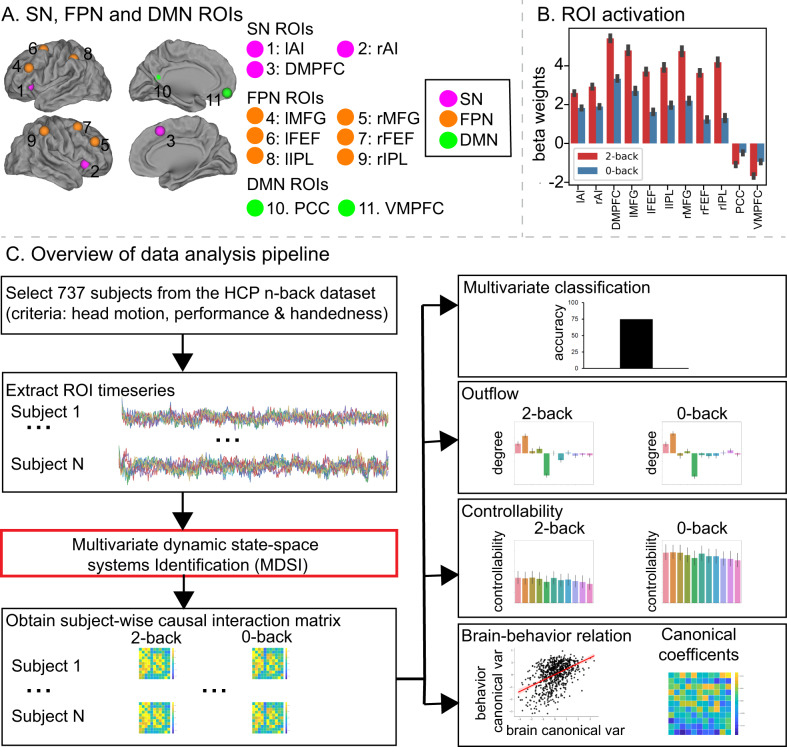
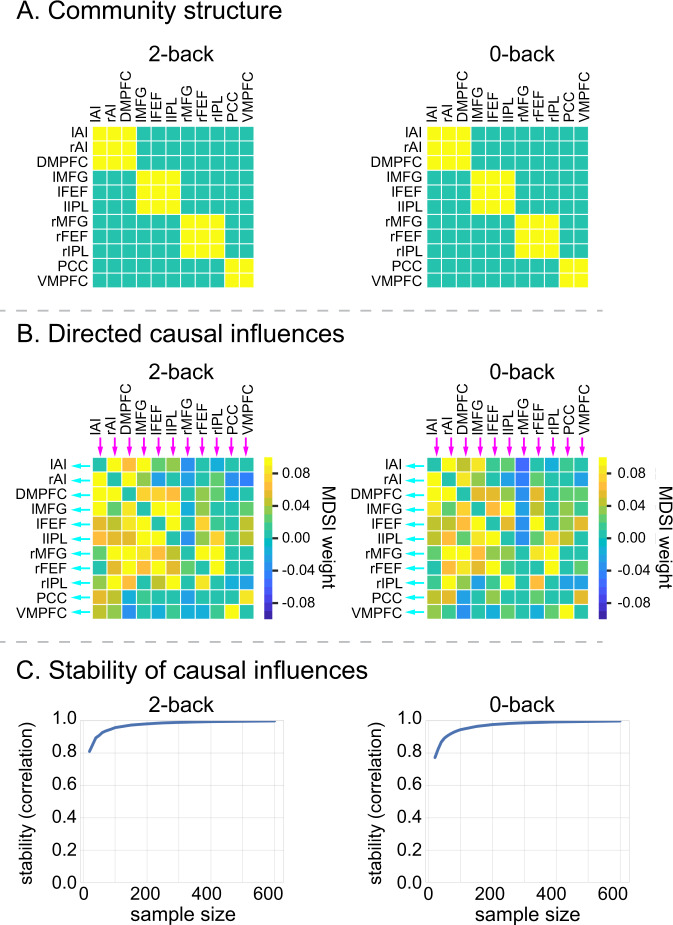
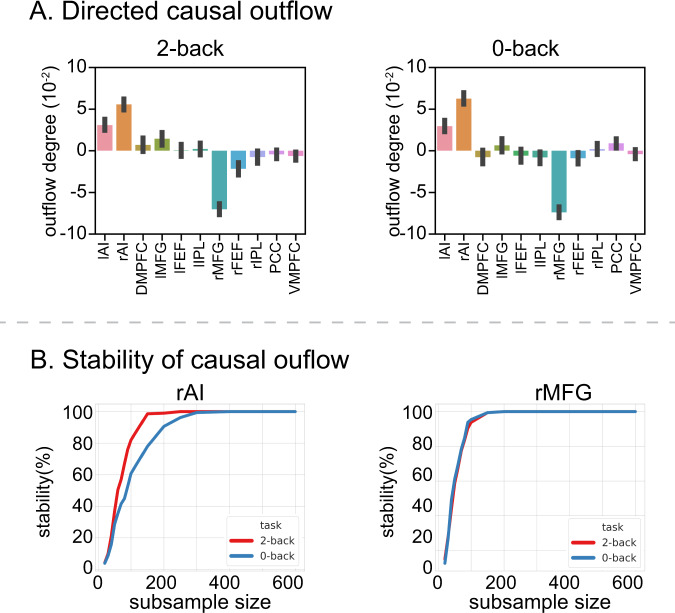
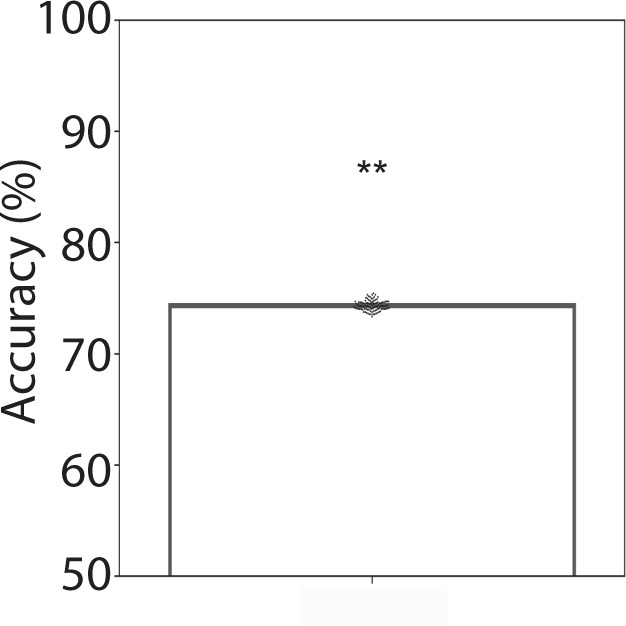
Control processes associated with working memory play a central role in human cognition, but their underlying dynamic brain circuit mechanisms are poorly understood. Here we use system identification, network science, stability analysis, and control theory to probe functional circuit dynamics during working memory task performance. Our results show that dynamic signaling between distributed brain areas encompassing the salience (SN), fronto-parietal (FPN), and default mode networks can distinguish between working memory load and predict performance. Network analysis of directed causal influences suggests the anterior insula node of the SN and dorsolateral prefrontal cortex node of the FPN are causal outflow and inflow hubs, respectively. Network controllability decreases with working memory load and SN nodes show the highest functional controllability. Our findings reveal dissociable roles of the SN and FPN in systems control and provide novel insights into dynamic circuit mechanisms by which cognitive control circuits operate asymmetrically during cognition.
Overview
The claims and statistics of this paper haven’t been checked yet.
Run the check — free, no account needed. It reads the open-access text and checks the sources it cites.
Integrity signals
Registry
Cites
Statistics
Figures
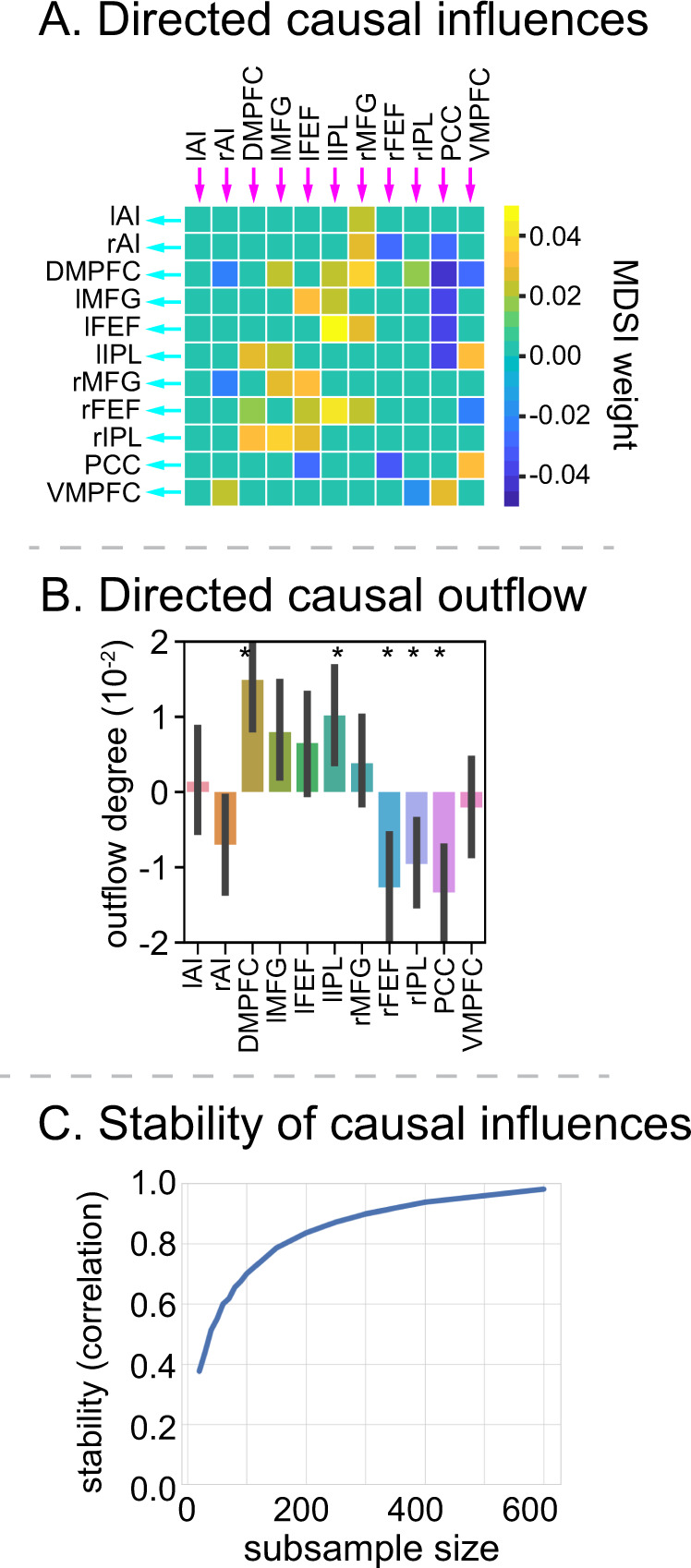
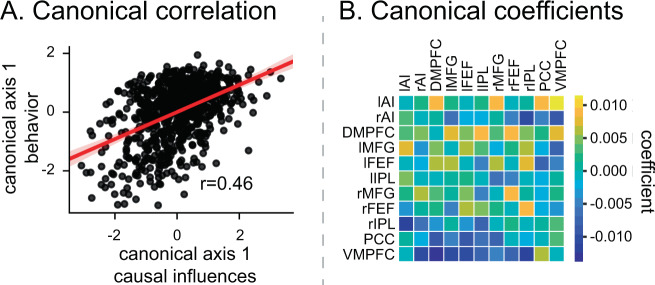
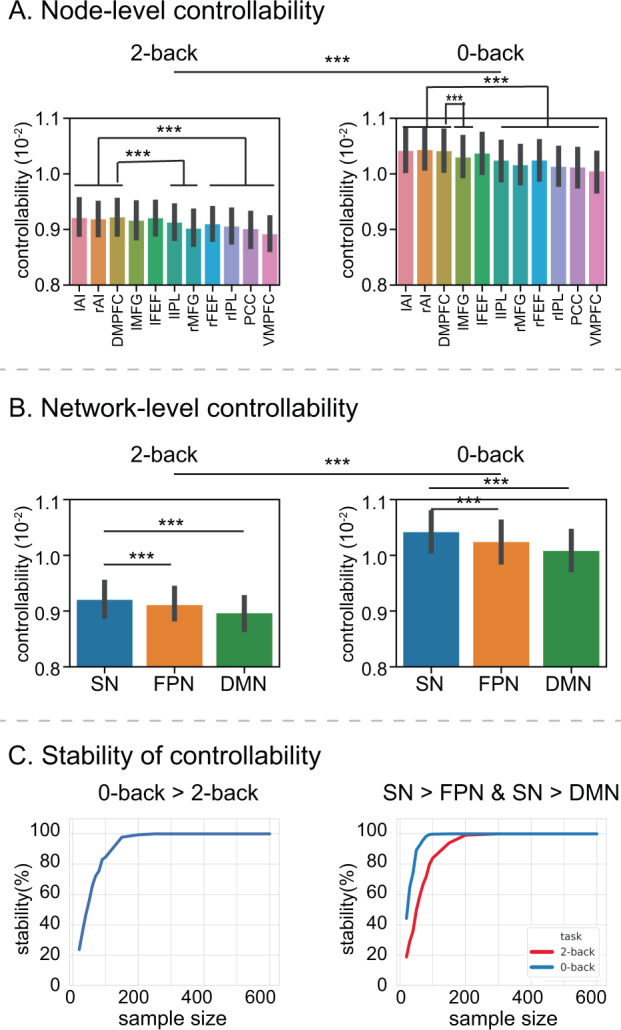
Verification
Claims the paper makes
The claims and statistics of this paper haven’t been checked yet.
Run the check — free, no account needed. It reads the open-access text and checks the sources it cites.
Claims other papers make about this one
Each is checked against this paper’s own text: does it say what the citing paper says it does?
The source backs part of the claim, not all of it — or backs it for a different population, condition or comparison.
In the citing paper
“Across a wide range of tasks, the anterior insula has emerged as a causal signaling hub that facilitates engagement of the lateral frontoparietal cortex involved in attention, response inhibition, and working memory while disengaging DMN nodes. 26,27”
From 20 years of the default mode network: A review and synthesis. (2023) · cites this paper as [26]
Experimental — accuracy not yet measured
Self-check
Percentages, sums and reported differences re-computed from the paper’s own numbers.
The self-check needs the paper’s full text.
Citations
Cites
Fast unfolding of communities in large networks
Blondel, V. D., Guillaume, J.-L., Lambiotte, R., & Lefebvre, E. (2008) · Journal of Statistical Mechanics: Theory and Experiment · doi:10.1088/1742-5468/2008/10/p10008 · Cited by 21,424
Modularity and community structure in networks
Newman, M. E. J. (2006) · Proceedings of the National Academy of Sciences · doi:10.1073/pnas.0601602103 · Cited by 12,256
Complex network measures of brain connectivity: Uses and interpretations
Rubinov, M., & Sporns, O. (2010) · NeuroImage · doi:10.1016/j.neuroimage.2009.10.003 · Cited by 11,522
Power failure: why small sample size undermines the reliability of neuroscience
Button, K. S., Ioannidis, J. P. A., Mokrysz, C., Nosek, B. A., Flint, J., Robinson, E. S. J., & Munafò, M. R. (2013) · Nature Reviews Neuroscience · doi:10.1038/nrn3475 · Cited by 7,641
Functional connectivity in the resting brain: a network analysis of the default mode hypothesis
Greicius, M. D., Krasnow, B., Reiss, A. L., & Menon, V. (2003) · Proceedings of the National Academy of Sciences · doi:10.1073/pnas.0135058100 · Cited by 6,358
Self-citationRELATIONS BETWEEN TWO SETS OF VARIATES
Hotelling, H. (1936) · Biometrika · doi:10.1093/biomet/28.3-4.321 · Cited by 6,041
Saliency, switching, attention and control: a network model of insula function
Menon, V., & Uddin, L. Q. (2010) · Brain Structure and Function · doi:10.1007/s00429-010-0262-0 · Cited by 5,592
Self-citationFast algorithm for detecting community structure in networks
Newman, M. E. J. (2004) · Physical Review E · doi:10.1103/physreve.69.066133 · Cited by 5,415
Correspondence of the brain's functional architecture during activation and rest
Smith, S. M., Fox, P. T., Miller, K. L., Glahn, D. C., Fox, P. M., Mackay, C. E., Filippini, N., Watkins, K. E., Toro, R., Laird, A. R., et al. (2009) · Proceedings of the National Academy of Sciences · doi:10.1073/pnas.0905267106 · Cited by 5,150
Functional Network Organization of the Human Brain
Power, J. D., Cohen, A. L., Nelson, S. M., Wig, G. S., Barnes, K. A., Church, J. A., Vogel, A. C., Laumann, T. O., Miezin, F. M., Schlaggar, B. L., et al. (2011) · Neuron · doi:10.1016/j.neuron.2011.09.006 · Cited by 4,124
Research works printed but not linked: 1
- Baddeley, A. D. Working Memory (Clarendon Press; Oxford University Press, 1986).
Cited by
Sorted by citations
Items 101–104 of 104
Higher-order interactions control the self-sustained activity in neural systems
Hu, Y.-P., Peng, Y.-J., Cao, Z., Tang, W.-D., Hu, X.-Y., & Jia, Y. (2026) · Chaos Solitons & Fractals · doi:10.1016/j.chaos.2026.119249
Ng, J., Feusner, J. D., & Hawco, C. S. (2026) · Frontiers in Human Neuroscience · doi:10.3389/fnhum.2026.1920417
Brain-Network Meta-State Dynamics Characterize 40-Hz tACS Effects on Working Memory
Zhou, Y., Ouyang, J., Kang, A., Zhao, J., Luo, Q., Zhao, Y., Liu, R., Wang, L., Suo, D., & Yan, T. (2026) · ICME International Conference on Complex Medical Engineering (CME) · doi:10.1109/cme70365.2026.11724245
A Control-Theoretic Account of Cognitive Effort in Working MemoryPreprint
Gholaminejad, T., & Holroyd, C. B. (2026) · bioRxiv (Cold Spring Harbor Laboratory) · doi:10.64898/2026.10.11.758303
Metadata
- Authors
- Cai, W., Ryali, S., Pasumarthy, R., Talasila, V., & Menon, V.
- Affiliations
- Stanford Medicine (US)
- Indian Institute of Technology Madras (IN)
- Ramaiah Institute of Technology (IN)
- Corresponding author
- Cai, Weidong
- Menon, Vinod
- Venue
- Nature Communications
- Published
- 2021-06-29
- Volume
- 12
- Issue
- 1
- Pages
- 3314-3314
- ISSN
- 2041-1723 (ISSN-L)
- PMC
- PMC8241851
- OpenAlex
- W3176607719
- Cited by
- 105
- References
- 115
- Citations by year
- 2026: 16 · 2025: 33 · 2024: 26 · 2023: 11 · 2022: 17 · 2021: 2
- FWCI
- 7.36
- Type
- journal article
- Language
- en
- Open access
- gold
- doi.org
- Locations
- Nature Communications (publishedVersion, cc-by)
- PubMed Central (publishedVersion, cc-by)
- PubMed (publishedVersion)
- RePEc: Research Papers in Economics (submittedVersion)
- DOAJ (DOAJ: Directory of Open Access Journals) (submittedVersion, cc-by-sa)
- Funders
- U.S. Department of Health & Human Services | NIH | National Institute of Mental Health (MH105625, MH121069)
- U.S. Department of Health & Human Services | NIH | National Institute of Biomedical Imaging and Bioengineering (EB022907)
- U.S. Department of Health & Human Services | NIH | National Institute of Neurological Disorders and Stroke (NS086085)
- U.S. Department of Health & Human Services | NIH | Eunice Kennedy Shriver National Institute of Child Health and Human Development (HD074652)
- Topics
- Life Sciences › Neuroscience › Cognitive Neuroscience › Functional Brain Connectivity Studies
- Life Sciences › Neuroscience › Cognitive Neuroscience › Neural dynamics and brain function
- Life Sciences › Neuroscience › Cognitive Neuroscience › Neural and Behavioral Psychology Studies
- Keywords
- working memory, network controllability, salience network, frontoparietal network, default mode network, anterior insula, dorsolateral prefrontal cortex, working memory load, network hubs, cognitive control
- MeSH terms
- Adult, Brain, Brain Mapping, Cerebral Cortex, Female, Gyrus Cinguli, Humans, Male, Memory, Short-Term, Models, Neurological, Nerve Net, Neural Pathways, Reproducibility of Results, Prefrontal Cortex, Young Adult, Executive Function
About these checks
Registry, retraction, Cites and statistics results are computed, not judged, with one exception: a printed reference that no index lists is read once by a model before it counts as a citation error. Claims are extracted by a model and kept only when their quote appears verbatim in the text; each cited source is then checked, with a model’s help, for whether it says what the claim relies on. Those verdicts can be wrong — read the claim’s quote and the cited source before relying on one.
Statistics and arithmetic are recomputed, not judged.
Confidence bands are shown only for fields calibrated on our annotated test set. None is calibrated yet, so no band is shown.
What counts as a claim ›How we measure confidence ›How we check this ›
Are you an author, or do you see a problem with this page? Request a review
