

In-silico trial of intracranial flow diverters replicates and expands insights from conventional clinical trials
Open accessPublished version of a preprint
The DOI matches its Crossref record; 61 of the 61 references it cites were found in a registry or an index.
Abstract
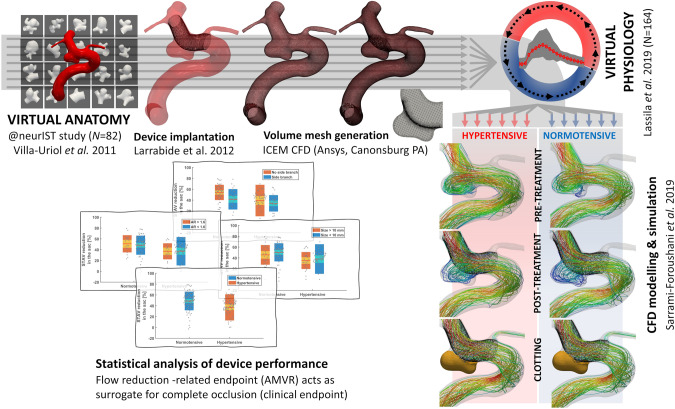
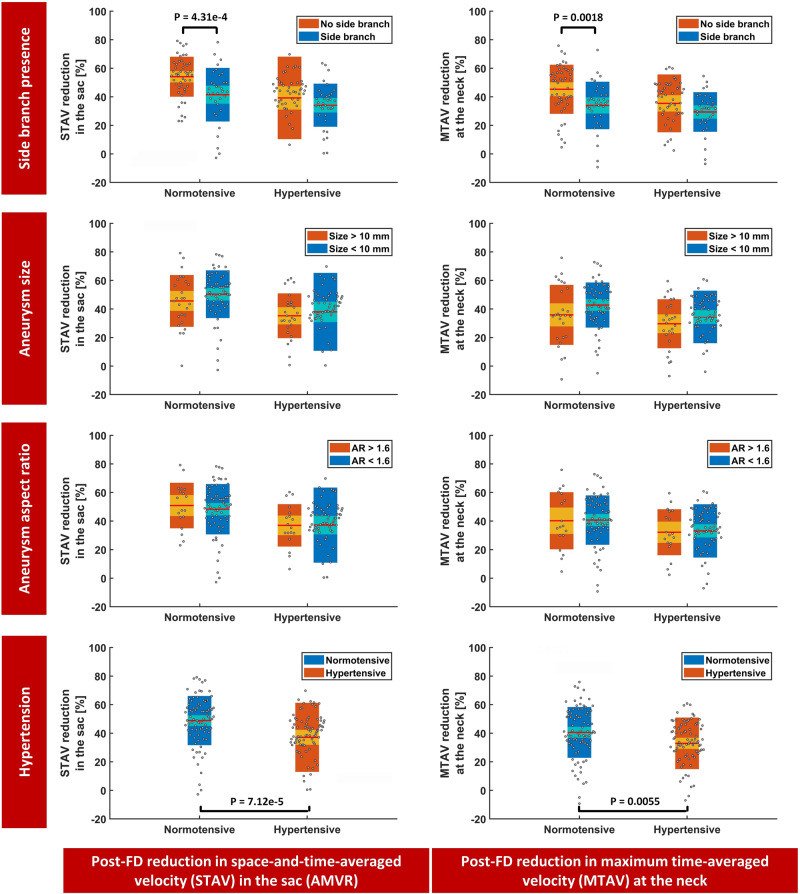
The cost of clinical trials is ever-increasing. In-silico trials rely on virtual populations and interventions simulated using patient-specific models and may offer a solution to lower these costs. We present the flow diverter performance assessment (FD-PASS) in-silico trial, which models the treatment of intracranial aneurysms in 164 virtual patients with 82 distinct anatomies with a flow-diverting stent, using computational fluid dynamics to quantify post-treatment flow reduction. The predicted FD-PASS flow-diversion success rates replicate the values previously reported in three clinical trials. The in-silico approach allows broader investigation of factors associated with insufficient flow reduction than feasible in a conventional trial. Our findings demonstrate that in-silico trials of endovascular medical devices can: (i) replicate findings of conventional clinical trials, and (ii) perform virtual experiments and sub-group analyses that are difficult or impossible in conventional trials to discover new insights on treatment failure, e.g. in the presence of side-branches or hypertension.
Overview
The claims and statistics of this paper haven’t been checked yet.
Free: it reads the open-access text and checks the first 5 claims that cite a source we can check. Create a free account to check every claim.
Integrity signals
Registry
Cites
Statistics
Figures
Verification
Claims the paper makes
The claims and statistics of this paper haven’t been checked yet.
Free: it reads the open-access text and checks the first 5 claims that cite a source we can check. Create a free account to check every claim.
Claims other papers make about this one
Each is checked against this paper’s own text: does it say what the citing paper says it does?
The cited source says what the claim attributes to it.
In the citing paper
“The ISCT endpoint was AMVR > 35%, argued as a surrogate for successful occlusion.”
From Credibility assessment of in silico clinical trials for medical devices (2024) · cites this paper as [16]
The cited source says what the claim attributes to it.
In the citing paper
“The flow diverter performance assessment (FD-PASS) study [16] was an in silico clinical trial that predicted post-treatment flow reduction in 164 virtual patients using computational fluid dynamics (CFD).”
From Credibility assessment of in silico clinical trials for medical devices (2024) · cites this paper as [16]
Self-check
Percentages, sums and reported differences re-computed from the paper’s own numbers.
The self-check needs the paper’s full text.
Citations
Cites
Practical Statistics for Medical Research
Altman, D. G. (1990) · doi:10.1201/9780429258589 · Cited by 10,668
Practical Statistics for Medical Research.
Bartko, J. J., & Altman, D. G. (1992) · Journal of the American Statistical Association · doi:10.2307/2290246 · Cited by 4,797
Wiebers, D. O. (2003) · The Lancet · doi:10.1016/s0140-6736(03)13860-3 · Cited by 3,905
Pipeline for Uncoilable or Failed Aneurysms: Results from a Multicenter Clinical Trial
Becske, T., Kallmes, D. F., Saatci, I., McDougall, C. G., Szikora, I., Lanzino, G., Moran, C. J., Woo, H. H., Lopes, D. K., Berez, A. L., et al. (2013) · Radiology · doi:10.1148/radiol.13120099 · Cited by 1,108
Cebral, J. R., Castro, M. A., Appanaboyina, S., Putman, C. M., Millan, D., & Frangi, A. F. (2005) · IEEE Transactions on Medical Imaging · doi:10.1109/tmi.2005.844159 · Cited by 545
Self-citationKulcsár, Z., Houdart, E., Bonafé, A., Parker, G., Millar, J., Goddard, A. J. P., Renowden, S., Gál, G., Turowski, B., Mitchell, K., et al. (2011) · American Journal of Neuroradiology · doi:10.3174/ajnr.a2370 · Cited by 521
Practical Statistics for Medical Research
BROWN, G. W. (1992) · Archives of Pediatrics & Adolescent Medicine · doi:10.1001/archpedi.1992.02160180040013 · Cited by 448
Becske, T., Brinjikji, W., Potts, M. B., Kallmes, D. F., Shapiro, M., Moran, C. J., Levy, E. I., McDougall, C. G., Szikora, I., Lanzino, G., et al. (2017) · Neurosurgery · doi:10.1093/neuros/nyw014 · Cited by 447
The FDA Critical Path Initiative and Its Influence on New Drug Development
Woodcock, J., & Woosley, R. (2008) · Annual Review of Medicine · doi:10.1146/annurev.med.59.090506.155819 · Cited by 434
Fischer, S., Vajda, Z., Aguilar Perez, M., Schmid, E., Hopf, N., Bäzner, H., & Henkes, H. (2012) · Neuroradiology · doi:10.1007/s00234-011-0948-x · Cited by 393
Research works printed but not linked: 2
- Becske T Pipeline for uncoilable or failed aneurysms: results from a multicenter clinical trial Radiology 2013 267 858 868 10.1148/radiol.13120099 23418004 · DOI · Paper page
- Turowski B Macht S Kulcsár Z Hänggi D Stummer W Early fatal hemorrhage after endovascular cerebral aneurysm treatment with a flow diverter (SILK-Stent) Neuroradiology 2011 53 37 41 10.1007/s00234-010-0676-7 20339842 · DOI · Paper page
Cited by
Moingeon, P., Chenel, M., Rousseau, C., Voisin, E., & Guedj, M. (2023) · Drug Discovery Today · doi:10.1016/j.drudis.2023.103605 · Cited by 121
Digital twins for the era of personalized surgery
Mekki, Y. M., Luijten, G., Hagert, E. M., Belkhair, S., Varghese, C., Qadir, J., Solaiman, B., Bilal, M., Dhanda, J., Egger, J., et al. (2025) · npj Digital Medicine · doi:10.1038/s41746-025-01575-5 · Cited by 96
Self-citationLin, C., Huang, X. L., Xue, Y., Jiang, S., Chen, C., Liu, Y., & Chen, K. (2025) · Bioactive Materials · doi:10.1016/j.bioactmat.2025.02.017 · Cited by 86
Liu, F., Beck, S., Yang, L., Luo, H., & Zhang, K. C. (2026) · Nature reviews. Cancer · doi:10.1038/s41568-026-00922-2 · Cited by 70
Credibility assessment of in silico clinical trials for medical devices
Pathmanathan, P., Aycock, K., Badal, A., Bighamian, R., Bodner, J., Craven, B. A., & Niederer, S. (2024) · PLOS Computational Biology · doi:10.1371/journal.pcbi.1012289 · Cited by 62
Metadata
- Authors
- Sarrami-Foroushani, A., Lassila, T., MacRaild, M., Asquith, J., Roes, K. C. B., Byrne, J. V., & Frangi, A. F.
- Affiliations
- University of Leeds (GB)
- Radboud University Medical Center (NL)
- University of Oxford (GB)
- Corresponding author
- Frangi, Alejandro F.
- ORCID
- Venue
- Nature Communications
- Published
- 2021-06-23
- Volume
- 12
- Issue
- 1
- Pages
- 3861-3861
- ISSN
- 2041-1723 (ISSN-L)
- PMC
- PMC8222326
- OpenAlex
- W3122608793
- Cited by
- 83
- References
- 61
- Citations by year
- 2026: 15 · 2025: 23 · 2024: 20 · 2023: 16 · 2022: 6 · 2021: 3
- FWCI
- 5.36
- Type
- journal article
- Language
- en
- Open access
- gold
- doi.org
- Licence
- cc-by
- creativecommons.org/licenses/by/4.0 (tdm)
- creativecommons.org/licenses/by/4.0 (vor)
- Locations
- Nature Communications (publishedVersion, cc-by)
- Research Square (acceptedVersion, cc-by)
- PubMed Central (publishedVersion, cc-by)
- PubMed (publishedVersion)
- Research Explorer (The University of Manchester) (publishedVersion, cc-by)
- Research Explorer (The University of Manchester) (publishedVersion)
- White Rose Research Online (University of Leeds, The University of Sheffield, University of York) (acceptedVersion)
- Lirias (submittedVersion, cc-by)
- RePEc: Research Papers in Economics (submittedVersion)
- DOAJ (DOAJ: Directory of Open Access Journals) (submittedVersion, cc-by-sa)
- Radboud Repository (Radboud University) (submittedVersion)
- Radboud Repository (Radboud University) (submittedVersion, other-oa)
- Funders
- Royal Academy of Engineering (CiET1919/19)
- European Commission (H2020 SC1, H2020, H2020-SC1-2017-CNECT-2, FP6-2004-IST-4, 777119, FP6-2004-IST-4-027703, 027703)
- Horizon 2020 Framework Programme (H2020‐SC1‐2017, 777119, H2020-SC1)
- Engineering and Physical Sciences Research Council (EP/L01615X/1, H2020)
- Topics
- Health Sciences › Medicine › Clinical Neurology › Intracranial Aneurysms: Treatment and Complications
- Health Sciences › Medicine › Surgery › Aortic aneurysm repair treatments
- Health Sciences › Medicine › Cardiology and Cardiovascular Medicine › Cerebrovascular and Carotid Artery Diseases
- Keywords
- in silico clinical trials, intracranial aneurysm, flow diverter, computational fluid dynamics, virtual patients, flow reduction, endovascular treatment, treatment failure, side branches, hypertension, subgroup analysis
- MeSH terms
- Adult, Algorithms, Intracranial Aneurysm, Clinical Trials as Topic, Computer Simulation, Female, Humans, Male, Middle Aged, Models, Theoretical, Reproducibility of Results, Stents, Treatment Outcome, Hydrodynamics
About these checks
Registry, retraction, Cites and statistics results are computed, not judged, with one exception: a printed reference that no index lists is read once by a model before it counts as a citation error. Claims are extracted by a model and kept only when their quote appears verbatim in the text; each cited source is then checked, with a model’s help, for whether it says what the claim relies on. Those verdicts can be wrong — read the claim’s quote and the cited source before relying on one.
Statistics and arithmetic are recomputed, not judged.
Confidence bands are shown only for fields calibrated on our annotated test set. None is calibrated yet, so no band is shown.
What counts as a claim ›How we measure confidence ›How we check this ›
Are you an author, or do you see a problem with this page? Request a review
How to cite
Cite CoChat for the checks on this page, and the paper for its own findings.
- This page
- CoChat. (2026). Citation check: In-silico trial of intracranial flow diverters replicates and expands insights from conventional clinical trials. https://app.cochat.ai/papers/10.1038/s41467-021-23998-w
- The paper
- Sarrami-Foroushani, A., Lassila, T., MacRaild, M., Asquith, J., Roes, K. C. B., Byrne, J. V., & Frangi, A. F. (2021). In-silico trial of intracranial flow diverters replicates and expands insights from conventional clinical trials. Nature Communications. https://doi.org/10.1038/s41467-021-23998-w
Data sources
Bibliographic data: Semantic Scholar, OpenAlex, Crossref.
Contains information from the Semantic Scholar Academic Graph Datasets, made available under the ODC Attribution License (ODC-BY 1.0).
Semantic Scholar’s data is described in: Kinney, R., et al. (2023). The Semantic Scholar Open Data Platform. arXiv:2301.10140.
