

In-silico trial of intracranial flow diverters replicates and expands insights from conventional clinical trials
Open accessPublished version of a preprint
The DOI matches its Crossref record; 61 of the 61 references it cites were found in a registry or an index.
Abstract
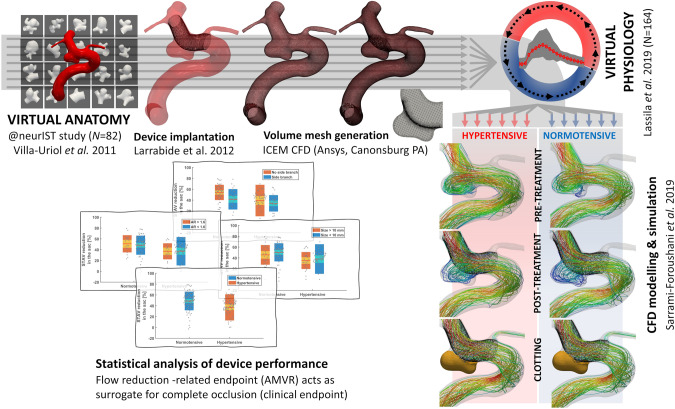
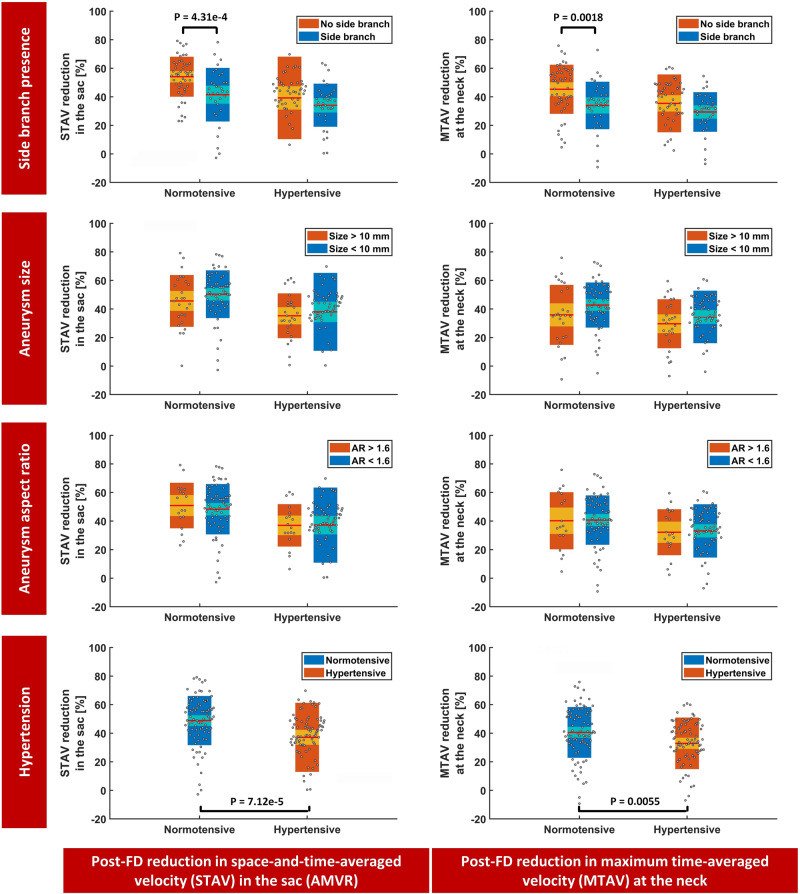
The cost of clinical trials is ever-increasing. In-silico trials rely on virtual populations and interventions simulated using patient-specific models and may offer a solution to lower these costs. We present the flow diverter performance assessment (FD-PASS) in-silico trial, which models the treatment of intracranial aneurysms in 164 virtual patients with 82 distinct anatomies with a flow-diverting stent, using computational fluid dynamics to quantify post-treatment flow reduction. The predicted FD-PASS flow-diversion success rates replicate the values previously reported in three clinical trials. The in-silico approach allows broader investigation of factors associated with insufficient flow reduction than feasible in a conventional trial. Our findings demonstrate that in-silico trials of endovascular medical devices can: (i) replicate findings of conventional clinical trials, and (ii) perform virtual experiments and sub-group analyses that are difficult or impossible in conventional trials to discover new insights on treatment failure, e.g. in the presence of side-branches or hypertension.
Overview
The claims and statistics of this paper haven’t been checked yet.
Free: it reads the open-access text and checks the first 5 claims that cite a source we can check. Create a free account to check every claim.
Integrity signals
Registry
Cites
Statistics
Figures
Verification
Claims the paper makes
The claims and statistics of this paper haven’t been checked yet.
Free: it reads the open-access text and checks the first 5 claims that cite a source we can check. Create a free account to check every claim.
Claims other papers make about this one
Each is checked against this paper’s own text: does it say what the citing paper says it does?
The cited source says what the claim attributes to it.
In the citing paper
“The ISCT endpoint was AMVR > 35%, argued as a surrogate for successful occlusion.”
From Credibility assessment of in silico clinical trials for medical devices (2024) · cites this paper as [16]
The cited source says what the claim attributes to it.
In the citing paper
“The flow diverter performance assessment (FD-PASS) study [16] was an in silico clinical trial that predicted post-treatment flow reduction in 164 virtual patients using computational fluid dynamics (CFD).”
From Credibility assessment of in silico clinical trials for medical devices (2024) · cites this paper as [16]
Self-check
Percentages, sums and reported differences re-computed from the paper’s own numbers.
The self-check needs the paper’s full text.
Citations
Cites
Practical Statistics for Medical Research
Altman, D. G. (1990) · doi:10.1201/9780429258589 · Cited by 10,668
Practical Statistics for Medical Research.
Bartko, J. J., & Altman, D. G. (1992) · Journal of the American Statistical Association · doi:10.2307/2290246 · Cited by 4,797
Wiebers, D. O. (2003) · The Lancet · doi:10.1016/s0140-6736(03)13860-3 · Cited by 3,905
Pipeline for Uncoilable or Failed Aneurysms: Results from a Multicenter Clinical Trial
Becske, T., Kallmes, D. F., Saatci, I., McDougall, C. G., Szikora, I., Lanzino, G., Moran, C. J., Woo, H. H., Lopes, D. K., Berez, A. L., et al. (2013) · Radiology · doi:10.1148/radiol.13120099 · Cited by 1,108
Cebral, J. R., Castro, M. A., Appanaboyina, S., Putman, C. M., Millan, D., & Frangi, A. F. (2005) · IEEE Transactions on Medical Imaging · doi:10.1109/tmi.2005.844159 · Cited by 545
Self-citationKulcsár, Z., Houdart, E., Bonafé, A., Parker, G., Millar, J., Goddard, A. J. P., Renowden, S., Gál, G., Turowski, B., Mitchell, K., et al. (2011) · American Journal of Neuroradiology · doi:10.3174/ajnr.a2370 · Cited by 521
Practical Statistics for Medical Research
BROWN, G. W. (1992) · Archives of Pediatrics & Adolescent Medicine · doi:10.1001/archpedi.1992.02160180040013 · Cited by 448
Becske, T., Brinjikji, W., Potts, M. B., Kallmes, D. F., Shapiro, M., Moran, C. J., Levy, E. I., McDougall, C. G., Szikora, I., Lanzino, G., et al. (2017) · Neurosurgery · doi:10.1093/neuros/nyw014 · Cited by 447
The FDA Critical Path Initiative and Its Influence on New Drug Development
Woodcock, J., & Woosley, R. (2008) · Annual Review of Medicine · doi:10.1146/annurev.med.59.090506.155819 · Cited by 434
Fischer, S., Vajda, Z., Aguilar Perez, M., Schmid, E., Hopf, N., Bäzner, H., & Henkes, H. (2012) · Neuroradiology · doi:10.1007/s00234-011-0948-x · Cited by 393
Hanel, R. A., Kallmes, D. F., Lopes, D. K., Nelson, P. K., Siddiqui, A., Jabbour, P., Pereira, V. M., Szikora István, I., Zaidat, O. O., Bettegowda, C., et al. (2020) · Journal of NeuroInterventional Surgery · doi:10.1136/neurintsurg-2019-015091 · Cited by 313
Kuharsky, A. L., & Fogelson, A. L. (2001) · Biophysical Journal · doi:10.1016/s0006-3495(01)76085-7 · Cited by 307
In silico clinical trials: how computer simulation will transform the biomedical industry
Viceconti, M., Henney, A., & Morley-Fletcher, E. (2016) · International Journal of Clinical Trials · doi:10.18203/2349-3259.ijct20161408 · Cited by 289
In silico clinical trials: concepts and early adoptions
Pappalardo, F., Russo, G., Tshinanu, F. M., & Viceconti, M. (2019) · Briefings in Bioinformatics · doi:10.1093/bib/bby043 · Cited by 279
Kallmes, D. F., Brinjikji, W., Cekirge, S., Fiorella, D., Hanel, R. A., Jabbour, P., Lopes, D., Lylyk, P., McDougall, C. G., & Siddiqui, A. (2017) · Journal of Neurosurgery · doi:10.3171/2016.8.jns16467 · Cited by 249
Stent-Supported Aneurysm Coiling: A Literature Survey of Treatment and Follow-Up
Shapiro, M., Becske, T., Sahlein, D., Babb, J., & Nelson, P. K. (2012) · American Journal of Neuroradiology · doi:10.3174/ajnr.a2719 · Cited by 244
Pipeline for uncoilable or failed aneurysms: 3-year follow-up results
Becske, T., Potts, M. B., Shapiro, M., Kallmes, D. F., Brinjikji, W., Saatci, I., McDougall, C. G., Szikora, I., Lanzino, G., Moran, C. J., et al. (2017) · Journal of Neurosurgery · doi:10.3171/2015.6.jns15311 · Cited by 229
Turowski, B., Macht, S., Kulcsár, Z., Hänggi, D., & Stummer, W. (2011) · Neuroradiology · doi:10.1007/s00234-010-0676-7 · Cited by 227
Flow Residence Time and Regions of Intraluminal Thrombus Deposition in Intracranial Aneurysms
Rayz, V. L., Boussel, L., Ge, L., Leach, J. R., Martin, A. J., Lawton, M. T., McCulloch, C., & Saloner, D. (2010) · Annals of Biomedical Engineering · doi:10.1007/s10439-010-0065-8 · Cited by 219
Aneurysm Study of Pipeline in an Observational Registry (ASPIRe)
Kallmes, D. F., Brinjikji, W., Boccardi, E., Ciceri, E., Diaz, O., Tawk, R., Woo, H., Jabbour, P., Albuquerque, F., Chapot, R., et al. (2016) · Interventional Neurology · doi:10.1159/000446503 · Cited by 210
Shapiro, M., Raz, E., Becske, T., & Nelson, P. K. (2014) · American Journal of Neuroradiology · doi:10.3174/ajnr.a3742 · Cited by 188
Mechanism of Action and Biology of Flow Diverters in the Treatment of Intracranial Aneurysms
Ravindran, K., Casabella, A. M., Cebral, J. R., Brinjikji, W., Kallmes, D. F., & Kadirvel, R. (2019) · Neurosurgery · doi:10.1093/neuros/nyz324 · Cited by 170
Larrabide, I., Kim, M., Augsburger, L., Villa‐Uriol, M., Rüfenacht, D. A., & Frangi, A. F. (2010) · Medical Image Analysis · doi:10.1016/j.media.2010.04.009 · Cited by 133
Self-citationBrinjikji, W., Lanzino, G. S., Cloft, H. J., Siddiqui, A. H., Boccardi, E. P., Cekirge, S. H., Fiorella, D. J., Hanel, R. A., Jabbour, P. M., Levy, E. I., et al. (2016) · American Journal of Neuroradiology · doi:10.3174/ajnr.a4807 · Cited by 127
Zhao, B., Yin, R. L., Lanzino, G. S., Kallmes, D. F., Cloft, H. J., & Brinjikji, W. (2016) · American Journal of Neuroradiology · doi:10.3174/ajnr.a4834 · Cited by 127
Mut, F., Raschi, M., Scrivano, E. V., Bleise, C., Chudyk, J., Ceratto, R., Lylyk, P. N., & Cebral, J. R. (2014) · Journal of NeuroInterventional Surgery · doi:10.1136/neurintsurg-2013-011080 · Cited by 121
Simulation of intracranial aneurysm stenting: Techniques and challenges
Appanaboyina, S., Mut, F., Löhner, R., Putman, C. M., & Cebral, J. R. (2009) · Computer Methods in Applied Mechanics and Engineering · doi:10.1016/j.cma.2009.01.017 · Cited by 115
Rusli, N. S., & Harith, S. (2020) · Journal of Nutrition Science · doi:10.35308/jns.v1i2.2757 · Cited by 115
Chancellor, B., Raz, E., Shapiro, M., Tanweer, O., Nossek, E. Z., Riina, H. A., & Nelson, P. K. (2019) · Neurosurgery · doi:10.1093/neuros/nyz345 · Cited by 108
Hendricks, B. K., Yoon, J. S., Yaeger, K., Kellner, C. P., Mocco, J., Leacy, R. A. D., Ducruet, A. F., Lawton, M. T., & Mascitelli, J. R. (2019) · Journal of neurosurgery · doi:10.3171/2019.3.jns183160 · Cited by 106
Rouchaud, A., Leclerc, O., Benayoun, Y., Saleme, S., Camilleri, Y., D’Argento, F., Boncoeur, M.-P., Robert, P.-Y., & Mounayer, C. (2014) · American Journal of Neuroradiology · doi:10.3174/ajnr.a4129 · Cited by 99
Berg, P., Roloff, C., Beuing, O., Voss, S., Sugiyama, S.-I., Aristokleous, N., Anayiotos, A. S., Ashton, N., Revell, A., Bressloff, N. W., et al. (2015) · Journal of Biomechanical Engineering · doi:10.1115/1.4031794 · Cited by 93
Introduction to the 3Rs (refinement, reduction and replacement).
Guhad, F. (2005) · PubMed · Cited by 92
Brinjikji, W., Lanzino, G. S., Cloft, H. J., Siddiqui, A. H., & Kallmes, D. F. (2015) · American Journal of Neuroradiology · doi:10.3174/ajnr.a4443 · Cited by 87
Bogunović, H., Pozo, J. M., Villa‐Uriol, M., Majoie, C. B. L. M., van den Berg, R., van Andel, H. A. F. G., Macho, J. M., Blasco, J., Román, L. S., & Frangi, A. F. (2010) · Medical Physics · doi:10.1118/1.3515749 · Cited by 87
Self-citationA Single Pipeline Embolization Device is Sufficient for Treatment of Intracranial Aneurysms
Chalouhi, N., Tjoumakaris, S., Phillips, J. L. H., Starke, R. M., Hasan, D. M., Wu, C., Zanaty, M., Kung, D. K., Gonzalez, L. F., Rosenwasser, R. H., et al. (2014) · American Journal of Neuroradiology · doi:10.3174/ajnr.a3957 · Cited by 81
Chow, M., McDougall, C. M., O'Kelly, C. J., Ashforth, R., Johnson, E., & Fiorella, D. J. (2011) · American Journal of Neuroradiology · doi:10.3174/ajnr.a2532 · Cited by 77
On Flow Diversion: The Changing Landscape of Intracerebral Aneurysm Management
Dmytriw, A. A., Phan, K. H., Moore, J. M., Pereira, V. M., Krings, T., & Thomas, A. J. (2019) · American Journal of Neuroradiology · doi:10.3174/ajnr.a6006 · Cited by 74
Ouared, R., Larrabide, I., Brina, O., Bouillot, P., Erceg, G., Yilmaz, H., Lövblad, K., & Pereira, V. M. (2016) · Journal of NeuroInterventional Surgery · doi:10.1136/neurintsurg-2015-012154 · Cited by 73
Systolic vs diastolic blood pressure and the burden of hypertension
Tin, L., Beevers, D. G., & Lip, G. Y. H. (2002) · Journal of Human Hypertension · doi:10.1038/sj.jhh.1001373 · Cited by 72
Maragkos, G. Α., Ascanio, L. C., Salem, M. M., Gopakumar, S., Gomez‐Paz, S., Enríquez-Marulanda, A., Jain, A. P., Schirmer, C. M., Foreman, P. M., Griessenauer, C. J., et al. (2019) · Journal of neurosurgery · doi:10.3171/2019.1.jns183226 · Cited by 71
Villa‐Uriol, M., Berti, G., Hose, D. R., Marzo, A., Chiarini, A., Penrose, J., Pozo, J. M., Schmidt, J. G., Singh, P., Lycett, R., et al. (2011) · Interface Focus · doi:10.1098/rsfs.2010.0033 · Cited by 70
Self-citationCredibility of In Silico Trial Technologies—A Theoretical Framing
Viceconti, M., Juarez, M. A., Curreli, C., Pennisi, M., Russo, G., & Pappalardo, F. (2020) · IEEE Journal of Biomedical and Health Informatics · doi:10.1109/jbhi.2019.2949888 · Cited by 67
Aneurysms with persistent patency after treatment with the Pipeline Embolization Device
Kan, P. T. M., Srinivasan, V. M., Mbabuike, N. S., Tawk, R. G., Ban, V. S., Welch, B. G., Mokin, M. V., Mitchell, B. D., Puri, A. S., Binning, M. J., et al. (2016) · Journal of neurosurgery · doi:10.3171/2016.6.jns16402 · Cited by 62
Increasing Flow Diversion for Cerebral Aneurysm Treatment Using a Single Flow Diverter
Xiang, J., Ma, D., Snyder, K. V., Levy, E. I., Siddiqui, A. H., & Meng, H. (2014) · Neurosurgery · doi:10.1227/neu.0000000000000409 · Cited by 60
Introduction: History and Development of Flow Diverter Technology and Evolution
Kühn, A. L., Gounis, M. J., & Puri, A. S. (2019) · Neurosurgery · doi:10.1093/neuros/nyz307 · Cited by 60
Ma, D., Xiang, J., Choi, H., Dumont, T. M., Natarajan, S. K., Siddiqui, A. H., & Meng, H. (2014) · American Journal of Neuroradiology · doi:10.3174/ajnr.a3933 · Cited by 56
Determination of a shear rate threshold for thrombus formation in intracranial aneurysms
de Sousa, D. R., Vallecilla, C., Chodzyński, K. J., Jerez, R. A. C., Malaspinas, O., Eker, O., Ouared, R., Vanhamme, L., Legrand, A., Chopard, B., et al. (2015) · Journal of NeuroInterventional Surgery · doi:10.1136/neurintsurg-2015-011737 · Cited by 44
Sarrami‐Foroushani, A., Lassila, T., Hejazi, S. M., Nagaraja, S., Bacon, A., & Frangi, A. F. (2019) · Journal of Biomechanics · doi:10.1016/j.jbiomech.2019.04.045 · Cited by 41
Self-citationThe ESMINT Retrospective Analysis of Delayed Aneurysm Ruptures after flow diversion (RADAR) study
Kulcsár, Z., & Szikora, I. (2012) · Cited by 40
Jou, L., Chintalapani, G., & Mawad, M. E. (2015) · Interventional Neuroradiology · doi:10.1177/1591019915617315 · Cited by 37
Failure of Flow Diverter Therapy: Predictors and Management Strategies
Bonney, P. A., Connor, M., Fujii, T., Singh, P., Koch, M. J., Stapleton, C. J., Mack, W. J., & Walcott, B. P. (2019) · Neurosurgery · doi:10.1093/neuros/nyz305 · Cited by 36
Sarrami‐Foroushani, A., Lassila, T., Gooya, A., Geers, A. J., & Frangi, A. F. (2016) · Journal of Biomechanics · doi:10.1016/j.jbiomech.2016.10.005 · Cited by 35
Self-citationTowards optimal flow diverter porosity for the treatment of intracranial aneurysm
Zhang, Y., Wang, Y., Kao, E., Flórez-Valencia, L., & Courbebaisse, G. (2018) · Journal of Biomechanics · doi:10.1016/j.jbiomech.2018.10.002 · Cited by 35
Hemodynamic analysis of fast and slow aneurysm occlusions by flow diversion in rabbits
Chung, B., Mut, F., Kadirvel, R., Lingineni, R. K., Kallmes, D. F., & Cebral, J. R. (2014) · Journal of NeuroInterventional Surgery · doi:10.1136/neurintsurg-2014-011412 · Cited by 31
Cebral, J. R., Chung, B. J., Mut, F., Chudyk, J., Bleise, C., Scrivano, E. V., Lylyk, P. N., Kadirvel, R., & Kallmes, D. F. (2019) · PubMed · doi:10.3174/ajnr.a6169 · Cited by 24
Cito, S., Geers, A. J., Arroyo, M. P., Palero, V. R., Pallarés, J., Vernet, A., Blasco, J., San Román, L., Fu, W., Qiao, A., et al. (2015) · Annals of Biomedical Engineering · doi:10.1007/s10439-014-1082-9 · Cited by 20
Self-citationFlow diverters and a tale of two aneurysms
Kuzmik, G. A., Williamson, T. L., Ediriwickrema, A., Andeejani, A. M. I., & Bulsara, K. R. (2012) · Journal of NeuroInterventional Surgery · doi:10.1136/neurintsurg-2012-010316 · Cited by 16
Virtual endovascular treatment of intracranial aneurysms: models and uncertainty
Sarrami‐Foroushani, A., Lassila, T., & Frangi, A. F. (2017) · WIREs Systems Biology and Medicine · doi:10.1002/wsbm.1385 · Cited by 16
Self-citationLassila, T., Sarrami‐Foroushani, A., Hejazi, S. M., & Frangi, A. F. (2019) · International Journal for Numerical Methods in Biomedical Engineering · doi:10.1002/cnm.3271 · Cited by 12
Self-citationCommentary: Failure of Flow Diverter Therapy: Predictors and Management Strategies
Enríquez-Marulanda, A., & Thomas, A. J. (2019) · Neurosurgery · doi:10.1093/neuros/nyz410 · Cited by 2
Research works printed but not linked: 2
- Becske T Pipeline for uncoilable or failed aneurysms: results from a multicenter clinical trial Radiology 2013 267 858 868 10.1148/radiol.13120099 23418004 · DOI · Paper page
- Turowski B Macht S Kulcsár Z Hänggi D Stummer W Early fatal hemorrhage after endovascular cerebral aneurysm treatment with a flow diverter (SILK-Stent) Neuroradiology 2011 53 37 41 10.1007/s00234-010-0676-7 20339842 · DOI · Paper page
Cited by
Moingeon, P., Chenel, M., Rousseau, C., Voisin, E., & Guedj, M. (2023) · Drug Discovery Today · doi:10.1016/j.drudis.2023.103605 · Cited by 121
Digital twins for the era of personalized surgery
Mekki, Y. M., Luijten, G., Hagert, E. M., Belkhair, S., Varghese, C., Qadir, J., Solaiman, B., Bilal, M., Dhanda, J., Egger, J., et al. (2025) · npj Digital Medicine · doi:10.1038/s41746-025-01575-5 · Cited by 96
Self-citationLin, C., Huang, X. L., Xue, Y., Jiang, S., Chen, C., Liu, Y., & Chen, K. (2025) · Bioactive Materials · doi:10.1016/j.bioactmat.2025.02.017 · Cited by 86
Liu, F., Beck, S., Yang, L., Luo, H., & Zhang, K. C. (2026) · Nature reviews. Cancer · doi:10.1038/s41568-026-00922-2 · Cited by 70
Credibility assessment of in silico clinical trials for medical devices
Pathmanathan, P., Aycock, K., Badal, A., Bighamian, R., Bodner, J., Craven, B. A., & Niederer, S. (2024) · PLOS Computational Biology · doi:10.1371/journal.pcbi.1012289 · Cited by 62
Metadata
- Authors
- Sarrami-Foroushani, A., Lassila, T., MacRaild, M., Asquith, J., Roes, K. C. B., Byrne, J. V., & Frangi, A. F.
- Affiliations
- University of Leeds (GB)
- Radboud University Medical Center (NL)
- University of Oxford (GB)
- Corresponding author
- Frangi, Alejandro F.
- ORCID
- Venue
- Nature Communications
- Published
- 2021-06-23
- Volume
- 12
- Issue
- 1
- Pages
- 3861-3861
- ISSN
- 2041-1723 (ISSN-L)
- PMC
- PMC8222326
- OpenAlex
- W3122608793
- Cited by
- 83
- References
- 61
- Citations by year
- 2026: 15 · 2025: 23 · 2024: 20 · 2023: 16 · 2022: 6 · 2021: 3
- FWCI
- 5.36
- Type
- journal article
- Language
- en
- Open access
- gold
- doi.org
- Licence
- cc-by
- creativecommons.org/licenses/by/4.0 (tdm)
- creativecommons.org/licenses/by/4.0 (vor)
- Locations
- Nature Communications (publishedVersion, cc-by)
- Research Square (acceptedVersion, cc-by)
- PubMed Central (publishedVersion, cc-by)
- PubMed (publishedVersion)
- Research Explorer (The University of Manchester) (publishedVersion, cc-by)
- Research Explorer (The University of Manchester) (publishedVersion)
- White Rose Research Online (University of Leeds, The University of Sheffield, University of York) (acceptedVersion)
- Lirias (submittedVersion, cc-by)
- RePEc: Research Papers in Economics (submittedVersion)
- DOAJ (DOAJ: Directory of Open Access Journals) (submittedVersion, cc-by-sa)
- Radboud Repository (Radboud University) (submittedVersion)
- Radboud Repository (Radboud University) (submittedVersion, other-oa)
- Funders
- Royal Academy of Engineering (CiET1919/19)
- European Commission (H2020 SC1, H2020, H2020-SC1-2017-CNECT-2, FP6-2004-IST-4, 777119, FP6-2004-IST-4-027703, 027703)
- Horizon 2020 Framework Programme (H2020‐SC1‐2017, 777119, H2020-SC1)
- Engineering and Physical Sciences Research Council (EP/L01615X/1, H2020)
- Topics
- Health Sciences › Medicine › Clinical Neurology › Intracranial Aneurysms: Treatment and Complications
- Health Sciences › Medicine › Surgery › Aortic aneurysm repair treatments
- Health Sciences › Medicine › Cardiology and Cardiovascular Medicine › Cerebrovascular and Carotid Artery Diseases
- Keywords
- in silico clinical trials, intracranial aneurysm, flow diverter, computational fluid dynamics, virtual patients, flow reduction, endovascular treatment, treatment failure, side branches, hypertension, subgroup analysis
- MeSH terms
- Adult, Algorithms, Intracranial Aneurysm, Clinical Trials as Topic, Computer Simulation, Female, Humans, Male, Middle Aged, Models, Theoretical, Reproducibility of Results, Stents, Treatment Outcome, Hydrodynamics
About these checks
Registry, retraction, Cites and statistics results are computed, not judged, with one exception: a printed reference that no index lists is read once by a model before it counts as a citation error. Claims are extracted by a model and kept only when their quote appears verbatim in the text; each cited source is then checked, with a model’s help, for whether it says what the claim relies on. Those verdicts can be wrong — read the claim’s quote and the cited source before relying on one.
Statistics and arithmetic are recomputed, not judged.
Confidence bands are shown only for fields calibrated on our annotated test set. None is calibrated yet, so no band is shown.
What counts as a claim ›How we measure confidence ›How we check this ›
Are you an author, or do you see a problem with this page? Request a review
Data sources
Bibliographic data: Semantic Scholar, OpenAlex, Crossref.
Contains information from the Semantic Scholar Academic Graph Datasets, made available under the ODC Attribution License (ODC-BY 1.0).
Semantic Scholar’s data is described in: Kinney, R., et al. (2023). The Semantic Scholar Open Data Platform. arXiv:2301.10140.
