

Object representations in the human brain reflect the co-occurrence statistics of vision and language
Open accessPublished version of a preprint
The DOI matches its Crossref record; 76 of the 76 references it cites were found in a registry or an index.
Abstract
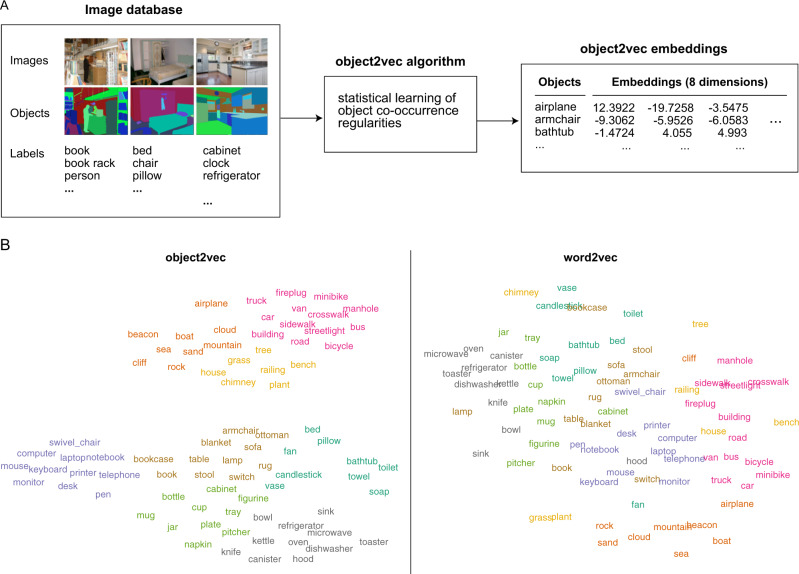
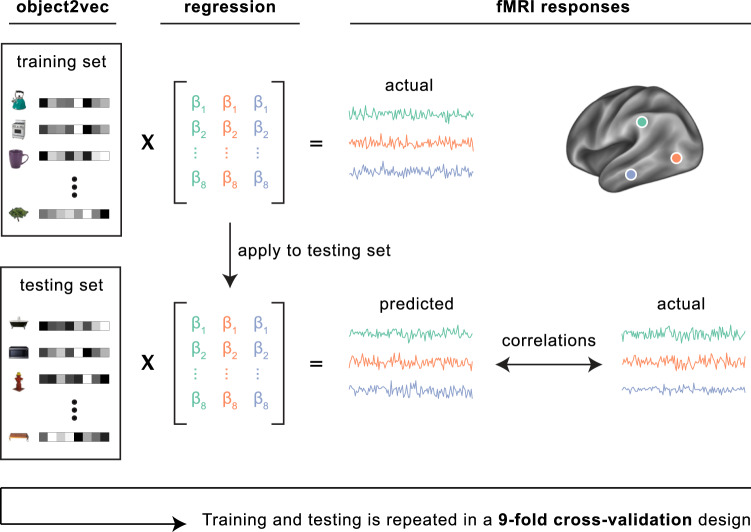
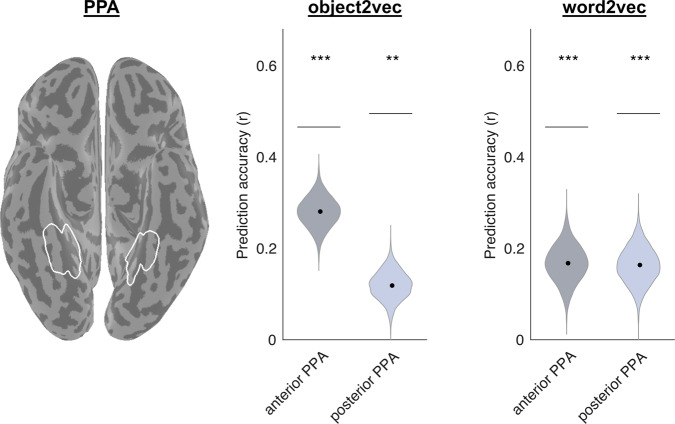
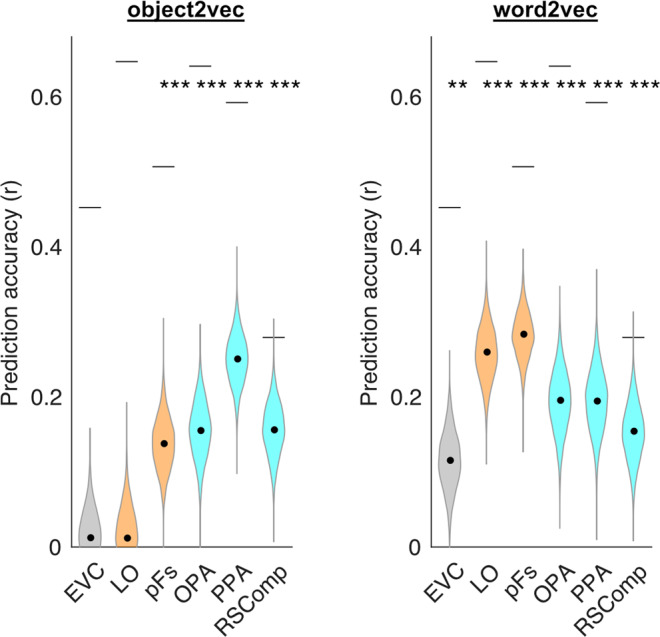
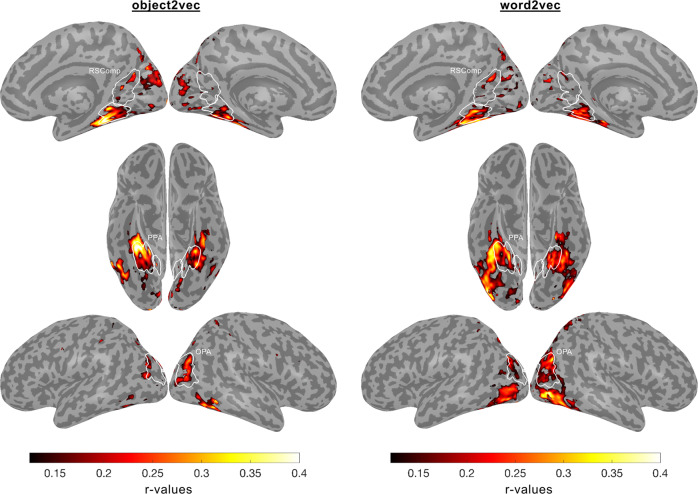
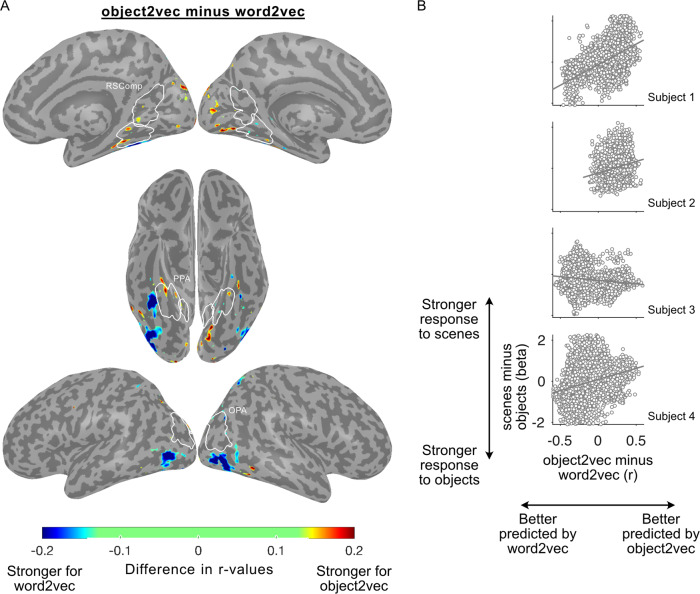
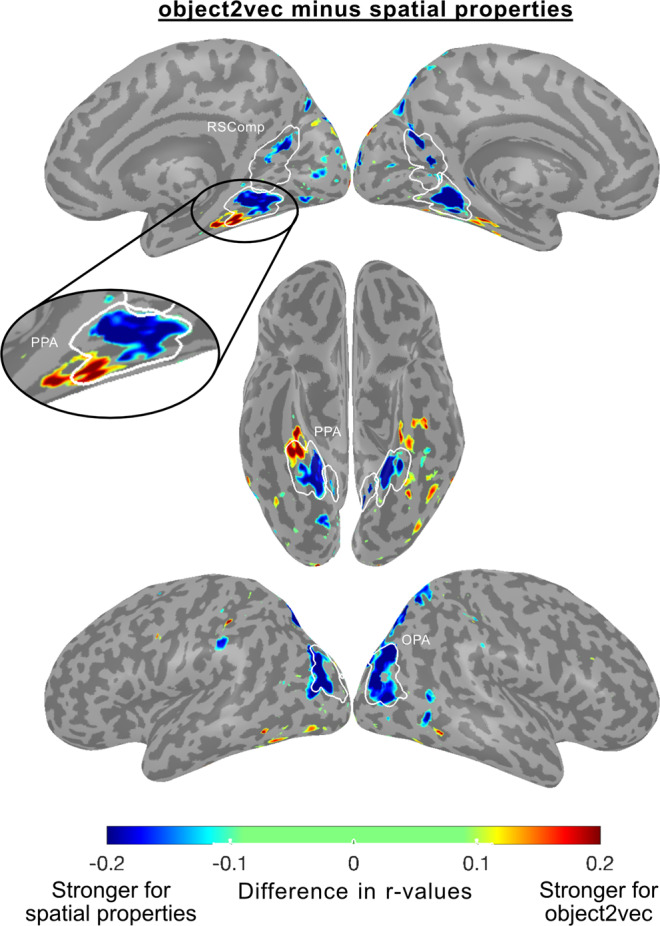
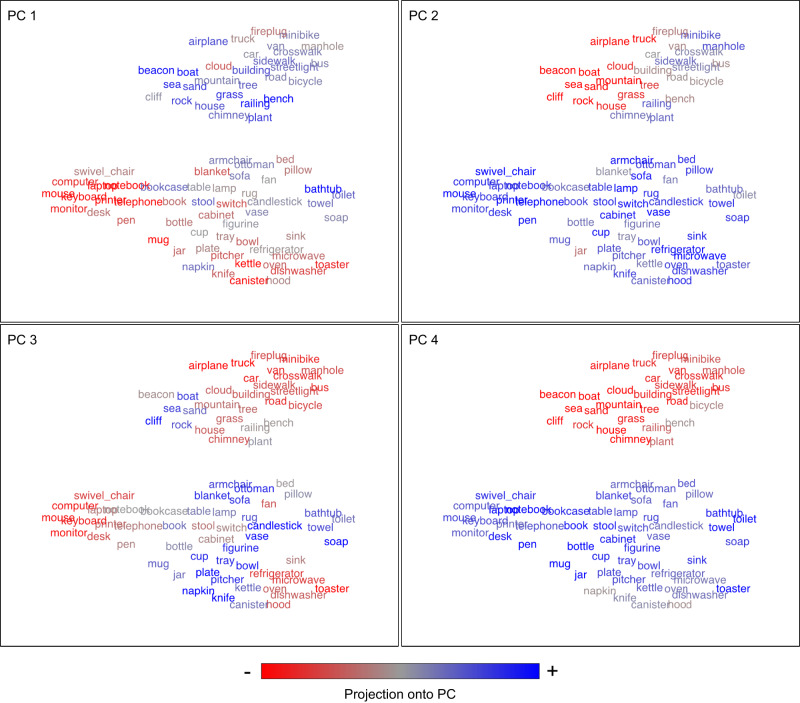
A central regularity of visual perception is the co-occurrence of objects in the natural environment. Here we use machine learning and fMRI to test the hypothesis that object co-occurrence statistics are encoded in the human visual system and elicited by the perception of individual objects. We identified low-dimensional representations that capture the latent statistical structure of object co-occurrence in real-world scenes, and we mapped these statistical representations onto voxel-wise fMRI responses during object viewing. We found that cortical responses to single objects were predicted by the statistical ensembles in which they typically occur, and that this link between objects and their visual contexts was made most strongly in parahippocampal cortex, overlapping with the anterior portion of scene-selective parahippocampal place area. In contrast, a language-based statistical model of the co-occurrence of object names in written text predicted responses in neighboring regions of object-selective visual cortex. Together, these findings show that the sensory coding of objects in the human brain reflects the latent statistics of object context in visual and linguistic experience.
Overview
The claims and statistics of this paper haven’t been checked yet.
Free: it reads the open-access text and checks the first 5 claims that cite a source we can check. Create a free account to check every claim.
Integrity signals
Registry
Cites
Statistics
Figures
Verification
Claims the paper makes
The claims and statistics of this paper haven’t been checked yet.
Free: it reads the open-access text and checks the first 5 claims that cite a source we can check. Create a free account to check every claim.
Claims other papers make about this one
Each is checked against this paper’s own text: does it say what the citing paper says it does?
The source backs part of the claim, not all of it — or backs it for a different population, condition or comparison.
In the citing paper
“Furthermore, recent studies have found a striking representational alignment between a wide variety of ANNs and the human brain, despite their having different architectures, network initializations, learning objectives, and even different modalities such as language and vision [12,15–22]”
From The Umwelt Representation Hypothesis: rethinking Universality (2026) · cites this paper as [15]
Experimental — accuracy not yet measured
Self-check
Percentages, sums and reported differences re-computed from the paper’s own numbers.
The self-check needs the paper’s full text.
Citations
Cites
Controlling the False Discovery Rate: A Practical and Powerful Approach to Multiple Testing
Benjamini, Y., & Hochberg, Y. (1995) · Journal of the Royal Statistical Society Series B: Statistical Methodology · doi:10.1111/j.2517-6161.1995.tb02031.x · Cited by 109,482
ImageNet: A large-scale hierarchical image database
Deng, J., Dong, W., Socher, R., Li, L.-J., Li, K., & Fei-Fei, L. (2009) · 2009 IEEE Conference on Computer Vision and Pattern Recognition · doi:10.1109/cvpr.2009.5206848 · Cited by 65,333
Efficient Estimation of Word Representations in Vector Space
Mikolov, T., Chen, K., Corrado, G., & Dean, J. (2013) · arXiv · doi:10.48550/arxiv.1301.3781 · Cited by 26,568
Distributed Representations of Words and Phrases and their Compositionality
Mikolov, T., Sutskever, I., Chen, K., Corrado, G., & Dean, J. (2013) · arXiv · doi:10.48550/arxiv.1310.4546 · Cited by 24,533
Enriching Word Vectors with Subword Information
Bojanowski, P., Grave, E., Joulin, A., & Mikolov, T. (2017) · Transactions of the Association for Computational Linguistics · doi:10.1162/tacl_a_00051 · Cited by 9,645
The free-energy principle: a unified brain theory?
Friston, K. (2010) · Nature Reviews Neuroscience · doi:10.1038/nrn2787 · Cited by 8,120
Proceedings of the 19th International Joint Conference on Artificial Intelligence
Pujol, J. M., Delgado, J., Ramon Sangüesa, A., & Flache, A. (2005) · International Joint Conference on Artificial Intelligence · Cited by 5,771
Emergence of simple-cell receptive field properties by learning a sparse code for natural images
Olshausen, B. A., & Field, D. J. (1996) · Nature · doi:10.1038/381607a0 · Cited by 5,694
A cortical representation of the local visual environment
Epstein, R., & Kanwisher, N. (1998) · Nature · doi:10.1038/33402 · Cited by 2,984
Self-citationNatural Image Statistics and Neural Representation
Simoncelli, E. P., & Olshausen, B. A. (2001) · Annual Review of Neuroscience · doi:10.1146/annurev.neuro.24.1.1193 · Cited by 2,460
Cited by
Hafri, A., & Firestone, C. (2021) · Trends in Cognitive Sciences · doi:10.1016/j.tics.2021.01.006 · Cited by 124
High-level visual representations in the human brain are aligned with large language models
Doerig, A., Kietzmann, T. C., Allen, E., Wu, Y., Naselaris, T., Kay, K., & Charest, I. (2025) · Nature Machine Intelligence · doi:10.1038/s42256-025-01072-0 · Cited by 175
“Studies of the neural basis of object context and relations have provided insight into the role of object co-occurrence statistics 16,17 , spatial and semantic interrelations among objects 18–21 , the context in which objects appear 22 and their typical locations in scenes 23–26 .”
Predictive processing of scenes and objects
Peelen, M. V., Berlot, E., & de Lange, F. P. (2023) · Nature Reviews Psychology · doi:10.1038/s44159-023-00254-0 · Cited by 73
“Moreover, voxelwise parahippocampal place area responses are more similar for isolated objects that are typically found in the same scene context than for objects that are found in different scene contexts 66 .”
How Does the “Default Mode” Network Contribute to Semantic Cognition?
Fernandino, L., & Binder, J. R. (2024) · Brain and Language · doi:10.1016/j.bandl.2024.105405 · Cited by 76
Three cortical scene systems and their development
Dilks, D. D., Kamps, F. S., & Persichetti, A. S. (2021) · Trends in Cognitive Sciences · doi:10.1016/j.tics.2021.11.002 · Cited by 76
“, with stronger responses or information processing in the anterior portion than the posterior one) [56,68,69].”
BackgroundColor-biased regions in the ventral visual pathway are food selective
Pennock, I., Racey, C., Allen, E., Wu, Y., Naselaris, T., Kay, K., Franklin, A., & Bosten, J. M. (2022) · Current Biology · doi:10.1016/j.cub.2022.11.063 · Cited by 79
Modeling short visual events through the BOLD moments video fMRI dataset and metadata
Lahner, B., Dwivedi, K., Iamshchinina, P., Graumann, M., Lascelles, A., Roig, G., Gifford, A. T., Pan, B., Jin, S., Murty, N. A. R., et al. (2024) · Nature Communications · doi:10.1038/s41467-024-50310-3 · Cited by 84
“122).”
High-performing neural network models of visual cortex benefit from high latent dimensionality
Elmoznino, E., & Bonner, M. F. (2024) · PLOS Computational Biology · doi:10.1371/journal.pcbi.1011792 · Cited by 49
Self-citationBrain-Inspired Learning, Perception, and Cognition: A Comprehensive Review
Jiao, L., Ma, M., He, P., Geng, X., Liu, X., Liu, F., Ma, W., Yang, S., Hou, B., & Tang, X. (2024) · IEEE Transactions on Neural Networks and Learning Systems · doi:10.1109/tnnls.2024.3401711 · Cited by 62
“For example, in [207], it has shown that the sensory coding of objects in the human brain reflects the underlying statistical data of the object context in visual and language experience.”
The human brain uses spatial schemas to represent segmented environments
Peer, M., & Epstein, R. A. (2021) · Current Biology · doi:10.1016/j.cub.2021.08.012 · Cited by 38
Self-citationNetwork representation learning systematic review: Ancestors and current development state
Amara, A., Taieb, M. A. H., & Aouicha, M. B. (2021) · Machine Learning with Applications · doi:10.1016/j.mlwa.2021.100130 · Cited by 37
Thornton, M. A., & Tamir, D. (2024) · Nature Communications · doi:10.1038/s41467-024-44870-7 · Cited by 37
“For instance, neural representations of visual objects re fl ect how frequently those objects co-occur in natural scenes: objects that often tend to co-occur elicit similar patterns of brain activity, even if they do not visually resemble each other 28 .”
BackgroundTransition dynamics shape mental state concepts.
Thornton, M. A., Rmus, M., Vyas, A. D., & Tamir, D. (2023) · Journal of Experimental Psychology General · doi:10.1037/xge0001405 · Cited by 30
“In doing so, the present study aligns with recent findings indicating that dynamics, such as co-occurrences and transition probabilities, shape the structure of representations in other domains such as objects (Bonner & Epstein, 2021) and motor sequences (Lynn et al., 2020).”
BackgroundResultHierarchical organization of objects in scenes is reflected in mental representations of objects
Turini, J., & Võ, M. L. ‐. (2022) · Scientific Reports · doi:10.1038/s41598-022-24505-x · Cited by 30
“…research on language) is becoming increasingly popular and provides interesting insights on learning statistical regularities in both vision an in language [22, 38), offering an alternative to traditionally employed categorical divisions based on experimente rs’ intuition or crowd-sourced ratings.”
BackgroundResultObjects guide human gaze behavior in dynamic real-world scenes
Roth, N., Rolfs, M., Hellwich, O., & Obermayer, K. (2023) · PLoS Computational Biology · doi:10.1371/journal.pcbi.1011512 · Cited by 28
Evidence for bidirectional causation between trait and mental state inferences
Lin, C., & Thornton, M. A. (2023) · Journal of Experimental Social Psychology · doi:10.1016/j.jesp.2023.104495 · Cited by 30
Recurrent connectivity supports higher-level visual and semantic object representations in the brain
von Seth, J., Nicholls, V. I., TYLER, L. K., & Clarke, A. (2023) · Communications Biology · doi:10.1038/s42003-023-05565-9 · Cited by 32
Different computational relations in language are captured by distinct brain systems
Fu, Z., Wang, X., Wang, X., Yang, H., Wang, J., Wei, T., Liao, X., Liu, Z., Chen, H., & Bi, Y. (2022) · Cerebral Cortex · doi:10.1093/cercor/bhac117 · Cited by 24
“This visual object result is aligned with recent findings of co-occurrence measures based on visual object2vec (Bonner and Epstein 2021), while our study further showed that it is the graph common structures shared between two objects that D o w n l oaded f r o m h tt p s :/ / a c ade m i c . oup .…”
MethodBracci, S., Mraz, J., Zeman, A. A., Leys, G., & de Beeck, H. O. (2023) · PLoS Computational Biology · doi:10.1371/journal.pcbi.1011086 · Cited by 22
“At the same time, statistical regularities of the world influence perception (11, 12, 13, 51 16), and interaction between object and scene processing has been shown at the neural level 52 (13-15, 33, 34, 87).”
BackgroundA Phone in a Basket Looks Like a Knife in a Cup: Role-Filler Independence in Visual Processing
Hafri, A., Bonner, M., Landau, B., & Firestone, C. (2024) · Open Mind · doi:10.1162/opmi_a_00146 · Cited by 21
“…perceptual processing of objects, their typical locations, and their relations with one another (e.g., where airplanes generally appear, or where mirrors appear relative to dressers; Kaiser et al., 2014, 2015, 2019; Võ, 2021; Võ et al., 2019; see also Bonner & Epstein, 2021; Kim & Biederman, 2011).”
BackgroundSelf-citationCarota, F., Nili, H., Kriegeskorte, N., & Pulvermüller, F. (2023) · Language Cognition and Neuroscience · doi:10.1080/23273798.2023.2232481 · Cited by 19
“…category-preferential visual and motor regions may take a role in representing distributional similarities for specific semantic word categories (Bonner & Epstein, 2021; Carlson et al., 2014; Carota et al., 2017; Hauk et al., 2004; Liuzzi et al., 2020; Mitchell et al., 2008; Popham et al.,…”
Universal dimensions of visual representation
Chen, Z., & Bonner, M. F. (2025) · Science Advances · doi:10.1126/sciadv.adw7697 · Cited by 16
“Previous work has shown that language-model embeddings of object names and scene captions are predictive of image representations in high-level visual cortex [4, 2, 6].”
Self-citationReilly, J. J., Finley, A. M., Litovsky, C. P., & Kenett, Y. N. (2023) · Journal of Experimental Psychology General · doi:10.1037/xge0001389 · Cited by 20
Nara, S., & KAISER, D. H. (2024) · Science Advances · doi:10.1126/sciadv.adi9294 · Cited by 20
“An interesting future avenue would be to not only compute the integration of purely visual information: For instance, future studies could also look at conceptual descriptors, for example using language models ( 66 , 67 ), to capture information integration in conceptual space for visual images.”
BackgroundConvolutional architectures are cortex-aligned de novo
Kazemian, A., Elmoznino, E., & Bonner, M. (2025) · Nature Machine Intelligence · doi:10.1038/s42256-025-01142-3 · Cited by 24
“This difference between the monkey and human data may be caused by several factors, such as differences in the stimulus sets and experimental tasks or representational differences across species, with human vision potentially placing a stronger emphasis on semantic associations 51–53 .”
Self-citationLiao, C., Sawayama, M., & Xiao, B. (2024) · PLoS Computational Biology · doi:10.1371/journal.pcbi.1012481 · Cited by 16
“Efforts were also made to explore how the brain encodes certain conceptual representations (e.g., objects, actions) elicited by visual and linguistic stimuli [15, 63].”
BackgroundGender Difference in Cognitive Function Among Stable Schizophrenia: A Network Perspective
Chen, M., Zhang, L., & Jiang, Q. (2022) · Neuropsychiatric Disease and Treatment · doi:10.2147/ndt.s393586 · Cited by 13
“Previous studies have shown that spatial and verbal cognition are separately managed by different brain regions,(52) although they often communicate with each other to participate in specific tasks together.(53) However, in this study, they showed a weak negative correlation, which further suggests that brain connecti…”
BackgroundSpatial Scene Memories Are Biased Towards a Fixed Amount of Semantic Information
Greene, M. R., & Trivedi, D. (2023) · Open Mind · doi:10.1162/opmi_a_00088 · Cited by 12
“Encoding models based on word2vec have shown to be helpful in predicting neural responses in object-selective cortex (Bonner & Epstein, 2021).”
MethodModelling brain representations of abstract concepts
KAISER, D. H., Jacobs, A. M., & Cichy, R. M. (2022) · PLoS Computational Biology · doi:10.1371/journal.pcbi.1009837 · Cited by 12
“Other studies have probed correspondences between language processing models and the brain through the use of encoding models [2,3,6,48,50].”
BackgroundHolm, E. L., Slezak, D. F., & Tagliazucchi, E. (2024) · NeuroImage · doi:10.1016/j.neuroimage.2024.120626 · Cited by 16
“Vision and language are key to these tasks, since they allow humans to identify objects from concrete or abstract representations, as well as to relay information about them to other humans (Bonner and Epstein, 2021).”
BackgroundVidanage, K., Noor, N. M. M., & Sathsara, S. (2024) · International Journal of Information Technology · doi:10.1007/s41870-024-01900-3 · Cited by 11
“…s / E v i d e n ce s R e fl ec ti on R e v i e w o f A I t ec hno l og i e s f o r p s y c ho t h e r a p e u ti c p r o ce du r e s B a y e s i a n T ec hno l og i e s [ 36 , 37 ] L o ca ti ng l a r g e d a t a s e t s i n t h e p s y c ho t h e r a p e u ti c do m a i n i s p r ob l e m a ti c .”
Neural decoding of speech with semantic-based classification
Lin, Y., & Hsieh, P. (2022) · Cortex · doi:10.1016/j.cortex.2022.05.018 · Cited by 11
“The presentation methods were motivated from Pereira et al. (2018) and Bonner and Epstein (2021).”
InfluentialDissociable contributions of the medial parietal cortex to recognition memory
Koslov, S. R., Kable, J. W., & Foster, B. L. (2024) · Journal of Neuroscience · doi:10.1523/jneurosci.2220-23.2024 · Cited by 10
Masotina, M., & Spagnolli, A. (2022) · Behaviour and Information Technology · doi:10.1080/0144929x.2022.2077234 · Cited by 10
“…context, we mean ‘ a set of situational elements in which the object being processed is included ’ (Bazire and Brézillon 2005), namely the environment in which that object is placed; that environment contributes to the process through which such element is made sense (e.g. Bonner and Epstein 2021).”
BackgroundSun, C., & Liu, F. (2024) · International Journal of Computational Intelligence Systems · doi:10.1007/s44196-024-00495-8 · Cited by 9
“We embed product descriptions using Word2Vec, following the deep learning literature [26–28].”
The timecourse of inter-object contextual facilitation
Quek, G. L., Theodorou, A., & Peelen, M. V. (2025) · Cortex · doi:10.1016/j.cortex.2025.05.020 · Cited by 7
Anchor objects drive realism while diagnostic objects drive categorization in GAN generated scenes
Kallmayer, A., & Võ, M. L. ‐. (2024) · Communications Psychology · doi:10.1038/s44271-024-00119-z · Cited by 6
Dymarska, A., & Connell, L. (2025) · Cognition · doi:10.1016/j.cognition.2025.106127 · Cited by 7
“Since concepts that occur in the same time or place are often encoded together in the language we use to describe the world around us (Bonner & Epstein, 2021; Connell, 2018; Goodhew et al., 2014; Louwerse, 2011; Louwerse & Zwaan, 2009), linguistic distributional statistics give rise to semantic…”
Li, D. S. P., & Bonner, M. (2021) · bioRxiv (Cold Spring Harbor Laboratory) · doi:10.1101/2021.09.24.461733 · Cited by 6
“See the original publication for a detailed description of these data (31).”
BackgroundMethodSelf-citationRelational Prior Knowledge Graphs for Detection and Instance Segmentation
Ülger, O., Wang, Y., Galama, Y., Karaoğlu, S., Gevers, T., & Oswald, M. R. (2023) · IEEE International Conference on Computer Vision Workshops · doi:10.1109/iccvw60793.2023.00012 · Cited by 6
Fine-Tuned BERT Algorithm-Based Automatic Query Expansion for Enhancing Document Retrieval System
Vishwakarma, D., & Kumar, S. (2024) · Cognitive Computation · doi:10.1007/s12559-024-10354-5 · Cited by 6
“Co-occurrence statistical information (CSI)-based key-word extraction technique examines both the distribution within the overall distribution and the distribution of words that occur together in the same phrases in order to identify meaningful terms [22].”
Context-Driven Visual Object Recognition Based on Knowledge Graphs
Monka, S., Halilaj, L., & Rettinger, A. (2022) · Lecture notes in computer science · doi:10.1007/978-3-031-19433-7_9 · Cited by 7
“Bonner et al. [6] recently showed that the sensory coding of objects in the ventral cortex of the human brain is related to statistical embeddings of object or word co-occurrences.”
BackgroundZhu, L. (2022) · Journal of Environmental and Public Health · doi:10.1155/2022/1757002 · Cited by 5
“In the appropriate natural context, the language organization and expression can arouse the resonance of the other party and achieve a better expression effect; in the cultural context, the expression of some words can only play their real role if they are expressed in a specific cultural context [17].”
BackgroundRetractedAccess to meaning from visual input: Object and word frequency effects in categorization behavior.Preprint
Gregorová, K., Turini, J., Gagl, B., & Võ, M. L. ‐. (2021) · PsyArXiv (OSF Preprints) · doi:10.31234/osf.io/37a9q · Cited by 5
A knowledge graph construction method based on co-occurrence for traffic entity prediction
Yin, Z., Chen, Y., Gu, J., Ying, S., & Guo, Y. C. (2025) · International Journal of Applied Earth Observation and Geoinformation · doi:10.1016/j.jag.2025.104717 · Cited by 4
Durteste, M., Delaux, A., Ariztégui, A., Cottereau, B. R., Sheynikhovich, D., Ramanoël, S., & Arleo, A. (2023) · bioRxiv (Cold Spring Harbor Laboratory) · doi:10.1101/2023.10.16.562507 · Cited by 6
Conceptual priorities shape individual gaze patterns during naturalistic visual attention
Haskins, A. J., Packard, K. O., & Robertson, C. E. (2026) · Proceedings of the National Academy of Sciences · doi:10.1073/pnas.2604369123 · Cited by 3
“Relatedly, the statistical structure of object co - occurrence in text and photographs has been shown to predict neural responses in object - selective and place - selective brain areas, respectively (42).”
Multi-Granularity Relation Enhancement Network for Tiny Defect Detection on Printed Circuit Board
Guo, F., Chen, Z., Chen, B., Jing, M., & Zuo, L. (2025) · IEEE Transactions on Instrumentation and Measurement · doi:10.1109/tim.2025.3597003 · Cited by 4
“Human visual mechanism has a natural inclination to group objects with similar co-occurrence or relevant information into the same category [18].”
Thorat, S., Doerig, A., Kroner, A., Amme, C., & Kietzmann, T. C. (2026) · Science Advances · doi:10.1126/sciadv.aee1955 · Cited by 4
“Ventral stream responses are sensitive to object co-occurrence ( 34,35 ) and spatial arrangement ( 36 ), and the parietal ROI overlaps with PPC/IPS regions sensitive to relative position and configural information ( 37, 38 ).”
Tour of a Map-Reader’s Brain, Part 4: Regions and Associations
Gersmehl, P. (2023) · The Geography Teacher · doi:10.1080/19338341.2023.2292124 · Cited by 3
“The term is awkward, because people in different disciplines have many other terms for the same basic idea, including co-occurrence, covariance, correlation, consociation, ecological connection, or spatial association (for example Bonner and Epstein 2021).”
BackgroundA distributional model of concepts grounded in the spatial organization of objects
de Varda, A. G., Petilli, M. A., & Marelli, M. (2025) · Journal of Memory and Language · doi:10.1016/j.jml.2025.104624 · Cited by 5
Characterizing internal models of the visual environment
Engeser, M., Ajith, S., Duymaz, İ., Wang, G., Foxwell, M. J., Cichy, R. M., Pitcher, D., & KAISER, D. H. (2025) · Proceedings of the Royal Society B Biological Sciences · doi:10.1098/rspb.2025.0602 · Cited by 4
“…started using computational analyses to determine typical scene properties more objectively, for example, by extracting object distributions across large scene databases [6,40,41], such approaches are still centred on the idea that the property selected by the researcher plays an important role.”
Spatiotemporal Representations of Contextual Associations for Real-World Objects
Yeh, L.-C., Peelen, M. V., & Kaiser, D. (2026) · Journal of Neuroscience · doi:10.1523/jneurosci.1967-25.2026 · Cited by 4
XGeoS-AI: an interpretable learning framework for deciphering geoscience image segmentation
Xu, J., Zhang, H., Tang, C., Li, L., & Shi, B. (2025) · Environmental Earth Sciences · doi:10.1007/s12665-025-12095-6 · Cited by 3
“2a, in the procedure of human decision in classifying vision signals, it often takes two steps to make an accurate decision (Bonner and Epstein 2021).”
Durteste, M., Liebi, L. R., Sapoval, E., Delaux, A., Arleo, A., & Ramanoël, S. (2023) · bioRxiv (Cold Spring Harbor Laboratory) · doi:10.1101/2023.10.18.562731 · Cited by 3
“The PPA is located on the ventral stream, it is selectively engaged during scene categorization and represents the summary statistics of scene content 36–39 .”
BackgroundKallmayer, A., Zacharias, L., Jetter, L., & Võ, M. L. ‐. (2024) · SSRN Electronic Journal · doi:10.2139/ssrn.5012214 · Cited by 3
van Dyck, L. E., & Dobs, K. (2026) · bioRxiv (Cold Spring Harbor Laboratory) · doi:10.64898/2026.02.16.706115 · Cited by 3
“This organization likely emerges from the combined pressures of task optimization for visual recognition (Dobs et al., 2022; G. R. Yang et al., 2019) and the co-occurrence statistics of natural images (Arcaro et al., 2020; Bonner & Epstein, 2021; Kaiser et al., 2019).”
The Umwelt Representation Hypothesis: rethinking Universality
Bosch, V., Sommers, R. P., Doerig, A., & Kietzmann, T. C. (2026) · Trends in Cognitive Sciences · doi:10.1016/j.tics.2026.07.004 · Cited by 2
Doyon, J., Shomstein, S., & Rosenblau, G. (2025) · Communications Psychology · doi:10.1038/s44271-025-00259-w · Cited by 2
Scene context is predictive of unconstrained object similarity judgments
Magri, C., Elmoznino, E., & Bonner, M. (2023) · Cognition · doi:10.1016/j.cognition.2023.105535 · Cited by 2
Self-citationMulti-modal Representation of the Size of Space in the Human Brain
Lee, J.-E., & Park, S. (2024) · Journal of Cognitive Neuroscience · doi:10.1162/jocn_a_02092 · Cited by 2
“…encodes scene features that are important for visually guided navigation, such as path direction, first-person motion, and distance to boundaries (Bonner & Epstein, 2021; Park & Park, 2020); the parahippocampal place area (PPA; Epstein & Kanwisher, 1998) encodes geometric spatial layout and…”
BackgroundLearning Object Semantic Similarity with Self-Supervision
Aubret, A., Schaumlöffel, T., Roig, G., & Triesch, J. (2024) · IEEE International Conference on Development and Learning (ICDL) · doi:10.1109/icdl61372.2024.10644930 · Cited by 5
“…slowness principle. b) Impact of visual co-occurrences on object representations: To learn object embeddings accounting for visual co-occurrences, [6] consider a scene dataset where all objects are labeled and learn embeddings by predicting objects present in a scene of a given object concept, in…”
BackgroundResultAssessing the Semantic Alignment in Multilingual Student-Teacher Concept Maps Using mBERT
Ariyanta, N. D., Prasetya, D. D., Zaeni, I. A. E., Hirashima, T., & Wicaksono, R. (2025) · Matrik Jurnal Manajemen Teknik Informatika dan Rekayasa Komputer · doi:10.30812/matrik.v25i1.5046 · Cited by 2
“Studies have shown that transformer-based models such as mBERT excel at tasks requiring contextual understanding, such as semantic similarity and text classification, especially when the input text is concise and well structured [31–33].”
SDLNet: Statistical Deep Learning Network for Co-Occurring Object Detection and Identification
Singh, B. K., & Lobo, N. D. V. (2024) · International Conference on Machine Learning Technologies (ICMLT) · doi:10.1145/3674029.3674055 · Cited by 1
“Relating to this in humans, visual cortex especially para hippocampal cortex is responsible for representing strong contextual associations [3] with other objects or locations in co-occurring objects.”
BackgroundProbing the content of semantic representations in body-selective regions
Yashiro, R., Sawayama, M., Yamashita, A., & Amano, K. (2026) · Imaging Neuroscience · doi:10.1162/imag.a.1309 · Cited by 2
“Another line of research has leveraged the statistical structure of object co-occurrence in natural scenes to generate embeddings for predicting brain responses ( Bonner & Epstein, 2021; Stansbury et al., 2013).”
Wu, Y., & Li, S. (2026) · PLoS Biology · doi:10.1371/journal.pbio.3003541 · Cited by 1
“Semantic: To model the semantic properties of the scene images, we employed the object2vec model [27], which is based on word2vec, a well-established algorithm in computational linguistics used to model the lexical-semantic properties of words based on their co-occurrence statistics [69].”
Simkova, K. M., Doerig, A., Hickey, C., & Charest, I. (2026) · Journal of Vision · doi:10.1167/jov.26.5.7 · Cited by 2
Kang, P., Chen, Z., Yang, C., Yang, S., Sun, S., Li, J., Ai, X., & Chen, H. (2026) · Advanced Materials · doi:10.1002/adma.74244 · Cited by 1
Co-occurrence statistics-based global and local feature learning for graph networks
Ye, F. (2023) · Soft Computing · doi:10.1007/s00500-023-08665-0 · Cited by 1
“…mainly uses the technology based on co-occurrence statistics which has been used for human-object interactions detecting (Kim et al. 2020), central regularity of visual perception (Bonner and Epstein 2021), fuzzy classifier for evaluation of research topics (Masoumi and Khajavi 2023) and so on.”
BackgroundMethodContextual coherence increases perceived numerosity independent of semantic content
Qu, C., Bonner, M., DeWind, N. K., & Brannon, E. M. (2023) · Journal of Vision · doi:10.1167/jov.23.9.5620 · Cited by 1
Self-citationModelling brain representations of abstract conceptsPreprint
KAISER, D. H., Jacobs, A. M., & Cichy, R. M. (2021) · bioRxiv (Cold Spring Harbor Laboratory) · doi:10.1101/2021.06.02.446744 · Cited by 1
Heimer‐McGinn, V., Trettel, S. G., Kent, B. W., Singh, M. A., & Burwell, R. D. (2022) · bioRxiv (Cold Spring Harbor Laboratory) · doi:10.1101/2022.06.23.497405 · Cited by 1
Contextual associations impact visual search across multiple processing stagesPreprint
Yeh, L.-C., Seferovic, B., Peelen, M. V., & KAISER, D. H. (2026) · SSRN Electronic Journal · doi:10.2139/ssrn.6144468 · Cited by 2
Cortical localization and dynamics of elementary mathematical conceptsPreprint
Debray, S., Karami, A., Valério, D., Cauté, M., Pallier, C., & Dehaene, S. (2026) · bioRxiv (Cold Spring Harbor Laboratory) · doi:10.64898/2026.04.30.721827 · Cited by 1
Turini, J., & Võ, M. L. ‐. (2022) · OSF Preprints (OSF Preprints) · doi:10.31219/osf.io/c2pxv
Turini, J. (2023) · Publication Server of Goethe University Frankfurt am Main (Goethe University Frankfurt) · doi:10.21248/gups.79588
Influence of visual processing on spatial memory and navigation in young and older adulthood
Durteste, M. (2023) · theses.fr (ABES) · doi:10.70675/bfb21aaez5e59z4f61z8abdz367a05eac771
Co-Occurring of Object Detection and Identification towards unlabeled object discoveryPreprint
Singh, B. K., & Lobo, N. D. V. (2024) · arXiv (Cornell University) · doi:10.48550/arxiv.2403.17223
“Our visual cortex, especially para hippocampal cortex is responsible for representing strong contextual associations ref [1] with other objects or locations in co-occurring objects.”
BackgroundCo-occurrence objects improve visual search precision in real-world scene through spatial memory
Liu, L., Zheng, Z., & Huang, J. (2024) · International Symposium on Visual Information Communication and Interaction (VINCI) · doi:10.1145/3678698.3678713
“Activation of the PPA by co-occurrence objects underscore its importance in situational memory [1, 2, 13].”
Towards Ecological Neuroscience
Zhang, Y. (2025) · Radboud University Press eBooks · doi:10.54195/9789465150666
Turini, J., & Võ, M. L. ‐. (2022) · OSF Preprints (OSF Preprints) · doi:10.31219/osf.io/c2pxv_v1
Image-Based Word Frequency Norms
Petilli, M. A., & Günther, F. (2025) · Elsevier eBooks · doi:10.1016/b978-0-323-95504-1.00859-0
Evolution of the ventral visual stream in primates
Froesel, M., Fitzgerald, N., Zhu, Q., & Vanduffel, W. (2025) · Elsevier eBooks · doi:10.1016/b978-0-443-27380-3.00047-6
Contextual associations of real-world objects guide attention in visual searchPreprint
Yeh, L.-C., Seferovic, B., Peelen, M. V., & KAISER, D. H. (2025) · bioRxiv (Cold Spring Harbor Laboratory) · doi:10.64898/2025.12.12.693961
Object Attention in Scene Perception and Memory
Hall, E. H. (2024) · eScholarship (California Digital Library)
Leferink, C. A., Damiano, C., & Walther, D. B. (2026) · Imaging Neuroscience · doi:10.1162/imag.a.1111
Zhang, Y., Tu, Y., Yin, Z., Zhang, J., Shi, W., Li, S., Dai, J., Hao, Y., & Jiang, T. (2026) · Research Square · doi:10.21203/rs.3.rs-8259624/v1
Spatio-Temporal Gaze Regularity-Guided Dynamic Fuzzy Bayesian Network for Intention Inference
Yin, Z., Wan, Z., Wu, S., Zhu, Q., Agaian, S. С., & Sun, X. W. (2026) · IEEE Transactions on Fuzzy Systems · doi:10.1109/tfuzz.2026.3651649
“Functional magnetic resonance imaging (fMRI) studies indicate that neural response preferences are organized to utilize limited computational resources efficiently, i.e., to transmit as much useful information as possible [24].”
Generating metamers of human scene understanding
Raina, R., Leite, A., Graikos, A., Ahn, S., Samaras, D., & Zelinsky, G. J. (2026) · PubMed · doi:10.48550/arxiv.2601.11675 · Cited by 1
“Understanding the latent representation of a scene formed by humans after viewing remains a fundamental unanswered challenge in cognitive science (Epstein & Baker, 2019; Bonner & Epstein, 2021; Malcolm et al., 2016; V˜o, 2021).”
Wang, R., Li, Y., Deb, M., Dudipala, K. R., Ravikanti, K., Chillarege, S., Bhanushali, A., Koushik, R., Katiyar, A., & Murty, N. A. R. (2026) · CHI Conference Extended Abstracts on Human Factors in Computing Systems (CHI EA) · doi:10.1145/3772363.3798548
“The current version of Cortex Canvas includes 126 widely used vision models (typically convolutional-[20] or transformer-[7, 27] based models), 6 public fMRI datasets [3, 4, 10, 18, 19, 28] for evaluation, and 2 fMRI datasets [1, 22] as training sources.”
Müller, N., Scholte, H. S., & Groen, I. I. A. (2026) · bioRxiv (Cold Spring Harbor Laboratory) · doi:10.64898/2026.04.24.720581
“Importantly, the human brain is sensitive to the co-occurrence statistic of objects in the real-world [26, 27, 28] Thus, it remains unclear whether neural processing of objects and scenes is also separated when both object and scene information are jointly presented, as during real-world visual…”
Antal, C., & de Almeida, R. G. (2026) · Behavior Research Methods · doi:10.3758/s13428-026-03069-y
Contextually Enhanced Unknown Aware Contrastive Learning-Based Co-Occurring Object Detection
Singh, B. K., & Lobo, N. D. V. (2026) · IEEE Access · doi:10.1109/access.2026.3718368 · Cited by 1
“Co-occurring object detection based on deep learning techniques such as [5] and [13] lacks proposal enhancement suited for robust prediction and adaptive discovery of unknown categories.”
Visual reasoning and retroduction: Redefining inference paradigm in cross-modal scenarios
Li, Y., Tang, X., & Hao, K. (2026) · Pattern Recognition · doi:10.1016/j.patcog.2026.114682
Wu, Y., Jiang, W., & Li, S. (2026) · bioRxiv (Cold Spring Harbor Laboratory) · doi:10.64898/2026.09.16.752038
“These included an object2vec model (Bonner & Epstein, 2021) based on co-occurrence statistics of NSD panoptic labels, an ANN model (VGG19) trained to classify image category from pixel values, and an MPNet model (Doerig et al., 2025) that use scene captions as input.”
Metadata
- Authors
- Bonner, M. F., & Epstein, R. A.
- Affiliations
- Johns Hopkins University (US)
- University of Pennsylvania (US)
- Corresponding author
- Bonner, Michael F.
- Venue
- Nature Communications
- Published
- 2021-07-02
- Volume
- 12
- Issue
- 1
- Pages
- 4081-4081
- ISSN
- 2041-1723 (ISSN-L)
- PMC
- PMC8253839
- OpenAlex
- W3174137462
- Cited by
- 96
- References
- 76
- Citations by year
- 2026: 15 · 2025: 17 · 2024: 18 · 2023: 25 · 2022: 14 · 2021: 7
- FWCI
- 8.41
- Type
- journal article
- Language
- en
- Open access
- gold
- doi.org
- Licence
- cc-by
- creativecommons.org/licenses/by/4.0 (tdm)
- creativecommons.org/licenses/by/4.0 (vor)
- Locations
- Nature Communications (publishedVersion, cc-by)
- bioRxiv (Cold Spring Harbor Laboratory) (acceptedVersion, cc-by-nc-nd)
- PubMed Central (publishedVersion, cc-by)
- PubMed (publishedVersion)
- RePEc: Research Papers in Economics (submittedVersion)
- DOAJ (DOAJ: Directory of Open Access Journals) (submittedVersion, cc-by-sa)
- OSF Preprints (OSF Preprints) (submittedVersion)
- Funders
- National Institutes of Health (EY022350)
- National Eye Institute (R01EY022350, P30EY001583)
- Topics
- Life Sciences › Neuroscience › Cognitive Neuroscience › Visual perception and processing mechanisms
- Life Sciences › Neuroscience › Cognitive Neuroscience › Face Recognition and Perception
- Social Sciences › Psychology › Experimental and Cognitive Psychology › Multisensory perception and integration
- Keywords
- statistical learning, object representation, parahippocampal place area, scene-selective cortex, visual context, language statistics, natural scene statistics, object perception
- MeSH terms
- Adult, Brain, Brain Mapping, Female, Humans, Language, Magnetic Resonance Imaging, Pattern Recognition, Visual, Perception, Visual Cortex, Visual Perception
About these checks
Registry, retraction, Cites and statistics results are computed, not judged, with one exception: a printed reference that no index lists is read once by a model before it counts as a citation error. Claims are extracted by a model and kept only when their quote appears verbatim in the text; each cited source is then checked, with a model’s help, for whether it says what the claim relies on. Those verdicts can be wrong — read the claim’s quote and the cited source before relying on one.
Statistics and arithmetic are recomputed, not judged.
Confidence bands are shown only for fields calibrated on our annotated test set. None is calibrated yet, so no band is shown.
What counts as a claim ›How we measure confidence ›How we check this ›
Are you an author, or do you see a problem with this page? Request a review
Data sources
Bibliographic data: Semantic Scholar, OpenAlex, Crossref.
Contains information from the Semantic Scholar Academic Graph Datasets, made available under the ODC Attribution License (ODC-BY 1.0).
Semantic Scholar’s data is described in: Kinney, R., et al. (2023). The Semantic Scholar Open Data Platform. arXiv:2301.10140.
