

Object representations in the human brain reflect the co-occurrence statistics of vision and language
Open accessPublished version of a preprint
The DOI matches its Crossref record; 76 of the 76 references it cites were found in a registry or an index.
Abstract
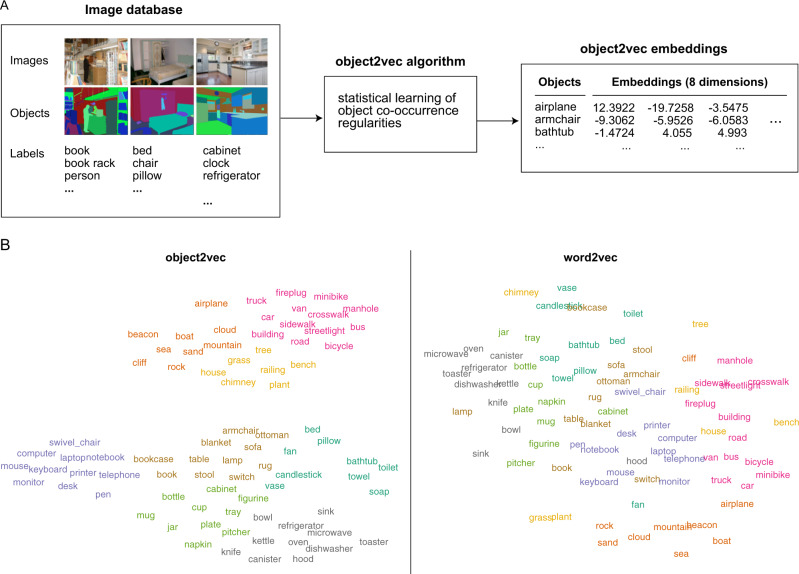
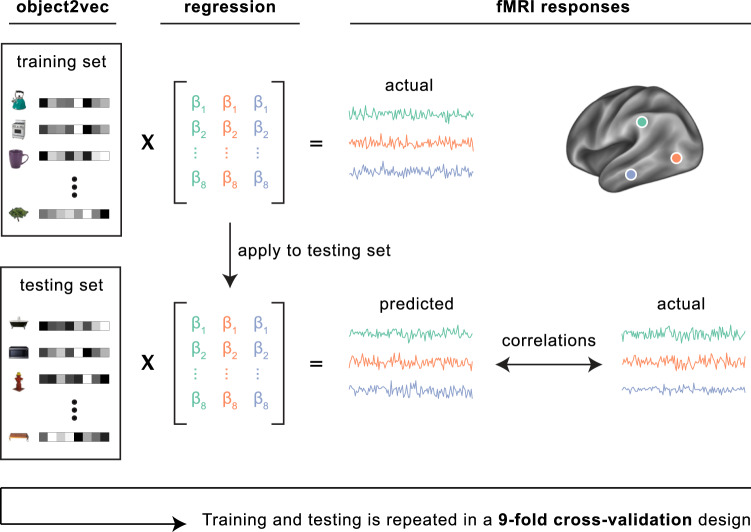
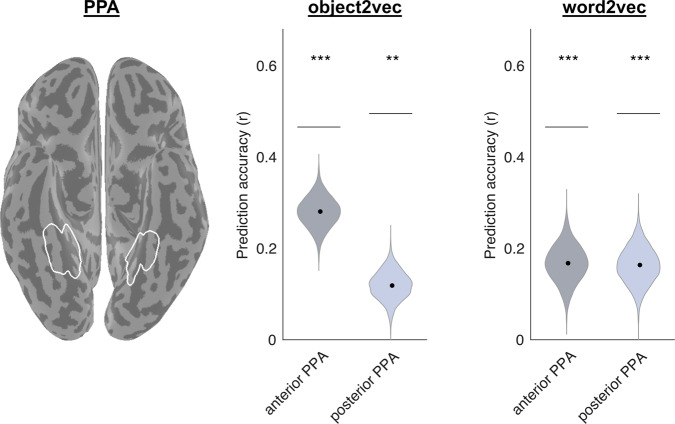
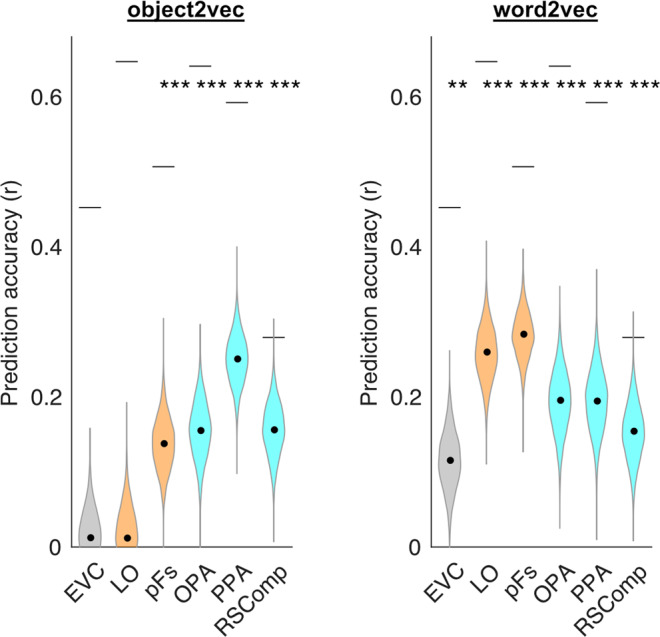
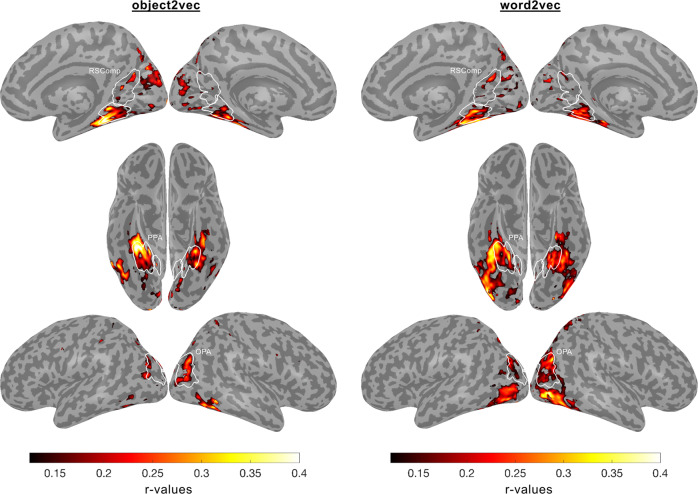
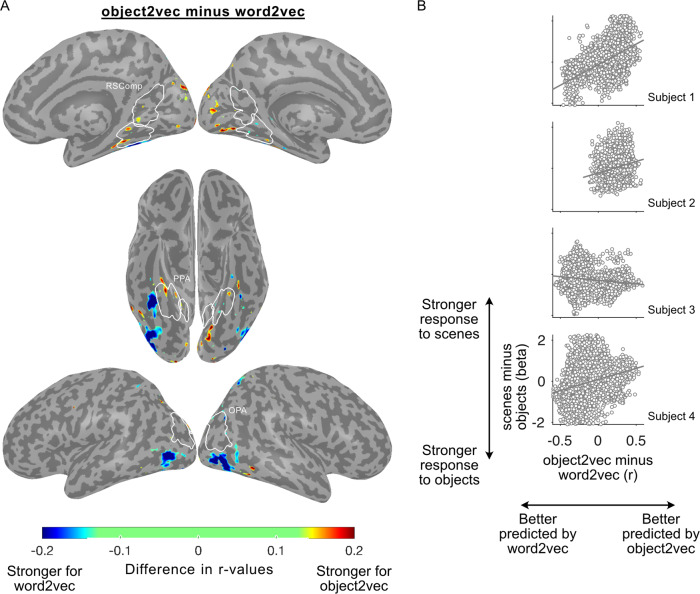
A central regularity of visual perception is the co-occurrence of objects in the natural environment. Here we use machine learning and fMRI to test the hypothesis that object co-occurrence statistics are encoded in the human visual system and elicited by the perception of individual objects. We identified low-dimensional representations that capture the latent statistical structure of object co-occurrence in real-world scenes, and we mapped these statistical representations onto voxel-wise fMRI responses during object viewing. We found that cortical responses to single objects were predicted by the statistical ensembles in which they typically occur, and that this link between objects and their visual contexts was made most strongly in parahippocampal cortex, overlapping with the anterior portion of scene-selective parahippocampal place area. In contrast, a language-based statistical model of the co-occurrence of object names in written text predicted responses in neighboring regions of object-selective visual cortex. Together, these findings show that the sensory coding of objects in the human brain reflects the latent statistics of object context in visual and linguistic experience.
Overview
The claims and statistics of this paper haven’t been checked yet.
Free: it reads the open-access text and checks the first 5 claims that cite a source we can check. Create a free account to check every claim.
Integrity signals
Registry
Cites
Statistics
Figures
Verification
Claims the paper makes
The claims and statistics of this paper haven’t been checked yet.
Free: it reads the open-access text and checks the first 5 claims that cite a source we can check. Create a free account to check every claim.
Claims other papers make about this one
Each is checked against this paper’s own text: does it say what the citing paper says it does?
The source backs part of the claim, not all of it — or backs it for a different population, condition or comparison.
In the citing paper
“Furthermore, recent studies have found a striking representational alignment between a wide variety of ANNs and the human brain, despite their having different architectures, network initializations, learning objectives, and even different modalities such as language and vision [12,15–22]”
From The Umwelt Representation Hypothesis: rethinking Universality (2026) · cites this paper as [15]
Experimental — accuracy not yet measured
Self-check
Percentages, sums and reported differences re-computed from the paper’s own numbers.
The self-check needs the paper’s full text.
Citations
Cites
Controlling the False Discovery Rate: A Practical and Powerful Approach to Multiple Testing
Benjamini, Y., & Hochberg, Y. (1995) · Journal of the Royal Statistical Society Series B: Statistical Methodology · doi:10.1111/j.2517-6161.1995.tb02031.x · Cited by 109,482
ImageNet: A large-scale hierarchical image database
Deng, J., Dong, W., Socher, R., Li, L.-J., Li, K., & Fei-Fei, L. (2009) · 2009 IEEE Conference on Computer Vision and Pattern Recognition · doi:10.1109/cvpr.2009.5206848 · Cited by 65,333
Efficient Estimation of Word Representations in Vector Space
Mikolov, T., Chen, K., Corrado, G., & Dean, J. (2013) · arXiv · doi:10.48550/arxiv.1301.3781 · Cited by 26,568
Distributed Representations of Words and Phrases and their Compositionality
Mikolov, T., Sutskever, I., Chen, K., Corrado, G., & Dean, J. (2013) · arXiv · doi:10.48550/arxiv.1310.4546 · Cited by 24,533
Enriching Word Vectors with Subword Information
Bojanowski, P., Grave, E., Joulin, A., & Mikolov, T. (2017) · Transactions of the Association for Computational Linguistics · doi:10.1162/tacl_a_00051 · Cited by 9,645
The free-energy principle: a unified brain theory?
Friston, K. (2010) · Nature Reviews Neuroscience · doi:10.1038/nrn2787 · Cited by 8,120
Proceedings of the 19th International Joint Conference on Artificial Intelligence
Pujol, J. M., Delgado, J., Ramon Sangüesa, A., & Flache, A. (2005) · International Joint Conference on Artificial Intelligence · Cited by 5,771
Emergence of simple-cell receptive field properties by learning a sparse code for natural images
Olshausen, B. A., & Field, D. J. (1996) · Nature · doi:10.1038/381607a0 · Cited by 5,694
A cortical representation of the local visual environment
Epstein, R., & Kanwisher, N. (1998) · Nature · doi:10.1038/33402 · Cited by 2,984
Self-citationNatural Image Statistics and Neural Representation
Simoncelli, E. P., & Olshausen, B. A. (2001) · Annual Review of Neuroscience · doi:10.1146/annurev.neuro.24.1.1193 · Cited by 2,460
Semantic Understanding of Scenes Through the ADE20K Dataset
Zhou, B., Zhao, H., Puig, X., Xiao, T., Fidler, S., Barriuso, A., & Torralba, A. (2019) · International Journal of Computer Vision · doi:10.1007/s11263-018-1140-0 · Cited by 1,831
Object-related activity revealed by functional magnetic resonance imaging in human occipital cortex.
Malach, R., Reppas, J. B., Benson, R. R., Kwong, K. K., Jiang, H., Kennedy, W. A., Ledden, P. J., Brady, T. J., Rosen, B. R., & Tootell, R. B. (1995) · Proceedings of the National Academy of Sciences · doi:10.1073/pnas.92.18.8135 · Cited by 1,761
Bar, M. (2004) · Nature Reviews Neuroscience · doi:10.1038/nrn1476 · Cited by 1,613
The Representation of Object Concepts in the Brain
Martin, A. (2007) · Annual Review of Psychology · doi:10.1146/annurev.psych.57.102904.190143 · Cited by 1,591
Grill-Spector, K., Kushnir, T., Edelman, S., Avidan, G., Itzchak, Y., & Malach, R. (1999) · Neuron · doi:10.1016/s0896-6273(00)80832-6 · Cited by 1,166
Scene perception: Detecting and judging objects undergoing relational violations
Biederman, I., Mezzanotte, R. J., & Rabinowitz, J. C. (1982) · Cognitive Psychology · doi:10.1016/0010-0285(82)90007-x · Cited by 1,056
The hippocampus as a predictive map
Stachenfeld, K. L., Botvinick, M. M., & Gershman, S. J. (2017) · Nature Neuroscience · doi:10.1038/nn.4650 · Cited by 1,000
Multimodal Distributional Semantics
Bruni, E., Tran, N. K., & Baroni, M. (2014) · Journal of Artificial Intelligence Research · doi:10.1613/jair.4135 · Cited by 908
The role of the parahippocampal cortex in cognition
Aminoff, E. M., Kveraga, K., & Bar, M. (2013) · Trends in Cognitive Sciences · doi:10.1016/j.tics.2013.06.009 · Cited by 855
Visual Perception and the Statistical Properties of Natural Scenes
Geisler, W. S. (2008) · Annual Review of Psychology · doi:10.1146/annurev.psych.58.110405.085632 · Cited by 677
A Common, High-Dimensional Model of the Representational Space in Human Ventral Temporal Cortex
Haxby, J. V., Guntupalli, J. S., Connolly, A. C., Halchenko, Y. O., Conroy, B. R., Gobbini, M. I., Hanke, M., & Ramadge, P. J. (2011) · Neuron · doi:10.1016/j.neuron.2011.08.026 · Cited by 648
The effects of contextual scenes on the identification of objects
Palmer, S. E. (1975) · Memory & Cognition · doi:10.3758/bf03197524 · Cited by 646
The Code for Facial Identity in the Primate Brain
Chang, L., & Tsao, D. Y. (2017) · Cell · doi:10.1016/j.cell.2017.05.011 · Cited by 644
Cortical Analysis of Visual Context
Bar, M., & Aminoff, E. (2003) · Neuron · doi:10.1016/s0896-6273(03)00167-3 · Cited by 625
Scene Consistency in Object and Background Perception
Davenport, J. L., & Potter, M. C. (2004) · Psychological Science · doi:10.1111/j.0956-7976.2004.00719.x · Cited by 552
Top-Down Attentional Guidance Based on Implicit Learning of Visual Covariation
Chun, M. M., & Jiang, Y. (1999) · Psychological Science · doi:10.1111/1467-9280.00168 · Cited by 500
The proactive brain: memory for predictions
Bar, M. (2009) · Philosophical Transactions of the Royal Society B: Biological Sciences · doi:10.1098/rstb.2008.0310 · Cited by 498
A Real-World Size Organization of Object Responses in Occipitotemporal Cortex
Konkle, T., & Oliva, A. (2012) · Neuron · doi:10.1016/j.neuron.2012.04.036 · Cited by 458
Distributional Models of Word Meaning
Lenci, A. (2018) · Annual Review of Linguistics · doi:10.1146/annurev-linguistics-030514-125254 · Cited by 447
Scene Perception in the Human Brain
Epstein, R. A., & Baker, C. I. (2019) · Annual Review of Vision Science · doi:10.1146/annurev-vision-091718-014809 · Cited by 347
Self-citationThe Parahippocampal Cortex Mediates Spatial and Nonspatial Associations
Aminoff, E., Gronau, N., & Bar, M. (2007) · Cerebral Cortex · doi:10.1093/cercor/bhl078 · Cited by 345
A functional and perceptual signature of the second visual area in primates
Freeman, J., Ziemba, C. M., Heeger, D. J., Simoncelli, E. P., & Movshon, J. A. (2013) · Nature Neuroscience · doi:10.1038/nn.3402 · Cited by 340
An algorithmic method for functionally defining regions of interest in the ventral visual pathway
Julian, J. B., Fedorenko, E., Webster, J., & Kanwisher, N. (2012) · NeuroImage · doi:10.1016/j.neuroimage.2012.02.055 · Cited by 334
How the hippocampus preserves order: the role of prediction and context
Davachi, L., & DuBrow, S. (2015) · Trends in Cognitive Sciences · doi:10.1016/j.tics.2014.12.004 · Cited by 328
Linking pattern completion in the hippocampus to predictive coding in visual cortex
Hindy, N. C., Ng, F. Y., & Turk-Browne, N. B. (2016) · Nature Neuroscience · doi:10.1038/nn.4284 · Cited by 246
Bar, M., Aminoff, E., & Schacter, D. L. (2008) · The Journal of Neuroscience · doi:10.1523/jneurosci.0987-08.2008 · Cited by 245
Mid-level visual features underlie the high-level categorical organization of the ventral stream
Long, B., Yu, C.-P., & Konkle, T. (2018) · Proceedings of the National Academy of Sciences · doi:10.1073/pnas.1719616115 · Cited by 243
Henderson, J. M. (2017) · Trends in Cognitive Sciences · doi:10.1016/j.tics.2016.11.003 · Cited by 201
A New Role for the Parahippocampal Cortex in Representing Space
Mullally, S. L., & Maguire, E. A. (2011) · The Journal of Neuroscience · doi:10.1523/jneurosci.0267-11.2011 · Cited by 197
Rajimehr, R., Devaney, K. J., Bilenko, N. Y., Young, J. C., & Tootell, R. B. H. (2011) · PLoS Biology · doi:10.1371/journal.pbio.1000608 · Cited by 187
Constructing scenes from objects in human occipitotemporal cortex
MacEvoy, S. P., & Epstein, R. A. (2011) · Nature Neuroscience · doi:10.1038/nn.2903 · Cited by 180
Self-citationThinking Outside the Box: Rectilinear Shapes Selectively Activate Scene-Selective Cortex
Nasr, S., Echavarria, C. E., & Tootell, R. B. H. (2014) · The Journal of Neuroscience · doi:10.1523/jneurosci.4802-13.2014 · Cited by 171
Object Vision in a Structured World
Kaiser, D., Quek, G. L., Cichy, R. M., & Peelen, M. V. (2019) · Trends in Cognitive Sciences · doi:10.1016/j.tics.2019.04.013 · Cited by 169
Interaction between Scene and Object Processing Revealed by Human fMRI and MEG Decoding
Brandman, T., & Peelen, M. V. (2017) · The Journal of Neuroscience · doi:10.1523/jneurosci.0582-17.2017 · Cited by 168
Image statistics underlying natural texture selectivity of neurons in macaque V4
Okazawa, G., Tajima, S., & Komatsu, H. (2015) · Proceedings of the National Academy of Sciences · doi:10.1073/pnas.1415146112 · Cited by 167
Differential connectivity within the Parahippocampal Place Area
Baldassano, C., Beck, D. M., & Fei-Fei, L. (2013) · NeuroImage · doi:10.1016/j.neuroimage.2013.02.073 · Cited by 167
Natural Scene Statistics Account for the Representation of Scene Categories in Human Visual Cortex
Stansbury, D. E., Naselaris, T., & Gallant, J. L. (2013) · Neuron · doi:10.1016/j.neuron.2013.06.034 · Cited by 160
Two distinct scene processing networks connecting vision and memory
Baldassano, C., Esteva, A., Fei-Fei, L., & Beck, D. M. (2016) · eneuro · doi:10.1523/eneuro.0178-16.2016 · Cited by 144
Multiple Object Properties Drive Scene-Selective Regions
Troiani, V., Stigliani, A., Smith, M. E., & Epstein, R. A. (2014) · Cerebral Cortex · doi:10.1093/cercor/bhs364 · Cited by 138
Self-citationBracci, S., Ritchie, J. B., & de Beeck, H. O. (2017) · Neuropsychologia · doi:10.1016/j.neuropsychologia.2017.06.010 · Cited by 129
Outside Looking In: Landmark Generalization in the Human Navigational System
Marchette, S. A., Vass, L. K., Ryan, J., & Epstein, R. A. (2015) · The Journal of Neuroscience · doi:10.1523/jneurosci.2270-15.2015 · Cited by 123
Self-citationStatistics of high-level scene context
Greene, M. R. (2013) · Frontiers in Psychology · doi:10.3389/fpsyg.2013.00777 · Cited by 114
Stojanoski, B., & Cusack, R. (2014) · Journal of Vision · doi:10.1167/14.12.6 · Cited by 112
The Emergence of Semantic Meaning in the Ventral Temporal Pathway
Carlson, T. A., Simmons, R. A., Kriegeskorte, N., & Slevc, L. R. (2014) · Journal of Cognitive Neuroscience · doi:10.1162/jocn_a_00458 · Cited by 111
A Cardinal Orientation Bias in Scene-Selective Visual Cortex
Nasr, S., & Tootell, R. B. H. (2012) · The Journal of Neuroscience · doi:10.1523/jneurosci.2036-12.2012 · Cited by 109
How Reliable Are Visual Context Effects in the Parahippocampal Place Area?
Epstein, R. A., & Ward, E. J. (2010) · Cerebral Cortex · doi:10.1093/cercor/bhp099 · Cited by 106
Self-citationCortical representations of bodies and faces are strongest in commonly experienced configurations
Chan, A. W.-Y., Kravitz, D. J., Truong, S., Arizpe, J., & Baker, C. I. (2010) · Nature Neuroscience · doi:10.1038/nn.2502 · Cited by 104
Bankson, B., Hebart, M. N., Groen, I. I. A., & Baker, C. I. (2018) · NeuroImage · doi:10.1016/j.neuroimage.2018.05.037 · Cited by 100
The hippocampus as a visual area organized by space and time: A spatiotemporal similarity hypothesis
Turk‐Browne, N. B. (2019) · Vision Research · doi:10.1016/j.visres.2019.10.007 · Cited by 99
Sadeghi, Z., McClelland, J. L., & Hoffman, P. (2014) · Neuropsychologia · doi:10.1016/j.neuropsychologia.2014.08.031 · Cited by 82
Sociality and interaction envelope organize visual action representations
Tarhan, L., & Konkle, T. (2020) · Nature Communications · doi:10.1038/s41467-020-16846-w · Cited by 72
Reinforcement learning, efficient coding, and the statistics of natural tasks
Botvinick, M., Weinstein, A., Solway, A., & Barto, A. G. (2015) · Current Opinion in Behavioral Sciences · doi:10.1016/j.cobeha.2015.08.009 · Cited by 70
Silson, E. H., Gilmore, A. W., Kalinowski, S. E., Steel, A., Kidder, A., Martin, A., & Baker, C. I. (2019) · The Journal of Neuroscience · doi:10.1523/jneurosci.1219-18.2018 · Cited by 67
Coding of Object Size and Object Category in Human Visual Cortex
Julian, J. B., Ryan, J., & Epstein, R. A. (2016) · Cerebral Cortex · doi:10.1093/cercor/bhw150 · Cited by 59
Self-citationDifferential Connectivity Within the Parahippocampal Place Area
Baldassano, C., Beck, D. M., & Fei-Fei, L. (2013) · Journal of Vision · doi:10.1167/13.9.1096 · Cited by 53
Reliability-based voxel selection
Tarhan, L., & Konkle, T. (2020) · NeuroImage · doi:10.1016/j.neuroimage.2019.116350 · Cited by 53
Object Recognition with and without Objects
Zhu, Z., Xie, L., & Yuille, A. (2017) · Proceedings of the Twenty-Sixth International Joint Conference on Artificial Intelligence · doi:10.24963/ijcai.2017/505 · Cited by 50
Neural Representations of Contextual Guidance in Visual Search of Real-World Scenes
Preston, T. J., Guo, F., Das, K., Giesbrecht, B., & Eckstein, M. P. (2013) · Journal of Neuroscience · doi:10.1523/jneurosci.5840-12.2013 · Cited by 48
Semantics of the Visual Environment Encoded in Parahippocampal Cortex
Bonner, M. F., Price, A. R., Peelle, J. E., & Grossman, M. (2016) · Journal of Cognitive Neuroscience · doi:10.1162/jocn_a_00908 · Cited by 45
Self-citationScene content is predominantly conveyed by high spatial frequencies in scene-selective visual cortex
Berman, D., Golomb, J. D., & Walther, D. B. (2017) · PLOS ONE · doi:10.1371/journal.pone.0189828 · Cited by 41
Bryan, P. B., Julian, J. B., & Epstein, R. A. (2016) · Frontiers in Human Neuroscience · doi:10.3389/fnhum.2016.00137 · Cited by 35
Self-citationKAISER, D. H., & Cichy, R. M. (2018) · Journal of Neurophysiology · doi:10.1152/jn.00229.2018 · Cited by 35
Bainbridge, W. A., & Oliva, A. (2015) · NeuroImage · doi:10.1016/j.neuroimage.2015.07.066 · Cited by 32
Capturing and measuring thematic relatedness
Kacmajor, M., & Kelleher, J. D. (2019) · Language Resources and Evaluation · doi:10.1007/s10579-019-09452-w · Cited by 28
Typical visual-field locations facilitate access to awareness for everyday objects
KAISER, D. H., & Cichy, R. M. (2018) · Cognition · doi:10.1016/j.cognition.2018.07.009 · Cited by 25
Signposts in the Fog: Objects Facilitate Scene Representations in Left Scene-selective Cortex
Brandman, T., & Peelen, M. V. (2018) · Journal of Cognitive Neuroscience · doi:10.1162/jocn_a_01258 · Cited by 24
Cited by
Hafri, A., & Firestone, C. (2021) · Trends in Cognitive Sciences · doi:10.1016/j.tics.2021.01.006 · Cited by 124
High-level visual representations in the human brain are aligned with large language models
Doerig, A., Kietzmann, T. C., Allen, E., Wu, Y., Naselaris, T., Kay, K., & Charest, I. (2025) · Nature Machine Intelligence · doi:10.1038/s42256-025-01072-0 · Cited by 175
“Studies of the neural basis of object context and relations have provided insight into the role of object co-occurrence statistics 16,17 , spatial and semantic interrelations among objects 18–21 , the context in which objects appear 22 and their typical locations in scenes 23–26 .”
Predictive processing of scenes and objects
Peelen, M. V., Berlot, E., & de Lange, F. P. (2023) · Nature Reviews Psychology · doi:10.1038/s44159-023-00254-0 · Cited by 73
“Moreover, voxelwise parahippocampal place area responses are more similar for isolated objects that are typically found in the same scene context than for objects that are found in different scene contexts 66 .”
How Does the “Default Mode” Network Contribute to Semantic Cognition?
Fernandino, L., & Binder, J. R. (2024) · Brain and Language · doi:10.1016/j.bandl.2024.105405 · Cited by 76
Three cortical scene systems and their development
Dilks, D. D., Kamps, F. S., & Persichetti, A. S. (2021) · Trends in Cognitive Sciences · doi:10.1016/j.tics.2021.11.002 · Cited by 76
“, with stronger responses or information processing in the anterior portion than the posterior one) [56,68,69].”
Background
Metadata
- Authors
- Bonner, M. F., & Epstein, R. A.
- Affiliations
- Johns Hopkins University (US)
- University of Pennsylvania (US)
- Corresponding author
- Bonner, Michael F.
- Venue
- Nature Communications
- Published
- 2021-07-02
- Volume
- 12
- Issue
- 1
- Pages
- 4081-4081
- ISSN
- 2041-1723 (ISSN-L)
- PMC
- PMC8253839
- OpenAlex
- W3174137462
- Cited by
- 96
- References
- 76
- Citations by year
- 2026: 15 · 2025: 17 · 2024: 18 · 2023: 25 · 2022: 14 · 2021: 7
- FWCI
- 8.41
- Type
- journal article
- Language
- en
- Open access
- gold
- doi.org
- Licence
- cc-by
- creativecommons.org/licenses/by/4.0 (tdm)
- creativecommons.org/licenses/by/4.0 (vor)
- Locations
- Nature Communications (publishedVersion, cc-by)
- bioRxiv (Cold Spring Harbor Laboratory) (acceptedVersion, cc-by-nc-nd)
- PubMed Central (publishedVersion, cc-by)
- PubMed (publishedVersion)
- RePEc: Research Papers in Economics (submittedVersion)
- DOAJ (DOAJ: Directory of Open Access Journals) (submittedVersion, cc-by-sa)
- OSF Preprints (OSF Preprints) (submittedVersion)
- Funders
- National Institutes of Health (EY022350)
- National Eye Institute (R01EY022350, P30EY001583)
- Topics
- Life Sciences › Neuroscience › Cognitive Neuroscience › Visual perception and processing mechanisms
- Life Sciences › Neuroscience › Cognitive Neuroscience › Face Recognition and Perception
- Social Sciences › Psychology › Experimental and Cognitive Psychology › Multisensory perception and integration
- Keywords
- statistical learning, object representation, parahippocampal place area, scene-selective cortex, visual context, language statistics, natural scene statistics, object perception
- MeSH terms
- Adult, Brain, Brain Mapping, Female, Humans, Language, Magnetic Resonance Imaging, Pattern Recognition, Visual, Perception, Visual Cortex, Visual Perception
About these checks
Registry, retraction, Cites and statistics results are computed, not judged, with one exception: a printed reference that no index lists is read once by a model before it counts as a citation error. Claims are extracted by a model and kept only when their quote appears verbatim in the text; each cited source is then checked, with a model’s help, for whether it says what the claim relies on. Those verdicts can be wrong — read the claim’s quote and the cited source before relying on one.
Statistics and arithmetic are recomputed, not judged.
Confidence bands are shown only for fields calibrated on our annotated test set. None is calibrated yet, so no band is shown.
What counts as a claim ›How we measure confidence ›How we check this ›
Are you an author, or do you see a problem with this page? Request a review
Data sources
Bibliographic data: Semantic Scholar, OpenAlex, Crossref.
Contains information from the Semantic Scholar Academic Graph Datasets, made available under the ODC Attribution License (ODC-BY 1.0).
Semantic Scholar’s data is described in: Kinney, R., et al. (2023). The Semantic Scholar Open Data Platform. arXiv:2301.10140.
