

Unsupervised deep learning identifies semantic disentanglement in single inferotemporal face patch neurons
Open accessThe DOI matches its Crossref record; 64 of the 64 references it cites were found in a registry or an index.
Abstract
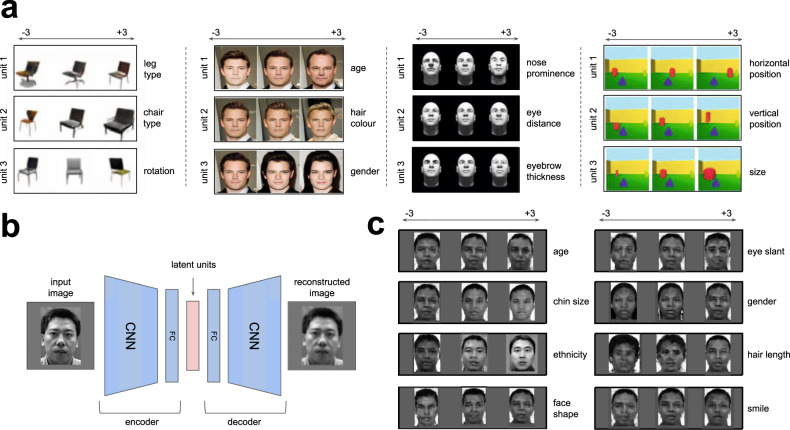
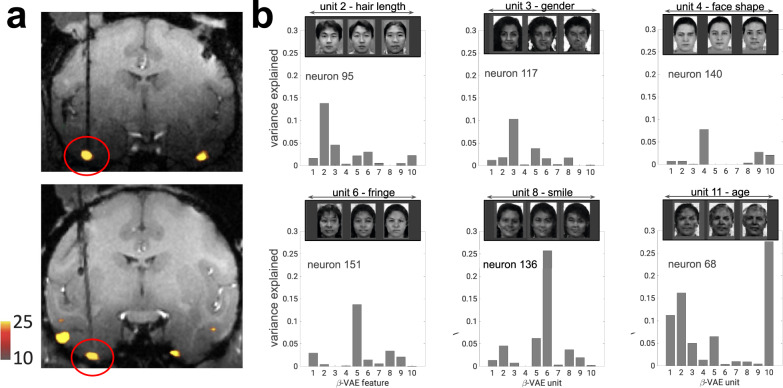
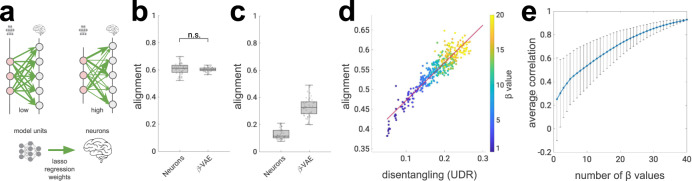
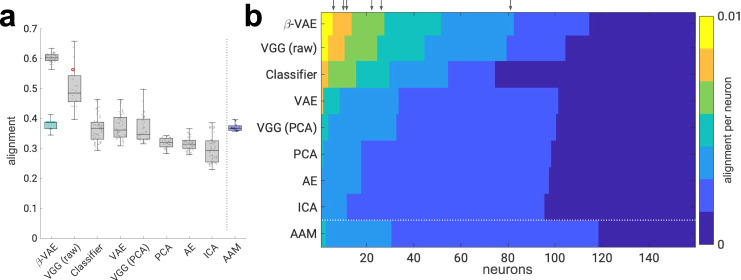
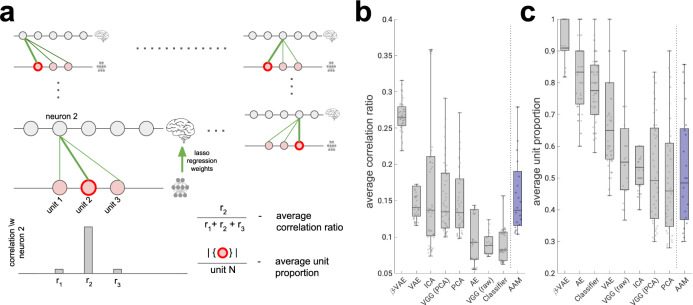
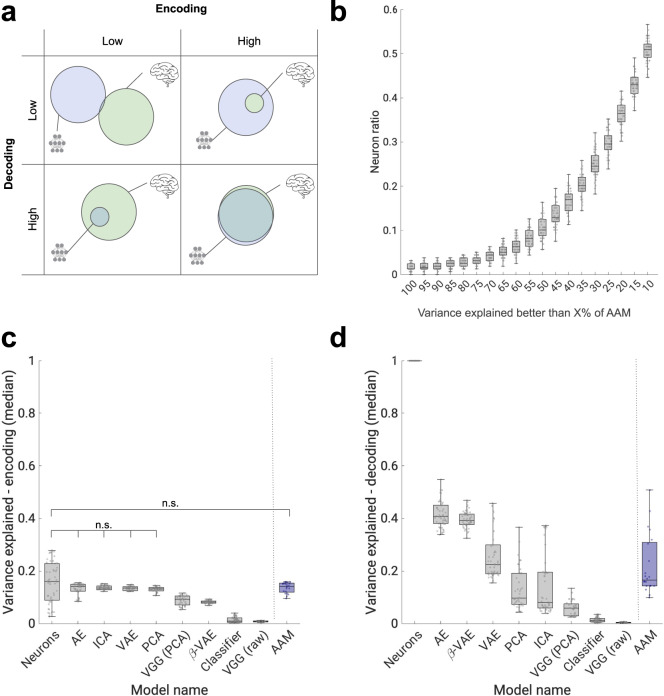
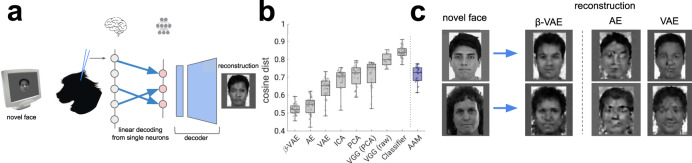
In order to better understand how the brain perceives faces, it is important to know what objective drives learning in the ventral visual stream. To answer this question, we model neural responses to faces in the macaque inferotemporal (IT) cortex with a deep self-supervised generative model, β -VAE, which disentangles sensory data into interpretable latent factors, such as gender or age. Our results demonstrate a strong correspondence between the generative factors discovered by β -VAE and those coded by single IT neurons, beyond that found for the baselines, including the handcrafted state-of-the-art model of face perception, the Active Appearance Model, and deep classifiers. Moreover, β -VAE is able to reconstruct novel face images using signals from just a handful of cells. Together our results imply that optimising the disentangling objective leads to representations that closely resemble those in the IT at the single unit level. This points at disentangling as a plausible learning objective for the visual brain.
Overview
The claims and statistics of this paper haven’t been checked yet.
Free: it reads the open-access text and checks the first 5 claims that cite a source we can check. Create a free account to check every claim.
Integrity signals
Registry
Cites
Statistics
Figures
Verification
Claims the paper makes
The claims and statistics of this paper haven’t been checked yet.
Free: it reads the open-access text and checks the first 5 claims that cite a source we can check. Create a free account to check every claim.
Claims other papers make about this one
Each is checked against this paper’s own text: does it say what the citing paper says it does?
The source backs part of the claim, not all of it — or backs it for a different population, condition or comparison.
In the citing paper
“Thus, managing the trade-off between latent variable compression and motor performance 25,56 may structure neural variability in ways that are distinct from previously hypothesized mechanisms like signal-dependent noise 54 or energy constraints 7.”
From A virtual rodent predicts the structure of neural activity across behaviours (2024) · cites this paper as [25]
Experimental — accuracy not yet measuredThe source backs part of the claim, not all of it — or backs it for a different population, condition or comparison.
In the citing paper
“suggesting a link between mechanisms for robustness and generalizability (see also 25,56).”
From A virtual rodent predicts the structure of neural activity across behaviours (2024) · cites this paper as [25]
Experimental — accuracy not yet measured
Self-check
Percentages, sums and reported differences re-computed from the paper’s own numbers.
The self-check needs the paper’s full text.
Citations
Cites
Reducing the dimensionality of data with neural networks
Hinton, G. E., & Salakhutdinov, R. R. (2006) · Science · doi:10.1126/science.1127647 · Cited by 20,928
Auto-Encoding Variational Bayes
Kingma, D. P., & Welling, M. (2013) · arXiv · doi:10.48550/arxiv.1312.6114 · Cited by 20,067 · cited 3×
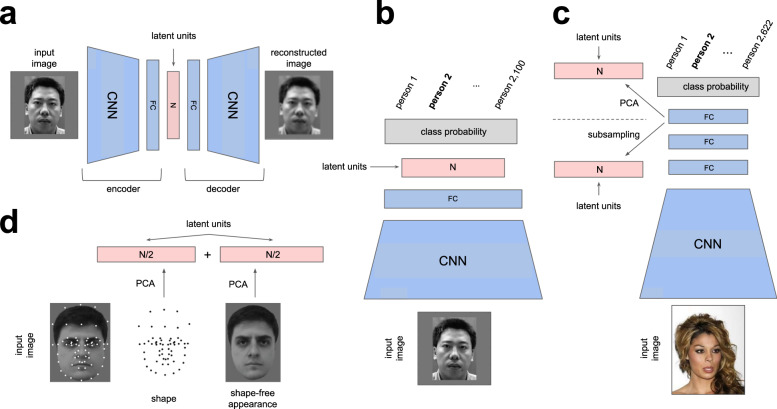
“…proposed as a good model for comparison against neural data in face recognition tasks 34,35 , other generative models, such as a basic autoencoder (AE) 36 and a variational autoencoder (VAE) 37 , as well as baselines provided by ICA, PCA and a classifier which used only the encoder from the β -VAE.”
MethodDelving Deep into Rectifiers: Surpassing Human-Level Performance on ImageNet Classification
He, K., Zhang, X., Ren, S., & Sun, J. (2015) · 2015 IEEE International Conference on Computer Vision (ICCV) · doi:10.1109/iccv.2015.123 · Cited by 19,741 · cited 1×
“When trained with high-density teaching signals, contemporary deep networks can outperform humans on multiway object recognition tasks 9 , and in doing so form high-dimensional representations that are multiplexed over many simulated neurons.”
BackgroundThe Hungarian method for the assignment problem
Kuhn, H. W. (1955) · Naval Research Logistics Quarterly · doi:10.1002/nav.3800020109 · Cited by 13,120
Representation Learning: A Review and New Perspectives
Bengio, Y., Courville, A., & Vincent, P. (2013) · IEEE Transactions on Pattern Analysis and Machine Intelligence · doi:10.1109/tpami.2013.50 · Cited by 13,001
Independent component analysis: algorithms and applications
Hyvärinen, A., & Oja, E. (2000) · Neural Networks · doi:10.1016/s0893-6080(00)00026-5 · Cited by 8,705
The free-energy principle: a unified brain theory?
Friston, K. (2010) · Nature Reviews Neuroscience · doi:10.1038/nrn2787 · Cited by 8,120
Deep Learning Face Attributes in the Wild
Liu, Z., Luo, P., Wang, X., & Tang, X. (2015) · 2015 IEEE International Conference on Computer Vision (ICCV) · doi:10.1109/iccv.2015.425 · Cited by 7,747
Fukushima, K. (1980) · Biological Cybernetics · doi:10.1007/bf00344251 · Cited by 5,759
Parkhi, O. M., Vedaldi, A., & Zisserman, A. (2015) · Procedings of the British Machine Vision Conference 2015 · doi:10.5244/c.29.41 · Cited by 5,479 · cited 6×
“We included a state-of-the-art deep supervised network (VGG, 33 ) that has previously been proposed as a good model for comparison against neural data in face recognition tasks 34,35 , other generative models, such as a basic autoencoder (AE) 36 and a variational autoencoder (VAE) 37 , as well as…”
MethodInfluential
Research works printed but not linked: 1
- Freund, R. J., Mohr, D. & Wilson, W. J.Statistical Methods (Academic Press, 2010).
Cited by
If deep learning is the answer, what is the question?
Saxe, A., Nelli, S., & Summerfield, C. (2021) · Nature Reviews Neuroscience · doi:10.1038/s41583-020-00395-8 · Cited by 397
“Although a focus on population coding emerged independently of the growing interest in deep learning, mixed selectivity is often (but not always) 42 a hallmark of coding in deep network models 4 .”
BackgroundSelf-citationThe neuroconnectionist research programme
Doerig, A., Sommers, R. P., Seeliger, K., Richards, B., Ismael, J., Lindsay, G. W., Kording, K. P., Konkle, T., van Gerven, M. A. J., Kriegeskorte, N., et al. (2023) · Nature Reviews Neuroscience · doi:10.1038/s41583-023-00705-w · Cited by 233
Using artificial neural networks to ask ‘why’ questions of minds and brains
Kanwisher, N., Khosla, M., & Dobs, K. (2023) · Trends in Neurosciences · doi:10.1016/j.tins.2022.12.008 · Cited by 182
“Single unit analyses (not illustrated) in networks and brains reveals the tuning properties of individual units, whether they are selective for meaningful perceptual attributes, forming disentangled representations [86], or exhibit mixed selectivity and distributed representations [87].”
BackgroundAbstract representations emerge in human hippocampal neurons during inference
Courellis, H. S., Minxha, J., Cardenas, A. R., Kimmel, D. L., Reed, C. M., Valiante, T. A., Salzman, C. D., Mamelak, A. N., Fusi, S., & Rutishauser, U. (2024) · Nature · doi:10.1038/s41586-024-07799-x · Cited by 192
Abrego-Martinez, J. C., Jafari, M., Chergui, S., Pavel, C., Che, D., & Siaj, M. (2022) · Biosensors and Bioelectronics · doi:10.1016/j.bios.2021.113595 · Cited by 159
The macaque face patch system: a turtle’s underbelly for the brain
Hesse, J. K., & Tsao, D. Y. (2020) · Nature reviews. Neuroscience · doi:10.1038/s41583-020-00393-w · Cited by 188
Self-citationMixed selectivity: Cellular computations for complexity
Tye, K. M., Miller, E. K., Taschbach, F. H., Benna, M. K., Rigotti, M., & Fusi, S. (2024) · Neuron · doi:10.1016/j.neuron.2024.04.017 · Cited by 118
“Linear mixed selectivity 4,44–46 neurons are typically the result of a process of abstraction and can facilitate generalization.”
Abstract representations emerge naturally in neural networks trained to perform multiple tasks
Johnston, W. J., & Fusi, S. (2023) · Nature Communications · doi:10.1038/s41467-023-36583-0 · Cited by 89
The geometry of cortical representations of touch in rodents
Nogueira, R., Rodgers, C. C., Bruno, R. M., & Fusi, S. (2023) · Nature Neuroscience · doi:10.1038/s41593-022-01237-9 · Cited by 86
A virtual rodent predicts the structure of neural activity across behaviours
Aldarondo, D., Merel, J., Marshall, J. D., Hasenclever, L., Klibaite, U., Gellis, A., Tassa, Y., Wayne, G., Botvinick, M., & Ölveczky, B. P. (2024) · Nature · doi:10.1038/s41586-024-07633-4 · Cited by 70
Self-citationBakhtiari, S., Mineault, P., Lillicrap, T., Pack, C. C., & Richards, B. A. (2021) · bioRxiv (Cold Spring Harbor Laboratory) · doi:10.1101/2021.06.18.448989 · Cited by 36
The implications of categorical and category-free mixed selectivity on representational geometries
Kaufman, M. T., Benna, M. K., Rigotti, M., Stefanini, F., Fusi, S., & Churchland, A. K. (2022) · Current Opinion in Neurobiology · doi:10.1016/j.conb.2022.102644 · Cited by 61
Fascianelli, V., Battista, A., Stefanini, F., Tsujimoto, S., Genovesio, A., & Fusi, S. (2024) · Nature Communications · doi:10.1038/s41467-024-50503-w · Cited by 64
Explaining face representation in the primate brain using different computational models
Chang, L., Egger, B., Vetter, T. R., & Tsao, D. Y. (2021) · Current Biology · doi:10.1016/j.cub.2021.04.014 · Cited by 102
Self-citationZhao, H., Wang, L., Zhao, Z., & Deng, W. (2024) · IEEE Transactions on Reliability · doi:10.1109/tr.2024.3371520 · Cited by 56
Balancing Flexibility and Interference in Working Memory
Buschman, T. J. (2021) · Annual Review of Vision Science · doi:10.1146/annurev-vision-100419-104831 · Cited by 58
Computational role of structure in neural activity and connectivity
Ostojic, S., & Fusi, S. (2024) · Trends in Cognitive Sciences · doi:10.1016/j.tics.2024.03.003 · Cited by 60
Pulvermüller, F. (2023) · Progress in Neurobiology · doi:10.1016/j.pneurobio.2023.102511 · Cited by 55
The neural code for “face cells” is not face-specific
Vinken, K., Prince, J. S., Konkle, T., & Livingstone, M. S. (2023) · Science Advances · doi:10.1126/sciadv.adg1736 · Cited by 54
Contrastive learning explains the emergence and function of visual category-selective regions
Prince, J. S., Alvarez, G. A., & Konkle, T. (2024) · Science Advances · doi:10.1126/sciadv.adl1776 · Cited by 65
Ito, T., Klinger, T., Schultz, D. H., Murray, J., Cole, M., & Rigotti, M. (2022) · neural information processing systems · doi:10.52202/068431-2335 · Cited by 92
“For instance, disentangled representation learning separates the independent factors underlying the structure of the input data into disjoint components of the feature vector [17, 18, 35, 16].”
BackgroundSymmetry-Based Representations for Artificial and Biological General Intelligence
Higgins, I., Racanière, S., & Rezende, D. J. (2022) · Frontiers in Computational Neuroscience · doi:10.3389/fncom.2022.836498 · Cited by 63
Self-citationA rubric for human-like agents and NeuroAI
Momennejad, I. (2022) · Philosophical Transactions of the Royal Society B Biological Sciences · doi:10.1098/rstb.2021.0446 · Cited by 49
“…that capture aspects of neural algorithms, architecture, or representations (e.g., convolutional neural networks that capture hierarchical vision in inferior temporal cortex, see section 1) are sometimes used to predict human-like behaviour and detailed correspondence with the brain [44,45].”
Applying Generative Artificial Intelligence to cognitive models of decision making
Malloy, T., & González, C. (2024) · Frontiers in Psychology · doi:10.3389/fpsyg.2024.1387948 · Cited by 54
Friston, K. J., Costa, L. D., Tschantz, A., Kiefer, A. B., Salvatori, T., Neacsu, V., Koudahl, M., Heins, C., Sajid, N., Marković, D., et al. (2024) · Biological Psychology · doi:10.1016/j.biopsycho.2024.108891 · Cited by 46
Active Inference and Intentional Behavior
Friston, K. J., Salvatori, T., Isomura, T., Tschantz, A., Kiefer, A. B., Verbelen, T., Koudahl, M., Paul, A., Parr, T., Razi, A., et al. (2025) · Neural Computation · doi:10.1162/neco_a_01738 · Cited by 49
“In machine learning, this kind of objective function underwrites disentanglement (Higgins et al., 2021; Sanchez et al., 2020) and generally leads to sparse representations (Gros, 2009; Olshausen & Field, 1996; Sakthivadivel, 2022; Tipping, 2001).”
From pixels to planning: scale-free active inference
Friston, K. J., Heins, C., Verbelen, T., Costa, L. D., Salvatori, T., Marković, D., Tschantz, A., Koudahl, M., Buckley, C., & Parr, T. (2025) · Frontiers in Network Physiology · doi:10.3389/fnetp.2025.1521963 · Cited by 47
Jozwik, K. M., Kietzmann, T. C., Cichy, R. M., Kriegeskorte, N., & Mur, M. (2023) · Journal of Neuroscience · doi:10.1523/jneurosci.1424-22.2022 · Cited by 42
Time, space, memory and brain–body rhythms
Buzsáki, G. (2025) · Nature reviews. Neuroscience · doi:10.1038/s41583-025-00987-2 · Cited by 43
“Such division of labour has been exploited in artificial intelligence under the term ‘disentanglement’ 54,55 and, in the brain, in the ‘what’ and ‘where’ streams of the visual system 56 and in the separate paths and mechanisms for coding the phonetics, grammar and meaning of spoken sentences in…”
Rotem, O., Schwartz, T., Maor, R., Tauber, Y., Shapiro, M. T., Meseguer, M., Gilboa, D., Seidman, D. S., & Zaritsky, A. (2024) · Nature Communications · doi:10.1038/s41467-024-51136-9 · Cited by 38
“…annotated side information of image properties, for example face images with annotated properties such as hair color, mustache,orskincolor 70 – 72 ,andtounconditionedmethodsthatdonot useanyfurtherdataannotationsbeyondthebinaryclassi fi cationlabels for training the classi fi cation model 22,24,73 .”
Federated inference and belief sharing
Friston, K. J., Parr, T., Heins, C., Constant, A., Friedman, D., Isomura, T., Fields, C., Verbelen, T., Ramstead, M., Clippinger, J., et al. (2024) · Neuroscience & Biobehavioral Reviews · doi:10.1016/j.neubiorev.2023.105500 · Cited by 30
“In machine learning, this kind of objective function underwrites disentanglement (Higgins et al., 2021; Sanchez et al., 2019), and generally leads to sparse representations (Gros, 2009; Olshausen and Field, 1996b; Sakthivadivel, 2022b; Tipping, 2001).”
BackgroundUnsupervised learning reveals interpretable latent representations for translucency perception
Liao, C., Sawayama, M., & Xiao, B. (2023) · PLoS Computational Biology · doi:10.1371/journal.pcbi.1010878 · Cited by 32
Generative Interpretable Visual Design: Using Disentanglement for Visual Conjoint Analysis
Sisodia, A., Burnap, A., & Kumar, V. (2024) · Journal of Marketing Research · doi:10.1177/00222437241276736 · Cited by 38
“Third, no algorithm can guarantee semantic interpretability of discovered visual characteristics, because that is a uniquely human ability (Higgins et al. 2021; Locatello et al. 2019).”
Natural General Intelligence: How understanding the brain can help us build AI
Summerfield, C. (2022) · doi:10.1093/oso/9780192843883.001.0001 · Cited by 43
Self-citationNeural population geometry and optimal coding of tasks with shared latent structure
Wakhloo, A. J., Slatton, W., & Chung, S. (2026) · Nature Neuroscience · doi:10.1038/s41593-025-02183-y · Cited by 33
“Early in learning, optimal neural representations are lower dimensional and exhibit higher correlations between single units and task variables than late in learning.”
A unifying framework from neural superposition to sparse interpretable codes
Klindt, D. A., O'Neill, C., Reizinger, P., Maurer, H., & Miolane, N. (2026) · Nature Machine Intelligence · doi:10.1038/s42256-026-01259-z · Cited by 29
“Empirical evidence aligns with a hierarchical model, suggesting a gradient of superposition from high feature mixing in early visual areas (for example, V1) to more disentangled representations in later stages (for example, IT cortex) 46,148 .”
A Closer Look at Benchmarking Self-supervised Pre-training with Image Classification
Marks, M., Knott, M., Kondapaneni, N., Cole, E., Defraeye, T., Pérez‐Cruz, F., & Perona, P. (2025) · International Journal of Computer Vision · doi:10.1007/s11263-025-02402-w · Cited by 41
“These embeddings can be used for various downstream tasks without further training the model (Pandarinath et al., 2018; Higgins et al., 2021; Sun et al., 2023).”
Unsupervised learning of mid-level visual representations
Matteucci, G., Piasini, E., & Zoccolan, D. (2023) · Current Opinion in Neurobiology · doi:10.1016/j.conb.2023.102834 · Cited by 21
“Consistent with recent computational work [64], this could result from an unsupervised learning process, although, given the social importance of faces for primates, reinforcement processes could also play an important role.”
The neuronal implementation of representational geometry in primate prefrontal cortex
Lin, X., Nieder, A., & Jacob, S. N. (2023) · Science Advances · doi:10.1126/sciadv.adh8685 · Cited by 18
Dado, T., Papale, P., Lozano, A., Le, L., Wang, F., van Gerven, M. A. J., Roelfsema, P. R., Güçlütürk, Y., & Güçlü, U. (2024) · PLoS Computational Biology · doi:10.1371/journal.pcbi.1012058 · Cited by 19
A Deep Learning Approach to Capture the Essence of Candida albicans Morphologies
Bettauer, V., Costa, A. C. B. P., Omran, R. P., Massahi, S., Kirbizakis, E., Simpson, S., Dumeaux, V., Law, C. O., Whiteway, M. S., & Hallett, M. T. (2022) · Microbiology Spectrum · doi:10.1128/spectrum.01472-22 · Cited by 16
Facial morphometric differences across face databases: influence of ethnicities and sex
Monteiro, L. C. P., Ripardo, R. C., Alves, N. T., & Souza, G. D. S. (2023) · Frontiers in Neuroscience · doi:10.3389/fnins.2023.1130867 · Cited by 16
Abstract representations emerge in human hippocampal neurons during inference behaviorPreprint
Courellis, H. S., Mixha, J., Cardenas, A. R., Kimmel, D. L., Reed, C. M., Valiante, T. A., Salzman, C. D., Mamelak, A. N., Fusi, S., & Rutishauser, U. (2023) · bioRxiv (Cold Spring Harbor Laboratory) · doi:10.1101/2023.11.10.566490 · Cited by 15
Factorized visual representations in the primate visual system and deep neural networks
Lindsey, J. W., & Issa, E. B. (2024) · eLife · doi:10.7554/elife.91685 · Cited by 16
“One prior study notably found that machine learning models designed to infer disentangled representations of visual data displayed single-unit responses that resembled those of individual neurons in macaque IT ( Higgins et al., 2021 ).”
BackgroundA brain-inspired object-based attention network for multiobject recognition and visual reasoning
Adeli, H., Ahn, S., & Zelinsky, G. J. (2023) · Journal of Vision · doi:10.1167/jov.23.5.16 · Cited by 14
Huang, L., Ma, Z., Yu, L., Zhou, H., & Tian, Y. (2023) · Proceedings of the AAAI Conference on Artificial Intelligence · doi:10.1609/aaai.v37i1.25073 · Cited by 20
Top-down perceptual inference shaping the activity of early visual cortex
Csikor, F., Meszéna, B., Ócsai, K., & Orbán, G. (2025) · Nature Communications · doi:10.1038/s41467-025-64967-x · Cited by 15
“In order to stick with the guarantees of VAEs, we did not rely on extensions of the framework that encourage disen-tanglement [21, 51], regularization methods that serve more stable learning but might distort the learned representations (see Methods), or methods that help to limit the number of…”
InfluentialMuratore, P., Tafazoli, S., Piasini, E., Laio, A., & Zoccolan, D. (2022) · neural information processing systems · doi:10.52202/068431-2190 · Cited by 22
Jointly efficient encoding and decoding in neural populations
Malerba, S. B., Micheli, A., Woodford, M., & da Silveira, R. A. (2024) · PLoS Computational Biology · doi:10.1371/journal.pcbi.1012240 · Cited by 18
“Broad tuning curves are beneficial to obtain smooth generative models, while still allowing high for coding performance.”
Neural Circuits for Fast Poisson Compressed Sensing in the Olfactory BulbPreprint
Zavatone-Veth, J. A., Masset, P., Tong, W. L., Zak, J. D., Murthy, V. N., & Pehlevan, C. (2023) · bioRxiv (Cold Spring Harbor Laboratory) · doi:10.1101/2023.06.21.545947 · Cited by 11
“In recent years, the question of when axis-aligned coding is optimal has attracted significant attention in machine learning and neuroscience (Whittington et al., 2023; Plumbley, 2002; Pehlevan, Mohan, and Chklovskii, 2017; Lipshutz, Pehlevan, and Chklovskii, 2022; Higgins et al., 2021; Chang and Tsao, 2017; Bao et al…”
BackgroundSoni, A. K., Srivastava, S., Maechler, M. R., Kording, K. P., & Khosla, M. (2024) · bioRxiv (Cold Spring Harbor Laboratory) · doi:10.1101/2024.08.07.607035 · Cited by 28
“Albeit not a commonly used measure, it has seen some use in the past [35]. rLP flips the direction of LP, asking if the model’s features can be linearly read out from the brain.”
A unified neural representation model for spatial and conceptual computations
Haga, T., Oseki, Y., & Fukai, T. (2025) · Proceedings of the National Academy of Sciences · doi:10.1073/pnas.2413449122 · Cited by 11
“We speculate that this is possible if we can appropriately construct disentangled representations for general sensory and task variables ( 61 , 71 , 72 ).”
Huang, Z., Ma, G., Ai, Z., Wang, J., Chang, X., & Zhou, W. (2026) · Reliability Engineering & System Safety · doi:10.1016/j.ress.2026.112348 · Cited by 10
Population Models, Not Analyses, of Human Neuroscience Measurements
Gardner, J. L., & Merriam, E. P. (2021) · Annual Review of Vision Science · doi:10.1146/annurev-vision-093019-111124 · Cited by 11
Fragemann, J., Ardizzone, L., Egger, J., Kleesiek, J., & Workshop, M. (2022) · TechRxiv · doi:10.36227/techrxiv.19364897 · Cited by 10
A hippocampal population code for rapid generalizationPreprint
Tang, W., Chang, H., Liu, C., Perez-Hernandez, S., Zheng, W. Y., Park, J., Oliva, A., & Fernández‐Ruiz, A. (2025) · bioRxiv (Cold Spring Harbor Laboratory) · doi:10.1101/2025.03.15.643456 · Cited by 11
“The hyperparameters for UMAP were: ‘n_dim’ = 3, ‘metric’ = ‘cosine’, ‘n_neighbours’ = 40, and ‘min_dist’ = 0.6, similar to previous studies 11,61 .”
InfluentialPoisson Variational Autoencoder
Vafaii, H., Galor, D., & Yates, J. L. (2024) · neural information processing systems · doi:10.52202/079017-1426 · Cited by 27
Schulz, A., Vetter, J., Gao, R., Morales, D., Ríos, V. L., Ramdya, P. P., Gonçalves, P. J., & Macke, J. H. (2025) · Cell Reports · doi:10.1016/j.celrep.2025.115338 · Cited by 9
How Well Do Unsupervised Learning Algorithms Model Human Real-time and Life-long Learning?
Zhuang, C., Xiang, V., Bai, Y., Jia, X., Turk‐Browne, N. B., Norman, K. A., DiCarlo, J. J., & Yamins, D. L. K. (2022) · PubMed · Cited by 9
Emergence of brain-like mirror-symmetric viewpoint tuning in convolutional neural networks
Farzmahdi, A., Zarco, W., Freiwald, W. A., Kriegeskorte, N., & Golan, T. (2024) · eLife · doi:10.7554/elife.90256 · Cited by 8
Abstract representations emerge naturally in neural networks trained to perform multiple tasksPreprint
Johnston, W. J., & Fusi, S. (2021) · bioRxiv (Cold Spring Harbor Laboratory) · doi:10.1101/2021.10.20.465187 · Cited by 11
Networks through the lens of high-frequency oscillations
Herlopian, A. (2024) · Frontiers in Network Physiology · doi:10.3389/fnetp.2024.1462672 · Cited by 7
Wyble, B., Tam, J., Deal, I., & Bowman, H. (2025) · Neuroscience & Biobehavioral Reviews · doi:10.1016/j.neubiorev.2025.106387 · Cited by 7
Yang, Z. (2026) · Microscopy and Microanalysis · doi:10.1093/mam/ozaf129 · Cited by 7
Domain-specific representation of social inference by neurons in the human amygdala and hippocampus
Cao, R., Dubois, J., Mamelak, A. N., Adolphs, R., Wang, S., & Rutishauser, U. (2024) · Science Advances · doi:10.1126/sciadv.ado6166 · Cited by 9
Reconstruction of perceived face images from brain activities based on multi-attribute constraints
Hou, X., Zhao, J., & Zhang, H. (2022) · Frontiers in Neuroscience · doi:10.3389/fnins.2022.1015752 · Cited by 8
“With the rapid development of deep learning, using convolutional neural networks (CNN) and generative adversarial networks (GAN) as tools to reconstruct face images has been a very successful attempt (Güçlütürk et al., 2017; VanRullen and Reddy, 2019; Bao et al., 2020; Du et al., 2020; Higgins et al., 2021; Dado et al…”
MethodInformation Optimization and Transferable State Abstractions in Deep Reinforcement Learning
Gomez, D., Quijano, N., & Giraldo, L. F. (2022) · IEEE Transactions on Pattern Analysis and Machine Intelligence · doi:10.1109/tpami.2022.3200726 · Cited by 12
Wright, J. J., & Bourke, P. D. (2022) · Frontiers in Computational Neuroscience · doi:10.3389/fncom.2022.869268 · Cited by 7
“Similar issues are now emerging in machine learning in the form of disentangling representations in deep (convolutional) neuronal networks (Higgins et al., 2021).”
BackgroundAdaptation shapes the representational geometry in mouse V1 to efficiently encode the environmentPreprint
Dipoppa, M., Nogueira, R., Bugeon, S., Friedman, Y., Reddy, C. B., Harris, K. D., Ringach, D. L., Miller, K. D., Carandini, M., & Fusi, S. (2024) · bioRxiv (Cold Spring Harbor Laboratory) · doi:10.1101/2024.12.11.628035 · Cited by 7
Fragemann, J., Ardizzone, L., Egger, J., Kleesiek, J., & Workshop, M. (2022) · doi:10.36227/techrxiv.19364897.v1 · Cited by 6
Neuronal Mechanisms Underlying Face Recognition in Non‐human Primates
Amita, H., Koyano, K. W., & Kunimatsu, J. (2024) · Japanese Psychological Research · doi:10.1111/jpr.12530 · Cited by 6
Latent Noise Segmentation: How Neural Noise Leads to the Emergence of Segmentation and GroupingPreprint
Lonnqvist, B., Wu, Z., & Herzog, M. H. (2023) · arXiv (Cornell University) · doi:10.48550/arxiv.2309.16515 · Cited by 8
“…the VAE and the AE is interesting, as the VAE has connections with predictive coding (Marino, 2022; Boutin et al., 2020) and the free energy principle (Friston, 2010; Mazzaglia et al., 2022), and has been shown empirical support as a coding principle in primate cortex (Higgins et al., 2021).”
BackgroundSchwartz, E., Alreja, A., Richardson, R. M., Ghuman, A. S., & Anzellotti, S. (2023) · Journal of Neuroscience · doi:10.1523/jneurosci.1277-22.2023 · Cited by 6
Disentangled deep generative models reveal coding principles of the human face processing network
Soulos, P., & Işık, L. (2024) · PLoS Computational Biology · doi:10.1371/journal.pcbi.1011887 · Cited by 5
Hierarchical VAEs provide a normative account of motion processing in the primate brain
Vafaii, H., Yates, J. L., & Butts, D. (2023) · neural information processing systems · doi:10.52202/075280-2002 · Cited by 14
Using unsupervised capsule neural network reveal spatial representations in the human brain
Wang, G., Jiang, N., Liu, T., Wang, L., Suo, D., Chen, D., Funahashi, S., & Yan, T. (2024) · Human Brain Mapping · doi:10.1002/hbm.26573 · Cited by 5
“These models may provide an incorrect explanation of how cortical neural representations are learned in the first place (Higgins et al., 2021; Zhuang et al., 2021).”
BackgroundInfluentialprotGear: A protein microarray data pre-processing suite
Mwai, K., Kibinge, N., Tuju, J., Kamuyu, G., Kimathi, R., Mburu, J., Chepsat, E., Nyamako, L., Chege, T. K., Nkumama, I. N., et al. (2021) · Computational and Structural Biotechnology Journal · doi:10.1016/j.csbj.2021.04.044 · Cited by 6
Arun, P. V., & Karnieli, A. (2022) · Neural Computing and Applications · doi:10.1007/s00521-022-07019-5 · Cited by 5
Using compositionality to understand parts in whole objects
Arun, S. P. (2022) · European Journal of Neuroscience · doi:10.1111/ejn.15746 · Cited by 6
“Recent examples of this approach include models of neurons in the inferior temporal cortex (Bashivan et al., 2019; Chang et al., 2021; Higgins et al., 2021; Owaki et al., 2018; Ponce et al., 2019; Yamins & DiCarlo, 2016), models of single voxel tuning in fMRI (Ratan Murty et al., 2021).”
MethodPiñero, P., de la Calle, F. M. M., Horndler, L., Alarcón, B., Barrientos, M. U., Sarmiento, H., & Tarín, F. (2021) · Scientific Reports · doi:10.1038/s41598-021-90054-4 · Cited by 5
Neural computations in the foveal and peripheral visual fields during active searchPreprint
Zhang, J., Zhu, X., Ma, Z., Wang, S., Wang, Y., Esteky, H., Tian, Y., & Zhou, H. (2021) · bioRxiv (Cold Spring Harbor Laboratory) · doi:10.1101/2021.11.22.469359 · Cited by 5
The geometry of context-dependent biased decisions during learningPreprint
Nogueira, R., Esteki, S., Fusi, S., & Kiani, R. (2026) · bioRxiv (Cold Spring Harbor Laboratory) · doi:10.64898/2026.01.14.699497 · Cited by 6
Configural processing as an optimized strategy for robust object recognition in neural networks
Jang, H., Sinha, P., & Boix, X. (2025) · Communications Biology · doi:10.1038/s42003-025-07672-1 · Cited by 5
Active inference and artificial reasoning
Friston, K. J., Costa, L. D., Tschantz, A., Heins, C., Buckley, C., Verbelen, T., & Parr, T. (2026) · Nature Communications · doi:10.1038/s41467-026-77209-5 · Cited by 4
“In machine learning, this kind of prior underwrites disentanglement 83,84 , and generallyleads to sparse representations 82,85 – 87 .”
Deep Learning-Powered Down Syndrome Detection Using Facial Images
Shaikh, M. A., Al-Rawashdeh, H. S., & Sait, A. R. W. (2025) · Life · doi:10.3390/life15091361 · Cited by 4
“The existing approaches range from traditional machine learning techniques with handcrafted features to recent advances utilizing CNN and ViT architectures [27].”
A variational-autoencoder approach to solve the hidden profile task in hybrid human-machine teams
Pescetelli, N., Reichert, P., & Rutherford, A. (2022) · PLoS ONE · doi:10.1371/journal.pone.0272168 · Cited by 6
“VAE-based approaches are used in several domains to generate low-dimensional interpretable embeddings from complex data [30].”
BackgroundNai, R., Wen, Z., Li, J., Li, Y., & Gao, Y. (2024) · Proceedings of the AAAI Conference on Artificial Intelligence · doi:10.1609/aaai.v38i13.29354 · Cited by 4
“Such property is analogous to biological mechanisms, as neurons in brains are specialized for specific tasks, with some aligned to axes of data generative factors (Higgins et al. 2021; Whittington et al. 2022).”
BackgroundGradient-Free De Novo Learning
Friston, K. J., Parr, T., Heins, C., Costa, L. D., Salvatori, T., Tschantz, A., Koudahl, M., de Maele, T. V., Buckley, C., & Verbelen, T. (2025) · Entropy · doi:10.3390/e27090992 · Cited by 5
“In machine learning, this kind of objective function underwrites disentanglement [66,67], and generally leads to sparse representations [65,68–70].”
Unsupervised inference approach to facial attractiveness
Ibáñez-Berganza, M., Amico, A., Lancia, G. L., Maggiore, F., Monechi, B., & Loreto, V. (2020) · PeerJ · doi:10.7717/peerj.10210 · Cited by 4
Predicting proprioceptive cortical anatomy and neural coding with topographic autoencoders
Grogan, M., Blum, K. P., Wu, Y., Harston, J. A., Miller, L. E., & Faisal, A. A. (2024) · PLoS Computational Biology · doi:10.1371/journal.pcbi.1012614 · Cited by 4
“While VAEs have been used before to learn both single neuron and population level features from spike train data [40,41] a vanilla VAE cannot induce a topographic mapping on the data.”
A large annotated dataset of vocalizations by common marmosets
Lamothe, C., Obliger-Debouche, M., Best, P., Trapeau, R., Ravel, S., Artières, T., Marxer, R., & Belin, P. (2025) · Scientific Data · doi:10.1038/s41597-025-04951-8 · Cited by 8
“They have also been proven proficient in untangling the neuro-computational mechanisms of face processing in macaques 24–26 .”
Sung, Y., Rigotti, M., & Lee, S. W. (2025) · Nature Communications · doi:10.1038/s41467-025-66677-w · Cited by 4
A decade of comparing brains to DNNs: Progress and perspectives
Schmitt, L., Dong, D. T., Çelik, E., de Lange, F. P., & Toneva, M. (2026) · Trends in Cognitive Sciences · doi:10.1016/j.tics.2026.06.011 · Cited by 3
Reconstructing voice identity from noninvasive auditory cortex recordings
Lamothe, C., Thoret, E., Trapeau, R., Giordano, B. L., Sein, J., Takerkart, S., Ayache, S., Artières, T., & Belin, P. (2026) · eLife · doi:10.7554/elife.98047.3 · Cited by 3
Unraveling the complexity of rat object vision requires a full convolutional network and beyond
Muratore, P., Alemi, A., & Zoccolan, D. (2025) · Patterns · doi:10.1016/j.patter.2024.101149 · Cited by 3
Yilmaz, H., Shah, A. D., Letrou, A., Kumar, S., Vogels, R., & Yildirim, I. (2025) · Proceedings of the National Academy of Sciences · doi:10.1073/pnas.2420287122 · Cited by 3
Leadholm, N., & Stringer, S. M. (2022) · Neural Networks · doi:10.1016/j.neunet.2022.07.003 · Cited by 4
A brain-inspired object-based attention network for multi-object recognition and visual reasoning
Adeli, H., Ahn, S., & Zelinsky, G. J. (2022) · Journal of Vision · doi:10.1167/jov.22.14.4294 · Cited by 5
Zhang, J., Huang, L., Ma, Z., & Zhou, H. (2023) · Cognitive Neurodynamics · doi:10.1007/s11571-023-09989-1 · Cited by 4
“…et al. 2021), V4 (Yamins et al. 2014; Nayebi et al. 2018; Schrimpf et al. 2018; Zhuang et al. 2021), and inferior temporal (IT) (Cadieu et al. 2014; Yamins et al. 2014; Nayebi et al. 2018; Schrimpf et al. 2018; Kubilius et al. 2019; Chang et al. 2021; Higgins et al. 2021; Zhuang et al. 2021).”
Ding, X., Wang, Z., Fang, J., Shu, Z., Hu, R., & Lin, C. (2023) · IEEE Transactions on Circuits and Systems for Video Technology · doi:10.1109/tcsvt.2023.3325357 · Cited by 3
“To this end, we adopt the β -vae decoupling network [12] to separate the low-quality face images into interpretable latent factors [13].”
Method
Metadata
- Authors
- Higgins, I., Chang, L., Langston, V., Hassabis, D., Summerfield, C., Tsao, D., & Botvinick, M.
- Affiliations
- Google DeepMind (United Kingdom) (GB)
- California Institute of Technology (US)
- University of Oxford (GB)
- Corresponding author
- Higgins, Irina
- Venue
- Nature Communications
- Published
- 2021-11-09
- Volume
- 12
- Issue
- 1
- Pages
- 6456-6456
- ISSN
- 2041-1723 (ISSN-L)
- PMC
- PMC8578601
- OpenAlex
- W3212335243
- Cited by
- 162
- References
- 64
- Citations by year
- 2026: 16 · 2025: 29 · 2024: 40 · 2023: 26 · 2022: 32 · 2021: 11
- FWCI
- 14.33
- Type
- journal article
- Language
- en
- Open access
- gold
- doi.org
- Licence
- cc-by
- creativecommons.org/licenses/by/4.0 (tdm)
- creativecommons.org/licenses/by/4.0 (vor)
- Locations
- Nature Communications (publishedVersion, cc-by)
- PubMed Central (publishedVersion, cc-by)
- PubMed (publishedVersion)
- arXiv (Cornell University) (submittedVersion)
- CaltechAUTHORS (California Institute of Technology) (submittedVersion, cc-by)
- RePEc: Research Papers in Economics (submittedVersion)
- DOAJ (DOAJ: Directory of Open Access Journals) (submittedVersion, cc-by-sa)
- arXiv (Cornell University)
- Funders
- Howard Hughes Medical Institute
- National Institutes of Health
- National Eye Institute (R01EY030650)
- National Institute of Neurological Disorders and Stroke (DP1NS083063)
- Topics
- Life Sciences › Neuroscience › Cognitive Neuroscience › Face Recognition and Perception
- Physical Sciences › Computer Science › Computer Vision and Pattern Recognition › Face recognition and analysis
- Physical Sciences › Computer Science › Computer Vision and Pattern Recognition › Face and Expression Recognition
- Keywords
- face perception, inferotemporal cortex, single neuron responses, semantic disentanglement, self-supervised learning, variational autoencoder, beta-VAE, latent representations, active appearance models, macaque, ventral stream, facial reconstruction
- MeSH terms
- Deep Learning, Brain, Cerebral Cortex, Humans, Neurons, Pattern Recognition, Visual, Semantics, Temporal Lobe, Neural Networks, Computer
About these checks
Registry, retraction, Cites and statistics results are computed, not judged, with one exception: a printed reference that no index lists is read once by a model before it counts as a citation error. Claims are extracted by a model and kept only when their quote appears verbatim in the text; each cited source is then checked, with a model’s help, for whether it says what the claim relies on. Those verdicts can be wrong — read the claim’s quote and the cited source before relying on one.
Statistics and arithmetic are recomputed, not judged.
Confidence bands are shown only for fields calibrated on our annotated test set. None is calibrated yet, so no band is shown.
What counts as a claim ›How we measure confidence ›How we check this ›
Are you an author, or do you see a problem with this page? Request a review
Data sources
Bibliographic data: Semantic Scholar, OpenAlex, Crossref.
Contains information from the Semantic Scholar Academic Graph Datasets, made available under the ODC Attribution License (ODC-BY 1.0).
Semantic Scholar’s data is described in: Kinney, R., et al. (2023). The Semantic Scholar Open Data Platform. arXiv:2301.10140.
