

Unsupervised deep learning identifies semantic disentanglement in single inferotemporal face patch neurons
Open accessThe DOI matches its Crossref record; 64 of the 64 references it cites were found in a registry or an index.
Abstract
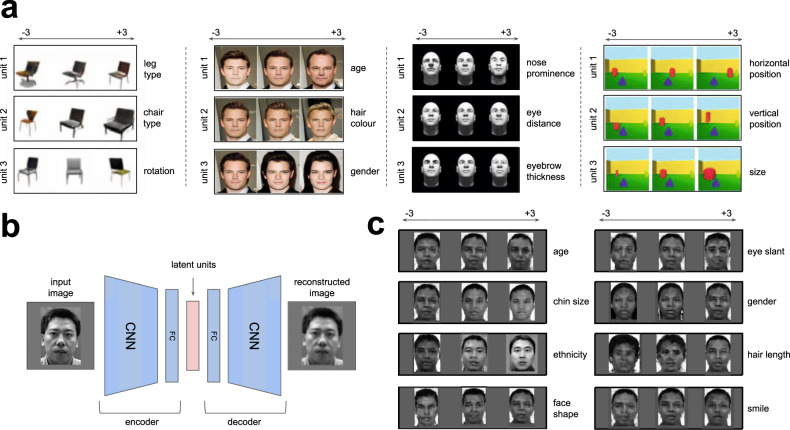
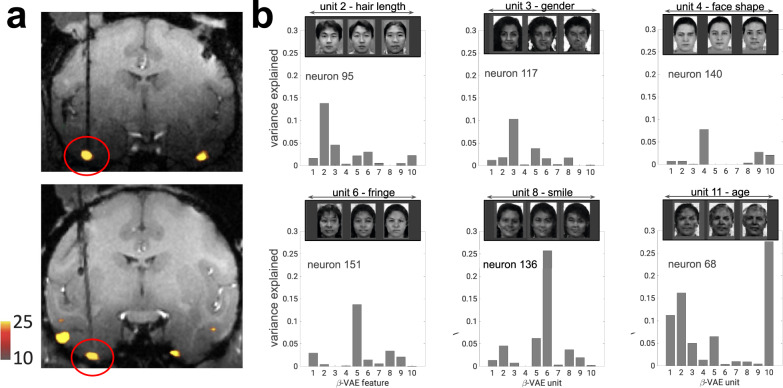
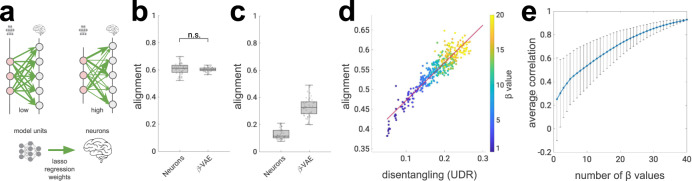
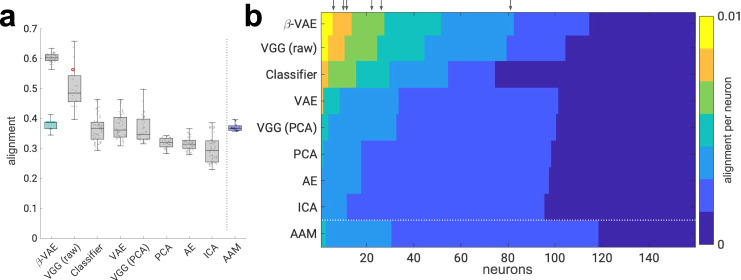
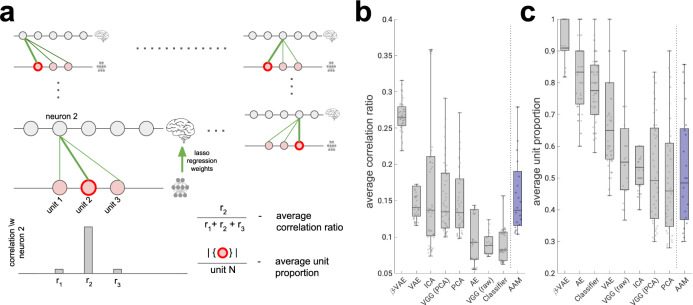
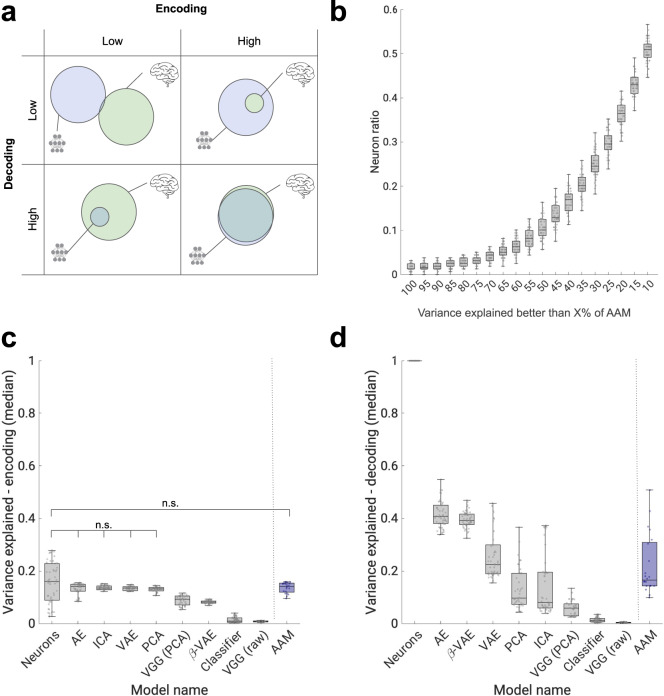
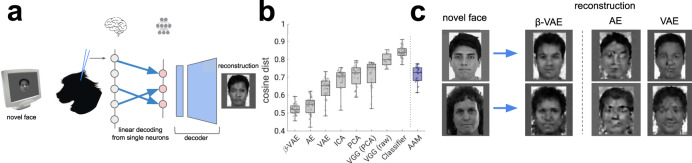
In order to better understand how the brain perceives faces, it is important to know what objective drives learning in the ventral visual stream. To answer this question, we model neural responses to faces in the macaque inferotemporal (IT) cortex with a deep self-supervised generative model, β -VAE, which disentangles sensory data into interpretable latent factors, such as gender or age. Our results demonstrate a strong correspondence between the generative factors discovered by β -VAE and those coded by single IT neurons, beyond that found for the baselines, including the handcrafted state-of-the-art model of face perception, the Active Appearance Model, and deep classifiers. Moreover, β -VAE is able to reconstruct novel face images using signals from just a handful of cells. Together our results imply that optimising the disentangling objective leads to representations that closely resemble those in the IT at the single unit level. This points at disentangling as a plausible learning objective for the visual brain.
Overview
The claims and statistics of this paper haven’t been checked yet.
Free: it reads the open-access text and checks the first 5 claims that cite a source we can check. Create a free account to check every claim.
Integrity signals
Registry
Cites
Statistics
Figures
Verification
Claims the paper makes
The claims and statistics of this paper haven’t been checked yet.
Free: it reads the open-access text and checks the first 5 claims that cite a source we can check. Create a free account to check every claim.
Claims other papers make about this one
Each is checked against this paper’s own text: does it say what the citing paper says it does?
The source backs part of the claim, not all of it — or backs it for a different population, condition or comparison.
In the citing paper
“Thus, managing the trade-off between latent variable compression and motor performance 25,56 may structure neural variability in ways that are distinct from previously hypothesized mechanisms like signal-dependent noise 54 or energy constraints 7.”
From A virtual rodent predicts the structure of neural activity across behaviours (2024) · cites this paper as [25]
Experimental — accuracy not yet measuredThe source backs part of the claim, not all of it — or backs it for a different population, condition or comparison.
In the citing paper
“suggesting a link between mechanisms for robustness and generalizability (see also 25,56).”
From A virtual rodent predicts the structure of neural activity across behaviours (2024) · cites this paper as [25]
Experimental — accuracy not yet measured
Self-check
Percentages, sums and reported differences re-computed from the paper’s own numbers.
The self-check needs the paper’s full text.
Citations
Cites
Reducing the dimensionality of data with neural networks
Hinton, G. E., & Salakhutdinov, R. R. (2006) · Science · doi:10.1126/science.1127647 · Cited by 20,928
Auto-Encoding Variational Bayes
Kingma, D. P., & Welling, M. (2013) · arXiv · doi:10.48550/arxiv.1312.6114 · Cited by 20,067 · cited 3×
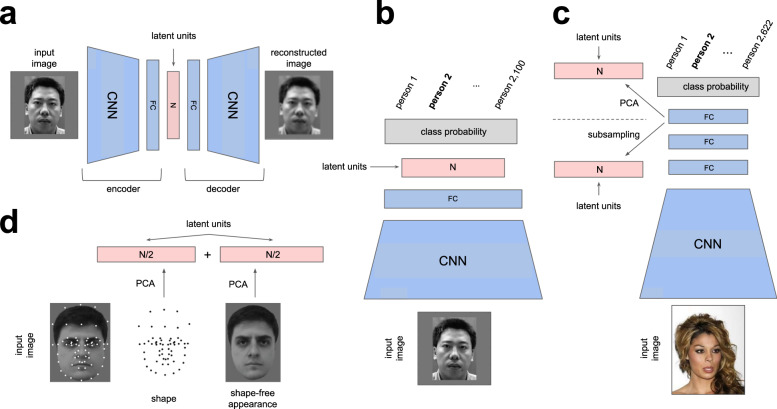
“…proposed as a good model for comparison against neural data in face recognition tasks 34,35 , other generative models, such as a basic autoencoder (AE) 36 and a variational autoencoder (VAE) 37 , as well as baselines provided by ICA, PCA and a classifier which used only the encoder from the β -VAE.”
MethodDelving Deep into Rectifiers: Surpassing Human-Level Performance on ImageNet Classification
He, K., Zhang, X., Ren, S., & Sun, J. (2015) · 2015 IEEE International Conference on Computer Vision (ICCV) · doi:10.1109/iccv.2015.123 · Cited by 19,741 · cited 1×
“When trained with high-density teaching signals, contemporary deep networks can outperform humans on multiway object recognition tasks 9 , and in doing so form high-dimensional representations that are multiplexed over many simulated neurons.”
BackgroundThe Hungarian method for the assignment problem
Kuhn, H. W. (1955) · Naval Research Logistics Quarterly · doi:10.1002/nav.3800020109 · Cited by 13,120
Representation Learning: A Review and New Perspectives
Bengio, Y., Courville, A., & Vincent, P. (2013) · IEEE Transactions on Pattern Analysis and Machine Intelligence · doi:10.1109/tpami.2013.50 · Cited by 13,001
Independent component analysis: algorithms and applications
Hyvärinen, A., & Oja, E. (2000) · Neural Networks · doi:10.1016/s0893-6080(00)00026-5 · Cited by 8,705
The free-energy principle: a unified brain theory?
Friston, K. (2010) · Nature Reviews Neuroscience · doi:10.1038/nrn2787 · Cited by 8,120
Deep Learning Face Attributes in the Wild
Liu, Z., Luo, P., Wang, X., & Tang, X. (2015) · 2015 IEEE International Conference on Computer Vision (ICCV) · doi:10.1109/iccv.2015.425 · Cited by 7,747
Fukushima, K. (1980) · Biological Cybernetics · doi:10.1007/bf00344251 · Cited by 5,759
Parkhi, O. M., Vedaldi, A., & Zisserman, A. (2015) · Procedings of the British Machine Vision Conference 2015 · doi:10.5244/c.29.41 · Cited by 5,479 · cited 6×
“We included a state-of-the-art deep supervised network (VGG, 33 ) that has previously been proposed as a good model for comparison against neural data in face recognition tasks 34,35 , other generative models, such as a basic autoencoder (AE) 36 and a variational autoencoder (VAE) 37 , as well as…”
MethodInfluential
Research works printed but not linked: 1
- Freund, R. J., Mohr, D. & Wilson, W. J.Statistical Methods (Academic Press, 2010).
Cited by
Items 101–175 of 175
T.Sanjay, & Priya, W. D. (2022) · Journal of Pharmaceutical Negative Results · doi:10.47750/pnr.2022.13.s04.051 · Cited by 3
Fusi, S., Boyle, L. M., Posani, L., Irfan, S., & Siegelbaum, S. A. (2022) · Research Square · doi:10.21203/rs.3.rs-1318889/v1 · Cited by 5
Gradual sensory maturation promotes abstract representation learningPreprint
Cheon, J., & Paik, S. (2025) · bioRxiv (Cold Spring Harbor Laboratory) · doi:10.1101/2025.06.24.661295 · Cited by 3
Understanding the Brain as a Mentalizing Machine with a Symbol Grounding Function
Kaneko, T., Ninomiya, T., & Isoda, M. (2026) · Journal of Neuroscience · doi:10.1523/jneurosci.2445-24.2025 · Cited by 2
Zeng, Y., Zhang, Q., Xiao, Y., Wu, S., Kim, S., Zhang, Y., Wang, M. W., Zhang, Y., Li, X. F., Lü, Z., et al. (2026) · Nature Biotechnology · doi:10.1038/s41587-026-03107-2 · Cited by 2
ACLMHA and FML: A brain-inspired kinship verification framework
Li, C., Bai, M., Zhang, L., Xiao, K., Song, W., & Zeng, H. (2022) · Frontiers in Neuroscience · doi:10.3389/fnins.2022.1093071 · Cited by 2
Can Deep Generative Models Explain Brain Function in People with Developmental Dyslexia?
Ogawa, H., Ogoshi, S., Ogoshi, Y., & Nakai, A. (2023) · Electronics · doi:10.3390/electronics12102305 · Cited by 3
Generative Environment-Representation Instance-Based Learning: A Cognitive Model
Malloy, T., Du, Y., Fang, F., & González, C. (2024) · Proceedings of the AAAI Symposium Series · doi:10.1609/aaaiss.v2i1.27696 · Cited by 4
“Of the GMs tested using the GERIBL model, the β -VAE based model has the closest connection to biological visual processing, which has been related to the disentanglement objective (Higgins et al. 2021).”
MethodInterpretable Visual Neural Decoding with Unsupervised Semantic Disentanglement
Zhou, Q., Du, C., Li, D., Wen, B., Chang, L., & He, H. (2025) · Machine Intelligence Research · doi:10.1007/s11633-023-1484-y · Cited by 2
Self-citationNeuroscientific insights about computer vision models: a concise review
Susan, S. (2024) · Biological Cybernetics · doi:10.1007/s00422-024-00998-9 · Cited by 2
Rotated Digit Recognition by Variational Autoencoders with Fixed Output DistributionsPreprint
Yevick, D. O. (2022) · Research Square · doi:10.21203/rs.3.rs-1789791/v1 · Cited by 2
Saxena, R., & McNaughton, B. L. (2025) · PubMed Central · Cited by 2
Reconstructing voice identity from noninvasive auditory cortex recordingsPreprint
Lamothe, C., Thoret, E., Trapeau, R., Giordano, B. L., Sein, J., Takerkart, S., Ayache, S., Artières, T., & Belin, P. (2024) · eLife · doi:10.7554/elife.98047 · Cited by 2
Prefrontal representations of retrospective spatial working memory in a rodent radial maze taskPreprint
Taliaferro, J. P., Posani, L., Greenwald, J. E., Lim, S. C., McGowan, J. C., Pekarskaya, E. A., Lacefield, C., Fusi, S., & Kellendonk, C. (2024) · bioRxiv (Cold Spring Harbor Laboratory) · doi:10.1101/2024.10.10.617655 · Cited by 2
A compressed code for memory discriminationPreprint
Zhou, D., Noh, S. M., Harhen, N. C., Banavar, N. V., Hartley, C. A., Kirwan, C. B., Yassa, M. A., & Bornstein, A. M. (2025) · bioRxiv (Cold Spring Harbor Laboratory) · doi:10.1101/2025.10.12.681901 · Cited by 2
“(F) We used computational model of compression, where β -variational autoencoders learn to reconstruct each task image using compressed probabilistic representations (53, 63, 64, 70) .”
Binhuraib, T. O. A., Tuckute, G., & Blauch, N. M. (2025) · arXiv (Cornell University) · doi:10.48550/arxiv.2510.18745 · Cited by 3
“Efforts to extract “monosemantic” features (Cunningham et al., 2023; Bricken et al., 2023) or to encourage disentangled representations (Higgins et al., 2021) may prove fruitful in yielding more interpretable topography in models, which in turn may help generate hypotheses regarding the human…”
Summerfield, C. (2022) · Oxford University Press eBooks · doi:10.1093/oso/9780192843883.003.0006 · Cited by 1
Self-citationInformation-theoretical analysis of the neural code for decoupled face representation
Ibáñez-Berganza, M., Lucibello, C., Mariani, L., & Pezzulo, G. (2024) · PLoS ONE · doi:10.1371/journal.pone.0295054 · Cited by 1
“From a computational perspective, decoupled coding affords accurate face processing, permitting the linear decoding of facial features from single cell responses; and it outperforms widely used schemes in vision research, such as eigenface coding [4, 7, 8].”
Sexton, C. L., Buckley, C., Sen, M., Subiaul, F., Hecht, E. E., & Bradley, B. J. (2024) · Human-Animal Interactions · doi:10.1079/hai.2024.0005 · Cited by 2
Interpretability of neural network using layer conductance analysis for the concept detection
Baazzouz, A., & Dabounou, J. (2025) · Journal of Engineering and Applied Science · doi:10.1186/s44147-025-00719-4 · Cited by 2
“There are other explainable techniques used to investigate the role of hidden units, like the identification of semantic disentanglement [9], the network dissection of the convolutional layer [10], and Grad-CAM + + for visual explanations [11].”
Neural computations in the foveal and peripheral visual fields during active search
Zhang, J., Zhu, X., Ma, Z., Wang, S., Wang, Y., Esteky, H., Tian, Y., & Zhou, H. (2026) · eLife · doi:10.7554/elife.109498.3 · Cited by 1
Factorized visual representations in the primate visual system and deep neural networksPreprint
Lindsey, J. W., & Issa, E. B. (2024) · eLife · doi:10.7554/elife.91685.2 · Cited by 1
The mechanism at hand: A goal-driven approach to modeling the human sensorimotor system
Weidler, T. (2024) · Research Publications (Maastricht University) · doi:10.26481/dis.20250110tw · Cited by 1
Zhao, Q., Xu, J., Li, D., Wu, X., Zhang, K., Chu, C., & Fan, L. (2025) · bioRxiv (Cold Spring Harbor Laboratory) · doi:10.1101/2025.08.31.672834 · Cited by 1
Circuit mechanisms for disentangled representations and generalization in the hippocampus
Tang, W., Chang, H., Liu, C., Perez-Hernandez, S., Zheng, W. Y., Park, J., Karaba, L. A., Oliva, A., & Fernandez-Ruiz, A. (2026) · Nature Neuroscience · doi:10.1038/s41593-026-02491-x
A variational-autoencoder approach to solve the hidden profile task in hybrid human-machine teamsPreprint
Pescetelli, N., Reichert, P., & Rutherford, A. (2021) · PsyArXiv (OSF Preprints) · doi:10.31234/osf.io/67jku
A variational-autoencoder approach to solve the hidden profile task in hybrid human-machine teamsPreprint
Pescetelli, N., & Reichert, P. (2021) · PsyArXiv (OSF Preprints) · doi:10.31234/osf.io/s67zf
Rotated Digit Recognition by Variational Autoencoders with Fixed Output DistributionsPreprint
Yevick, D. O. (2022) · arXiv (Cornell University) · doi:10.48550/arxiv.2206.13388
Chien, J. M., Wallis, J. D., & Rich, E. L. (2022) · bioRxiv (Cold Spring Harbor Laboratory) · doi:10.1101/2022.12.10.519901
Summerfield, C. (2022) · Oxford University Press eBooks · doi:10.1093/oso/9780192843883.003.0008
Self-citationSummerfield, C. (2022) · Oxford University Press eBooks · doi:10.1093/oso/9780192843883.003.0003
Self-citationSummerfield, C. (2022) · Oxford University Press eBooks · doi:10.1093/oso/9780192843883.003.0007
Self-citationSummerfield, C. (2022) · Oxford University Press eBooks · doi:10.1093/oso/9780192843883.003.0002
Self-citationSummerfield, C. (2022) · Oxford University Press eBooks · doi:10.1093/oso/9780192843883.003.0004
Self-citationSummerfield, C. (2022) · Oxford University Press eBooks · doi:10.1093/oso/9780192843883.002.0003
Self-citationSummerfield, C. (2022) · Oxford University Press eBooks · doi:10.1093/oso/9780192843883.002.0004
Self-citationSummerfield, C. (2022) · Oxford University Press eBooks · doi:10.1093/oso/9780192843883.002.0006
Self-citationSummerfield, C. (2022) · Oxford University Press eBooks · doi:10.1093/oso/9780192843883.003.0005
Self-citationSummerfield, C. (2022) · Oxford University Press eBooks · doi:10.1093/oso/9780192843883.003.0001
Self-citationRotated Digit Recognition by Variational Autoencoders with Fixed Output DistributionsPreprint
Yevick, D. O. (2023) · SSRN Electronic Journal · doi:10.2139/ssrn.4668699
Author response: Reconstructing Voice Identity from Noninvasive Auditory Cortex Recordings
Lamothe, C., Thoret, E., Trapeau, R., Giordano, B. L., Sein, J., Takerkart, S., Ayache, S., Artières, T., & Belin, P. (2024) · eLife · doi:10.7554/elife.98047.1.sa4
eLife Assessment: Reconstructing Voice Identity from Noninvasive Auditory Cortex Recordings
Martin, A. E. (2024) · eLife · doi:10.7554/elife.98047.1.sa3
Reconstructing Voice Identity from Noninvasive Auditory Cortex RecordingsPreprint
Lamothe, C., Thoret, E., Trapeau, R., Giordano, B. L., Sein, J., Takerkart, S., Ayache, S., Artières, T., & Belin, P. (2024) · eLife · doi:10.7554/elife.98047.1
How Video Meetings Change Your Expression
Sarin, S., Mall, U., Tendulkar, P., & Vondrick, C. (2024) · Lecture notes in computer science · doi:10.1007/978-3-031-72643-9_10
Retrodictive Evidence for the Structure of Memory EngramPreprint
Vadakkan, K. I. (2025) · SSRN Electronic Journal · doi:10.2139/ssrn.5072253
Ye, Z., & Weßel, R. (2025) · bioRxiv (Cold Spring Harbor Laboratory) · doi:10.1101/2025.04.23.650305
Nishida, K., & Motoyoshi, I. (2025) · bioRxiv (Cold Spring Harbor Laboratory) · doi:10.1101/2025.05.02.651866
Song, Y., Keller, T. A., Sebe, N., & Welling, M. (2025) · Synthesis lectures on computer vision · doi:10.1007/978-3-031-88111-4_2
A Unified Visual Architecture for Few-shot LearningPreprint
Jin, D., Xiang, N., & Li, D. (2025) · Research Square · doi:10.21203/rs.3.rs-7634782/v1
Reconstructing Voice Identity from Noninvasive Auditory Cortex RecordingsPreprint
Lamothe, C., Thoret, E., Trapeau, R., Giordano, B. L., Sein, J., Takerkart, S., Ayache, S., Artières, T., & Belin, P. (2025) · eLife · doi:10.7554/elife.98047.2
Inferring response times of perceptual decisions with Poisson variational autoencodersPreprint
Johnson, H. R., Krouglova, A. N., Vafaii, H., Yates, J. L., & Gonçalves, P. J. (2025) · arXiv (Cornell University) · doi:10.48550/arxiv.2511.11480
“Evidence for this comes from several directions: (i) VAE representations align with the primate cortex across both ventral [27] and dorsal [28] streams; (ii) VAEs develop cortex-like topographic organization [29, 30]; and (iii) VAEs produce perceptual errors resembling those of humans [31].”
Vafaii, H. (2023) · arXiv (Cornell University) · doi:10.13016/i1ah-cyjy
Efficient, probabilistic analysis of combinatorial neural codesPreprint
Burns, T., & Irwansyah (2022) · arXiv (Cornell University) · doi:10.13140/rg.2.2.18055.68003
Face-selective responses correlate with deep networks that learn from environment feedbackPreprint
Zhou, M., Schwartz, E., Alreja, A., Richardson, R. M., Ghuman, A. S., & Anzellotti, S. (2026) · bioRxiv (Cold Spring Harbor Laboratory) · doi:10.64898/2026.02.25.703652
“A modified version of a variational model was selected as the other: this choice was motivated by recent results showing that variational architectures learn factors that show correspondence with the tuning properties of neurons in inferotemporal cortex (Higgins et al., 2021).”
InfluentialDiscovering Interpretable Semantics from Radio Signals for Contactless Cardiac Monitoring
Chen, J., Wang, H., Xu, G., Yuan, Y., Cai, X., Wei, Z., Zhang, D., Sun, Q., Zhang, T., Guan, C., et al. (2026) · Advanced Science · doi:10.1002/advs.202524283
Encoding and decoding of information through efficient neural representations
Malerba, S. B. (2022) · theses.fr (ABES) · doi:10.70675/fb444c77z28a6z476bza8d4z4d6b60064e35
Baba, M., Kanari, K., Iwasaki, K., & Komatsu, H. (2026) · Journal of Vision · doi:10.1167/jov.26.5.4
“Higgins et al. (2021) showed that neuronal responses in face patches in monkey IT cortex closely correspond to the latent variables of a model trained on face images using a beta-variational autoencoder ( β -VAE) (Higgins et al., 2017), an unsupervised learning model.”
Nadeau, S. E. (2026) · Cognitive and Behavioral Neurology · doi:10.1097/wnn.0000000000000424
Neural spiketrains and population vectors entangle neural representationsPreprint
Vaupel, M., Olsen, V. K., Gaukstad, S., Hermansen, E., & Dunn, B. A. (2026) · bioRxiv (Cold Spring Harbor Laboratory) · doi:10.64898/2026.08.27.744867
“Both varieties have been reported in the literature 7;11–16;36;37 .”
Zhang, T., Cho, C. J., & Gallant, J. L. (2026) · bioRxiv (Cold Spring Harbor Laboratory) · doi:10.64898/2026.09.02.749001
“Generative approaches to understanding the brain have been applied to both neurophysiology (Bashivan et al., 2019; Higgins et al., 2021; Ponce et al., 2019) and neuroimaging (Dado et al., 2022; Gaziv et al., 2022; Horikawa & Kamitani, 2017; Lin et al., 2022; Luo et al., 2023; Ozcelik & VanRullen,…”
Wang, Y., Zhuang, K., Liang, X., Feng, J., Hebart, M. N., & Vatansever, D. (2026) · bioRxiv (Cold Spring Harbor Laboratory) · doi:10.64898/2026.09.09.749976
“…method 52,53 , so any nonlinear structure in the representational manifold falls outside its scope, and nonlinear dimensionality reduction or more flexible latent-variable models 22 would be a natural extension that could reveal additional geometric complexity without sacrificing interpretability.”
Complete or Sparse: A Tale of Two IdentifiabilitiesPreprint
Zhou, J., & Klindt, D. A. (2026) · arXiv (Cornell University) · doi:10.48550/arxiv.2610.20851
“This stands in tension to the empirical observations of clean selective ( monosemantic ), interpretable neurons [2, 7, 5, 4, 12].”
Metadata
- Authors
- Higgins, I., Chang, L., Langston, V., Hassabis, D., Summerfield, C., Tsao, D., & Botvinick, M.
- Affiliations
- Google DeepMind (United Kingdom) (GB)
- California Institute of Technology (US)
- University of Oxford (GB)
- Corresponding author
- Higgins, Irina
- Venue
- Nature Communications
- Published
- 2021-11-09
- Volume
- 12
- Issue
- 1
- Pages
- 6456-6456
- ISSN
- 2041-1723 (ISSN-L)
- PMC
- PMC8578601
- OpenAlex
- W3212335243
- Cited by
- 162
- References
- 64
- Citations by year
- 2026: 16 · 2025: 29 · 2024: 40 · 2023: 26 · 2022: 32 · 2021: 11
- FWCI
- 14.33
- Type
- journal article
- Language
- en
- Open access
- gold
- doi.org
- Licence
- cc-by
- creativecommons.org/licenses/by/4.0 (tdm)
- creativecommons.org/licenses/by/4.0 (vor)
- Locations
- Nature Communications (publishedVersion, cc-by)
- PubMed Central (publishedVersion, cc-by)
- PubMed (publishedVersion)
- arXiv (Cornell University) (submittedVersion)
- CaltechAUTHORS (California Institute of Technology) (submittedVersion, cc-by)
- RePEc: Research Papers in Economics (submittedVersion)
- DOAJ (DOAJ: Directory of Open Access Journals) (submittedVersion, cc-by-sa)
- arXiv (Cornell University)
- Funders
- Howard Hughes Medical Institute
- National Institutes of Health
- National Eye Institute (R01EY030650)
- National Institute of Neurological Disorders and Stroke (DP1NS083063)
- Topics
- Life Sciences › Neuroscience › Cognitive Neuroscience › Face Recognition and Perception
- Physical Sciences › Computer Science › Computer Vision and Pattern Recognition › Face recognition and analysis
- Physical Sciences › Computer Science › Computer Vision and Pattern Recognition › Face and Expression Recognition
- Keywords
- face perception, inferotemporal cortex, single neuron responses, semantic disentanglement, self-supervised learning, variational autoencoder, beta-VAE, latent representations, active appearance models, macaque, ventral stream, facial reconstruction
- MeSH terms
- Deep Learning, Brain, Cerebral Cortex, Humans, Neurons, Pattern Recognition, Visual, Semantics, Temporal Lobe, Neural Networks, Computer
About these checks
Registry, retraction, Cites and statistics results are computed, not judged, with one exception: a printed reference that no index lists is read once by a model before it counts as a citation error. Claims are extracted by a model and kept only when their quote appears verbatim in the text; each cited source is then checked, with a model’s help, for whether it says what the claim relies on. Those verdicts can be wrong — read the claim’s quote and the cited source before relying on one.
Statistics and arithmetic are recomputed, not judged.
Confidence bands are shown only for fields calibrated on our annotated test set. None is calibrated yet, so no band is shown.
What counts as a claim ›How we measure confidence ›How we check this ›
Are you an author, or do you see a problem with this page? Request a review
Data sources
Bibliographic data: Semantic Scholar, OpenAlex, Crossref.
Contains information from the Semantic Scholar Academic Graph Datasets, made available under the ODC Attribution License (ODC-BY 1.0).
Semantic Scholar’s data is described in: Kinney, R., et al. (2023). The Semantic Scholar Open Data Platform. arXiv:2301.10140.
