

Unsupervised deep learning identifies semantic disentanglement in single inferotemporal face patch neurons
Open accessThe DOI matches its Crossref record; 64 of the 64 references it cites were found in a registry or an index.
Abstract
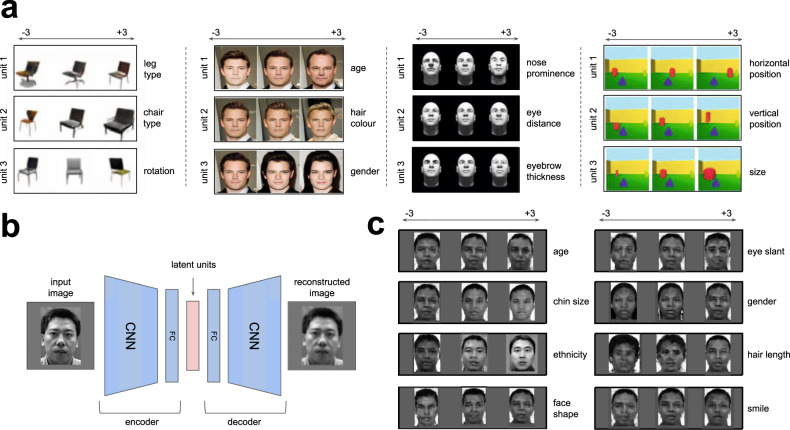
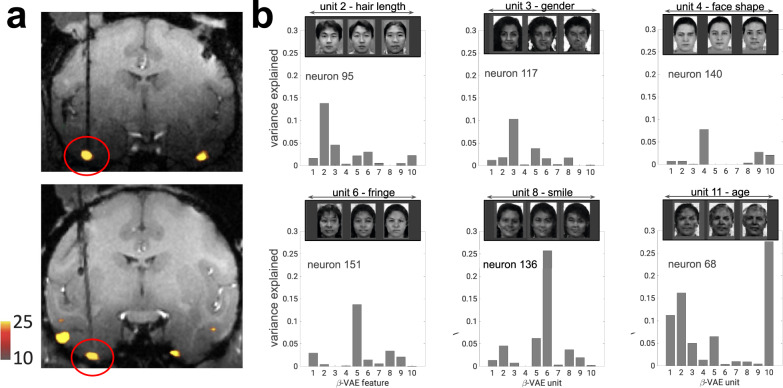
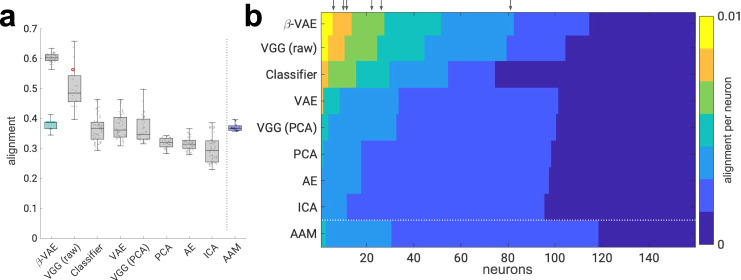
In order to better understand how the brain perceives faces, it is important to know what objective drives learning in the ventral visual stream. To answer this question, we model neural responses to faces in the macaque inferotemporal (IT) cortex with a deep self-supervised generative model, β -VAE, which disentangles sensory data into interpretable latent factors, such as gender or age. Our results demonstrate a strong correspondence between the generative factors discovered by β -VAE and those coded by single IT neurons, beyond that found for the baselines, including the handcrafted state-of-the-art model of face perception, the Active Appearance Model, and deep classifiers. Moreover, β -VAE is able to reconstruct novel face images using signals from just a handful of cells. Together our results imply that optimising the disentangling objective leads to representations that closely resemble those in the IT at the single unit level. This points at disentangling as a plausible learning objective for the visual brain.
Overview
The claims and statistics of this paper haven’t been checked yet.
Free: it reads the open-access text and checks the first 5 claims that cite a source we can check. Create a free account to check every claim.
Integrity signals
Registry
Cites
Statistics
Figures
Verification
Claims the paper makes
The claims and statistics of this paper haven’t been checked yet.
Free: it reads the open-access text and checks the first 5 claims that cite a source we can check. Create a free account to check every claim.
Claims other papers make about this one
Each is checked against this paper’s own text: does it say what the citing paper says it does?
The source backs part of the claim, not all of it — or backs it for a different population, condition or comparison.
In the citing paper
“Thus, managing the trade-off between latent variable compression and motor performance 25,56 may structure neural variability in ways that are distinct from previously hypothesized mechanisms like signal-dependent noise 54 or energy constraints 7.”
From A virtual rodent predicts the structure of neural activity across behaviours (2024) · cites this paper as [25]
Experimental — accuracy not yet measuredThe source backs part of the claim, not all of it — or backs it for a different population, condition or comparison.
In the citing paper
“suggesting a link between mechanisms for robustness and generalizability (see also 25,56).”
From A virtual rodent predicts the structure of neural activity across behaviours (2024) · cites this paper as [25]
Experimental — accuracy not yet measured
Self-check
Percentages, sums and reported differences re-computed from the paper’s own numbers.
The self-check needs the paper’s full text.
Citations
Cites
Reducing the dimensionality of data with neural networks
Hinton, G. E., & Salakhutdinov, R. R. (2006) · Science · doi:10.1126/science.1127647 · Cited by 20,928
Auto-Encoding Variational Bayes
Kingma, D. P., & Welling, M. (2013) · arXiv · doi:10.48550/arxiv.1312.6114 · Cited by 20,067 · cited 3×
“…proposed as a good model for comparison against neural data in face recognition tasks 34,35 , other generative models, such as a basic autoencoder (AE) 36 and a variational autoencoder (VAE) 37 , as well as baselines provided by ICA, PCA and a classifier which used only the encoder from the β -VAE.”
MethodDelving Deep into Rectifiers: Surpassing Human-Level Performance on ImageNet Classification
He, K., Zhang, X., Ren, S., & Sun, J. (2015) · 2015 IEEE International Conference on Computer Vision (ICCV) · doi:10.1109/iccv.2015.123 · Cited by 19,741 · cited 1×
“When trained with high-density teaching signals, contemporary deep networks can outperform humans on multiway object recognition tasks 9 , and in doing so form high-dimensional representations that are multiplexed over many simulated neurons.”
BackgroundThe Hungarian method for the assignment problem
Kuhn, H. W. (1955) · Naval Research Logistics Quarterly · doi:10.1002/nav.3800020109 · Cited by 13,120
Representation Learning: A Review and New Perspectives
Bengio, Y., Courville, A., & Vincent, P. (2013) · IEEE Transactions on Pattern Analysis and Machine Intelligence · doi:10.1109/tpami.2013.50 · Cited by 13,001
Independent component analysis: algorithms and applications
Hyvärinen, A., & Oja, E. (2000) · Neural Networks · doi:10.1016/s0893-6080(00)00026-5 · Cited by 8,705
The free-energy principle: a unified brain theory?
Friston, K. (2010) · Nature Reviews Neuroscience · doi:10.1038/nrn2787 · Cited by 8,120
Deep Learning Face Attributes in the Wild
Liu, Z., Luo, P., Wang, X., & Tang, X. (2015) · 2015 IEEE International Conference on Computer Vision (ICCV) · doi:10.1109/iccv.2015.425 · Cited by 7,747
Fukushima, K. (1980) · Biological Cybernetics · doi:10.1007/bf00344251 · Cited by 5,759
Parkhi, O. M., Vedaldi, A., & Zisserman, A. (2015) · Procedings of the British Machine Vision Conference 2015 · doi:10.5244/c.29.41 · Cited by 5,479 · cited 6×
“We included a state-of-the-art deep supervised network (VGG, 33 ) that has previously been proposed as a good model for comparison against neural data in face recognition tasks 34,35 , other generative models, such as a basic autoencoder (AE) 36 and a variational autoencoder (VAE) 37 , as well as…”
MethodInfluentialReceptive fields of single neurones in the cat's striate cortex
Hubel, D. H., & Wiesel, T. N. (1959) · The Journal of Physiology · doi:10.1113/jphysiol.1959.sp006308 · Cited by 4,653 · cited 1×
“…cells are the key building blocks of brain function 1 , and decades of extracellular single neuron recordings have defined canonical coding principles, such as the sensitivity of early visual neurons to oriented contours and more anterior ventral stream neurons to complex objects and faces 2,3 .”
BackgroundAlgorithms for the Assignment and Transportation Problems
Munkres, J. (1957) · Journal of the Society for Industrial and Applied Mathematics · doi:10.1137/0105003 · Cited by 3,986
Representational similarity analysis-connecting the branches of systems neuroscience
Kriegeskorte, N. (2008) · Frontiers in Systems Neuroscience · doi:10.3389/neuro.06.004.2008 · Cited by 3,355
Hierarchical models of object recognition in cortex
Riesenhuber, M., & Poggio, T. (1999) · Nature Neuroscience · doi:10.1038/14819 · Cited by 3,309 · cited 1×
“These deep generative models thus continue the longstanding tradition from the neuroscience community of building self-supervised models of vision 21,22 , while moving in a new direction that allows strong generalisation, imagination, abstract reasoning, compositional inference and other hallmarks…”
Background(2017) · International Conference on Learning Representations · Cited by 3,248
Self-citationThe FERET database and evaluation procedure for face-recognition algorithms
Phillips, P. J., Wechsler, H., Huang, J., & Rauss, P. J. (1998) · Image and Vision Computing · doi:10.1016/s0262-8856(97)00070-x · Cited by 2,431
Stochastic Backpropagation and Approximate Inference in Deep Generative Models
Rezende, D. J., Mohamed, S., & Wierstra, D. (2014) · arXiv (Cornell University) · doi:10.48550/arxiv.1401.4082 · Cited by 2,405
Performance-optimized hierarchical models predict neural responses in higher visual cortex
Yamins, D. L. K., Hong, H., Cadieu, C. F., Solomon, E. A., Seibert, D., & DiCarlo, J. J. (2014) · Proceedings of the National Academy of Sciences · doi:10.1073/pnas.1403112111 · Cited by 1,924 · cited 8×
“In order to make a fairer comparison with the other baselines, we therefore created different model instances by extracting different numbers of representation dimensions with N∈ [10, 50], resulting in 41 PCA and VGG (PCA) model instances, and 21 AAM instances (since N needs to split evenly into shapeand appearance-re…”
MethodInfluentialHow does the brain solve visual object recognition?
DiCarlo, J. J., Zoccolan, D., & Rust, N. C. (2012) · Neuron · doi:10.1016/j.neuron.2012.01.010 · Cited by 1,790 · cited 2×
“Building on this intuition, one longstanding hypothesis 16,17 is that the visual system uses self-supervision to recover the semantically interpretable latent structure of sensory signals, such as the shape or size of an object, or the gender or age of a face image.”
BackgroundThe Chicago face database: a free stimulus set of faces and norming data
Ma, D. S., Correll, J., & Wittenbrink, B. (2015) · Behavior Research Methods · doi:10.3758/s13428-014-0532-5 · Cited by 1,788
Using goal-driven deep learning models to understand sensory cortex
Yamins, D. L. K., & DiCarlo, J. J. (2016) · Nature Neuroscience · doi:10.1038/nn.4244 · Cited by 1,621 · cited 1×
“In parallel, visual neuroscience moved beyond handcrafted computational models towards theories that emphasise representation learning through end-to-end optimization 7,8 .”
BackgroundNeuroscience-Inspired Artificial Intelligence
Hassabis, D., Kumaran, D., Summerfield, C., & Botvinick, M. (2017) · Neuron · doi:10.1016/j.neuron.2017.06.011 · Cited by 1,557
Self-citationDeep supervised, but not unsupervised, models may explain IT cortical representation
Khaligh-Razavi, S.-M., & Kriegeskorte, N. (2014) · PLoS Computational Biology · doi:10.1371/journal.pcbi.1003915 · Cited by 1,204 · cited 9×
“Hence, we extracted N ∈ [10 , 50] independent components with ten random initialisation seeds each, resulting in 41 ICA model instances.”
BackgroundMethodInfluentialA Cortical Region Consisting Entirely of Face-Selective Cells
Tsao, D. Y., Freiwald, W. A., Tootell, R. B. H., & Livingstone, M. S. (2006) · Science · doi:10.1126/science.1119983 · Cited by 1,141
Self-citationChallenging Common Assumptions in the Unsupervised Learning of Disentangled Representations
Locatello, F., Bauer, S., Lucic, M., Rätsch, G., Gelly, S., Schölkopf, B., & Bachem, O. (2018) · arXiv · doi:10.48550/arxiv.1811.12359 · Cited by 1,067 · cited 2×
“Another factor that affects the quality of disentangled representation is the random initialisation seed for training the models 31 .”
BackgroundA deep learning framework for neuroscience
Richards, B. A., Lillicrap, T. P., Beaudoin, P., Bengio, Y., Bogacz, R., Christensen, A., Clopath, C., Costa, R. P., de Berker, A., Ganguli, S., et al. (2019) · Nature Neuroscience · doi:10.1038/s41593-019-0520-2 · Cited by 1,027 · cited 2×
“A natural synergy has thus arisen between new tools for multivariate population encoding and new computational theories that assume that the tuning properties of a single unit are all but uninterpretable 5–7 .”
BackgroundGuclu, U., & van Gerven, M. A. J. (2015) · Journal of Neuroscience · doi:10.1523/jneurosci.5023-14.2015 · Cited by 961
The CAS-PEAL large-scale chinese face database and baseline evaluations
Gao, W., Cao, B., Shan, S., Chen, X., Zhou, D., Zhang, X., & Zhao, D. (2008) · IEEE Transactions on Systems, Man, and Cybernetics - Part A: Systems and Humans · doi:10.1109/tsmca.2007.909557 · Cited by 773
Tsao, D. Y., & Livingstone, M. S. (2008) · Annual Review of Neuroscience · doi:10.1146/annurev.neuro.30.051606.094238 · Cited by 661 · cited 4×
“…possible visual objects, and neurons that preferentially respond to faces tend to cluster in particular patches of the inferotemporal (IT) cortex 27 , the computational mechanisms and basic units of representation employed for face processing may in fact generalise more broadly within the…”
BackgroundMethodInfluentialSelf-citationFFA: a flexible fusiform area for subordinate-level visual processing automatized by expertise
Tarr, M. J., & Gauthier, I. (2000) · Nature Neuroscience · doi:10.1038/77666 · Cited by 650 · cited 2×
“…and neurons that preferentially respond to faces tend to cluster in particular patches of the inferotemporal (IT) cortex 27 , the computational mechanisms and basic units of representation employed for face processing may in fact generalise more broadly within the ventral visual stream 27,28 .”
BackgroundThe Code for Facial Identity in the Primate Brain
Chang, L., & Tsao, D. Y. (2017) · Cell · doi:10.1016/j.cell.2017.05.011 · Cited by 644 · cited 16×
“Hence, β -VAE provides a learning -based counterpart to the handcrafted AAM units that could generalise beyond the domain of faces.”
BackgroundMethodResultInfluentialSelf-citationNavigating cognition: Spatial codes for human thinking
Bellmund, J. L. S., Gärdenfors, P., Moser, E. I., & Doeller, C. F. (2018) · Science · doi:10.1126/science.aat6766 · Cited by 643 · cited 1×
“…insights from machine learning may now feed back to the neuroscience community to investigate the merit of disentangled representations for supporting intelligence in the biological systems, in particular as the basis for abstract reasoning 47 , or generalisable and efficient task learning 48 .”
BackgroundStatistical factors involved in neuromuscular facilitation and depression
del Castillo, J., & Katz, B. (1954) · The Journal of Physiology · doi:10.1113/jphysiol.1954.sp005130 · Cited by 583
Convolutional Neural Networks as a Model of the Visual System: Past, Present, and Future
Lindsay, G. W. (2021) · Journal of Cognitive Neuroscience · doi:10.1162/jocn_a_01544 · Cited by 557 · cited 1×
“…identifying interpretable codes in the IT encountered in the past may have been due to the fact that semantically meaningful axes of variation of complex visual objects are more challenging for humans to define (and hence use as visual probes) compared to simple features, such as visual edges 14 .”
BackgroundA framework for the quantitative evaluation of disentangled representations
Eastwood, C., & Williams, C. K. I. (2018) · Edinburgh Research Explorer (University of Edinburgh) · Cited by 543
Neural population control via deep image synthesis
Bashivan, P., Kar, K., & DiCarlo, J. J. (2019) · Science · doi:10.1126/science.aav9436 · Cited by 434 · cited 1×
“Examined at the population level, these tuning distributions closely resemble those in biological systems 10 , especially in higher-performing networks 11 , allowing deep learning networks to make accurate predictions about neural responses to synthesised images 12 .”
BackgroundLearning task-state representations
Niv, Y. (2019) · Nature Neuroscience · doi:10.1038/s41593-019-0470-8 · Cited by 356 · cited 8×
“In order to make a fairer comparison with the other baselines, we therefore created different model instances by extracting different numbers of representation dimensions with N∈ [10, 50], resulting in 41 PCA and VGG (PCA) model instances, and 21 AAM instances (since N needs to split evenly into shapeand appearance-re…”
MethodInfluentialDeep convolutional models improve predictions of macaque V1 responses to natural images
Cadena, S. A., Denfield, G. H., Walker, E. Y., Gatys, L. A., Tolias, A. S., Bethge, M., & Ecker, A. S. (2019) · PLOS Computational Biology · doi:10.1371/journal.pcbi.1006897 · Cited by 347
The Developing Infant Creates a Curriculum for Statistical Learning
Smith, L. B., Jayaraman, S., Clerkin, E., & Yu, C. (2018) · Trends in Cognitive Sciences · doi:10.1016/j.tics.2018.02.004 · Cited by 299
Inferotemporal neurons represent low-dimensional configurations of parameterized shapes
Op de Beeck, H., Wagemans, J., & Vogels, R. (2001) · Nature Neuroscience · doi:10.1038/nn767 · Cited by 284 · cited 1×
“Past studies have proposed that the ventral visual cortex may disentangle 17,38 and represent visual information with a low-dimensional code 3,39,40 .”
BackgroundMONet: Unsupervised Scene Decomposition and Representation
Burgess, C. P., Matthey, L., Watters, N., Kabra, R., Higgins, I., Botvinick, M., & Lerchner, A. (2019) · arXiv · doi:10.48550/arxiv.1901.11390 · Cited by 270 · cited 1×
“…the longstanding tradition from the neuroscience community of building self-supervised models of vision 21,22 , while moving in a new direction that allows strong generalisation, imagination, abstract reasoning, compositional inference and other hallmarks of biological visual cognition 19,23–25 .”
BackgroundSelf-citationTowards a Definition of Disentangled Representations
Higgins, I., Amos, D., Pfau, D., Racanière, S., Matthey, L., Rezende, D. J., & Lerchner, A. (2018) · arXiv (Cornell University) · doi:10.48550/arxiv.1812.02230 · Cited by 267
Self-citationHow face perception unfolds over time
Dobs, K., Isik, L., Pantazis, D., & Kanwisher, N. (2019) · Nature Communications · doi:10.1038/s41467-019-09239-1 · Cited by 231 · cited 3×
“…was the VGG-Face model 33 (referred to as the VGG in all figures and text), a more powerful deep network developed for state-of-the-art face recognition performance and previously chosen as an appropriate computational model for comparison against neural data in face recognition tasks 34,35,57 (Fig.”
MethodA Model of V4 Shape Selectivity and Invariance
Cadieu, C., Kouh, M., Pasupathy, A., Connor, C. E., Riesenhuber, M., & Poggio, T. (2007) · Journal of Neurophysiology · doi:10.1152/jn.01265.2006 · Cited by 226
Darla Improving zero-shot transfer in reinforcement learning
Higgins, I., Pal, A., Rusu, A. A., Matthey, L., Burgess, C. P., Pritzel, A., Botvinick, M., Blundell, C., & Lerchner, A. (2017) · arXiv · doi:10.48550/arxiv.1707.08475 · Cited by 219 · cited 2×
“While the development of β -VAE for learning disentangled representations was originally guided by high level neuroscience principles 43–45 , subsequent work in demonstrating the utility of such representations for intelligent behaviour was primarily done in the machine learning community 23–25 .”
BackgroundSelf-citationReconstructing faces from fMRI patterns using deep generative neural networks
VanRullen, R., & Reddy, L. (2019) · Communications Biology · doi:10.1038/s42003-019-0438-y · Cited by 155
Tuning for shape dimensions in macaque inferior temporal cortex
Kayaert, G., Biederman, I., Op de Beeck, H. P., & Vogels, R. (2005) · European Journal of Neuroscience · doi:10.1111/j.1460-9568.2005.04202.x · Cited by 152
Life-Long Disentangled Representation Learning with Cross-Domain Latent HomologiesPreprint
Achille, A., Eccles, T., Matthey, L., Burgess, C., Watters, N., Lerchner, A., & Higgins, I. (2018) · arXiv (Cornell University) · doi:10.48550/arxiv.1808.06508 · Cited by 142 · cited 2×
“While the development of β -VAE for learning disentangled representations was originally guided by high level neuroscience principles 43–45 , subsequent work in demonstrating the utility of such representations for intelligent behaviour was primarily done in the machine learning community 23–25 .”
BackgroundSelf-citationThe MR2: A multi-racial, mega-resolution database of facial stimuli
Strohminger, N., Gray, K., Chituc, V., Heffner, J., Schein, C., & Heagins, T. B. (2016) · Behavior Research Methods · doi:10.3758/s13428-015-0641-9 · Cited by 128
Grossman, S., Gaziv, G., Yeagle, E. M., Harel, M., Mégevand, P., Groppe, D. M., Khuvis, S., Herrero, J. L., Irani, M., Mehta, A. D., et al. (2019) · Nature Communications · doi:10.1038/s41467-019-12623-6 · Cited by 116 · cited 3×
“…was the VGG-Face model 33 (referred to as the VGG in all figures and text), a more powerful deep network developed for state-of-the-art face recognition performance and previously chosen as an appropriate computational model for comparison against neural data in face recognition tasks 34,35,57 (Fig.”
MethodLearning Deep Disentangled Embeddings with the F-Statistic Loss
Ridgeway, K., & Mozer, M. C. (2018) · arXiv (Cornell University) · doi:10.48550/arxiv.1802.05312 · Cited by 111
Explaining face representation in the primate brain using different computational models
Chang, L., Egger, B., Vetter, T. R., & Tsao, D. Y. (2021) · Current Biology · doi:10.1016/j.cub.2021.04.014 · Cited by 102
Self-citationWeakly-Supervised Disentanglement Without Compromises
Locatello, F., Poole, B., Rätsch, G., Schölkopf, B., Bachem, O., & Tschannen, M. (2020) · arXiv (Cornell University) · doi:10.48550/arxiv.2002.02886 · Cited by 89
SCAN: Learning Hierarchical Compositional Visual Concepts
Higgins, I., Sonnerat, N., Matthey, L., Pal, A., Burgess, C., Bošnjak, M., Shanahan, M., Botvinick, M., Hassabis, D., & Lerchner, A. (2017) · arXiv (Cornell University) · doi:10.48550/arxiv.1707.03389 · Cited by 76
Self-citationHigh-Fidelity Synthesis with Disentangled Representation
Lee, W., Kim, D., Hong, S., & Lee, H. (2020) · Lecture notes in computer science · doi:10.1007/978-3-030-58574-7_10 · Cited by 73
Reconstructing perceived faces from brain activations with deep adversarial neural decoding
Güçlütürk, Y., Güçlü, U., Seeliger, K., Bosch, S., van Lier, R., & van Gerven, M. A. J. (2017) · Radboud Repository (Radboud University) · Cited by 70
Suspect identification based on descriptive facial attributes
Klare, B. F., Klum, S., Klontz, J. C., Taborsky, E., Akgül, T., & Jain, A. K. (2014) · IEEE International Joint Conference on Biometrics (IJCB) · doi:10.1109/btas.2014.6996255 · Cited by 55
Wood, J. N., & Wood, S. M. W. (2018) · Cognitive Science · doi:10.1111/cogs.12595 · Cited by 47 · cited 1×
“While the development of β -VAE for learning disentangled representations was originally guided by high level neuroscience principles 43–45 , subsequent work in demonstrating the utility of such representations for intelligent behaviour was primarily done in the machine learning community 23–25 .”
BackgroundInfants’ statistical learning: 2- and 5-month-olds’ segmentation of continuous visual sequences
Slone, L. K., & Johnson, S. P. (2015) · Journal of Experimental Child Psychology · doi:10.1016/j.jecp.2015.01.007 · Cited by 42 · cited 1×
“An important challenge for theories that rely on deep supervised networks, however, is that external teaching signals are scarce in the natural world, and visual development relies heavily on untutored statistical learning 13–15 .”
BackgroundUnsupervised Model Selection for Variational Disentangled Representation Learning
Duan, S., Matthey, L., Saraiva, A., Watters, N., Burgess, C., Lerchner, A., & Higgins, I. (2019) · arXiv (Cornell University) · doi:10.48550/arxiv.1905.12614 · Cited by 32 · cited 7×
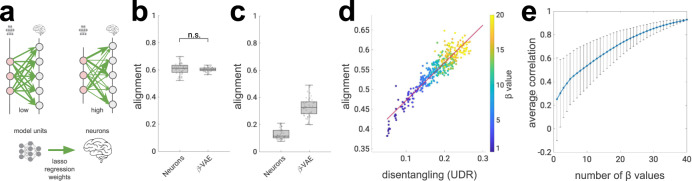
“We first compared alignment scores between the β -VAE and the monkey data to a theoretical ceiling which was obtained by subsampling the neural data to match the intrinsic dimensionality of the β -VAE latent representation (see Online Methods) and computing its alignment with itself (Fig.”
BackgroundInfluentialSelf-citationSubtasks of Unconstrained Face Recognition
Leibo, J. Z., Liao, Q., & Poggio, T. (2014) · DSpace@MIT (Massachusetts Institute of Technology) · Cited by 20
How can deep learning advance computational modeling of sensory information processing?Preprint
Thompson, J. A. F., Bengio, Y., Formisano, E., & Schönwiesner, M. (2018) · arXiv (Cornell University) · doi:10.48550/arxiv.1810.08651 · Cited by 14
Representational untangling by the firing rate nonlinearity in V1 simple cells
Gáspár, M. E., Polack, P., Golshani, P., Lengyel, M., & Orbán, G. (2019) · eLife · doi:10.7554/elife.43625 · Cited by 13 · cited 2×
“Moreover, we show that disentangling may occur at the end of the ventral visual stream (IT), extending results recently reported for V1 38 .”
BackgroundSUFR-W (Subtasks of unconstrained face recognition)
Leibo, J. Z., Liao, Q., & Poggio, T. (2018) · Harvard Dataverse · doi:10.7910/dvn/sjv7qk · Cited by 1
Research works printed but not linked: 1
- Freund, R. J., Mohr, D. & Wilson, W. J.Statistical Methods (Academic Press, 2010).
Cited by
If deep learning is the answer, what is the question?
Saxe, A., Nelli, S., & Summerfield, C. (2021) · Nature Reviews Neuroscience · doi:10.1038/s41583-020-00395-8 · Cited by 397
“Although a focus on population coding emerged independently of the growing interest in deep learning, mixed selectivity is often (but not always) 42 a hallmark of coding in deep network models 4 .”
BackgroundSelf-citationThe neuroconnectionist research programme
Doerig, A., Sommers, R. P., Seeliger, K., Richards, B., Ismael, J., Lindsay, G. W., Kording, K. P., Konkle, T., van Gerven, M. A. J., Kriegeskorte, N., et al. (2023) · Nature Reviews Neuroscience · doi:10.1038/s41583-023-00705-w · Cited by 233
Using artificial neural networks to ask ‘why’ questions of minds and brains
Kanwisher, N., Khosla, M., & Dobs, K. (2023) · Trends in Neurosciences · doi:10.1016/j.tins.2022.12.008 · Cited by 182
“Single unit analyses (not illustrated) in networks and brains reveals the tuning properties of individual units, whether they are selective for meaningful perceptual attributes, forming disentangled representations [86], or exhibit mixed selectivity and distributed representations [87].”
BackgroundAbstract representations emerge in human hippocampal neurons during inference
Courellis, H. S., Minxha, J., Cardenas, A. R., Kimmel, D. L., Reed, C. M., Valiante, T. A., Salzman, C. D., Mamelak, A. N., Fusi, S., & Rutishauser, U. (2024) · Nature · doi:10.1038/s41586-024-07799-x · Cited by 192
Abrego-Martinez, J. C., Jafari, M., Chergui, S., Pavel, C., Che, D., & Siaj, M. (2022) · Biosensors and Bioelectronics · doi:10.1016/j.bios.2021.113595 · Cited by 159
Metadata
- Authors
- Higgins, I., Chang, L., Langston, V., Hassabis, D., Summerfield, C., Tsao, D., & Botvinick, M.
- Affiliations
- Google DeepMind (United Kingdom) (GB)
- California Institute of Technology (US)
- University of Oxford (GB)
- Corresponding author
- Higgins, Irina
- Venue
- Nature Communications
- Published
- 2021-11-09
- Volume
- 12
- Issue
- 1
- Pages
- 6456-6456
- ISSN
- 2041-1723 (ISSN-L)
- PMC
- PMC8578601
- OpenAlex
- W3212335243
- Cited by
- 162
- References
- 64
- Citations by year
- 2026: 16 · 2025: 29 · 2024: 40 · 2023: 26 · 2022: 32 · 2021: 11
- FWCI
- 14.33
- Type
- journal article
- Language
- en
- Open access
- gold
- doi.org
- Licence
- cc-by
- creativecommons.org/licenses/by/4.0 (tdm)
- creativecommons.org/licenses/by/4.0 (vor)
- Locations
- Nature Communications (publishedVersion, cc-by)
- PubMed Central (publishedVersion, cc-by)
- PubMed (publishedVersion)
- arXiv (Cornell University) (submittedVersion)
- CaltechAUTHORS (California Institute of Technology) (submittedVersion, cc-by)
- RePEc: Research Papers in Economics (submittedVersion)
- DOAJ (DOAJ: Directory of Open Access Journals) (submittedVersion, cc-by-sa)
- arXiv (Cornell University)
- Funders
- Howard Hughes Medical Institute
- National Institutes of Health
- National Eye Institute (R01EY030650)
- National Institute of Neurological Disorders and Stroke (DP1NS083063)
- Topics
- Life Sciences › Neuroscience › Cognitive Neuroscience › Face Recognition and Perception
- Physical Sciences › Computer Science › Computer Vision and Pattern Recognition › Face recognition and analysis
- Physical Sciences › Computer Science › Computer Vision and Pattern Recognition › Face and Expression Recognition
- Keywords
- face perception, inferotemporal cortex, single neuron responses, semantic disentanglement, self-supervised learning, variational autoencoder, beta-VAE, latent representations, active appearance models, macaque, ventral stream, facial reconstruction
- MeSH terms
- Deep Learning, Brain, Cerebral Cortex, Humans, Neurons, Pattern Recognition, Visual, Semantics, Temporal Lobe, Neural Networks, Computer
About these checks
Registry, retraction, Cites and statistics results are computed, not judged, with one exception: a printed reference that no index lists is read once by a model before it counts as a citation error. Claims are extracted by a model and kept only when their quote appears verbatim in the text; each cited source is then checked, with a model’s help, for whether it says what the claim relies on. Those verdicts can be wrong — read the claim’s quote and the cited source before relying on one.
Statistics and arithmetic are recomputed, not judged.
Confidence bands are shown only for fields calibrated on our annotated test set. None is calibrated yet, so no band is shown.
What counts as a claim ›How we measure confidence ›How we check this ›
Are you an author, or do you see a problem with this page? Request a review
Data sources
Bibliographic data: Semantic Scholar, OpenAlex, Crossref.
Contains information from the Semantic Scholar Academic Graph Datasets, made available under the ODC Attribution License (ODC-BY 1.0).
Semantic Scholar’s data is described in: Kinney, R., et al. (2023). The Semantic Scholar Open Data Platform. arXiv:2301.10140.
