

The DOI matches its Crossref record; 52 of the 55 references it cites were found in a registry or an index.
Development of a BCL-xL and BCL-2 dual degrader with improved anti-leukemic activity,
Open accessAbstract
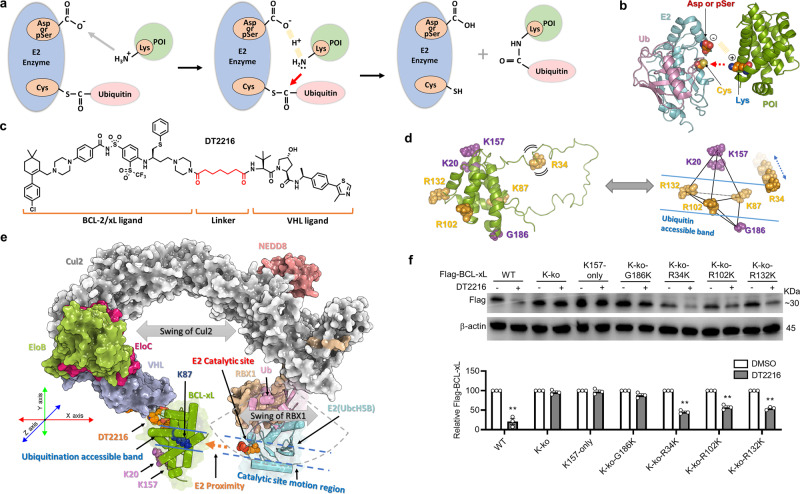
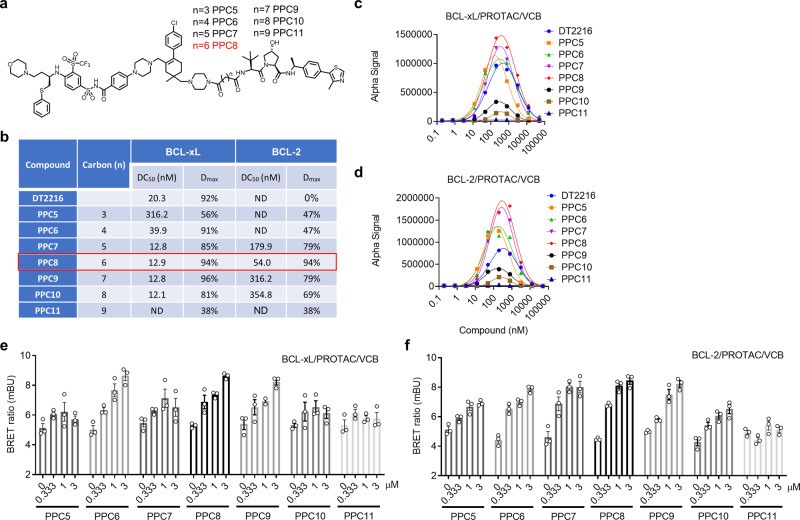
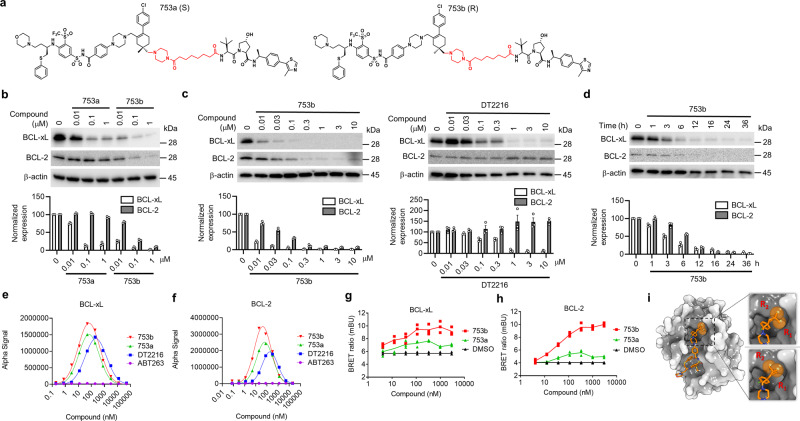
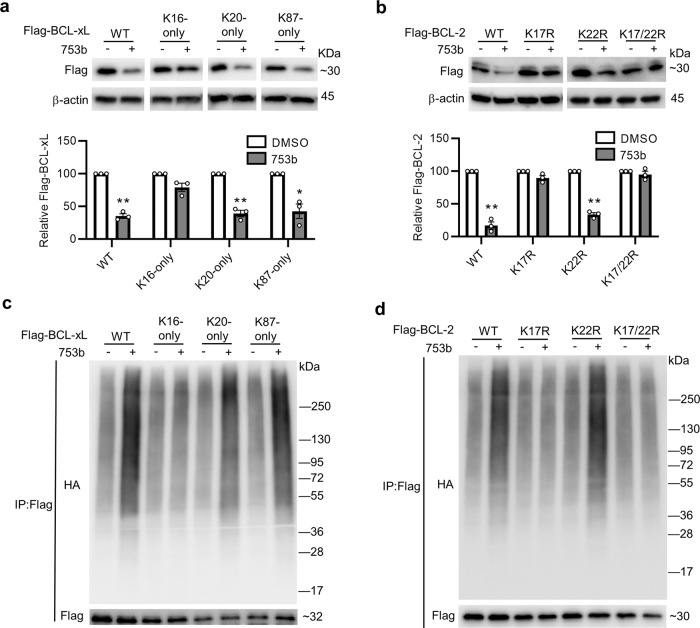
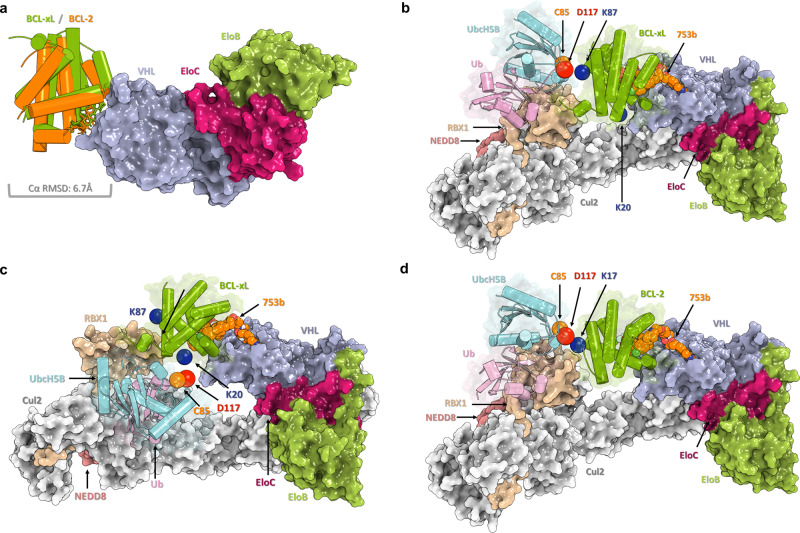
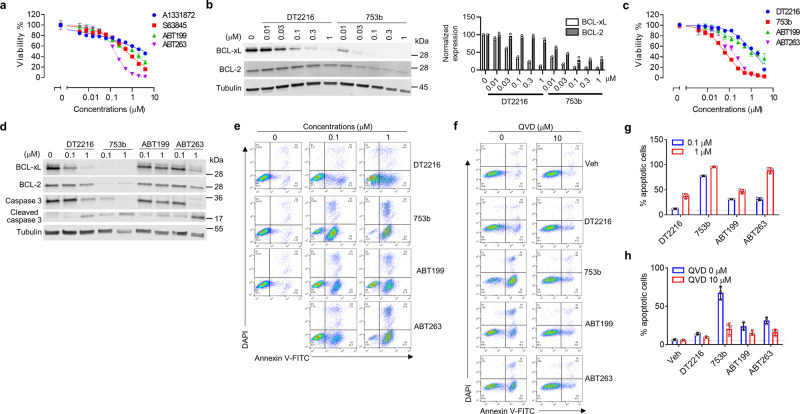
PROteolysis-TArgeting Chimeras (PROTACs) have emerged as an innovative drug development platform. However, most PROTACs have been generated empirically because many determinants of PROTAC specificity and activity remain elusive. Through computational modelling of the entire NEDD8-VHL Cullin RING E3 ubiquitin ligase (CRL VHL )/PROTAC/BCL-xL/UbcH5B(E2)-Ub/RBX1 complex, we find that this complex can only ubiquitinate the lysines in a defined band region on BCL-xL. Using this approach to guide our development of a series of ABT263-derived and VHL-recruiting PROTACs, we generate a potent BCL-xL and BCL-2 (BCL-xL/2) dual degrader with significantly improved antitumor activity against BCL-xL/2-dependent leukemia cells. Our results provide experimental evidence that the accessibility of lysines on a target protein plays an important role in determining the selectivity and potency of a PROTAC in inducing protein degradation, which may serve as a conceptual framework to guide the future development of PROTACs.
Overview
The claims and statistics of this paper haven’t been checked yet.
Run the check — free, no account needed. It reads the open-access text and checks the sources it cites.
Integrity signals
Registry
Cites
Statistics
Figures
Verification
Claims the paper makes
The claims and statistics of this paper haven’t been checked yet.
Run the check — free, no account needed. It reads the open-access text and checks the sources it cites.
Claims other papers make about this one
Each is checked against this paper’s own text: does it say what the citing paper says it does?
In the citing paper
“Finally, 753b (203) displayed high selectivity for cancer cells over normal platelets and a lower toxicity profile, making it a promising candidate for future cancer therapy (Table 4).495”
From Recent advances in targeting the “undruggable” proteins: from drug discovery to clinical trials (2023) · cites this paper as [495]
In the citing paper
“Moreover, some recent studies have shown that only the ternary complex models with optimal target-lysine accessibility for the E2 could predict target degradation outcomes.[181][182][183]”
From Chasing molecular glue degraders: screening approaches (2022) · cites this paper as [183]
Self-check
Percentages, sums and reported differences re-computed from the paper’s own numbers.
The self-check needs the paper’s full text.
Citations
Cites
Hallmarks of Cancer: The Next Generation
Hanahan, D., & Weinberg, R. A. (2011) · Cell · doi:10.1016/j.cell.2011.02.013 · Cited by 66,590
Double-slit photoelectron interference in strong-field ionization of the neon dimer
Kunitski, M., Eicke, N., Huber, P., Köhler, J., Zeller, S., Voigtsberger, J., Schlott, N., Henrichs, K., Sann, H., Trinter, F., et al. (2019) · Institutional Repository of Leibniz Universität Hannover (Leibniz Universität Hannover) · doi:10.15488/5174 · Cited by 8,378
ABT-199, a potent and selective BCL-2 inhibitor, achieves antitumor activity while sparing platelets
Souers, A. J., Leverson, J. D., Boghaert, E. R., Ackler, S. L., Catron, N. D., Chen, J., Dayton, B. D., Ding, H., Enschede, S. H., Fairbrother, W. J., et al. (2013) · Nature Medicine · doi:10.1038/nm.3048 · Cited by 3,058
The Bcl-2 apoptotic switch in cancer development and therapy
Adams, J. M., & Cory, S. (2007) · Oncogene · doi:10.1038/sj.onc.1210220 · Cited by 2,256
Structural basis of PROTAC cooperative recognition for selective protein degradation
Gadd, M. S., Testa, A., Lucas, X., Chan, K.-H., Chen, W., Lamont, D. J., Zengerle, M., & Ciulli, A. (2017) · Nature Chemical Biology · doi:10.1038/nchembio.2329 · Cited by 1,242
Gray, J. J., Moughon, S. E., Wang, C., Schueler‐Furman, O., Kuhlman, B. A., Rohl, C. A., & Baker, D. A. (2003) · Journal of Molecular Biology · doi:10.1016/s0022-2836(03)00670-3 · Cited by 1,130
Konopleva, M. Y., Pollyea, D. A., Potluri, J., Chyla, B., Hogdal, L. J., Busman, T. A., McKeegan, E. M., Salem, A. H., Zhu, M., Ricker, J. L., et al. (2016) · Cancer Discovery · doi:10.1158/2159-8290.cd-16-0313 · Cited by 1,101
Self-citationThe MCL1 inhibitor S63845 is tolerable and effective in diverse cancer models
Kotschy, A., Szlavik, Z., Murray, J., Davidson, J., Maragno, A. L., Le Toumelin-Braizat, G., Chanrion, M., Kelly, G. L., Gong, J.-N., Moujalled, D. M., et al. (2016) · Nature · doi:10.1038/nature19830 · Cited by 1,047
Lessons in PROTAC Design from Selective Degradation with a Promiscuous Warhead
Bondeson, D. P., Smith, B. E., Burslem, G. M., Buhimschi, A. D., Hines, J., Jaime-Figueroa, S., Wang, J., Hamman, B. D., Ishchenko, A., & Crews, C. M. (2018) · Cell Chemical Biology · doi:10.1016/j.chembiol.2017.09.010 · Cited by 923
From basic apoptosis discoveries to advanced selective BCL-2 family inhibitors
Ashkenazi, A., Fairbrother, W. J., Leverson, J. D., & Souers, A. J. (2017) · Nature Reviews Drug Discovery · doi:10.1038/nrd.2016.253 · Cited by 903
Research works printed but not linked: 1
- Ester, M., Kriegel, H.-P., Sander, J. & Xu, X. in Kdd, Vol. 96, 226-231 (1996).
Cited by
Sorted by citations
The BCL2 family: from apoptosis mechanisms to new advances in targeted therapy
Vogler, M., Braun, Y., Smith, V. M., Westhoff, M.-A., Pereira, R. S., Pieper, N. M., Anders, M., Callens, M., Vervliet, T., Abbas, M., et al. (2025) · Signal Transduction and Targeted Therapy · doi:10.1038/s41392-025-02176-0 · Cited by 462
Recent advances in targeting the “undruggable” proteins: from drug discovery to clinical trials
Xie, X., Yu, T., Li, X., Zhang, N., Foster, L. J., Peng, C., Huang, W., & He, G. (2023) · Signal Transduction and Targeted Therapy · doi:10.1038/s41392-023-01589-z · Cited by 396
Targeted protein degradation: advances in drug discovery and clinical practice
Zhong, G., Chang, X., Xie, W., & Zhou, X. (2024) · Signal Transduction and Targeted Therapy · doi:10.1038/s41392-024-02004-x · Cited by 326
PROTACs: great opportunities for academia and industry (an update from 2020 to 2021)
He, M., Cao, C., Ni, Z., Liu, Y., Song, P., Hao, S., He, Y., Sun, X., & Rao, Y. (2022) · Signal Transduction and Targeted Therapy · doi:10.1038/s41392-022-00999-9 · Cited by 283
Diehl, C. J., & Ciulli, A. (2022) · Chemical Society Reviews · doi:10.1039/d2cs00387b · Cited by 269
Metadata
- Authors
- Lv, D., Pal, P., Liu, X., Jia, Y., Thummuri, D., Zhang, P., Hu, W., Pei, J., Zhang, Q., Zhou, S., Khan, S., Zhang, X., Hua, N., Yang, Q., Arango, S., Zhang, W., Nayak, D., Olsen, S. K., Weintraub, S. T., Hromas, R., Konopleva, M., Yuan, Y., Zheng, G., & Zhou, D.
- Affiliations
- University of Florida (US)
- The University of Texas MD Anderson Cancer Center (US)
- The University of Texas at San Antonio Health Science Center (US)
- Corresponding author
- Yuan, Yaxia
- Zheng, Guangrong
- Zhou, Daohong
- ORCID
- Venue
- Nature Communications
- Published
- 2021-11-25
- Volume
- 12
- Issue
- 1
- Pages
- 6896-6896
- ISSN
- 2041-1723 (ISSN-L)
- PMC
- PMC8617031
- OpenAlex
- W3215130076
- Cited by
- 158
- References
- 55
- Citations by year
- 2026: 27 · 2025: 38 · 2024: 41 · 2023: 22 · 2022: 30
- FWCI
- 7.30
- Type
- journal article
- Language
- en
- Open access
- gold
- doi.org
- Locations
- Nature Communications (publishedVersion, cc-by)
- PubMed Central (publishedVersion, cc-by)
- PubMed (publishedVersion)
- RePEc: Research Papers in Economics (submittedVersion)
- DOAJ (DOAJ: Directory of Open Access Journals) (submittedVersion, cc-by-sa)
- Funders
- U.S. Department of Health & Human Services | National Institutes of Health (R01 CA241191, R01 AG063801, R01 CA205224, R01 GM115568, R01 GM128731, R01 CA200673, R01 CA203834)
- Cancer Prevention and Research Institute of Texas (RR200030)
- Topics
- Life Sciences › Biochemistry, Genetics and Molecular Biology › Molecular Biology › Protein Degradation and Inhibitors
- Life Sciences › Biochemistry, Genetics and Molecular Biology › Molecular Biology › Ubiquitin and proteasome pathways
- Life Sciences › Biochemistry, Genetics and Molecular Biology › Molecular Biology › Cell death mechanisms and regulation
- Keywords
- PROTACs, Bcl-xL, Bcl-2, UbcH5b, RBX1, ubiquitination, navitoclax, leukemia, protein degradation
- MeSH terms
- Antineoplastic Agents, Cell Line, Cell Survival, Humans, Leukemia, Lysine, Models, Molecular, Protein Binding, Protein Conformation, Proto-Oncogene Proteins c-bcl-2, Ubiquitin-Conjugating Enzymes, Ubiquitin-Protein Ligases, Proteasome Endopeptidase Complex, bcl-X Protein, Von Hippel-Lindau Tumor Suppressor Protein, Small Molecule Libraries, Ubiquitination, Proteolysis
About these checks
Registry, retraction, Cites and statistics results are computed, not judged, with one exception: a printed reference that no index lists is read once by a model before it counts as a citation error. Claims are extracted by a model and kept only when their quote appears verbatim in the text; each cited source is then checked, with a model’s help, for whether it says what the claim relies on. Those verdicts can be wrong — read the claim’s quote and the cited source before relying on one.
Statistics and arithmetic are recomputed, not judged.
Confidence bands are shown only for fields calibrated on our annotated test set. None is calibrated yet, so no band is shown.
What counts as a claim ›How we measure confidence ›How we check this ›
Are you an author, or do you see a problem with this page? Request a review
