

Randomized controlled trial for time-restricted eating in healthy volunteers without obesity
Open accessThe DOI matches its Crossref record; 77 of the 77 references it cites were found in a registry or an index.
Abstract
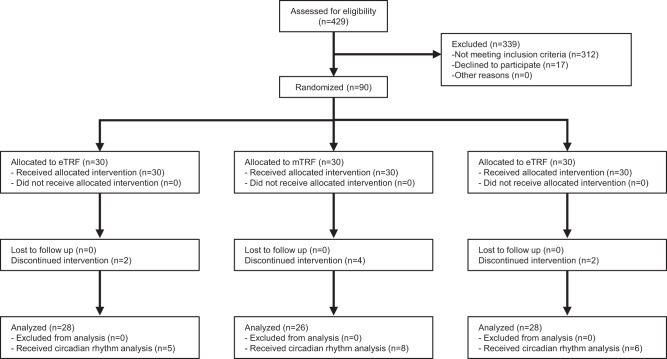
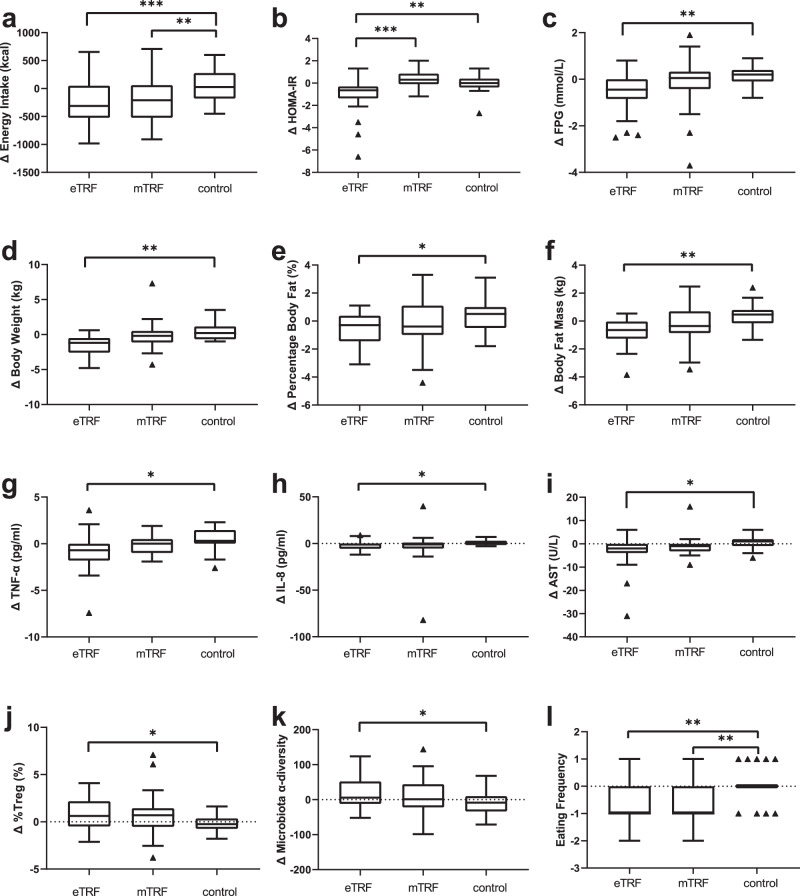
Time-restricted feeding (TRF) improves metabolic health. Both early TRF (eTRF, food intake restricted to the early part of the day) and mid-day TRF (mTRF, food intake restricted to the middle of the day) have been shown to have metabolic benefits. However, the two regimens have yet to be thoroughly compared. We conducted a five-week randomized trial to compare the effects of the two TRF regimens in healthy individuals without obesity (ChiCTR2000029797). The trial has completed. Ninety participants were randomized to eTRF (n=30), mTRF (n=30), or control groups (n=30) using a computer-based random-number generator. Eighty-two participants completed the entire five-week trial and were analyzed (28 in eTRF, 26 in mTRF, 28 in control groups). The primary outcome was the change in insulin resistance. Researchers who assessed the outcomes were blinded to group assignment, but participants and care givers were not. Here we show that eTRF was more effective than mTRF at improving insulin sensitivity. Furthermore, eTRF, but not mTRF, improved fasting glucose, reduced total body mass and adiposity, ameliorated inflammation, and increased gut microbial diversity. No serious adverse events were reported during the trial. In conclusion, eTRF showed greater benefits for insulin resistance and related metabolic parameters compared with mTRF. Clinical Trial Registration URL: http://www.chictr.org.cn/showproj.aspx?proj=49406 .
Overview
The claims and statistics of this paper haven’t been checked yet.
Free: it reads the open-access text and checks the first 5 claims that cite a source we can check. Create a free account to check every claim.
Integrity signals
Registry
Cites
Statistics
Figures
Verification
Claims the paper makes
The claims and statistics of this paper haven’t been checked yet.
Free: it reads the open-access text and checks the first 5 claims that cite a source we can check. Create a free account to check every claim.
Claims other papers make about this one
Each is checked against this paper’s own text: does it say what the citing paper says it does?
The source backs part of the claim, not all of it — or backs it for a different population, condition or comparison.
In the citing paper
“Furthermore, TRE demonstrates beneficial effects on cardiovascular metabolic parameters [87, 90] and lipid profiles [76, 83, 87].”
From Comparing caloric restriction regimens for effective weight management in adults: a systematic review and network meta-analysis (2024) · cites this paper as [76]
Experimental — accuracy not yet measuredThe source backs part of the claim, not all of it — or backs it for a different population, condition or comparison.
In the citing paper
“Fasting may affect weight control by altering the composition of the gut microbiota [76, 96]”
From Comparing caloric restriction regimens for effective weight management in adults: a systematic review and network meta-analysis (2024) · cites this paper as [76]
Experimental — accuracy not yet measured
Self-check
Percentages, sums and reported differences re-computed from the paper’s own numbers.
The self-check needs the paper’s full text.
Citations
Cites
Matthews, D. R., Hosker, J. P., Rudenski, A. S., Naylor, B. A., Treacher, D. F., & Turner, R. C. (1985) · Diabetologia · doi:10.1007/bf00280883 · Cited by 31,502
Search and clustering orders of magnitude faster than BLAST
Edgar, R. C. (2010) · Bioinformatics · doi:10.1093/bioinformatics/btq461 · Cited by 20,826
Metagenomic biomarker discovery and explanation
Segata, N., Izard, J., Waldron, L., Gevers, D., Miropolsky, L., Garrett, W. S., & Huttenhower, C. (2011) · Genome Biology · doi:10.1186/gb-2011-12-6-r60 · Cited by 16,192
Structure, function and diversity of the healthy human microbiome
The Human Microbiome Project Consortium (2012) · Nature · doi:10.1038/nature11234 · Cited by 11,726
Predictive functional profiling of microbial communities using 16S rRNA marker gene sequences
Langille, M. G. I., Zaneveld, J., Caporaso, J. G., McDonald, D., Knights, D., Reyes, J. A., Clemente, J. C., Burkepile, D. E., Vega Thurber, R. L., Knight, R., et al. (2013) · Nature Biotechnology · doi:10.1038/nbt.2676 · Cited by 9,116
Richness of human gut microbiome correlates with metabolic markers
Le Chatelier, E., Nielsen, T., Qin, J., Prifti, E., Hildebrand, F., Falony, G., Almeida, M., Arumugam, M., Batto, J.-M., Kennedy, S., et al. (2013) · Nature · doi:10.1038/nature12506 · Cited by 4,662
Inflammatory Mechanisms in Obesity
Gregor, M. F., & Hotamisligil, G. S. (2011) · Annual Review of Immunology · doi:10.1146/annurev-immunol-031210-101322 · Cited by 3,754
Damiola, F., Le Minh, N., Preitner, N., Kornmann, B., Fleury-Olela, F., & Schibler, U. (2000) · Genes & Development · doi:10.1101/gad.183500 · Cited by 2,394
Feuerer, M., Herrero, L., Cipolletta, D., Naaz, A., Wong, J., Nayer, A., Lee, J., Goldfine, A. B., Benoist, C., Shoelson, S., et al. (2009) · Nature Medicine · doi:10.1038/nm.2002 · Cited by 2,145
PANDAseq: paired-end assembler for Illumina sequences
Masella, A. P., Bartram, A. K., Truszkowski, J. M., Brown, D. G., & Neufeld, J. D. (2012) · BMC Bioinformatics · doi:10.1186/1471-2105-13-31 · Cited by 2,132
Research works printed but not linked: 3
- Moro T Effects of eight weeks of time-restricted feeding (16/8) on basal metabolism, maximal strength, body composition, inflammation, and cardiovascular risk factors in resistance-trained males J. Transl. Med. 2016 14 1 10 27737674 PMC5064803 · DOI · Paper page
- Briseño-Bass P Chávez-Pérez R López-Zendejas M Prevalence of hepatic steatosis and its relation to liver function tests and lipid profile in patients at medical check-up Rev. Gastroenterol. Mex. 2019 84 290 295 30292582
- Yang, Y. X., Wang, G. & Pan, X. China Food Composition (Peking University Medical Press, 2009).
Cited by
Items 201–300 of 319
Szekely, K., Gerl, M. J., Peters, B., Schwarz, J., Schuppelius, B., Damm, M., Soliz‐Rueda, J. R., Sehgal, R., Lazaratos, M., Klose, C. D., et al. (2025) · Advanced Science · doi:10.1002/advs.202507149 · Cited by 4
Tan, L.-J., & Shin, S. (2024) · The Journal of Nutritional Biochemistry · doi:10.1016/j.jnutbio.2024.109835 · Cited by 3
Huo, Q., Yue, T., Li, W., Wang, X., Dong, Y., Wu, X., He, X., Lu, L., Zhang, J., Zhao, Y., et al. (2024) · International Immunopharmacology · doi:10.1016/j.intimp.2024.111695 · Cited by 3
Duan, D., Pham, L. V., Jun, J. C., Turkson‐Ocran, R., Pilla, S. J., Clark, J. M., & Maruthur, N. M. (2025) · SLEEP · doi:10.1093/sleep/zsaf089 · Cited by 3
Overnight Fasting and Body Weight: Emulated Target Trial Using Cancer Prevention Study-3 Data
Elahy, V., Wang, Y., Flanders, W. D., Zhong, C., & McCullough, M. L. (2025) · Nutrients · doi:10.3390/nu17091559 · Cited by 2
“Additionally, these trials primarily focus on late TRE, leaving early TRE largely unexplored despite its potential for greater metabolic benefits [10].”
Wang, Z., Zhang, M., Chen, M., Fu, S., Zhang, Y., Chen, Y., Ruan, X. Z., & Chen, Y. (2025) · Journal of Lipid Research · doi:10.1016/j.jlr.2025.100853 · Cited by 2
Yu, Z., & Ueda, T. (2025) · Nutrients · doi:10.3390/nu17183011 · Cited by 2
“Recent studies have suggested that the timing of the eating window during the day may differentially affect metabolic outcomes [29,39–44].”
Chen, J., Zhang, X., Chen, X., Yu, W., Jia, M., Zhu, L., Liu, Z., & Hu, J. (2025) · BMJ Open · doi:10.1136/bmjopen-2025-099591 · Cited by 2
Yu, T., Shi, G., Ye, Z., Jiang, X., Jia, W., Wang, Y., Wang, Y., & Xu, J. (2025) · Stroke and Vascular Neurology · doi:10.1136/svn-2025-004382 · Cited by 2
Cardiometabolic effects of time-restricted eating
Søndergaard, A. M., Kjærulff, M. L. G., Gormsen, L. C., & Søndergaard, E. (2026) · American Journal of Physiology-Cell Physiology · doi:10.1152/ajpcell.00766.2025 · Cited by 2
Zhang, L., Wang, Z.-D., Zhang, Z., Liu, J., Li, Z., Ren, Y., Liu, Z., Zhang, X., Wang, X., Qi, K., et al. (2026) · Obesity · doi:10.1002/oby.70207 · Cited by 2
“However, a randomized controlled study showed that early TRE determined a significant increase in alpha diversity, while later TRE failed to demonstrate any differences in bacterial richness versus the control group [10].”
Aminian, M., Hajshafiha, M., Heidari, M., & Daneghian, S. (2026) · European Journal of Nutrition · doi:10.1007/s00394-026-04034-3 · Cited by 2
The Postprandial Chronobiome in Interorgan Glucose Homeostasis
Božić, J., Šantić, R., & Kumrić, M. (2026) · Comprehensive physiology · doi:10.1002/cph4.70236 · Cited by 2
Christmas and New Year “Dietary Titbits” and Perspectives from Chronobiology
Erren, T. C., Wild, U., & Lewis, P. (2022) · Nutrients · doi:10.3390/nu14153177 · Cited by 2
“There is also suggestion that the corresponding window during which the body’s response to, and the fate of, nutrients is optimal occurs earlier in the day rather than later [53,54].”
BackgroundGastrointestinal health and therapeutic carbohydrate restriction
Campbell-McBride, N., Rice, S. M., & Murphy, T. (2023) · Elsevier eBooks · doi:10.1016/b978-0-12-821617-0.00001-2 · Cited by 2
Mao, H., Wang, W. J., Lu, L., Huang, W., Min, Y., Wang, C., Liao, W., Pan, J., Lin, W., & Ju, K. (2024) · Environmental Research Letters · doi:10.1088/1748-9326/ad1d9c · Cited by 2
Hu, N., Zhang, L., Shen, D., Yang, X., Cui, L., & Liu, M. (2024) · Neurology Asia · doi:10.54029/2024esc · Cited by 2
Editorial: Rising stars in red blood cell physiology: 2022
D’Alessandro, A. (2022) · Frontiers in Physiology · doi:10.3389/fphys.2022.1020144 · Cited by 2
“While a growing body of literature is exploiting dietary interventions [from time-restricted feeding to starvation (Sanderson et al., 2019; Xie et al., 2022)], limited to no study has hitherto OPEN ACCESS”
BackgroundTime-restricted Feeding Changes as Inspiration for Drug Design
He, Z., Yang, H., & Mao, Y. (2023) · Current Pharmaceutical Design · doi:10.2174/1381612829666230307104103 · Cited by 2
Self-citationWilming, I., Tuschewski, J., Osterhaus, J. M., Bringmann, T. J., Hühne-Landgraf, A., Pivovarova‐Ramich, O., & Landgraf, D. (2024) · medRxiv · doi:10.1101/2024.01.30.24301983 · Cited by 2
Intermittent fasting is good for losing (some) weight
Altonji, O. M., & Peterson, C. M. (2025) · Nature Medicine · doi:10.1038/s41591-024-03468-8 · Cited by 2
Impact of time‐restricted feeding on kidney injury in male rats with experimental metabolic syndrome
Harishkumar, R., Alonso, E. M. B., Martin, W. P., & Docherty, N. G. (2023) · Experimental Physiology · doi:10.1113/ep091145 · Cited by 1
“Current scientific debate centres on whether the advantages of TRE in humans depend on timing of food intake per se or arise merely as a result of reductions in daily calorie intake (Liu et al., 2022; Xie et al., 2022).”
BackgroundKrononütrisyon Davranışlarının Maternal Sağlık Üzerine Etkileri
AKIMAL, G. Ç., & Bilici, S. (2024) · Journal of Nutrition and Dietetics · doi:10.33076/2024.bdd.1945 · Cited by 1
Association of sleep and feeding time in diet-induced obesity Drosophila melanogaster
Damini, C. S., & Venkat, S. (2025) · Biological Rhythm Research · doi:10.1080/09291016.2025.2559067 · Cited by 1
“It is evident that the circadian clock intimately interacts with nutrient-sensing pathways in humans; TRF significantly reduces fasting blood glucose levels by approximately 1.71 mg/dL and contributes to greater weight loss – about 1.07 kg more than standard diets without TRF (Xie et al. 2022).”
InfluentialYang, L., Tie, X., Liu, X., Liu, Y., Li, F., Guo, Y., & Liang, Y. (2025) · Nutrition Journal · doi:10.1186/s12937-025-01213-6 · Cited by 1
“Previous studies have emphasized the positive impact of prolonging the duration of nocturnal fasting [41, 42].”
Zhang, H., Zhou, K., & Song, G. (2025) · Nutrition Metabolism and Cardiovascular Diseases · doi:10.1016/j.numecd.2025.104365 · Cited by 1
Self-citationSilverii, G. A., & Turrini, A. (2025) · Current Obesity Reports · doi:10.1007/s13679-025-00663-7 · Cited by 1
“Moreover, in healthy people without obesity [68], or in healthy and physically active subjects [69], intermittent fasting provided a greater weight loss than a usual diet.”
Tao, H., Chen, S., Zeng, W., You, L., Xu, J., Saw, P. E., Li, Y., & Ren, M. (2025) · Journal of Renal Nutrition · doi:10.1053/j.jrn.2025.10.016 · Cited by 1
Selen, H. (2025) · Frontiers in Nutrition · doi:10.3389/fnut.2025.1718105 · Cited by 1
Daniel, A., Myint, K., Husain, R., Alshehade, S. A., & Alshawsh, M. A. (2026) · Nutrition and Health · doi:10.1177/02601060261417201 · Cited by 1
Peng, L., Chen, L., Xia, J., Zhou, J., Shi, N., CHENG, R., Shu, L., Huang, J., Hu, M., & Liao, J. (2026) · Medicine & Science in Sports & Exercise · doi:10.1249/mss.0000000000003962 · Cited by 1
“Moreover, evidence suggests that the timing of food intake may influence metabolic adaptations, with early TRF (eating earlier in the day) producing greater benefits for insulin sensitivity, blood pressure, and mood compared with later or midday eating patterns (36,37).”
Dietary rhythms and biological aging risk across multiple organs
Zheng, L., Jia, Z., Gong, S., Zheng, T. J., Zhuang, Y., Lin, L., Li, Q., Lin, F., & Ren, M. (2026) · npj Science of Food · doi:10.1038/s41538-026-00799-3 · Cited by 1
“Time-restricted eating (TRE), limiting food intake to speci fi c windows to extend overnight fasting, has gained attention for its metabolic health bene fi ts 17 – 21 .”
Rehman, Z., Altonji, O. M., Steger, F. L., Jamshed, H., Richman, J., Warriner, A. H., & Peterson, C. M. (2026) · Journal of Nutrition · doi:10.1016/j.tjnut.2026.101526 · Cited by 1
Xing, K., Liu, R., Peng, S., Zi, X., Lian, L., Yang, B., Cen, Y., Li, Y., Zhao, Y. S., & Zhang, Y. (2026) · Nutrients · doi:10.3390/nu18111799 · Cited by 1
“Atotalofnine[56,57,62,63,69–71,74 ,80], seven[55 ,58 ,59 , 67 However, adaptations in fat mass (FM) and fat-free mass (FFM) exhibited distinct, age-dependent patterns.”
Xu, W., Sakal, C., Zhang, W., Chen, T., Wang, C., Zhao, Q., & Li, X. (2026) · BMC Medicine · doi:10.1186/s12916-026-05105-2 · Cited by 1
“Earlier studies demonstrated that TRE could improve metabolic biomarkers in individuals without diabetes [5, 6].”
Habitual fasting duration and accelerated multimorbidity in older adults
Kalmbach, L., Abbad-Gomez, D., Beridze, G., Rodríguez‐Artalejo, F., Vetrano, D. L., Calderón‐Larrañaga, A., & Carballo‐Casla, A. (2026) · Journal of Internal Medicine · doi:10.1111/joim.70150 · Cited by 1
“Although fasting appears beneficial in younger populations [15], findings in older adults are limited and more nuanced.”
Time-restricted eating, immunomodulation and ketone metabolism in humans
Macheret, N. A., THOTA, G. P., Hengist, A., Courville, A. B., Chen, K. Y., Brychta, R. J., Klein, R. J., Malandrino, N., Puchalska, P., Crawford, P. A., et al. (2026) · Metabolism · doi:10.1016/j.metabol.2026.156753 · Cited by 1
Sarmento‐Cabral, A., Novelle, M. G., Sánchez‐Mendoza, L. M., Hermán‐Sánchez, N., de la Haba, S. L., Rodriguez-Vazquez, M., Sanz, P., Chicano‐Gálvez, E., Cubero, F. J., Luque, R. M., et al. (2026) · Molecular Metabolism · doi:10.1016/j.molmet.2026.102432 · Cited by 1
Fasting Relationship with an Immune System and Heart Disease
Abud, H. N., & Ahmed, H. S. (2024) · Journal for Research in Applied Sciences and Biotechnology · doi:10.55544/jrasb.2.6.28 · Cited by 1
Non-rhythmic modulators of the circadian system: A new class of circadian modulators
de Assis, L. V. M., & Oster, H. (2024) · International review of cytology · doi:10.1016/bs.ircmb.2024.04.003 · Cited by 1
Braun, L., Haumann, H., Polanc, A., Koch, R., Feil, E., Klein, A., Salm, C., Peters-Klimm, F., Hübner, G., Thies, C. J., et al. (2025) · Nutrition Journal · doi:10.1186/s12937-025-01091-y · Cited by 1
“The focus will be on explainable machine learning (ML) by using glass-box models, such as explainable boosting machines, and explainability techniques for blackbox models [33, 34].”
Chang, Y. J., Turner, L., Teong, X. T., Zhao, L., Variji, A., Wittert, G., Thompkins, S., Vincent, A. D., Grosser, L., Young, M. J., et al. (2025) · Nutrition Research · doi:10.1016/j.nutres.2025.03.009 · Cited by 1
Zhu, W., & Zhou, W. (2025) · Alimentary Pharmacology & Therapeutics · doi:10.1111/apt.70154 · Cited by 1
“TRF's efficacy likely depends on synchronising food intake with endogenous circadian clocks regulating hepatic metabolism [3].”
Time-restricted feeding: what we have done and what more we can do?
Sun, Y., Ye, Y., He, Y., & Liu, S. (2023) · HepatoBiliary Surgery and Nutrition · doi:10.21037/hbsn-23-246 · Cited by 1
“carried out a 5-week TRF study involving 90 healthy volunteers (13) showed that TRF do not result in an increased frequency of constipation, diarrhoea, nausea, irritability, fatigue or dizziness, nor cause digestive system diseases such as peptic ulcer and gallstones.”
BackgroundSelf-citationZhu, M., Liang, D., Li, Y., Zhong, P., Li, W., Kuang, L., Lin, Y., Wang, S., Zhang, S., & Li, L. (2024) · Research Square · doi:10.21203/rs.3.rs-4738766/v1 · Cited by 1
Granero, N., Mancinetti, F., Mecocci, P., & Boccardi, V. (2027) · Ageing Research Reviews · doi:10.1016/j.arr.2026.103416
Improving flexibility in substrate metabolism: a pharmacological and lifestyle approach
Veelen, A. (2022) · Research Publications (Maastricht University) · doi:10.26481/dis.20230125av
Wilming, I., Tuschewski, J., Osterhaus, J. M., Bringmann, T. J., Hühne-Landgraf, A., & Landgraf, D. (2024) · doi:10.7554/elife.96837.1
Wilming, I., Tuschewski, J., Osterhaus, J. M., Bringmann, T. J., Hühne-Landgraf, A., & Landgraf, D. (2025) · doi:10.7554/elife.96837
Bağırsak Mikrobiyotası ve Zaman Kısıtlı Beslenme
Karadeniz, K., & Yurttagül, S. M. (2024) · Sağlık Bilimleri ve Klinik Araştırmaları Dergisi · doi:10.5281/zenodo.13621384
Wilming, I., Tuschewski, J., Osterhaus, J. M., Bringmann, T. J., Hühne-Landgraf, A., & Landgraf, D. (2024) · doi:10.7554/elife.96837.2
Intermittent fasting: Effectiveness and safety. A review
Altashina, M. V., Иванникова, Е. В., & Troshina, E. A. (2024) · Terapevticheskii arkhiv · doi:10.26442/00403660.2024.10.202884
The Effects Of Chrononutrition On Body Composition In Obesity
Sangaji, M. I., & Wahyuni, N. (2024) · International Journal of Research Publication and Reviews · doi:10.55248/gengpi.5.1224.0203
Wilming, I., Tuschewski, J., Osterhaus, J. M., Bringmann, T. J., Hühne-Landgraf, A., & Landgraf, D. (2025) · doi:10.7554/elife.96837.3.sa0
Wilming, I., Tuschewski, J., Osterhaus, J. M., Bringmann, T. J., Hühne-Landgraf, A., & Landgraf, D. (2025) · doi:10.7554/elife.96837.3
Nagoeva, Z. M., Друк, И. В., & Martirosian, K. A. (2025) · Экспериментальная и клиническая гастроэнтерология · doi:10.31146/1682-8658-ecg-229-9-26-35
Neuroglia in eating disorders (obesity, Prader-Willi syndrome and anorexia nervosa)
Corrêa‐da‐Silva, F., & Yi, C. (2025) · Handbook of clinical neurology · doi:10.1016/b978-0-443-19102-2.00019-3
Fasting And Health – A Review Of Research
Mielimonka, K. (2023) · Biuletyn Głównej Biblioteki Lekarskiej · doi:10.2478/bgbl-2023-0007
Impacto del ayuno intermitente en la reducción de triglicéridos y colesterol
Gallegos, G. A. S., & Mora, Á. S. R. (2025) · ASCE MAGAZINE · doi:10.70577/asce/1016.1032/2025
Pharmacotherapy of Energy Metabolism in Obesity
Ussher, J. R. (2025) · Frontiers Media SA eBooks · doi:10.3389/978-2-8325-6300-7
Ramirez, S., Quispe, J., & Navarrete, E. (2025) · Cognitive Models and Artificial Intelligence Conference (AICCONF) · doi:10.1109/aicconf64766.2025.11064276
“While the primary focus of this work is the development and evaluation of the instance segmentation and caloric estimation model, the promising results motivate its integration into a practical mobile application: Eat4U [4].”
InfluentialZhang, X., Yue, S., Wang, Y., Shen, K., Zhang, P., He, J., & Xiu, M. (2025) · Chinese Science Bulletin (Chinese Version) · doi:10.1360/csb-2025-5169
Chen, Y., Xu, J., Wang, Q., Fu, Z., Zhang, J., Wang, Q., Song, Y., Ao, X., Zhao, L., Sun, C., et al. (2025) · Free Radical Biology and Medicine · doi:10.1016/j.freeradbiomed.2025.10.279
de Araújo, A. N. V., de Araújo, J. M. D., Dutra, L. M. G., Alves, M. E. F., Alves, A. F., Sousa, M. C. D. P., Salvadori, M. G. D. S. S., Soares, J. K. B., & Aquino, J. D. S. (2025) · The Journal of Nutritional Biochemistry · doi:10.1016/j.jnutbio.2025.110159
Gasmi, M., van der Merwe, M., Hardiany, N. S., Zeb, F., Hejazi, M., & Muscella, A. (2025) · Nutrition and Health · doi:10.1177/02601060251395142
“The timing of the eating window is a critical factor: early TRE (eTRE) aligns with circadian rhythms and the diurnal oscillations of gut microbiota, potentially promoting greater microbial diversity, whereas mid-day TRE may attenuate these effects (Xie et al., 2022).”
InfluentialZhou, X., Lin, X., Yu, J., Yang, Y., Muzammel, H., Amissi, S., Schini‐Kerth, V. B., Lei, X., Jose, P. A., Yang, J., et al. (2024) · Figshare · doi:10.6084/m9.figshare.26734746
Wang, X., Zhang, J., Xu, X., Pan, S., Cheng, L., Dang, K., Qi, X., & Li, Y. (2024) · Figshare · doi:10.6084/m9.figshare.27071808
Zhou, X., Lin, X., Yu, J., Yang, Y., Muzammel, H., Amissi, S., Schini‐Kerth, V. B., Lei, X., Jose, P. A., Yang, J., et al. (2024) · Figshare · doi:10.6084/m9.figshare.26734743
The relevance of chronotype for meal timing, glycemic response and hunger sensations
Stutz, B. (2024) · Habilitation Regulations of the Faculty of Mechanical Engineering (University of Paderborn) · doi:10.17619/unipb/1-2044
Wang, X., Zhang, J., Xu, X., Pan, S., Cheng, L., Dang, K., Qi, X., & Li, Y. (2024) · Figshare · doi:10.6084/m9.figshare.27071805
Wang, X., Zhang, J., Xu, X., Pan, S., Cheng, L., Dang, K., Qi, X., & Li, Y. (2024) · Figshare · doi:10.6084/m9.figshare.27071814
IL DIGIUNO INTERMITTENTE: EFFETTI SULLA SINDROME METABOLICA
Valeria, I. (2024) · Electronic Theses and Dissertations Repository (University of Pisa)
Walker, A. (2024) · e-space (Manchester Metropolitan University)
Cros, A. P. (2022) · Repositori digital de la UPF (Universitat Pompeu Fabra)
Učinek časovno omejenega prehranjevanja na meritve telesne sestave
Šmid, K. (2024) · Repository of the University of Primorsk (University of Primorska)
Ren, X., Li, J., Loerbroks, A., & Chen, L. (2026) · British Journal Of Nutrition · doi:10.1017/s0007114525105825
Effects of 16:8 intermittent fasting on inflammatory markers and oxidative stress in obese women
Jamoussi, H. K., Nesrine, D., Karmous, I., Mahjoub, F., Chaabene, A. B., Gamoudi, A., Kacem, A., Feki, M., Ahmed, M. B., Talbi, E., et al. (2026) · La Tunisie Médicale · doi:10.62438/tunismed.v103i12.5899
“However, Mao et al. reported that after five weeks of IF, lower levels of TNF-α and IL-8 were observed (18).”
Wu, X., Miao, J., Peng, Z., An, X., Liu, Q., Chen, L., & Liang, X. (2026) · Clinical and Experimental Hypertension · doi:10.1080/10641963.2026.2635384
AYDAŞ, E. C., & YALÇINKAYA, Ş. E. (2023) · Dspace Repository (Marmara Üniversitesi)
Impact of Intermittent Fasting on Human Endocrine and Metabolic Physiology: A Systematic Review
Tirimzi, S. S. A., Khalid, M., Shuaib, A., Aziz, A., Riaz, A., & Aslam, M. (2026) · Pakistan Journal of Health Sciences · doi:10.54393/pjhs.v7i3.3736
Miladi, S. (2024) · theses.fr (ABES) · doi:10.70675/e885d131z8209z4190zb218z9fcdf5db8f98
Effects of chrononutrition on aging and lifespan
Wang, Y., Zhang, S., Xiang, P., Liu, G., Yu, A., Yuan, H., Jiang, L., & Shi, D. (2026) · Food Research International · doi:10.1016/j.foodres.2026.119237
Giuffrida, A., Burnett-Armstrong, L., West, E., & King, A. (2026) · Nutrition and Health · doi:10.1177/02601060261450010
Time-restricted feeding rejuvenates cerebrovascular function and preserves cognition during agingPreprint
Tarantini, S., Milan, M., Negri, S., Rudraboina, R., Troyano‐Rodriguez, E., Ihuoma, J., Kosmider, A., Awasthi, S., Jung, W., Abushukair, H., et al. (2026) · Research Square · doi:10.21203/rs.3.rs-9520035/v1
Celada-Guerrero, J. A., Rubio-Gordón, L., Jiménez-Perez, Y., López-Lora, L., Lopez-Gonzalez, A., Delbuono, S., Huertas, A., Martínez‐Urbistondo, D., Ordovás, J. M., Victor De la, O., et al. (2026) · Frontiers in Endocrinology · doi:10.3389/fendo.2026.1849550
Rojas, M. F., Ortiz, A. B. W., Reyes, A. F., & Juárez, I. D. J. Z. (2026) · Revista CIE · doi:10.29059/cie.v..25
Liu, J., Huang, K., Qian, J., & Zhai, Q. (2026) · Nutrition Reviews · doi:10.1093/nutrit/nuag095
Judijanto, L. (2026) · Multitech Journal of Science and Technology · doi:10.59890/mjst.v3i6.250
Mohammadpour, S., Hadaegh, F., Zayeri, F., Hosseinpour-Niazi, S., Badrooj, N., Dankoob, V., Shab-bidar, S., & Mirmiran, P. (2026) · Appetite · doi:10.1016/j.appet.2026.108718
Mao, Z., Grant, H., Costacou, T., Ding, Y., Dashti, H. S., Newman, A. B., & Farsijani, S. (2026) · European Journal of Nutrition · doi:10.1007/s00394-026-04020-9
Duan, D., Carnell, S., Pilla, S. J., Chung, S. T., Clark, J. M., & Maruthur, N. M. (2026) · Obesity · doi:10.1002/oby.70270
Does timing matter more than diet? Rethinking metabolic health through the circadian-microbiome lens
Fatima, A., & Bakshi, A. (2026) · Biological Rhythm Research · doi:10.1080/09291016.2026.2711230
“…controlled diet, circadian phenotyping and repeated microbiome or metabolite sampling (Thaiss et al. 2014; Zarrinpar et al. 2014; Kaczmarek et al. 2017; Reitmeier et al. 2020; Xie et al. 2022; Bermingham et al. 2023; Allaband et al. 2024; Huang et al. 2024; Habe et al. 2025; Leone et al. 2026).”
InfluentialHu, W., Wang, M., Liu, S., Wu, Q., Di, H., Qin, T., Zhou, S., Guo, Y., Cheng, X., Wang, C., et al. (2026) · European Journal of Clinical Nutrition · doi:10.1038/s41430-026-01796-1
Díaz‐Garrido, N., Regaldiz, A., Zagmutt, S., Cisternas, P., Bastías-Pérez, M., & Cortés‐Martín, A. (2026) · Nutrients · doi:10.3390/nu18162657 · Cited by 1
“…of an 8-h eating window induced detectable changes in the fecal microbiota over 12 weeks [59]. https://doi.org/10.3390/nu18162657 In contrast, Xie et al. reported increased gut microbial diversity following a 5-week early TRE (eTRE), but not mid-day TRE, in healthy individuals without obesity [69].”
InfluentialMercantepe, F., Karahan, B., Kızılkaya, B., Çiftel, S., & Gürbüzer, N. (2026) · Eating Disorders · doi:10.1080/10640266.2026.2716232
Zhu, M., Liang, D., Zhang, S., Zhong, P., Jin, Y., Li, Y., Li, W., Kuang, L., Lin, Y., Wang, S., et al. (2026) · International Journal of Clinical Practice · doi:10.1155/ijcp/8578269
Metabolic Syndrome: From Mechanisms to Therapeutic Interventions
Yan, M., & Xiang, Q. (2026) · MedComm · doi:10.1002/mco2.70934
Metadata
- Authors
- Xie, Z., Sun, Y., Ye, Y., Hu, D., Zhang, H., He, Z., Zhao, H., Yang, H., & Mao, Y.
- Affiliations
- Chinese Academy of Medical Sciences & Peking Union Medical College (CN)
- Corresponding author
- Yang, Huayu
- Mao, Yilei
- Venue
- Nature Communications
- Published
- 2022-02-22
- Volume
- 13
- Issue
- 1
- Pages
- 1003-1003
- ISSN
- 2041-1723 (ISSN-L)
- PMC
- PMC8864028
- OpenAlex
- W4213105658
- Semantic Scholar
- efb9c9add571793e7e132061ec70c88fdfd63897
- Cited by
- 276
- References
- 75
- Citations by year
- 2026: 38 · 2025: 71 · 2024: 76 · 2023: 59 · 2022: 31
- FWCI
- 36.65
- Type
- journal article
- Language
- en
- Open access
- gold
- doi.org
- Licence
- cc-by
- creativecommons.org/licenses/by/4.0 (tdm)
- creativecommons.org/licenses/by/4.0 (vor)
- Locations
- Nature Communications (publishedVersion, cc-by)
- PubMed Central (publishedVersion, cc-by)
- PubMed (publishedVersion)
- RePEc: Research Papers in Economics (submittedVersion)
- DOAJ (DOAJ: Directory of Open Access Journals) (submittedVersion, cc-by-sa)
- Funders
- Chinese Academy of Medical Sciences (CIFMS No.2016-I2M-1-001)
- Topics
- Health Sciences › Medicine › Physiology (medical) › Dietary Effects on Health
- Health Sciences › Medicine › Public Health, Environmental and Occupational Health › Nutritional Studies and Diet
- Health Sciences › Medicine › Physiology (medical) › Diet and metabolism studies
- Keywords
- time-restricted feeding, insulin resistance, insulin sensitivity, fasting blood glucose, body mass, adiposity, inflammation, gut microbiota diversity, metabolic health, healthy volunteers
- MeSH terms
- Fasting, Glucose, Humans, Insulin Resistance, Obesity, Healthy Volunteers
About these checks
Registry, retraction, Cites and statistics results are computed, not judged, with one exception: a printed reference that no index lists is read once by a model before it counts as a citation error. Claims are extracted by a model and kept only when their quote appears verbatim in the text; each cited source is then checked, with a model’s help, for whether it says what the claim relies on. Those verdicts can be wrong — read the claim’s quote and the cited source before relying on one.
Statistics and arithmetic are recomputed, not judged.
Confidence bands are shown only for fields calibrated on our annotated test set. None is calibrated yet, so no band is shown.
What counts as a claim ›How we measure confidence ›How we check this ›
Are you an author, or do you see a problem with this page? Request a review
Data sources
Bibliographic data: Semantic Scholar, OpenAlex, Crossref.
Contains information from the Semantic Scholar Academic Graph Datasets, made available under the ODC Attribution License (ODC-BY 1.0).
Semantic Scholar’s data is described in: Kinney, R., et al. (2023). The Semantic Scholar Open Data Platform. arXiv:2301.10140.
