

Randomized controlled trial for time-restricted eating in healthy volunteers without obesity
Open accessThe DOI matches its Crossref record; 77 of the 77 references it cites were found in a registry or an index.
Abstract
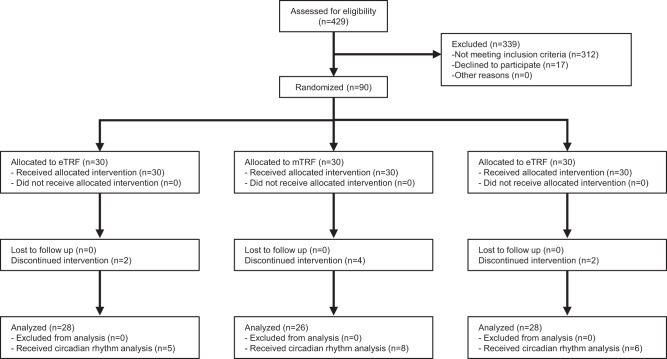
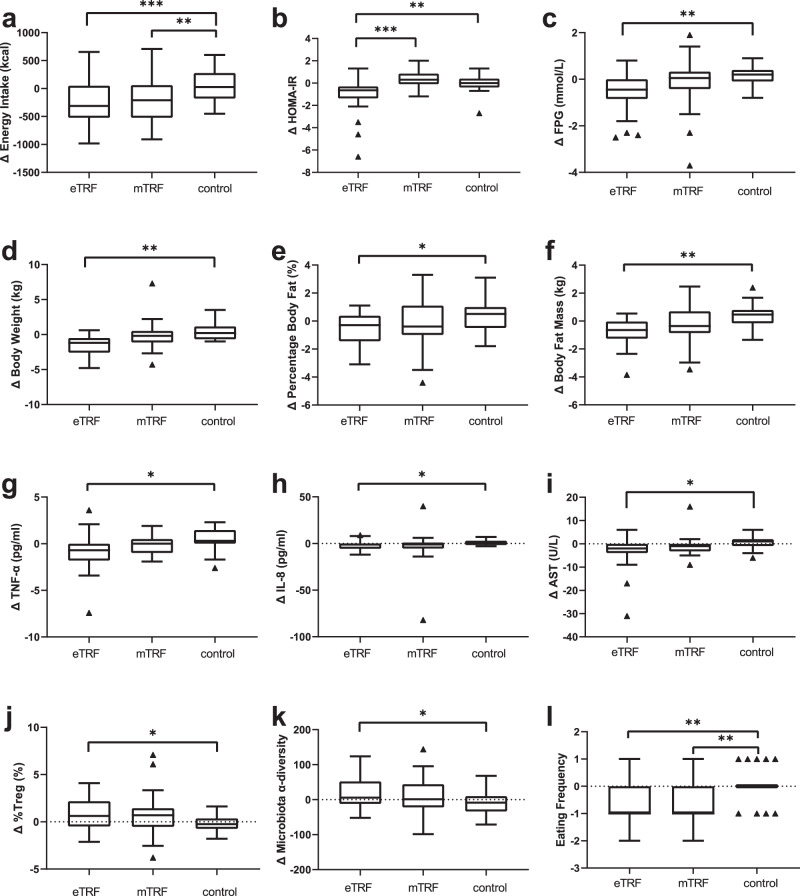
Time-restricted feeding (TRF) improves metabolic health. Both early TRF (eTRF, food intake restricted to the early part of the day) and mid-day TRF (mTRF, food intake restricted to the middle of the day) have been shown to have metabolic benefits. However, the two regimens have yet to be thoroughly compared. We conducted a five-week randomized trial to compare the effects of the two TRF regimens in healthy individuals without obesity (ChiCTR2000029797). The trial has completed. Ninety participants were randomized to eTRF (n=30), mTRF (n=30), or control groups (n=30) using a computer-based random-number generator. Eighty-two participants completed the entire five-week trial and were analyzed (28 in eTRF, 26 in mTRF, 28 in control groups). The primary outcome was the change in insulin resistance. Researchers who assessed the outcomes were blinded to group assignment, but participants and care givers were not. Here we show that eTRF was more effective than mTRF at improving insulin sensitivity. Furthermore, eTRF, but not mTRF, improved fasting glucose, reduced total body mass and adiposity, ameliorated inflammation, and increased gut microbial diversity. No serious adverse events were reported during the trial. In conclusion, eTRF showed greater benefits for insulin resistance and related metabolic parameters compared with mTRF. Clinical Trial Registration URL: http://www.chictr.org.cn/showproj.aspx?proj=49406 .
Overview
The claims and statistics of this paper haven’t been checked yet.
Free: it reads the open-access text and checks the first 5 claims that cite a source we can check. Create a free account to check every claim.
Integrity signals
Registry
Cites
Statistics
Figures
Verification
Claims the paper makes
The claims and statistics of this paper haven’t been checked yet.
Free: it reads the open-access text and checks the first 5 claims that cite a source we can check. Create a free account to check every claim.
Claims other papers make about this one
Each is checked against this paper’s own text: does it say what the citing paper says it does?
The source backs part of the claim, not all of it — or backs it for a different population, condition or comparison.
In the citing paper
“Furthermore, TRE demonstrates beneficial effects on cardiovascular metabolic parameters [87, 90] and lipid profiles [76, 83, 87].”
From Comparing caloric restriction regimens for effective weight management in adults: a systematic review and network meta-analysis (2024) · cites this paper as [76]
Experimental — accuracy not yet measuredThe source backs part of the claim, not all of it — or backs it for a different population, condition or comparison.
In the citing paper
“Fasting may affect weight control by altering the composition of the gut microbiota [76, 96]”
From Comparing caloric restriction regimens for effective weight management in adults: a systematic review and network meta-analysis (2024) · cites this paper as [76]
Experimental — accuracy not yet measured
Self-check
Percentages, sums and reported differences re-computed from the paper’s own numbers.
The self-check needs the paper’s full text.
Citations
Cites
Matthews, D. R., Hosker, J. P., Rudenski, A. S., Naylor, B. A., Treacher, D. F., & Turner, R. C. (1985) · Diabetologia · doi:10.1007/bf00280883 · Cited by 31,502
Search and clustering orders of magnitude faster than BLAST
Edgar, R. C. (2010) · Bioinformatics · doi:10.1093/bioinformatics/btq461 · Cited by 20,826
Metagenomic biomarker discovery and explanation
Segata, N., Izard, J., Waldron, L., Gevers, D., Miropolsky, L., Garrett, W. S., & Huttenhower, C. (2011) · Genome Biology · doi:10.1186/gb-2011-12-6-r60 · Cited by 16,192
Structure, function and diversity of the healthy human microbiome
The Human Microbiome Project Consortium (2012) · Nature · doi:10.1038/nature11234 · Cited by 11,726
Predictive functional profiling of microbial communities using 16S rRNA marker gene sequences
Langille, M. G. I., Zaneveld, J., Caporaso, J. G., McDonald, D., Knights, D., Reyes, J. A., Clemente, J. C., Burkepile, D. E., Vega Thurber, R. L., Knight, R., et al. (2013) · Nature Biotechnology · doi:10.1038/nbt.2676 · Cited by 9,116
Richness of human gut microbiome correlates with metabolic markers
Le Chatelier, E., Nielsen, T., Qin, J., Prifti, E., Hildebrand, F., Falony, G., Almeida, M., Arumugam, M., Batto, J.-M., Kennedy, S., et al. (2013) · Nature · doi:10.1038/nature12506 · Cited by 4,662
Inflammatory Mechanisms in Obesity
Gregor, M. F., & Hotamisligil, G. S. (2011) · Annual Review of Immunology · doi:10.1146/annurev-immunol-031210-101322 · Cited by 3,754
Damiola, F., Le Minh, N., Preitner, N., Kornmann, B., Fleury-Olela, F., & Schibler, U. (2000) · Genes & Development · doi:10.1101/gad.183500 · Cited by 2,394
Feuerer, M., Herrero, L., Cipolletta, D., Naaz, A., Wong, J., Nayer, A., Lee, J., Goldfine, A. B., Benoist, C., Shoelson, S., et al. (2009) · Nature Medicine · doi:10.1038/nm.2002 · Cited by 2,145
PANDAseq: paired-end assembler for Illumina sequences
Masella, A. P., Bartram, A. K., Truszkowski, J. M., Brown, D. G., & Neufeld, J. D. (2012) · BMC Bioinformatics · doi:10.1186/1471-2105-13-31 · Cited by 2,132
Research works printed but not linked: 3
- Moro T Effects of eight weeks of time-restricted feeding (16/8) on basal metabolism, maximal strength, body composition, inflammation, and cardiovascular risk factors in resistance-trained males J. Transl. Med. 2016 14 1 10 27737674 PMC5064803 · DOI · Paper page
- Briseño-Bass P Chávez-Pérez R López-Zendejas M Prevalence of hepatic steatosis and its relation to liver function tests and lipid profile in patients at medical check-up Rev. Gastroenterol. Mex. 2019 84 290 295 30292582
- Yang, Y. X., Wang, G. & Pan, X. China Food Composition (Peking University Medical Press, 2009).
Cited by
The role of insufficient sleep and circadian misalignment in obesity
Chaput, J.-P., McHill, A. W., Cox, R. C., Broussard, J. L., Dutil, C., da Costa, B. G. G., Sampasa-Kanyinga, H., & Wright, K. P. (2023) · Nature Reviews Endocrinology · doi:10.1038/s41574-022-00747-7 · Cited by 649
Developing dietary interventions as therapy for cancer
Taylor, S. R., Falcone, J. N., Cantley, L. C., & Goncalves, M. D. (2022) · Nature reviews. Cancer · doi:10.1038/s41568-022-00485-y · Cited by 186
Time-restricted eating: Watching the clock to treat obesity
Ezpeleta, M., Cienfuegos, S., Lin, S., Pavlou, V., Gabel, K., Tussing-Humphreys, L., & Varady, K. A. (2024) · Cell Metabolism · doi:10.1016/j.cmet.2023.12.004 · Cited by 148
Dietary regulation in health and disease
Wu, Q., Gao, Z.-J., Yu, X., & Wang, P. (2022) · Signal Transduction and Targeted Therapy · doi:10.1038/s41392-022-01104-w · Cited by 176
“Compared with mid-day TRF (mTRF, food intake restricted to the middle of the day), early TRF (eTRF, food intake restricted to the early part of the day) is reported to be more conducive to enhancing insulin sensitivity, increasing gut microbial diversity, ameliorating inflammation, and reducing body weight, adiposity…”
BackgroundBaHammam, A. S., & Pirzada, A. (2023) · Clocks & Sleep · doi:10.3390/clockssleep5030034 · Cited by 129
Haganes, K. L., Silva, C. P., Eyjólfsdóttir, S. K., Steen, S., Grindberg, M., Lydersen, S., Hawley, J. A., & Moholdt, T. (2022) · Cell Metabolism · doi:10.1016/j.cmet.2022.09.003 · Cited by 129
Associations between circadian disruption and cardiometabolic disease risk: A review
Ansu, V., & Knutson, K. L. (2023) · Obesity · doi:10.1002/oby.23666 · Cited by 128
“002) in healthy participants without obesity [75].”
Semnani‐Azad, Z., Khan, T. A., Chiavaroli, L., Chen, V., Bhatt, H. A., Chen, A., Chiang, N., Oguntala, J. O., Kabisch, S., Lau, D. C. W., et al. (2025) · BMJ · doi:10.1136/bmj-2024-082007 · Cited by 121
He, M., Wang, J., Liang, Q., Li, M., Guo, H., Wang, Y., Deji, C., Sui, J., Wang, Y.-W., Liu, Y., et al. (2022) · Cell Reports Medicine · doi:10.1016/j.xcrm.2022.100777 · Cited by 111
“However, several studies on lTRE demonstrated conflicting results regarding body weight.(62,63) Moreover, the thermic effect of food, insulin sensitivity, and b cell function is better in early morning than night because the body is optimized to ingesting food in early morning.”
Metabolic and chemical architecture of the mammalian circadian clock
Laothamatas, I., Rasmussen, E. S., Green, C. B., & Takahashi, J. S. (2023) · Cell chemical biology · doi:10.1016/j.chembiol.2023.08.014 · Cited by 110
Liu, J., Yi, P., & Liu, F. (2023) · The Journal of Clinical Endocrinology & Metabolism · doi:10.1210/clinem/dgad036 · Cited by 89
Circadian desynchrony and glucose metabolism
Speksnijder, E. M., Bisschop, P. H., Siegelaar, S. E., Stenvers, D. J., & Kalsbeek, A. (2024) · Journal of Pineal Research · doi:10.1111/jpi.12956 · Cited by 84
“214,215 However, eating restricted to an early part of the day significantly improved fasting glucose and insulin sensitivity in healthy volunteers 216 and people with prediabetes.”
BackgroundComplex physiology and clinical implications of time-restricted eating
Petersen, M. C., Gallop, M. R., Ramos, S. F., Zarrinpar, A., Broussard, J. L., Chondronikola, M., Chaix, A., & Klein, S. (2022) · Physiological Reviews · doi:10.1152/physrev.00006.2022 · Cited by 102
Marjot, T., Tomlinson, J. W., Hodson, L., & Ray, D. W. (2023) · Gut · doi:10.1136/gutjnl-2023-329998 · Cited by 83
“156 In addition to circulating biomarkers, TRE also has a direct impact on the rhythmic behaviour of metabolically active tissues known to be integral to the pathogenesis of NAFLD, including adipose and skeletal muscle.”
BackgroundDietary patterns and cardiometabolic health: Clinical evidence and mechanism
Wang, W., Liu, Y., Li, Y., Luo, B., Lin, Z., Chen, K., & Liu, Y. (2023) · MedComm · doi:10.1002/mco2.212 · Cited by 100
Dietary circadian rhythms and cardiovascular disease risk in the prospective NutriNet-Santé cohort
Cros, A. P., Andreeva, V. A., Fezeu, L., Julia, C., Bellicha, A., Kesse‐Guyot, E., Herçberg, S., Romaguera, D., Kogevinas, M., Touvier, M., et al. (2023) · Nature Communications · doi:10.1038/s41467-023-43444-3 · Cited by 98
“Recent interventional studies are starting to demonstrate that eTRE is more bene fi cial than other fasting regimens with later eating windows throughout the day 55 .”
Liu, L., Chen, W., Wu, D., & Hu, F. (2022) · The Journal of Clinical Endocrinology & Metabolism · doi:10.1210/clinem/dgac570 · Cited by 79
Steger, F. L., Jamshed, H., Bryan, D. R., Richman, J., Warriner, A. H., Hanick, C. J., Martin, C. K., Salvy, S., & Peterson, C. M. (2022) · Obesity · doi:10.1002/oby.23614 · Cited by 93
“Our per-protocol findings are consistent with most efficacy studies, which report that eTRE improves glucose levels, insulin levels, insulin sensitivity, and/or β-cell responsiveness [9, 10, 12, 23, 42].”
BackgroundResultFasting: From Physiology to Pathology
Tang, D., Tang, Q., Huang, W., Zhang, Y., Tian, Y., & Fu, X. (2023) · Advanced Science · doi:10.1002/advs.202204487 · Cited by 87
Zeb, F., Osaili, T. M. I., Obaid, R. S., Naja, F., Radwan, H. M., Ismail, L. C., Hasan, H. A., Hashim, M. S., Alam, I., Sehar, B., et al. (2023) · Nutrients · doi:10.3390/nu15020259 · Cited by 80
“R-TRF/29 days 9 healthy adults ↑ microbial richness Enriched genera including Butyricicoccus, Bacteroides, Faecalibacterium, Roseburia, Allobaculum, Eubacterium, Dialister, and Erysipelotrichi 16S rRNA [132]”
BackgroundChrononutrition—When We Eat Is of the Essence in Tackling Obesity
Ahluwalia, M. K. (2022) · Nutrients · doi:10.3390/nu14235080 · Cited by 64
Tsitsou, S., Zacharodimos, N., Poulia, K., Karatzi, K., Dimitriadis, G., & Papakonstantinou, E. (2022) · Nutrients · doi:10.3390/nu14224778 · Cited by 75
“In seven of the twenty-two TRF studies, the female sample was greater than the male one [39,41,42,44,51,52,59], while only one study had more male participants compared to females [47].”
BackgroundResultInfluentialIntermittent fasting and cardiovascular health: a circadian rhythm-based approach
Zhang, J., Chen, Y., Zhong, Y., Wang, Y., Huang, H., Xu, W. L., Pan, W., Chen, L., Zhu, Y., Bischof, E. Y., et al. (2025) · 中国科学通报:英文版 · doi:10.1016/j.scib.2025.05.017 · Cited by 75
Dote‐Montero, M., Clavero‐Jimeno, A., Merchán-Ramírez, E., Osés, M., Echarte, J., Camacho-Cardeñosa, A., Alavarez, M. C., Amaro‐Gahete, F. J., Alcántara, J. M. A., López-Vázquez, A., et al. (2025) · Nature Medicine · doi:10.1038/s41591-024-03375-y · Cited by 75
“Our study’s findings are consistent with the majority of previous evidence 12,16–19 , which overall shows no differences in the effects on VAT, body weight and composition across early, late and self-selected TRE groups.”
InfluentialIntermittent fasting influences immunity and metabolism
Marko, D. M., Conn, M. O., & Schertzer, J. D. (2024) · Trends in Endocrinology and Metabolism · doi:10.1016/j.tem.2024.04.014 · Cited by 70
Common and divergent molecular mechanisms of fasting and ketogenic diets
Paoli, A., Tinsley, G. M., Mattson, M. P., Vivo, I. D., Dhawan, R., & Moro, T. (2023) · Trends in Endocrinology and Metabolism · doi:10.1016/j.tem.2023.10.001 · Cited by 67
Zhao, Y., Jia, M., Ding, C., Bao, B., Li, H., Ma, J., Dong, W., Gao, R., Chen, X., Chen, J., et al. (2025) · iMeta · doi:10.1002/imt2.70006 · Cited by 66
Gudan, A., Kozłowska‐Petriczko, K., Wunsch, E., Bodnarczuk, T., & Stachowska, E. (2023) · Nutrients · doi:10.3390/nu15061323 · Cited by 62
“Studies conducted in people with pre-diabetes, hypertension and MS indicate a beneficial effect of eTRF on metabolic parameters (fasting glucose, fasting insulin, lipid profile, oxidative stress, hypertension, postprandial insulin) [153,154], even without total body fat mass reduction [155].”
BackgroundChang, Y., Du, T., Zhuang, X., & Ma, G. (2024) · iScience · doi:10.1016/j.isci.2024.109000 · Cited by 56
“57,58 Consistent with the conclusions of some previous studies that e-TRE was superior to d-TRE in terms of metabolic improvement, this meta-analysis found similar results that body composition and metabolic parameters in e-TRE were better than those in d-TRE under the ad libitum intake condition,…”
ResultLi, L., Li, R., Tian, Q., Luo, Y., Li, R., Lin, X., Ou, Y., Guo, T., Chen, X., Pan, A., et al. (2024) · Cell Reports Medicine · doi:10.1016/j.xcrm.2024.101801 · Cited by 57
Rovira‐Llopis, S., Luna-Marco, C., Perea‐Galera, L., Bañuls, C., Morillas, C., & Víctor, V. M. (2023) · Reviews in Endocrine and Metabolic Disorders · doi:10.1007/s11154-023-09853-x · Cited by 54
“However, the superiority of TRE [25, 26].”
BackgroundMethodResultInfluentialSun, J.-C., Tan, Z.-T., He, C., Hu, H., Zhai, C., & Qian, G. (2023) · European Journal of Clinical Nutrition · doi:10.1038/s41430-023-01311-w · Cited by 53
Turner, L., Charrouf, R., Martínez‐Vizcaíno, V., Hutchison, A. T., Heilbronn, L. K., & Fernández‐Rodríguez, R. (2023) · American Journal of Clinical Nutrition · doi:10.1016/j.ajcnut.2023.10.009 · Cited by 52
James, D. L., Hawley, N. A., Mohr, A. E., Hermer, J., Ofori, E., Yu, F., & Sears, D. D. (2024) · Nutrients · doi:10.3390/nu16020316 · Cited by 51
“In a recent 2022 5-week RCT, Xie et al. examined two different TRE protocols (i.e., early TRF [eTRF]; n = 30; and mid-day TRF [mTRF]; n = 30) compared with a control group ( n = 30) among healthy individuals living without obesity [49].”
BackgroundInfluentialObesity, cancer risk, and time-restricted eating
Das, M., & Webster, N. J. G. (2022) · Cancer and Metastasis Reviews · doi:10.1007/s10555-022-10061-3 · Cited by 47
“Longitudinal 5-weeks eTRE 8 h (6am-3 pm) vs mTRE 8 h (11am-8 pm) vs Control n = 82 (64 females, 18 males), normal weight mean age 31 Weight loss and improved HOMA-IR in eTRE group [163]”
BackgroundThe Effects of Time-Restricted Eating on Metabolism and Gut Microbiota: A Real-Life Study
Ferrocino, I., Pellegrini, M., D’Eusebio, C., Goitre, I., Ponzo, V., Fadda, M., Rosato, R., Mengozzi, G., Beccuti, G., Merlo, F. D., et al. (2022) · Nutrients · doi:10.3390/nu14132569 · Cited by 48
“Few human studies on small numbers of subjects are at present available on this topic, showing that TRE increased abundance of Akkermansia muciniphila and the Bacteroides fragilis group [12] and enhanced gut-microbial richness, with enrichment of Prevotellaceae and Bacteroideaceae [6,13,14], particularly increasing th…”
Ezzati, A., Rosenkranz, S. K., Phelan, J., & Logan, C. (2023) · Journal of the Academy of Nutrition and Dietetics · doi:10.1016/j.jand.2022.09.013 · Cited by 45
Eating, diet, and nutrition for the treatment of non-alcoholic fatty liver disease
Semmler, G., Datz, C., & Trauner, M. (2022) · Clinical and Molecular Hepatology · doi:10.3350/cmh.2022.0364 · Cited by 46
“during the mid of the day (11:00–20:00).(141) “Alternate day fasting” describes a mode of TRF in which fasting periods over 36 hours are followed by ad-libitum food consumption over the next 12 hours (i.”
BackgroundGlobal Scientific Trends on Healthy Eating from 2002 to 2021: A Bibliometric and Visualized Analysis
Fang, T., Cao, H., Wang, Y., Gong, Y., & Wang, Z. (2023) · Nutrients · doi:10.3390/nu15061461 · Cited by 45
“A randomized controlled trial revealed that the time window for eating restrictedly during the day had superior metabolic effects to that at the night [53,54].”
BackgroundEating Around the Clock: Circadian Rhythms of Eating and Metabolism
McHill, A. W., & Butler, M. P. (2024) · Annual Review of Nutrition · doi:10.1146/annurev-nutr-062122-014528 · Cited by 47
Chen, Y., Li, X., Yang, M., Chen, J., He, Z., Zhou, S., Ruan, P., Wang, Y., Tang, C., Pan, W., et al. (2024) · Redox Biology · doi:10.1016/j.redox.2024.103422 · Cited by 42
“Time-restricted eating (TRE) is a method of fasting that involves restricting daily food intake to a period of 6 – 8 h. TRE has been found to reduce blood glucose, body mass index and body fat, alleviate inflammation and increase the diversity of the gut microbiome [8].”
Self-citationLiu, H., Chen, S., Ji, H., & Dai, Z. (2023) · Frontiers in Public Health · doi:10.3389/fpubh.2023.1020887 · Cited by 42
“Recent studies have shown that TRF can reduce body weight, lower blood pressure and blood lipid levels, and promote metabolic health (19, 37, 38).”
BackgroundInfluentialHuang, L., Chen, Y., Wen, S., Lu, D., Shen, X., Deng, H., & Xu, L. (2022) · Food Science & Nutrition · doi:10.1002/fsn3.3194 · Cited by 41
Bridging the brain and gut: neuroimmune mechanisms of neuroinflammation and therapeutic insights
Müller, L., & Benedetto, S. D. (2025) · Frontiers in Cellular Neuroscience · doi:10.3389/fncel.2025.1590002 · Cited by 41
Circadian‐mediated regulation of cardiometabolic disorders and aging with time‐restricted feeding
Roth, J. R., Varshney, S., de Moraes, R. C. M., & Melkani, G. C. (2023) · Obesity · doi:10.1002/oby.23664 · Cited by 39
“recently started answering this question, comparing early TRE (eating from 6 AM to 3 PM) and midday TRE (11 AM and 8 PM) for 5 weeks in healthy adults [100].”
BackgroundResearch advances in the therapy of metabolic syndrome
Lin, Z., & Sun, L. (2024) · Frontiers in Pharmacology · doi:10.3389/fphar.2024.1364881 · Cited by 38
Dashti, H. S., Jansen, E. C., Zuraikat, F. M., Dixit, S., Brown, M. K., Laposky, A. D., Broussard, J. L., Butler, M. P., Creasy, S. A., Crispim, C. A., et al. (2025) · Journal of the American Heart Association · doi:10.1161/jaha.124.039373 · Cited by 39
Circadian Disruption and the Risk of Developing Obesity
Duez, H., & Staels, B. (2025) · Current Obesity Reports · doi:10.1007/s13679-025-00610-6 · Cited by 40
“TRE in insulin resistant and/or diabetic patients resulted also in weight loss, and improved cardiometabolic health (improved insulin sensitivity and beta cell function and reduced blood pressure) [88–93].”
Lao, B., Luo, J., Xu, X.-Y., Fu, L., Tang, F. X., Ouyang, W., Xu, X.-Z., Wei, M.-T., Xiao, B.-J., Chen, L.-Y., et al. (2023) · Frontiers in Endocrinology · doi:10.3389/fendo.2023.1096093 · Cited by 37
Zhou, X., Lin, X., Yu, J., Yang, Y., Muzammel, H., Amissi, S., Schini‐Kerth, V. B., Lei, X., José, P. A., Yang, J., et al. (2024) · Nutrition Journal · doi:10.1186/s12937-024-00967-9 · Cited by 36
“Participants in the control group were instructed to consume DASH diet, with food consumed over more than 8 h per day [21].”
MethodIntermittent fasting—the future treatment in NASH patients?
Minciună, I., Gallage, S., Heikenwälder, M. F., Zelber‐Sagi, S., & Dufour, J. (2023) · Hepatology · doi:10.1097/hep.0000000000000330 · Cited by 37
Pieczyńska-Zając, J. M., Malinowska, A. M., Łagowska, K., Leciejewska, N., & Bajerska, J. (2023) · Nutrition Reviews · doi:10.1093/nutrit/nuad093 · Cited by 37
“15,16 In the case of human studies, 4 studies used the V3-V4 region, 22,23,28,29 2 studies used the V4 region, 17,25 and 1 study used the V1-V3 region.”
BackgroundMethodInfluentialCircadian dysfunction and cardio-metabolic disorders in humans
MARHEFKOVÁ, N., Sládek, M., Sumová, A., & Dubský, M. (2024) · Frontiers in Endocrinology · doi:10.3389/fendo.2024.1328139 · Cited by 36
“The score ranges from 16 to 86, with lower scores indicating the evening types.”
BackgroundMethodLeptin receptor neurons in the dorsomedial hypothalamus input to the circadian feeding network
Tang, Q., Godschall, E., Brennan, C. D., Zhang, Q., Abraham‐Fan, R., Williams, S. P., Güngül, T. B., Onoharigho, R., Buyukaksakal, A., Salinas, R., et al. (2023) · Science Advances · doi:10.1126/sciadv.adh9570 · Cited by 35
Popa, A. D., Niță, O., Gherasim, A., Enache, A. I., Caba, L., Mihalache, L., & Arhire, L. I. (2023) · Nutrients · doi:10.3390/nu15092095 · Cited by 33
“[24] RCT 5 weeks Healthy individuals without obesity eTRF (n = 28)”
BackgroundResultInfluentialFasting as Medicine: Mitochondrial and Endothelial Rejuvenation in Vascular Aging
Milan, M., Troyano‐Rodriguez, E., Ihuoma, J., Negri, S., Rudraboina, R., Kosmider, A., Awasthi, S., Balasubramanian, P., Conley, S. M., Yabluchanskiy, A., et al. (2026) · Aging Cell · doi:10.1111/acel.70372 · Cited by 32
The effects of time-restricted eating on sleep, cognitive decline, and Alzheimer's disease
Ezzati, A., & Pak, V. M. (2022) · Experimental Gerontology · doi:10.1016/j.exger.2022.112033 · Cited by 32
Kim, J., & Song, Y. (2022) · Obesity Facts · doi:10.1159/000527838 · Cited by 30
Time‐restricted eating for chronodisruption‐related chronic diseases
Cheng, W., Desmet, L., & Depoortere, I. (2023) · Acta Physiologica · doi:10.1111/apha.14027 · Cited by 29
Intermittent fasting and immunomodulatory effects: A systematic review
He, Z., Xu, H., Li, C., Yang, H., & Mao, Y. (2023) · Frontiers in Nutrition · doi:10.3389/fnut.2023.1048230 · Cited by 28
“(21) TRF RCT healthy 5w TNF-α: ↓(p = 0.”
BackgroundResultInfluentialSelf-citationPhotoperiod and metabolic health: evidence, mechanism, and implications
Regmi, P., Young, M. J., Minigo, G., Milic, N. L., & Gyawali, P. (2023) · Metabolism · doi:10.1016/j.metabol.2023.155770 · Cited by 28
Sampieri, A., Paoli, A., Spinello, G., Santinello, E., & Moro, T. (2024) · Journal of Translational Medicine · doi:10.1186/s12967-024-05849-6 · Cited by 27
Gong, Y., Zhang, H., Feng, J., Li, Y., Ji, M., Wei, S., & Ma, Q. (2025) · Frontiers in Immunology · doi:10.3389/fimmu.2025.1501850 · Cited by 26
“Recent clinical studies have shown that early TRF, starting at 06:00 AM, can further improve metabolic parameters such as fasting glucose and insulin sensitivity (10, 11).”
Self-citationThe Interplay of Genetic Predisposition, Circadian Misalignment, and Metabolic Regulation in Obesity
Halder, S. K., & Melkani, G. C. (2025) · Current Obesity Reports · doi:10.1007/s13679-025-00613-3 · Cited by 26
“Moreover, physical activity could be another alternative therapy to improve metabolic conditions and obesity [32].”
Nutritional Support for Liver Diseases
Jamioł-Milc, D., Gudan, A., Kaźmierczak-Siedlecka, K., Hołowko, J., Maciejewska, D., Janda, K., & Stachowska, E. (2023) · Nutrients · doi:10.3390/nu15163640 · Cited by 26
“Early time-restricted feeding (eTRF) is a protocol whereby there is a strictly defined period in the first quarter of the day when one eats and fasts [50].”
BackgroundDote‐Montero, M., Merchán-Ramírez, E., Osés, M., Echarte, J., Clavero‐Jimeno, A., Alcántara, J. M. A., Camacho-Cardeñosa, A., Cupeiro, R., Rodríguez-Miranda, M. D. L. N., López-Vázquez, A., et al. (2023) · Nutrition Metabolism and Cardiovascular Diseases · doi:10.1016/j.numecd.2023.09.014 · Cited by 26
Petridi, F., Geurts, J. M. W., Nyakayiru, J., Schaafsma, A., Schaafsma, D., Meex, R. C. R., & Singh‐Povel, C. M. (2024) · Nutrients · doi:10.3390/nu16111721 · Cited by 27
“…intervention appeared to reduce HOMA-IR (Figure 2C) with eTRF HOMA-IR being lower than lTRF ( − 1.5 to − 0.5, n = 3; significant in two studies [28,30]) and controls ( − 1.26 to − 0.70, n = 6; significant in three studies [30,31,34]). to control on fasting insulin was signi fi cant in one of three…”
BackgroundResultInfluentialJeong, S., Chokkalla, A. K., Davis, C. K., Jeong, H., Chelluboina, B., Arruri, V. K., Kim, B. R., Narman, A., Bathula, S., Arumugam, T. V., et al. (2024) · Stroke · doi:10.1161/strokeaha.124.046400 · Cited by 26
Huang, J., Li, Y., Chen, M., Cai, Z., Cai, Z., & Jiang, Z. (2024) · International Journal of Behavioral Nutrition and Physical Activity · doi:10.1186/s12966-024-01657-9 · Cited by 25
“Fasting may affect weight control by altering the composition of the gut microbiota [76, 96], while reciprocal interactions among gut microbes can also re-regulate metabolism processes [97].”
BackgroundImpact of caloric restriction on the gut microbiota
Kern, L., Kviatcovsky, D., He, Y., & Elinav, E. (2023) · Current Opinion in Microbiology · doi:10.1016/j.mib.2023.102287 · Cited by 25
Li, J., Hou, J., Zhang, L., Dou, S., Liu, Y., Teng, V., Zhang, C., Sun, H., Lu, P., & Guo, Y. (2023) · Environmental Research · doi:10.1016/j.envres.2023.117765 · Cited by 26
Dawson, M. A., Cheung, S. N., Frano, M. R. L., Nagpal, R., & Berryman, C. E. (2024) · Cell Reports Medicine · doi:10.1016/j.xcrm.2023.101363 · Cited by 25
“The impact of TRE on the microbiome is equivocal, with trials us-ing late TRE interventions 39,40 and eTRE 41 reporting changes in diversity metrics and other trials 42,43 reporting no impact on microbiome diversity.”
ResultClavero‐Jimeno, A., Dote‐Montero, M., Migueles, J. H., Camacho-Cardeñosa, A., Medrano, M., Alfaro-Magallanes, V. M., Osés, M., Carneiro‐Barrera, A., de Cabo, R., Muñoz‐Torres, M., et al. (2025) · JAMA Network Open · doi:10.1001/jamanetworkopen.2025.17268 · Cited by 25
Deng, Y., Liu, X., Sun, Y., Zhou, L., Li, Q., Lei, Z., Yang, F., Chen, L., Zhang, C., Tan, W., et al. (2024) · Obesity · doi:10.1002/oby.23965 · Cited by 25
“Because the eTRE was in alignment with circadian rhythms and human metabolism is optimized for food intake in the morning [18, 21, 22], we hypothesized that the eTRE would produce greater reductions in intrahepatic fat and bring more health benefits than lTRE.”
BackgroundResultInfluentialSelf-citationČrešnovar, T., Habe, B., Mohorko, N., Kenig, S., Pražnikar, Z. J., & Petelin, A. (2025) · Clinical Nutrition · doi:10.1016/j.clnu.2025.04.001 · Cited by 25
Khalafi, M., Maleki, A. H., Mojtahedi, S., Ehsanifar, M., Rosenkranz, S. K., Symonds, M. E., Tarashi, M. S., Fatolahi, S., & Fernández, M. L. (2025) · Nutrients · doi:10.3390/nu17152388 · Cited by 23
Peters, B., Schwarz, J., Schuppelius, B., Ottawa, A., Koppold, D. A., Weber, D., Steckhan, N., Mai, K., Grune, T., Pfeiffer, A. F. H., et al. (2025) · Science Translational Medicine · doi:10.1126/scitranslmed.adv6787 · Cited by 25
Santos, H. O., & Tinsley, G. M. (2023) · Diabetes/Metabolism Research and Reviews · doi:10.1002/dmrr.3684 · Cited by 24
Cheng, W., Meng, X., Gao, J., Jiang, W., Sun, X., Li, Y., Han, T., Zhang, D., & Wei, W. (2024) · International Journal of Behavioral Nutrition and Physical Activity · doi:10.1186/s12966-023-01556-5 · Cited by 23
“It is worth noting that several studies have previously under-scored the positive health effects associated with night-time fasting durations exceeding 14 h [11–14].”
BackgroundIntermittent Fasting and Hormonal Regulation: Pathways to Improved Metabolic Health
Shkorfu, W., Fadel, A., Hamsho, M., Ranneh, Y., & Shahbaz, H. M. (2025) · Food Science & Nutrition · doi:10.1002/fsn3.70586 · Cited by 22
Whittaker, D. S., Tamai, K., Bains, R. S., Villanueva, S. A. M. B., Luk, S. H. C., Dell’Angelica, D., Block, G. D., Ghiani, C. A., & Colwell, C. S. (2022) · Frontiers in Nutrition · doi:10.3389/fnut.2022.1034743 · Cited by 22
“Cxcr4 34 ± 10 26 ± 6 39 ± 5 34 ± 3 F(1,20) = 6.”
InfluentialTime-restricted eating, the clock ticking behind the scenes
Ribas‐Latre, A., Fernández‐Veledo, S., & Vendrell, J. J. (2024) · Frontiers in Pharmacology · doi:10.3389/fphar.2024.1428601 · Cited by 22
Timing Is Important—Management of Metabolic Syndrome According to the Circadian Rhythm
Zečević, K., Popović, N., Vuksanović-Božarić, A., Vukmirović, M., Rizzo, M., & Muzurović, E. M. (2023) · Biomedicines · doi:10.3390/biomedicines11041171 · Cited by 21
“In addition, late TRF results in inconsistent weight loss, ranging from a slight to no discernible change in weight and whole-body fat mass [62,64,87,102].”
BackgroundPrecision nutrition for targeting pathophysiology of cardiometabolic phenotypes
Shannon, C. E., Chathail, M. B. N., Mullin, S. M., Meehan, A., McGillicuddy, F. C., & Roche, H. M. (2023) · Reviews in Endocrine and Metabolic Disorders · doi:10.1007/s11154-023-09821-5 · Cited by 22
“Reductions in one or more of these biomarkers have been reported following caloric restriction [152], time restricted eating [153, 154] and high fiber diets [155], yet results are very inconsistent across studies.”
ResultNie, Z., Xu, J., Cheng, Y., Li, Z., Zhang, R., Zhang, W., & Zhao, L. (2023) · Diabetology & Metabolic Syndrome · doi:10.1186/s13098-023-01190-y · Cited by 21
“The effects of TRE depend on the change in energy intake, participants in all TRE studies with a reduction in energy intake also demonstrated a reduction in body weight [40].”
BackgroundHe, M., Li, B., Li, M., & Gao, S. (2024) · Diabetes & Metabolic Syndrome Clinical Research & Reviews · doi:10.1016/j.dsx.2024.102952 · Cited by 21
The Prevalence of Metabolically Unhealthy Normal Weight and Its Influence on the Risk of Diabetes
Ye, J., Guo, K., Li, X., Yang, L., & Zhou, Z. (2023) · The Journal of Clinical Endocrinology & Metabolism · doi:10.1210/clinem/dgad152 · Cited by 20
Cheung, K., Chan, V. W.-K., Chan, S., Wong, M. M. H., Chung, G. K.-K., Cheng, W., Lo, K. K.-H., & Zeng, F. (2024) · Nutrients · doi:10.3390/nu16030357 · Cited by 20
“However, people with chronic diseases such as diabetes, heart failure, asthma, and cancers are suggested to be more likely to experience adverse events [58].”
BackgroundInfluentialChen, Y.-E., Tsai, H.-L., Tu, Y., & Chen, L. (2026) · BMJ Medicine · doi:10.1136/bmjmed-2024-001071 · Cited by 23
Ye, Y., Chai, S.-F., Li, X.-R., Wu, M., Cai, H.-Y., & Wang, Z.-J. (2023) · Metabolic Brain Disease · doi:10.1007/s11011-023-01288-2 · Cited by 19
“Five weeks of eTRF lowered fasting plasma glucose in healthy nonobese participants, it was more effective in improving insulin resistance than mid-day TRF (mTRF, food intake restricted to the middle of the day) (Xie et al. 2022).”
InfluentialSelf-citationWang, X., Zhang, J., Xu, X., Pan, S., Cheng, L., Dang, K., Qi, X., & Li, Y. (2024) · International Journal of Behavioral Nutrition and Physical Activity · doi:10.1186/s12966-024-01654-y · Cited by 19
“Additionally, our study found that longer NFD ( ≥ 14.1 h) was associated with higher predicted age metrics, while previous research showed the health benefits from NFD longer than 15 h [29, 30].”
InfluentialEzzati, A., Tamargo, J. A., Golberg, L., Haub, M. D., & Anton, S. D. (2025) · Nutrients · doi:10.3390/nu17020322 · Cited by 20
“In contrast, a 5-week early TRE intervention (6 a.m. to 3 p.m.) improved pro-inflammatory cytokines (TNF-α and IL-8) in young adults without obesity, while midday TRE (11 a.m. to 8 p.m.) did not show improvements in these markers [12].”
InfluentialZhai, T., Zou, X., Zhang, Z., Wang, Y., Shi, L. S., Ren, W., & Huang, J. (2025) · Gut Microbes · doi:10.1080/19490976.2025.2532703 · Cited by 19
“102,103 Additionally, the gut microbiota serves as a crucial regulator of the rhythmicity of the hypothalamic-pituitary-adrenal (HPA) axis.”
Unraveling the Health Benefits and Mechanisms of Time-Restricted Feeding: Beyond Caloric Restriction
Wang, R., Liao, Y., Deng, Y., & Rong, S. (2024) · Nutrition Reviews · doi:10.1093/nutrit/nuae074 · Cited by 18
Vo, N., Zhang, Q., & Sung, H. (2024) · Journal of Pharmacy & Pharmaceutical Sciences · doi:10.3389/jpps.2024.13062 · Cited by 18
“Recent clinical studies have highlighted that early TRF, with the window starting at 06:00 AM, further improves metabolic parameters such as fasting glucose and insulin sensitivity [39, 40].”
BackgroundZheng, Y., Wang, X., Wang, J., Yang, J., Wang, T., Li, Q., Zhu, W., Wang, Y., Sui, J., Qiang, W., et al. (2024) · Clinical Nutrition · doi:10.1016/j.clnu.2024.08.029 · Cited by 19
The gut microbiota predicts and time-restricted feeding delays experimental colitis
Ruple, H. K., Haasis, E., Bettenburg, A., Maier, C., Fritz, C., Schüle, L., Löcker, S., Soltow, Y., Schintgen, L., Schmidt, N. S., et al. (2025) · Gut Microbes · doi:10.1080/19490976.2025.2453019 · Cited by 18
“Fecal samples were collected before and after the 2-week adaptation period and 4 weeks after clock disruption with or without TRF. Tissue samples were harvested as described for E.2.”
InfluentialYu, Z., & Ueda, T. (2025) · Nutrients · doi:10.3390/nu17061022 · Cited by 18
“…in a five-week randomized controlled trial involving non-obese, healthy participants, Xie et al. reported that eTRE—compared with dTRE—produced more pronounced benefits in improving insulin sensitivity and fasting glucose levels, in addition to reducing overall body weight and adiposity [37].”
Chrono‐nutrition for hypertension
Bohmke, N. J., Dixon, D. L., & Kirkman, D. L. (2024) · Diabetes/Metabolism Research and Reviews · doi:10.1002/dmrr.3760 · Cited by 18
“147 Clinical trials show that TRE is successful in reducing inflammation 152,167 and oxidative stress 147 , which are both contributors to vascular dysfunction.”
BackgroundA Bibliometric and Visualization Analysis of Intermittent Fasting
Chen, S., Han, R., & Liu, H. (2022) · Frontiers in Public Health · doi:10.3389/fpubh.2022.946795 · Cited by 17
Metadata
- Authors
- Xie, Z., Sun, Y., Ye, Y., Hu, D., Zhang, H., He, Z., Zhao, H., Yang, H., & Mao, Y.
- Affiliations
- Chinese Academy of Medical Sciences & Peking Union Medical College (CN)
- Corresponding author
- Yang, Huayu
- Mao, Yilei
- Venue
- Nature Communications
- Published
- 2022-02-22
- Volume
- 13
- Issue
- 1
- Pages
- 1003-1003
- ISSN
- 2041-1723 (ISSN-L)
- PMC
- PMC8864028
- OpenAlex
- W4213105658
- Semantic Scholar
- efb9c9add571793e7e132061ec70c88fdfd63897
- Cited by
- 276
- References
- 75
- Citations by year
- 2026: 38 · 2025: 71 · 2024: 76 · 2023: 59 · 2022: 31
- FWCI
- 36.65
- Type
- journal article
- Language
- en
- Open access
- gold
- doi.org
- Licence
- cc-by
- creativecommons.org/licenses/by/4.0 (tdm)
- creativecommons.org/licenses/by/4.0 (vor)
- Locations
- Nature Communications (publishedVersion, cc-by)
- PubMed Central (publishedVersion, cc-by)
- PubMed (publishedVersion)
- RePEc: Research Papers in Economics (submittedVersion)
- DOAJ (DOAJ: Directory of Open Access Journals) (submittedVersion, cc-by-sa)
- Funders
- Chinese Academy of Medical Sciences (CIFMS No.2016-I2M-1-001)
- Topics
- Health Sciences › Medicine › Physiology (medical) › Dietary Effects on Health
- Health Sciences › Medicine › Public Health, Environmental and Occupational Health › Nutritional Studies and Diet
- Health Sciences › Medicine › Physiology (medical) › Diet and metabolism studies
- Keywords
- time-restricted feeding, insulin resistance, insulin sensitivity, fasting blood glucose, body mass, adiposity, inflammation, gut microbiota diversity, metabolic health, healthy volunteers
- MeSH terms
- Fasting, Glucose, Humans, Insulin Resistance, Obesity, Healthy Volunteers
About these checks
Registry, retraction, Cites and statistics results are computed, not judged, with one exception: a printed reference that no index lists is read once by a model before it counts as a citation error. Claims are extracted by a model and kept only when their quote appears verbatim in the text; each cited source is then checked, with a model’s help, for whether it says what the claim relies on. Those verdicts can be wrong — read the claim’s quote and the cited source before relying on one.
Statistics and arithmetic are recomputed, not judged.
Confidence bands are shown only for fields calibrated on our annotated test set. None is calibrated yet, so no band is shown.
What counts as a claim ›How we measure confidence ›How we check this ›
Are you an author, or do you see a problem with this page? Request a review
Data sources
Bibliographic data: Semantic Scholar, OpenAlex, Crossref.
Contains information from the Semantic Scholar Academic Graph Datasets, made available under the ODC Attribution License (ODC-BY 1.0).
Semantic Scholar’s data is described in: Kinney, R., et al. (2023). The Semantic Scholar Open Data Platform. arXiv:2301.10140.
