CoChat

A programmable qudit-based quantum processor

Open access

The DOI matches its Crossref record; 78 of the 78 references it cites were found in a registry or an index.

Abstract

Controlling and programming quantum devices to process quantum information by the unit of quantum dit, i.e., qudit, provides the possibilities for noise-resilient quantum communications, delicate quantum molecular simulations, and efficient quantum computations, showing great potential to enhance the capabilities of qubit-based quantum technologies. Here, we report a programmable qudit-based quantum processor in silicon-photonic integrated circuits and demonstrate its enhancement of quantum computational parallelism. The processor monolithically integrates all the key functionalities and capabilities of initialisation, manipulation, and measurement of the two quantum quart (ququart) states and multi-value quantum-controlled logic gates with high-level fidelities. By reprogramming the configuration of the processor, we implemented the most basic quantum Fourier transform algorithms, all in quaternary, to benchmark the enhancement of quantum parallelism using qudits, which include generalised Deutsch-Jozsa and Bernstein-Vazirani algorithms, quaternary phase estimation and fast factorization algorithms. The monolithic integration and high programmability have allowed the implementations of more than one million high-fidelity preparations, operations and projections of qudit states in the processor. Our work shows an integrated photonic quantum technology for qudit-based quantum computing with enhanced capacity, accuracy, and efficiency, which could lead to the acceleration of building a large-scale quantum computer.

Overview

The claims and statistics of this paper haven’t been checked yet.

Free: it reads the open-access text and checks the first 5 claims that cite a source we can check. Create a free account to check every claim.

A few free checks a day · papers already verified open instantly · results are public

Integrity signals

Registry

Crossref · 10.1038/s41467-022-28767-x

Cites

78 of 78 references verified0 citation errors · 0 not checkable

Statistics

Figures

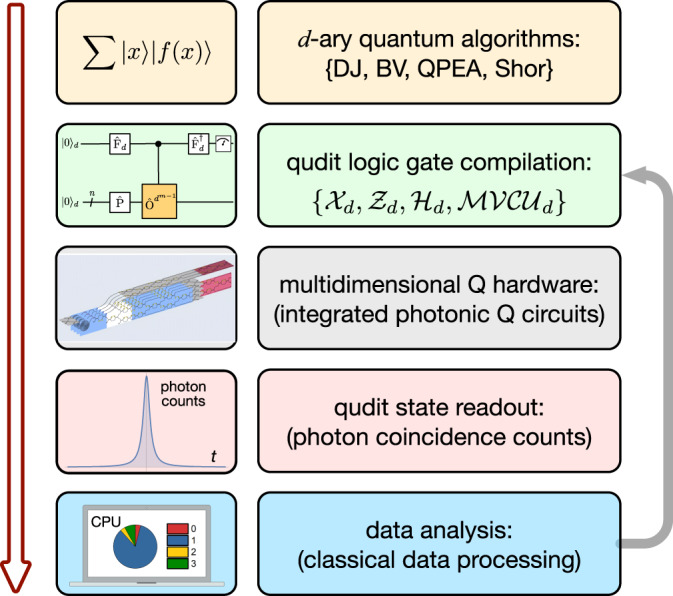
Fig. 1 The top-down hierarchy of qudit-based quantum computation. Users can define different quantum tasks and implement different quantum algorithms in d-ary, e.g., the generalised Deutsch-Jozsa (DJ), Bernstein-Vazirani (BV), quantum phase estimation (QPEA) and Shor’s fast factorization algorithms. In the software level, a multi-qudit quantum logical circuit for executing the algorithm is compiled with single-qudit gates (e.g, Zd, Xd and Hd) and multi-value controlled-unitary (MVCUd) gates. In the hardware level, the logical circuit is physically implemented by an integrated photonic quantum device, i.e, the programmable d-QPU, and the gate operations are realised by optical waveguide devices, such as entangled photon sources, phase shifters, beamsplitters and interferometers. Multiple quantum tasks and algorithms can be executed, without the need of altering the device, only by reprogramming the configurations of waveguide circuits. The outcome of the hardware is given by photon coincidence counts, which are recorded and analysed by classical electronics and classical computer. Experimental outcomes can be feed-forwarded into the d-QPU for the implementation of Kitaev’s version of quantum Fourier transform algorithms.
Fig. 1 The top-down hierarchy of qudit-based quantum computation. Users can define different quantum tasks and implement different quantum algorithms in d-ary, e.g., the generalised Deutsch-Jozsa (DJ), Bernstein-Vazirani (BV), quantum phase estimation (QPEA) and Shor’s fast factorization algorithms. In the software level, a multi-qudit quantum logical circuit for executing the algorithm is compiled with single-qudit gates (e.g, Zd, Xd and Hd) and multi-value controlled-unitary (MVCUd) gates. In the hardware level, the logical circuit is physically implemented by an integrated photonic quantum device, i.e, the programmable d-QPU, and the gate operations are realised by optical waveguide devices, such as entangled photon sources, phase shifters, beamsplitters and interferometers. Multiple quantum tasks and algorithms can be executed, without the need of altering the device, only by reprogramming the configurations of waveguide circuits. The outcome of the hardware is given by photon coincidence counts, which are recorded and analysed by classical electronics and classical computer. Experimental outcomes can be feed-forwarded into the d-QPU for the implementation of Kitaev’s version of quantum Fourier transform algorithms.CC BY · PubMed Central
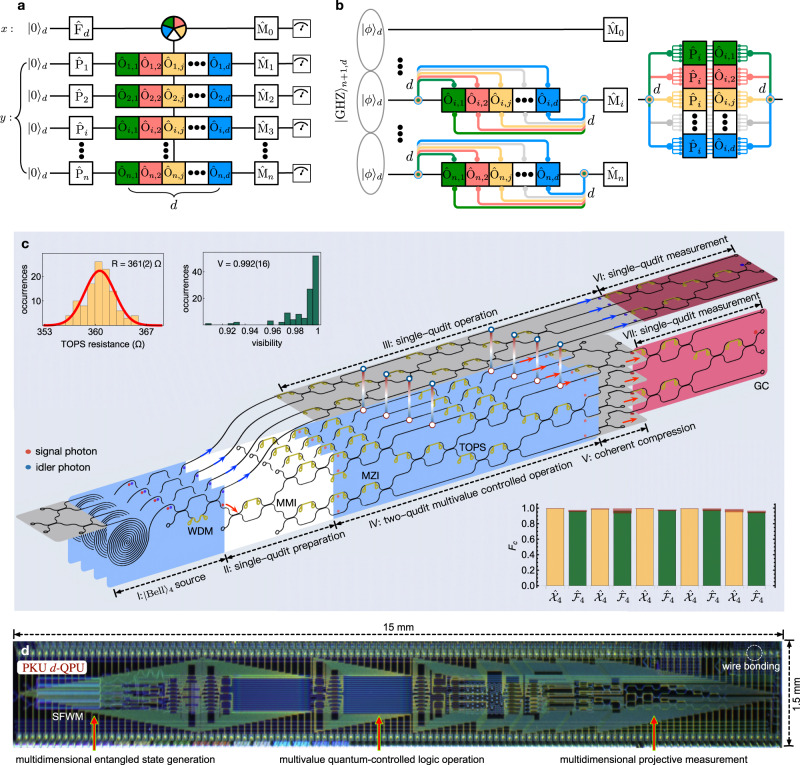
Fig. 2 A qudit-based programmable quantum processing unit in a photonic integrated circuit chip. a Quantum circuit, and b physical implementation of the multiqudit QPU. It bases on multiphoton multidimensional entanglement of ∣GHZ⟩n+1,d, where n + 1 is the number of photonic qudits and d is the local dimensionality of each qudit. Pi is an arbitrary single-qudit gate; Fd is a generalised d-level Fourier gate; Mi is an arbitrary single-qudit projector; Oi,j (i = 1,..., n, j = 1,..., d) is an arbitrary single-qudit logic gate that is locally performed on the i-th qudit of the y-register, and the Oi,j gates are coherently entangled with the x-register state. The process of “space expansion--local operation--coherent compression" results in the multiqudit entangling gate, with a success probability of 1/d, independent on n. c The simplified schematic of a two-ququart d-QPU: (I) generation of four-level entangled state in an array of four integrated identical SFWM sources; (II) Hilbert space expansion and arbitrary single-qudit preparation of the y-register state; (III) arbitrary single-qudit operation of the x-register state; (IV) arbitrary single-qudit operation (loading in the four layers) of the y-register state, in which the operations are coherently entangled with the x-register state, thus forming the MVCU entangling gate, where the state-gate entanglement is indicated by the four colourful links; (V) coherent compression of Hilbert space by an indistinguishable erasure of spatial information; (VI) and (VII) arbitrary single-qudit projective measurement in the x and y registers. Insets: left top, measured resistance of all thermal-optic phase shifters (TOPSs); measured interference visibility of all 2-dimensional Mach-Zehnder Interferometers (MZIs); bottom right, measured classical statistic fidelities (Fc) for the Pauli X4 gate with a mean of 0.988(13) and Fourier F4 gate with a mean of 0.967(19). d A microscopy image of the d-QPU chip. It monolithically integrates 451 optical components, including 4 SFWM sources, 116 reconfigurable TOPS, 131 multimode interferometer (MMI) beamsplitters, 4 wavelength-division multiplexing (WDM) filters, 156 waveguide crossings and 40 grating couplers (GC). The d-QPU chip is wire bounded and can be flexibly controlled by classical electronics, and can be reliably reprogrammed and reconfigured to benchmark a spectrum of different quaternary quantum algorithms.
Fig. 2 A qudit-based programmable quantum processing unit in a photonic integrated circuit chip. a Quantum circuit, and b physical implementation of the multiqudit QPU. It bases on multiphoton multidimensional entanglement of ∣GHZ⟩n+1,d, where n + 1 is the number of photonic qudits and d is the local dimensionality of each qudit. Pi is an arbitrary single-qudit gate; Fd is a generalised d-level Fourier gate; Mi is an arbitrary single-qudit projector; Oi,j (i = 1,..., n, j = 1,..., d) is an arbitrary single-qudit logic gate that is locally performed on the i-th qudit of the y-register, and the Oi,j gates are coherently entangled with the x-register state. The process of “space expansion--local operation--coherent compression" results in the multiqudit entangling gate, with a success probability of 1/d, independent on n. c The simplified schematic of a two-ququart d-QPU: (I) generation of four-level entangled state in an array of four integrated identical SFWM sources; (II) Hilbert space expansion and arbitrary single-qudit preparation of the y-register state; (III) arbitrary single-qudit operation of the x-register state; (IV) arbitrary single-qudit operation (loading in the four layers) of the y-register state, in which the operations are coherently entangled with the x-register state, thus forming the MVCU entangling gate, where the state-gate entanglement is indicated by the four colourful links; (V) coherent compression of Hilbert space by an indistinguishable erasure of spatial information; (VI) and (VII) arbitrary single-qudit projective measurement in the x and y registers. Insets: left top, measured resistance of all thermal-optic phase shifters (TOPSs); measured interference visibility of all 2-dimensional Mach-Zehnder Interferometers (MZIs); bottom right, measured classical statistic fidelities (Fc) for the Pauli X4 gate with a mean of 0.988(13) and Fourier F4 gate with a mean of 0.967(19). d A microscopy image of the d-QPU chip. It monolithically integrates 451 optical components, including 4 SFWM sources, 116 reconfigurable TOPS, 131 multimode interferometer (MMI) beamsplitters, 4 wavelength-division multiplexing (WDM) filters, 156 waveguide crossings and 40 grating couplers (GC). The d-QPU chip is wire bounded and can be flexibly controlled by classical electronics, and can be reliably reprogrammed and reconfigured to benchmark a spectrum of different quaternary quantum algorithms.CC BY · PubMed Central
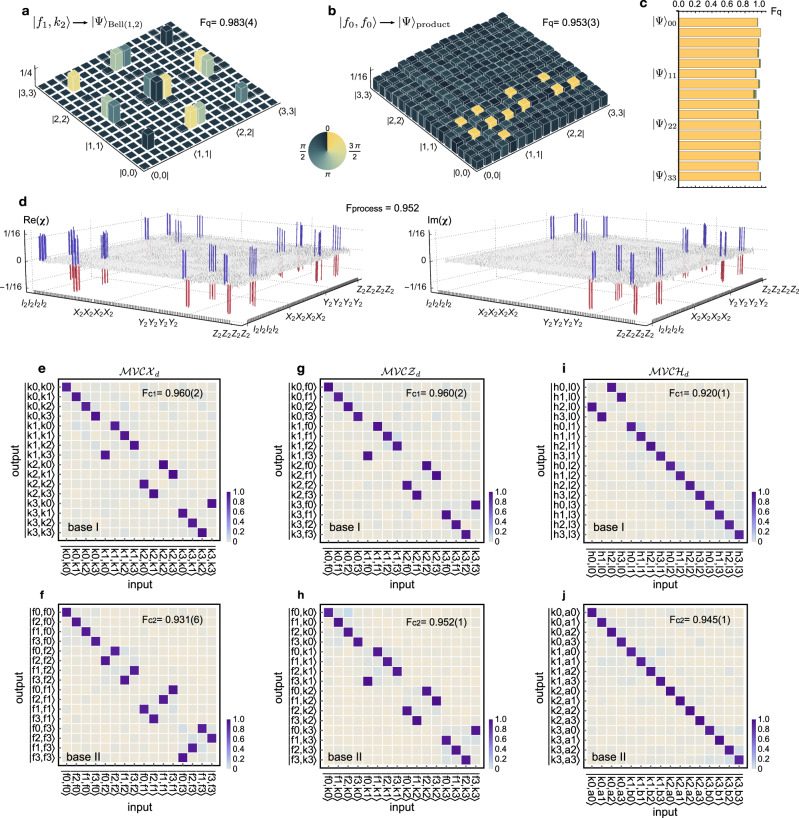
Fig. 3 Characterisation of quaternary multi-value controlled-unitary logic operations. a, b Measured density matrices (ρ) for a four-level maximally entangled Bell state and a fully product state. Column heights (colours) represent absolute values ∣ρ∣ (phases Arg(ρ)) of the elements. Quantum state fidelity Fq was measured to be 0.983(4) and 0.953(3), respectively. c, Measured quantum state fidelities for a complete set of four-level Bell states ∣Ψ⟩i,j, i, j = 0,1,2,3. The generalised Bell states are created by operating input states of ∣fi⟩⊗∣kj⟩ in the MVCXd gate. Shaded areas atop bars refer to ± 1σ error bars. The Fq values in a–c were estimated by Monte Carlo the photon counts with photon Poissonian statistics. d Reconstructed process matrix (χ) of the MVCXd gate. It was measured by quantum process tomography with in total 256 quantum state tomographic measurements. We obtained the quantum process fidelity of 0.952, that is defined as Tr[χ0χ], where χ0 is the ideal matrix. The χ matrix is represented in the standard identity and Pauli basis {I2, X2, Y2, Z2}. Blue and red colours are used to improve the clarity. e–j Measured truth tables (normalised photon counts) for three MVCU logic gates in two complementary bases {I, II}: e, f, a multi-value controlled-Xd (MVCXd) gate; g, h, a multi-value controlled-Zd (MVCZd) gate; i, j, a multi-value controlled-Hd (MVCHd) gate. The definitions of basis are given as: computational basis ∣ki⟩; Fourier basis ∣fi⟩; Hadamard basis ∣hi⟩; basis ∣li⟩ is another eigenstate of the Hadamard and ∣ai⟩ and ∣bi⟩ are given by rotations, which are provided in Supplementary (i = {0, 1, 2, 3}). Classical statistic fidelities (Fc1, Fc2) are measured, which are adopted to estimate the lower and upper bound of the complementary classical fidelity: [0.891(2), 0.931(1)] for the MVCXd, [0.912(2), 0.952(1)] for the MVCZd, and [0.865(1), 0.920(1)] for the MVCHd. In e–j, the probability distributions are colour coded (key is provided at the right bottom). The values in parentheses of Fc and Fq refer to ± 1σ uncertainty from photon statistics.
Fig. 3 Characterisation of quaternary multi-value controlled-unitary logic operations. a, b Measured density matrices (ρ) for a four-level maximally entangled Bell state and a fully product state. Column heights (colours) represent absolute values ∣ρ∣ (phases Arg(ρ)) of the elements. Quantum state fidelity Fq was measured to be 0.983(4) and 0.953(3), respectively. c, Measured quantum state fidelities for a complete set of four-level Bell states ∣Ψ⟩i,j, i, j = 0,1,2,3. The generalised Bell states are created by operating input states of ∣fi⟩⊗∣kj⟩ in the MVCXd gate. Shaded areas atop bars refer to ± 1σ error bars. The Fq values in a–c were estimated by Monte Carlo the photon counts with photon Poissonian statistics. d Reconstructed process matrix (χ) of the MVCXd gate. It was measured by quantum process tomography with in total 256 quantum state tomographic measurements. We obtained the quantum process fidelity of 0.952, that is defined as Tr[χ0χ], where χ0 is the ideal matrix. The χ matrix is represented in the standard identity and Pauli basis {I2, X2, Y2, Z2}. Blue and red colours are used to improve the clarity. e–j Measured truth tables (normalised photon counts) for three MVCU logic gates in two complementary bases {I, II}: e, f, a multi-value controlled-Xd (MVCXd) gate; g, h, a multi-value controlled-Zd (MVCZd) gate; i, j, a multi-value controlled-Hd (MVCHd) gate. The definitions of basis are given as: computational basis ∣ki⟩; Fourier basis ∣fi⟩; Hadamard basis ∣hi⟩; basis ∣li⟩ is another eigenstate of the Hadamard and ∣ai⟩ and ∣bi⟩ are given by rotations, which are provided in Supplementary (i = {0, 1, 2, 3}). Classical statistic fidelities (Fc1, Fc2) are measured, which are adopted to estimate the lower and upper bound of the complementary classical fidelity: [0.891(2), 0.931(1)] for the MVCXd, [0.912(2), 0.952(1)] for the MVCZd, and [0.865(1), 0.920(1)] for the MVCHd. In e–j, the probability distributions are colour coded (key is provided at the right bottom). The values in parentheses of Fc and Fq refer to ± 1σ uncertainty from photon statistics.CC BY · PubMed Central
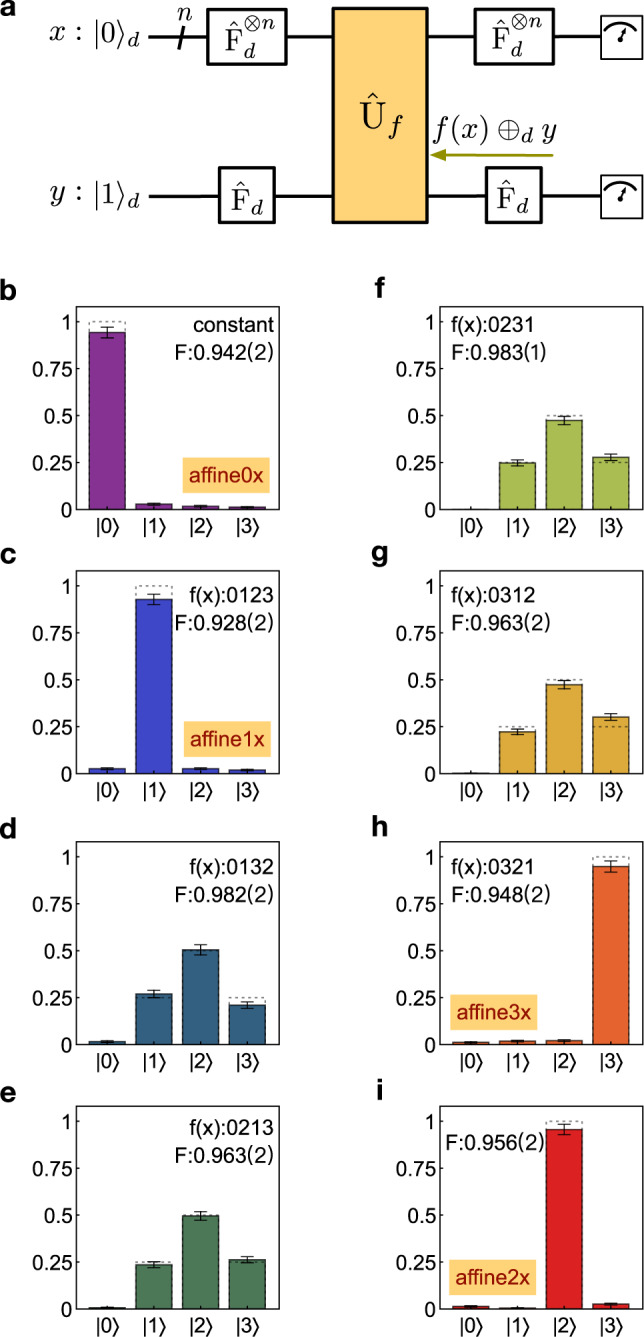
Fig. 4 Implementations of generalised Deutsch-Jozsa and Bernstein-Vazirani algorithms in quaternary. a Quantum logical circuit for implementing the d-ary Deutsch-Jozsa and Bernstein-Vazirani algorithms. This circuit can be implemented by the scheme in Fig. 1a, b with an exchange of the x and y registers. The task of the d-ary Deutsch-Jozsa algorithm is to determine an unknown multi-value function f: {0, 1,..., d−1}n → {0, 1,..., d − 1} is either constant or balanced, while that of the d-ary Bernstein-Vazirani algorithm is to compute the close expression of a multi-value affine function f: A0 ⊕ A1x1. . . ⊕ Anxn, using only a single call of quantum oracle. When d equals to 2, the two algorithms return to the original Deutsch’s algorithms. The key part is the implementation of f(x) ⊕ dy by the MVCU gate. The outcome of the algorithms is measured in the computation basis of the x-register states. b–i Measured probability distributions (normalised coincidence counts) of the x-register in the computational basis. Results in b–h demonstrate that the d-ary Deutsch-Jozsa algorithm allows the determination of whether f(x) is constant (b) or balanced (c–h). Results in b, c, i, h show the d-ary Bernstein-Vazirani algorithm can determine the expression of affine functions f: b, f(x) is constant and A1=0; c, f(x) is affine and A1=1; i, f(x) is affine and A1=2; h, f(x) is affine and A1=3; Dotted boxes in (b--i) refer to theoretical probability distributions. Experimental probability distributions (coloured bars) are obtained from photon coincidences, which are accumulated by 20s per measurement. The classical fidelity Fc presents the success probability of each measurement. In order to make the small error bars visible in the plots, they are plot by ± 3σ. The values in parentheses refer to ± 1σ uncertainty. All error bars are estimated from photon Poissonian statistics.
Fig. 4 Implementations of generalised Deutsch-Jozsa and Bernstein-Vazirani algorithms in quaternary. a Quantum logical circuit for implementing the d-ary Deutsch-Jozsa and Bernstein-Vazirani algorithms. This circuit can be implemented by the scheme in Fig. 1a, b with an exchange of the x and y registers. The task of the d-ary Deutsch-Jozsa algorithm is to determine an unknown multi-value function f: {0, 1,..., d−1}n → {0, 1,..., d − 1} is either constant or balanced, while that of the d-ary Bernstein-Vazirani algorithm is to compute the close expression of a multi-value affine function f: A0 ⊕ A1x1. . . ⊕ Anxn, using only a single call of quantum oracle. When d equals to 2, the two algorithms return to the original Deutsch’s algorithms. The key part is the implementation of f(x) ⊕ dy by the MVCU gate. The outcome of the algorithms is measured in the computation basis of the x-register states. b–i Measured probability distributions (normalised coincidence counts) of the x-register in the computational basis. Results in b–h demonstrate that the d-ary Deutsch-Jozsa algorithm allows the determination of whether f(x) is constant (b) or balanced (c–h). Results in b, c, i, h show the d-ary Bernstein-Vazirani algorithm can determine the expression of affine functions f: b, f(x) is constant and A1=0; c, f(x) is affine and A1=1; i, f(x) is affine and A1=2; h, f(x) is affine and A1=3; Dotted boxes in (b--i) refer to theoretical probability distributions. Experimental probability distributions (coloured bars) are obtained from photon coincidences, which are accumulated by 20s per measurement. The classical fidelity Fc presents the success probability of each measurement. In order to make the small error bars visible in the plots, they are plot by ± 3σ. The values in parentheses refer to ± 1σ uncertainty. All error bars are estimated from photon Poissonian statistics.CC BY · PubMed Central
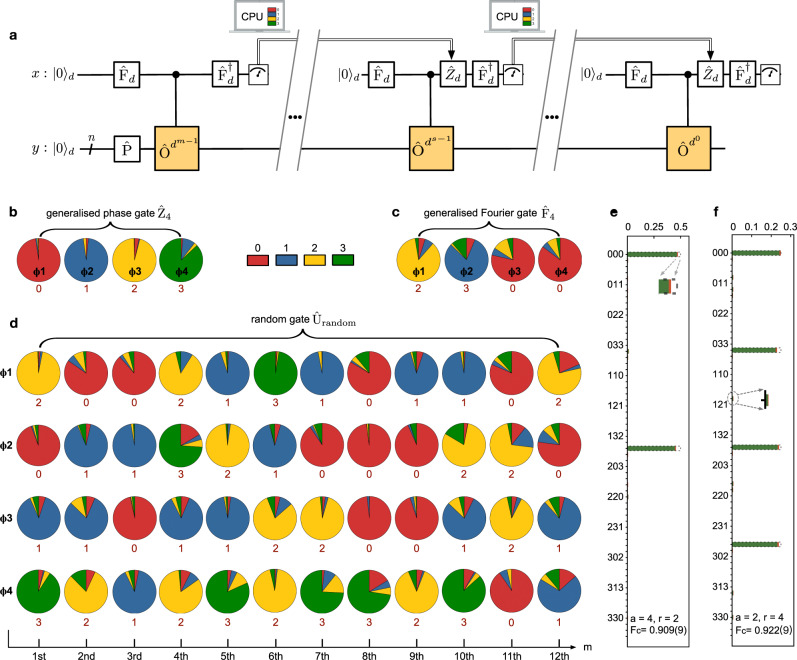
Fig. 5 Implementations of quaternary quantum phase estimation and order-finding. a Their quantum logical circuit for implementing Kitaev’s scalable approaches. For the d-ary phase estimation, the task is to compute the eigenphase ϕ of a unitary O given its eigenstate of ∣ϕ⟩. For the d-ary order-finding, the task is to find the order of a function as (armodN) = 1. The x-register single-qudit state is initialised by the Fourier gate Fd; the y-register is prepared in the ∣ϕ⟩ eigenstate ((∣0⟩)d^(⊗n) state) for phase estimation (for order-finding). The Fd^(†) terminates the x-register to output the desired solution in the computational basis. In the s-th step, the Zd rotation is added with a feedback angle of θs= − 0.0ϕs+1ϕs+2…ϕm, that is determined by previous measurements. The algorithm is iterated m times -- each step returns 1 dit result with d-ary accuracy, to obtain a m-dit estimation of the eigenphase of a unitary or the order of a function. b–d Measured probability pie-distributions of the four eigenphases (ϕ1, ϕ2, ϕ3, ϕ4) for three different unitary matrices, using the quaternary quantum phase estimation: b a generalised phase gate Z4 as diag[1,e^i2πθ,e^i2π2θ,e^i2π3θ] where θ = 1/4; c a generalised Fourier gate F4; d a random gate Urandom (see form in Supplementary Note 5). Coloured sectors represent the experimental outcomes of {0,1,2,3} for each iteration, measured in the computational basis of {∣0⟩,∣1⟩,∣2⟩,∣3⟩}, respectively. The measured dominating sector is used to obtain every dit of the eigenphases; theoretical values for each dit are provided under the pies. The eigenphases are backwardly computed from the least significant dit from m = 12 to 1. e, f Measured probability distributions for the quaternary order-finding algorithm with a setting of a = 4 and a = 2, respectively. From the distributions, the order of r = 2 and r = 4 are experimentally computed with a 3-quart resolution (equivalent to 64-level), and with a classical statistic fidelity (Fc) of 0.909(9) and 0.922(9), respectively. The order-finding together with classical algorithm allows the factorisation of 15 = 3 × 5. Errors ( ± 1σ) arising from photon Poissonian noise are indicated as red shaded caps. Dashed lines refer to theoretical predictions. Experimental probability distributions in b–f are calculated from photon coincidences, which are accumulated by 20s per measurement.
Fig. 5 Implementations of quaternary quantum phase estimation and order-finding. a Their quantum logical circuit for implementing Kitaev’s scalable approaches. For the d-ary phase estimation, the task is to compute the eigenphase ϕ of a unitary O given its eigenstate of ∣ϕ⟩. For the d-ary order-finding, the task is to find the order of a function as (armodN) = 1. The x-register single-qudit state is initialised by the Fourier gate Fd; the y-register is prepared in the ∣ϕ⟩ eigenstate ((∣0⟩)d^(⊗n) state) for phase estimation (for order-finding). The Fd^(†) terminates the x-register to output the desired solution in the computational basis. In the s-th step, the Zd rotation is added with a feedback angle of θs= − 0.0ϕs+1ϕs+2…ϕm, that is determined by previous measurements. The algorithm is iterated m times -- each step returns 1 dit result with d-ary accuracy, to obtain a m-dit estimation of the eigenphase of a unitary or the order of a function. b–d Measured probability pie-distributions of the four eigenphases (ϕ1, ϕ2, ϕ3, ϕ4) for three different unitary matrices, using the quaternary quantum phase estimation: b a generalised phase gate Z4 as diag[1,e^i2πθ,e^i2π2θ,e^i2π3θ] where θ = 1/4; c a generalised Fourier gate F4; d a random gate Urandom (see form in Supplementary Note 5). Coloured sectors represent the experimental outcomes of {0,1,2,3} for each iteration, measured in the computational basis of {∣0⟩,∣1⟩,∣2⟩,∣3⟩}, respectively. The measured dominating sector is used to obtain every dit of the eigenphases; theoretical values for each dit are provided under the pies. The eigenphases are backwardly computed from the least significant dit from m = 12 to 1. e, f Measured probability distributions for the quaternary order-finding algorithm with a setting of a = 4 and a = 2, respectively. From the distributions, the order of r = 2 and r = 4 are experimentally computed with a 3-quart resolution (equivalent to 64-level), and with a classical statistic fidelity (Fc) of 0.909(9) and 0.922(9), respectively. The order-finding together with classical algorithm allows the factorisation of 15 = 3 × 5. Errors ( ± 1σ) arising from photon Poissonian noise are indicated as red shaded caps. Dashed lines refer to theoretical predictions. Experimental probability distributions in b–f are calculated from photon coincidences, which are accumulated by 20s per measurement.CC BY · PubMed Central

Verification

Claims the paper makes

The claims and statistics of this paper haven’t been checked yet.

Free: it reads the open-access text and checks the first 5 claims that cite a source we can check. Create a free account to check every claim.

A few free checks a day · papers already verified open instantly · results are public

Self-check

Percentages, sums and reported differences re-computed from the paper’s own numbers.

The self-check needs the paper’s full text.

Citations

Cites

Show all 78 references

Research works printed but not linked: 2

  1. Shor, P. W. Algorithms for quantum computation: Discrete logarithms and factoring. Proc. 35nd Annual Symposium on Foundations of Computer Science, IEEE Computer Society Press (1994).
  2. Deutsch, D. & Jozsa, R. Rapid solution of problems by quantum computation. Proc. R. Soc. Lond. Ser. A Math. Phys. Sci. 439, 553–558 (1992).

Cited by

See all 273

Metadata

Authors
Chi, Y., Huang, J., Zhang, Z., Mao, J., Zhou, Z., Chen, X., Zhai, C., Bao, J., Dai, T., Yuan, H., Zhang, M., Dai, D., Tang, B., Yang, Y., Li, Z., Ding, Y., Oxenløwe, L. K., Thompson, M. G., O’Brien, J. L., Li, Y., Gong, Q., & Wang, J.
Affiliations
  • Peking University (CN)
  • State Key Laboratory of Modern Optical Instruments (CN)
  • Chinese Academy of Sciences (CN)
  • Technical University of Denmark (DK)
  • University of Bristol (GB)
  • The University of Western Australia (AU)
  • Shanxi University (CN)
Corresponding author
Wang, Jianwei
Venue
Nature Communications
Published
2022-03-04
Volume
13
Issue
1
Pages
1166-1166
ISSN
2041-1723 (ISSN-L)
OpenAlex
W4214944326
Cited by
273
References
78
Citations by year
2026: 44 · 2025: 73 · 2024: 72 · 2023: 61 · 2022: 23
FWCI
18.77
Type
journal article
Language
en
Open access
Licence
Locations
  • Nature Communications (publishedVersion, cc-by)
  • PubMed Central (publishedVersion, cc-by)
  • PubMed (publishedVersion)
  • UWA Profiles and Research Repository (UWA) (submittedVersion, cc-by)
  • UWA Profiles and Research Repository (University of Western Australia) (submittedVersion)
  • RePEc: Research Papers in Economics (submittedVersion)
  • DOAJ (DOAJ: Directory of Open Access Journals) (submittedVersion, cc-by-sa)
  • Technical University of Denmark, DTU Orbit (Technical University of Denmark, DTU) (submittedVersion, other-oa)
  • Technical University of Denmark, DTU Orbit (Technical University of Denmark, DTU) (submittedVersion)
  • Greater South Information System
Funders
  • Villum Fonden (00013367, 00025371)
  • National Natural Science Foundation of China (61975001, 61675007, 61775003, 61590933, 61904196, 2018B030329001)
Topics
  • Physical Sciences › Computer Science › Artificial Intelligence › Quantum Computing Algorithms and Architecture
  • Physical Sciences › Physics and Astronomy › Atomic and Molecular Physics, and Optics › Quantum Information and Cryptography
  • Physical Sciences › Engineering › Electrical and Electronic Engineering › Photonic and Optical Devices
Keywords
qudits, silicon photonics, photonic integrated circuits, programmable quantum processors, quantum parallelism, quantum Fourier transform, Deutsch-Jozsa algorithm, Bernstein-Vazirani algorithm, phase estimation, quantum state preparation and measurement, monolithic integration

About these checks

Registry, retraction, Cites and statistics results are computed, not judged, with one exception: a printed reference that no index lists is read once by a model before it counts as a citation error. Claims are extracted by a model and kept only when their quote appears verbatim in the text; each cited source is then checked, with a model’s help, for whether it says what the claim relies on. Those verdicts can be wrong — read the claim’s quote and the cited source before relying on one.

Statistics and arithmetic are recomputed, not judged.

Confidence bands are shown only for fields calibrated on our annotated test set. None is calibrated yet, so no band is shown.

What counts as a claim ›How we measure confidence ›How we check this ›

Are you an author, or do you see a problem with this page? Request a review

How to cite

Cite CoChat for the checks on this page, and the paper for its own findings.

This page
CoChat. (2026). Citation check: A programmable qudit-based quantum processor. https://app.cochat.ai/papers/10.1038/s41467-022-28767-x
The paper
Chi, Y., Huang, J., Zhang, Z., Mao, J., Zhou, Z., Chen, X., Zhai, C., Bao, J., Dai, T., Yuan, H., Zhang, M., Dai, D., Tang, B., Yang, Y., Li, Z., Ding, Y., Oxenløwe, L. K., Thompson, M. G., O’Brien, J. L., . . . Wang, J. (2022). A programmable qudit-based quantum processor. Nature Communications. https://doi.org/10.1038/s41467-022-28767-x

Data sources

Bibliographic data: Semantic Scholar, OpenAlex, Crossref.

Contains information from the Semantic Scholar Academic Graph Datasets, made available under the ODC Attribution License (ODC-BY 1.0).

Semantic Scholar’s data is described in: Kinney, R., et al. (2023). The Semantic Scholar Open Data Platform. arXiv:2301.10140.