

A programmable qudit-based quantum processor
Open accessThe DOI matches its Crossref record; 79 of the 79 references it cites were found in a registry or an index.
Abstract
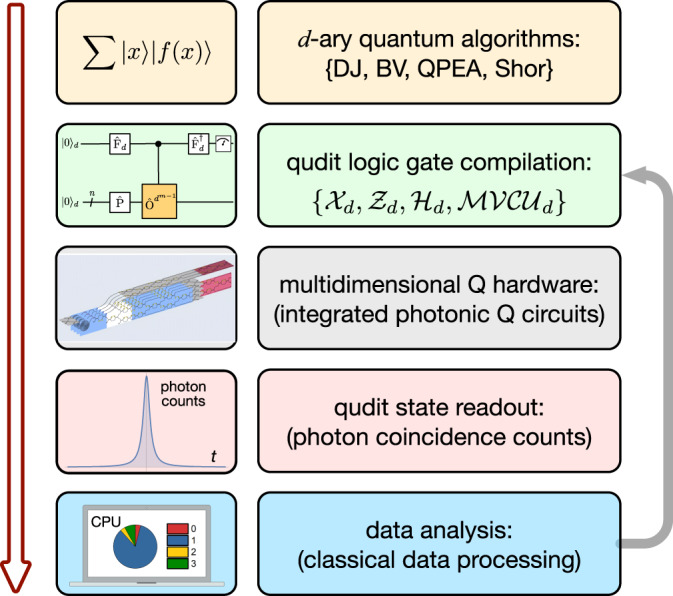
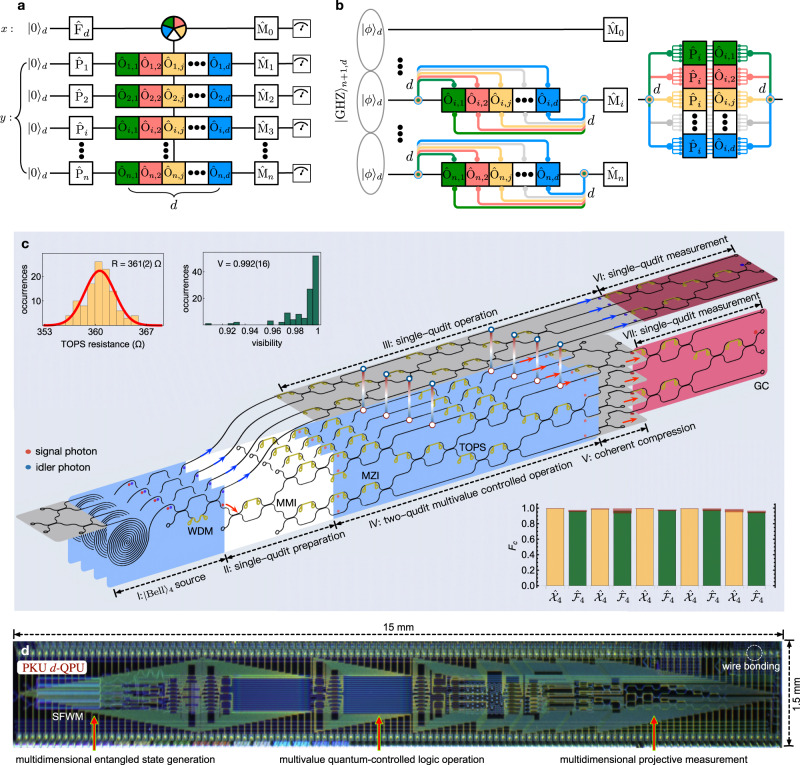
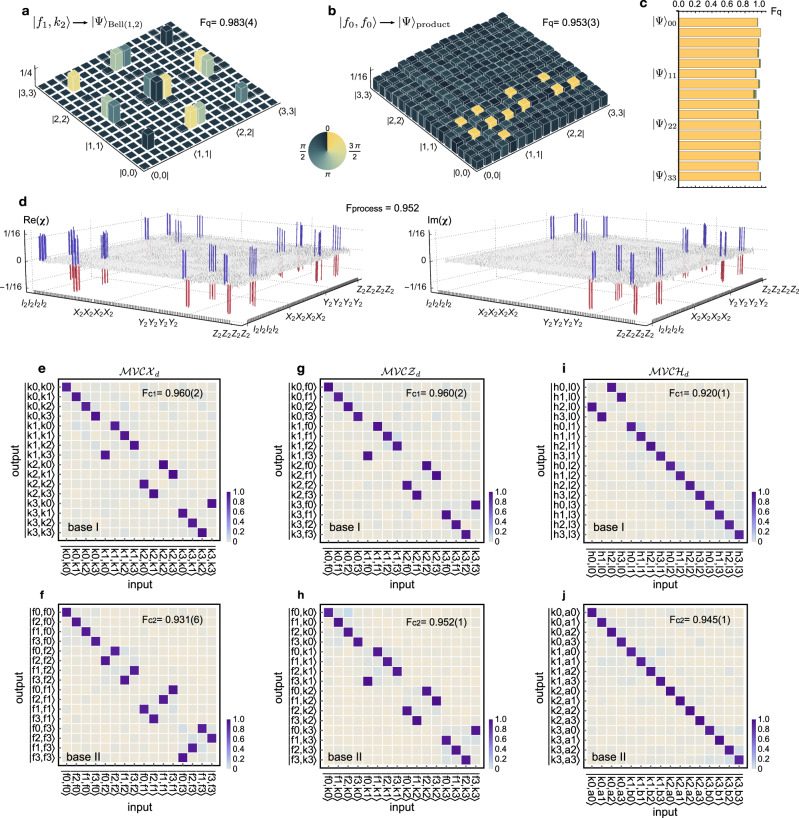
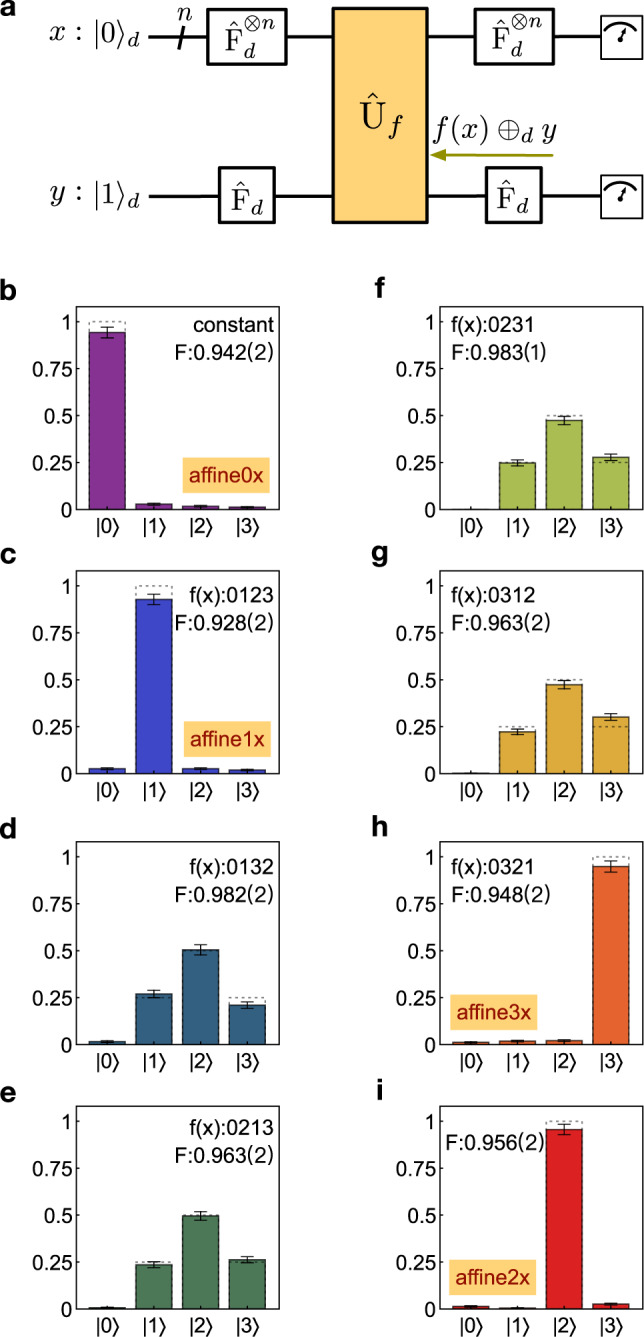
Controlling and programming quantum devices to process quantum information by the unit of quantum dit, i.e., qudit, provides the possibilities for noise-resilient quantum communications, delicate quantum molecular simulations, and efficient quantum computations, showing great potential to enhance the capabilities of qubit-based quantum technologies. Here, we report a programmable qudit-based quantum processor in silicon-photonic integrated circuits and demonstrate its enhancement of quantum computational parallelism. The processor monolithically integrates all the key functionalities and capabilities of initialisation, manipulation, and measurement of the two quantum quart (ququart) states and multi-value quantum-controlled logic gates with high-level fidelities. By reprogramming the configuration of the processor, we implemented the most basic quantum Fourier transform algorithms, all in quaternary, to benchmark the enhancement of quantum parallelism using qudits, which include generalised Deutsch-Jozsa and Bernstein-Vazirani algorithms, quaternary phase estimation and fast factorization algorithms. The monolithic integration and high programmability have allowed the implementations of more than one million high-fidelity preparations, operations and projections of qudit states in the processor. Our work shows an integrated photonic quantum technology for qudit-based quantum computing with enhanced capacity, accuracy, and efficiency, which could lead to the acceleration of building a large-scale quantum computer.
Overview
The claims and statistics of this paper haven’t been checked yet.
Free: it reads the open-access text and checks the first 5 claims that cite a source we can check. Create a free account to check every claim.
Integrity signals
Registry
Cites
Statistics
Figures
Verification
Claims the paper makes
The claims and statistics of this paper haven’t been checked yet.
Free: it reads the open-access text and checks the first 5 claims that cite a source we can check. Create a free account to check every claim.
Self-check
Percentages, sums and reported differences re-computed from the paper’s own numbers.
The self-check needs the paper’s full text.
Citations
Cites
Quantum supremacy using a programmable superconducting processor
Arute, F., Arya, K., Babbush, R., Bacon, D., Bardin, J. C., Barends, R., Biswas, R., Boixo, S., Brandao, F. G. S. L., Buell, D. A., et al. (2019) · Nature · doi:10.1038/s41586-019-1666-5 · Cited by 7,720 · cited 1×
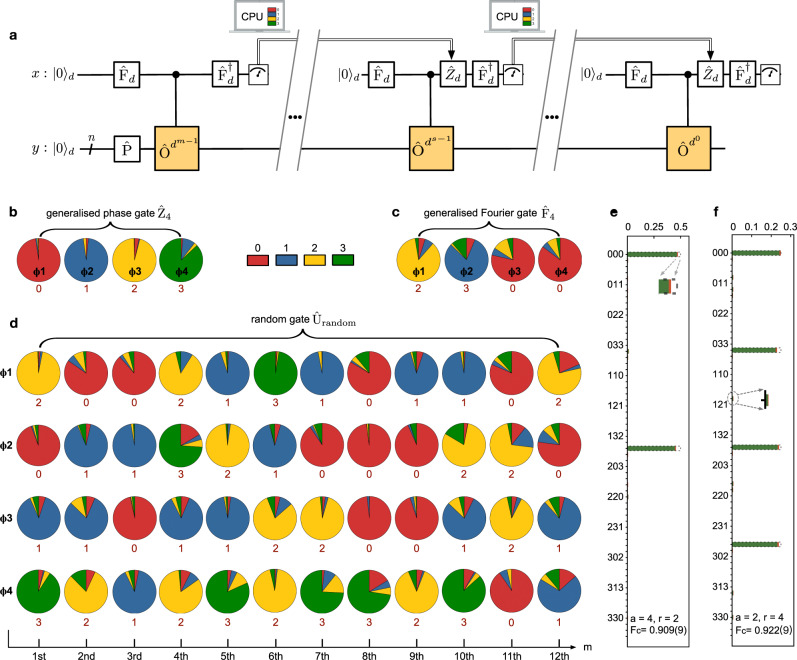
“The order-finding algorithm together with classical processing using the continued fraction algorithm returns the factor of gcd(ar/2 ± 1,N) = (3, 5).”
MethodRapid solution of problems by quantum computation
Deutsch, D., & Jozsa, R. (1992) · Proceedings of the Royal Society of London. Series A: Mathematical and Physical Sciences · doi:10.1098/rspa.1992.0167 · Cited by 2,700
Satellite-to-ground quantum key distribution
Liao, S.-K., Cai, W.-Q., Liu, W.-Y., Zhang, L., Li, Y., Ren, J.-G., Yin, J., Shen, Q., Cao, Y., Li, Z.-P., et al. (2017) · Nature · doi:10.1038/nature23655 · Cited by 1,821 · cited 1×
“The order-finding algorithm together with classical processing using the continued fraction algorithm returns the factor of gcd(ar/2 ± 1,N) = (3, 5).”
MethodSelf-citationIntegrated photonic quantum technologies
Wang, J., Sciarrino, F., Laing, A., & Thompson, M. G. (2020) · Nature Photonics · doi:10.1038/s41566-019-0532-1 · Cited by 1,576 · cited 1×
“We designed the integrated quantum photonic circuit and use 248nm deep ultraviolet lithography to fabricate the silicon-based quantum photonic chip shown in Fig 1A on 220nm silicon-on-insulator (SOI) [3].”
MethodSelf-citationSignificant-Loophole-Free Test of Bell’s Theorem with Entangled Photons
Giustina, M., Versteegh, M. A. M., Wengerowsky, S., Handsteiner, J., Hochrainer, A., Phelan, K., Steinlechner, F., Kofler, J., Larsson, J.-Å., Abellán, C., et al. (2015) · Physical Review Letters · doi:10.1103/physrevlett.115.250401 · Cited by 1,529
Bernstein, E., & Vazirani, U. (1997) · SIAM Journal on Computing · doi:10.1137/s0097539796300921 · Cited by 1,503
Simulated Quantum Computation of Molecular Energies
Aspuru-Guzik, A., Dutoi, A. D., Love, P. J., & Head-Gordon, M. (2005) · Science · doi:10.1126/science.1113479 · Cited by 1,418
Strong Loophole-Free Test of Local Realism
Shalm, L. K., Meyer-Scott, E., Christensen, B. G., Bierhorst, P., Wayne, M. A., Stevens, M. J., Gerrits, T., Glancy, S., Hamel, D. R., Allman, M. S., et al. (2015) · Physical Review Letters · doi:10.1103/physrevlett.115.250402 · Cited by 1,402 · cited 1×
“967(2) was measured to quantify its success probability.”
BackgroundSecurity of Quantum Key Distribution Usingd-Level Systems
Cerf, N. J., Bourennane, M., Karlsson, A., & Gisin, N. (2002) · Physical Review Letters · doi:10.1103/physrevlett.88.127902 · Cited by 1,354 · cited 1×
“922(9) were obtained in comparison with theoretical distributions, showing successful estimations of the order of r= 2 (Fig.”
BackgroundOptimal design for universal multiport interferometers
Clements, W. R., Humphreys, P. C., Metcalf, B. J., Kolthammer, W. S., & Walsmley, I. A. (2016) · Optica · doi:10.1364/optica.3.001460 · Cited by 1,216 · cited 1×
“Together with the combination of on-chip integrated Mach-Zehnder interferometers (MZI) [4], we achieved high-dimensional quantum state generations, unitary operations, coherent state compression, and projection measurements.”
MethodCarolan, J., Harrold, C., Sparrow, C., Martín-López, E., Russell, N. J., Silverstone, J. W., Shadbolt, P. J., Matsuda, N., Oguma, M., Itoh, M., et al. (2015) · Science · doi:10.1126/science.aab3642 · Cited by 1,093
Self-citationStrong Quantum Computational Advantage Using a Superconducting Quantum Processor
Wu, Y., Bao, W.-S., Cao, S., Chen, F., Chen, M.-C., Chen, X., Chung, T.-H., Deng, H., Du, Y., Fan, D., et al. (2021) · Physical Review Letters · doi:10.1103/physrevlett.127.180501 · Cited by 1,059
Self-citationObservation of discrete time-crystalline order in a disordered dipolar many-body system
Choi, S., Choi, J., Landig, R., Kucsko, G., Zhou, H., Isoya, J., Jelezko, F., Onoda, S., Sumiya, H., Khemani, V., et al. (2017) · Nature · doi:10.1038/nature21426 · Cited by 1,012
Bell Inequalities for Arbitrarily High-Dimensional Systems
Collins, D., Gisin, N., Linden, N., Massar, S., & Popescu, S. (2002) · Physical Review Letters · doi:10.1103/physrevlett.88.040404 · Cited by 981
Multidimensional quantum entanglement with large-scale integrated optics
Wang, J., Paesani, S., Ding, Y., Santagati, R., Skrzypczyk, P., Salavrakos, A., Tura, J., Augusiak, R., Mančinska, L., Bacco, D., et al. (2018) · Science · doi:10.1126/science.aar7053 · Cited by 816 · cited 1×
“Recent years, significant progress has been made in the generation and measurement of high-dimensional quantum states [2], the improvement of quantum communication capacity, strengthen in Bell’s non-local properties and reduce in measurement loophole.”
BackgroundSelf-citationProgrammable Quantum Simulations of Spin Systems with Trapped Ions
Monroe, C., Campbell, W. C., Duan, L. M., Gong, Z. X., Gorshkov, A. V., Hess, P., Islam, R., Kim, K., Linke, N., Pagano, G., et al. (2019) · arXiv · doi:10.48550/arxiv.1912.07845 · Cited by 806
Programmable quantum simulations of spin systems with trapped ions
Monroe, C., Campbell, W. C., Duan, L.-M., Gong, Z.-X., Gorshkov, A. V., Hess, P. W., Islam, R., Kim, K., Linke, N. M., Pagano, G., et al. (2021) · Reviews of Modern Physics · doi:10.1103/revmodphys.93.025001 · Cited by 802
Towards quantum chemistry on a quantum computer
Lanyon, B. P., Whitfield, J. D., Gillett, G. G., Goggin, M. E., Almeida, M. P., Kassal, I., Biamonte, J. D., Mohseni, M., Powell, B. J., Barbieri, M., et al. (2010) · Nature Chemistry · doi:10.1038/nchem.483 · Cited by 796
Satellite-Relayed Intercontinental Quantum Network
Liao, S.-K., Cai, W.-Q., Handsteiner, J., Liu, B., Yin, J., Zhang, L., Rauch, D., Fink, M., Ren, J.-G., Liu, W.-Y., et al. (2018) · Physical Review Letters · doi:10.1103/physrevlett.120.030501 · Cited by 789
Self-citationDemonstration of a small programmable quantum computer with atomic qubits
Debnath, S., Linke, N. M., Figgatt, C., Landsman, K. A., Wright, K., & Monroe, C. (2016) · Nature · doi:10.1038/nature18648 · Cited by 777
A programmable two-qubit quantum processor in silicon
Watson, T. F., Philips, S. G. J., Kawakami, E., Ward, D. R., Scarlino, P., Veldhorst, M., Savage, D. E., Lagally, M. G., Friesen, M., Coppersmith, S. N., et al. (2018) · Nature · doi:10.1038/nature25766 · Cited by 741
Kues, M., Reimer, C., Lukens, J. M., Munro, W. J., Weiner, A. M., Moss, D. J., & Morandotti, R. (2019) · Nature Photonics · doi:10.1038/s41566-019-0363-0 · Cited by 697
Dada, A. C., Leach, J., Buller, G. S., Padgett, M. J., & Andersson, E. (2011) · Nature Physics · doi:10.1038/nphys1996 · Cited by 638
High-dimensional one-way quantum processing implemented on d-level cluster states
Reimer, C., Sciara, S., Roztocki, P., Islam, M., Romero Cortés, L., Zhang, Y., Fischer, B., Loranger, S., Kashyap, R., Cino, A., et al. (2019) · Nature Physics · doi:10.1038/s41567-018-0347-x · Cited by 617
Advances in high-dimensional quantum entanglement
Erhard, M., Krenn, M., & Zeilinger, A. (2020) · Nature Reviews Physics · doi:10.1038/s42254-020-0193-5 · Cited by 609 · cited 1×
“Qudit-based quantum technology has the advantages of larger Hilbert space, stronger bell nonlocality, better error-tolerance and natural implementation in optical systems [1].”
BackgroundThe potential and global outlook of integrated photonics for quantum technologies
Pelucchi, E., Fagas, G., Aharonovich, I., Englund, D., Figueroa, E., Gong, Q., Hannes, H., Liu, J., Lu, C.-Y., Matsuda, N., et al. (2021) · Nature Reviews Physics · doi:10.1038/s42254-021-00398-z · Cited by 533
Self-citationRealization of a scalable Shor algorithm
Monz, T., Nigg, D., Martinez, E. A., Brandl, M. F., Schindler, P., Rines, R., Wang, S. X., Chuang, I. L., & Blatt, R. (2016) · Science · doi:10.1126/science.aad9480 · Cited by 486
Qudits and High-Dimensional Quantum Computing
Wang, Y., Hu, Z., Sanders, B. C., & Kais, S. (2020) · Frontiers in Physics · doi:10.3389/fphy.2020.589504 · Cited by 478
Metalens-array–based high-dimensional and multiphoton quantum source
Li, L., Liu, Z., Ren, X., Wang, S., Su, V.-C., Chen, M.-K., Chu, C. H., Kuo, H. Y., Liu, B., Zang, W., et al. (2020) · Science · doi:10.1126/science.aba9779 · Cited by 461
Phase-Programmable Gaussian Boson Sampling Using Stimulated Squeezed Light
Zhong, H.-S., Deng, Y.-H., Qin, J., Wang, H., Chen, M.-C., Peng, L.-C., Luo, Y.-H., Wu, D., Gong, S.-Q., Su, H., et al. (2021) · Physical Review Letters · doi:10.1103/physrevlett.127.180502 · Cited by 434
Self-citationSemiclassical Fourier Transform for Quantum Computation
Griffiths, R. B., & Niu, C.-S. (1996) · Physical Review Letters · doi:10.1103/physrevlett.76.3228 · Cited by 431
Quantum-process tomography: Resource analysis of different strategies
Mohseni, M., Rezakhani, A. T., & Lidar, D. A. (2008) · Physical Review A · doi:10.1103/physreva.77.032322 · Cited by 416
Quantum teleportation in high dimensions
Luo, Y.-H., Zhong, H.-S., Erhard, M., Wang, X.-L., Peng, L.-C., Krenn, M., Jiang, X., Li, L., Liu, N.-L., Lu, C.-Y., et al. (2019) · Physical Review Letters · doi:10.1103/physrevlett.123.070505 · Cited by 406
Multi-photon entanglement in high dimensions
Malik, M., Erhard, M., Huber, M., Krenn, M., Fickler, R., & Zeilinger, A. (2016) · Nature Photonics · doi:10.1038/nphoton.2016.12 · Cited by 366
Provably secure and high-rate quantum key distribution with time-bin qudits
Islam, N. T., Lim, C. C. W., Cahall, C., Kim, J., & Gauthier, D. J. (2017) · Science Advances · doi:10.1126/sciadv.1701491 · Cited by 355
A universal qudit quantum processor with trapped ions
Ringbauer, M., Meth, M., Postler, L., Stricker, R., Blatt, R., Schindler, P., & Monz, T. (2022) · Nature Physics · doi:10.1038/s41567-022-01658-0 · Cited by 351
Experimental realization of Shor's quantum factoring algorithm using qubit recycling
Martín-López, E., Laing, A., Lawson, T., Alvarez, R., Zhou, X.-Q., & O'Brien, J. L. (2012) · Nature Photonics · doi:10.1038/nphoton.2012.259 · Cited by 349
Self-citationChip-to-chip quantum teleportation and multi-photon entanglement in silicon
Llewellyn, D., Ding, Y., Faruque, I. I., Paesani, S., Bacco, D., Santagati, R., Qian, Y.-J., Li, Y., Xiao, Y.-F., Huber, M., et al. (2020) · Nature Physics · doi:10.1038/s41567-019-0727-x · Cited by 331
Self-citationEmulation of a Quantum Spin with a Superconducting Phase Qudit
Neeley, M., Ansmann, M., Bialczak, R. C., Hofheinz, M., Lucero, E., O'Connell, A. D., Sank, D., Wang, H., Wenner, J., Cleland, A. N., et al. (2009) · Science · doi:10.1126/science.1173440 · Cited by 304 · cited 1×
“988(13) and Fourier F4 gate with a mean of 0.”
BackgroundQuantum Information Scrambling on a Superconducting Qutrit Processor
Blok, M. S., Ramasesh, V. V., Schuster, T., O’Brien, K., Kreikebaum, J. M., Dahlen, D., Morvan, A., Yoshida, B., Yao, N. Y., & Siddiqi, I. (2021) · Physical Review X · doi:10.1103/physrevx.11.021010 · Cited by 262
Closing the Detection Loophole in Bell Experiments Using Qudits
Vértesi, T., Pironio, S., & Brunner, N. (2010) · Physical Review Letters · doi:10.1103/physrevlett.104.060401 · Cited by 254
Experimental quantum Hamiltonian learning
Wang, J., Paesani, S., Santagati, R., Knauer, S., Gentile, A. A., Wiebe, N., Petruzzella, M., O’Brien, J. L., Rarity, J. G., Laing, A., et al. (2017) · Nature Physics · doi:10.1038/nphys4074 · Cited by 247
Self-citationExperimental High-Dimensional Quantum Teleportation
Hu, X.-M., Zhang, C., Liu, B.-H., Cai, Y., Ye, X.-J., Guo, Y., Xing, W.-B., Huang, C.-X., Huang, Y.-F., Li, C.-F., et al. (2020) · Physical Review Letters · doi:10.1103/physrevlett.125.230501 · Cited by 237
High-efficiency single-photon generation via large-scale active time multiplexing
Kaneda, F., & Kwiat, P. G. (2019) · Science Advances · doi:10.1126/sciadv.aaw8586 · Cited by 232
Generation and sampling of quantum states of light in a silicon chip
Paesani, S., Ding, Y., Santagati, R., Chakhmakhchyan, L., Vigliar, C., Rottwitt, K., Oxenløwe, L. K., Wang, J., Thompson, M. G., & Laing, A. (2019) · Nature Physics · doi:10.1038/s41567-019-0567-8 · Cited by 214
Self-citationWitnessing eigenstates for quantum simulation of Hamiltonian spectra
Santagati, R., Wang, J., Gentile, A. A., Paesani, S., Wiebe, N., McClean, J. R., Morley-Short, S., Shadbolt, P. J., Bonneau, D., Silverstone, J. W., et al. (2018) · Science Advances · doi:10.1126/sciadv.aap9646 · Cited by 211
Self-citationDobšíček, M., Johansson, G., Shumeiko, V., & Wendin, G. (2007) · Physical Review A · doi:10.1103/physreva.76.030306 · Cited by 208
Near-ideal spontaneous photon sources in silicon quantum photonics
Paesani, S., Borghi, M., Signorini, S., Maïnos, A., Pavesi, L., & Laing, A. (2020) · Nature Communications · doi:10.1038/s41467-020-16187-8 · Cited by 192
Enhanced Fault-Tolerant Quantum Computing ind-Level Systems
Campbell, E. T. (2014) · Physical Review Letters · doi:10.1103/physrevlett.113.230501 · Cited by 184
Wei, T.-C., Affleck, I., & Raussendorf, R. (2011) · Physical Review Letters · doi:10.1103/physrevlett.106.070501 · Cited by 172 · cited 1×
“967(19) for the five F4 gates, where the values in parentheses are uncertainty from photon statistics.”
BackgroundHigh-dimensional optical quantum logic in large operational spaces
Imany, P., Jaramillo-Villegas, J. A., Alshaykh, M. S., Lukens, J. M., Odele, O. D., Moore, A. J., Leaird, D. E., Qi, M., & Weiner, A. M. (2019) · npj Quantum Information · doi:10.1038/s41534-019-0173-8 · Cited by 169
Experimental Greenberger–Horne–Zeilinger entanglement beyond qubits
Erhard, M., Malik, M., Krenn, M., & Zeilinger, A. (2018) · Nature Photonics · doi:10.1038/s41566-018-0257-6 · Cited by 168
Quantum computation based on d-level cluster state
Zhou, D. L., Zeng, B., Xu, Z., & Sun, C. P. (2003) · Physical Review A · doi:10.1103/physreva.68.062303 · Cited by 167
Experimental quantum compressed sensing for a seven-qubit system
Riofrío, C. A., Gross, D., Flammia, S. T., Monz, T., Nigg, D., Blatt, R., & Eisert, J. (2017) · Nature Communications · doi:10.1038/ncomms15305 · Cited by 151
Quantifying Photonic High-Dimensional Entanglement
Martin, A., Guerreiro, T., Tiranov, A., Designolle, S., Fröwis, F., Brunner, N., Huber, M., & Gisin, N. (2017) · Physical Review Letters · doi:10.1103/physrevlett.118.110501 · Cited by 149
High-dimensional quantum cloning and applications to quantum hacking
Bouchard, F., Fickler, R., Boyd, R. W., & Karimi, E. (2017) · Science Advances · doi:10.1126/sciadv.1601915 · Cited by 135
On-chip coherent conversion of photonic quantum entanglement between different degrees of freedom
Feng, L.-T., Zhang, M., Zhou, Z.-Y., Li, M., Xiong, X., Yu, L., Shi, B.-S., Guo, G.-P., Dai, D.-X., Ren, X.-F., et al. (2016) · Nature Communications · doi:10.1038/ncomms11985 · Cited by 134
Self-citationEfficient Factorization with a Single Pure Qubit andlogNMixed Qubits
Parker, S., & Plenio, M. B. (2000) · Physical Review Letters · doi:10.1103/physrevlett.85.3049 · Cited by 130
Programmable four-photon graph states on a silicon chip
Adcock, J. C., Vigliar, C., Santagati, R., Silverstone, J. W., & Thompson, M. G. (2019) · Nature Communications · doi:10.1038/s41467-019-11489-y · Cited by 129 · cited 1×
“For comparison, rates of qubits with the same capacity features ∼ mHz [7], an advantage of qudit regarding faster speed of computation.”
BackgroundSelf-citationOversimplifying quantum factoring
Smolin, J. A., Smith, G., & Vargo, A. (2013) · Nature · doi:10.1038/nature12290 · Cited by 127
Cervera-Lierta, A., Krenn, M., Aspuru‐Guzik, A., & Galda, A. (2022) · Physical Review Applied · doi:10.1103/physrevapplied.17.024062 · Cited by 126
Efficient Generation of High-Dimensional Entanglement through Multipath Down-Conversion
Hu, X., Xing, W.-B., Liu, B., Huang, Y., Li, C., Guo, G., Erker, P., & Huber, M. (2020) · Physical Review Letters · doi:10.1103/physrevlett.125.090503 · Cited by 122
Asymptotic improvements to quantum circuits via qutrits
Gokhale, P., Baker, J. M., Duckering, C., Brown, N. C., Brown, K. R., & Chong, F. T. (2019) · Proceedings of the 46th International Symposium on Computer Architecture · doi:10.1145/3307650.3322253 · Cited by 120
Error-protected qubits in a silicon photonic chip
Vigliar, C., Paesani, S., Ding, Y., Adcock, J. C., Wang, J., Morley-Short, S., Bacco, D., Oxenløwe, L. K., Thompson, M. G., Rarity, J. G., et al. (2021) · Nature Physics · doi:10.1038/s41567-021-01333-w · Cited by 118
Self-citationFactoring with qutrits: Shor's algorithm on ternary and metaplectic quantum architectures
Bocharov, A., Roetteler, M., & Svore, K. M. (2017) · Physical Review A · doi:10.1103/physreva.96.012306 · Cited by 114
Universal quantum computation with qudits
Luo, M., & Wang, X. (2014) · Science China Physics Mechanics and Astronomy · doi:10.1007/s11433-014-5551-9 · Cited by 101
Hofmann, H. F. (2005) · Physical Review Letters · doi:10.1103/physrevlett.94.160504 · Cited by 97
Scheme for Universal High-Dimensional Quantum Computation with Linear Optics
Paesani, S., Bulmer, J. F. F., Jones, A. E., Santagati, R., & Laing, A. (2021) · Physical Review Letters · doi:10.1103/physrevlett.126.230504 · Cited by 85
Quantum entanglement on photonic chips: a review
Chen, X., Fu, Z., Gong, Q., & Wang, J. (2021) · Advanced Photonics · doi:10.1117/1.ap.3.6.064002 · Cited by 78
Self-citationOptical one-way quantum computing with a simulated valence-bond solid
Kaltenbaek, R., Lavoie, J., Zeng, B., Bartlett, S. D., & Resch, K. J. (2010) · Nature Physics · doi:10.1038/nphys1777 · Cited by 77
Duality quantum computer and the efficient quantum simulations
Wei, S.-J., & Long, G. (2016) · Quantum Information Processing · doi:10.1007/s11128-016-1263-6 · Cited by 73
Quantum Phase Estimation with Time‐Frequency Qudits in a Single Photon
Lu, H., Hu, Z., Alshaykh, M. S., Moore, A. J., Wang, Y., Imany, P., Weiner, A. M., & Kais, S. (2019) · Advanced Quantum Technologies · doi:10.1002/qute.201900074 · Cited by 72
Calculating unknown eigenvalues with a quantum algorithm
Zhou, X.-Q., Kalasuwan, P., Ralph, T. C., & O'Brien, J. L. (2013) · Nature Photonics · doi:10.1038/nphoton.2012.360 · Cited by 58 · cited 1×
“We designed and programmed the 4-dimensional iterative quantum phase estimation algorithm (IPEA) with the quantum circuit in Fig 1E on chip [8].”
MethodSelf-citationProgrammable Quantum Simulations of Bosonic Systems with Trapped Ions
Katz, O., & Monroe, C. (2023) · Physical Review Letters · doi:10.1103/physrevlett.131.033604 · Cited by 42
Qudit quantum computation on matrix product states with global symmetry
Wang, D., Stephen, D. T., & Raussendorf, R. (2017) · Physical Review A · doi:10.1103/physreva.95.032312 · Cited by 36
A generalized multipath delayed-choice experiment on a large-scale quantum nanophotonic chip
Chen, X., Deng, Y., Liu, S., Pramanik, T., Mao, J., Bao, J., Zhai, C., Dai, T., Yuan, H., Guo, J., et al. (2021) · Nature Communications · doi:10.1038/s41467-021-22887-6 · Cited by 35
Self-citationA Generalization of the Deutsch-Jozsa Algorithm to Multi-Valued Quantum Logic
Fan, Y. (2007) · IEEE International Symposium on Multiple-Valued Logic (ISMVL) · doi:10.1109/ismvl.2007.3 · Cited by 33
A generalized multipath delayed-choice experiment on a large-scale quantum nanophotonic chip
Chen, X., Deng, Y., Liu, S., Pramanik, T., Mao, J., Bao, J., Zhai, C., Dai, T., Yuan, H., Guo, J., et al. (2021) · RePEc: Research Papers in Economics · Cited by 30
Self-citationQuantum computation with coherent spin states and the close Hadamard problem
Adcock, M. R. A., Høyer, P., & Sanders, B. C. (2016) · Quantum Information Processing · doi:10.1007/s11128-015-1229-0 · Cited by 26
Research works printed but not linked: 1
- Shor, P. W. Algorithms for quantum computation: Discrete logarithms and factoring. Proc. 35nd Annual Symposium on Foundations of Computer Science, IEEE Computer Society Press (1994).
Cited by
Prospects and applications of on-chip lasers
Zhou, Z., Ou, X., Fang, Y., Alkhazraji, E., Xu, R., Wan, Y., & Bowers, J. E. (2023) · eLight · doi:10.1186/s43593-022-00027-x · Cited by 319
“For a programmable qudit-based quantum processor, by reprogramming the integrated reconfigurable MZIs on a silicon photonics platform, basic Fourier transform algorithms can be implemented in quaternary [154].”
MethodSelf-citationVery-large-scale integrated quantum graph photonics
Bao, J., Fu, Z., Pramanik, T., Mao, J., Chi, Y., Cao, Y., Zhai, C., Mao, Y., Dai, T., Chen, X., et al. (2023) · Nature Photonics · doi:10.1038/s41566-023-01187-z · Cited by 198
“Entangling multiple particles in multiple dimensions could provide the key resources for strong quantum correlation tests 33 and qudit-based quantum computing 34 .”
BackgroundMethodSelf-citationQuantum many-body simulations on digital quantum computers: State-of-the-art and future challenges
Fauseweh, B. (2024) · Nature Communications · doi:10.1038/s41467-024-46402-9 · Cited by 152
Hardware Efficient Quantum Simulation of Non-Abelian Gauge Theories with Qudits on Rydberg Platforms
González-Cuadra, D., Zache, T. V., Carrasco, J. A., Kraus, B., & Zoller, P. (2022) · Physical Review Letters · doi:10.1103/physrevlett.129.160501 · Cited by 197
High-fidelity qutrit entangling gates for superconducting circuits
Goss, N., Morvan, A., Marinelli, B., Mitchell, B. K., Nguyen, L. B., Naik, R. K., Chen, L., Jünger, C., Kreikebaum, J. M., Santiago, D. I., et al. (2022) · Nature Communications · doi:10.1038/s41467-022-34851-z · Cited by 129
Metadata
- Authors
- Chi, Y., Huang, J., Zhang, Z., Mao, J., Zhou, Z., Chen, X., Zhai, C., Bao, J., Dai, T., Yuan, H., Zhang, M., Dai, D., Tang, B., Yang, Y., Li, Z., Ding, Y., Oxenløwe, L. K., Thompson, M. G., O’Brien, J. L., Li, Y., Gong, Q., & Wang, J.
- Affiliations
- Peking University (CN)
- State Key Laboratory of Modern Optical Instruments (CN)
- Chinese Academy of Sciences (CN)
- Technical University of Denmark (DK)
- University of Bristol (GB)
- The University of Western Australia (AU)
- Shanxi University (CN)
- Corresponding author
- Wang, Jianwei
- ORCID
- Venue
- Nature Communications
- Published
- 2022-03-04
- Volume
- 13
- Issue
- 1
- Pages
- 1166-1166
- ISSN
- 2041-1723 (ISSN-L)
- PMC
- PMC8897515
- OpenAlex
- W4214944326
- Semantic Scholar
- a4390a7f1c46ff8a7fdae863295d0b610023d977
- Cited by
- 273
- References
- 78
- Citations by year
- 2026: 44 · 2025: 73 · 2024: 72 · 2023: 61 · 2022: 23
- FWCI
- 18.77
- Type
- journal article
- Language
- en
- Open access
- gold
- doi.org
- Licence
- cc-by
- creativecommons.org/licenses/by/4.0 (tdm)
- creativecommons.org/licenses/by/4.0 (vor)
- Locations
- Nature Communications (publishedVersion, cc-by)
- PubMed Central (publishedVersion, cc-by)
- PubMed (publishedVersion)
- UWA Profiles and Research Repository (UWA) (submittedVersion, cc-by)
- UWA Profiles and Research Repository (University of Western Australia) (submittedVersion)
- RePEc: Research Papers in Economics (submittedVersion)
- DOAJ (DOAJ: Directory of Open Access Journals) (submittedVersion, cc-by-sa)
- Technical University of Denmark, DTU Orbit (Technical University of Denmark, DTU) (submittedVersion, other-oa)
- Technical University of Denmark, DTU Orbit (Technical University of Denmark, DTU) (submittedVersion)
- Greater South Information System
- Funders
- Villum Fonden (00013367, 00025371)
- National Natural Science Foundation of China (61975001, 61675007, 61775003, 61590933, 61904196, 2018B030329001)
- Topics
- Physical Sciences › Computer Science › Artificial Intelligence › Quantum Computing Algorithms and Architecture
- Physical Sciences › Physics and Astronomy › Atomic and Molecular Physics, and Optics › Quantum Information and Cryptography
- Physical Sciences › Engineering › Electrical and Electronic Engineering › Photonic and Optical Devices
- Keywords
- qudits, silicon photonics, photonic integrated circuits, programmable quantum processors, quantum parallelism, quantum Fourier transform, Deutsch-Jozsa algorithm, Bernstein-Vazirani algorithm, phase estimation, quantum state preparation and measurement, monolithic integration
About these checks
Registry, retraction, Cites and statistics results are computed, not judged, with one exception: a printed reference that no index lists is read once by a model before it counts as a citation error. Claims are extracted by a model and kept only when their quote appears verbatim in the text; each cited source is then checked, with a model’s help, for whether it says what the claim relies on. Those verdicts can be wrong — read the claim’s quote and the cited source before relying on one.
Statistics and arithmetic are recomputed, not judged.
Confidence bands are shown only for fields calibrated on our annotated test set. None is calibrated yet, so no band is shown.
What counts as a claim ›How we measure confidence ›How we check this ›
Are you an author, or do you see a problem with this page? Request a review
Data sources
Bibliographic data: Semantic Scholar, OpenAlex, Crossref.
Contains information from the Semantic Scholar Academic Graph Datasets, made available under the ODC Attribution License (ODC-BY 1.0).
Semantic Scholar’s data is described in: Kinney, R., et al. (2023). The Semantic Scholar Open Data Platform. arXiv:2301.10140.
