

Biomimetic hydrogel supports initiation and growth of patient-derived breast tumor organoids
Open accessThe DOI matches its Crossref record; 85 of the 87 references it cites were found in a registry or an index.
Abstract
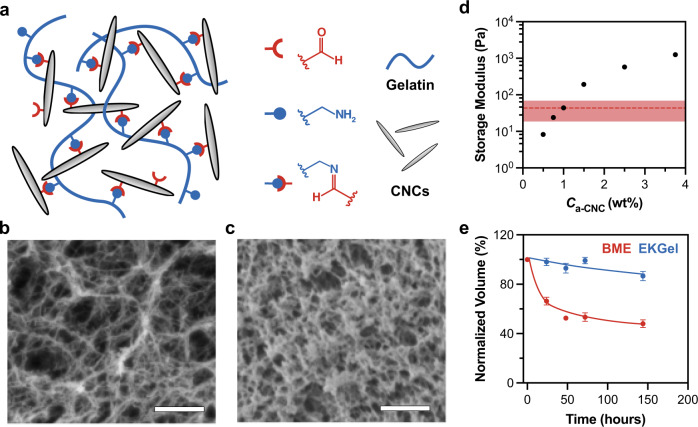
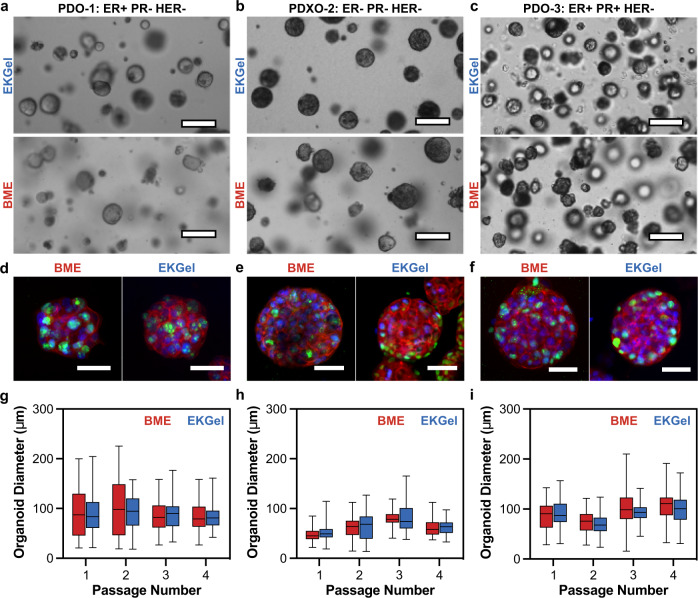
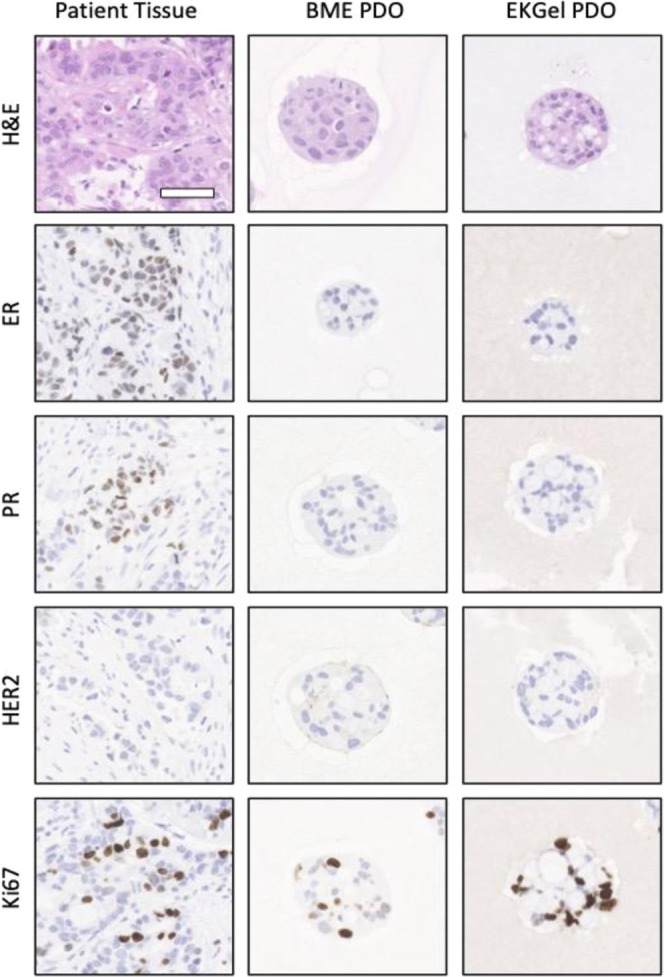
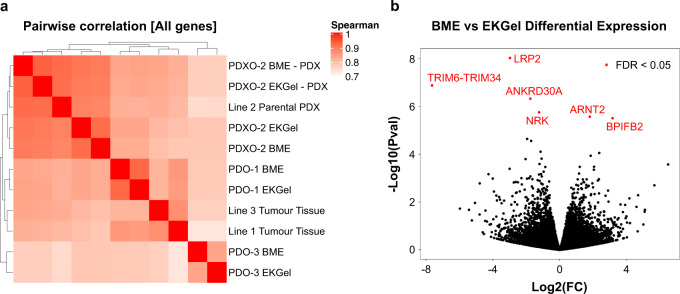
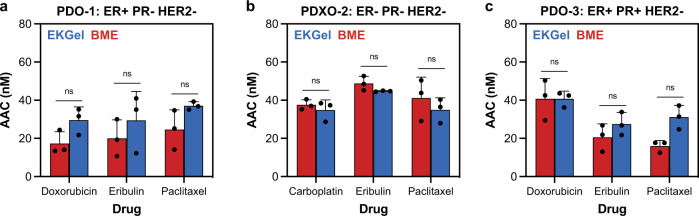
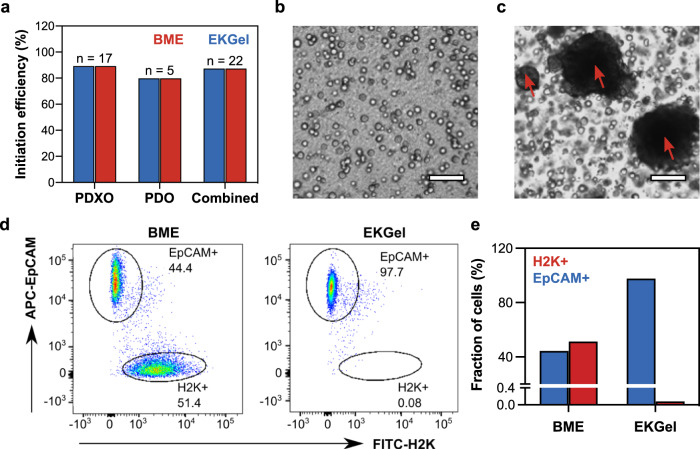
Patient-derived tumor organoids (PDOs) are a highly promising preclinical model that recapitulates the histology, gene expression, and drug response of the donor patient tumor. Currently, PDO culture relies on basement-membrane extract (BME), which suffers from batch-to-batch variability, the presence of xenogeneic compounds and residual growth factors, and poor control of mechanical properties. Additionally, for the development of new organoid lines from patient-derived xenografts, contamination of murine host cells poses a problem. We propose a nanofibrillar hydrogel (EKGel) for the initiation and growth of breast cancer PDOs. PDOs grown in EKGel have histopathologic features, gene expression, and drug response that are similar to those of their parental tumors and PDOs in BME. In addition, EKGel offers reduced batch-to-batch variability, a range of mechanical properties, and suppressed contamination from murine cells. These results show that EKGel is an improved alternative to BME matrices for the initiation, growth, and maintenance of breast cancer PDOs.
Overview
The claims and statistics of this paper haven’t been checked yet.
Free: it reads the open-access text and checks the first 5 claims that cite a source we can check. Create a free account to check every claim.
Integrity signals
Registry
Cites
Statistics
Figures
Verification
Claims the paper makes
The claims and statistics of this paper haven’t been checked yet.
Free: it reads the open-access text and checks the first 5 claims that cite a source we can check. Create a free account to check every claim.
Claims other papers make about this one
Each is checked against this paper’s own text: does it say what the citing paper says it does?
The check wasn’t confident either way, so it gives no verdict — never disputed.
In the citing paper
“the presence of normal cells (MCF‐10A or HDF‐n) significantly increased the migration of MDA‐MB‐231 cells by increasing the expression level of IL‐6 protein.”
From 3D Biomimetic Models to Reconstitute Tumor Microenvironment In Vitro: Spheroids, Organoids, and Tumor‐on‐a‐Chip (2023) · cites this paper as [119]
Experimental — accuracy not yet measured
Self-check
Percentages, sums and reported differences re-computed from the paper’s own numbers.
The self-check needs the paper’s full text.
Citations
Cites
Moderated estimation of fold change and dispersion for RNA-seq data with DESeq2
Love, M. I., Huber, W., & Anders, S. (2014) · Genome Biology · doi:10.1186/s13059-014-0550-8 · Cited by 95,106
Hallmarks of Cancer: The Next Generation
Hanahan, D., & Weinberg, R. A. (2011) · Cell · doi:10.1016/j.cell.2011.02.013 · Cited by 66,590
Subramanian, A., Tamayo, P., Mootha, V. K., Mukherjee, S., Ebert, B. L., Gillette, M. A., Paulovich, A., Pomeroy, S. L., Golub, T. R., Lander, E. S., et al. (2005) · Proceedings of the National Academy of Sciences · doi:10.1073/pnas.0506580102 · Cited by 53,625
Siegel, R. L., Miller, K. D., & Jemal, A. (2020) · CA: A Cancer Journal for Clinicians · doi:10.3322/caac.21590 · Cited by 20,444
Near-optimal probabilistic RNA-seq quantification
Bray, N. L., Pimentel, H., Melsted, P., & Pachter, L. (2016) · Nature Biotechnology · doi:10.1038/nbt.3519 · Cited by 9,723
Microenvironmental regulation of tumor progression and metastasis
Quail, D. F., & Joyce, J. A. (2013) · Nature Medicine · doi:10.1038/nm.3394 · Cited by 7,994
Molecular Mechanisms of Stress-Responsive Changes in Collagen and Elastin Networks in Skin
Aziz, J., Shezali, H., Radzi, Z., Yahya, N. A., Abu Kassim, N. H., Czernuszka, J., & Rahman, M. T. (2016) · Skin Pharmacology and Physiology · doi:10.1159/000447017 · Cited by 7,323
The Reactome pathway Knowledgebase
Fabregat, A., Sidiropoulos, K., Garapati, P., Gillespie, M., Hausmann, K., Haw, R., Jassal, B., Jupe, S., Korninger, F., McKay, S., et al. (2016) · Nucleic Acids Research · doi:10.1093/nar/gkv1351 · Cited by 5,605
Lutolf, M. P., & Hubbell, J. A. (2005) · Nature Biotechnology · doi:10.1038/nbt1055 · Cited by 4,551
Matrix Crosslinking Forces Tumor Progression by Enhancing Integrin Signaling
Levental, K. R., Yu, H., Kass, L., Lakins, J. N., Egeblad, M., Erler, J. T., Fong, S. F. T., Csiszar, K., Giaccia, A., Weninger, W., et al. (2009) · Cell · doi:10.1016/j.cell.2009.10.027 · Cited by 4,101
Research works printed but not linked: 2
- Park SE Georgescu A Huh D Organoids-on-a-chip Science 2019 364 960 965 31171693 PMC7764943 · DOI · Paper page
- Jang, I. S., Neto, E. C., Guinney, J., Friend, S. H. & Margolin, A. A. Systematic assessment of analytical methods for drug sensitivity prediction from cancer cell line data. Pac. Symp. Biocomput. 63–74 (2014). PMC3995541 24297534
Cited by
Organoids: The current status and biomedical applications
Yang, S., Hu, H., Kung, H., Zou, R., Dai, Y., Hu, Y., Wang, T., Lv, T., Yu, J., & Li, F. (2023) · MedComm · doi:10.1002/mco2.274 · Cited by 266
AI-enabled organoids: Construction, analysis, and application
Bai, L., Wu, Y., Li, G., Zhang, W., Zhang, H., & Su, J. (2024) · Bioactive Materials · doi:10.1016/j.bioactmat.2023.09.005 · Cited by 207
“Machine learning-guided image analysis of in morphology scale: As aforementioned, the involvement of matrix gel materials is necessary in the construction of organoids, and the morphological analysis of these materials is crucial for their biological performance [157].”
Human organoids-on-chips for biomedical research and applications
Wang, H., Ning, X., Zhao, F. H., Zhao, H., & Li, D. (2024) · Theranostics · doi:10.7150/thno.90492 · Cited by 159
Trends in Droplet Microfluidics: From Droplet Generation to Biomedical Applications
Chen, Z., Kheiri, S., Young, E. W. K., & Kumacheva, E. (2022) · Langmuir · doi:10.1021/acs.langmuir.2c00491 · Cited by 133
Self-citationPolysaccharide-based tumor microenvironment-responsive drug delivery systems for cancer therapy
Wu, Q., Hu, Y., Yu, B., Hu, H., & Xu, F. (2023) · Journal of Controlled Release · doi:10.1016/j.jconrel.2023.08.019 · Cited by 122
Metadata
- Authors
- Prince, E., Cruickshank, J., Ba-Alawi, W., Hodgson, K., Haight, J., Tobin, C., Wakeman, A., Avoulov, A., Topolskaia, V., Elliott, M. J., McGuigan, A. P., Berman, H. K., Haibe-Kains, B., Cescon, D. W., & Kumacheva, E.
- Affiliations
- University of Toronto (CA)
- University Health Network (CA)
- Corresponding author
- Cescon, David W.
- Kumacheva, Eugenia
- ORCID
- Venue
- Nature Communications
- Published
- 2022-03-18
- Volume
- 13
- Issue
- 1
- Pages
- 1466-1466
- ISSN
- 2041-1723 (ISSN-L)
- PMC
- PMC8933543
- OpenAlex
- W4220911853
- Semantic Scholar
- 229f7eba3b969f657b2727877e9d57d4dc27b10d
- Cited by
- 135
- References
- 87
- Citations by year
- 2026: 26 · 2025: 32 · 2024: 33 · 2023: 34 · 2022: 10
- FWCI
- 8.93
- Type
- journal article
- Language
- en
- Open access
- gold
- doi.org
- Licence
- cc-by
- creativecommons.org/licenses/by/4.0 (tdm)
- creativecommons.org/licenses/by/4.0 (vor)
- Locations
- Nature Communications (publishedVersion, cc-by)
- PubMed Central (publishedVersion, cc-by)
- PubMed (publishedVersion)
- RePEc: Research Papers in Economics (submittedVersion)
- DOAJ (DOAJ: Directory of Open Access Journals) (submittedVersion)
- Funders
- American Association for Cancer Research
- Entertainment Industry Foundation
- Ontario Institute for Cancer Research
- Government of Ontario (SU2C-AACR-DT-18-15)
- Terry Fox Research Institute (PPG-1064)
- Stand Up To Cancer (SU2C-AACR-DT-18-15)
- Natural Sciences and Engineering Research Council of Canada
- Topics
- Physical Sciences › Materials Science › Biomaterials › Hydrogels: synthesis, properties, applications
- Physical Sciences › Engineering › Biomedical Engineering › 3D Printing in Biomedical Research
- Life Sciences › Biochemistry, Genetics and Molecular Biology › Cell Biology › Cellular Mechanics and Interactions
- Keywords
- patient-derived tumor organoids, breast cancer, basement membrane extract, biomimetic hydrogels, batch-to-batch variation, tumor mechanical properties, drug response
- MeSH terms
- Animals, Breast Neoplasms, Female, Humans, Organoids, Hydrogels, Biomimetics, Mice
About these checks
Registry, retraction, Cites and statistics results are computed, not judged, with one exception: a printed reference that no index lists is read once by a model before it counts as a citation error. Claims are extracted by a model and kept only when their quote appears verbatim in the text; each cited source is then checked, with a model’s help, for whether it says what the claim relies on. Those verdicts can be wrong — read the claim’s quote and the cited source before relying on one.
Statistics and arithmetic are recomputed, not judged.
Confidence bands are shown only for fields calibrated on our annotated test set. None is calibrated yet, so no band is shown.
What counts as a claim ›How we measure confidence ›How we check this ›
Are you an author, or do you see a problem with this page? Request a review
Data sources
Bibliographic data: Semantic Scholar, OpenAlex, Crossref.
Contains information from the Semantic Scholar Academic Graph Datasets, made available under the ODC Attribution License (ODC-BY 1.0).
Semantic Scholar’s data is described in: Kinney, R., et al. (2023). The Semantic Scholar Open Data Platform. arXiv:2301.10140.
