

Clinical sequencing of soft tissue and bone sarcomas delineates diverse genomic landscapes and potential therapeutic targets
Open accessPublished version of a preprint
The DOI matches its Crossref record; 68 of the 68 references it cites were found in a registry or an index.
Abstract
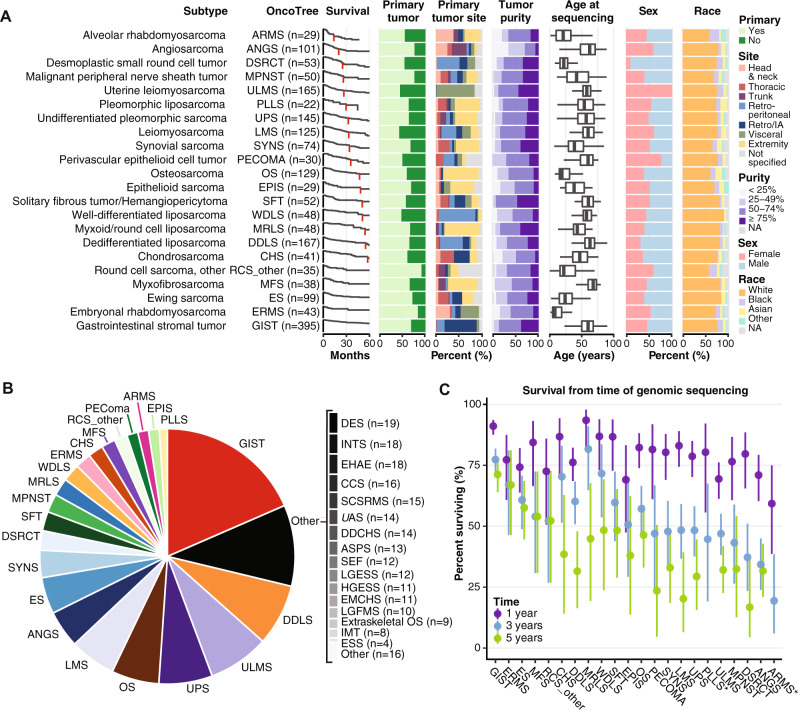
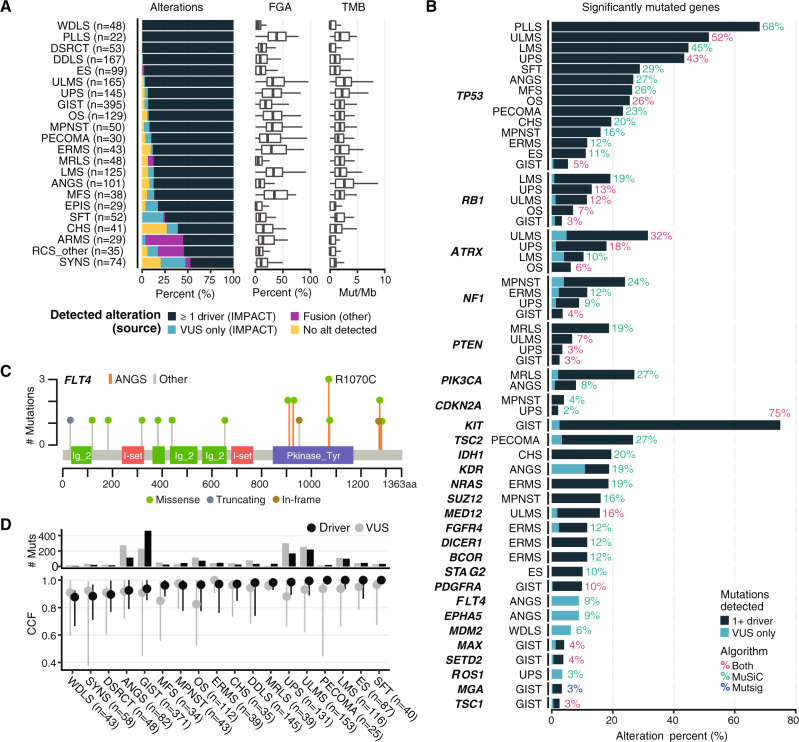
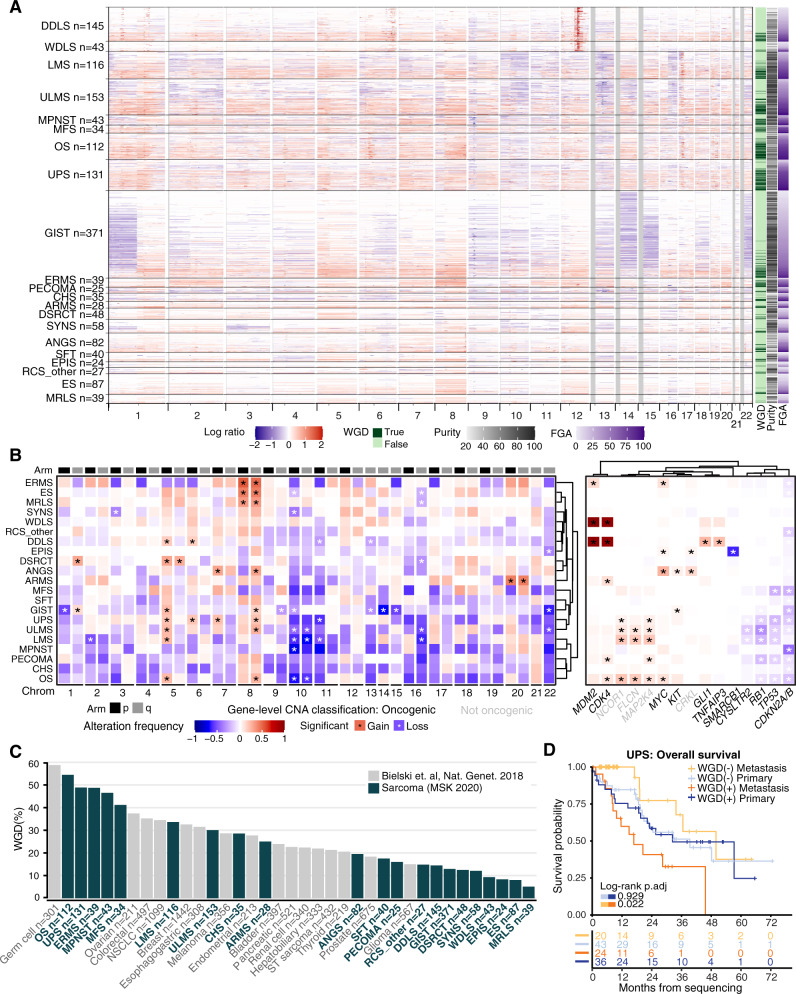
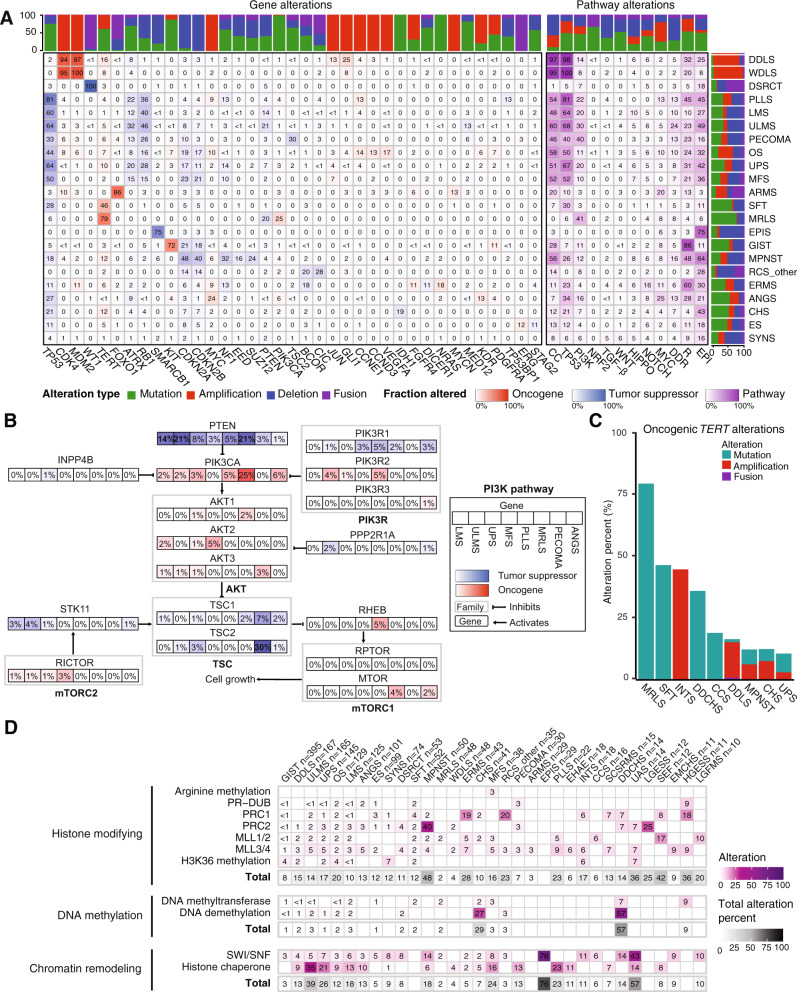
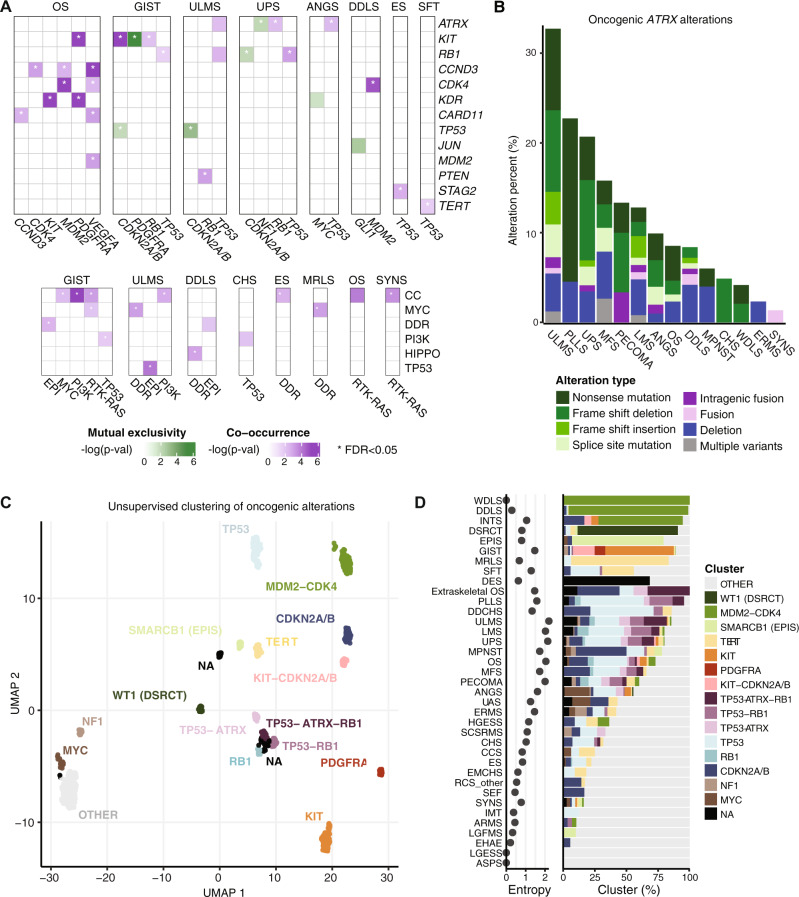
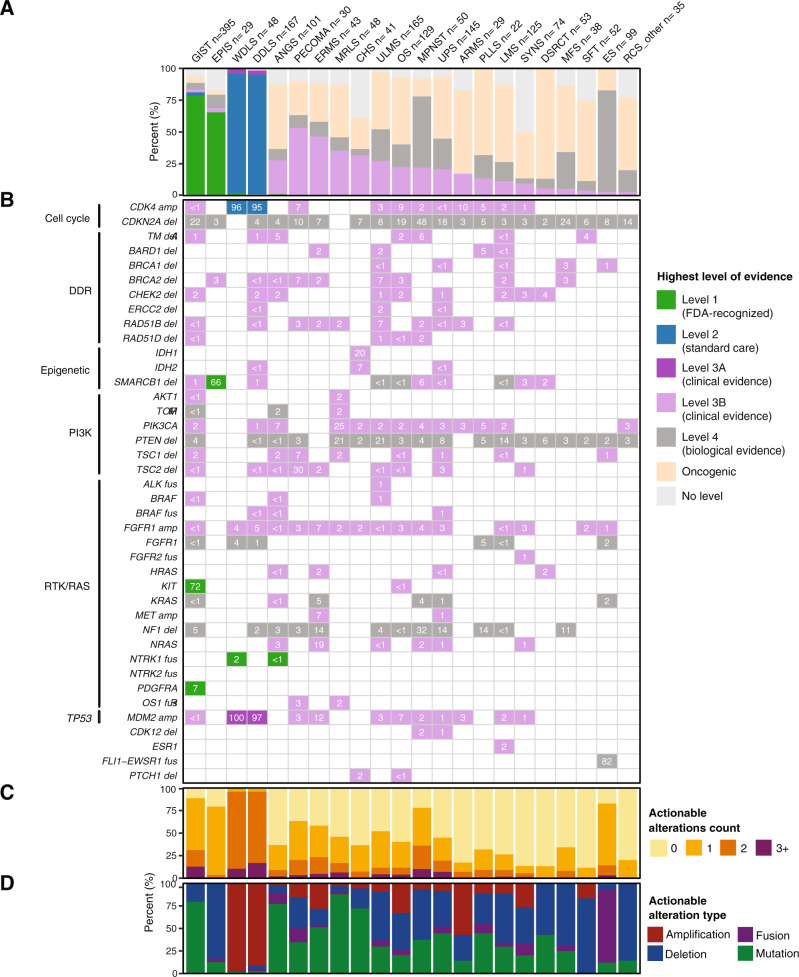
The genetic, biologic, and clinical heterogeneity of sarcomas poses a challenge for the identification of therapeutic targets, clinical research, and advancing patient care. Because there are > 100 sarcoma subtypes, in-depth genetic studies have focused on one or a few subtypes. Herein, we report a comparative genetic analysis of 2,138 sarcomas representing 45 pathological entities. This cohort is prospectively analyzed using targeted sequencing to characterize subtype-specific somatic alterations in targetable pathways, rates of whole genome doubling, mutational signatures, and subtype-agnostic genomic clusters. The most common alterations are in cell cycle control and TP53 , receptor tyrosine kinases/PI3K/RAS, and epigenetic regulators. Subtype-specific associations include TERT amplification in intimal sarcoma and SWI/SNF alterations in uterine adenosarcoma. Tumor mutational burden, while low compared to other cancers, varies between and within subtypes. This resource will improve sarcoma models, motivate studies of subtype-specific alterations, and inform investigations of genetic factors and their correlations with treatment response.
Overview
The claims and statistics of this paper haven’t been checked yet.
Free: it reads the open-access text and checks the first 5 claims that cite a source we can check. Create a free account to check every claim.
Integrity signals
Registry
Cites
Statistics
Figures
Verification
Claims the paper makes
The claims and statistics of this paper haven’t been checked yet.
Free: it reads the open-access text and checks the first 5 claims that cite a source we can check. Create a free account to check every claim.
Claims other papers make about this one
Each is checked against this paper’s own text: does it say what the citing paper says it does?
The source backs part of the claim, not all of it — or backs it for a different population, condition or comparison.
In the citing paper
“Despite their genetic complexity, these sarcomas share genomic alterations causing PI3K/Akt/mTOR and MAPK pathway activation”
From Targeting eIF4A-dependent translation in genetically complex sarcoma (2026) · cites this paper as [8]
Experimental — accuracy not yet measuredThe cited source says what the claim attributes to it.
In the citing paper
“However, due to the high heterogeneity of somatic mutations in osteosarcoma,14,15 the use of a tumor-agnostic MRD panel would compromise sensitivity, leading to reduced sequencing depth and overlooking unique somatic variants.”
From Tumor-informed deep sequencing of ctDNA detects minimal residual disease and predicts relapse in osteosarcoma (2024) · cites this paper as [14]
Self-check
Percentages, sums and reported differences re-computed from the paper’s own numbers.
The self-check needs the paper’s full text.
Citations
Cites
PD-1 and PD-L1 Immune Checkpoint Blockade to Treat Breast Cancer
Hartkopf, A. D., Taran, F.-A., Wallwiener, M., Walter, C. B., Krämer, B., Grischke, E.-M., & Brucker, S. Y. (2016) · Breast Care · doi:10.1159/000453569 · Cited by 30,845
Cerami, E., Gao, J., Dogrusoz, U., Gross, B. E., Sumer, S. O., Aksoy, B. A., Jacobsen, A., Byrne, C. J., Heuer, M. L., Larsson, E., et al. (2012) · Cancer Discovery · doi:10.1158/2159-8290.cd-12-0095 · Cited by 17,455
Self-citationSiegel, R. L., Miller, K. D., & Jemal, A. (2018) · CA: A Cancer Journal for Clinicians · doi:10.3322/caac.21442 · Cited by 16,579
Bioconductor: open software development for computational biology and bioinformatics
Gentleman, R. C., Carey, V. J., Bates, D. M., Bolstad, B., Dettling, M., Dudoit, S., Ellis, B., Gautier, L., Ge, Y., Gentry, J., et al. (2004) · Genome Biology · doi:10.1186/gb-2004-5-10-r80 · Cited by 12,172
Mutational landscape determines sensitivity to PD-1 blockade in non–small cell lung cancer
Rizvi, N. A., Hellmann, M. D., Snyder, A., Kvistborg, P., Makarov, V., Havel, J. J., Lee, W., Yuan, J., Wong, P., Ho, T. S., et al. (2015) · Science · doi:10.1126/science.aaa1348 · Cited by 7,802
Mismatch repair deficiency predicts response of solid tumors to PD-1 blockade
Le, D. T., Durham, J. N., Smith, K. N., Wang, H., Bartlett, B. R., Aulakh, L. K., Lu, S., Kemberling, H., Wilt, C., Luber, B. S., et al. (2017) · Science · doi:10.1126/science.aan6733 · Cited by 6,645
Mutational heterogeneity in cancer and the search for new cancer-associated genes
Lawrence, M. S., Stojanov, P., Polak, P., Kryukov, G. V., Cibulskis, K., Sivachenko, A., Carter, S. L., Stewart, C., Mermel, C. H., Roberts, S. A., et al. (2013) · Nature · doi:10.1038/nature12213 · Cited by 5,461
Tumor mutational load predicts survival after immunotherapy across multiple cancer types
Samstein, R. M., Lee, C.-H., Shoushtari, A. N., Hellmann, M. D., Shen, R., Janjigian, Y. Y., Barron, D. A., Zehir, A., Jordan, E. J., Omuro, A., et al. (2019) · Nature Genetics · doi:10.1038/s41588-018-0312-8 · Cited by 4,071 · cited 1×
“Indeed, recent work suggests that the highest quintile of TMB within a specific cancer 405 type is associated with improved outcomes following checkpoint inhibitor therapy and, following 406 from that observation, that the TMB threshold for benefit is not absolute (49).”
BackgroundSelf-citationThe repertoire of mutational signatures in human cancer
Alexandrov, L. B., Kim, J., Haradhvala, N. J., Huang, M. N., Tian Ng, A. W., Wu, Y., Boot, A., Covington, K. R., Gordenin, D. A., Bergstrom, E. N., et al. (2020) · Nature · doi:10.1038/s41586-020-1943-3 · Cited by 3,496 · cited 1×
“480 Mutational signatures for samples with ≥ 15 synonymous and nonsynonymous single nucleotide 481 variants (SNVs) were extracted using the COSMIC v3 catalog of exome reference signatures 482 and default parameters (59) (https://github.”
MethodSelf-citationZehir, A., Benayed, R., Shah, R. H., Syed, A., Middha, S., Kim, H. R., Srinivasan, P., Gao, J., Chakravarty, D., Devlin, S. M., et al. (2017) · Nature Medicine · doi:10.1038/nm.4333 · Cited by 3,380 · cited 3×
“160 Because a pan-cancer MSK-IMPACT analysis identified TERT promoter mutations in a subset 161 of sarcomas (18), we investigated their frequency as a function of sarcoma subtype (Fig.”
BackgroundMethodSelf-citation
Cited by
The landscape of drug sensitivity and resistance in sarcoma
Shihabi, A. A., Tebon, P. J., Nguyen, H. T. L., Chantharasamee, J., Sartini, S., Davarifar, A., Jensen, A. Y., Diaz-Infante, M. B., Cox, H., Gonzalez, A. E., et al. (2024) · Cell stem cell · doi:10.1016/j.stem.2024.08.010 · Cited by 87
ESGO/EURACAN/GCIG guidelines for the management of patients with uterine sarcomas
Ray-Coquard, I. L., Casali, P. G., Croce, S., Fennessy, F. M., Fischerová, D., Jones, R. L., Sanfilippo, R. G., Zapardiel, I., Amant, F. C., Blay, J., et al. (2024) · International Journal of Gynecological Cancer · doi:10.1136/ijgc-2024-005823 · Cited by 87
“40 The diagnosis of PEComa is based on morphology, and melanocytic marker expression (see Table 1).”
Self-citationBiology and Management of High-Grade Chondrosarcoma: An Update on Targets and Treatment Options
Tlemsani, C., Larousserie, F., Percin, S. D., Audard, V., Hadjadj, D., Chen, J., Biau, D. J., Anract, P., Terris, B., Goldwasser, F., et al. (2023) · International Journal of Molecular Sciences · doi:10.3390/ijms24021361 · Cited by 59
“The most extensive cohort includes 55 conventional or dedifferentiated CS and has been performed by the MSKCC-IMPACT program [28].”
MethodThe proteomic landscape of soft tissue sarcomas
Burns, J., Wilding, C. P., Krásný, L., Zhu, X., Chadha, M., Tam, Y. B., Hari, P. S., Mahalingam, A. H., Lee, A. T. J., Arthur, A., et al. (2023) · Nature Communications · doi:10.1038/s41467-023-39486-2 · Cited by 50
Luo, T., Fan, Z., Zeng, A., Wang, A., Pan, Y., Xu, Y., Chen, H., Chen, W., Nie, D., Lin, J., et al. (2024) · Advanced Science · doi:10.1002/advs.202410427 · Cited by 45
Fu, Y., Xu, Y., Liu, W., Zhang, J., Wang, F., Jian, Q., Huang, G., Zou, C., Xie, X., Kim, A. H., et al. (2024) · eClinicalMedicine · doi:10.1016/j.eclinm.2024.102697 · Cited by 37
“13 However, due to the high heterogeneity of somatic mutations in osteosarcoma, 14,15 the use of a tumor-agnostic MRD panel would compromise sensitivity, leading to reduced sequencing depth and overlooking unique somatic variants.”
BackgroundThe Role of Macrophages in Sarcoma Tumor Microenvironment and Treatment
Zając, A. E., Czarnecka, A. M., & Rutkowski, P. L. (2023) · Cancers · doi:10.3390/cancers15215294 · Cited by 38
“Furthermore, the complement 32 response gene (RGC-32), which is a cell cycle regulator, also plays an important role in the polarization of M2 macrophages [8].”
BackgroundDeveloping Novel Genomic Risk Stratification Models in Soft Tissue and Uterine Leiomyosarcoma
Dermawan, J. K. T. K., Chiang, S., Singer, S., Jadeja, B., Hensley, M. L., Tap, W. D., Movva, S., Maki, R. G., & Antonescu, C. R. (2024) · Clinical Cancer Research · doi:10.1158/1078-0432.ccr-24-0148 · Cited by 37
Self-citationSarcoma care in the era of precision medicine
Wallander, K., Öfverholm, I., Boye, K., Tsagkozis, P., Papakonstantinou, A., Lin, Y., & Haglund de Flon, F. (2023) · Journal of Internal Medicine · doi:10.1111/joim.13717 · Cited by 30
“Notably, the p53 and Rb1 pathways are also implied in several of the oncogene-driven sarcomas, including subtypes with aberrant activation of MDM2 , CDK4 , TERT , CCND1 , MYC , and MET [42, 66, 67].”
BackgroundInfluentialPalmerini, E., Lopez Pousa, A., Grignani, G., Redondo, A., Hindi, N., Provenzano, S., Sebio, A., Lopez Martin, J. A., Valverde, C., Martinez Trufero, J., et al. (2025) · Cancer · doi:10.1002/cncr.35628 · Cited by 29
“Indeed, BS on average show very low TMB: 0.79–1.96 mutations/Mbase in osteosarcoma, 11,17–19 ~0.2 mutations/Mbas in Ewing sarcoma 19,20 and 5 mutations/Mbase in chondrosarcoma with some correlation with grade.”
InfluentialPlanas‐Paz, L., Pliego‐Mendieta, A., Hagedorn, C., Aguilera‐Garcia, D., Haberecker, M., Arnold, F. M., Herzog, M., Bankel, L., Guggenberger, R., Steiner, S., et al. (2023) · EMBO Molecular Medicine · doi:10.15252/emmm.202216863 · Cited by 28
“Our genomic analyses are in line with recently published work (Gounder et al, 2022; Nacev et al, 2022) that described molecular patterns and genomic instability signatures in distinct sarcoma histotypes using a large cohort of sarcoma patients.”
ResultThe biology and treatment of leiomyosarcomas
Kerrison, W. G. J., Thway, K., Jones, R. L., & Huang, P. H. (2023) · Critical Reviews in Oncology/Hematology · doi:10.1016/j.critrevonc.2023.103955 · Cited by 40
Wilky, B. A., Schwartz, G. K., Gordon, M. S., El-Khoueiry, A. B., Bullock, A. J., Henick, B. S., Agulnik, M., Singh, A. S., Mahadevan, D., Stebbing, J., et al. (2025) · Journal of Clinical Oncology · doi:10.1200/jco-24-02524 · Cited by 31
Henon, C., Vibert, J., Eychenne, T., Gruel, N., Daage, L. C., Ngo, C., Garrido, M., Dorvault, N., Costa, M. E. M. D., Marty, V., et al. (2024) · Cell Reports Medicine · doi:10.1016/j.xcrm.2024.101582 · Cited by 34
Immunotherapy for Soft Tissue Sarcomas: Anti-PD1/PDL1 and Beyond
Fazel, M., Dufresne, A., Vanacker, H., Waïssi, W., Blay, J., & Brahmi, M. (2023) · Cancers · doi:10.3390/cancers15061643 · Cited by 29
Guidelines for Next-Generation Sequencing in Sarcoma Diagnosis and Treatment: A Consensus Review
Serrano, C., Bauer, S., Blay, J., Casali, P. G., Cicala, C. M., Tos, A. P. D., Digklia, A., Gelderblom, H. A. J., Italiano, A., Jones, R. L., et al. (2025) · JAMA Oncology · doi:10.1001/jamaoncol.2025.3608 · Cited by 23
Self-citationThe Future of Targeted Therapy for Leiomyosarcoma
Denu, R. A., Dann, A. M., Keung, E. Z.-Y., Nakazawa, M. S., & Nassif, E. F. (2024) · Cancers · doi:10.3390/cancers16050938 · Cited by 21
“TP53 pathway alterations were seen in 42–64% STLMS and 41–68% of ULMS [18,36].”
BackgroundInfluentialExpanding the Spectrum of NR4A3 Fusion–Positive Gynecologic Leiomyosarcomas
Boroujeni, A. M., Mullaney, K. A., DiNapoli, S. E., Leitão, M. M., Hensley, M. L., Katabi, N., Allison, D. H. R., Park, K. J., Antonescu, C. R., & Chiang, S. (2024) · Modern Pathology · doi:10.1016/j.modpat.2024.100474 · Cited by 19
Self-citationEsperança‐Martins, M., Melo-Alvim, C., Dâmaso, S., Lopes-Brás, R., Peniche, T., Nogueira-Costa, G., Abreu, C., Pais, H. L., Sousa, R., Torres, S., et al. (2023) · Cancers · doi:10.3390/cancers15153933 · Cited by 19
“Of note, these samples were all from the MSKCC cohort, and the sample population was small.”
MethodLudwig, M. P., Galbraith, M. D., Eduthan, N. P., Hill, A. A., Clay, M. R., Tellez, C. M., Wilky, B. A., ELIAS, A. D., Espinosa, J. M., & Sullivan, K. D. (2023) · Cancer Research · doi:10.1158/0008-5472.can-22-3173 · Cited by 20
“Consistent with thismechanism of inactivation of the p53 pathway, liposarcoma tumors retain wild-type (WT) p53 activity in 95% of cases (9, 10).”
BackgroundZhou, M. Y., Bui, N. Q., Rathore, R., Sudhaman, S., George, G. V., Malashevich, A. K., Malhotra, M., Liu, M. C., Aleshin, A. A., & Ganjoo, K. N. (2022) · Cancers · doi:10.3390/cancers15010157 · Cited by 19
“At the molecular level, sarcomas are genetically diverse, characterized by unique and often complex somatic mutations, commonly including cell cycle genes such as MDM2, TP53, RB1, and CDK4 [3].”
BackgroundLee, A. Q., Hao, C., Pan, M., Ganjoo, K. N., & Bui, N. Q. (2024) · Clinical Cancer Research · doi:10.1158/1078-0432.ccr-24-3485 · Cited by 17
Lévy, A., Morel, D., Texier, M., Rodriguez-Ruiz, M. E., Bouarroudj, L., Bouquet, F., Bustillos, A., Quevrin, C., Clémenson, C., Mondini, M., et al. (2025) · Signal Transduction and Targeted Therapy · doi:10.1038/s41392-025-02173-3 · Cited by 18
“4,23 However, baseline PD-L1 status has become controversial, 3 and some other conventional markers (like TMB, mismatch repair de fi - ciency, and neoantigens) are considered impractical for STS. 24,25 Recent efforts in better selecting advanced STS patient candidates for immunotherapy have focused on the lymphoid comp…”
InfluentialStereotactic body radiation therapy for sarcoma pulmonary metastases
Lebow, E. S., Lobaugh, S. M., Zhang, Z., Dickson, M. A., E, E. R. P., D’Angelo, S. P., Nacev, B. A., Shepherd, A. F., Shaverdian, N., Wolden, S. L., et al. (2023) · Radiotherapy and Oncology · doi:10.1016/j.radonc.2023.109824 · Cited by 20
Self-citationSoupir, A. C., Ospina, O. E., Hampton, O. A., Churchman, M. L., Radmacher, M. D., Hedges, D. J., McKean, D., Agius, P., Zeeshan, S., Seligson, N. D., et al. (2025) · Nature Communications · doi:10.1038/s41467-025-58678-6 · Cited by 22
“2 shows very low resolution and it is illegible; the words upstream of the tree on the left are unreadable and overlaid on the graph, there are no color legend for “Role in Cancer” on the left and “Histology collapsed” on the bottom.”
Dermawan, J. K. T. K., & Rubin, B. P. (2023) · The Journal of Pathology · doi:10.1002/path.6140 · Cited by 17
Illuminating phenotypic drug responses of sarcoma cells to kinase inhibitors by phosphoproteomics
Lee, C., The, M., Meng, C., Bayer, F. P., Putzker, K., Müller, J., Streubel, J., Woortman, J., Sakhteman, A., Moritz, R., et al. (2023) · Molecular Systems Biology · doi:10.1038/s44320-023-00004-7 · Cited by 19
“Genomic pro fi ling of sarcoma cells or tissues can be bene fi cial for the diagnosis and classi fi cation of certain subtypes, but information about actionable genomic alterations is often limited (Gounder et al, 2022; Grunewald et al, 2020; Nacev et al, 2022).”
Quantitative proteomic studies addressing unmet clinical needs in sarcoma
Connolly, E. A., Grimison, P., Horvath, L. G., Robinson, P. J., & Reddel, R. R. (2023) · Frontiers in Oncology · doi:10.3389/fonc.2023.1126736 · Cited by 16
Targeting the Clear Cell Sarcoma Oncogenic Driver Fusion Gene EWSR1::ATF1 by HDAC Inhibition
Mae, H., Outani, H., Imura, Y., Chijimatsu, R., Inoue, A., Kotani, Y., Yasuda, N., Nakai, S., Nakai, T., Takenaka, S., et al. (2023) · Cancer Research Communications · doi:10.1158/2767-9764.crc-22-0518 · Cited by 17
“Other large-scale clinical sequencing analyses showed that 20% of CCS harbors TERT promoter mutations and that the level of genetic similarity among CCSs isrelativelylow(22).”
Osteosarcomas With Few Chromosomal Alterations or Adult Onset Are Genetically Heterogeneous
Difilippo, V., Saba, K. H., Styring, E., Magnusson, L., Nilsson, J., Nathrath, M., Baumhoer, D., & Nord, K. H. (2023) · Laboratory Investigation · doi:10.1016/j.labinv.2023.100283 · Cited by 14
Öfverholm, I. I., Wallander, K., Haglund, C., Chellappa, V., Wejde, J., Gellerbring, A., Wirta, V., Renevey, A., Caceres, E., Tsagkozis, P., et al. (2024) · Clinical Cancer Research · doi:10.1158/1078-0432.ccr-24-0384 · Cited by 16
A League of Its Own? Established and Emerging Therapies in Undifferentiated Pleomorphic Sarcoma
Graves, L. A., Jeck, W. R., & Grilley‐Olson, J. E. (2023) · Current Treatment Options in Oncology · doi:10.1007/s11864-023-01054-7 · Cited by 15
Sex-dependent Prognosis of Patients with Advanced Soft Tissue Sarcoma
Pan, M., Zhou, M. Y., Jiang, C., Zhang, Z., Bui, N. Q., Bien, J. Y., Siy, A., Achacoso, N. S., Solorzano, A. V., Tse, P., et al. (2023) · Clinical Cancer Research · doi:10.1158/1078-0432.ccr-23-1990 · Cited by 15
The interplay between neoantigens and immune cells in sarcomas treated with checkpoint inhibition
Anzar, I., Malone, B., Samarakoon, P. S., Vardaxis, I., Simovski, B., Fontenelle, H., Meza‐Zepeda, L. A., Stratford, R., Keung, E. Z.-Y., Burgess, M. A., et al. (2023) · Frontiers in Immunology · doi:10.3389/fimmu.2023.1226445 · Cited by 15
ATRX guards against aberrant differentiation in mesenchymal progenitor cells
Yan, F., Barrows, D., Dabas, Y., Carroll, T., Singer, S., Tap, W. D., & Nacev, B. A. (2024) · Nucleic Acids Research · doi:10.1093/nar/gkae160 · Cited by 12
Self-citationTlemsani, C., Heske, C. M., Elloumi, F., Pongor, L. S., Khandagale, P., Varma, S., Luna, A., Meltzer, P. S., Khan, J. I., Reinhold, W. C., et al. (2024) · iScience · doi:10.1016/j.isci.2024.109781 · Cited by 12
Dermawan, J. K. T. K., Abramson, D. H., Chiang, S., Hensley, M. L., Tap, W. D., Movva, S., Maki, R. G., Mandelker, D. L., & Antonescu, C. R. (2024) · Clinical Cancer Research · doi:10.1158/1078-0432.ccr-24-1160 · Cited by 14
Self-citationComprehensive mutational profiling identifies new driver events in cutaneous leiomyosarcoma
van der Weyden, L., Velasco‐Herrera, M. D. C., Cheema, S., Wong, K., Boccacino, J. M., Offord, V., Droop, A., Jones, D. R. A., Vermes, I., Anderson, E. L., et al. (2024) · British Journal of Dermatology · doi:10.1093/bjd/ljae386 · Cited by 13
Sarcoma Common MHC-I Haplotype Restricts Tumor-Specific CD8+ T Cell Response
Mosca, L., Angelis, A. D., Ronchi, A., Chiara, A. D., Fazioli, F., Ruosi, C., Altucci, L., Conte, M., & de Nigris, F. (2022) · Cancers · doi:10.3390/cancers14143414 · Cited by 12
“Trials that have already investigated immune checkpoint therapy targeting PD-1/PD-L1 for some sarcoma histotypes pose a challenges to the identification of subtype specific genetic and molecular alterations [38].”
BackgroundDenu, R. A., Moyers, J. T., Gouda, M. A., Conley, A. P., Lazar, A. J., & Subbiah, V. (2023) · Clinical Cancer Research · doi:10.1158/1078-0432.ccr-23-0876 · Cited by 10
Classification of pediatric soft and bone sarcomas using DNA methylation-based profiling
Silva, F. L. T., Euzébio, M. F., Ruas, J. S., Franco, M. T., Cassone, A. E., Junqueira, T., Lucon, D. R., Cardinalli, I. A., Pereira, L. H., Zenatti, P. P., et al. (2024) · BMC Cancer · doi:10.1186/s12885-024-13159-9 · Cited by 13
“The presence of a gene fusion is regarded as the gold standard marker for the diagnosis of a mesenchymal tumor [3, 9].”
Wang, X. Q., Jones, K. B., & Nielsen, T. O. (2025) · Oncogene · doi:10.1038/s41388-025-03547-1 · Cited by 12
“…large scale targeted oncogene sequencing studies using MSK-IMPACT (including 74 SSs) and FoundationOne (259 SSs) panels have found that 21% of cases exhibit mutations in chromatin remodelers or histone modi fi ers, supporting a key role for epigenetic dysregulation in SS pathogenesis [19, 20].”
Gene partners of the EWSR1 fusion may represent molecularly distinct entities
Walker, V., Jin, D. X., Millis, S. Z., Nasri, E., Corao, D., Tan, A. C., Fridley, B. L., Chen, J. L., & Seligson, N. D. (2023) · Translational Oncology · doi:10.1016/j.tranon.2023.101795 · Cited by 10
“Prior studies have demonstrated the potential in aiding clinical decision making in sarcomas, either through identifying targeted treatment strategies as well as the potential for diagnosis refinement [38,41,42].”
BackgroundMolecular analysis of cancer genomes in children with Lynch syndrome: Exploring causal associations
Weijers, D., Hirsch, S., Bakhuizen, J. J., van Engelen, N., Kester, L. A., Kranendonk, M. E. G., Hiemcke‐Jiwa, L. S., de Vos‐Kerkhof, E., Loeffen, J. L. C., Autry, R. J., et al. (2024) · International Journal of Cancer · doi:10.1002/ijc.34832 · Cited by 10
Liu, W., Cheng, H., Huang, Z., Li, Y., Zhang, Y., Yang, Y., Jin, T., Sun, Y., Deng, Z., Zhang, Q., et al. (2023) · Molecular Oncology · doi:10.1002/1878-0261.13526 · Cited by 9
“These data were obtained from a previous study, which performed a comprehensive genomic analysis of 2138 sarcomas (including 129 OS patients) using Memorial Sloan Kettering-Integrated Mutation Profiling of Actionable Cancer Targets (MSK-IMPACT) assay [13].”
MethodATRX and Its Prognostic Significance in Soft Tissue Sarcoma
Cullen, M. M., Floyd, W., Dow, B., Schleupner, B., Brigman, B. E., Visgauss, J. D., Cardona, D. M., Somarelli, J. A., & Eward, W. C. (2024) · Sarcoma · doi:10.1155/2024/4001796 · Cited by 11
“Finally, utilizing the MSK large next-generation sequencing database [27–29], there was no diference in survival between the top four soft tissue sarcomas in our patient cohort (Figure 4).”
MethodPasquali, S., Vallacchi, V., Lalli, L., Collini, P., Barisella, M., Romagosa, C., Bagué, S., Coindre, J., Tos, A. P. D., Palmerini, E., et al. (2024) · EBioMedicine · doi:10.1016/j.ebiom.2024.105220 · Cited by 11
Dell’Anno, F., Giugliano, R., Listorti, V., & Razzuoli, E. (2024) · Veterinary Sciences · doi:10.3390/vetsci11080362 · Cited by 15
“The newly identified genes include SETD2 and MAX, encoding, respectively, (i) a histone methyltransferase, a MYC binding partner, and a transcription factor, and ii) a MGA whose product binds the MAX-MYC complex [8].”
BackgroundMolecular Profiling Defines Three Subtypes of Synovial Sarcoma
Chen, Y., Su, Y., Cao, X., Siavelis, I., Leo, I. R., Zeng, J., Tsagkozis, P., Hesla, A. C., Papakonstantinou, A., Liu, X., et al. (2024) · Advanced Science · doi:10.1002/advs.202404510 · Cited by 19
Extended molecular profiling in mesenchymal tumors: a consensus paper from the Italian Sarcoma Group
D’Ambrosio, L., Sbaraglia, M., Merlini, A., Rabino, M., Grignani, G., Appolloni, V., Badalamenti, G., Baldi, G. G., Bellan, E., Benelli, M., et al. (2025) · Critical Reviews in Oncology/Hematology · doi:10.1016/j.critrevonc.2025.104960 · Cited by 12
Szumera‐Ciećkiewicz, A., Bobak, K., Spalek, M. J., Sokół, K., Wągrodzki, M., Owczarek, D., Kawecka, M., Puton, B., Koseła-Paterczyk, H., Rutkowski, P. L., et al. (2023) · Cancers · doi:10.3390/cancers15112960 · Cited by 8
“TERT amplification is typical in intimal sarcoma, while SWI/SNF alterations are typical for uterine adenosarcoma [12].”
BackgroundWang, H., Li, J., & Xu, L. (2023) · Aging · doi:10.18632/aging.204764 · Cited by 9
The genomic landscape of distant metastatic endometrial cancer
Zammarrelli, W. A., Nandakumar, S., Kertowidjojo, E. C., Nguyen, B., Moukarzel, L. A., Paula, A. D. C., Rios‐Doria, E., Smith, S. A., Boroujeni, A. M., Makker, V., et al. (2025) · Gynecologic Oncology · doi:10.1016/j.ygyno.2025.03.006 · Cited by 8
Self-citationE, E. R. P., Seier, K., Bradić, M., Movva, S., Kelly, C. M., Dickson, M. A., Keohan, M. L., Gounder, M. M., Chi, P., Nacev, B. A., et al. (2025) · ESMO Open · doi:10.1016/j.esmoop.2025.105522 · Cited by 9
Self-citationThe Landscape of Immunotherapy for Retroperitoneal Sarcoma
Gingrich, A. A., Nassif, E. F., Roland, C. L., & Keung, E. Z.-Y. (2023) · Current Oncology · doi:10.3390/curroncol30020165 · Cited by 9
“The authors also performed unsupervised clustering and found that samples grouped by genomic mutations which were histotype agnostic, that is, distinct from histologic iden‐ tity [37].”
BackgroundInfluentialUnique Transcriptional Profiles Underlie Osteosarcomagenesis Driven by Different p53 Mutants
Chachad, D., Patel, L. R., Recio, C. V., Pourebrahim, R., Whitley, E. M., Wang, W., Su, X., Xu, A., Lee, D., & Lozano, G. (2023) · Cancer Research · doi:10.1158/0008-5472.can-22-3464 · Cited by 9
Revisiting 'Hallmarks of Cancer' In Sarcomas
Honoki, K., Tsujiuchi, T., Kishi, S., & Kuniyasu, H. (2024) · Journal of Cancer · doi:10.7150/jca.92844 · Cited by 9
“Recently, two comprehensive genetic analysis of thousands of sarcomas with more than 40 pathological entities have been reported using MSK-IMPACT and Foundation One HEME TM [32,33].”
MethodProgress in histology specific treatments in soft tissue sarcoma
Redaelli, S., Merlini, A., Khan, M. U., & Gronchi, A. (2024) · Expert Review of Anticancer Therapy · doi:10.1080/14737140.2024.2384584 · Cited by 8
“Based on distinct molecular and genetic features, recent classifications have identified two distinct groups of sarcomas [4,10,11].”
Insights into targeting LKB1 in tumorigenesis
Trelford, C. B., & Shepherd, T. G. (2024) · Genes & Diseases · doi:10.1016/j.gendis.2024.101402 · Cited by 13
Synovial Sarcoma Chromatin Dynamics Reveal a Continuum in SS18:SSX ReprogramingPreprint
Hofvander, J., Qiu, A., Lee, K., Bilenky, M., Carles, A., Cao, Q., Moksa, M., Steif, J., Su, E., Sotiriou, A., et al. (2024) · bioRxiv (Cold Spring Harbor Laboratory) · doi:10.1101/2024.05.14.594262 · Cited by 10
Self-citationSu, C., Kent, C. L., Pierpoint, M., Floyd, W., Luo, L., Williams, N. T., Ma, Y., Peng, B., Lazarides, A. L., Subramanian, A., et al. (2024) · JCI Insight · doi:10.1172/jci.insight.178767 · Cited by 10
“However, the chemically induced p53/MCA sarcomas have a much greater number of nonsynonymous somatic mutations when compared with most human UPS (11, 70, 71).”
BackgroundPerformance assessment of computational tools to detect microsatellite instability
Anthony, H., & Seoighe, C. (2024) · Briefings in Bioinformatics · doi:10.1093/bib/bbae390 · Cited by 9
“Although the original MSIsensor publication recommended a threshold of 3.5, more recent publications have used a threshold of 10 [41,42].”
BackgroundInfluentialPark, C., Kim, R., Bae, J. M., Lee, T., Song, S. Y., Kwak, Y., Kb, L., Youk, J., Keam, B., Kim, T. M., et al. (2025) · ESMO Open · doi:10.1016/j.esmoop.2024.104097 · Cited by 13
Shenasa, E., Thornton, S., Gao, D., Kommoss, F. K. F., & Nielsen, T. O. (2025) · Laboratory Investigation · doi:10.1016/j.labinv.2025.104091 · Cited by 8
Odintsov, I., Papke, D. J., George, S., Padera, R. F., Hornick, J. L., & Siegmund, S. (2025) · Clinical Cancer Research · doi:10.1158/1078-0432.ccr-24-3277 · Cited by 12
Chan, S. P. Y., Rashid, M. B. M. A., Lim, J. J., Goh, J. J. N., Wong, W. Y., Hooi, L., Ismail, N. N., Luo, B., Chen, B. J., Noor, N. F. B. M., et al. (2025) · npj Precision Oncology · doi:10.1038/s41698-025-00851-7 · Cited by 9
“Comparative genetic analysis has highlighted varying frequencies of chromosomal translocations, oncogenic mutations and gene ampli fi cations across all STS histologies 5,6 .”
DNA demethylating agents suppress preclinical models of synovial sarcoma
Hasegawa, N., Benabdallah, N. S., Smith-Fry, K., Li, L., McCollum, S., Li, J., Jones, C. A., Wagner, L., Dalal, V., Golde, V., et al. (2025) · Journal of Clinical Investigation · doi:10.1172/jci190855 · Cited by 10
“This chimeric oncoprotein alone is sufficient to drive sarcomagene-sis in the mouse, and is associated with a very low tumor mutational burden in humans and mice (7–12).”
LaFramboise, W. A., Petrosko, P., Gallo, P. H., Gil, L., Lam, T. L., Barr, R. M., Schumacher, P. E., Kharoud, H., Taylor, K. M., Dalton, E., et al. (2025) · Journal of Molecular Diagnostics · doi:10.1016/j.jmoldx.2025.05.007 · Cited by 8
Nakata, E., Ennishi, D., Osone, T., Ninomiya, K., Tomida, S., Itano, T., Fujiwara, T., Kunisada, T., Ida, N., Yamamoto, H., et al. (2025) · Cancer Medicine · doi:10.1002/cam4.71098 · Cited by 7
Necroptosis in the sarcoma immune microenvironment: From biology to therapy
Ye, H., Lu, M., Tu, C., & Li, M. (2023) · International Immunopharmacology · doi:10.1016/j.intimp.2023.110603 · Cited by 6
Lee, H. H. Y., Chow, K. L., Wong, H. S., Chong, T. Y., Wong, A. S. T., Cheng, G. H. W., Ko, J. M. K., Siu, H. C., Yeung, M. C. F., Huen, M. S. Y., et al. (2024) · Clinical Cancer Research · doi:10.1158/1078-0432.ccr-23-3720 · Cited by 9
“Recent studies have shown that uterine LMS frequently exhibits genetic alterations in TP53 , RB1 , ATRX , and PTEN (3–6).”
Gao, T., He, X., Wang, J., Liu, J., Hu, X., Bai, C., Yin, S., Shi, Y., Wang, Y., Tan, Z., et al. (2025) · Cell Reports Medicine · doi:10.1016/j.xcrm.2025.101990 · Cited by 11
Khan, R., Sunthankar, K. I., Yasinzai, A. Q. K., Tareen, B., Zarak, M. S., Khan, J., Nasir, H., Nakasaki, M., Jahangir, E., Heneidi, S. G., et al. (2023) · Clinical Research in Cardiology · doi:10.1007/s00392-023-02236-x · Cited by 8
Wei, C. H., Sadimin, E. T., Agulnik, M., Yost, S. E., Longacre, T. A., & Fadare, O. (2023) · International Journal of Gynecological Pathology · doi:10.1097/pgp.0000000000000996 · Cited by 6
“In a large clinical sequencing study of uterine adenosarcoma, histone modi fi cation/chromatin remodeling genes were found to be altered in 36% of the cohort, including KMT2C mutation (9).”
BackgroundEpigenetic determinants of fusion-driven sarcomas: paradigms and challenges
Stanton, B. Z., & Pomella, S. (2024) · Frontiers in Cell and Developmental Biology · doi:10.3389/fcell.2024.1416946 · Cited by 6
Fujii, H., Hirano, H., Shiraishi, K., Shoji, H., Hirose, T., Okita, N. T., Takashima, A., Koyama, T., & Kato, K. (2024) · JCO Precision Oncology · doi:10.1200/po.24.00284 · Cited by 12
van der Laan, P., van Houdt, W. J., van Boven, H., Snæbjörnsson, P., Bosch, L. J. W., Monkhorst, K., Schrage, Y. M., Heimans, L., Kerst, J. M., Steeghs, N., et al. (2025) · ESMO Open · doi:10.1016/j.esmoop.2025.105287 · Cited by 6
“29 However, it is not yet known whether the cutoff that was used in this study (10 mutations per megabase) is the appropriate threshold for TMB as predictive biomarker in sarcoma to respond to immune checkpoint blockade.”
SCAN-ACT: adoptive T cell therapy target discovery through single-cell transcriptomics
Testa, S., Pal, A., Subramanian, A., Varma, S., Tang, J. P., Graham, D., Arfan, S., Pan, M., Bui, N. Q., Ganjoo, K. N., et al. (2025) · Genome Medicine · doi:10.1186/s13073-025-01514-9 · Cited by 9
“We then studied the frequency of CNAs, gene fusions, and SNVs and small insertions/deletions (indels) involving each target, using publicly available DNA sequencing data (TCGA SARC [121] and MSK-IMPACT, Additional file 1:Tabl e S13,TableS14,TableS15,TableS16) [122].”
Next-generation sequencing-based genomic profiling of advanced soft tissue and bone sarcomas
Gündoğdu, Y., Taşçı, E. Ş., Özer, L., Boynukara, C., Çeçen, R., Mutlu, A. U., & Yıldız, İ. (2025) · Frontiers in Oncology · doi:10.3389/fonc.2025.1627452 · Cited by 6
Grünewald, T. G. P., Oehme, I., Wagner, J., & Fröhling, S. (2026) · Seminars in Cancer Biology · doi:10.1016/j.semcancer.2026.02.001 · Cited by 7
Overcoming Barriers to Tumor Genomic Profiling through Direct-to-Patient Outreach
Doe-Tetteh, S. A., Camp, S. Y., Reales, D. N., Crowdis, J. P., Noronha, A. M., Wolff, B., Alano, T., Galle, J., Selçuklu, S. D., Viale, A. J., et al. (2023) · Clinical Cancer Research · doi:10.1158/1078-0432.ccr-22-3247 · Cited by 7
Self-citationLi, H., Lin, G., Cui, M., Wang, L., Ding, D., Li, X., Fan, X., Yang, Q., Wang, Y., Kang, C., et al. (2023) · Medicine · doi:10.1097/md.0000000000036414 · Cited by 10
“[18] 19–21] Figure 13.”
Schoedel, K. E., Heim, T. E., Duensing, A. U., Lohse, I., Presutti, L., Belayneh, R., Bhogal, S. S., Singh‐Varma, A., Chang, A., Chandran, U. R., et al. (2024) · Cancers · doi:10.3390/cancers16020247 · Cited by 5
“TERT mutations were also identified in approximately 35% of dedifferentiated chondrosarcomas in Nacev’s study [22].”
BackgroundFormalin-Fixed, Paraffin-Embedded–Targeted Locus Capture
Stelloo, E., Meijers, R. W. J., Swennenhuis, J. F., Allahyar, A., Hajo, K., Cangiano, M., de Leng, W. W. J., van Helvert, S., der Meulen, J. V., Creytens, D., et al. (2023) · Journal of Molecular Diagnostics · doi:10.1016/j.jmoldx.2023.06.012 · Cited by 6
Suurmeijer, A. J. H., Xu, B., Torrence, D. E., Dickson, B. C., & Antonescu, C. R. (2023) · Genes Chromosomes and Cancer · doi:10.1002/gcc.23205 · Cited by 6
Self-citationSchuetze, S. M., Rothe, M., Mangat, P. K., Garrett-Mayer, E. S., Meric‐Bernstam, F., Calfa, C. J., Farrington, L. C., Livingston, M. B., Wentzel, K. P., Behl, D., et al. (2024) · JCO Precision Oncology · doi:10.1200/po.24.00219 · Cited by 15
New established cell lines from undifferentiated pleomorphic sarcoma for in vivo study
Lee, E., Kim, Y.-H., Rayhan, M. A., Kang, H. G., Kim, J. H., Park, J. W., Park, S.-Y., Lee, S. H., & You, H. J. (2023) · BMB Reports · doi:10.5483/bmbrep.2022-0209 · Cited by 7
Funk, C. M., Ehlers, A. C., Orth, M. F., Aljakouch, K., Li, J., Hölting, T. L. B., Will, R. D., Ceranski, A. K., Willis, F. M., Vinca, E., et al. (2022) · bioRxiv (Cold Spring Harbor Laboratory) · doi:10.1101/2022.12.11.519935 · Cited by 6
Targeting liposarcoma: unveiling molecular pathways and therapeutic opportunities
Liu, H., Wang, X., Liu, L., Yan, B., Qiu, F., & Zhou, B. (2024) · Frontiers in Oncology · doi:10.3389/fonc.2024.1484027 · Cited by 7
Outani, H., Ikegami, M., Imura, Y., Nakai, S., Takami, H., Kotani, Y., Inoue, A., & Okada, S. (2024) · International Journal of Clinical Oncology · doi:10.1007/s10147-024-02673-2 · Cited by 6
Targeting the DNA damage response to enhance radiotherapy in soft tissue sarcomas
van Riet, B. H. G., Venneker, S., Bovée, J. V. M. G., Steeghs, N., & Haas, R. L. (2025) · Critical Reviews in Oncology/Hematology · doi:10.1016/j.critrevonc.2025.104811 · Cited by 8
Molecular Pathogenesis of Uterine Sarcomas: Mechanisms and Implications for Treatment
Chiang, S. (2025) · Annual Review of Pathology Mechanisms of Disease · doi:10.1146/annurev-pathmechdis-111523-023434 · Cited by 5
Self-citationBeadle, E. P., Bennett, N. E., & Rhoades, J. A. (2023) · Cancers · doi:10.3390/cancers15133360 · Cited by 5
“Sequencing was performed as outlined in original publications [12,26].”
BackgroundMethodInfluentialNTRK amplification occurs frequently in pan-TRK immunopositive dedifferentiated liposarcomas
Lippai, Z., Papp, G., Szuhai, K., Sápi, J., Dezső, K., & Sápi, Z. (2025) · Pathology & Oncology Research · doi:10.3389/pore.2024.1611993 · Cited by 5
de Nigris, F., Meo, C., & Palinski, W. (2023) · Cells · doi:10.3390/cells12172204 · Cited by 5
Loss of the DNA Repair Gene RNase H2 Identifies a Unique Subset of DDR-Deficient Leiomyosarcomas
Nakazawa, M. S., Silverman, I. M., Rimkunas, V. M., Veloso, A., Głodzik, D., Johnson, A., Ohsumi, T. K., PATEL, S. R., Conley, A. P., Roland, C. L., et al. (2024) · Molecular Cancer Therapeutics · doi:10.1158/1535-7163.mct-23-0761 · Cited by 5
Interdependence of SS18-SSX–driven YAP1 and β-Catenin Activation in Synovial Sarcoma
Isfort, I., Berthold, R., Heinst, L., Wardelmann, E., Larsson, O., Trautmann, M., & Hartmann, W. (2023) · Molecular Cancer Research · doi:10.1158/1541-7786.mcr-22-0588 · Cited by 4
Rapid Classification of Sarcomas Using Methylation Fingerprint: A Pilot Study
Iluz, A., Maoz, M., Lavi, N., Charbit, H., Or, O., Olshinka, N., Demma, J. A., Adileh, M., Wygoda, M. R., Blumenfeld, P. A., et al. (2023) · Cancers · doi:10.3390/cancers15164168 · Cited by 6
Hildebrand, K. M., Hildebrand, K., Arcila, C. S., Marritt, K., Rajwani, J., Assadzadeh, G. E., Dufour, A., Jirik, F. R., & Monument, M. J. (2025) · OncoImmunology · doi:10.1080/2162402x.2025.2534912 · Cited by 7
“21–24 Numerous STING agonists are now in early phase clinical trials for carcinomas, melanoma, and lymphomas 25,26 We have recently shown that intra-tumoral (i.t.) STING activation using the murine STING agonist, DMXAA, can also induce potent immune-mediated tumor clearance in the murine KP model of high-grade STS, wi…”
InfluentialAdvancing the Management of Skull Base Chondrosarcomas: A Systematic Review of Targeted Therapies
Agosti, E., Zeppieri, M., Antonietti, S., Ius, T., Fontanella, M. M., & Panciani, P. P. (2024) · Journal of Personalized Medicine · doi:10.3390/jpm14030261 · Cited by 7
“Additionally, Ayala et al. [35] shed light on the microvasculature and VEGFR expression in cartilaginous tumors, reinforcing the significance of angiogenic processes in the tumor’s biology.”
Background
Metadata
- Authors
- Nacev, B. A., Sanchez-Vega, F., Smith, S. A., Antonescu, C. R., Rosenbaum, E., Shi, H., Tang, C., Socci, N. D., Rana, S., Gularte-Mérida, R., Zehir, A., Gounder, M. M., Bowler, T. G., Luthra, A., Jadeja, B., Okada, A., Strong, J. A., Stoller, J., Chan, J. E., Chi, P., D’Angelo, S. P., Dickson, M. A., Kelly, C. M., Keohan, M. L., Movva, S., Thornton, K., Meyers, P. A., Wexler, L. H., Slotkin, E. K., Glade Bender, J. L., Shukla, N. N., Hensley, M. L., Healey, J. H., La Quaglia, M. P., Alektiar, K. M., Crago, A. M., Yoon, S. S., Untch, B. R., Chiang, S., Agaram, N. P., Hameed, M. R., Berger, M. F., Solit, D. B., Schultz, N., Ladanyi, M., Singer, S., & Tap, W. D.
- Affiliations
- Memorial Sloan Kettering Cancer Center (US)
- Corresponding author
- Singer, Samuel
- Tap, William D.
- ORCID
- Nacev, Benjamin A.
- Sanchez-Vega, Francisco
- Smith, Shaleigh A.
- Antonescu, Cristina R.
- Shi, Hongyu
- Socci, Nicholas D.
- Rana, Satshil
- Gularte-Mérida, Rodrigo
- Zehir, Ahmet
- Gounder, Mrinal M.
- Luthra, Anisha
- Jadeja, Bhumika
- Chan, Jason E.
- Chi, Ping
- D’Angelo, Sandra P.
- Dickson, Mark A.
- Kelly, Ciara M.
- Keohan, Mary Louise
- Movva, Sujana
- Meyers, Paul A.
- Wexler, Leonard H.
- Slotkin, Emily K.
- Glade Bender, Julia L.
- Shukla, Neerav N.
- Hensley, Martee L.
- Healey, John H.
- Alektiar, Kaled M.
- Crago, Aimee M.
- Yoon, Sam S.
- Untch, Brian R.
- Chiang, Sarah
- Agaram, Narasimhan P.
- Hameed, Meera R.
- Berger, Michael F.
- Solit, David B.
- Schultz, Nikolaus
- Ladanyi, Marc
- Singer, Samuel
- Tap, William D.
- Venue
- Nature Communications
- Published
- 2022-06-15
- Volume
- 13
- Issue
- 1
- Pages
- 3405-3405
- ISSN
- 2041-1723 (ISSN-L)
- PMC
- PMC9200818
- OpenAlex
- W4282977145
- Cited by
- 232
- References
- 68
- Citations by year
- 2026: 58 · 2025: 64 · 2024: 59 · 2023: 45 · 2022: 6
- FWCI
- 28.69
- Type
- journal article
- Language
- en
- Open access
- gold
- doi.org
- Licence
- cc-by
- creativecommons.org/licenses/by/4.0 (tdm)
- creativecommons.org/licenses/by/4.0 (vor)
- Locations
- Nature Communications (publishedVersion, cc-by)
- medRxiv (acceptedVersion, cc-by-nc-nd)
- PubMed Central (publishedVersion, cc-by)
- PubMed (publishedVersion)
- RePEc: Research Papers in Economics (submittedVersion)
- DOAJ (DOAJ: Directory of Open Access Journals) (submittedVersion, cc-by-sa)
- Funders
- U.S. Department of Health & Human Services | National Institutes of Health (P50 CA217694, P30 CA008748)
- Topics
- Health Sciences › Medicine › Oncology › Sarcoma Diagnosis and Treatment
- Life Sciences › Biochemistry, Genetics and Molecular Biology › Molecular Biology › Chromatin Remodeling and Cancer
- Life Sciences › Biochemistry, Genetics and Molecular Biology › Cancer Research › Cancer Genomics and Diagnostics
- Keywords
- soft tissue sarcoma, bone sarcoma, sarcoma subtypes, somatic alterations, therapeutic target, whole-genome duplication, mutational signatures, tumor mutational burden, TP53, receptor tyrosine kinase, epigenetic regulators, TERT amplification, intimal sarcoma, uterine adenosarcoma, genomic heterogeneity
- MeSH terms
- Bone Neoplasms, Humans, Sarcoma, Osteosarcoma, Soft Tissue Neoplasms, Genomics
About these checks
Registry, retraction, Cites and statistics results are computed, not judged, with one exception: a printed reference that no index lists is read once by a model before it counts as a citation error. Claims are extracted by a model and kept only when their quote appears verbatim in the text; each cited source is then checked, with a model’s help, for whether it says what the claim relies on. Those verdicts can be wrong — read the claim’s quote and the cited source before relying on one.
Statistics and arithmetic are recomputed, not judged.
Confidence bands are shown only for fields calibrated on our annotated test set. None is calibrated yet, so no band is shown.
What counts as a claim ›How we measure confidence ›How we check this ›
Are you an author, or do you see a problem with this page? Request a review
Data sources
Bibliographic data: Semantic Scholar, OpenAlex, Crossref.
Contains information from the Semantic Scholar Academic Graph Datasets, made available under the ODC Attribution License (ODC-BY 1.0).
Semantic Scholar’s data is described in: Kinney, R., et al. (2023). The Semantic Scholar Open Data Platform. arXiv:2301.10140.
