

Clinical sequencing of soft tissue and bone sarcomas delineates diverse genomic landscapes and potential therapeutic targets
Open accessPublished version of a preprint
The DOI matches its Crossref record; 68 of the 68 references it cites were found in a registry or an index.
Abstract
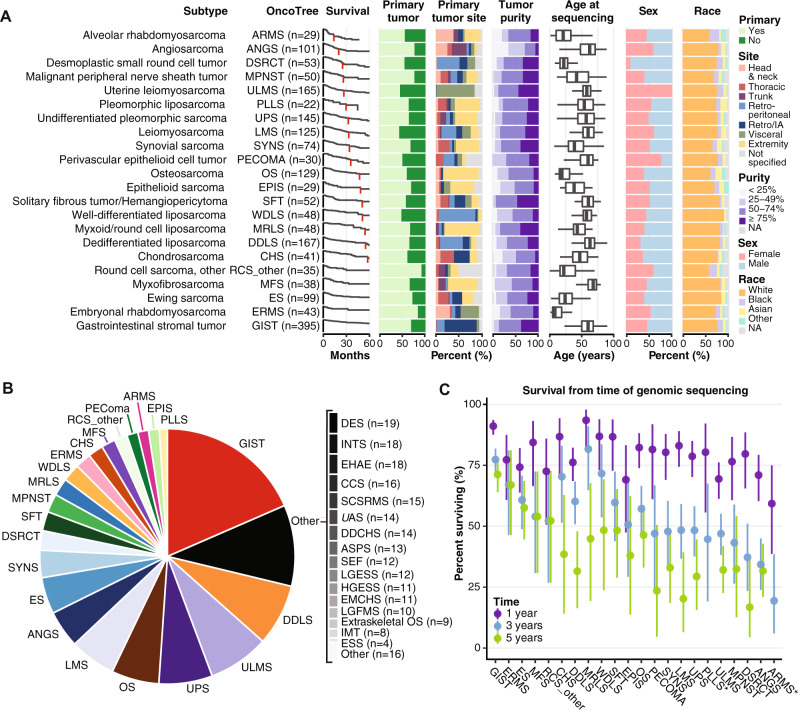
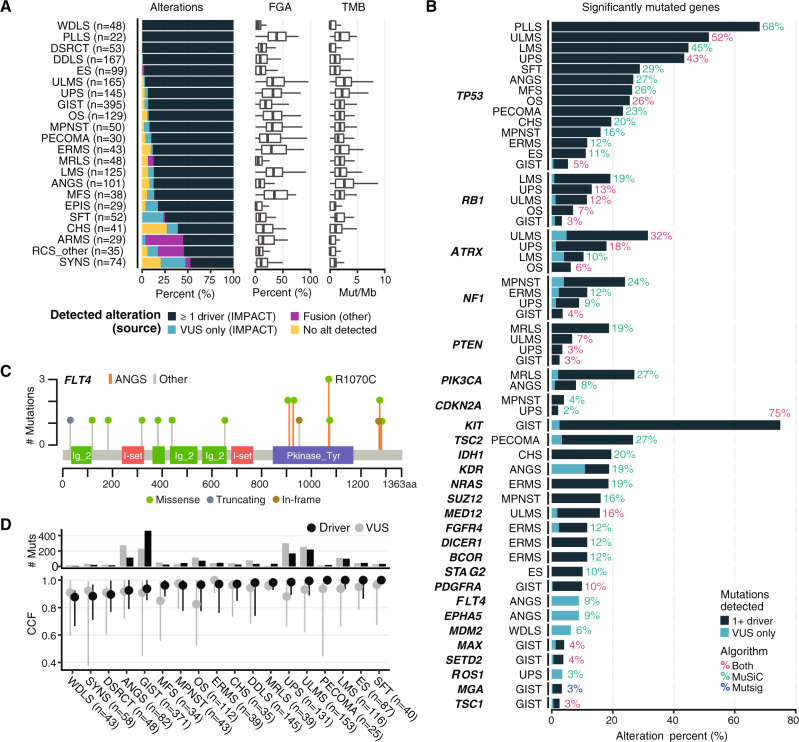
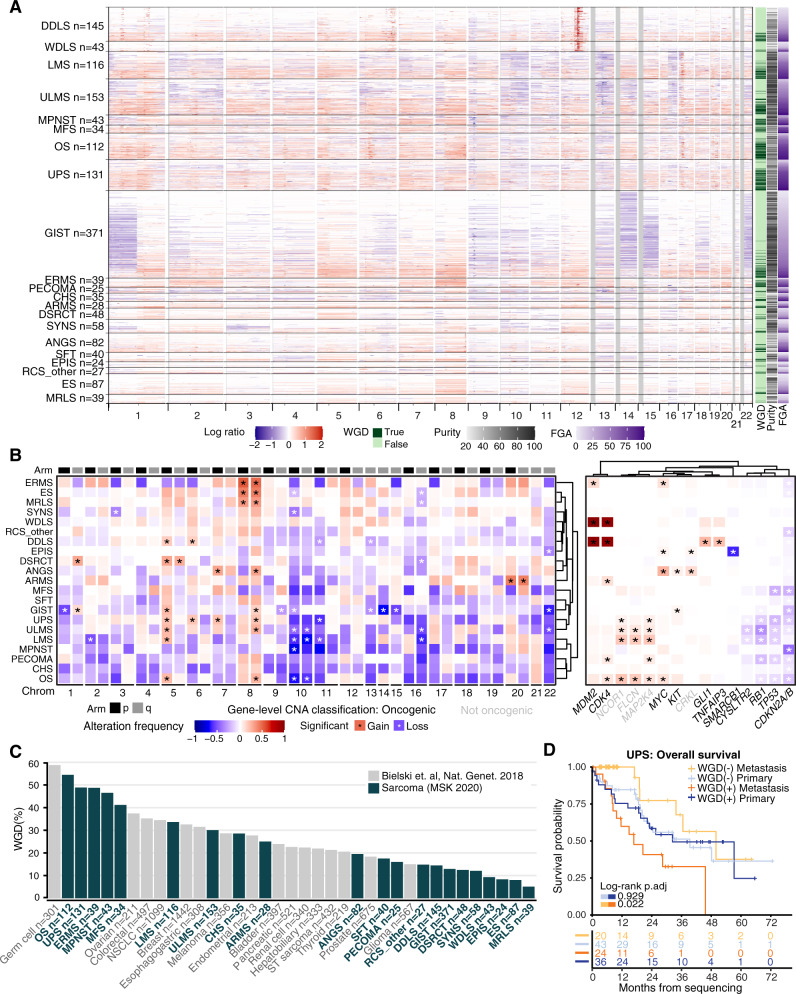
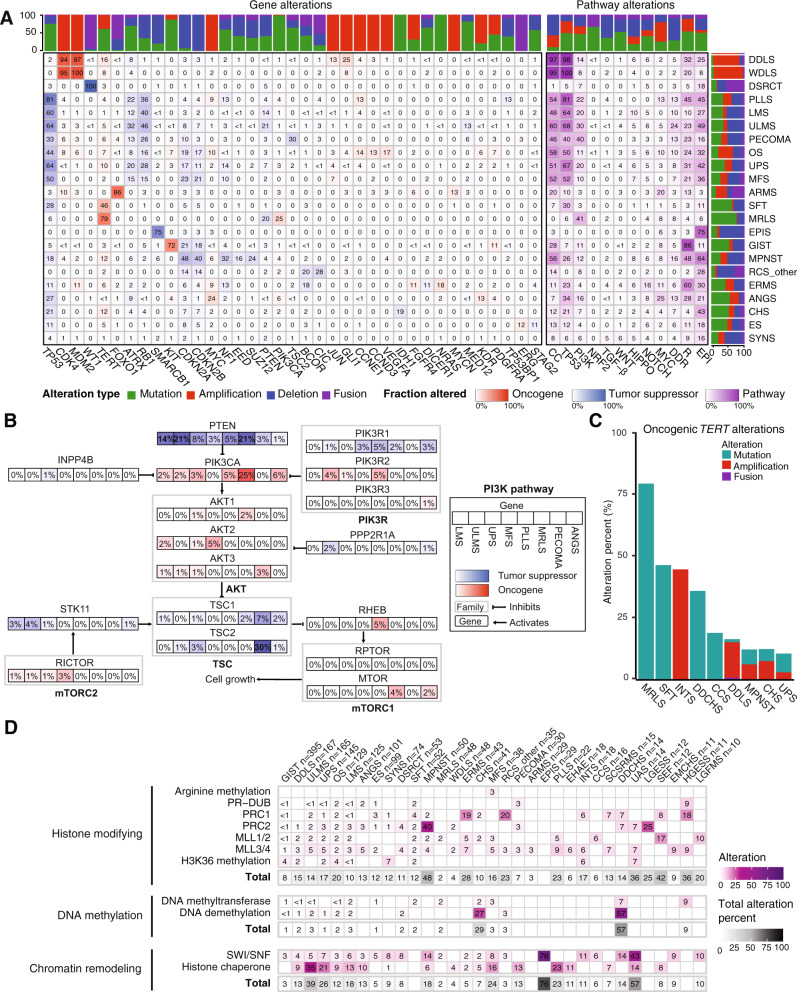
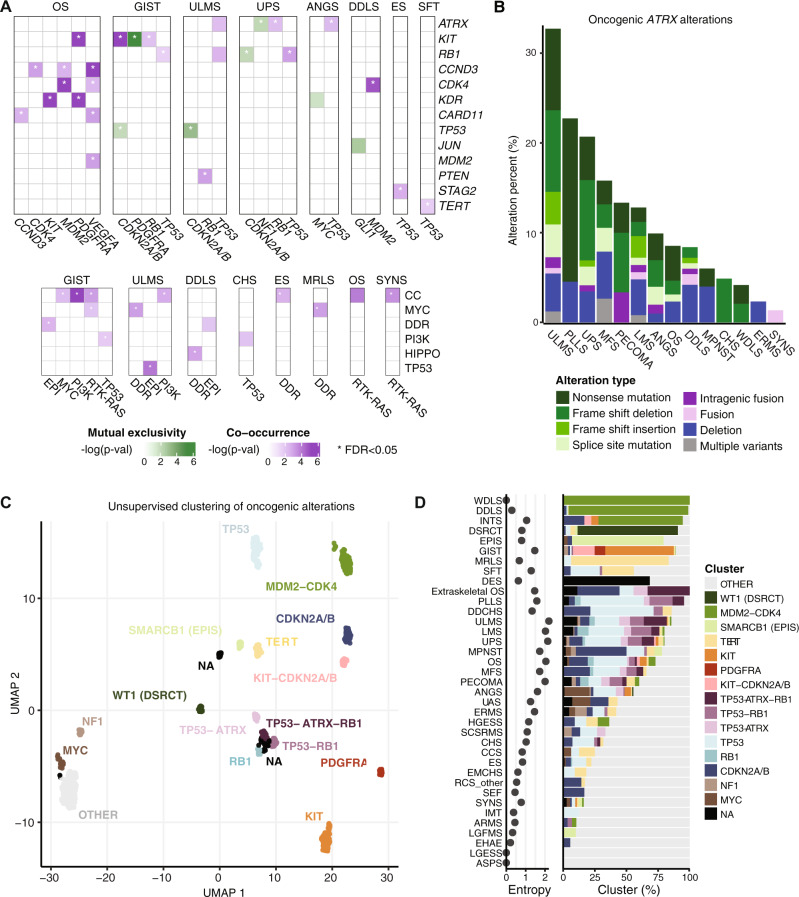
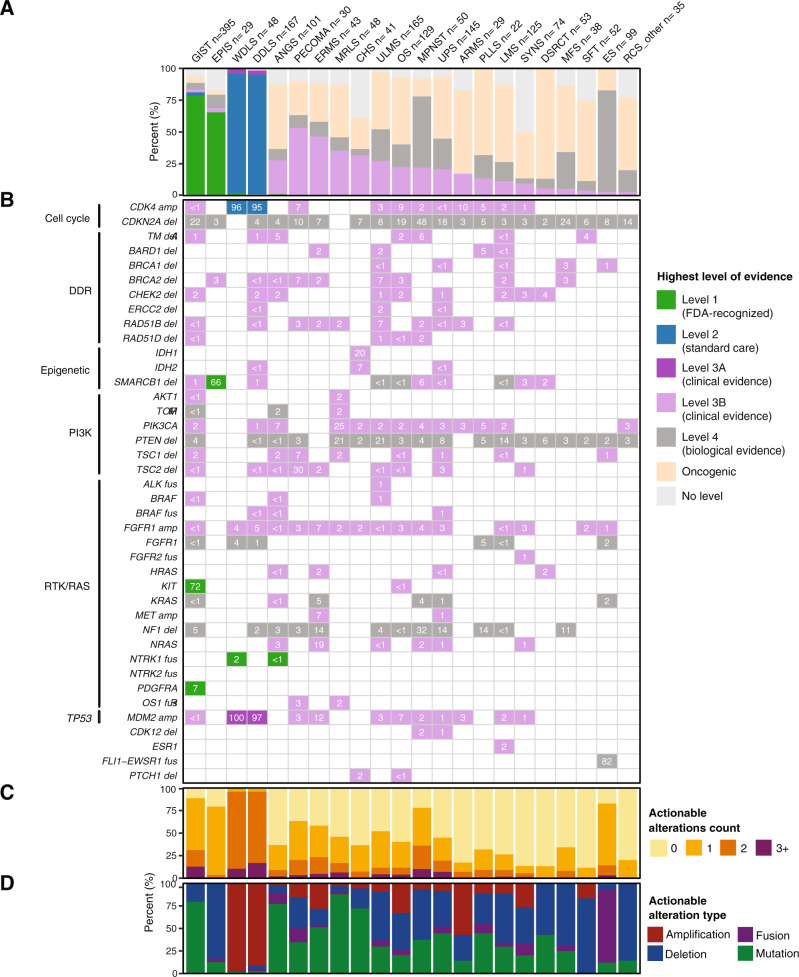
The genetic, biologic, and clinical heterogeneity of sarcomas poses a challenge for the identification of therapeutic targets, clinical research, and advancing patient care. Because there are > 100 sarcoma subtypes, in-depth genetic studies have focused on one or a few subtypes. Herein, we report a comparative genetic analysis of 2,138 sarcomas representing 45 pathological entities. This cohort is prospectively analyzed using targeted sequencing to characterize subtype-specific somatic alterations in targetable pathways, rates of whole genome doubling, mutational signatures, and subtype-agnostic genomic clusters. The most common alterations are in cell cycle control and TP53 , receptor tyrosine kinases/PI3K/RAS, and epigenetic regulators. Subtype-specific associations include TERT amplification in intimal sarcoma and SWI/SNF alterations in uterine adenosarcoma. Tumor mutational burden, while low compared to other cancers, varies between and within subtypes. This resource will improve sarcoma models, motivate studies of subtype-specific alterations, and inform investigations of genetic factors and their correlations with treatment response.
Overview
The claims and statistics of this paper haven’t been checked yet.
Free: it reads the open-access text and checks the first 5 claims that cite a source we can check. Create a free account to check every claim.
Integrity signals
Registry
Cites
Statistics
Figures
Verification
Claims the paper makes
The claims and statistics of this paper haven’t been checked yet.
Free: it reads the open-access text and checks the first 5 claims that cite a source we can check. Create a free account to check every claim.
Claims other papers make about this one
Each is checked against this paper’s own text: does it say what the citing paper says it does?
The source backs part of the claim, not all of it — or backs it for a different population, condition or comparison.
In the citing paper
“Despite their genetic complexity, these sarcomas share genomic alterations causing PI3K/Akt/mTOR and MAPK pathway activation”
From Targeting eIF4A-dependent translation in genetically complex sarcoma (2026) · cites this paper as [8]
Experimental — accuracy not yet measuredThe cited source says what the claim attributes to it.
In the citing paper
“However, due to the high heterogeneity of somatic mutations in osteosarcoma,14,15 the use of a tumor-agnostic MRD panel would compromise sensitivity, leading to reduced sequencing depth and overlooking unique somatic variants.”
From Tumor-informed deep sequencing of ctDNA detects minimal residual disease and predicts relapse in osteosarcoma (2024) · cites this paper as [14]
Self-check
Percentages, sums and reported differences re-computed from the paper’s own numbers.
The self-check needs the paper’s full text.
Citations
Cites
PD-1 and PD-L1 Immune Checkpoint Blockade to Treat Breast Cancer
Hartkopf, A. D., Taran, F.-A., Wallwiener, M., Walter, C. B., Krämer, B., Grischke, E.-M., & Brucker, S. Y. (2016) · Breast Care · doi:10.1159/000453569 · Cited by 30,845
Cerami, E., Gao, J., Dogrusoz, U., Gross, B. E., Sumer, S. O., Aksoy, B. A., Jacobsen, A., Byrne, C. J., Heuer, M. L., Larsson, E., et al. (2012) · Cancer Discovery · doi:10.1158/2159-8290.cd-12-0095 · Cited by 17,455
Self-citationSiegel, R. L., Miller, K. D., & Jemal, A. (2018) · CA: A Cancer Journal for Clinicians · doi:10.3322/caac.21442 · Cited by 16,579
Bioconductor: open software development for computational biology and bioinformatics
Gentleman, R. C., Carey, V. J., Bates, D. M., Bolstad, B., Dettling, M., Dudoit, S., Ellis, B., Gautier, L., Ge, Y., Gentry, J., et al. (2004) · Genome Biology · doi:10.1186/gb-2004-5-10-r80 · Cited by 12,172
Mutational landscape determines sensitivity to PD-1 blockade in non–small cell lung cancer
Rizvi, N. A., Hellmann, M. D., Snyder, A., Kvistborg, P., Makarov, V., Havel, J. J., Lee, W., Yuan, J., Wong, P., Ho, T. S., et al. (2015) · Science · doi:10.1126/science.aaa1348 · Cited by 7,802
Mismatch repair deficiency predicts response of solid tumors to PD-1 blockade
Le, D. T., Durham, J. N., Smith, K. N., Wang, H., Bartlett, B. R., Aulakh, L. K., Lu, S., Kemberling, H., Wilt, C., Luber, B. S., et al. (2017) · Science · doi:10.1126/science.aan6733 · Cited by 6,645
Mutational heterogeneity in cancer and the search for new cancer-associated genes
Lawrence, M. S., Stojanov, P., Polak, P., Kryukov, G. V., Cibulskis, K., Sivachenko, A., Carter, S. L., Stewart, C., Mermel, C. H., Roberts, S. A., et al. (2013) · Nature · doi:10.1038/nature12213 · Cited by 5,461
Tumor mutational load predicts survival after immunotherapy across multiple cancer types
Samstein, R. M., Lee, C.-H., Shoushtari, A. N., Hellmann, M. D., Shen, R., Janjigian, Y. Y., Barron, D. A., Zehir, A., Jordan, E. J., Omuro, A., et al. (2019) · Nature Genetics · doi:10.1038/s41588-018-0312-8 · Cited by 4,071 · cited 1×
“Indeed, recent work suggests that the highest quintile of TMB within a specific cancer 405 type is associated with improved outcomes following checkpoint inhibitor therapy and, following 406 from that observation, that the TMB threshold for benefit is not absolute (49).”
BackgroundSelf-citationThe repertoire of mutational signatures in human cancer
Alexandrov, L. B., Kim, J., Haradhvala, N. J., Huang, M. N., Tian Ng, A. W., Wu, Y., Boot, A., Covington, K. R., Gordenin, D. A., Bergstrom, E. N., et al. (2020) · Nature · doi:10.1038/s41586-020-1943-3 · Cited by 3,496 · cited 1×
“480 Mutational signatures for samples with ≥ 15 synonymous and nonsynonymous single nucleotide 481 variants (SNVs) were extracted using the COSMIC v3 catalog of exome reference signatures 482 and default parameters (59) (https://github.”
MethodSelf-citationZehir, A., Benayed, R., Shah, R. H., Syed, A., Middha, S., Kim, H. R., Srinivasan, P., Gao, J., Chakravarty, D., Devlin, S. M., et al. (2017) · Nature Medicine · doi:10.1038/nm.4333 · Cited by 3,380 · cited 3×
“160 Because a pan-cancer MSK-IMPACT analysis identified TERT promoter mutations in a subset 161 of sarcomas (18), we investigated their frequency as a function of sarcoma subtype (Fig.”
BackgroundMethodSelf-citation
Cited by
Items 101–200 of 236
Gupta, K., Grimison, P., Fernandez, K., Choi, V., & Bhadri, V. A. (2025) · JCO Precision Oncology · doi:10.1200/po-25-00228 · Cited by 4
Schmidt, M. J., Benzler, K., Lauer, U. M., Zender, L., Hinterleitner, C., & Hinterleitner, M. (2022) · Journal of Clinical Medicine · doi:10.3390/jcm11195798 · Cited by 4
“Cl nical characteristics in STS patients with IIN.”
BackgroundLi, W., Liu, L., Liang, Z., Lai, H., Wu, J., Zhang, H., & Fang, C. (2024) · Medicine · doi:10.1097/md.0000000000037423 · Cited by 4
Decoding the Epigenome: Comparative Analysis of Uterine Leiomyosarcoma and Leiomyoma
Pfaff, M., Costa, P. A., Tang, H., Sailo, B., Sharma, A. R., & Ahuja, N. (2025) · Cancers · doi:10.3390/cancers17162610 · Cited by 6
“…HDAC3’s deacetylase activity is dependent on activated NCOR1, targeting the PI3K/Akt/mTOR pathway represents a promising therapeutic strategy that could simultaneously disrupt multiple epigenetic oncogenic processes in ULMS by interfering with NCOR1 function and downstream HDAC3 activity [135,136].”
Advances in Soft Tissue and Bone Sarcoma
Rutland, C. S. (2024) · Cancers · doi:10.3390/cancers16162875 · Cited by 4
Jeyaraman, N., Jeyaraman, M., Ramasubramanian, S., Ramasubramanian, S., Balaji, S., Muthu, S., Rajendran, R. L., & Gangadaran, P. (2025) · Pathology - Research and Practice · doi:10.1016/j.prp.2025.155908 · Cited by 4
Clinicopathologic and proteomic characteristics of low-grade undifferentiated spindle cell sarcoma
Wei, Y., Li, H., He, S., Li, M., Chen, Y., Shi, H., & Han, A. (2025) · Frontiers in Molecular Biosciences · doi:10.3389/fmolb.2025.1591644 · Cited by 3
Self-citationJarroudi, O. A., Bairi, K. E., Brahmi, S. A., & Afqir, S. (2025) · Frontiers in Oncology · doi:10.3389/fonc.2025.1418537 · Cited by 3
Wang, B., Chen, R., Yin, H., Chang, Z., Liu, Y., Zhong, D., & Li, F. (2025) · Frontiers in Immunology · doi:10.3389/fimmu.2025.1668537 · Cited by 3
Pearce, H., Chang, Y.-C., Metalonis, S. W., Rose, B. E., Jonczak, E., Subhawong, T. K., D’Amato, G. Z., Grossman, J. G., Castillo, P., Huang, M. S., et al. (2025) · Cancers · doi:10.3390/cancers17213544 · Cited by 5
Díaz‐Martín, J., Ranft, A., Blanquer-Maceiras, M., Noguera, R., Salguero‐Aranda, C., Delgado‐Bellido, D., Romero‐Pérez, L., Dirksen, U., & de Álava, E. (2025) · Experimental and Molecular Pathology · doi:10.1016/j.yexmp.2025.105008 · Cited by 5
Demanelis, K., Leix, J., Burgess, M. A., & Nacev, B. A. (2026) · ESMO rare cancers. · doi:10.1016/j.esmorc.2026.100129 · Cited by 3
“Patient-level, tumor-level, RNA-seq, and 450K methylation data were accessed via the Genomics Data Portal 27 using TCGAbiolinks 12,28–30 and TCGAretriever.”
InfluentialSelf-citationJin, H., Huang, C. P., Dong, Y., Xiong, Q., Wang, D., He, Z., Shang, Y., Shen, L., Ma, C., Wang, Z., et al. (2026) · Frontiers in Oncology · doi:10.3389/fonc.2025.1665299 · Cited by 5
“Collectively, these SCNA-driven alterations establish a coordinated proliferation – anti-apoptosis axis that enables sustained tumour growth and survival under therapeutic stress (9).”
InfluentialBrown, J., Patel, R., Smith-Fry, K., Ward, M., Oliver, T. G., & Jones, K. B. (2024) · Neoplasia · doi:10.1016/j.neo.2023.100956 · Cited by 3
“Soft-tissue sarcoma subtypes are traditionally named for the differentiated tissue they resemble, as in liposarcoma (adipose tissue), leiomyosarcoma (smooth muscle), or rhabdomyosarcoma (skeletal muscle), for example [18].”
BackgroundWang, J., Wang, G., Hu, T., Wang, H., & Zhou, Y. (2024) · European journal of medical research · doi:10.1186/s40001-023-01624-3 · Cited by 4
“According to the latest WHO classification, there are more than 170 subtypes of SARC that vary in pathology, clinical presentation, molecular features and response to treatment [3, 4].”
MethodBielo, L. B., Repetto, M., Crimini, E., Belli, C., Setola, E., Parma, G., Fusco, N., Barberis, M. C. P., Guerini‐Rocco, E., Marra, A., et al. (2024) · The Oncologist · doi:10.1093/oncolo/oyae082 · Cited by 3
“10,15 Specifically, in uLMS BRCA2 alt represented 60% (9 of 15) of all HR-/DDR-genes defects.”
BackgroundTranslocation in bone and soft tissue sarcomas: a comprehensive epidemiological investigation
Kawaguchi, K., Endo, M., Shimada, E., Kohashi, K., Hirose, T., Nabeshima, A., Fujiwara, T., Kawai, A., Oda, Y., & Nakashima, Y. (2024) · ESMO Open · doi:10.1016/j.esmoop.2024.103726 · Cited by 3
“10 is presumed to be microsatellite instability-high (MSI-high), 11,22 and TMB (cid”
Isaacson, A. L., Berry, R. S., Ulici, V., Armstrong, S. M., Bena, J., John, I., Karunamurthy, A. D., Billings, S. D., Dermawan, J. K. T. K., Goldblum, J. R., et al. (2024) · Histopathology · doi:10.1111/his.15373 · Cited by 4
“7,21,22 Two cases in our series classified as eMFS with comprehensive molecular testing lacked high TMB; however, we acknowledge that larger-scale testing would be necessary to provide further evidence to support this hypothesis.”
Fighting sarcomas at the root: The role of mesenchymal stem cells in sarcomagenesis
Chantoiseau, M., Costa, M. E. M. D., Geoerger, B., Gaspar, N., & Marchais, A. (2025) · European Journal of Cancer · doi:10.1016/j.ejca.2025.115628 · Cited by 4
On the Relevance of Soft Tissue Sarcomas Metabolic Landscape Mapping
Esperança‐Martins, M., Duarte, I. F., Rodrigues, M., do Brito, J. S., Lopéz‐Presa, D., Costa, L., Fernandes, I., & Dias, S. (2022) · International Journal of Molecular Sciences · doi:10.3390/ijms231911430 · Cited by 3
“Sarcomas are mesenchymal malignancies of bone or soft tissues that can develop in different anatomic sites and distinct connective tissue types, showing a wide spectrum of clinical behaviors and biological activity patterns [1,2].”
BackgroundInfluentialEmerging predictive biomarkers in the management of bone and soft tissue sarcomas
Haddox, C. L., & Riedel, R. F. (2023) · Expert Review of Anticancer Therapy · doi:10.1080/14737140.2023.2200169 · Cited by 5
“HRR involves a complex cascade of molecular events wherein ATM and ATR kinases activate several key effector proteins, DNA end resection is performed by nucleases, and interactions between BRCA1, BRCA2, and PALB2 result in loading of the DNA recombinase RAD51 to sites of DNA damage.”
BackgroundInfluentialDistinct genomic features between osteosarcomas firstly metastasing to bone and to lung
Xie, L., Cai, Z., Lu, H., Meng, F., Zhang, X., Luo, K., Su, X., Yan, L., Xu, J., Lou, J., et al. (2023) · Heliyon · doi:10.1016/j.heliyon.2023.e15527 · Cited by 3
“S2), which was in accordance with recent publications on genomic differences between pediatric and adult sarcomas by targeted panel sequencing of 7494 sarcomas representing 44 histologies [22,23].”
ResultMusa, J., Willis, F. M., Harnoss, J. M., Rompen, I. F., Sauerteig, C., Kochendoerfer, S. M., Grünewald, T. G. P., Al‐Saeedi, M., Schneider, M., & Harnoss, J.-C. (2023) · European Journal of Surgical Oncology · doi:10.1016/j.ejso.2023.05.023 · Cited by 4
Paniagua‐Herranz, L., Doger, B., Díaz‐Tejeiro, C., Sanvicente, A., Nieto‐Jiménez, C., Moreno, V., Pérez‐Segura, P., Győrffy, B., Calvo, E., & Ocaña, A. (2023) · Cancers · doi:10.3390/cancers15123250 · Cited by 3
“some indications, authors used additional sources including for: PRAD (MSK, [24]), CHOL (ICGC, [25]), PAAD (QCMG, [26]), SARC (MSK, [27]) and LUAD (MSK, [28]).”
MethodSensitivity to ALK-Directed Therapy in Osteosarcoma With an Acquired ALK Rearrangement
Ordulu, Z., Giunta, P., Hung, W., Hung, Y. P., Simon, J., Fintelmann, F. J., Lennerz, J. K., Naxerova, K., & Cote, G. M. (2023) · JCO Precision Oncology · doi:10.1200/po.23.00287 · Cited by 3
Pan, M., Zhou, M. Y., Jiang, C., Zhang, Z., Bui, N. Q., Bien, J. Y., Siy, A., Achacoso, N. S., Solorzano, A. V., Tse, P., et al. (2024) · BJC Reports · doi:10.1038/s44276-023-00029-3 · Cited by 4
“Several dozen genomic alterations have been identi fi ed in advanced STSs including fusions, deletions, missense pathogenic variants, and others [2, 3].”
BackgroundLiu, J., Moura, D. S., Jones, R. L., Aggarwal, A., Ebert, P. J., Wagner, A. J., Wright, J. A., Martín‐Broto, J., & Tap, W. D. (2024) · Clinical Cancer Research · doi:10.1158/1078-0432.ccr-23-3936 · Cited by 4
Self-citationKaseb, H. O., Tan, C., Townsend, J. P., Costa, J. C., & Laskin, W. B. (2024) · Genetic Testing and Molecular Biomarkers · doi:10.1089/gtmb.2024.0080 · Cited by 3
“In keeping with previous studies with emphasis on OS (Kovac et al., 2015; Nacev et al., 2022), we identi fi ed LOH in BRCA-related genes in six tumors with corresponding normal tissue.”
Suehara, Y., Kitada, R., Kamio, S., Ogura, K., Iwata, S., Kobayashi, E., Kawai, A., & Khosaka, S. (2024) · Journal of Orthopaedic Science · doi:10.1016/j.jos.2024.10.016 · Cited by 3
Statz-Geary, K., Elliott, A., Bialick, S., Serrano, C., von Mehren, M., Oberley, M. J., Freire, A. P. E., Coelho, P. B., Costa, P. A., D’Amato, G. Z., et al. (2025) · Cancers · doi:10.3390/cancers17121962 · Cited by 4
“[7–10].”
InfluentialLaranga, R., Pazzaglia, L., Pedrini, E., Sambri, A., Ferrari, C., Locatelli, M., Sangiorgi, L., Righi, A., Scotlandi, K., & Bianchi, G. (2024) · Laboratory Investigation · doi:10.1016/j.labinv.2024.102088 · Cited by 2
Nacev, B. A., Bradić, M., Woo, H. J., Richards, A. L., Kelly, C. M., Dickson, M. A., Gounder, M. M., Keohan, M. L., Chi, P., Movva, S., et al. (2025) · Journal for ImmunoTherapy of Cancer · doi:10.1136/jitc-2025-012357 · Cited by 4
“18 Alternative biomarkers such as tertiary lymphoid structures (TLSs) and B cell and CD8+ T cell infiltrates correlate with ICI response in some soft tissue sarcomas such as UPS.”
Self-citationMethylation Profiles in Bone and Soft Tissue Tumors: Do They Help Classify the Unclassifiable?
Dermawan, J. K. T. K. (2025) · Modern Pathology · doi:10.1016/j.modpat.2025.100910 · Cited by 5
Wang, D., Sun, D., Tu, J., Cui, X., Qu, L., Chen, L., Zhang, Z., Jiang, Z., Li, R., Xuan, Z., et al. (2025) · Precision Clinical Medicine · doi:10.1093/pcmedi/pbaf027 · Cited by 2
“Although the genomic and epige-nomic profiles of pan-STS have been discussed in several large-scale studies, these findings have yet to be translated into routine clinical management [ 10–13 ].”
Li, X., Lin, Z., Liu, Q., Yuan, Y., Luo, H., Zheng, H., & Luo, W. (2025) · International Journal of Biological Macromolecules · doi:10.1016/j.ijbiomac.2025.149130 · Cited by 2
D’Ambrosio, L., Merlini, A., Brunello, A., Ferraresi, V., Paioli, A., Vincenzi, B., Pantaleo, M. A., Pas, T. M. D., Gurrieri, L., Sanfilippo, R. G., et al. (2025) · Annals of Oncology · doi:10.1016/j.annonc.2025.11.019 · Cited by 10
“28,31 Consis-tently, the uLMS population derived the greatest benefit from trabectedin — olaparib with outcomes similar to a phase II single-arm study with temozolomide — olaparib combination in advanced uLMS.”
A systematic review and meta-analysis of pazopanib efficacy and adverse effects in sarcomas
Picozzi, F., Ottaiano, A., Marretta, A. L., Santorsola, M., Cannella, L., Pizzolorusso, A., Caraglia, F., Scarpati, G. D. V., Bracigliano, A., Clemente, O., et al. (2026) · Journal of Translational Medicine · doi:10.1186/s12967-026-07775-1 · Cited by 2
Epithelioid sarcoma: from SMARCB1 loss to therapeutic vulnerabilities
Sobczuk, P., Gomez-Palmero, C., & Serrano, C. (2026) · Current Opinion in Oncology · doi:10.1097/cco.0000000000001236 · Cited by 2
Gantzer, J., Lu, X., Weingertner, N., Fattori, A., Chenard, M., Plassard, D., Amri, A. E., Sauleau, E., Gangi, A., Kurtz, J., et al. (2026) · European Journal of Cancer · doi:10.1016/j.ejca.2026.116905 · Cited by 2
Molecular Heterogeneity in Leiomyosarcoma and Implications for Personalised Medicine
Arfan, S., Thway, K., Jones, R. L., & Huang, P. H. (2024) · Current Treatment Options in Oncology · doi:10.1007/s11864-024-01204-5 · Cited by 4
Schneider, D., Brown, E. D. L., Gluski, J. M., Mishra, A., Shah, H. A., Sciubba, D. M., & Lo, S.-F. L. (2025) · American Journal of Clinical Oncology · doi:10.1097/coc.0000000000001161 · Cited by 3
“3,4 7 Immunotherapy trials in sarcoma have shown some promise.”
Wen, R., Huang, R., Xu, K., & Yi, X. (2025) · International Journal of Biological Macromolecules · doi:10.1016/j.ijbiomac.2025.141807 · Cited by 2
Schneider, D., Gluski, J. M., Brown, E. D. L., Mishra, A., Sciubba, D. M., & Lo, S.-F. L. (2025) · American Journal of Clinical Oncology · doi:10.1097/coc.0000000000001207 · Cited by 2
Koyama, M., Yamaguchi, K. D., Chigusa, Y., Yamanoi, K., Taki, M., Sunada, M., Horie, A., Hamanishi, J., Minamiguchi, S., & Mandai, M. (2023) · International Cancer Conference Journal · doi:10.1007/s13691-022-00591-6 · Cited by 2
Wang, Y., Zhu, Q., Wu, Y., Li, B., Su, X., Xiang, C., & Han, Y. (2024) · The Journal of Pathology · doi:10.1002/path.6324 · Cited by 1
“However, the branch-speci fi c mutations were different from recurrently mutated genes in other exclusively sarcoma patients [37].”
Huang, Y., Gong, M., Tang, Q., Chen, H., Hu, J., Deng, C., Lin, J., Huang, A., Xu, Y., Feng, H., et al. (2024) · Frontiers in Immunology · doi:10.3389/fimmu.2024.1448464 · Cited by 1
Ferraro, D. A., Bisig, B., Rotzinger, D. C., Pareja, F. G., Missiaglia, E., Voutsadakis, I. A., Homicskó, K., & Digklia, A. (2025) · Frontiers in Oncology · doi:10.3389/fonc.2025.1485386 · Cited by 2
Leiomyosarcoma Therapeutic Approaches and Future Directions
Haddox, C. L., Papke, D. J., & Serrano, C. (2025) · Hematology/Oncology Clinics of North America · doi:10.1016/j.hoc.2025.04.007 · Cited by 3
Ramineni, M., Ulici, V., Hicks, D. G., Huber, A. R., Dieudonné, G., & Wang, X. (2025) · International Journal of Surgical Pathology · doi:10.1177/10668969251340430 · Cited by 1
Coward, V. S., Dorsey, J., Babichev, Y., Gökgöz, N., Seto, A., Griffin, A. M., Nash, J. O., Brar, S. S., Ferguson, P. C., Swallow, C. J., et al. (2025) · Clinical Cancer Research · doi:10.1158/1078-0432.ccr-25-0111 · Cited by 2
A prognostic model of platinum resistance in osteosarcoma: Key roles of BNIP3, MYC, and ACTA2
Che, W., Luo, X., Xu, X., & Qi, J. (2025) · Computers in Biology and Medicine · doi:10.1016/j.compbiomed.2025.111001 · Cited by 2
Schieffer, K. M., Bajaj, R., Koo, S. C., Lavoie, J., Lopez-Terrada, D. H., Lu, X., Luo, M., Phung, T. L., Smolarek, T. A., Sutcliffe, M. J., et al. (2025) · Cancer Genetics · doi:10.1016/j.cancergen.2025.10.106 · Cited by 1
Schmiester, M., Freytag, A., Gillissen, B. F., Sträng, E., Hablesreiter, R., Richter, A., Striefler, J. K., von Laffert, M., Hummel, M., Jarosch, A., et al. (2025) · International Journal of Hyperthermia · doi:10.1080/02656736.2025.2573753 · Cited by 1
“SCNAs are predominant genomic aberrations in StSs and were foreseeably frequent in our cohort (figure 2(A)) [5,6,17,18,20,30]. prior to Ct/rHt, only the one synovial sarcoma in our cohort did not harbor SCNAs changes.”
InfluentialDeep-Learning Tool ScVital Enables Species-Agnostic Integration of Cancer Cell States
Rub, J., Chan, J. E., Sussman, C., Guzman, G., Tap, W. D., Antonescu, C. R., Singer, S., Tammela, T., & Betel, D. (2025) · Cancer Research · doi:10.1158/0008-5472.can-24-4889 · Cited by 3
Self-citationGenomic Profile and Clinicopathologic Analyses of Wild-Type Gastrointestinal Stromal Tumors
Sun, L., Li, J., Liu, H., Chen, J., Wang, S., Deng, R., & Sun, Y. K. (2025) · Molecular Cancer Research · doi:10.1158/1541-7786.mcr-25-0524 · Cited by 1
Borella, F., Gallio, N., Ferraioli, D., Ray-Coquard, I. L., & Cosma, S. D. (2025) · International Journal of Gynecological Cancer · doi:10.1016/j.ijgc.2025.102815 · Cited by 1
“%) in adult sarcomas 16 (Fig.).”
Lee, E., Kim, J. H., Park, J. W., Kang, H. G., Park, S.-Y., Sun, J., Kim, S.-Y., Cho, A., Lee, B., & You, H. J. (2026) · Medicina · doi:10.3390/medicina62020271 · Cited by 1
Lee, E., Cho, A., Park, S. R., Kim, J. H., Kang, H. G., Park, J. W., Lim, J. H., Kwon, J., & You, H. J. (2026) · International Journal of Molecular Sciences · doi:10.3390/ijms27073309 · Cited by 2
Linder‐Stragliotto, C., Tsagkozis, P., Potdar, S., Brodin, C. A., & Brodin, B. A. (2026) · Clinical & Translational Oncology · doi:10.1007/s12094-026-04261-4 · Cited by 1
“The tumors are aneuploid and display a high rate of chromosomal aberrations [5–7], gene mutations most frequent in the TP53, RB1, and ATRX genes [8].”
ASB7 promotes osteosarcoma lung metastasis through ubiquitin-mediated degradation of ATF2
Zou, Y., Zhong, J., Huo, L., Chen, J., Yu, X., Wang, J., Chen, Z., Yin, L., Zeng, C., Zhang, X., et al. (2026) · Cell Discovery · doi:10.1038/s41421-026-00890-9 · Cited by 1
“Despite the signi fi cant clinical challenge of treating metastatic osteosarcoma, recent advances in high-throughput genomic sequencing have substantially advanced our understanding of its pathogenesis, offering opportunities to overcome current therapeutic limitations 3 – 7 .”
Molecular Pathology and Testing in Bone Tumors: An Update
Chadha, P., Pasricha, S., Pruthi, M., & Rohela, H. (2026) · Indian Journal of Medical and Paediatric Oncology · doi:10.1055/s-0046-1822838 · Cited by 1
Onesti, C. E., Casini, B., Chiara, A. D., Fausti, V., Luksch, R., Milano, G. M., Palmerini, E., Vari, S., Ceddia, S., Riva, F., et al. (2026) · Frontiers in Oncology · doi:10.3389/fonc.2026.1641281 · Cited by 1
“A low MSI and TMB were also con fi rmed by other reports on sarcomas (44, 45).”
Understanding and Overcoming Osteosarcoma Heterogeneity
Cho, S., Shelmidine, K., & Yustein, J. T. (2026) · Biomolecules · doi:10.3390/biom16060874 · Cited by 1
Immunotherapy in Soft Tissue Sarcomas—An Ongoing Quest
Cobeña, S., Esperança‐Martins, M., Queiroz, A. S., Melo-Alvim, C., & Costa, L. (2026) · Cells · doi:10.3390/cells15141297 · Cited by 1
“Overall, the limited mutational landscape of STS results in a reduced neoantigen repertoire, contributing to an “immune-cold” phenotype and contributes to the modest clinical efficacy of immunotherapy compared with highly immunogenic tumors such as melanoma or non-small cell lung cancer [16,18].”
Seligson, N. D., Asmann, Y. W., Almerey, T., Zayas, Y. C., Edgar, M. A., Attia, S., Knutson, K. L., & Bagaria, S. P. (2024) · Surgical Oncology · doi:10.1016/j.suronc.2024.102125 · Cited by 2
Genomics‐led approach to drug testing in models of undifferentiated pleomorphic sarcoma
Manasterski, P. J., Danks, M. R., Thomson, J. P., Muir, M., Lee, M. W., Dawson, J. C., Amaral, A. T., Díaz‐Martín, J., Moura, D. S., Martín‐Broto, J., et al. (2025) · Molecular Oncology · doi:10.1002/1878-0261.70059 · Cited by 1
“As with previous studies, our UPS tumour samples, cell lines and PDX models were dominated by complex genomic perturbations such as CN changes, rather than SNV events [10,14].”
InfluentialUpregulation of POLE and proficient DNA repair are features of CIC::DUX4 sarcomas
Seligson, N. D., Paragji, A., Shahalam, F., Yilma, B., & Chen, J. L. (2025) · npj Precision Oncology · doi:10.1038/s41698-025-00985-8 · Cited by 1
“39 , and Gounder, et al. 40 .”
A deep-learning tool for species-agnostic integration of cancer cell statesPreprint
Rub, J., Chan, J. E., Sussman, C., Tap, W. D., Singer, S., Tammela, T., & Betel, D. (2024) · bioRxiv (Cold Spring Harbor Laboratory) · doi:10.1101/2024.12.20.629285 · Cited by 1
Self-citationSS18-SSX co-opts P300 to sustain oncogenic transcription independent of SWI/SNF activityPreprint
Doherty, A. M., Lagan, E., Elliott, R. J. R., Wynne, K. J., Monger, C., Bracken, A. P., Shi, J., Vakoc, C. R., Armstrong, S. A., Oliviero, G., et al. (2026) · bioRxiv (Cold Spring Harbor Laboratory) · doi:10.64898/2026.01.26.701706 · Cited by 2
Targeting eIF4A-dependent translation in genetically complex sarcoma
Kim, Y.-M., Mohan, P., Sehrawat, U., Seffar, E., De Queiroz, R. M., Chadalavada, K., Persaud, N., Okada, T., Kulkarni, A., Lin, J., et al. (2026) · JCI Insight · doi:10.1172/jci.insight.192936
Self-citationEx vivo drug testing in an ultra-rare sarcoma reveals therapeutic vulnerability and resistancePreprint
Chan, S. P. Y., Luo, B., Chen, B. J., Villanueva, A., Sam, X. X., Farah, B. L., Shannon, N. B., Ong, C. J., Chia, C. S., Yong, M., et al. (2022) · medRxiv · doi:10.1101/2022.08.03.22278327
Mae, H., Outani, H., Imura, Y., Chijimatsu, R., Inoue, A., Kotani, Y., Yasuda, N., Nakai, S., Nakai, T., Takenaka, S., et al. (2023) · doi:10.1158/2767-9764.c.6686778
Park, C., Kim, R., Choi, J., Kim, M., Kim, T., Han, I., Kim, J., & Kim, H. (2023) · Cancer Research and Treatment · doi:10.4143/crt.2023.864 · Cited by 1
“The pleomorphic liposarcoma sample showed TP53 mutation and loss-of-function RB1 mutation [21,22].”
Nacev, B. A., Bradić, M., Woo, H. J., Richards, A. L., Kelly, C. M., Dickson, M. A., Gounder, M. M., Keohan, M. L., Chi, P., Movva, S., et al. (2024) · medRxiv · doi:10.1101/2024.01.02.24300710
Self-citationLiu, X., Zhao, J., Di, X., Cao, G., Zhang, H., & Wang, J. (2024) · Frontiers in Oncology · doi:10.3389/fonc.2024.1339955
Hereditary Factors in Carcinogenesis and the Key Cancer Syndromes
Rose, A. M., & Mitchell, A. F. (2024) · Springer eBooks · doi:10.1007/978-3-030-71113-9_25-1
Soft Tissue Sarcomas: Epidemiologic Trends at King Abdulaziz University Hospital in Jeddah
Refai, F. A. (2024) · Journal of Contemporary Medical Sciences · doi:10.22317/jcms.v10i4.1587
Novel MEN1-associated retroperitoneal pleomorphic liposarcoma
McNicoll, C. F., Belmonte, J., Nir, I., & Ferguson, B. D. (2024) · Rare Tumors · doi:10.1177/20363613241286934
Jin, X., Ji, R., Wu, Y.-L. L. C., Wang, J., & Chen, X. (2025) · Nigerian Journal of Clinical Practice · doi:10.4103/njcp.njcp_817_23
MS-stable/TMB-high pleomorphic liposarcoma successfully treated with pembrolizumab: a case report
Miwa, S., Kobayashi, H., Hirai, T., Okajima, K., Ishibashi, Y., Tsuda, Y., Zhang, L., Ando, T., Shinozaki‐Ushiku, A., & Tanaka, S. (2025) · Frontiers in Oncology · doi:10.3389/fonc.2025.1552411
Martinez, J. M., Munoz, M. M., & Gonzalez, C. A. (2025) · Cureus · doi:10.7759/cureus.87800
“These amplifications are shared with well-differentiated liposarcoma (WDL); however, DDL has a more aggressive behavior than WDL [10-11].”
Akdağ, Z., Bir, F., Kılıçarslan, E., Şatıroğlu-Tufan, N. L., & Dodurga, Y. (2025) · Research Square · doi:10.21203/rs.3.rs-7009634/v1
Transforming sarcoma treatment: The role of genomic profiling and immunotherapy
Mishra, B. K., & Kapoor, A. (2025) · Cancer Research Statistics and Treatment · doi:10.4103/crst.crst_44_25
Hereditary Factors in Carcinogenesis and the Key Cancer Syndromes
Rose, A. M., & Mitchell, A. F. (2025) · Springer eBooks · doi:10.1007/978-3-031-76882-8_25
Global Profiling of Remodeled Subcellular Structures Due to Drug Treatment and Disease
Victor, R. A., Altemus, J. J., Lay, M. A., Shepherd, S. N., Thompson, V. F., Zianti, M., Padilla‐Rodriguez, M., Lipinski, A. A., Mouneimne, G., Langlais, P. R., et al. (2026) · Molecular and Cellular Biology · doi:10.1080/10985549.2026.2705873
“10,11 A challenge to the discovery of novel subcellular structures, especially condensates, is that they comprise of weak interactions that dissociate under cell lysis conditions.”
Demanelis, K., Leix, J., Burgess, M. A., & Nacev, B. A. (2025) · medRxiv · doi:10.1101/2025.11.13.25340146
Self-citationTanaka, A., Ogawa, M., Otani, Y., Hendrickson, R. C., Li, Z., Agaram, N. P., Klimstra, D. S., Wang, J. Y., Wei, W., & Roehrl, M. H. A. (2025) · bioRxiv (Cold Spring Harbor Laboratory) · doi:10.1101/2025.11.19.689365
Self-citationGraham, D. S., Francis, A., Brainerd, M. J., Garbarine, I. C., Rademacher, N., Koch, K. L., Selfridge, J. M., Childers, C. P., Boyle, M. K., Sparkman, B. K., et al. (2025) · Surgical Oncology Insight · doi:10.1016/j.soi.2025.100203
Lee, J., Ye, M., Ybarra, M., Fei, J., Gao, Y., & Ma, C. (2025) · Lab on a Chip · doi:10.1039/d5lc00856e
Wang, J., Wang, G., Hu, T., Wang, H., & Zhou, Y. (2024) · Figshare · doi:10.6084/m9.figshare.26666443
Wang, J., Wang, G., Hu, T., Wang, H., & Zhou, Y. (2024) · Figshare · doi:10.6084/m9.figshare.26666440
Wang, J., Wang, G., Hu, T., Wang, H., & Zhou, Y. (2024) · Figshare · doi:10.6084/m9.figshare.26666437
Parra, A., Palmerini, E., Laginestra, M. A., Ferrari, C., Cocchi, S., Simonetti, E., Pellegrini, E., Feo, A. D., Magagnoli, G., Frega, G., et al. (2025) · Cancers · doi:10.3390/cancers18010139
Jamison, T. S. (2026) · Research Square · doi:10.21203/rs.3.rs-8554974/v1
Cancer genome profiling in sarcomas: current status and future perspectives in Japan
Shimoi, T., Kita, S., & Yonemori, K. (2026) · Expert Review of Anticancer Therapy · doi:10.1080/14737140.2026.2617407
“In addition, the intrinsic genomic complexity of many pleomorphic sarcomas yields numerous variants of uncertain significance, making it challenging to distinguish true driver mutations from background ‘noise’ [15].”
Bulanov, D. V., Makhachev, D. R., Abdullaev, M. A., Mikheeva, A. S., Soloveva, A. M., Ivanova, V. V., Khutornaya, M. V., Knyazyukova, K. P., Bolatova, L. A., Biktimerov, A. R., et al. (2026) · Bone and soft tissue sarcomas tumors of the skin · doi:10.17650/2219-4614-2025-17-4-29-36
Yaacov, A. (2026) · International Journal of Molecular Sciences · doi:10.3390/ijms27041764 · Cited by 2
“External validation sets: Sarcoma (MSK-SARC) [29]: 1464 tumors; hepatocellular cancer (MSK-HCC) [30]: 288 tumors.”
Martin-Broto, J., Martinez-Trufero, J., Beveridge, R. D., Gutierrez, A., Carrasco-García, I., López-Jiménez, C., Sebio, A., González‐Billalabeitia, E., Ramos, R., Romagosa, C., et al. (2026) · Clinical Cancer Research · doi:10.1158/1078-0432.ccr-26-0032
Hare, L., Hughes, J., Morgan, M., Burke, G. A. A., Trotman, J., Tarpey, P. S., Hatcher, H. M., Ford, S. J., Watkins, A. J., Hook, C. E., et al. (2026) · Pediatric Blood & Cancer · doi:10.1002/1545-5017.70193
Kang, M., Zhu, L., Niu, L., Zhang, L. Z., Wang, Y., & Jiang, J. (2026) · BMC Cancer · doi:10.1186/s12885-026-15922-6
“First, prospective multi-center studies with larger sample sizes are needed to verify the study, and improve pathological review and standardized IHC or NGS testing to reduce unspecified sarcoma rates and improve subtype accuracy [18].”
Metadata
- Authors
- Nacev, B. A., Sanchez-Vega, F., Smith, S. A., Antonescu, C. R., Rosenbaum, E., Shi, H., Tang, C., Socci, N. D., Rana, S., Gularte-Mérida, R., Zehir, A., Gounder, M. M., Bowler, T. G., Luthra, A., Jadeja, B., Okada, A., Strong, J. A., Stoller, J., Chan, J. E., Chi, P., D’Angelo, S. P., Dickson, M. A., Kelly, C. M., Keohan, M. L., Movva, S., Thornton, K., Meyers, P. A., Wexler, L. H., Slotkin, E. K., Glade Bender, J. L., Shukla, N. N., Hensley, M. L., Healey, J. H., La Quaglia, M. P., Alektiar, K. M., Crago, A. M., Yoon, S. S., Untch, B. R., Chiang, S., Agaram, N. P., Hameed, M. R., Berger, M. F., Solit, D. B., Schultz, N., Ladanyi, M., Singer, S., & Tap, W. D.
- Affiliations
- Memorial Sloan Kettering Cancer Center (US)
- Corresponding author
- Singer, Samuel
- Tap, William D.
- ORCID
- Nacev, Benjamin A.
- Sanchez-Vega, Francisco
- Smith, Shaleigh A.
- Antonescu, Cristina R.
- Shi, Hongyu
- Socci, Nicholas D.
- Rana, Satshil
- Gularte-Mérida, Rodrigo
- Zehir, Ahmet
- Gounder, Mrinal M.
- Luthra, Anisha
- Jadeja, Bhumika
- Chan, Jason E.
- Chi, Ping
- D’Angelo, Sandra P.
- Dickson, Mark A.
- Kelly, Ciara M.
- Keohan, Mary Louise
- Movva, Sujana
- Meyers, Paul A.
- Wexler, Leonard H.
- Slotkin, Emily K.
- Glade Bender, Julia L.
- Shukla, Neerav N.
- Hensley, Martee L.
- Healey, John H.
- Alektiar, Kaled M.
- Crago, Aimee M.
- Yoon, Sam S.
- Untch, Brian R.
- Chiang, Sarah
- Agaram, Narasimhan P.
- Hameed, Meera R.
- Berger, Michael F.
- Solit, David B.
- Schultz, Nikolaus
- Ladanyi, Marc
- Singer, Samuel
- Tap, William D.
- Venue
- Nature Communications
- Published
- 2022-06-15
- Volume
- 13
- Issue
- 1
- Pages
- 3405-3405
- ISSN
- 2041-1723 (ISSN-L)
- PMC
- PMC9200818
- OpenAlex
- W4282977145
- Semantic Scholar
- c33a8ac1986143d3e230f2a4fed6bcf6e494b74d
- Cited by
- 232
- References
- 68
- Citations by year
- 2026: 58 · 2025: 64 · 2024: 59 · 2023: 45 · 2022: 6
- FWCI
- 28.69
- Type
- journal article
- Language
- en
- Open access
- gold
- doi.org
- Licence
- cc-by
- creativecommons.org/licenses/by/4.0 (tdm)
- creativecommons.org/licenses/by/4.0 (vor)
- Locations
- Nature Communications (publishedVersion, cc-by)
- medRxiv (acceptedVersion, cc-by-nc-nd)
- PubMed Central (publishedVersion, cc-by)
- PubMed (publishedVersion)
- RePEc: Research Papers in Economics (submittedVersion)
- DOAJ (DOAJ: Directory of Open Access Journals) (submittedVersion, cc-by-sa)
- Funders
- U.S. Department of Health & Human Services | National Institutes of Health (P50 CA217694, P30 CA008748)
- Topics
- Health Sciences › Medicine › Oncology › Sarcoma Diagnosis and Treatment
- Life Sciences › Biochemistry, Genetics and Molecular Biology › Molecular Biology › Chromatin Remodeling and Cancer
- Life Sciences › Biochemistry, Genetics and Molecular Biology › Cancer Research › Cancer Genomics and Diagnostics
- Keywords
- soft tissue sarcoma, bone sarcoma, sarcoma subtypes, somatic alterations, therapeutic target, whole-genome duplication, mutational signatures, tumor mutational burden, TP53, receptor tyrosine kinase, epigenetic regulators, TERT amplification, intimal sarcoma, uterine adenosarcoma, genomic heterogeneity
- MeSH terms
- Bone Neoplasms, Humans, Sarcoma, Osteosarcoma, Soft Tissue Neoplasms, Genomics
About these checks
Registry, retraction, Cites and statistics results are computed, not judged, with one exception: a printed reference that no index lists is read once by a model before it counts as a citation error. Claims are extracted by a model and kept only when their quote appears verbatim in the text; each cited source is then checked, with a model’s help, for whether it says what the claim relies on. Those verdicts can be wrong — read the claim’s quote and the cited source before relying on one.
Statistics and arithmetic are recomputed, not judged.
Confidence bands are shown only for fields calibrated on our annotated test set. None is calibrated yet, so no band is shown.
What counts as a claim ›How we measure confidence ›How we check this ›
Are you an author, or do you see a problem with this page? Request a review
Data sources
Bibliographic data: Semantic Scholar, OpenAlex, Crossref.
Contains information from the Semantic Scholar Academic Graph Datasets, made available under the ODC Attribution License (ODC-BY 1.0).
Semantic Scholar’s data is described in: Kinney, R., et al. (2023). The Semantic Scholar Open Data Platform. arXiv:2301.10140.
