

Uncertainty-informed deep learning models enable high-confidence predictions for digital histopathology
Open accessThe DOI matches its Crossref record; 50 of the 50 references it cites were found in a registry or an index.
Abstract
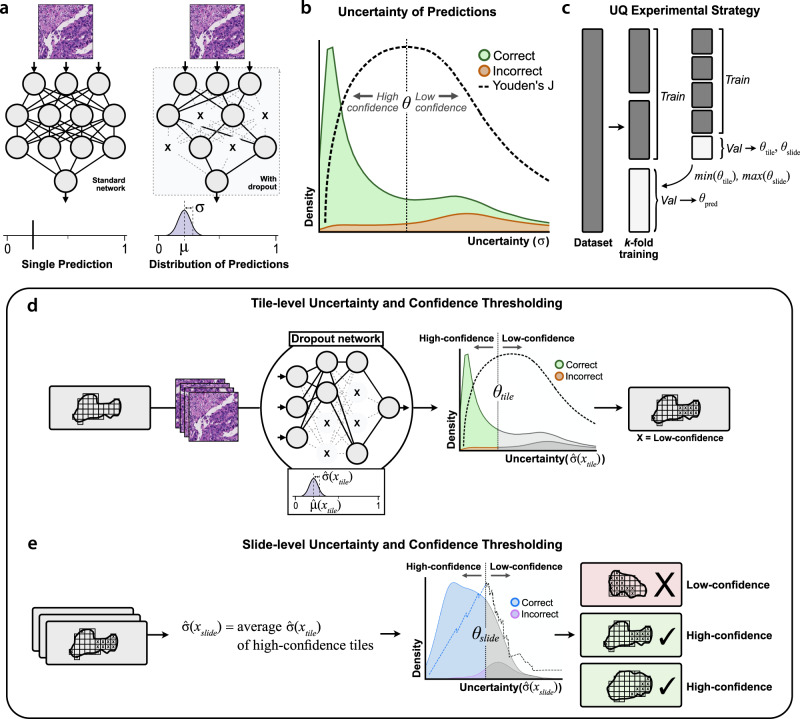
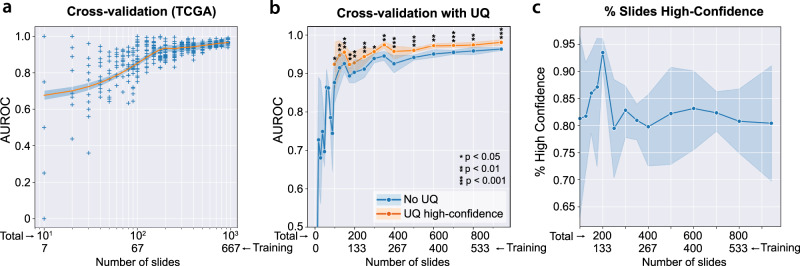
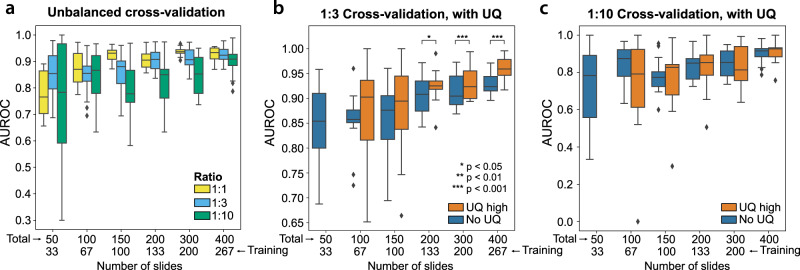
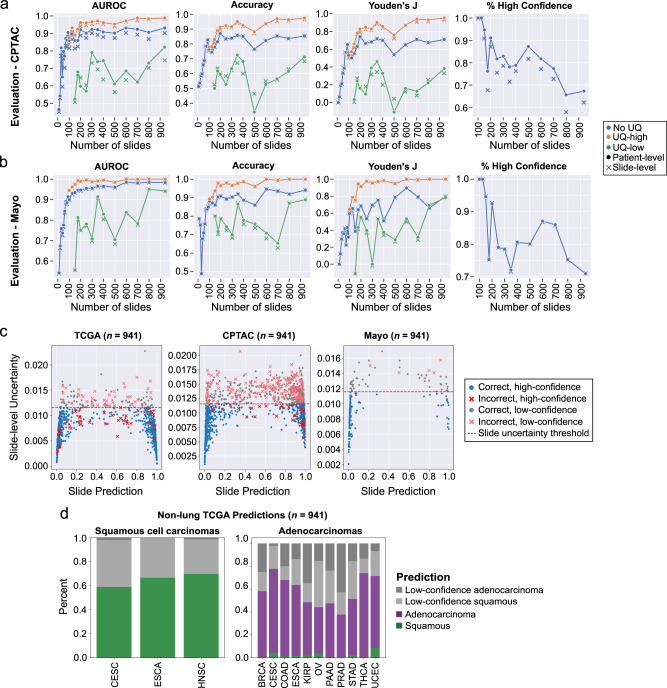
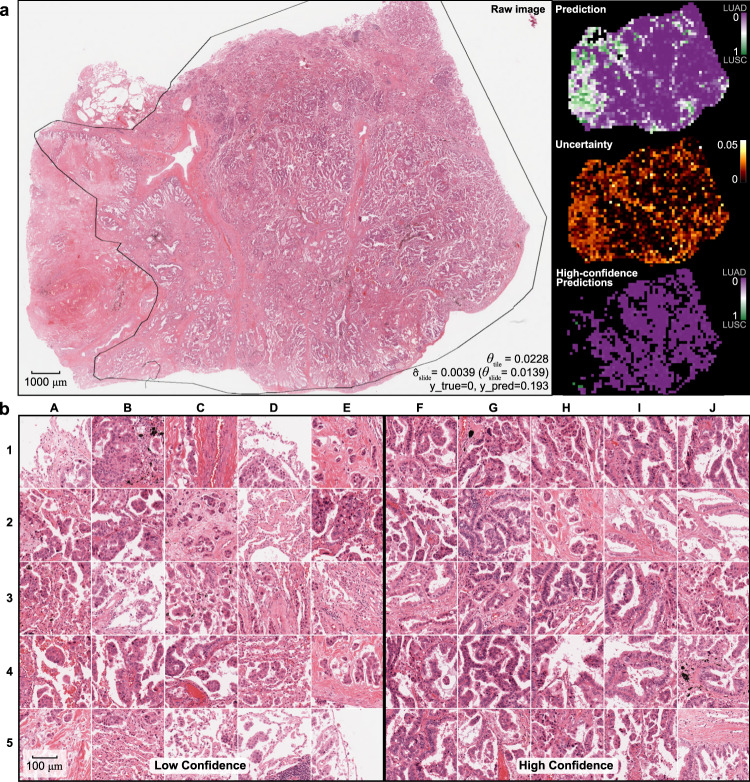
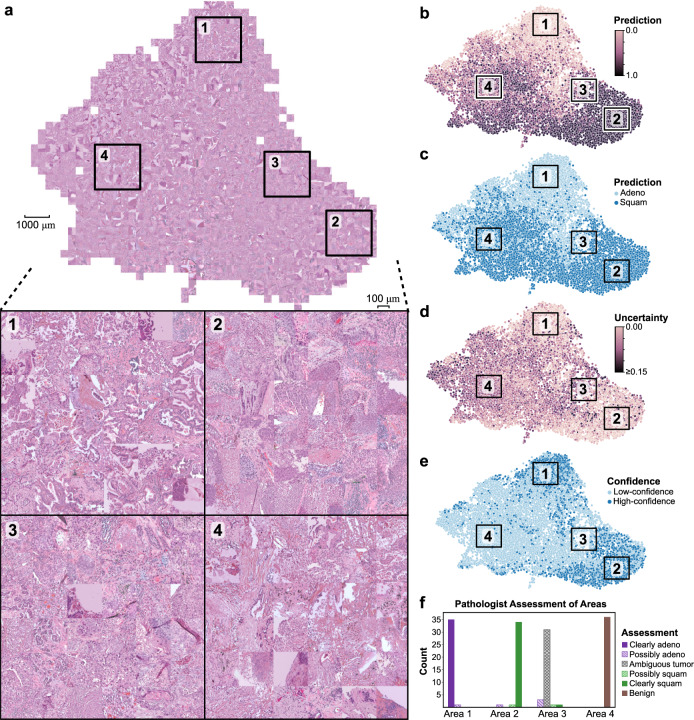
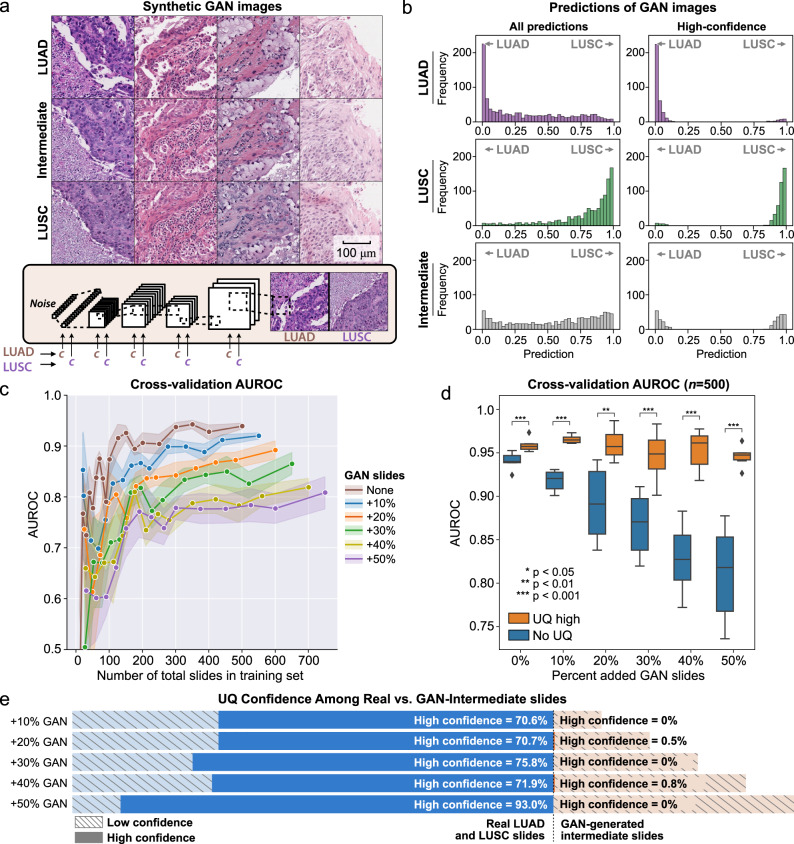
A model’s ability to express its own predictive uncertainty is an essential attribute for maintaining clinical user confidence as computational biomarkers are deployed into real-world medical settings. In the domain of cancer digital histopathology, we describe a clinically-oriented approach to uncertainty quantification for whole-slide images, estimating uncertainty using dropout and calculating thresholds on training data to establish cutoffs for low- and high-confidence predictions. We train models to identify lung adenocarcinoma vs. squamous cell carcinoma and show that high-confidence predictions outperform predictions without uncertainty, in both cross-validation and testing on two large external datasets spanning multiple institutions. Our testing strategy closely approximates real-world application, with predictions generated on unsupervised, unannotated slides using predetermined thresholds. Furthermore, we show that uncertainty thresholding remains reliable in the setting of domain shift, with accurate high-confidence predictions of adenocarcinoma vs. squamous cell carcinoma for out-of-distribution, non-lung cancer cohorts.
Overview
The claims and statistics of this paper haven’t been checked yet.
Free: it reads the open-access text and checks the first 5 claims that cite a source we can check. Create a free account to check every claim.
Integrity signals
Registry
Cites
Statistics
Figures
Verification
Claims the paper makes
The claims and statistics of this paper haven’t been checked yet.
Free: it reads the open-access text and checks the first 5 claims that cite a source we can check. Create a free account to check every claim.
Claims other papers make about this one
Each is checked against this paper’s own text: does it say what the citing paper says it does?
The source backs part of the claim, not all of it — or backs it for a different population, condition or comparison.
In the citing paper
“Current methods rely on attention-based multiple instance learning (MIL) and transformers, saliency-inference techniques for small lesions, and uncertainty-aware heatmaps that flag areas requiring human verification [33,34].”
From Artificial Intelligence in Dermatopathology: An Update and Review of the Current Literature (2026) · cites this paper as [34]
Experimental — accuracy not yet measuredThe cited source says what the claim attributes to it.
In the citing paper
“Confidence and uncertainty estimation are also recognized as critical components of AI systems, allowing algorithms to detect cases that may require expert review [34,74].”
From Artificial Intelligence in Dermatopathology: An Update and Review of the Current Literature (2026) · cites this paper as [34]
In the citing paper
“While anonymization provides reasonable protection, advanced reidentification techniques have emerged, highlighting the need for a more robust data management system based on data decentralization and federated learning.103”
From Artificial intelligence and endo-histo-omics: new dimensions of precision endoscopy and histology in inflammatory bowel disease (2024) · cites this paper as [103]
Self-check
Percentages, sums and reported differences re-computed from the paper’s own numbers.
The self-check needs the paper’s full text.
Citations
Cites
A Threshold Selection Method from Gray-Level Histograms
Otsu, N. (1979) · IEEE Transactions on Systems, Man, and Cybernetics · doi:10.1109/tsmc.1979.4310076 · Cited by 43,398
UMAP: Uniform Manifold Approximation and Projection
McInnes, L., Healy, J., Saul, N., & Großberger, L. (2018) · Journal of Open Source Software · doi:10.21105/joss.00861 · Cited by 9,826
The cancer genome atlas pan-cancer analysis project
The Cancer Genome Atlas Research Network, Weinstein, J. N., Collisson, E. A., Mills, G. B., Shaw, K. R. M., Ozenberger, B. A., Ellrott, K., Shmulevich, I., Sander, C., & Stuart, J. M. (2013) · Nature Genetics · doi:10.1038/ng.2764 · Cited by 9,092
Analyzing and Improving the Image Quality of StyleGAN
Karras, T., Laine, S., Aittala, M., Hellsten, J., Lehtinen, J., & Aila, T. (2020) · 2020 IEEE/CVF Conference on Computer Vision and Pattern Recognition (CVPR) · doi:10.1109/cvpr42600.2020.00813 · Cited by 6,332
Analyzing and Improving the Image Quality of StyleGAN
Karras, T., Laine, S., Aittala, M., Hellsten, J., Lehtinen, J., & Aila, T. (2019) · arXiv · doi:10.48550/arxiv.1912.04958 · Cited by 6,332
Reinhard, E., Adhikhmin, M., Gooch, B., & Shirley, P. (2001) · IEEE Computer Graphics and Applications · doi:10.1109/38.946629 · Cited by 2,937
Coudray, N., Ocampo, P. S., Sakellaropoulos, T., Narula, N., Snuderl, M., Fenyö, D., Moreira, A. L., Razavian, N., & Tsirigos, A. (2018) · Nature Medicine · doi:10.1038/s41591-018-0177-5 · Cited by 2,930 · cited 1×
“Despite the ambiguity that may exist in some cases, however, Coudray et al demonstrated feasibility of deep learning for classification of this outcome from standard H&E slides 7 .”
BackgroundData-efficient and weakly supervised computational pathology on whole-slide images
Lu, M. Y., Williamson, D. F. K., Chen, T. Y., Chen, R. J., Barbieri, M., & Mahmood, F. (2021) · Nature Biomedical Engineering · doi:10.1038/s41551-020-00682-w · Cited by 2,282
Deep learning in histopathology: the path to the clinic
van der Laak, J., Litjens, G., & Ciompi, F. (2021) · Nature Medicine · doi:10.1038/s41591-021-01343-4 · Cited by 902 · cited 1×
“Over the past several years, there has been a growing awareness of the need for better estimates of confidence and uncertainty within medical applications of AI 24-26 .”
BackgroundLuo, Y., Zheng, L., Guan, T., Yu, J., & Yang, Y. (2019) · 2019 IEEE/CVF Conference on Computer Vision and Pattern Recognition (CVPR) · doi:10.1109/cvpr.2019.00261 · Cited by 798 · cited 1×
“However, consistent with previous observations in the broader ML literature 39, 22, 23, 40 , uncertainty estimates were susceptible to domain shift when applied to external datasets 35, 36 , raising concerns about generalizability.”
Result
Research works printed but not linked: 7
- Ghosal, S., Xie, A. & Shah, P. Uncertainty quantified deep learning for predicting dice coefficient of digital histopathology image segmentation. Preprint at https://arxiv.org/abs/2109.00115 (2021). · arXiv
- Gal, Y. & Ghahramani, Z. Dropout as a Bayesian approximation: Representing model uncertainty in deep learning. Proc. 33rd Int. Conf. Mach. Learn. 48, 1050-1059 (2016).
- Sida, W. & Christopher, M. Fast dropout training. Proc. 30th Int. Conf. Mach. Learn. 28, 118-126 (2013).
- Lakshminarayanan, B., Pritzel, A. & Blundell, C. Simple and scalable predictive uncertainty estimation using deep ensembles. Adv. Neural Inf. Process. Syst. 30, 6405-6416 (2017).
- Bickel, S., Brückner, M. & Scheffer, T. Discriminative learning under covariate shift. J. Mach. Learn. Res. 10, 2137-2155 (2009).
- Tripuraneni, N., Adlam, B. & Pennington, J. Overparameterization improves robustness to covariate shift in high dimensions. Adv. Neural Inf. Process. Syst. 34, 13883-13897 (2021).
- Linmans, J., Laak, J. V. D. & Litjens, G. Efficient out-of-distribution detection in digital pathology using multi-head convolutional neural networks. Proc. Third Conf. Med. Imaging Deep Learn. 121, 465-478 (2020).
Cited by
Artificial intelligence for digital and computational pathology
Song, A. H., Jaume, G., Williamson, D. F. K., Lu, M. Y., Vaidya, A., Miller, T. R., & Mahmood, F. (2023) · Nature Reviews Bioengineering · doi:10.1038/s44222-023-00096-8 · Cited by 356
“Only through the concerted effort of multi-institutional data collection initiatives, open-source software packages and continued technical inspiration from advancements in computer vision and AI research can the said goals be reached.”
BackgroundLambert, B., Forbes, F., Doyle, S., Dehaene, H., & Dojat, M. (2024) · Artificial Intelligence in Medicine · doi:10.1016/j.artmed.2024.102830 · Cited by 269
Deep semi-supervised learning for medical image segmentation: A review
Han, K., Sheng, V. S., Song, Y., Liu, Y., Qiu, C., Ma, S., & Liu, Z. (2024) · Expert Systems with Applications · doi:10.1016/j.eswa.2023.123052 · Cited by 247
Seoni, S., Jahmunah, V., Salvi, M., Barua, P. D., Molinari, F., & Acharya, U. R. (2023) · Computers in Biology and Medicine · doi:10.1016/j.compbiomed.2023.107441 · Cited by 239
A review of uncertainty estimation and its application in medical imaging
Zou, K., Chen, Z., Yuan, X., Shen, X., Wang, M., & Fu, H. (2023) · Meta-Radiology · doi:10.1016/j.metrad.2023.100003 · Cited by 158
Huang, L., Ruan, S., Xing, Y., & Feng, M. (2024) · Medical Image Analysis · doi:10.1016/j.media.2024.103223 · Cited by 121
Uncertainty-inspired open set learning for retinal anomaly identification
Wang, M., Lin, T., Wang, L., Lin, A., Zou, K., Xu, X., Zhou, Y., Peng, Y., Meng, Q., Qian, Y., et al. (2023) · Nature Communications · doi:10.1038/s41467-023-42444-7 · Cited by 109
Davri, A. S., Birbas, E., Kanavos, T., Ntritsos, G., Γιαννακέας, Ν., Tzallas, A. T., & Batistatou, A. K. (2023) · Cancers · doi:10.3390/cancers15153981 · Cited by 111
“The majority of these mainly include ADC and SCC WSIs, mostly from the TCGA dataset, whereas the classification task is performed by a CNN or a combination of the state-of-the-art CNN architectures with varying approaches and techniques [37,47,51–56, 58, 59 ].”
MethodFatigue monitoring using wearables and AI: Trends, challenges, and future opportunities
Kakhi, K., Jagatheesaperumal, S. K., Khosravi, A., Alizadehsani, R., & Acharya, U. R. (2025) · Computers in Biology and Medicine · doi:10.1016/j.compbiomed.2025.110461 · Cited by 118
Iacucci, M., Santacroce, G., Zammarchi, I., Maeda, Y., Del Amor, R., Meseguer, P., Kolawole, B. B., Chaudhari, U., Di Sabatino, A., Danese, S., et al. (2024) · The Lancet Gastroenterology & Hepatology · doi:10.1016/s2468-1253(24)00053-0 · Cited by 73
Learning generalizable AI models for multi-center histopathology image classification
Asadi-Aghbolaghi, M., Darbandsari, A., Zhang, A. W., Contreras‐Sanz, A., Boschman, J., Ahmadvand, P., Köbel, M., Farnell, D., Huntsman, D. D., Churg, A., et al. (2024) · npj Precision Oncology · doi:10.1038/s41698-024-00652-4 · Cited by 90
Slideflow: deep learning for digital histopathology with real-time whole-slide visualization
Dolezal, J. M., Kochanny, S. E., Dyer, E., Ramesh, S., Srisuwananukorn, A., Sacco, M., Howard, F. M., Li, A., Mohan, P., & Pearson, A. T. (2024) · BMC Bioinformatics · doi:10.1186/s12859-024-05758-x · Cited by 99
“…have been utilized for many diverse research objectives, including gene expression prediction [6], prognostication [76], uncertainty quantification [31], identification of bias and batch effects [40], drug response prediction [77], and generation of synthetic histology for model explainability…”
BackgroundMethodInfluentialSelf-citationUncertainty-Aware Deep Learning: A Promising Tool for Trustworthy Fault Diagnosis
Ren, J., Wen, J., Zhao, Z., Yan, R., Chen, X., & Nandi, A. K. (2024) · IEEE/CAA Journal of Automatica Sinica · doi:10.1109/jas.2024.124290 · Cited by 80
Unleashing the potential of AI for pathology: challenges and recommendations
Asif, A., Rajpoot, K., Graham, S., Snead, D. R. J., Minhas, F., & Rajpoot, N. (2023) · The Journal of Pathology · doi:10.1002/path.6168 · Cited by 75
Buchicchio, E., Angelis, A. D., Santoni, F., & Carbone, P. (2023) · Measurement · doi:10.1016/j.measurement.2023.113341 · Cited by 50
Hasan, F., Medley, P. B., Drake, J. B., & Chen, G. (2024) · Water · doi:10.3390/w16131904 · Cited by 61
General Place Recognition Survey: Toward Real-World Autonomy
Yin, P., Jiao, J., Zhao, S., Xu, L., Huang, G. P., Choset, H., Scherer, S., & Han, J. (2025) · IEEE Transactions on Robotics · doi:10.1109/tro.2025.3550771 · Cited by 73
“Intuitively, PR extends beyond mere image-based approaches, encompassing a variety of solutions.”
Matz, S., Beck, E. D., Atherton, O. E., White, M. J. D., Rauthmann, J. F., Mroczek, D. K., Kim, M.-H., & Bogg, T. (2023) · Perspectives on Psychological Science · doi:10.1177/17456916231191774 · Cited by 54
“Finally, although accuracies are typically estimated and reported at the level of predictive models, there are novel techniques that allow estimating uncertainty (or confidence) at the level of the individual (Dolezal et al., 2022).”
Tuan, T. A., Zeevi, T., Haider, S. P., Karam, G. A., Berson, E. R., Tharmaseelan, H., Qureshi, A. I., Sanelli, P. C., Werring, D. J., Malhotra, A., et al. (2024) · npj Digital Medicine · doi:10.1038/s41746-024-01007-w · Cited by 37
Smart plant disease diagnosis using multiple deep learning and web application integration
Kheir, A. M. S., Koubâa, A., Kolluru, V., Mungara, S., & Feike, T. (2025) · Journal of Agriculture and Food Research · doi:10.1016/j.jafr.2025.101948 · Cited by 36
Ji, Z., Ge, Y., Chukwudi, C. C., Kaicheng, U., Zhang, S. M., Peng, Y., Zhu, J., Zaki, H. A., Zhang, X., Yang, S., et al. (2025) · IEEE Journal of Biomedical and Health Informatics · doi:10.1109/jbhi.2025.3548048 · Cited by 35
“Dolezal et al. [73] show that ,aidingexpertsinconfidentdecision-makingand trustincomputer-aideddiagnostics.”
A primer on the use of machine learning to distil knowledge from data in biological psychiatry
Quinn, T. P., Hess, J., Marshe, V. S., Barnett, M. M., Hauschild, A.-C., Maciukiewicz, M., Elsheikh, S. S. M., Men, X., Schwarz, E., Trakadis, Y. J., et al. (2024) · Molecular Psychiatry · doi:10.1038/s41380-023-02334-2 · Cited by 43
Kludt, C., Wang, Y., Ahmad, W., Bychkov, A., Fukuoka, J., Gaisa, N. T., Kühnel, M., Jonigk, D. D., Pryalukhin, A., Mairinger, F. D., et al. (2024) · Cell Reports Medicine · doi:10.1016/j.xcrm.2024.101697 · Cited by 54
Application of artificial intelligence and digital tools in cancer pathology
Shaktah, L., Carrero, Z. I., Hewitt, K. J., Gustav, M., Cecchini, M. J., Foersch, S., Berezowska, S., & Kather, J. N. (2025) · The Lancet Digital Health · doi:10.1016/j.landig.2025.100933 · Cited by 52
Integrating artificial intelligence with smartphone-based imaging for cancer detection in vivo
Song, B., & Liang, R. (2024) · Biosensors and Bioelectronics · doi:10.1016/j.bios.2024.116982 · Cited by 29
A framework for evaluating clinical artificial intelligence systems without ground-truth annotations
Kiyasseh, D., Cohen, A., Jiang, C., & Altieri, N. (2024) · Nature Communications · doi:10.1038/s41467-024-46000-9 · Cited by 26
“However, data in the wild often (a) follow a distribution which is different from that of the held-out data and (b) lack ground-truth labels for the task at hand (Fig.”
Choi, D. H., Lim, M. H., Kim, K. H., Shin, S. D., Hong, K. J., & Kim, S. (2023) · Scientific Reports · doi:10.1038/s41598-023-40708-2 · Cited by 27
“Because the AI-BPM is based on BNN, the uncertainty of each of the predictions can be estimated 9,38 .”
MethodDeng, T., Huang, Y., Han, G., Shi, Z., Lin, J., Dou, Q., Liu, Z., Guo, X., Chen, C. L. P., & Han, C. (2024) · IEEE Transactions on Cybernetics · doi:10.1109/tcyb.2024.3403927 · Cited by 27
“[26] cropped WSIs into tiles for training the uncertainty quantization model and solved the problem of domain shift in external validation data.”
Sahlsten, J., Jaskari, J., Wahid, K. A., Ahmed, S., Glerean, E., He, R., Kann, B. H., Mäkitie, A. A., Fuller, C. D., Naser, M. A., et al. (2024) · Communications Medicine · doi:10.1038/s43856-024-00528-5 · Cited by 35
Shi, J., Li, C., Gong, T., & Fu, H. (2024) · Medical Image Analysis · doi:10.1016/j.media.2024.103294 · Cited by 22
Uncertainty-aware ensemble of foundation models differentiates glioblastoma from its mimics
Zhao, J., Lin, S.-Y., Attias, R., Mathews, L., Engel, C., Larghero, G., Vremenko, D., Kao, T., Lee, T.-H., Wang, Y.-H., et al. (2025) · Nature Communications · doi:10.1038/s41467-025-64249-6 · Cited by 27
Artificial Intelligence Applications in Oral Cancer and Oral Dysplasia
Viet, C. T., Zhang, M., Dharmaraj, N., Li, G. Y., Pearson, A. T., Mañón, V. A., Grandhi, A., Xu, K., Aouizerat, B. E., & Young, S. W. (2024) · Tissue Engineering Part A · doi:10.1089/ten.tea.2024.0096 · Cited by 23
Self-citationChoudhury, D., Dolezal, J. M., Dyer, E., Kochanny, S. E., Ramesh, S., Howard, F. M., Margalus, J. R., Schroeder, A. R., Schulte, J. J., Garassino, M. C., et al. (2024) · EBioMedicine · doi:10.1016/j.ebiom.2024.105276 · Cited by 23
“27,28 Computational resources DL models often require central processing units (CPUs) and graphical processing units (GPUs) with suf fi cient computational power to generate predictions.”
BackgroundSelf-citationShi, S., Fu, L., Yi, J., Yang, Z., Zhang, X., Deng, Y., Wang, W., Wu, C., Zhao, W., Hou, T., et al. (2024) · Nucleic Acids Research · doi:10.1093/nar/gkae424 · Cited by 20
“In this study, we applied the maximized Youden’s index as the threshold for categorizing uncertainty estimation results ( 48 ): prediction uncertainties exceeding the threshold are labeled as ‘Low-confidence,’ whereas prediction uncertainties below this threshold are categorized as…”
MethodESCOX: A tool for skill and occupation extraction using LLMs from unstructured text
Kavargyris, D. C., Georgiou, K., Papaioannou, E., Petrakis, K., Mittas, N., & Angelis, L. (2025) · Software Impacts · doi:10.1016/j.simpa.2025.100772 · Cited by 27
Measurement Methodology: Visualizing Uncertainty in Machine Learning-Assisted Measurements
Shirmohammadi, S. (2023) · IEEE Instrumentation & Measurement Magazine · doi:10.1109/mim.2023.10238361 · Cited by 16
“Let us now calculate the uncertainty with three methods: cardinality ratio and information entropy, as explained in [22], and deviation of predictions, as explained in [11] and [25].”
BackgroundMethodInfluentialFan, F., Wu, G., Yang, Y., Liu, F., Qian, Y., Yu, Q., Ren, H., & Geng, J. (2023) · Environmental Science & Technology · doi:10.1021/acs.est.3c04571 · Cited by 17
Region Uncertainty Estimation for Medical Image Segmentation With Noisy Labels
Han, K., Wang, S., Chen, J., Qian, C., Lyu, C., Ma, S., Qiu, C., Sheng, V. S., Huang, Q., & Liu, Z. (2025) · IEEE Transactions on Medical Imaging · doi:10.1109/tmi.2025.3589058 · Cited by 28
“The Monte Carlo methods use random sampling for multiple predictions without major changes to the neural network, avoiding extra computations, and are widely applied in medical image analysis for uncertainty estimation [30], [31].”
Wolk, R., & Lingen, M. W. (2023) · Head and Neck Pathology · doi:10.1007/s12105-023-01544-y · Cited by 16
Deep neural network uncertainty estimation for early oral cancer diagnosis
Lin, H., Chen, H., & Lin, J. (2024) · Journal of Oral Pathology and Medicine · doi:10.1111/jop.13536 · Cited by 15
Hagos, M. T., Curran, K. M., Namee, B. M., & Initiative, A. D. N. (2025) · Scientific Reports · doi:10.1038/s41598-025-86110-y · Cited by 18
“By avoiding uncertain outputs of a model, we can reduce the number of incorrect predictions 24 .”
Hu, H., Wang, B., Zhang, D., Yan, K., Tan, T., & Wu, D. (2025) · Journal of Materials Chemistry C · doi:10.1039/d5tc00865d · Cited by 14
Yu, H., Chen, T., Zhang, X., Yang, Y., Liu, Q., Yang, C., Shen, K., Li, H., Tang, W., Zhong, X., et al. (2025) · Journal of Medical Internet Research · doi:10.2196/77334 · Cited by 22
“When the model’s predicted confidence falls below a predefined threshold, the corresponding result may be withheld [51,52].”
Shirmohammadi, S., Wang, F., & Hsu, C.-H. (2025) · IEEE Open Journal of Instrumentation and Measurement · doi:10.1109/ojim.2025.3621742 · Cited by 17
C³DA: A Universal Domain Adaptation Method for Scene Classification From Remote Sensing Imagery
Guo, J., Lai, Y. F., Zhang, J., Zheng, J., Fu, H., Gan, L., Hu, L. Q., Xu, G., & Che, X. (2024) · IEEE Geoscience and Remote Sensing Letters · doi:10.1109/lgrs.2024.3383061 · Cited by 17
“This also suggests that high-confidence yet low-certainty samples will diminish the model’s ability to effectively recognize “unknown” classes [15].”
BackgroundHuang, D., Zuo, R., Wang, J., & Tolosana‐Delgado, R. (2025) · Applied Geochemistry · doi:10.1016/j.apgeochem.2025.106385 · Cited by 11
Chang, J., & Hatfield, B. S. (2024) · Advances in cancer research · doi:10.1016/bs.acr.2024.05.006 · Cited by 15
Peeters, D., Alves, N., Venkadesh, K. V., Dinnessen, R., Saghir, Z., Scholten, E. T., Schaefer‐Prokop, C. M., Vliegenthart, R., Prokop, M., & Jacobs, C. (2024) · European Radiology · doi:10.1007/s00330-024-10714-7 · Cited by 13
“These findings align with prior research that ensemble-based DL algorithms provide noteworthy uncertainty assessments by quantifying the prediction variability through approaches such as entropy [11, 14, 21, 22].”
Hu, Y., Sirinukunwattana, K., Li, B., Gaitskell, K. L., Domingo, E., Bonnaffé, W., Wojciechowska, M., Wood, R., Alham, N. K., Malacrino, S., et al. (2025) · Medical Image Analysis · doi:10.1016/j.media.2024.103437 · Cited by 16
Xie, A., Elfatimi, E., Ghosal, S., & Shah, P. P. (2024) · International Conference on Machine Learning and Applications · doi:10.1109/icmla61862.2024.00178 · Cited by 17
“In medical applications, MCD has been used for classifying lung adenocarcinoma vs. squamous cell carcinoma without segmentation or Dice score evaluations of ROIs [14].”
Kasukurthi, A., & Davuluri, R. L. (2024) · Multimedia Tools and Applications · doi:10.1007/s11042-024-19360-z · Cited by 10
Shirmohammadi, S., Amiri, M. H., & Osman, H. A. (2024) · IEEE Instrumentation & Measurement Magazine · doi:10.1109/mim.2024.10700740 · Cited by 8
“Used for example in [15], this method quantifies the uncertainty as the variance of the distribution of the predicted probabilities of the predicted class; i.e.,: where T is the number of observations, pc is the predicted class, p pct is the predictive probability of the predicted class in…”
MethodA multimodal uncertainty-aware AI system optimizes ovarian cancer risk assessment workflow
Wang, X., Lv, X., Wang, J., Zou, L., Chen, Z., Zhao, R., Zhao, L., Zhao, M., Zhang, X., Zhang, B., et al. (2025) · npj Digital Medicine · doi:10.1038/s41746-025-01986-4 · Cited by 11
Diagnosis with confidence: deep learning for reliable classification of laryngeal dysplasia
Lubrano, M., Bellahsen‐Harrar, Y., Berlemont, S., Atallah, S., Vaz, E., Walter, T., & Badoual, C. (2023) · Histopathology · doi:10.1111/his.15067 · Cited by 12
“30,31 Tempering the AI model’s predictions with a measure of its confidence could help pathologists to better blend them into their routine grading, thereby fostering model acceptance.”
BackgroundBorra, S., Dey, N., Fong, S., Sherratt, R. S., & Shi, F. (2026) · Cancers · doi:10.3390/cancers18091361 · Cited by 9
Memristive Monte Carlo DropConnect crossbar array enabled by device and algorithm co-design
Kim, D. H., Cheong, W. H., Song, H., Jeon, J. B., Kim, G., & Kim, K. M. (2024) · Materials Horizons · doi:10.1039/d3mh02049e · Cited by 7
Cycle-Consistency-Based Uncertainty Quantification of Neural Networks in Inverse Imaging Problems
Huang, L., Li, J., Ding, X., Zhang, Y., Chen, H., & Özcan, A. (2023) · Intelligent Computing · doi:10.34133/icomputing.0071 · Cited by 9
“Bayesian uncertainty quantification has been applied in inverse imaging problems 19,20,25 , especially in the field of biomedical imaging 26–30 .”
Pintawong, S., Shuangshoti, S., Jitpasutham, T., Shuangshoti, S., Wiwatwarayos, K., Kobchaisawat, T., & Chalidabhongse, T. H. (2025) · IEEE Access · doi:10.1109/access.2025.3552934 · Cited by 7
“For example, Monte Carlo dropout was applied to estimate the uncertainty and confidence by randomly dropping out neural nodes, which generated a distribution of predictions for each input sample [22], [23].”
Chen, B., Zhang, Y., Wang, L., Zhan, Z., Guan, X., Rong, Z., Cui, Y., Lin, E., Cao, S., Huang, Y., et al. (2025) · Science Advances · doi:10.1126/sciadv.adw1379 · Cited by 7
Tchokponhoue, G. A. D., & Idri, A. (2025) · Applied Soft Computing · doi:10.1016/j.asoc.2025.114249 · Cited by 9
Li, Z., Mao, Q., Wu, H., Chong, J. Y., & Zhang, P. (2025) · Journal of Power Sources · doi:10.1016/j.jpowsour.2025.239142 · Cited by 7
Sahlsten, J., Jaskari, J., Wahid, K. A., Ahmed, S., Glerean, E., He, R., Kann, B. H., Mäkitie, A. A., Fuller, C. D., Naser, M. A., et al. (2023) · medRxiv · doi:10.1101/2023.02.20.23286188 · Cited by 6
Deep learning meta architecture to detect spatially coherent coarse grain regions in ultrasonic data
Elischberger, F., & Jiang, X. (2025) · NDT & E International · doi:10.1016/j.ndteint.2025.103342 · Cited by 6
Liu, J., Liu, K., Deng, Y., Shi, S., Fu, X., Jiang, Y., Fang, J., Zhang, Q., Jiang, D., Liu, S., et al. (2025) · Journal of Chemical Information and Modeling · doi:10.1021/acs.jcim.5c01532 · Cited by 5
Srisuwananukorn, A., Loscocco, G. G., Dolezal, J. M., Kuykendall, A. T., Santi, R., Zhang, L., Singh, A., Guglielmelli, P., Vannucchi, A. M., Salama, M. E., et al. (2026) · Leukemia · doi:10.1038/s41375-026-02893-7 · Cited by 5
Self-citationTang, Z., Yang, L., Chen, Z., Li, L., Li, C., Chen, R., Zhang, X., & Zheng, Q. (2025) · IEEE Transactions on Medical Imaging · doi:10.1109/tmi.2025.3526848 · Cited by 7
“WSIs can be noisy due to the complexity of their preparation process, leading to morphological ambiguity and inadequate material for reliable diagnoses [33], [34].”
Majzoubi, N., Allègre, R., Wemmert, C., & Liverneaux, P. A. (2024) · Hand surgery & rehabilitation · doi:10.1016/j.hansur.2024.101742 · Cited by 5
“Relying on multiple deep neural models, instead of a single one, has proven to result in high-confidence predictions by providing reliable uncertainty estimation, e.g. through prediction variance [27, 28, 29].”
BackgroundJeffrey, J., RajKumar, A., Pandey, S., Bathala, L., & Yalavarthy, P. K. (2025) · Computerized Medical Imaging and Graphics · doi:10.1016/j.compmedimag.2025.102630 · Cited by 4
Few-shot meta-learning for pre-symptomatic detection of Covid-19 from limited health tracker data
Sarwar, A., Almadani, A., & Agu, E. (2024) · Smart Health · doi:10.1016/j.smhl.2024.100459 · Cited by 4
PALM: Personalized Active Learning for mmWave-Based Activity Recognition
Chiang, H.-C., Wu, Y., Li, G.-H., Shirmohammadi, S., & Hsu, C.-H. (2025) · IEEE Transactions on Instrumentation and Measurement · doi:10.1109/tim.2025.3547487 · Cited by 7
“These methods include least confidence (LC), margin sampling [9], [10], deviation of predictions [11], [12], and information entropy [14], [15].”
Improving Accuracy and Calibration via Differentiated Deep Mutual Learning
Liu, H., Cui, P., Wang, B., Chen, W., Zhang, Y., Zhu, J., & Hu, X. (2025) · IEEE Computer Society Conference on Computer Vision and Pattern Recognition/Proceedings - IEEE Computer Society Conference on Computer Vision and Pattern Recognition/Proceedings · doi:10.1109/cvpr52734.2025.02404 · Cited by 5
“In safety-critical areas such as medical diagnosis [4, 18], self-driving cars [20], and protein engineering [6], accurate uncertainty estimation (i.e., well-calibrated prediction) is crucial for reliable model deployment.”
Alavi, S. E., Sharma, L. A., Sharma, A. K., & Shahmabadi, H. E. (2025) · Clinical & Translational Oncology · doi:10.1007/s12094-025-04120-8 · Cited by 3
A Human-Centered AI Framework for Efficient Labelling of ECGs From Drug Safety Trials
Diaw, M. D., Papelier, S., Durand-Salmon, A., Felblinger, J., & Oster, J. (2023) · IEEE Transactions on Biomedical Engineering · doi:10.1109/tbme.2023.3348329 · Cited by 4
“Indeed, in DL, such an approach, usually referred to as a human-in-the-loop pipeline, typically consists in deferring to human experts when model uncertainty is too high and is being investigated in different clinical applications [39], [40].”
BackgroundUncertainty-Aware Pre-Trained Foundation Models for Patient Risk Prediction via Gaussian Process
Lu, J., Zhao, S., Ma, W., Shao, H., Hu, X., Xi, Y., & Yang, C. (2024) · International World Wide Web Conference (WWW) · doi:10.1145/3589335.3651456 · Cited by 5
Kucerenko, A., Buddenkotte, T., Apostolova, I. I., Klutmann, S., Ledig, C., & Buchert, R. (2024) · European Journal of Nuclear Medicine and Molecular Imaging · doi:10.1007/s00259-024-06988-0 · Cited by 3
Generalisation and reliability of deep learning for digital pathology in a clinical setting
Pocevičiūtė, M. (2023) · Linköping studies in science and technology. Dissertations · doi:10.3384/9789180753005 · Cited by 6
“For example, the most uncertain predictions may be marked for further evaluation by medical experts, enabling them to concentrate on difficult cases [72, 27].”
BackgroundScatterUQ: Interactive Uncertainty Visualizations for Multiclass Deep Learning Problems
Li, H. X., Jorgensen, S., Holodnak, J. T., & Wollaber, A. (2023) · Visualization · doi:10.1109/vis54172.2023.00058 · Cited by 3
“In particular, D EEP L ENS and our earlier work [11] use a slider to control the OOD threshold, which provides an interactive threshold that is of particular importance for uncalibrated OOD scores [4].”
BackgroundMethodInfluentialZhang, X., Wang, T., Yan, C., Najdawi, F., Zhou, K., Ma, Y., Cheung, Y., & Malin, B. (2024) · medRxiv · doi:10.1101/2024.12.27.24319715 · Cited by 3
“Following the design in [14], all models were trained at the tile level, with slide-level classifications obtained by averaging tile-level outputs across each WSI.”
InfluentialFogalli, G. B., Line, S. R. P., & Baum, D. (2023) · Frontiers in Imaging · doi:10.3389/fimag.2023.1215764 · Cited by 2
Lu, H.-J., Ma, H., Chen, D. F., Wei, H., Chen, Y., Ying, T., Hua, J., & Zhang, D.-H. (2025) · IEEE Sensors Journal · doi:10.1109/jsen.2025.3572770 · Cited by 2
“Similar to malignancy identification, medical imaging and deep learning are developed to identify histological subtype of lung cancer [14], [15], [16], [17], [18], [19], [20].”
Large-scale deep learning for metastasis detection in pathology reports
Krawczuk, P., Fox, Z., Petkov, V. I., Negoita, S., Doherty, J. A., Stroup, A. M., Schwartz, S., Penberthy, L. T., Hsu, E. R., Gounley, J. P., et al. (2025) · JAMIA Open · doi:10.1093/jamiaopen/ooaf070 · Cited by 3
Ensemble-based adversarial defense with dynamic model selection for intrusion detection systems
Hasan, M. M., Islam, R., Mamun, Q., Islam, M. Z., & Gao, J. (2026) · Internet of Things · doi:10.1016/j.iot.2026.101970 · Cited by 4
Jang, C., & Woo, B.-H. (2025) · Nondestructive Testing And Evaluation · doi:10.1080/10589759.2025.2552338 · Cited by 2
“When the BE for the prediction data is less than 0.125 for uncertainty, it is considered to sufficiently confident [39].”
InfluentialReliable Radiologic Skeletal Muscle Area Assessment—A Biomarker for Cancer Cachexia Diagnosis
Ahmed, S., Parker, N. H., Park, M., Jeong, D. K., Peres, L. C., Davis, E. W., Permuth, J. B., Siegel, E. M., Schabath, M. B., Yilmaz, Y., et al. (2026) · Cells · doi:10.3390/cells15060515 · Cited by 5
“Many models trained on large datasets achieve strong performance on benchmark datasets, but often degrade in real-world settings, which may be out-of-distribution or noisy [30].”
Qian, J., Luo, Y., Zhou, Q., & Guan, X. (2026) · Journal of Chemical Information and Modeling · doi:10.1021/acs.jcim.6c00973 · Cited by 2
Kucukgoz, B., Zou, K., Murphy, D. C., STEEL, D. H., Obara, B., & Fu, H. (2024) · Computerized Medical Imaging and Graphics · doi:10.1016/j.compmedimag.2024.102461 · Cited by 8
A semi-supervised multiscale generalized-VAE framework for one-class classification
Sharma, R., & Awate, S. P. (2024) · Neurocomputing · doi:10.1016/j.neucom.2024.129172 · Cited by 2
Ganitidis, T., Αθανασίου, Μ., & Nikita, K. S. (2024) · IEEE-EMBS International Conference on Biomedical and Health Informatics (BHI ...) · doi:10.1109/bhi62660.2024.10913500 · Cited by 3
“This approach has been successfully applied in various domains, including digital pathology [13] and brain-computer interfaces [14], to provide uncertainty estimates alongside predictions, thereby enhancing the reliability of AI systems in critical applications.”
Liboureau, P., Tanabe, P., Riccardi, E., Schlenk, D., Forsgren, K. L., & Pampanin, D. M. (2025) · Environmental Science & Technology Letters · doi:10.1021/acs.estlett.5c00295 · Cited by 2
Lubrano, M., Bellahsen‐Harrar, Y., Berlemont, S., Atallah, S., Vaz, E., Walter, T., & Badoual, C. (2022) · bioRxiv (Cold Spring Harbor Laboratory) · doi:10.1101/2022.12.21.521392 · Cited by 2
“(42) proposed a thresholding paradigm not susceptible to domain shift for reliable use of uncertainty measure in clinical practice.”
BackgroundArtificial Intelligence in Dermatopathology: An Update and Review of the Current Literature
Abu-Dayeh, A., Cazzato, G., & Giubellino, A. (2026) · Diagnostics · doi:10.3390/diagnostics16111702 · Cited by 1
“Current methods rely on attention-based multiple instance learning (MIL) and transformers, saliency-inference techniques for small lesions, and uncertainty-aware heatmaps that flag areas requiring human verification [33,34].”
Medical-Domain-Expert-Centered AI-Assisted Digitized Histopathology Education Tool
Váczlavová, E., & Laco, M. (2024) · Lecture notes in computer science · doi:10.1007/978-3-031-64576-1_19 · Cited by 1
A human-in-the-loop framework for refining deep learning models in pathology segmentation
Khalili, N., Spronck, J., Ciompi, F., van der Laak, J. A. W. M., & Litjens, G. J. S. (2025) · SPIE Medical Imaging: Digital and Computational Pathology · doi:10.1117/12.3046750 · Cited by 1
“4,5 Deep ensembles are the state-of-the-art for accurately quantifying uncertainty in the field of digital pathology.”
When AI Hesitates: Methods for Identifying and Managing Model Uncertainty
Urbaite, G. (2025) · Luminis Applied Science and Engineering · doi:10.69760/lumin.2025000203 · Cited by 1
“Dolezal et al. (2022) similarly demonstrate that high-37 confidence predictions (selected by uncertainty thresholds) in cancer histopathology yield substantially better accuracy than unfiltered predictions.”
LATTE-MV: Learning to Anticipate Table Tennis Hits from Monocular Videos
Etaat, D., Kalaria, D., Rahmanian, N., & Sastry, S. (2025) · IEEE Computer Society Conference on Computer Vision and Pattern Recognition/Proceedings - IEEE Computer Society Conference on Computer Vision and Pattern Recognition/Proceedings · doi:10.1109/cvpr52734.2025.00667 · Cited by 12
“The primary tools for performing uncertainty estimation with neural networks are ensemble-based methods [12, 25, 34], which combine outputs from multiple independently trained models to reduce variance and improve robustness, and conformal prediction [2, 37], which provides calibrated confidence…”
Cheng, Y., Azouzi, N., Laurent-Bellue, A., Guo, Z., Chung, T., Zeng, Q., Ghodsifard, A., Albrecht, T., Roessler, S. K., Boulagnon‐Rombi, C., et al. (2026) · Annals of Oncology · doi:10.1016/j.annonc.2026.02.018 · Cited by 4
Wang, X., Xiong, D., Cui, S., Duan, B., Hung, Y., Jing, H. E., Ding, G., Tang, Y., & Wang, Q. (2026) · Discover Oncology · doi:10.1007/s12672-026-04864-x · Cited by 6
“Continuous performance monitoring, periodic re-validation on new cohorts, and anomaly detection are therefore becoming core elements of “AI stewardship” programs within hospitals [127].”
Zhang, X., Wang, T., Yan, C., Najdawi, F., Zhou, K., Ma, Y., Cheung, Y.-M., Yeung, M. C. F., & Malin, B. (2026) · Nature Biomedical Engineering · doi:10.1038/s41551-026-01694-8 · Cited by 5
“In light of these issues, we set out to equip pathology AI with a formal, principled and scalable UQ, as well as demonstrate how it empowers trustworthy subtyping of non-small-cell lung cancers (NSCLC) 25 using whole-slide images (WSI).”
InfluentialDeep Learning-Enabled Cross-Device Calibration for Smartphone-Based Optical Biosensing: A Review
Zuo, H.-M., Geng, Q., Li, H.-Y., Tao, M.-X., Feng, Y.-X., & Geng, Z.-X. (2026) · IEEE Sensors Journal · doi:10.1109/jsen.2026.3716330
“Monitoring frameworks can then trigger quality review, reacquisition, or refusal [92], and uncertainty-informed medical-AI studies illustrate why such confidence qualification matters under out-of-distribution conditions [89], [91].”
Wang, J., Zhang, Q., & Liu, G. (2023) · Physics in Medicine and Biology · doi:10.1088/1361-6560/acd2a0 · Cited by 1
Metadata
- Authors
- Dolezal, J. M., Srisuwananukorn, A., Karpeyev, D., Ramesh, S., Kochanny, S., Cody, B., Mansfield, A. S., Rakshit, S., Bansal, R., Bois, M. C., Bungum, A. O., Schulte, J. J., Vokes, E. E., Garassino, M. C., Husain, A. N., & Pearson, A. T.
- Affiliations
- University of Chicago Medical Center (US)
- Tisch Cancer Institute (US)
- University of Chicago (US)
- Mayo Clinic (US)
- University of Wisconsin–Madison (US)
- Corresponding author
- Pearson, Alexander T.
- ORCID
- Venue
- Nature Communications
- Published
- 2022-11-02
- Volume
- 13
- Issue
- 1
- Pages
- 6572-6572
- ISSN
- 2041-1723 (ISSN-L)
- PMC
- PMC9630455
- OpenAlex
- W4308149258
- Cited by
- 147
- References
- 47
- Citations by year
- 2026: 42 · 2025: 40 · 2024: 41 · 2023: 23 · 2022: 1
- FWCI
- 8.64
- Type
- journal article
- Language
- en
- Open access
- gold
- doi.org
- Licence
- cc-by
- creativecommons.org/licenses/by/4.0 (tdm)
- creativecommons.org/licenses/by/4.0 (vor)
- Locations
- Nature Communications (publishedVersion, cc-by)
- PubMed Central (publishedVersion, cc-by)
- PubMed (publishedVersion)
- arXiv (Cornell University) (submittedVersion)
- RePEc: Research Papers in Economics (submittedVersion)
- DOAJ (DOAJ: Directory of Open Access Journals) (submittedVersion, cc-by-sa)
- arXiv (Cornell University)
- Funders
- U.S. Department of Health & Human Services | NIH | National Cancer Institute (U01-CA243075)
- U.S. Department of Health & Human Services | NIH | National Institute of Dental and Craniofacial Research (R56-DE030958)
- Cancer Research Foundation
- EIF | Stand Up To Cancer
- EC | Horizon 2020 Framework Programme (2021-SC1-BHC I3LUNG)
- Topics
- Physical Sciences › Computer Science › Artificial Intelligence › AI in cancer detection
- Health Sciences › Medicine › Radiology, Nuclear Medicine and Imaging › Radiomics and Machine Learning in Medical Imaging
- Health Sciences › Medicine › Health Informatics › Artificial Intelligence in Healthcare and Education
- Keywords
- uncertainty quantification, confidence threshold, digital histopathology, whole slide images, lung adenocarcinoma, squamous cell carcinoma, cancer classification, domain shift, out-of-distribution prediction
- MeSH terms
- Deep Learning, Adenocarcinoma, Carcinoma, Squamous Cell, Humans, Uncertainty
About these checks
Registry, retraction, Cites and statistics results are computed, not judged, with one exception: a printed reference that no index lists is read once by a model before it counts as a citation error. Claims are extracted by a model and kept only when their quote appears verbatim in the text; each cited source is then checked, with a model’s help, for whether it says what the claim relies on. Those verdicts can be wrong — read the claim’s quote and the cited source before relying on one.
Statistics and arithmetic are recomputed, not judged.
Confidence bands are shown only for fields calibrated on our annotated test set. None is calibrated yet, so no band is shown.
What counts as a claim ›How we measure confidence ›How we check this ›
Are you an author, or do you see a problem with this page? Request a review
Data sources
Bibliographic data: Semantic Scholar, OpenAlex, Crossref.
Contains information from the Semantic Scholar Academic Graph Datasets, made available under the ODC Attribution License (ODC-BY 1.0).
Semantic Scholar’s data is described in: Kinney, R., et al. (2023). The Semantic Scholar Open Data Platform. arXiv:2301.10140.
