

Uncertainty-informed deep learning models enable high-confidence predictions for digital histopathology
Open accessThe DOI matches its Crossref record; 50 of the 50 references it cites were found in a registry or an index.
Abstract
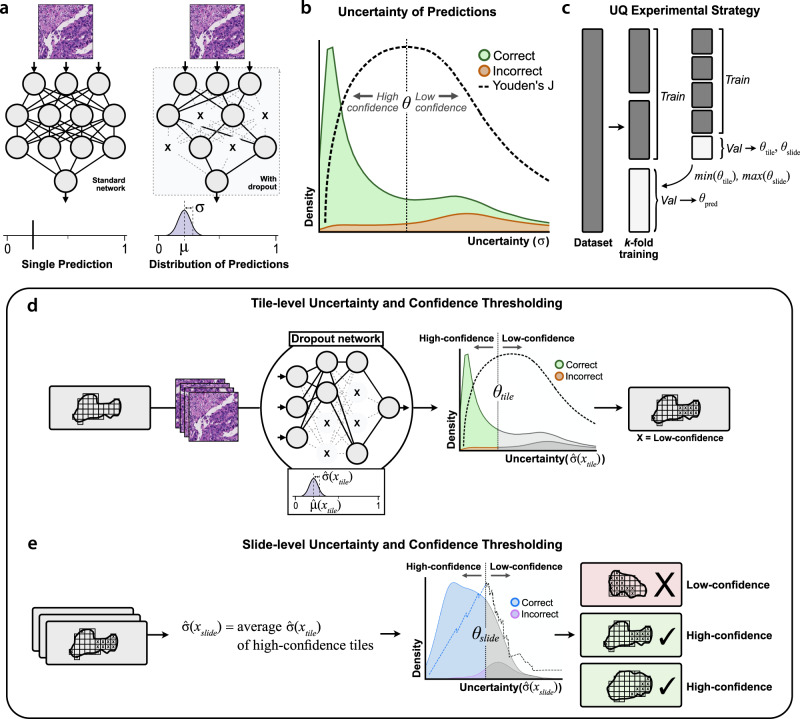
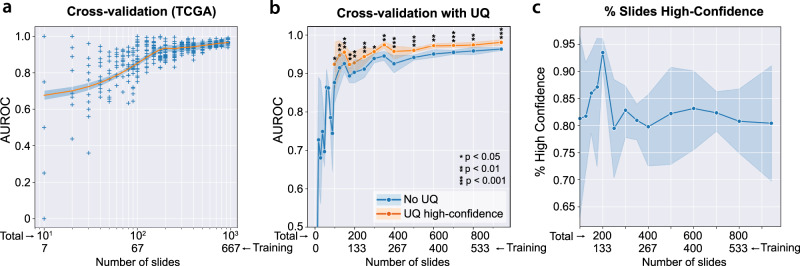
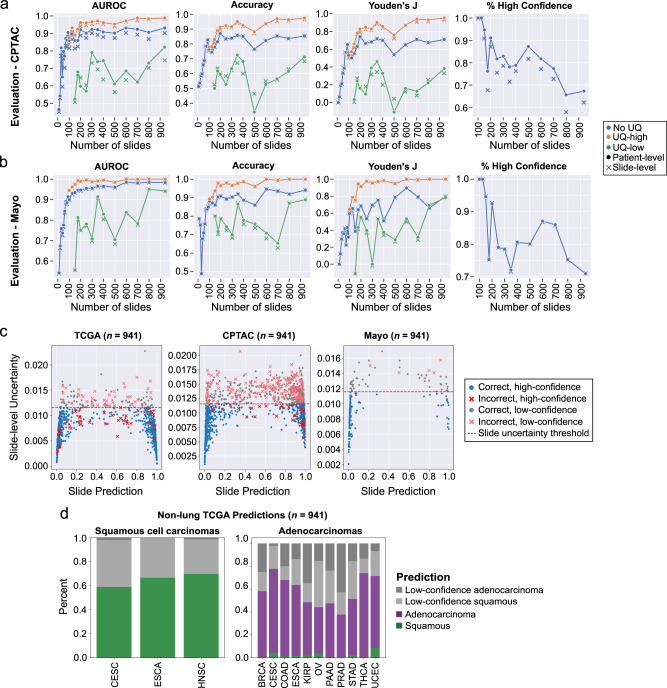
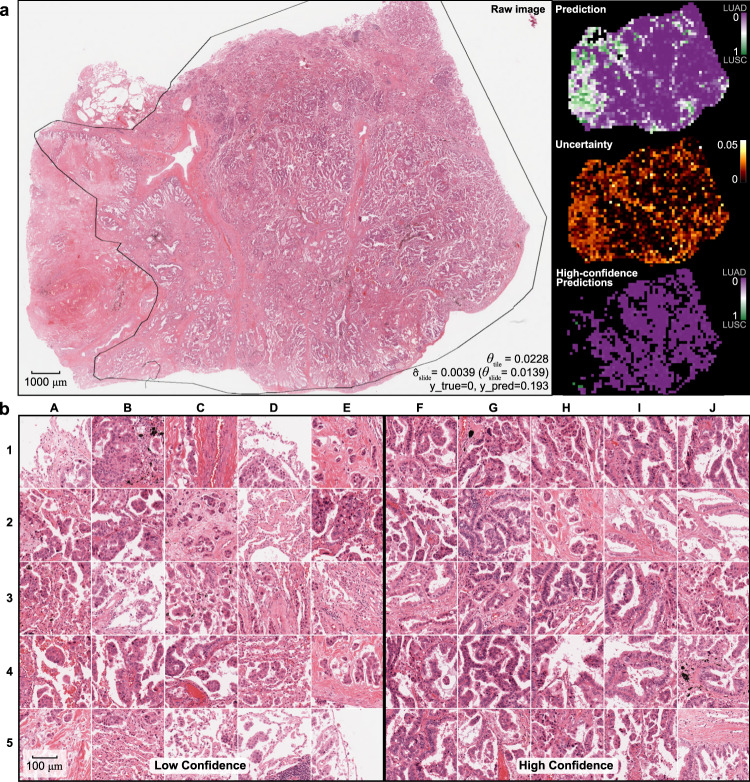
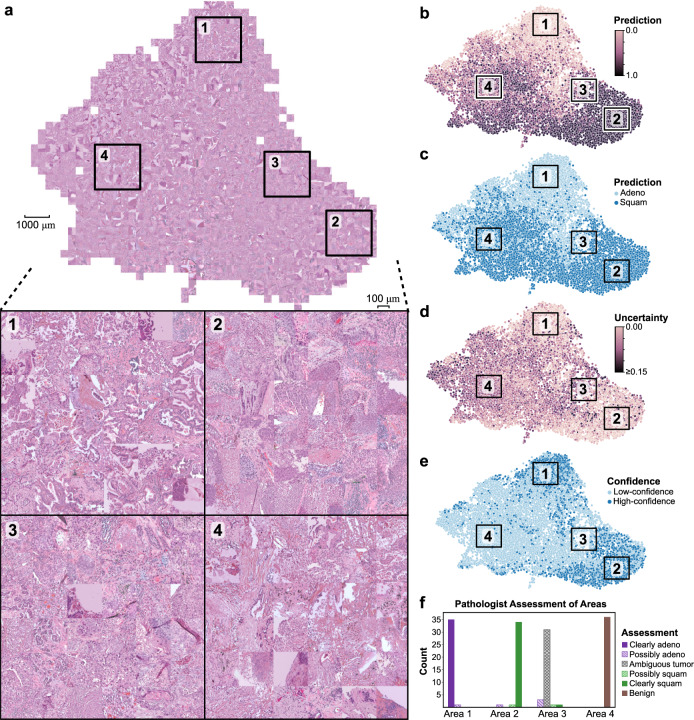
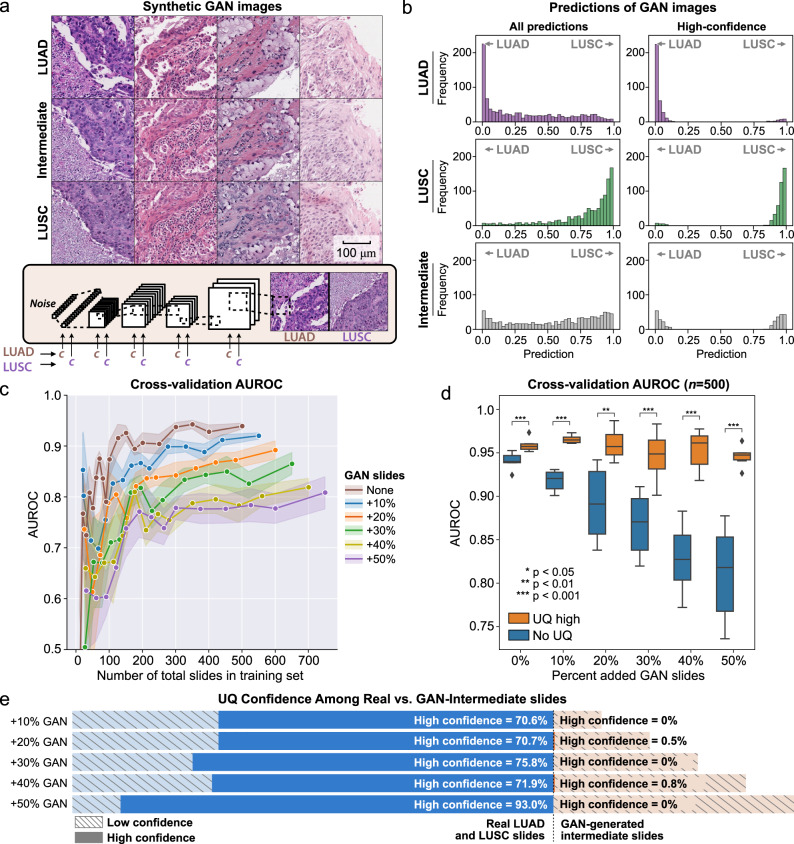
A model’s ability to express its own predictive uncertainty is an essential attribute for maintaining clinical user confidence as computational biomarkers are deployed into real-world medical settings. In the domain of cancer digital histopathology, we describe a clinically-oriented approach to uncertainty quantification for whole-slide images, estimating uncertainty using dropout and calculating thresholds on training data to establish cutoffs for low- and high-confidence predictions. We train models to identify lung adenocarcinoma vs. squamous cell carcinoma and show that high-confidence predictions outperform predictions without uncertainty, in both cross-validation and testing on two large external datasets spanning multiple institutions. Our testing strategy closely approximates real-world application, with predictions generated on unsupervised, unannotated slides using predetermined thresholds. Furthermore, we show that uncertainty thresholding remains reliable in the setting of domain shift, with accurate high-confidence predictions of adenocarcinoma vs. squamous cell carcinoma for out-of-distribution, non-lung cancer cohorts.
Overview
The claims and statistics of this paper haven’t been checked yet.
Free: it reads the open-access text and checks the first 5 claims that cite a source we can check. Create a free account to check every claim.
Integrity signals
Registry
Cites
Statistics
Figures
Verification
Claims the paper makes
The claims and statistics of this paper haven’t been checked yet.
Free: it reads the open-access text and checks the first 5 claims that cite a source we can check. Create a free account to check every claim.
Claims other papers make about this one
Each is checked against this paper’s own text: does it say what the citing paper says it does?
The source backs part of the claim, not all of it — or backs it for a different population, condition or comparison.
In the citing paper
“Current methods rely on attention-based multiple instance learning (MIL) and transformers, saliency-inference techniques for small lesions, and uncertainty-aware heatmaps that flag areas requiring human verification [33,34].”
From Artificial Intelligence in Dermatopathology: An Update and Review of the Current Literature (2026) · cites this paper as [34]
Experimental — accuracy not yet measuredThe cited source says what the claim attributes to it.
In the citing paper
“Confidence and uncertainty estimation are also recognized as critical components of AI systems, allowing algorithms to detect cases that may require expert review [34,74].”
From Artificial Intelligence in Dermatopathology: An Update and Review of the Current Literature (2026) · cites this paper as [34]
In the citing paper
“While anonymization provides reasonable protection, advanced reidentification techniques have emerged, highlighting the need for a more robust data management system based on data decentralization and federated learning.103”
From Artificial intelligence and endo-histo-omics: new dimensions of precision endoscopy and histology in inflammatory bowel disease (2024) · cites this paper as [103]
Self-check
Percentages, sums and reported differences re-computed from the paper’s own numbers.
The self-check needs the paper’s full text.
Citations
Cites
A Threshold Selection Method from Gray-Level Histograms
Otsu, N. (1979) · IEEE Transactions on Systems, Man, and Cybernetics · doi:10.1109/tsmc.1979.4310076 · Cited by 43,398
UMAP: Uniform Manifold Approximation and Projection
McInnes, L., Healy, J., Saul, N., & Großberger, L. (2018) · Journal of Open Source Software · doi:10.21105/joss.00861 · Cited by 9,826
The cancer genome atlas pan-cancer analysis project
The Cancer Genome Atlas Research Network, Weinstein, J. N., Collisson, E. A., Mills, G. B., Shaw, K. R. M., Ozenberger, B. A., Ellrott, K., Shmulevich, I., Sander, C., & Stuart, J. M. (2013) · Nature Genetics · doi:10.1038/ng.2764 · Cited by 9,092
Analyzing and Improving the Image Quality of StyleGAN
Karras, T., Laine, S., Aittala, M., Hellsten, J., Lehtinen, J., & Aila, T. (2020) · 2020 IEEE/CVF Conference on Computer Vision and Pattern Recognition (CVPR) · doi:10.1109/cvpr42600.2020.00813 · Cited by 6,332
Analyzing and Improving the Image Quality of StyleGAN
Karras, T., Laine, S., Aittala, M., Hellsten, J., Lehtinen, J., & Aila, T. (2019) · arXiv · doi:10.48550/arxiv.1912.04958 · Cited by 6,332
Reinhard, E., Adhikhmin, M., Gooch, B., & Shirley, P. (2001) · IEEE Computer Graphics and Applications · doi:10.1109/38.946629 · Cited by 2,937
Coudray, N., Ocampo, P. S., Sakellaropoulos, T., Narula, N., Snuderl, M., Fenyö, D., Moreira, A. L., Razavian, N., & Tsirigos, A. (2018) · Nature Medicine · doi:10.1038/s41591-018-0177-5 · Cited by 2,930 · cited 1×
“Despite the ambiguity that may exist in some cases, however, Coudray et al demonstrated feasibility of deep learning for classification of this outcome from standard H&E slides 7 .”
BackgroundData-efficient and weakly supervised computational pathology on whole-slide images
Lu, M. Y., Williamson, D. F. K., Chen, T. Y., Chen, R. J., Barbieri, M., & Mahmood, F. (2021) · Nature Biomedical Engineering · doi:10.1038/s41551-020-00682-w · Cited by 2,282
Deep learning in histopathology: the path to the clinic
van der Laak, J., Litjens, G., & Ciompi, F. (2021) · Nature Medicine · doi:10.1038/s41591-021-01343-4 · Cited by 902 · cited 1×
“Over the past several years, there has been a growing awareness of the need for better estimates of confidence and uncertainty within medical applications of AI 24-26 .”
BackgroundLuo, Y., Zheng, L., Guan, T., Yu, J., & Yang, Y. (2019) · 2019 IEEE/CVF Conference on Computer Vision and Pattern Recognition (CVPR) · doi:10.1109/cvpr.2019.00261 · Cited by 798 · cited 1×
“However, consistent with previous observations in the broader ML literature 39, 22, 23, 40 , uncertainty estimates were susceptible to domain shift when applied to external datasets 35, 36 , raising concerns about generalizability.”
Result
Research works printed but not linked: 7
- Ghosal, S., Xie, A. & Shah, P. Uncertainty quantified deep learning for predicting dice coefficient of digital histopathology image segmentation. Preprint at https://arxiv.org/abs/2109.00115 (2021). · arXiv
- Gal, Y. & Ghahramani, Z. Dropout as a Bayesian approximation: Representing model uncertainty in deep learning. Proc. 33rd Int. Conf. Mach. Learn. 48, 1050-1059 (2016).
- Sida, W. & Christopher, M. Fast dropout training. Proc. 30th Int. Conf. Mach. Learn. 28, 118-126 (2013).
- Lakshminarayanan, B., Pritzel, A. & Blundell, C. Simple and scalable predictive uncertainty estimation using deep ensembles. Adv. Neural Inf. Process. Syst. 30, 6405-6416 (2017).
- Bickel, S., Brückner, M. & Scheffer, T. Discriminative learning under covariate shift. J. Mach. Learn. Res. 10, 2137-2155 (2009).
- Tripuraneni, N., Adlam, B. & Pennington, J. Overparameterization improves robustness to covariate shift in high dimensions. Adv. Neural Inf. Process. Syst. 34, 13883-13897 (2021).
- Linmans, J., Laak, J. V. D. & Litjens, G. Efficient out-of-distribution detection in digital pathology using multi-head convolutional neural networks. Proc. Third Conf. Med. Imaging Deep Learn. 121, 465-478 (2020).
Cited by
Items 101–147 of 147
Wang, F., Shirmohammadi, S., & Hsu, C.-H. (2025) · IEEE International Instrumentation and Measurement Technology Conference · doi:10.1109/i2mtc62753.2025.11078994 · Cited by 1
“Used for examples in [11] [12], this method quantifies the uncertainty as the standard deviation of the distribution of the predicted probabilities of the predicted class, i.e.: where T is the number of observations using Monte-Carlo dropout, pc is the predicted class, p t pc is the predictive…”
CondSR: Conditional Shift-Robust Conformal Prediction for Graph Neural Networks
Akansha, S. (2026) · Soft Computing · doi:10.1007/s00500-025-11152-3 · Cited by 1
“Due to its robust framework, CP has found applications across various domains, including medicine (Lei and Candès 2021; Kompa et al. 2021; Dolezal et al. 2022; Chua et al. 2023), risk control (Bates et al. 2021; Angelopoulos et al. 2022), language modeling (Quach et al. 2023; Deutschmann et al.…”
Hu, Y., Sirinukunwattana, K., Li, B., Gaitskell, K. L., Bonnaffé, W., Wojciechowska, M., Wood, R., Alham, N. K., Malacrino, S., Woodcock, D. J., et al. (2023) · medRxiv · doi:10.1101/2023.07.30.23293391
Benefits of spatial uncertainty aggregation for segmentation in digital pathology
Pocevičiūtė, M., Eilertsen, G., & Lundström, C. F. (2024) · Journal of medical imaging · doi:10.1117/1.jmi.11.1.017501 · Cited by 2
“23,24 Similarly, uncertainty heatmaps can be generated and superimposed on the original image for visual inspection.”
BackgroundConditional Shift-Robust Conformal Prediction for Graph Neural NetworkPreprint
Singh, A. (2024) · SSRN Electronic Journal · doi:10.2139/ssrn.4862107
Self-Healing Model from Uncertain Data
Ciu, A.-V., & Marginean, A. N. (2024) · IEEE International Conference on Intelligent Computer Communication and Processing (ICCP) · doi:10.1109/iccp63557.2024.10793040
“Previous studies have extensively documented the impact of data uncertainty on the performance of machine learning models in medical imaging [2], [3], [5].”
BAKER: Bayesian Kernel Uncertainty in Domain-Specific Document Modelling
Azam, U., Razzak, I., Vishwakarma, S., Hacid, H., Zhang, D., & Jameel, S. (2025) · ACM International Conference on Web Search and Data Mining (WSDM) · doi:10.1145/3701551.3703517
Conformal Prediction for Deep Learning Classification Model in Histopathological Images
Gelvez, S., Clavijo, D., & Romo‐Bucheli, D. (2025) · Symposium on Image, Signal Processing and Artificial Vision (STSIVA) · doi:10.1109/stsiva66383.2025.11156416
“Dolezal et al. [8] proposed a clinically oriented uncertainty quantification approach for whole-slide images (WSIs), using Monte Carlo dropout and calibrated thresholds to separate high-and low-confidence predictions.”
AnnotateAnyCell: Open-Source AI Framework for Efficient Annotation in Digital PathologyPreprint
Verma, S., Malusare, A., Wang, M., Wang, L., Mahapatra, A., English, A., Cox, A. D., Broman, M. M., de Brot, S., Burcham, G. N., et al. (2025) · bioRxiv (Cold Spring Harbor Laboratory) · doi:10.1101/2025.11.02.686114 · Cited by 1
“Uncertainty quantification methods, particularly Monte Carlo dropout [7], have enabled high-confidence predictions robust to domain shift.”
Zafar, S., Qin, W., Chengliang, L., Khan, A. A., Nazir, A., Faisal, M. S., Khalid, F., Vemula, S. S. M., & Khan, A. R. (2025) · doi:10.2196/preprints.88967
Uncertainty Quantification for Metaplasia Detection in Gastrointestinal Histopathology Images
Acosta-Velasquez, R., Cano, F., Romero, E., & Gonzalez, F. A. (2025) · International Symposium on Medical Information Processing and Analysis (SIPAIM) · doi:10.1109/sipaim67325.2025.11283194
Dolezal, J. M., Kochanny, S. E., Dyer, E., Ramesh, S., Srisuwananukorn, A., Sacco, M., Howard, F. M., Li, A., Mohan, P., & Pearson, A. T. (2024) · Figshare · doi:10.6084/m9.figshare.26698715
Self-citationLo, C.-H., Shi, K., Kafadarian, L. N., Bermudez, A. G., Diaz, J., Edwards, L., Hong, Y., Chen, Z., Hwang, H., Yan, W., et al. (2026) · bioRxiv (Cold Spring Harbor Laboratory) · doi:10.64898/2026.01.24.701539
“This "High-Confidence Zone" methodology aligns with current trends in high-stakes biomedical AI 63,64 , where generative consistency serves as a computational proxy for mechanistic accuracy.”
Bakhshayeshi, I., Hosseini, M. M., Argha, A., Zahedi, R., Lovell, N. H., & Alinejad-Rokny, H. (2026) · Advanced Science · doi:10.1002/advs.202512842 · Cited by 2
Sun, K., Wang, Y., Deng, X., Wang, J., & Chen, Q. (2025) · IEEE International Conference on Bioinformatics and Biomedicine (BIBM) · doi:10.1109/bibm66473.2025.11356913
“As higher entropy indicates greater uncertainty or noisier representations [13].”
High-sensitivity pan-cancer AI assessment of lymph node metastasis via uncertainty quantification
Wang, X., Chen, Y., Liu, X., Qiu, C., Tang, H., Huang, T., Guo, S., Ma, S., Cai, M., Sun, Q., et al. (2026) · npj Digital Medicine · doi:10.1038/s41746-026-02564-y
Deep learning for incidence rate prediction and radiation risk assessment of solid tumors
Liu, Z., Nakamizo, T., Misumi, M., Ono, S., Shuryak, I., & Ullrich, R. L. (2026) · Scientific Reports · doi:10.1038/s41598-026-46756-8
“The DNN aids in identifying crucial parameters and relationships within the data, forming a robust foundation for constructing a more interpretable and computationally efficient parametric model 29,30 .”
Arega, T. W. (2023) · theses.fr (ABES) · doi:10.70675/6f691b31z766dz4a4azb504za7b14d4cf213 · Cited by 3
Deep Learning Methods for Grading Head and Neck Squamous Lesions from Whole Slide Images
Lubrano, M. (2023) · theses.fr (ABES) · doi:10.70675/c2fe54c9ze50cz444bzb5f8zd650c647e2ae
Probabilistic Models for Demand Supply Prediction in The Eenergy Sector
Eressa, M. R. (2024) · theses.fr (ABES) · doi:10.70675/50ea6b38z9fa6z44dez8a82z0800e09e8e38
Li, X. B., Qin, H.-Z., Wei, J.-Y., Wei, K., & Huang, Z. (2026) · Frontiers in Immunology · doi:10.3389/fimmu.2026.1773927 · Cited by 1
An Uncertainty-Aware Attention-Based Residual U-Net for Cochineal Insect Segmentation
Benali, A., Fourati, R., & Jdey, I. (2026) · IEEE International Conference on Complex Systems and Intelligent Computing (ICCSIC) · doi:10.1109/iccsic69301.2026.11521138
“Evidential Deep Learning [28] offers an alternative by leveraging evidence theory to derive uncertainty directly from network outputs, providing an effective balance between computational cost and predictive reliability.”
Min, J., Vishnyakova, O., Brooks-Wilson, A., & Elliott, L. T. (2026) · GeroScience · doi:10.1007/s11357-026-02280-1
Andriansyah, G., Suratman, F. Y., & Istiqomah (2026) · IEEE Access · doi:10.1109/access.2026.3696665
CG-IRNet: Structure–Confidence Hybrid Learning for Low-False-Alarm Infrared Small Target Detection
Zhu, Z., & Liao, M. (2026) · Electronics · doi:10.3390/electronics15112405
Gedik, B., Çankaya, A. B., Erdem, M. A., Hassan, M. M., Ali, R., & Khurshid, Z. (2026) · European Journal of General Dentistry · doi:10.1055/s-0046-1822827
Agam, S. T. R., Wicaksono, R., & Nugroho, H. A. (2026) · International Conference on Electrical Engineering/Electronics, Computer, Telecommunications and Information Technology (ECTI-CON) · doi:10.1109/ecti-con68836.2026.11609195
“Predictive uncertainty consists of 2 types of UC, epistemic uncertainty (knowledge limitations) and aleatoric uncertainty (noise of the data) [13].”
Vega, F., Koopmans, L. D., Roest, C., Türkbey, B., Yakar, D., & Kwee, T. C. (2026) · Abdominal Radiology · doi:10.1007/s00261-026-05714-8 · Cited by 3
Șerban, M., Toader, C., Ciurea, A. V., Danaila, L., & Covache-Busuioc, R.-A. (2026) · Journal of Clinical Medicine · doi:10.3390/jcm15166147
“This appears desirable for emerging decision-support platforms, as it directs focus towards cases needing greater human expertise, supportive reviews, and careful planning [38].”
Zhang, B., Ma, F., Meng, H., Hu, Y., & Wang, Y. (2026) · Biomedical Signal Processing and Control · doi:10.1016/j.bspc.2026.111260
Baviello, C., Capuano, D. M., & Verna, R. (2026) · Life · doi:10.3390/life16081346
“The primary weakness of these models is their relatively low specificity; algorithms frequently detect spurious morphological correlations that do not reflect true biological causation [48].”
Gao, X., Wang, Y., Zhang, Y., Ge, S. S., & Wei, X. (2026) · Ceramics International · doi:10.1016/j.ceramint.2026.08.278
Arefin, M. S., Islam, M. S., Nabi, M. S., Sumon, R. I., Lapina, M., Lapin, V. G., & Muthanna, M. S. A. (2026) · Diagnostics · doi:10.3390/diagnostics16172752
“Uncertainty-based approaches have therefore been investigated as tools for identifying difficult or potentially unreliable histopathology predictions [35].”
Li, A., Oloughlin, P., Yue, L., Zhang, W. E., Swart, B., & Chen, W. (2026) · Journal of Pathology Informatics · doi:10.1016/j.jpi.2026.100720
“57 Evaluation should stratify performance by institution, scanner, stain, specimen type, and work fl ow phase; report calibration and uncertainty; test near-and far-out-of-distribution inputs and domain shift; de fi ne abstention and escalation thresholds; and monitor drift after deployment.”
Biotechnology-Enabled Artificial Intelligence for Veterinary Histopathology and Disease Detection
Essa, I. M., Lokeshwari, B., Saranraj, P., Kesavardhini, K., Kandhan, K., & Kanshiya, S. (2026) · Advances in computational intelligence and robotics book series · doi:10.4018/979-8-2600-1358-8.ch008
Ouyang, Y., Guo, J., Yuan, J., Wu, Z., & Li, J. (2026) · Life · doi:10.3390/life16091574
“Whole-slide computational pathology can complement expert review by providing reproducible spatial summaries of heterogeneous tissue, but performance estimates depend strongly on the unit of data partitioning and require validation beyond patch-level splits [16–18].”
Lahrmann, B., Keil, A., Ruiz, F. M., Clarke, M. A., Egemen, D., Grewal, K. K., Grabe, F., Bartels, L., Krauthoff, A., Risley, C., et al. (2026) · NEJM AI · doi:10.1056/aioa2600270 · Cited by 5
Mehmood, S., Hussain, M., & Khan, M. A. (2026) · Archiv für Pathologische Anatomie und Physiologie und für Klinische Medicin · doi:10.1007/s00428-026-04727-4
Annotation-Boundary Effects in Ki-67 Cell Detection on BCData
Sholtan, Y., Zhaksylyk, T., Abdikenov, B., KOVCHEGOV, I. O., & Lyubko, S. A. (2026) · IEEE Access · doi:10.1109/access.2026.3738191
“In histology specifically, recent studies have explored soft labels, uncertainty-aware supervision, and calibration strategies to better accommodate noisy or inconsistent annotations [24], [25], [26], [27].”
Stylianakis, D., Sánchez-Bayona, R., Denaro, N., & Solinas, C. (2026) · Frontiers in Pharmacology · doi:10.3389/fphar.2026.1953714
“In digital histopathology, dropout-based uncertainty estimation flags a substantial proportion of cases a model is likely to misclassify, allowing low-confidence predictions to be routed for expert review rather than acted upon automatically (Dolezal et al., 2022; Linmans et al., 2023).”
Lo, C.-H., Shi, K., Kafadarian, L. N., Bermudez, A. G., Diaz, J., Edwards, L., Hong, Y., Chen, Z., Hwang, H., Yan, W., et al. (2026) · Advanced Science · doi:10.1002/advs.78186
“This variance-gated “High-Confidence Zone” methodology aligns with emerging approaches in high-stakes biomedical AI [ 55, 56 ], in which generative consistency can serve as an empirically calibrated indicator of predictive reliability.”
Montana, A., D’Anna, T., Licitra, F., Zamparese, R., Buscemi, L., Montanari, E., Tattoli, L., Fede, M. S., Raffino, C., & Malta, G. (2026) · Diagnostics · doi:10.3390/diagnostics16203299
Hu, Y., Li, Q., Li, W., Liu, Z., Ji, D., Chang, B., Yio, M. H. N., & Lin, J. (2026) · Engineering Structures · doi:10.1016/j.engstruct.2026.123960
Du, Y., Liao, H., Li, J., He, Y., & Di, J. (2026) · medRxiv · doi:10.64898/2026.10.12.26365351
Kutlu, H., & Çolak, C. (2026) · Journal of Clinical Medicine · doi:10.3390/jcm15208058
“Uncertainty-aware models that abstain on low-confidence cases can improve reliability, and uncertainty estimates have been reported to remain informative under domain shift in some imaging settings [28].”
The Role of Artificial Intelligence in Oral Dysplasia and Oral Cancer
Zbarsky, S. J. D., Lee, A. Y., & Viet, C. T. (2026) · Oral and Maxillofacial Surgery Clinics of North America · doi:10.1016/j.coms.2026.09.010
Luo, Y., Wang, M., Lin, T., Lin, A., Chen, Y., He, G., Lin, Z., Chen, L. J., Yam, J. C. S., Cheng, C., et al. (2026) · Cell Reports Medicine · doi:10.1016/j.xcrm.2026.103124
Metadata
- Authors
- Dolezal, J. M., Srisuwananukorn, A., Karpeyev, D., Ramesh, S., Kochanny, S., Cody, B., Mansfield, A. S., Rakshit, S., Bansal, R., Bois, M. C., Bungum, A. O., Schulte, J. J., Vokes, E. E., Garassino, M. C., Husain, A. N., & Pearson, A. T.
- Affiliations
- University of Chicago Medical Center (US)
- Tisch Cancer Institute (US)
- University of Chicago (US)
- Mayo Clinic (US)
- University of Wisconsin–Madison (US)
- Corresponding author
- Pearson, Alexander T.
- ORCID
- Venue
- Nature Communications
- Published
- 2022-11-02
- Volume
- 13
- Issue
- 1
- Pages
- 6572-6572
- ISSN
- 2041-1723 (ISSN-L)
- PMC
- PMC9630455
- OpenAlex
- W4308149258
- Semantic Scholar
- 09bb95dc51bd58c8fefc237a1dc22848394f641c
- Cited by
- 147
- References
- 47
- Citations by year
- 2026: 42 · 2025: 40 · 2024: 41 · 2023: 23 · 2022: 1
- FWCI
- 8.64
- Type
- journal article
- Language
- en
- Open access
- gold
- doi.org
- Licence
- cc-by
- creativecommons.org/licenses/by/4.0 (tdm)
- creativecommons.org/licenses/by/4.0 (vor)
- Locations
- Nature Communications (publishedVersion, cc-by)
- PubMed Central (publishedVersion, cc-by)
- PubMed (publishedVersion)
- arXiv (Cornell University) (submittedVersion)
- RePEc: Research Papers in Economics (submittedVersion)
- DOAJ (DOAJ: Directory of Open Access Journals) (submittedVersion, cc-by-sa)
- arXiv (Cornell University)
- Funders
- U.S. Department of Health & Human Services | NIH | National Cancer Institute (U01-CA243075)
- U.S. Department of Health & Human Services | NIH | National Institute of Dental and Craniofacial Research (R56-DE030958)
- Cancer Research Foundation
- EIF | Stand Up To Cancer
- EC | Horizon 2020 Framework Programme (2021-SC1-BHC I3LUNG)
- Topics
- Physical Sciences › Computer Science › Artificial Intelligence › AI in cancer detection
- Health Sciences › Medicine › Radiology, Nuclear Medicine and Imaging › Radiomics and Machine Learning in Medical Imaging
- Health Sciences › Medicine › Health Informatics › Artificial Intelligence in Healthcare and Education
- Keywords
- uncertainty quantification, confidence threshold, digital histopathology, whole slide images, lung adenocarcinoma, squamous cell carcinoma, cancer classification, domain shift, out-of-distribution prediction
- MeSH terms
- Deep Learning, Adenocarcinoma, Carcinoma, Squamous Cell, Humans, Uncertainty
About these checks
Registry, retraction, Cites and statistics results are computed, not judged, with one exception: a printed reference that no index lists is read once by a model before it counts as a citation error. Claims are extracted by a model and kept only when their quote appears verbatim in the text; each cited source is then checked, with a model’s help, for whether it says what the claim relies on. Those verdicts can be wrong — read the claim’s quote and the cited source before relying on one.
Statistics and arithmetic are recomputed, not judged.
Confidence bands are shown only for fields calibrated on our annotated test set. None is calibrated yet, so no band is shown.
What counts as a claim ›How we measure confidence ›How we check this ›
Are you an author, or do you see a problem with this page? Request a review
Data sources
Bibliographic data: Semantic Scholar, OpenAlex, Crossref.
Contains information from the Semantic Scholar Academic Graph Datasets, made available under the ODC Attribution License (ODC-BY 1.0).
Semantic Scholar’s data is described in: Kinney, R., et al. (2023). The Semantic Scholar Open Data Platform. arXiv:2301.10140.
