

The DOI matches its Crossref record; 45 of the 45 references it cites were found in a registry or an index.
Effectiveness of mRNA-1273 vaccination against SARS-CoV-2 omicron subvariants BA.1, BA.2, BA.2.12.1, BA.4, and BA.5
Open accessPublished version of a preprint
Abstract
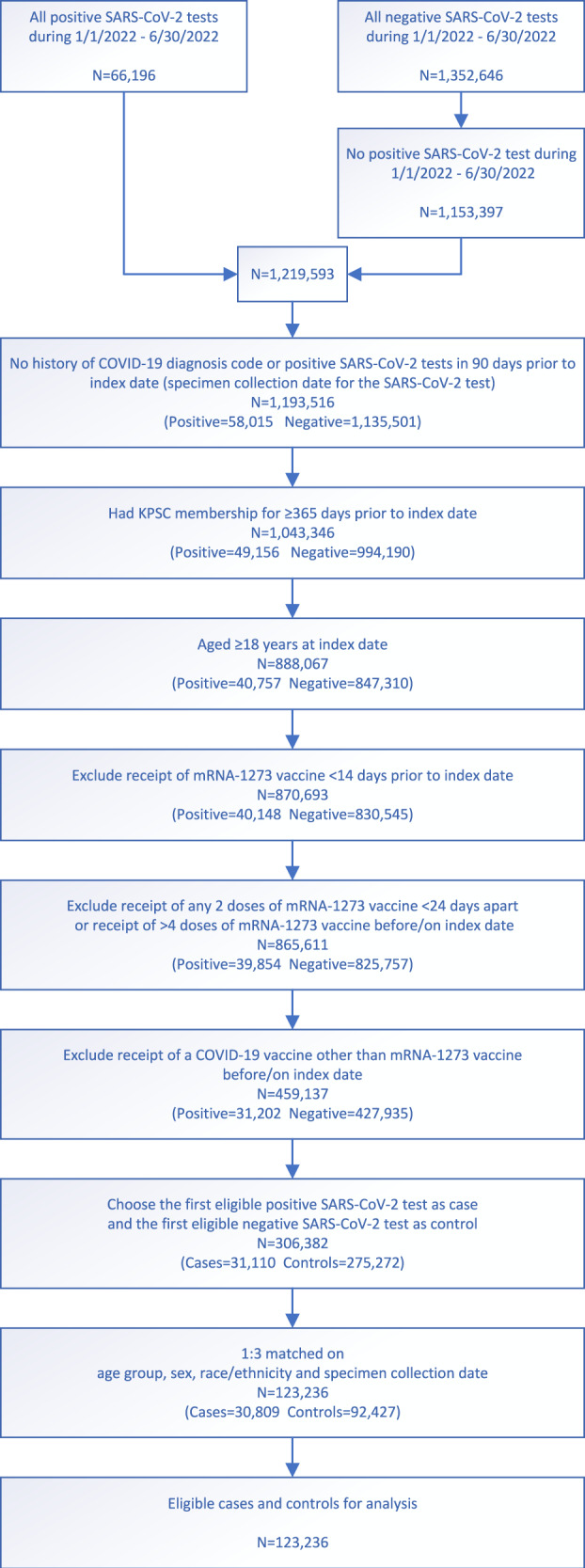
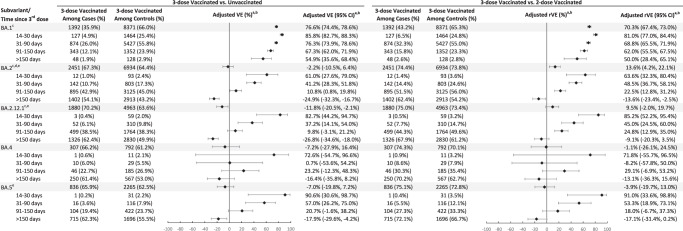
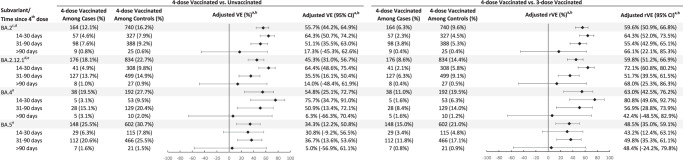
Studies have reported reduced natural SARS-CoV-2 infection- and vaccine-induced neutralization against omicron BA.4/BA.5 compared with earlier omicron subvariants. This test-negative case-control study evaluates mRNA-1273 vaccine effectiveness (VE) against infection and hospitalization with omicron subvariants. The study includes 30,809 SARS-CoV-2 positive and 92,427 SARS-CoV-2 negative individuals aged ≥18 years tested during 1/1/2022-6/30/2022. While 3-dose VE against BA.1 infection is high and wanes slowly, VE against BA.2, BA.2.12.1, BA.4, and BA.5 infection is initially moderate to high (61.0%-90.6% 14-30 days post third dose) and wanes rapidly. The 4-dose VE against infection with BA.2, BA.2.12.1, and BA.4 ranges between 64.3%-75.7%, and is low (30.8%) against BA.5 14-30 days post fourth dose, disappearing beyond 90 days for all subvariants. The 3-dose VE against hospitalization for BA.1, BA.2, and BA.4/BA.5 is 97.5%, 82.0%, and 72.4%, respectively; 4-dose VE against hospitalization for BA.4/BA.5 is 88.5%. Evaluation of the updated bivalent booster is warranted.
Overview
The claims and statistics of this paper haven’t been checked yet.
Run the check — free, no account needed. It reads the open-access text and checks the sources it cites.
Integrity signals
Registry
Cites
Statistics
Figures

Verification
Claims the paper makes
The claims and statistics of this paper haven’t been checked yet.
Run the check — free, no account needed. It reads the open-access text and checks the sources it cites.
Claims other papers make about this one
Each is checked against this paper’s own text: does it say what the citing paper says it does?
The cited source says what the claim attributes to it.
In the citing paper
“Of three studies assessing VE against infection/symptomatic disease during both BA.2 and BA.4/BA.5 periods, all showed similar VE estimates or estimates with overlapping 95 % confidence intervals against both subvariants [25,26,31-33].”
From Assessing COVID-19 vaccine effectiveness against Omicron subvariants: Report from a meeting of the World Health Organization (2023) · cites this paper as [33]
The cited source says what the claim attributes to it.
In the citing paper
“Eight studies assessed VE of primary series or first booster dose vaccination separately for at least two different Omicron subvariants (six assessed VE of both primary series and booster dose vaccination and two assessed VE of a booster dose only, Tables 1 and 2) [21,24-26,28-33].”
From Assessing COVID-19 vaccine effectiveness against Omicron subvariants: Report from a meeting of the World Health Organization (2023) · cites this paper as [33]
The cited source says what the claim attributes to it.
In the citing paper
“Among 4 studies that compared VE against outcomes of SARS-CoV-2 infection and/or symptomatic COVID-19 disease between BA.1 and BA.2, all showed lower VE against BA.2 [26,29,31,33].”
From Assessing COVID-19 vaccine effectiveness against Omicron subvariants: Report from a meeting of the World Health Organization (2023) · cites this paper as [33]
Self-check
Percentages, sums and reported differences re-computed from the paper’s own numbers.
The self-check needs the paper’s full text.
Citations
Cites
Quan, H., Li, B., Couris, C. M., Fushimi, K., Graham, P. J., Hider, P., Januel, J., & Sundararajan, V. (2011) · American Journal of Epidemiology · doi:10.1093/aje/kwq433 · Cited by 5,967
Khoury, D. S., Cromer, D., Reynaldi, A., Schlub, T. E., Wheatley, A. K., Juno, J. A., Subbarao, K., Kent, S. J., Triccas, J. A., & Davenport, M. P. (2021) · Nature Medicine · doi:10.1038/s41591-021-01377-8 · Cited by 3,742
Effectiveness of COVID-19 vaccines against the Omicron (B.1.1.529) variant of concern
Andrews, N., Stowe, J., Kirsebom, F., Toffa, S., Rickeard, T., Gallagher, E., Gower, C., Kall, M., Groves, N., O’Connell, A.-M., et al. (2021) · doi:10.1101/2021.12.14.21267615 · Cited by 2,420
Rapid epidemic expansion of the SARS-CoV-2 Omicron variant in southern Africa
Viana, R. P. E. S., Moyo, S. M., Amoako, D. G., Tegally, H., Scheepers, C., Althaus, C. L., Anyaneji, U. J., Bester, P. A., Boni, M. F., Chand, M., et al. (2022) · Nature · doi:10.1038/s41586-022-04411-y · Cited by 1,678
BA.2.12.1, BA.4 and BA.5 escape antibodies elicited by Omicron infection
Cao, Y., Yisimayi, A., Jian, F., Song, W., Xiao, T., Wang, L., Du, S., Wang, J., Li, Q., Chen, X., et al. (2022) · Nature · doi:10.1038/s41586-022-04980-y · Cited by 1,306
mRNA-based COVID-19 vaccine boosters induce neutralizing immunity against SARS-CoV-2 Omicron variant
Garcia-Beltran, W. F., St. Denis, K. J., Hoelzemer, A., Lam, E. C., Nitido, A. D., Sheehan, M. L., Berrios, C., Ofoman, O., Chang, C. C., Hauser, B. M., et al. (2022) · Cell · doi:10.1016/j.cell.2021.12.033 · Cited by 1,045
Koebnick, C., Langer-Gould, A. M., Gould, M. K., Chao, C. R., Iyer, R. L., Smith, N., Chen, W., & Jacobsen, S. J. (2012) · The Permanente Journal · doi:10.7812/tpp/12-031 · Cited by 789
Antibody evasion by SARS-CoV-2 Omicron subvariants BA.2.12.1, BA.4 and BA.5
Wang, Q., Guo, Y., Iketani, S., Nair, M. S., Li, Z., Mohri, H., Wang, M., Yu, J., Bowen, A. D., Chang, J. Y., et al. (2022) · Nature · doi:10.1038/s41586-022-05053-w · Cited by 775
Emergence of SARS-CoV-2 Omicron lineages BA.4 and BA.5 in South Africa
Tegally, H., Moir, M., Everatt, J., Giovanetti, M., Scheepers, C., Wilkinson, E., Subramoney, K., Makatini, Z., Moyo, S., Amoako, D. G., et al. (2022) · Nature Medicine · doi:10.1038/s41591-022-01911-2 · Cited by 707
Antibody escape of SARS-CoV-2 Omicron BA.4 and BA.5 from vaccine and BA.1 serum
Tuekprakhon, A., Nutalai, R., Dijokaite-Guraliuc, A., Zhou, D., Ginn, H. M., Selvaraj, M., Liu, C., Mentzer, A. J., Supasa, P., Duyvesteyn, H. M. E., et al. (2022) · Cell · doi:10.1016/j.cell.2022.06.005 · Cited by 687
Research works printed but not linked: 4
- The World Health Organization. WHO Coronavirus (COVID-19) Dashboard. Vol. 2022 (2022).
- Andrews, N. et al. Covid-19 Vaccine Effectiveness against the Omicron (B.1.1.529) Variant. N. Engl. J. Med. 386, 1532–1546 (2022). · DOI · Paper page
- Link-Gelles, R. et al. Effectiveness of 2, 3, and 4 COVID-19 mRNA vaccine doses among immunocompetent adults during periods when SARS-CoV-2 Omicron BA.1 and BA.2/BA.2.12.1 sublineages predominated — VISION Network, 10 States, december 2021–June 2022. MMWR Morbidity Mortal. Wkly. Rep. 71, 931–939 (2022). · DOI · Paper page
- Stowe, J., Andrews, N., Kirsebom, F., Ramsay, M. & Bernal, J. L. Effectiveness of COVID-19 vaccines against Omicron and Delta hospitalisation, a test negative case-control study. Nat. Commun. 13, 5736 (2022). · DOI · Paper page
Cited by
Sorted by citations
Items 101–105 of 105
Humoral epitope dominance and immune imprinting by SARS ‐ CoV ‐1 and SARS ‐ CoV ‐2 vaccines
Burnett, D. L., Moxon, A., Aggarwal, A., Jackson, K., Cotter, C. A., Akerman, A., Russell, A. J., KALMAN, R., Langley, D. B., Henry, J. Y., et al. (2026) · Immunology and Cell Biology · doi:10.1111/imcb.70072
Tangsathapornpong, A., Nanthapisal, S., Fukpho, W., Bunjoungmanee, P., Neamkul, Y., Pontan, K., Boonyarangkul, A., Wanpen, S., Thongphubeth, K., Tharabenjasin, P., et al. (2026) · Vaccines · doi:10.3390/vaccines14040348
Healthy vaccinee effect did not bias COVID-19 vaccine effectiveness estimates
Chemaitelly, H. S., Ayoub, H. H., Coyle, P. V., Tang, P., Hasan, M. R., Yassine, H. M., Thani, A. A. A., Kanaani, Z. A., Al‐Kuwari, E., Jeremijenko, A. M., et al. (2026) · Communications Health · doi:10.1038/s44528-026-00006-5 · Cited by 1
Chemaitelly, H. S., Ayoub, H. H., Coyle, P. V., Tang, P., Hasan, M. R., Yassine, H. M., Thani, A. A. A., Kanaani, Z. A., Al‐Kuwari, E., Jeremijenko, A. M., et al. (2026) · Open Forum Infectious Diseases · doi:10.1093/ofid/ofag602
Feikin, D. R., Higdon, M. M., Abu-Raddad, L. J., Andrews, N., & Araos, R. (2023) · The Lancet Respiratory Medicine · doi:10.1016/s2213-2600(23)00015-6
Metadata
- Authors
- Tseng, H. F., Ackerson, B. K., Bruxvoort, K. J., Sy, L. S., Tubert, J. E., Lee, G. S., Ku, J. H., Florea, A., Luo, Y., Qiu, S., Choi, S. K., Takhar, H. S., Aragones, M., Paila, Y. D., Chavers, S., Talarico, C. A., & Qian, L.
- Affiliations
- Kaiser Permanente (US)
- AstraZeneca (United States) (US)
- Corresponding author
- Tseng, Hung Fu
- ORCID
- Venue
- Nature Communications
- Published
- 2023-01-12
- Volume
- 14
- Issue
- 1
- Pages
- 189-189
- ISSN
- 2041-1723 (ISSN-L)
- PMC
- PMC9836332
- OpenAlex
- W4315779712
- Cited by
- 105
- References
- 44
- Citations by year
- 2026: 5 · 2025: 18 · 2024: 33 · 2023: 46
- FWCI
- 20.99
- Type
- journal article
- Language
- en
- Open access
- gold
- doi.org
- Locations
- Nature Communications (publishedVersion, cc-by)
- medRxiv (acceptedVersion)
- PubMed Central (publishedVersion, cc-by)
- PubMed (publishedVersion)
- RePEc: Research Papers in Economics (submittedVersion)
- DOAJ (DOAJ: Directory of Open Access Journals) (submittedVersion, cc-by-sa)
- Funders
- Moderna, Inc.
- Topics
- Health Sciences › Medicine › Infectious Diseases › SARS-CoV-2 and COVID-19 Research
- Physical Sciences › Mathematics › Modeling and Simulation › COVID-19 epidemiological studies
- Health Sciences › Medicine › Infectious Diseases › COVID-19 Clinical Research Studies
- Keywords
- mRNA-1273 vaccine, SARS-CoV-2 Omicron subvariants, vaccine effectiveness, BA.1, BA.2, BA.2.12.1, BA.4, BA.5, COVID-19 infection, hospitalization, waning immunity, bivalent booster, neutralizing antibodies
- MeSH terms
- COVID-19, SARS-CoV-2, 2019-nCoV Vaccine mRNA-1273, Adolescent, Adult, Humans, Vaccination, Case-Control Studies
About these checks
Registry, retraction, Cites and statistics results are computed, not judged, with one exception: a printed reference that no index lists is read once by a model before it counts as a citation error. Claims are extracted by a model and kept only when their quote appears verbatim in the text; each cited source is then checked, with a model’s help, for whether it says what the claim relies on. Those verdicts can be wrong — read the claim’s quote and the cited source before relying on one.
Statistics and arithmetic are recomputed, not judged.
Confidence bands are shown only for fields calibrated on our annotated test set. None is calibrated yet, so no band is shown.
What counts as a claim ›How we measure confidence ›How we check this ›
Are you an author, or do you see a problem with this page? Request a review
