

The DOI matches its Crossref record; 85 of the 85 references it cites were found in a registry or an index.
Discovering highly potent antimicrobial peptides with deep generative model HydrAMP
Open accessPublished version of a preprint
Abstract
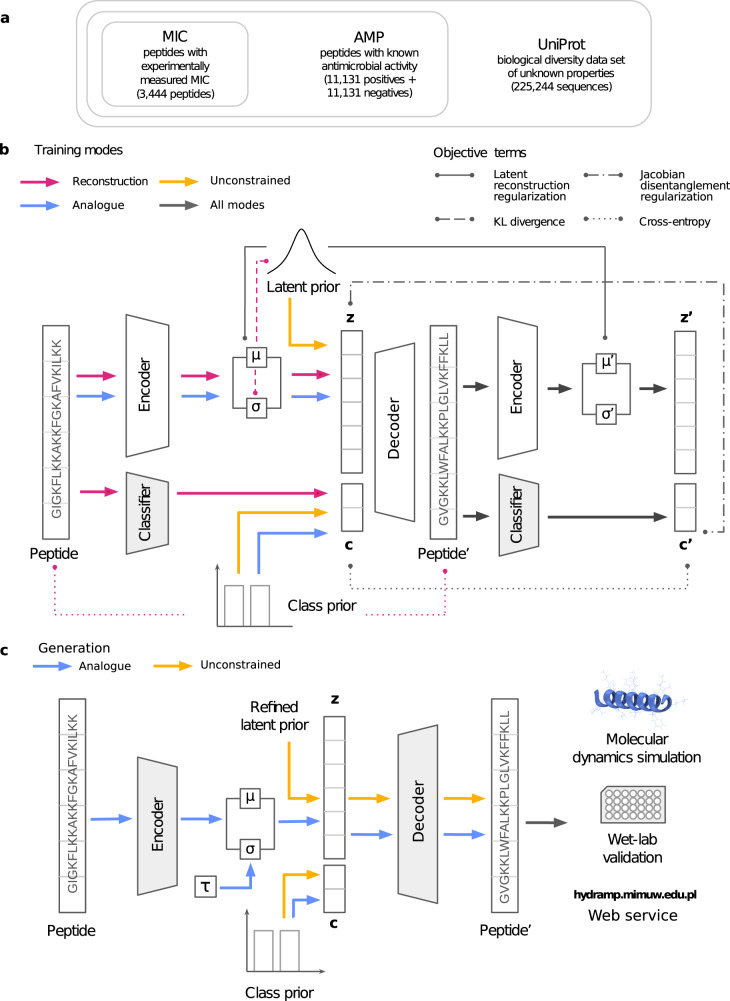
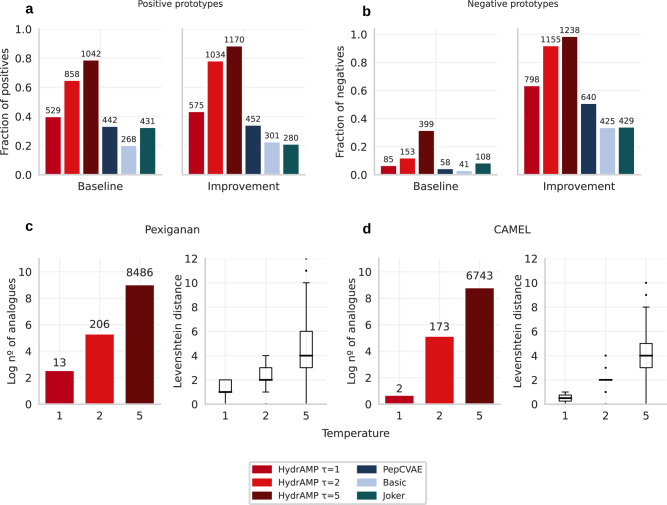
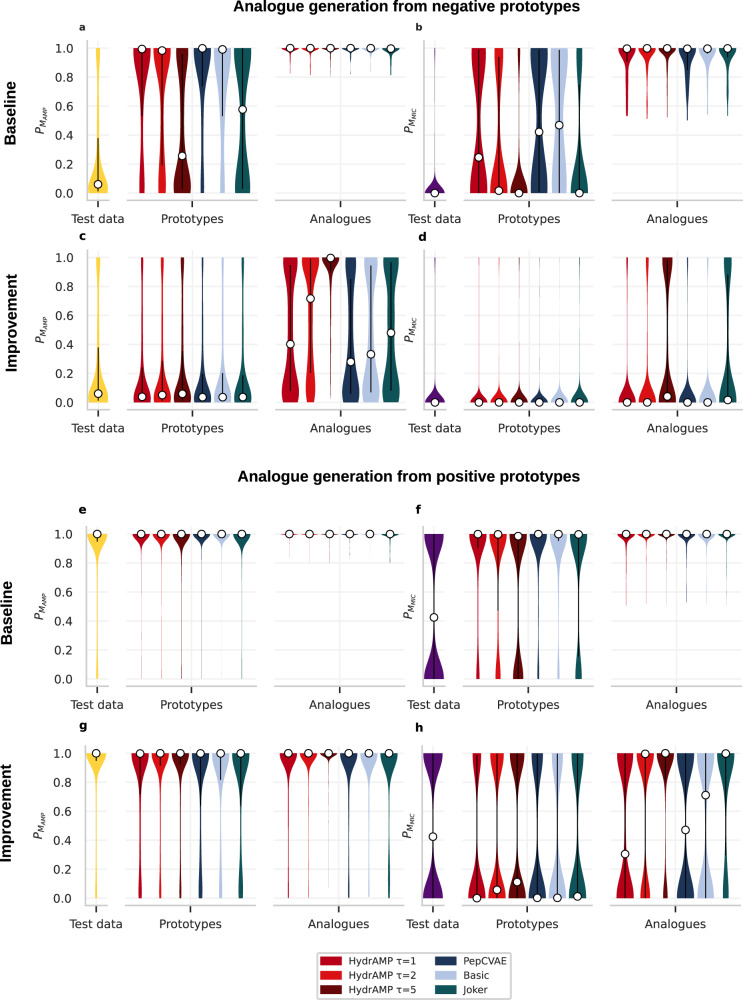
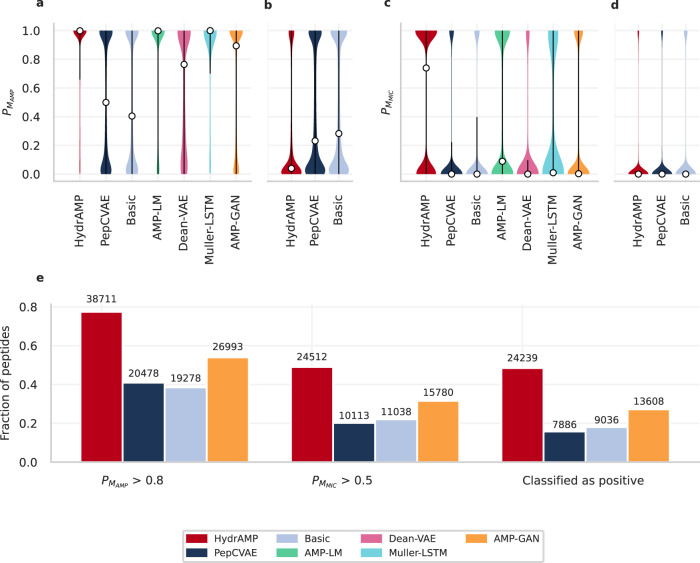
Antimicrobial peptides emerge as compounds that can alleviate the global health hazard of antimicrobial resistance, prompting a need for novel computational approaches to peptide generation. Here, we propose HydrAMP, a conditional variational autoencoder that learns lower-dimensional, continuous representation of peptides and captures their antimicrobial properties. The model disentangles the learnt representation of a peptide from its antimicrobial conditions and leverages parameter-controlled creativity. HydrAMP is the first model that is directly optimized for diverse tasks, including unconstrained and analogue generation and outperforms other approaches in these tasks. An additional preselection procedure based on ranking of generated peptides and molecular dynamics simulations increases experimental validation rate. Wet-lab experiments on five bacterial strains confirm high activity of nine peptides generated as analogues of clinically relevant prototypes, as well as six analogues of an inactive peptide. HydrAMP enables generation of diverse and potent peptides, making a step towards resolving the antimicrobial resistance crisis.
Overview
The claims and statistics of this paper haven’t been checked yet.
Run the check — free, no account needed. It reads the open-access text and checks the sources it cites.
Integrity signals
Registry
Cites
Statistics
Figures
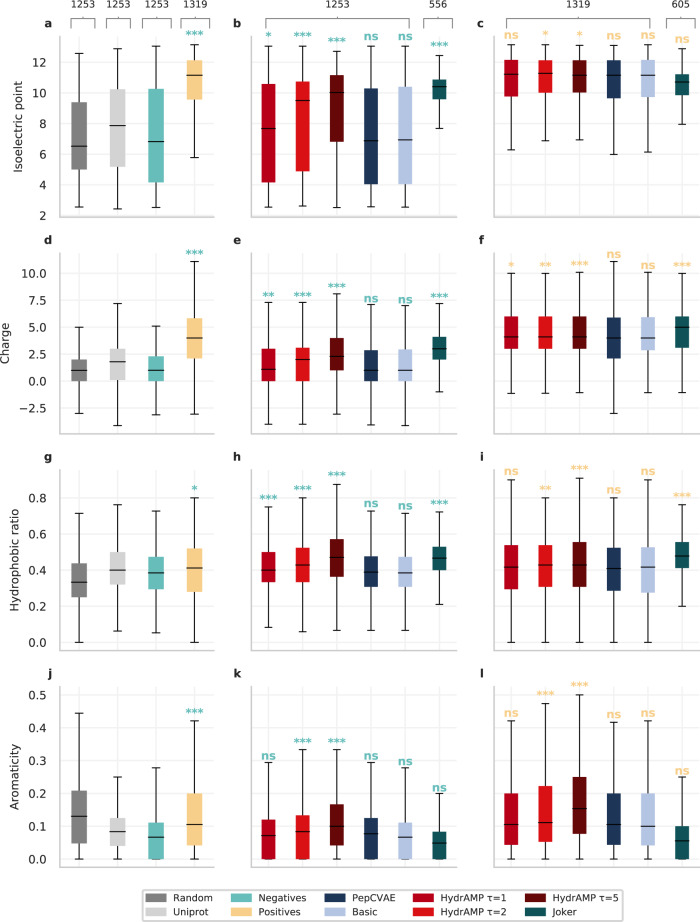
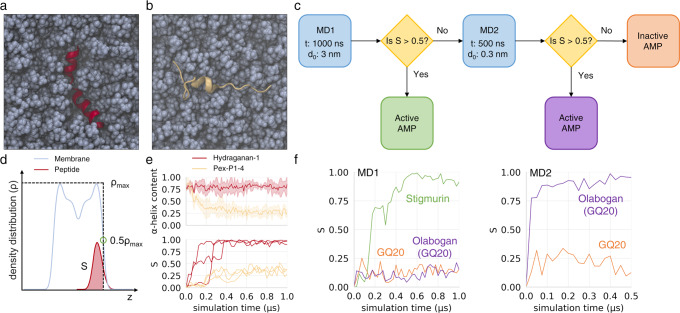
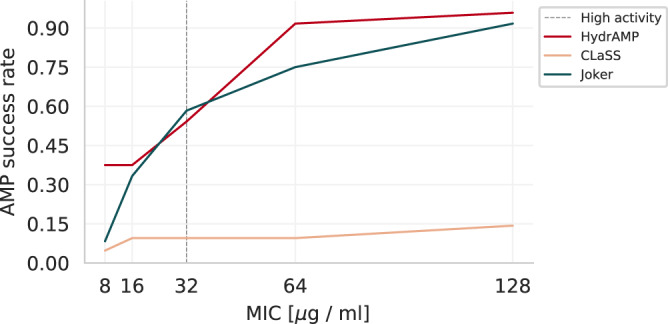
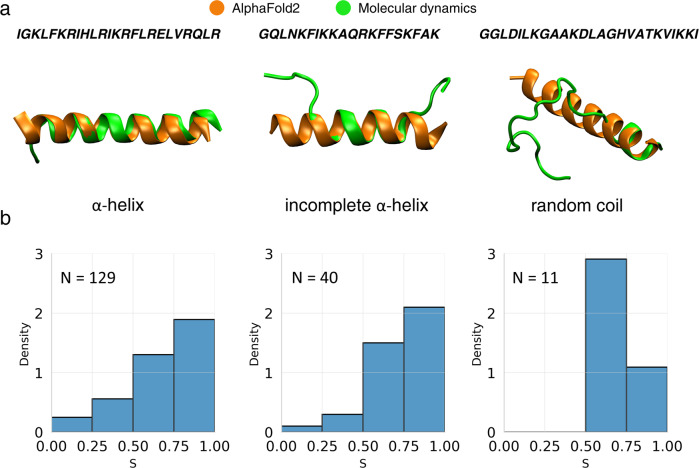
Verification
Claims the paper makes
The claims and statistics of this paper haven’t been checked yet.
Run the check — free, no account needed. It reads the open-access text and checks the sources it cites.
Self-check
Percentages, sums and reported differences re-computed from the paper’s own numbers.
The self-check needs the paper’s full text.
Citations
Cites
Vaswani, A., Shazeer, N., Parmar, N., Uszkoreit, J., Jones, L., Gomez, A. N., Kaiser, L., & Polosukhin, I. (2017) · arXiv · doi:10.48550/arxiv.1706.03762 · Cited by 120,404
Hochreiter, S., & Schmidhuber, J. (1997) · Neural Computation · doi:10.1162/neco.1997.9.8.1735 · Cited by 102,318
Adam: A Method for Stochastic Optimization
Kingma, D. P., & Ba, J. (2014) · arXiv · doi:10.48550/arxiv.1412.6980 · Cited by 98,946
Highly accurate protein structure prediction with AlphaFold
Jumper, J., Evans, R., Pritzel, A., Green, T., Figurnov, M., Ronneberger, O., Tunyasuvunakool, K., Bates, R., Žídek, A., Potapenko, A., et al. (2021) · Nature · doi:10.1038/s41586-021-03819-2 · Cited by 43,764
Comparison of simple potential functions for simulating liquid water
Jorgensen, W. L., Chandrasekhar, J., Madura, J., Impey, R., & Klein, M. (1983) · The Journal of Chemical Physics · doi:10.1063/1.445869 · Cited by 38,397
Abraham, M. J., Murtola, T., Schulz, R., Páll, S., Smith, J. C., Hess, B., & Lindahl, E. (2015) · SoftwareX · doi:10.1016/j.softx.2015.06.001 · Cited by 27,190
A simple method for displaying the hydropathic character of a protein
Kyte, J., & Doolittle, R. F. (1982) · Journal of Molecular Biology · doi:10.1016/0022-2836(82)90515-0 · Cited by 22,927
Advances in neural information processing systems 7
Cios, K. J., & Shields, M. E. (1997) · Neurocomputing · doi:10.1016/s0925-2312(97)90018-7 · Cited by 22,093
Auto-Encoding Variational Bayes
Kingma, D. P., & Welling, M. (2013) · arXiv · doi:10.48550/arxiv.1312.6114 · Cited by 20,067
Kabsch, W., & Sander, C. (1983) · Biopolymers · doi:10.1002/bip.360221211 · Cited by 15,320
Research works printed but not linked: 7
- O’Neill, J. Tackling drug-resistant infections globally: final report and recommendations. The Review on Antimicrobial Resistance, Government of the United Kingdom (2016).
- Lee, E., Fulan, B., Wong, G. & Ferguson, A. Mapping membrane activity in undiscovered peptide sequence space using machine learning. Proc. Natl. Acad. Sci. USA. 113, 13588–13593 (2016). · DOI
- Tucs, A. et al. Generating ampicillin-level antimicrobial peptides with activity-aware generative adversarial networks. ACS Omega 5, 22847–22851 (2020). · DOI
- Witten, J. & Witten, Z.Deep learning regression model for antimicrobial peptide design. Accessed 01.02.2023 from https://github.com/zswitten/Antimicrobial-Peptides. (2019). · DOI
- Higgins, I.et al. beta-VAE: Learning Basic Visual Concepts with a Constrained Variational Framework.International conference on learning representations (2017).
- Tomczak, J. & Welling, M. VAE with a VampPrior in Proceedings of the Twenty-First International Conference on Artificial Intelligence and Statistics (eds Storkey, A. & Perez-Cruz, F.) 84 1214–1223 (PMLR, 2018).
- Clinical & (CLSI), L. S. I. Methods for Dilution Antimicrobial Susceptibility Tests for Bacteria That Grow Aerobically; Approved Standard-Ninth Edition; Document M07-A8 (2012).
Cited by
Sorted by citations
Items 201–239 of 239
Zou, Y., Hao, J., Ren, X., Wang, X., ChongBin, W. E. I., Zhou, F., & Jia, Z. (2026) · Chemical Engineering Journal · doi:10.1016/j.cej.2026.179115
Wei, Y., Sun, Y., Bang, J. K., & Kim, W. J. (2026) · Insect Molecular Biology · doi:10.1111/imb.70064
Peptide Therapeutics in Orthopaedics
Urish, K. L., Osifo, S. E., & Steckbeck, J. D. (2026) · Journal of Bone and Joint Surgery · doi:10.2106/jbjs.26.00785
Transformer-based Discovery of Antimicrobial Peptides and Prediction of their Antibacterial Activity
Pan, S., Soo, E., & Wong, K. (2026) · International Journal of Computer Information Systems and Industrial Management Applications · doi:10.70917/ijcisim-2026-3793
Advances in Molecular Medicine and Clinical Research
Şahin, F., Kızılkurtlu, A. A., Yılmaz, Ö., Değirmenci, N. S., Ulu, Z. Ö., Guliyeva, V., Saraydemir, Ö., Pedük, D., Hussain, S., Rukhsar, A., et al. (2026) · doi:10.38066/hy.9xpehqn2.hph
Xu, J., Yang, D., Zheng, Q., Li, T., Cui, Y., & Tian, J. (2026) · Diagnostics · doi:10.3390/diagnostics16152430
Machine learning for precision prediction of antimicrobial peptide activity and spectrum
Wan, T., Wang, Y., Ren, T., Lin, Z., Sun, P., Hu, Z., Huang, L., Huang, Z., Huang, W., Yu, R., et al. (2026) · Biotechnology Advances · doi:10.1016/j.biotechadv.2026.109002
Evolutionary Design of Membrane-Lytic Antimicrobial Peptides with Mixture of ExpertsPreprint
Dong, R., & Song, C. (2026) · bioRxiv (Cold Spring Harbor Laboratory) · doi:10.64898/2026.07.29.741660
Patil, A., Jadhav, M., Hussain, U., & Kakde, R. B. (2026) · The Journal of Antibiotics · doi:10.1038/s41429-026-00951-x
Geometry-Preserving Supervised Biological Sequence Design
Sadeghi, E., Lin, I.-H., Deng, X.-Q., Copp, S. M., & Bogdanov, P. (2026) · Knowledge Discovery and Data Mining · doi:10.1145/3770855.3818843
Rashid¹, Z., Siddiqui, M. R. U., & Nisar, S. (2026) · Research Square · doi:10.21203/rs.3.rs-10525951/v1
Liu, S., Gao, X., Wang, J., Li, Z., Liu, Y., Wang, Y., Hou, T., Liu, Y., & Liu, Y. (2026) · Journal of Chemical Information and Modeling · doi:10.1021/acs.jcim.6c01300
Wang, Z., Sun, L., Li, Y., Yang, F., & Chang, Y. (2026) · Journal of Pharmaceutical Analysis · doi:10.1016/j.jpha.2026.101754 · Cited by 1
Qin, W., Wu, Y., Li, C., Cao, S., Guo, J., Ge, Y., Guo, J., Mo, J., Zhu, N., & Duan, H. (2026) · Journal of Cheminformatics · doi:10.1186/s13321-026-01269-4
Chu, Y., Zhang, S., Pan, B., Zhang, Q., Zhou, X., Liu, Y., & Li, F. (2026) · Probiotics and Antimicrobial Proteins · doi:10.1007/s12602-026-11195-4
Tian, C., Zhou, M., Wang, H., Jinbo, Y., Shao, X., & Cai, W. (2026) · Journal of Chemical Theory and Computation · doi:10.1021/acs.jctc.6c01030
Designing antimicrobials with programmable mechanism and safetyPreprint
Szymczak, P., Torres, M. D. T., Soares, D., Hetzel, L., Puczko-Szymański, B., Jegelka, S., Günnemann, S., Theis, F. J., de la Fuente‐Núñez, C., & Szczurek, E. (2026) · bioRxiv (Cold Spring Harbor Laboratory) · doi:10.64898/2026.09.01.747572
Self-citationActivity is in the Activations: Inference-Time Steering of Peptide Models for Antimicrobial Design
Siudak, G., Szymczak, P., Szczurek, E., & Deja, K. R. (2026) · Lecture notes in computer science · doi:10.1007/978-3-032-37657-2_21
Self-citationSchmidt, O., Weber, L., & Richter, J. (2026) · Journal of Artificial Intelligence for Healthcare Systems · doi:10.68159/m899132055
Recent advances in peptide-based AIE materials: from molecular aggregation to biomedical application
Hou, D., Qiao, S., Wang, H., Chen, K., & Tang, B. Z. (2026) · Progress in Materials Science · doi:10.1016/j.pmatsci.2026.101836
Yongco, J. S., Ramayan, A. J. R., DANGDANG, G. O., Bucad, R. G., & Borinaga, N. (2026) · Trends in Food Science & Technology · doi:10.1016/j.tifs.2026.106096
Long, X., Lin, Y., Xie, J., Wang, J., Wei, X., Wei, L., Deng, Z., & Gao, J. (2026) · Wiley Interdisciplinary Reviews Computational Molecular Science · doi:10.1002/wcms.70087
Li, X., Gao, J., Xia, X., Cao, W., Lin, H., Zheng, H., & Zheng, Z. (2026) · Food Bioscience · doi:10.1016/j.fbio.2026.110064
Fernández, N. B., Hernández-Rosas, F., & Pawar, T. J. (2026) · World Congress on Medical Physics and Biomedical Engineering, September 7 - 12, 2009, Munich, Germany · doi:10.1007/978-3-032-37739-5_9
Jiang, X., Zhuo, X., Chen, Z., Zhang, S., & Liang, G. (2026) · Food Bioscience · doi:10.1016/j.fbio.2026.110132
Saleem, N., El-Omar, E., Kumar, N., Willcox, M. D. P., & Jiang, X. (2026) · Frontiers in Cellular and Infection Microbiology · doi:10.3389/fcimb.2026.1894311
Thammathaporn, W., Klubthawee, N., & Aunpad, R. (2026) · PeerJ · doi:10.7717/peerj.21717
From code to cure: Harnessing AI for antibiotic discovery and design
Krishnan, A., Cao, H., Collins, J. J., & de la Fuente‐Núñez, C. (2026) · Science Translational Medicine · doi:10.1126/scitranslmed.aee4629
Ibisanmi, T. A., Bahatheg, G., Urmi, U. L., Mishra, S. K., Khan, R. A., Shen, J., Enninful, G. N., To, T. A., Willcox, M. D. P., & Kumar, N. (2026) · Drug Resistance Updates · doi:10.1016/j.drup.2026.101490
Luo, W., Wang, S., Cai, X., Chen, X., & Wang, S. (2026) · Trends in Food Science & Technology · doi:10.1016/j.tifs.2026.106131
Vijayanand, M., & Patil, K. K. (2026) · International Journal of Peptide Research and Therapeutics · doi:10.1007/s10989-026-10870-y
Generating Plausible Sequences of Protein Groups with Latent Optimal Transport Flow Matching
Kong, Z., Xu, Y., Jiang, X., Wu, J., & Xu, H. (2026) · International Joint Conference on Neural Networks (IJCNN) · doi:10.1109/ijcnn69854.2026.11728557
Dellis, C., Mishra, B., Zhang, L., Basu, A., Felix, L. O., Shehadeh, F., Ganesan, N., Kolocouris, A., & Mylonakis, E. E. (2026) · Frontiers in Microbiology · doi:10.3389/fmicb.2026.1967486
Abhigyan, R., Sood, V., Arora, P., & Kaur, B. (2026) · Artificial Intelligence in the Life Sciences · doi:10.1016/j.ailsci.2026.100190
Computational Peptide Design: Emerging Concepts in Antibiotics, Immunity, and Evolution
Chen, S., Wang, X., Li, F., Franco, O. L., Song, J., & de la Fuente‐Núñez, C. (2026) · Annual Review of Microbiology · doi:10.1146/annurev-micro-042524-035131
Pektaş, A. N., Pektaş, A. N., & AKÇAY, A. (2026) · Bidge Yayınları eBooks · doi:10.70269/brsqsphnjkvi
Liu, B., Liu, H., Jia, Y., He, J., Wang, Y., 姜海燕, Xue, Z., Guo, S., Zhu, Y., Kong, L., et al. (2026) · Marine Drugs · doi:10.3390/md24110375
Jessie, A. A. A., Raja, M., Selson, J. H., & Yagoo, A. (2026) · International Journal of Novel Research and Development · doi:10.56975/ijnrd.v11i10.329312
Metadata
- Authors
- Szymczak, P., Możejko, M., Grzegorzek, T., Jurczak, R., Bauer, M., Neubauer, D., Sikora, K., Michalski, M., Sroka, J., Setny, P., Kamysz, W., & Szczurek, E.
- Affiliations
- University of Warsaw (PL)
- Nvidia (United States) (US)
- Gdańsk Medical University (PL)
- Corresponding author
- Szczurek, Ewa
- ORCID
- Venue
- Nature Communications
- Published
- 2023-03-15
- Volume
- 14
- Issue
- 1
- Pages
- 1453-1453
- ISSN
- 2041-1723 (ISSN-L)
- PMC
- PMC10017685
- OpenAlex
- W4324344300
- Cited by
- 231
- References
- 78
- Citations by year
- 2026: 85 · 2025: 88 · 2024: 49 · 2023: 9
- FWCI
- 42.06
- Type
- journal article
- Language
- en
- Update notices
- correction (2023-08-23)
- Open access
- gold
- doi.org
- Locations
- Nature Communications (publishedVersion, cc-by)
- bioRxiv (Cold Spring Harbor Laboratory) (acceptedVersion, cc-by-nc-nd)
- PubMed Central (publishedVersion, cc-by)
- PubMed (publishedVersion)
- ReIn UW (University of Warsaw) (submittedVersion, cc-by-nc-nd)
- RePEc: Research Papers in Economics (submittedVersion)
- DOAJ (DOAJ: Directory of Open Access Journals) (submittedVersion, cc-by-sa)
- Funders
- Nvidia
- Narodowym Centrum Nauki
- Uniwersytet Warszawski
- Interdyscyplinarne Centrum Modelowania Matematycznego i Komputerowego UW
- Topics
- Life Sciences › Immunology and Microbiology › Microbiology › Antimicrobial Peptides and Activities
- Life Sciences › Pharmacology, Toxicology and Pharmaceutics › Drug Discovery › Computational Drug Discovery Methods
- Physical Sciences › Chemistry › Organic Chemistry › Chemical Synthesis and Analysis
- Keywords
- antimicrobial peptides, conditional variational autoencoder, deep generative models, peptide production, antimicrobial resistance, peptide analogues, disentangled representations, molecular dynamics simulation
- MeSH terms
- Antimicrobial Peptides, Anti-Infective Agents, Bacteria, Antimicrobial Cationic Peptides
About these checks
Registry, retraction, Cites and statistics results are computed, not judged, with one exception: a printed reference that no index lists is read once by a model before it counts as a citation error. Claims are extracted by a model and kept only when their quote appears verbatim in the text; each cited source is then checked, with a model’s help, for whether it says what the claim relies on. Those verdicts can be wrong — read the claim’s quote and the cited source before relying on one.
Statistics and arithmetic are recomputed, not judged.
Confidence bands are shown only for fields calibrated on our annotated test set. None is calibrated yet, so no band is shown.
What counts as a claim ›How we measure confidence ›How we check this ›
Are you an author, or do you see a problem with this page? Request a review
