

Hydrogel-in-hydrogel live bioprinting for guidance and control of organoids and organotypic cultures
Open accessThe DOI matches its Crossref record; 39 of the 39 references it cites were found in a registry or an index.
Abstract
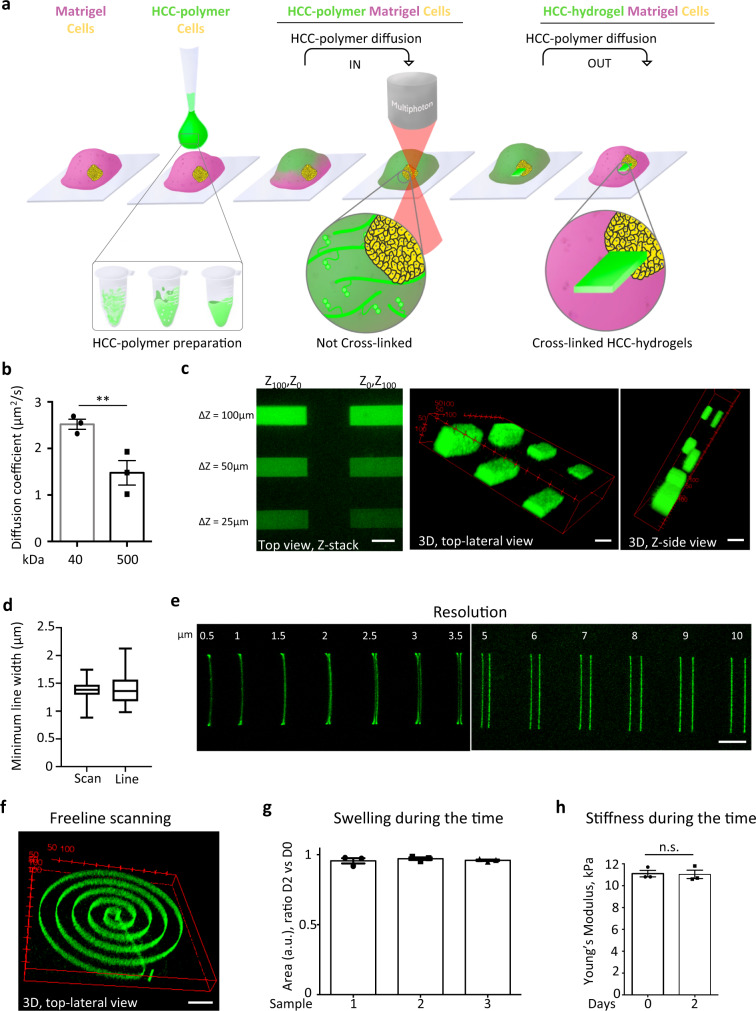
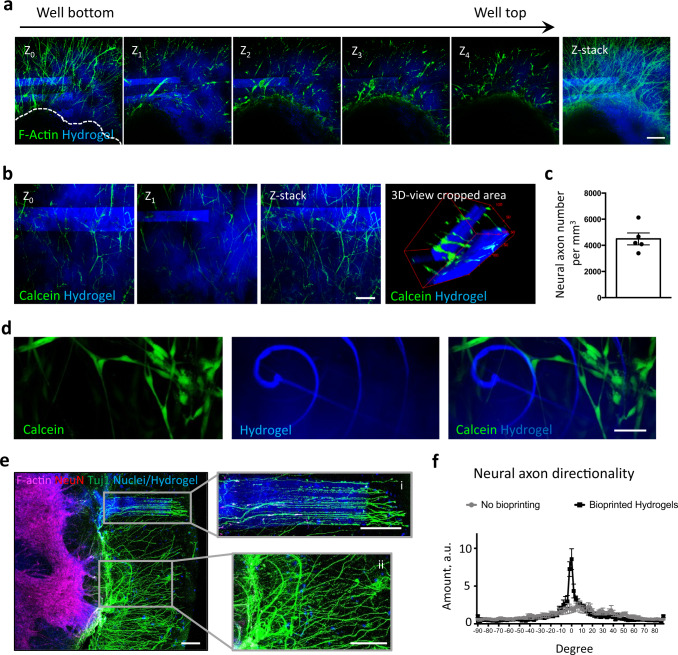
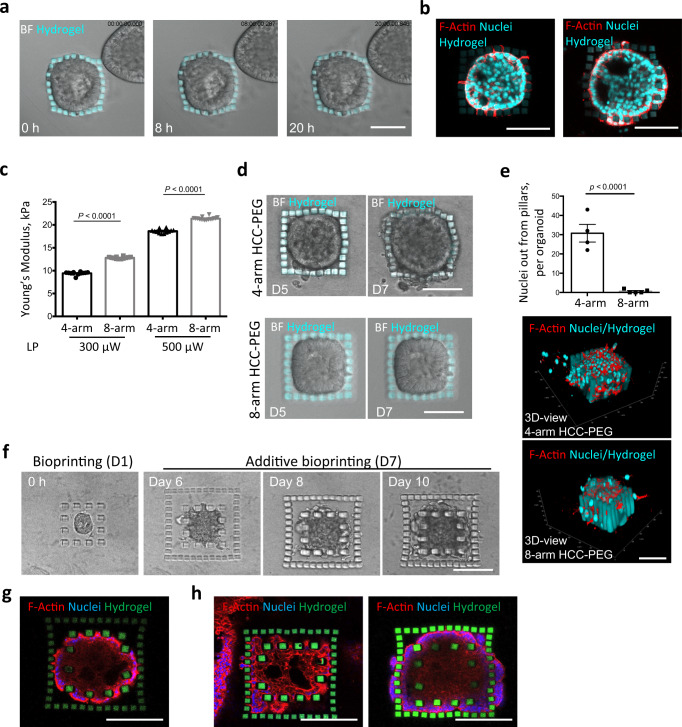
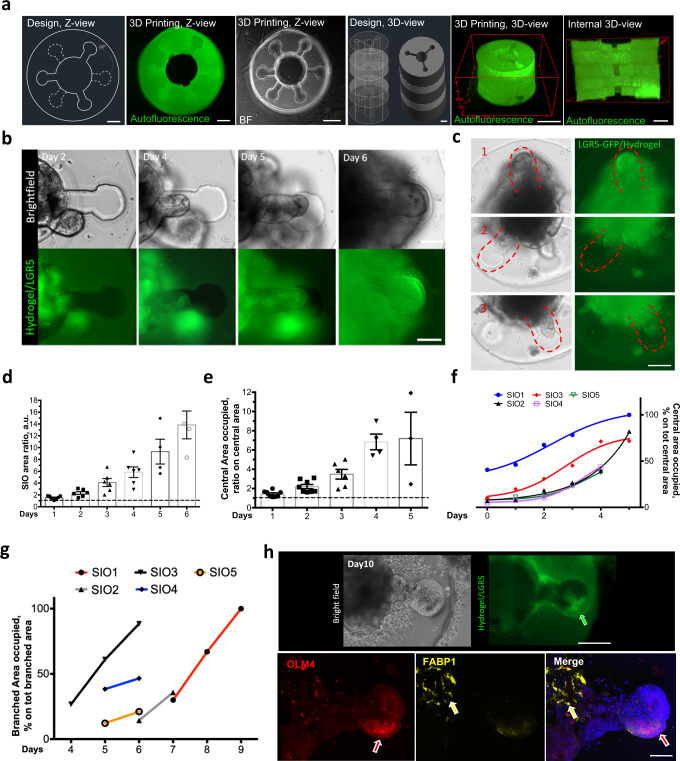
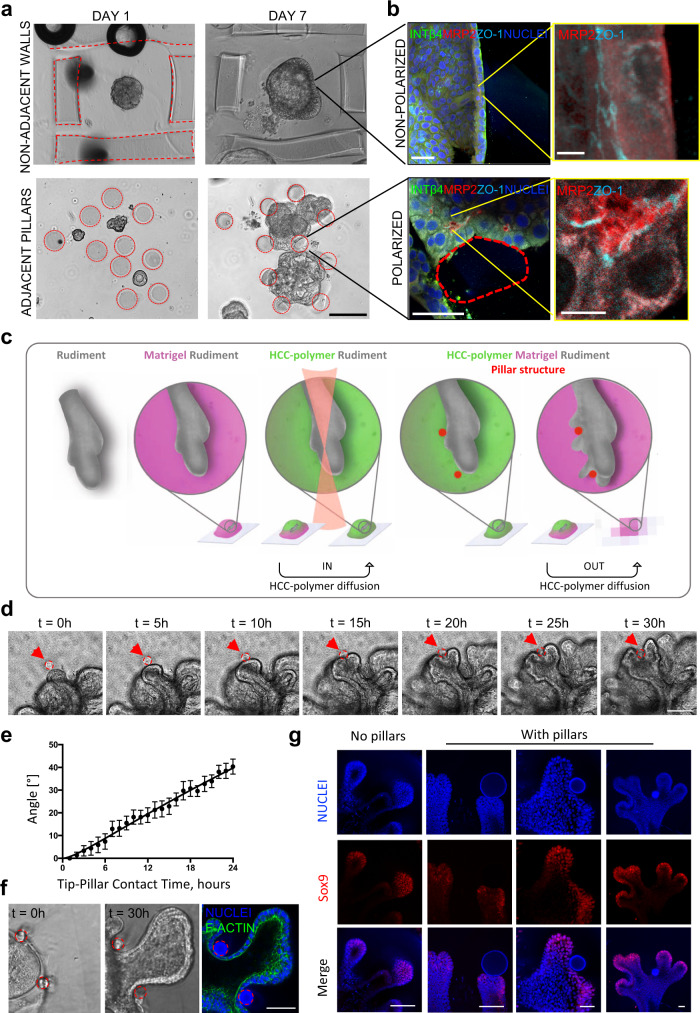
Three-dimensional hydrogel-based organ-like cultures can be applied to study development, regeneration, and disease in vitro. However, the control of engineered hydrogel composition, mechanical properties and geometrical constraints tends to be restricted to the initial time of fabrication. Modulation of hydrogel characteristics over time and according to culture evolution is often not possible. Here, we overcome these limitations by developing a hydrogel-in-hydrogel live bioprinting approach that enables the dynamic fabrication of instructive hydrogel elements within pre-existing hydrogel-based organ-like cultures. This can be achieved by crosslinking photosensitive hydrogels via two-photon absorption at any time during culture. We show that instructive hydrogels guide neural axon directionality in growing organotypic spinal cords, and that hydrogel geometry and mechanical properties control differential cell migration in developing cancer organoids. Finally, we show that hydrogel constraints promote cell polarity in liver organoids, guide small intestinal organoid morphogenesis and control lung tip bifurcation according to the hydrogel composition and shape.
Overview
The claims and statistics of this paper haven’t been checked yet.
Free: it reads the open-access text and checks the first 5 claims that cite a source we can check. Create a free account to check every claim.
Integrity signals
Registry
Cites
Statistics
Figures
Verification
Claims the paper makes
The claims and statistics of this paper haven’t been checked yet.
Free: it reads the open-access text and checks the first 5 claims that cite a source we can check. Create a free account to check every claim.
Claims other papers make about this one
Each is checked against this paper’s own text: does it say what the citing paper says it does?
The check wasn’t confident either way, so it gives no verdict — never disputed.
In the citing paper
“Another study found that structured microtissues were more stable than unstructured ones when implanted subcutaneously (Fig. 8B-D) [145].”
From Constructing biomimetic microenvironments for liver regeneration (2025) · doi:10.1186/s12951-025-03729-9 · cites this paper as [145]
Experimental — accuracy not yet measured
Self-check
Percentages, sums and reported differences re-computed from the paper’s own numbers.
The self-check needs the paper’s full text.
Citations
Cites
Single Lgr5 stem cells build crypt-villus structures in vitro without a mesenchymal niche
Sato, T., Vries, R. G., Snippert, H. J., van de Wetering, M., Barker, N., Stange, D. E., van Es, J. H., Abo, A., Kujala, P., Peters, P. J., et al. (2009) · Nature · doi:10.1038/nature07935 · Cited by 7,204
Self-citationDrost, J., & Clevers, H. (2018) · Nature Reviews Cancer · doi:10.1038/s41568-018-0007-6 · Cited by 1,790
Self-citationA reserve stem cell population in small intestine renders Lgr5-positive cells dispensable
Tian, H., Biehs, B., Warming, S., Leong, K. G., Rangell, L., Klein, O. D., & de Sauvage, F. J. (2011) · Nature · doi:10.1038/nature10408 · Cited by 1,204
Progress and potential in organoid research
Rossi, G., Manfrin, A., & Lutolf, M. P. (2018) · Nature Reviews Genetics · doi:10.1038/s41576-018-0051-9 · Cited by 1,182
Long-Term Expansion of Functional Mouse and Human Hepatocytes as 3D Organoids
Hu, H., Gehart, H., Artegiani, B., LÖpez-Iglesias, C., Dekkers, F., Basak, O., van Es, J., Chuva de Sousa Lopes, S. M., Begthel, H., Korving, J., et al. (2018) · Cell · doi:10.1016/j.cell.2018.11.013 · Cited by 837
Self-citationThe branching programme of mouse lung development
Metzger, R. J., Klein, O. D., Martin, G. R., & Krasnow, M. A. (2008) · Nature · doi:10.1038/nature07005 · Cited by 784
Homeostatic mini-intestines through scaffold-guided organoid morphogenesis
Nikolaev, M., Mitrofanova, O., Broguiere, N., Geraldo, S., Dutta, D., Tabata, Y., Elci, B., Brandenberg, N., Kolotuev, I., Gjorevski, N., et al. (2020) · Nature · doi:10.1038/s41586-020-2724-8 · Cited by 755
Self-citationThree-dimensional organotypic culture: experimental models of mammalian biology and disease
Shamir, E. R., & Ewald, A. J. (2014) · Nature Reviews Molecular Cell Biology · doi:10.1038/nrm3873 · Cited by 719
Villification: How the Gut Gets Its Villi
Shyer, A. E., Tallinen, T., Nerurkar, N. L., Wei, Z., Gil, E. S., Kaplan, D. L., Tabin, C. J., & Mahadevan, L. (2013) · Science · doi:10.1126/science.1238842 · Cited by 562
Giobbe, G. G., Crowley, C., Luni, C., Campinoti, S., Khedr, M., Kretzschmar, K., De Santis, M. M., Zambaiti, E., Michielin, F., Meran, L., et al. (2019) · Nature Communications · doi:10.1038/s41467-019-13605-4 · Cited by 500
Self-citation
Cited by
Items 101–120 of 120
Liver Organoids: From Disease Modelling to Regenerative Medicine
Wang, T., Qu, X., Si, J., Meng, J., Zhang, T., & Niu, S. (2026) · Cell Proliferation · doi:10.1111/cpr.70268 · Cited by 2
“Urciuolo et al. developed a special technique that uses a hydrogel- in-hydrogel live bioprinting approach to create instructive hydrogel elements within organoid cultures that already exist [92].”
3D bioprinting modalities for tissue engineering and regenerative medicine
Narayanan, K. B., & Han, S. S. (2026) · Advances in Colloid and Interface Science · doi:10.1016/j.cis.2026.104026 · Cited by 1
Shaping intestinal organoids: Engineering crypt curvature to guide stem cell niches
Barrile, R., & Kasendra, M. J. (2025) · Cell stem cell · doi:10.1016/j.stem.2025.03.015 · Cited by 1
Minimal-invasive 3D laser printing of microimplants in organismoPreprint
Afting, C., Mainik, P., Vazquez‐Martel, C., Abele, T., Kaul, V., Göpfrich, K., Lemke, S., Blasco, E., & Wittbrodt, J. (2024) · bioRxiv (Cold Spring Harbor Laboratory) · doi:10.1101/2024.01.23.576808 · Cited by 1
Harbuz, I., Banciu, D. D., David, R., Cercel, C., Cotîrță, O., Ciurea, B. M., Radu, S. M., Dinescu, S., Jinga, S. I., & Banciu, A. (2023) · International Journal of Molecular Sciences · doi:10.3390/ijms241914722
“Through using such technologies, blood vessels [11] and muscle-like structures [12] have been created, and these structures have been shown to organize themselves according to factors such as mechanical strength and proximity [13].”
Designer Cellular Spheroids with DNA Origami for Drug ScreeningPreprint
Pei, H., Wei, J., Sun, Y., Wang, H., Zhu, T., Li, L., Zhou, Y., Liu, Q., Dai, Z., Li, W., et al. (2023) · Research Square · doi:10.21203/rs.3.rs-3555194/v1
Cellular self-organization in hydrogels
Xie, Y. (2024) · Scientia Sinica Chimica · doi:10.1360/ssc-2024-0155
Bolaños, M. A. C. (2025) · Progress in Biomedical Engineering · doi:10.1088/2516-1091/ae2c2a · Cited by 1
“Common synthetic materials include polyethylene glycol (PEG) [40], acrylonitrile-butadiene-styrene copolymer [41], poly (2-hydroxyethyl methacrylate) [42], poly (ethylene glycol) diacrylate (PEG-DA) [43], poly-ethylene (PE) [44], polypropylene, polyamide, and polycarbonate [45].”
Controlled activin A signaling enables liver organoid generation from human pluripotent stem cells
Cotovio, J. P., Borges, A. C., Nogueira, D. E. S., Rodrigues, C. A. V., Cabral, J. M. S., & Fernandes, T. G. (2026) · iScience · doi:10.1101/2025.11.27.690974
“In our system, the appearance of a basal lamina surrounding epithelial buds suggests the establishment of hepatocyte polarity, a critical feature for liver-specific function, akin to what has been reported in hydrogel culture systems 62 .”
Organoid Perturbations as Tools to Explore Cellular Function and Plasticity
Kohl, K. E., & Busslinger, G. A. (2026) · Annual Review of Genomics and Human Genetics · doi:10.1146/annurev-genom-120324-024252 · Cited by 1
Current Cell/Organoid and Animal Models for Primary Sclerosing Cholangitis
Yao, Q., Cheng, S., Pan, Q., Yu, J., & Hongcui, C. (2026) · Portal hypertension & cirrhosis · doi:10.1002/poh2.70048
Robust generation of distal respiratory airway organoids by an engineered cuboid chip
Yin, J., Bi, Z., Dai, T., Meng, H., Shi, F., Sun, J., Xu, T., & Liu, H. (2026) · Journal of Nanobiotechnology · doi:10.1186/s12951-026-04522-y
“…regulating the 3D culture microenvironment overcomes the diffusion limitations inherent in the traditional dome structure formed by droplet gels, preventing the formation of “necrotic cores” during organoid culture and accelerating the maturation of both organoid structure and function [25, 26].”
Rodríguez‐Alonso, P., Montero-Toquero, A. I., Herrero-Fernández, S., Quintanilla‐Sierra, L., Rodríguez‐Cabello, J. C., & Santos-García, M. (2026) · European Polymer Journal · doi:10.1016/j.eurpolymj.2026.114828
Arnheim, A. D., Morales, I., Tran, A., & Carlo, D. D. (2026) · bioRxiv (Cold Spring Harbor Laboratory) · doi:10.64898/2026.08.07.741917
“23 In research settings, hydrogels are also increasingly used as defined microenvironments for cell culture, 24,25 organoid growth, 26 – 28 and assay compartmentalization.”
Biofabrication for spatial control of multiscale biological crosstalk in tissue models
Yoon, G., Kim, J., & Jang, J. (2026) · npj Biomedical Innovations. · doi:10.1038/s44385-026-00102-9 · Cited by 1
“Urciuolo et al. employed a hydrogel-in-hydrogel live bioprinting strategy that combined photosensitive hydrogels https://doi.org/10.1038/s44385-026-00102-9 with two-photon – mediated crosslinking, thereby enabling spatiotemporal control over local hydrogel geometry, stiffness, and position 143 (Fig.”
InfluentialHydrogel nanofiber-based 3D cell cultures and organoids
Tipan-Quishpe, A., Oh, C.-M., & Yoon, M. (2026) · Chemical Science · doi:10.1039/d6sc03257e
Photo‐Responsive Functional Hydrogels: Mechanism, Design, and Application
Zhu, S., Tan, D., Wu, W., Dai, J., Liu, A., & Jia, X. (2026) · Chemistry - An Asian Journal · doi:10.1002/asia.70987
Sun, K., Wang, Y., Yan, Y., Song, H., Han, F., Wang, Y., Wu, T. S., & Jiao, W. (2026) · Advanced Healthcare Materials · doi:10.1002/adhm.71751
Spatiotemporal Control of Organoid Biofabrication with Nanoengineered Bioinks
Han, S., Seo, G. M., & Park, S. (2026) · BioChip Journal · doi:10.1007/s13206-026-00282-x
Programmed photocontrol of polymer materials with multiple stimuli for fabrication and degradation
Masai, H. (2026) · Chemical Society Reviews · doi:10.1039/d6cs01019a
Metadata
- Authors
- Urciuolo, A., Giobbe, G. G., Dong, Y., Michielin, F., Brandolino, L., Magnussen, M., Gagliano, O., Selmin, G., Scattolini, V., Raffa, P., Caccin, P., Shibuya, S., Scaglioni, D., Wang, X., Qu, J., Nikolic, M., Montagner, M., Galea, G. L., Clevers, H., Giomo, M., De Coppi, P., & Elvassore, N.
- Affiliations
- University of Padua (IT)
- University College London (GB)
- ShanghaiTech University (CN)
- Città della Speranza Foundation (IT)
- F. Hoffmann-La Roche AG (CH)
- Corresponding author
- Urciuolo, Anna
- Elvassore, Nicola
- ORCID
- Urciuolo, Anna
- Giobbe, Giovanni Giuseppe
- Dong, Yixiao
- Michielin, Federica
- Magnussen, Michael
- Gagliano, Onelia
- Selmin, Giulia
- Scattolini, Valentina
- Raffa, Paolo
- Caccin, Paola
- Shibuya, Soichi
- Scaglioni, Dominic
- Wang, Xuechun
- Nikolic, Marko
- Montagner, Marco
- Galea, Gabriel L.
- Clevers, Hans
- Giomo, Monica
- De Coppi, Paolo
- Elvassore, Nicola
- Venue
- Nature Communications
- Published
- 2023-05-30
- Volume
- 14
- Issue
- 1
- Pages
- 3128-3128
- ISSN
- 2041-1723 (ISSN-L)
- PMC
- PMC10229611
- OpenAlex
- W4378783036
- Semantic Scholar
- 164566658355f04cc1022b9ebeb6e2e5c7cbdd31
- Cited by
- 121
- References
- 39
- Citations by year
- 2026: 24 · 2025: 56 · 2024: 28 · 2023: 13
- FWCI
- 9.56
- Type
- journal article
- Language
- en
- Open access
- gold
- doi.org
- Licence
- cc-by
- creativecommons.org/licenses/by/4.0 (tdm)
- creativecommons.org/licenses/by/4.0 (vor)
- Locations
- Nature Communications (publishedVersion, cc-by)
- PubMed Central (publishedVersion, cc-by)
- PubMed (publishedVersion)
- KNAW research portal (Royal Academy of Art and Sciences (KNAW)) (publishedVersion, other-oa)
- UCL Discovery (University College London) (submittedVersion, cc-by)
- Lirias (submittedVersion, cc-by)
- Padua Research Archive (University of Padova) (submittedVersion, cc-by)
- RePEc: Research Papers in Economics (submittedVersion)
- Cineca Institutional Research Information System (Tor Vergata University) (submittedVersion, other-oa)
- DOAJ (DOAJ: Directory of Open Access Journals) (submittedVersion, cc-by-sa)
- Utrecht University Repository (Utrecht University) (submittedVersion, other-oa)
- Funders
- Wellcome Trust (211112/Z/18/Z, 211112/Z/18/Z and 211112/Z/18/A, 211112, 211112/Z/18/A)
- National Institute for Health and Care Research (RP_2014-04-046)
- University College London
- Rosetrees Trust (Seedcorn2020 100052)
- Science and Technology Commission of Shanghai Municipality (21140901500)
- Università degli Studi di Padova (LS3-19613)
- Associazione Italiana per la Ricerca sul Cancro (MFAG 2021)
- Regione del Veneto
- Medical Research Council (MR/W00111X/1, MR/R015635/1, MR/S005579/1)
- Japan Society for the Promotion of Science (211112)
- NIHR Great Ormond Street Hospital Biomedical Research Centre
- HORIZON EUROPE European Research Council (101055300)
- Topics
- Physical Sciences › Engineering › Biomedical Engineering › 3D Printing in Biomedical Research
- Physical Sciences › Materials Science › Biomaterials › Hydrogels: synthesis, properties, applications
- Life Sciences › Biochemistry, Genetics and Molecular Biology › Cell Biology › Cellular Mechanics and Interactions
- Keywords
- organotypic culture, organoids, photosensitive hydrogel, axon guidance, spinal cord organoids, tumor organoids, cell migration, liver organoids, cell polarity, small intestinal organoids, hydrogel mechanical properties
- MeSH terms
- Lung, Organoids, Cell Polarity, Hydrogels, Tissue Engineering, Bioprinting
About these checks
Registry, retraction, Cites and statistics results are computed, not judged, with one exception: a printed reference that no index lists is read once by a model before it counts as a citation error. Claims are extracted by a model and kept only when their quote appears verbatim in the text; each cited source is then checked, with a model’s help, for whether it says what the claim relies on. Those verdicts can be wrong — read the claim’s quote and the cited source before relying on one.
Statistics and arithmetic are recomputed, not judged.
Confidence bands are shown only for fields calibrated on our annotated test set. None is calibrated yet, so no band is shown.
What counts as a claim ›How we measure confidence ›How we check this ›
Are you an author, or do you see a problem with this page? Request a review
Data sources
Bibliographic data: Semantic Scholar, OpenAlex, Crossref.
Contains information from the Semantic Scholar Academic Graph Datasets, made available under the ODC Attribution License (ODC-BY 1.0).
Semantic Scholar’s data is described in: Kinney, R., et al. (2023). The Semantic Scholar Open Data Platform. arXiv:2301.10140.
