

A lab-based test of the gravitational redshift with a miniature clock network
Open accessThe DOI matches its Crossref record; 55 of the 55 references it cites were found in a registry or an index.
Abstract
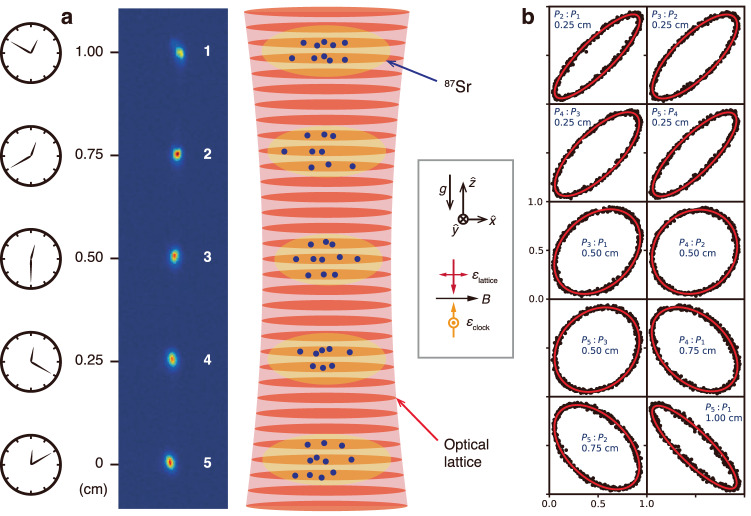
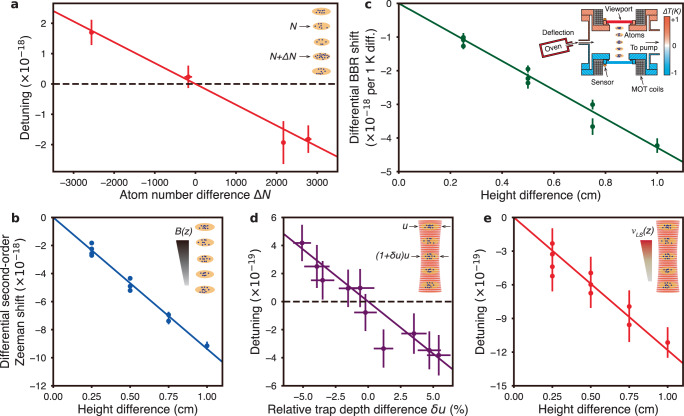
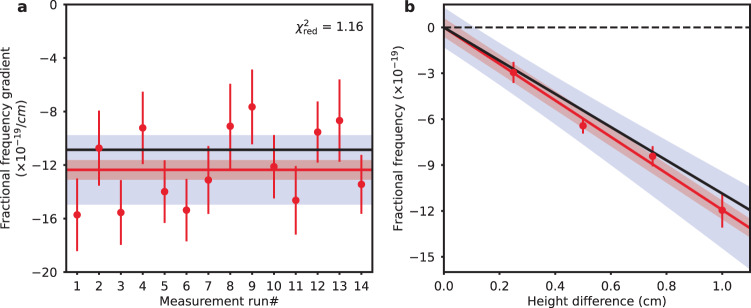
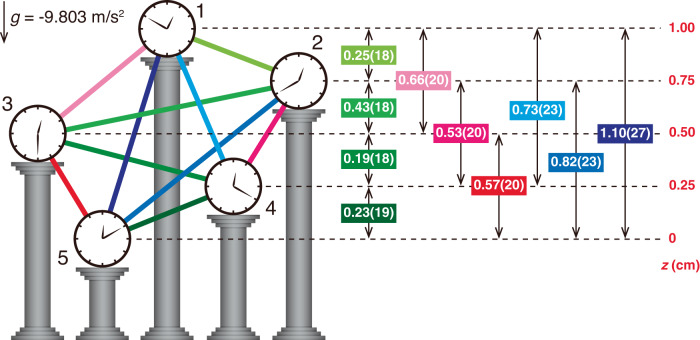
Einstein’s theory of general relativity predicts that a clock at a higher gravitational potential will tick faster than an otherwise identical clock at a lower potential, an effect known as the gravitational redshift. Here we perform a laboratory-based, blinded test of the gravitational redshift using differential clock comparisons within an evenly spaced array of 5 atomic ensembles spanning a height difference of 1 cm. We measure a fractional frequency gradient of [ − 12.4 ± 0. 7 (stat) ± 2. 5 (sys) ] × 10 −19 /cm, consistent with the expected redshift gradient of − 10.9 × 10 −19 /cm. Our results can also be viewed as relativistic gravitational potential difference measurements with sensitivity to mm scale changes in height on the surface of the Earth. These results highlight the potential of local-oscillator-independent differential clock comparisons for emerging applications of optical atomic clocks including geodesy, searches for new physics, gravitational wave detection, and explorations of the interplay between quantum mechanics and gravity.
Overview
The claims and statistics of this paper haven’t been checked yet.
Free: it reads the open-access text and checks the first 5 claims that cite a source we can check. Create a free account to check every claim.
Integrity signals
Registry
Cites
Statistics
Figures
Verification
Claims the paper makes
The claims and statistics of this paper haven’t been checked yet.
Free: it reads the open-access text and checks the first 5 claims that cite a source we can check. Create a free account to check every claim.
Claims other papers make about this one
Each is checked against this paper’s own text: does it say what the citing paper says it does?
The cited source says what the claim attributes to it.
In the citing paper
“Previously, extremely small redshifts have been resolved with optical clocks [18, 19] by differential observations in a single apparatus.”
From Long-distance chronometric leveling with a portable optical clock (2024) · cites this paper as [19]
Self-check
Percentages, sums and reported differences re-computed from the paper’s own numbers.
The self-check needs the paper’s full text.
Citations
Cites
Observation of Gravitational Waves from a Binary Black Hole Merger
Abbott, B. P., Abbott, R., Abbott, T. D., Abernathy, M. R., Acernese, F., Ackley, K., Adams, C., Adams, T., Addesso, P., Adhikari, R. X., et al. (2016) · Physical Review Letters · doi:10.1103/physrevlett.116.061102 · Cited by 14,151
The Confrontation between General Relativity and Experiment
Will, C. M. (2014) · Living Reviews in Relativity · doi:10.12942/lrr-2014-4 · Cited by 3,996
Ludlow, A. D., Boyd, M. M., Ye, J., Peik, E., & Schmidt, P. O. (2015) · Reviews of Modern Physics · doi:10.1103/revmodphys.87.637 · Cited by 2,385
Search for new physics with atoms and molecules
Safronova, M. S., Budker, D., DeMille, D., Kimball, D. F. J., Derevianko, A., & Clark, C. W. (2018) · Reviews of Modern Physics · doi:10.1103/revmodphys.90.025008 · Cited by 1,560
Observation of Gravitationally Induced Quantum Interference
Colella, R., Overhauser, A. W., & Werner, S. A. (1975) · Physical Review Letters · doi:10.1103/physrevlett.34.1472 · Cited by 1,058 · cited 2×
“These results represent an important milestone along the way to gravitational potential measurements at the sub-centimeter scale with optical atomic clocks 15,31 – 34 , and explorations of the interplay between quantum mechanics and gravity 10 – 12 .”
Dyson, F. W., Eddington, A. S., & Davidson, C. (1920) · Philosophical Transactions of the Royal Society of London. Series A, Containing Papers of a Mathematical or Physical Character · doi:10.1098/rsta.1920.0009 · Cited by 975
Chou, C. W., Hume, D. B., Rosenband, T., & Wineland, D. J. (2010) · Science · doi:10.1126/science.1192720 · Cited by 828 · cited 1×
“Recent tests of the gravitational redshift include a frequency comparison between two single-ion clocks with one of the clocks elevated by 30cm 21 , comparisons between terrestrial clocks and microwave atomic clocks in eccentric orbitswhichhaveproducedthestrongestlimitsondeviationsfromthe expected…”
A sub-40-mHz-linewidth laser based on a silicon single-crystal optical cavity
Kessler, T., Hagemann, C., Grebing, C., Legero, T., Sterr, U., Riehle, F., Martin, M. J., Chen, L., & Ye, J. (2012) · Nature Photonics · doi:10.1038/nphoton.2012.217 · Cited by 754 · cited 1×
“State-of-the-art laboratory-based optical clocks often make use of bulky and immobile reference cavities with second-scale coherence times 37 – 39 in order to achieve lower levels of clock instability and to aid in rapid systematic evaluation, limiting deployment in the fi eld.”
Atomic clock performance enabling geodesy below the centimetre level
McGrew, W. F., Zhang, X., Fasano, R. J., Schäffer, S. A., Beloy, K., Nicolodi, D., Brown, R. C., Hinkley, N., Milani, G., Schioppo, M., et al. (2018) · Nature · doi:10.1038/s41586-018-0738-2 · Cited by 727 · cited 4×
“With optical clocks now reaching instabilities and inac-curacies at the level of 10 − 18 and below 15 – 17, 26, 27 , Emerging clock applications such as relativistic geodesy require transportable optical clocks, which currently have poorer stabilities and accuracies than those of laboratory-based…”
Influential(2019) · doi:10.1103/physrevlett.123.033201 · Cited by 711
Research works printed but not linked: 5
- Einstein A Grundgedanken der allgemeinen Relativitätstheorie und Anwendung dieser Theorie in der Astronomie. Preuss. Akad. der Wissenschaften Sitzungsberichte 1915 315 778 786
- Huang Y A compact, transportable single-ion optical clock with 7.8 × 10⁻¹⁷ systematic uncertainty Appl. Phys. B 2017 123 112
- Delva P Lodewyck J Atomic clocks: new prospects in metrology and geodesy Acta Futura 2013 7 67 78
- Halir, R. & Flusser, J. Numerically stable direct least squares fitting of ellipses. Proc. of Sixth Intl Conf. Computer Graphics and Visualization 1 (1998).
- Estey, B.V.Ph. D. thesis (2016).
Cited by
Clock with 8 × 10 − 19 Systematic Uncertainty
Aeppli, A., Kim, K., Warfield, W., Safronova, M. S., & Ye, J. (2024) · Physical Review Letters · doi:10.1103/physrevlett.133.023401 · Cited by 211
Realizing spin squeezing with Rydberg interactions in an optical clock
Eckner, W. J., Oppong, N. D., Cao, A., Young, A. W., Milner, W. R., Robinson, J. M., Ye, J., & Kaufman, A. M. (2023) · Nature · doi:10.1038/s41586-023-06360-6 · Cited by 230
Quantum networks with neutral atom processing nodes
Covey, J. P., Weinfurter, H., & Bernien, H. (2023) · npj Quantum Information · doi:10.1038/s41534-023-00759-9 · Cited by 180
Long-distance chronometric leveling with a portable optical clock
Grotti, J., Nosske, I., Koller, S. B., Herbers, S., Denker, H., Timmen, L., Vishnyakova, G., Grosche, G., Waterholter, T., Kuhl, A., et al. (2024) · Physical Review Applied · doi:10.1103/physrevapplied.21.l061001 · Cited by 33
“Previously, extremely small redshifts have been resolved with optical clocks [12, 13] by differential observations in a single apparatus.”
Reducing the Instability of an Optical Lattice Clock Using Multiple Atomic Ensembles
Zheng, X., Dolde, J., & Kolkowitz, S. (2024) · Physical Review X · doi:10.1103/physrevx.14.011006 · Cited by 27
Self-citationTesting quantum theory on curved spacetime with quantum networks
Borregaard, J., & Pikovski, I. (2025) · Physical Review Research · doi:10.1103/physrevresearch.7.023192 · Cited by 28
Excited-Band Coherent Delocalization for Improved Optical Lattice Clock Performance
Siegel, J. L., McGrew, W. F., Hassan, Y. S., Chen, C.-C., Beloy, K., Grogan, T., Zhang, X., & Ludlow, A. D. (2024) · Physical Review Letters · doi:10.1103/physrevlett.132.133201 · Cited by 17
Quantum Sensing with Erasure Qubits
Niroula, P., Dolde, J., Zheng, X., Bringewatt, J., Ehrenberg, A., Cox, K. C., Thompson, J., Gullans, M. J., Kolkowitz, S., & Gorshkov, A. V. (2024) · Physical Review Letters · doi:10.1103/physrevlett.133.080801 · Cited by 27
Self-citationLattice Light Shift Evaluations in a Dual-Ensemble Yb Optical Lattice Clock
Bothwell, T., Hunt, B. D., Siegel, J. L., Hassan, Y. S., Grogan, T., Kobayashi, T., Gibble, K., Porsev, S. G., Safronova, M. S., Brown, R. C., et al. (2025) · Physical Review Letters · doi:10.1103/physrevlett.134.033201 · Cited by 18
“Modern clock performance further supports studies of fundamental physics, from searches for dark matter [10, 11] to tests of general relativity [12, 13].”
BackgroundCepollaro, C., & Giacomini, F. (2024) · Classical and Quantum Gravity · doi:10.1088/1361-6382/ad6d26 · Cited by 34
“In addition, quantum clocks can now discriminate differences in the gravitational redshift at the millimetre scale [19, 20].”
BackgroundQin, C.-G., Liu, T., Dai, X.-Y., Guo, P., Huang, W., Liu, X., Tan, Y.-J., & Shao, C.-G. (2024) · Classical and Quantum Gravity · doi:10.1088/1361-6382/ad4ae2 · Cited by 14
“Atomic clocks, based on quantum transitions, provide the best available references for time and frequency, with stability and uncertainty levels reaching 10 − 18 and even 10 − 19 [29–34].”
Chu, A., Martínez-Lahuerta, V. J., Miklos, M., Kim, K., Zoller, P., Hammerer, K., Ye, J., & Rey, A. M. (2025) · Physical Review Letters · doi:10.1103/physrevlett.134.093201 · Cited by 19
“In parallel, the resolution of the gravitational redshift using spatially separated clocks has improved from meter scales [5, 6] to sub millimeters [7, 8].”
Kim, K., Aeppli, A., Warfield, W., Chu, A., Rey, A. M., & Ye, J. (2025) · Physical Review Letters · doi:10.1103/3wtv-sty2 · Cited by 29
Quantum time dilation in a gravitational field
Paczos, J., Dębski, K., Grochowski, P. T., Smith, A. R. H., & Dragan, A. (2024) · Quantum · doi:10.22331/q-2024-05-07-1338 · Cited by 20
Finite pulse-time effects in long-baseline quantum clock interferometry
Janson, G., Friedrich, A., & Lopp, R. (2024) · AVS Quantum Science · doi:10.1116/5.0178230 · Cited by 9
“All aspects of the equivalence principle have proven to be extremely resilient to experimental challenges over an extremely large regime ranging from the microscopic to the cosmic scale 32–44 .”
BackgroundTesting screened scalar-tensor theories of gravity with atomic clocks
Lévy, H., & Uzan, J. (2025) · Physical review. D/Physical review. D. · doi:10.1103/physrevd.111.064012 · Cited by 11
“Provided that the boxes are big enough for the field to reach ϕ min in their interior, the previously exposed qualitative arguments of this thought experiment shall remain valid.”
Witnessing mass-energy equivalence with trapped atom interferometers
Paczos, J., Foo, J., & Zych, M. (2025) · Quantum · doi:10.22331/q-2025-08-08-1827 · Cited by 5
“While, to the best of our knowledge, the 1 s is the longest that has been achieved for strontium atoms so far, experiments with minute-scale oscillation times have been performed using cesium atoms [21, 22] (with these atoms, however, the frequency ω 0 is much smaller, so the effect would be even…”
Direct measurement of the P 0 3 clock state natural lifetime in Sr 87
Dolde, J., Ganapathy, D., Zheng, X., Ma, S., Beloy, K., & Kolkowitz, S. (2025) · Physical Review A · doi:10.1103/f6pt-flnt · Cited by 7
Self-citationAfanasiev, A. E., Skakunenko, P. I., Bykova, D. V., Kalmykov, A. S., & Balykin, V. I. (2024) · Physics-Uspekhi · doi:10.3367/ufne.2024.09.039752 · Cited by 5
Lifetime measurement of the 5 s 5 p 1 P 1 state in strontium
Puljić, I., Cipris, A., Aumiler, D., Ban, T., & Šantić, N. (2025) · Physical Review A · doi:10.1103/physreva.111.032809 · Cited by 5
“These levels of accuracy not only put Sr as one of the leading candidate elements for the re-definition of the second [2], but also promise to advance geodesy [3–9], impose constraints on dark matter models [10–14] and on the variation of fundamental constants [15, 16].”
Okamoto, N., Aoki, T., & Torii, Y. (2025) · Physical Review A · doi:10.1103/j7s7-b7mj · Cited by 5
“…a cornerstone in diverse areas of modern atomic physics, including precision metrology [1–9], tests of special relativity [10], gravitational redshift measurements [11–13], quantum simulation [14], quantum information [15], gravitational wave detection [16, 17], and search for dark matter [17, 18].”
Josephson’s effect in the Schwarzschild background
Pantig, R. C., & Övgün, A. (2026) · Journal of High Energy Physics · doi:10.1007/jhep02(2026)006 · Cited by 5
“On the metrology side, weak-field signatures align with redshift and AB-type tests in atom-based platforms [13, 14, 26, 27].”
Limitation of single-repumping schemes for laser cooling of Sr atoms
Okamoto, N., Aoki, T., & Torii, Y. (2024) · Physical Review Research · doi:10.1103/physrevresearch.6.043088 · Cited by 6
“…a diverse array of applications such as precision measurements [1–8], tests of special relativity [9], detection of gravitational redshift [10–12], quantum simulation [13], quantum information [14] and search for fundamental physics [15], including gravitational wave detection [16, 17] and…”
BackgroundQuantum sensing using atomic clocks for nuclear and particle physics
Kawasaki, A. (2025) · Applied Physics Reviews · doi:10.1063/5.0273813 · Cited by 10
Test of the gravitational redshift with single-photon-based atomic clock interferometers
Liu, J., Xu, Y., Luo, H.-Q., Cao, L., Zhou, M.-K., Duan, X., & Hu, Z.-K. (2024) · Quantum Frontiers · doi:10.1007/s44214-024-00049-1 · Cited by 5
Wu, K., Shen, W.-B., Fok, H. S., Lian, Z., Zhang, P., Li, L., Wang, L., Ning, A., Xu, R. L., & Shen, Z. (2025) · Advances in Space Research · doi:10.1016/j.asr.2025.10.010 · Cited by 4
Lieb-Mattis States for Robust Entangled Differential Phase Sensing
Kaubruegger, R., Padilla, D. F., Shankar, A., Hotter, C., Muleady, S. R., Bringewatt, J., Baamara, Y., Abbasgholinejad, E., Gorshkov, A. V., Mølmer, K., et al. (2026) · Physical Review X · doi:10.1103/ksyh-mb4s · Cited by 9
“Moreover, the performance of unentangled probes can often be effectively restored through classical post-processing techniques—such as ellipse fitting [27]—which are routinely employed in differential atom interferometry and optical atomic clocks [2, 12, 21, 22, 28–32].”
InfluentialEnhancing Optical Lattice Clock Coherence Times with Erasure Conversion
Ma, S., Dolde, J., Zheng, X., Ganapathy, D., Shtov, A., Chen, J., Stöltzel, A., Christensen, B. J., & Kolkowitz, S. (2025) · PRX Quantum · doi:10.1103/2rqf-r9gw · Cited by 8
“The experimental setup used here is similar to the apparatus described in our previous work [11].”
Self-citationDirect loading of a Sr magneto-optical trap from a thermal atomic beam
Okamoto, N., Sato, T., Aoki, T., & Torii, Y. (2026) · Review of Scientific Instruments · doi:10.1063/5.0311769 · Cited by 3
“These features offer diverse applications, including precision measurements 1–8 , tests of special relativity 9 , probing of gravitational redshift 10–12 , quantum simulation 13 , quantum information 14–16 , detection of gravitational waves 17,18 , and search for dark matter 18,19 .”
171 Yb optical lattice clock with uncertainty below 5×10 −18
Zhang, T., Jin, T., 戚其超, Lei, S., Xia, Y., Zhang, J., Chang, H., Feng, S., Liu, X., Wang, J., et al. (2026) · Metrologia · doi:10.1088/1681-7575/ae4aaf · Cited by 3
Ruby, A., Shen, W., Shaker, A., Zhang, P., Wu, K., Ashry, M., & Shen, Z. (2026) · Universe · doi:10.3390/universe12030082 · Cited by 1
Aghanim, A., Oukaira, A., Lasri, R., Oulhaj, O., Zbitou, J., Guermal, M., Esshaimi, Y., Meziani, K., & Aziz, N. E. (2026) · Sensors and Actuators A Physical · doi:10.1016/j.sna.2026.117864 · Cited by 2
Afanas'ev, A. E., Skakunenko, P. I., Bykova, D. V., Kalmykov, A. S., & Balykin, V. I. (2024) · Uspekhi Fizicheskih Nauk · doi:10.3367/ufnr.2024.09.039752 · Cited by 1
Laser-cooling Cadmium Bosons and Fermions with Near Ultraviolet Triplet Excitations
Gibble, K. (2024) · Journal of Physics Conference Series · doi:10.1088/1742-6596/2889/1/012006 · Cited by 4
Physics news on the Internet: October 2023
Eroshenko, Y. N. (2023) · Uspekhi Fizicheskih Nauk · doi:10.3367/ufnr.2023.09.039551
Physics news on the Internet: October 2023
Eroshenko, Y. N. (2023) · Physics-Uspekhi · doi:10.3367/ufne.2023.09.039551
Duty cycle engineering for improved optical lattice clock stability
Butuc-Mayer, F., Johnson, M., Feng, C.-H., Bowden, W., Hobson, R., & Hill, I. R. (2024) · Journal of Physics Conference Series · doi:10.1088/1742-6596/2889/1/012049
Jingjing, 夏. X., Feng, 郭. G., Yanyan, 刘. L., Lu, X., & Chang, H. (2025) · Acta Optica Sinica · doi:10.3788/aos241628 · Cited by 2
Effects of gravitational time dilation on multi-photon interference
Yang, Y. (2025) · Optics Express · doi:10.1364/oe.574667 · Cited by 1
Low-frequency fiber-optic vibration sensing with a Floquet-engineered optical lattice clock
Yin, M.-J., Wang, R., Zhou, R., Qiao, X., & Zhang, S. (2026) · Chinese Optics Letters · doi:10.3788/col202624.090201
“Neutral atom optical lattice clocks have achieved unprecedented frequency stability and accuracy, enabling a wide range of precision measurements beyond time and frequency metrology, including relativistic geodesy, gravitational-wave detection, and dark-matter searches [1 – 5] .”
Experimental setup of NTSC SrII optical lattice clock
郭, F. 峰. G., 李, J.-A. 家. L., 刘, Y.-Y. 艳. L., 卢, X.-T. 晓. L., & Chang, H. (2025) · Chinese Physics B · doi:10.1088/1674-1056/adecfd · Cited by 1
Ultracold-atom gyroscope based on a spiral Bessel beam
Lv, X., Wang, Z., & Lin, Q. (2026) · Photonics Research · doi:10.1364/prj.584016
Limits to the Validity of Gravitational Redshift as a Quantum-optical Multimode Mixer
Leber, N., Rodríguez, L. A. A., Ferreri, A., Schell, A. W., & Bruschi, D. E. (2026) · International Journal of Theoretical Physics · doi:10.1007/s10773-026-06297-2 · Cited by 2
Direct measurement of the 5 s 5 p P 1 1 → 5 s 4 d D 2 1 decay rate in strontium
Okamoto, N., Aoki, T., & Torii, Y. (2026) · Physical Review A · doi:10.1103/8b7c-l2jl · Cited by 4
“…transitions, enabling a broad range of applications, including precision metrology [1–8], tests of special relativity [9], measurements of gravitational redshift [10–12], quantum simulation [13], quantum information [14], gravitational wave detection [15, 16], and search for dark matter [16, 17].”
Toward high-efficiency repumping for ultra-stable Yb inner-shell optical lattice clocks
Feng, S., Jin, T., Zhang, T., Lei, S., Zhang, J., Xia, Y., Chang, H., Liu, X., Zhang, R., Pan, Y., et al. (2026) · Applied Physics Letters · doi:10.1063/5.0325272
Demonstration of an Optical Atomic Clock with an Integrated Laser
Morrow, W., Scholten, S. K., Griesser, H., Ratschbacher, L., Perrella, C., Hebert, N. B., Haerteis, L.-S., Jung, S., Pointon, L., Billington, C. J., et al. (2026) · ACS Photonics · doi:10.1021/acsphotonics.6c00958
Geometric Phase-Induced Stückelberg Interference in an Optical Lattice Clock
Liu, W.-X., Lu, Z.-P., & Wang, T. (2026) · Entropy · doi:10.3390/e28080931
“As one of the most precise measurement platforms, the OLC has made considerable progress over the past few years [39–43], and supports a wide range of applications including gravitational redshift tests [44,45], verification of relativistic effects [46,47], and detections of dark matter [48].”
Metadata
- Authors
- Zheng, X., Dolde, J., Cambria, M. C., Lim, H. M., & Kolkowitz, S.
- Affiliations
- University of Wisconsin–Madison (US)
- Corresponding author
- Kolkowitz, Shimon
- Venue
- Nature Communications
- Published
- 2023-08-12
- Volume
- 14
- Issue
- 1
- Pages
- 4886-4886
- ISSN
- 2041-1723 (ISSN-L)
- PMC
- PMC10423269
- OpenAlex
- W4385784013
- Semantic Scholar
- 013d25ddd53dbde893ff961df7b851593c3ebbe1
- Cited by
- 47
- References
- 53
- Citations by year
- 2026: 13 · 2025: 15 · 2024: 15 · 2023: 4
- FWCI
- 5.45
- Type
- journal article
- Language
- en
- Open access
- gold
- doi.org
- Licence
- cc-by
- creativecommons.org/licenses/by/4.0 (tdm)
- creativecommons.org/licenses/by/4.0 (vor)
- Locations
- Nature Communications (publishedVersion, cc-by)
- PubMed Central (publishedVersion, cc-by)
- PubMed (publishedVersion)
- arXiv (Cornell University) (submittedVersion)
- eScholarship (California Digital Library) (submittedVersion, cc-by)
- RePEc: Research Papers in Economics (submittedVersion)
- DOAJ (DOAJ: Directory of Open Access Journals) (submittedVersion, cc-by-sa)
- arXiv (Cornell University) (cc-by)
- Funders
- United States Department of Commerce | National Institute of Standards and Technology
- John Templeton Foundation
- David and Lucile Packard Foundation
- United States Department of Defense | United States Army | U.S. Army Research, Development and Engineering Command | Army Research Office (W911NF-21-1-0012)
- NSF | Directorate for Mathematical & Physical Sciences | Division of Physics (2143870)
- Alfred P. Sloan Foundation
- Northwestern University Center for Fundamental Physics Wisconsin Alumni Research Foundation
- Topics
- Physical Sciences › Physics and Astronomy › Atomic and Molecular Physics, and Optics › Advanced Frequency and Time Standards
- Physical Sciences › Physics and Astronomy › Astronomy and Astrophysics › Relativity and Gravitational Theory
- Physical Sciences › Physics and Astronomy › Astronomy and Astrophysics › Pulsars and Gravitational Waves Research
- Keywords
- gravitational redshift, general relativity, optical atomic clocks, clock distribution, frequency gradient, geodesy
About these checks
Registry, retraction, Cites and statistics results are computed, not judged, with one exception: a printed reference that no index lists is read once by a model before it counts as a citation error. Claims are extracted by a model and kept only when their quote appears verbatim in the text; each cited source is then checked, with a model’s help, for whether it says what the claim relies on. Those verdicts can be wrong — read the claim’s quote and the cited source before relying on one.
Statistics and arithmetic are recomputed, not judged.
Confidence bands are shown only for fields calibrated on our annotated test set. None is calibrated yet, so no band is shown.
What counts as a claim ›How we measure confidence ›How we check this ›
Are you an author, or do you see a problem with this page? Request a review
Data sources
Bibliographic data: Semantic Scholar, OpenAlex, Crossref.
Contains information from the Semantic Scholar Academic Graph Datasets, made available under the ODC Attribution License (ODC-BY 1.0).
Semantic Scholar’s data is described in: Kinney, R., et al. (2023). The Semantic Scholar Open Data Platform. arXiv:2301.10140.
