

A lab-based test of the gravitational redshift with a miniature clock network
Open accessThe DOI matches its Crossref record; 55 of the 55 references it cites were found in a registry or an index.
Abstract
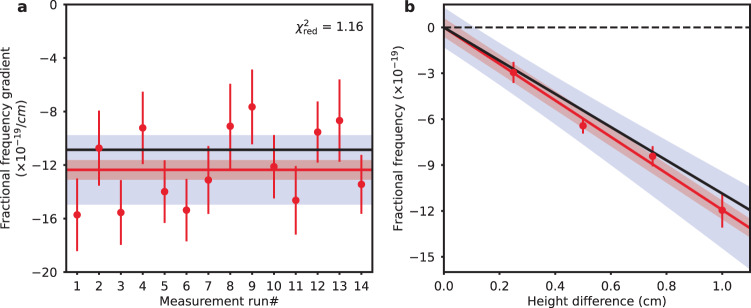
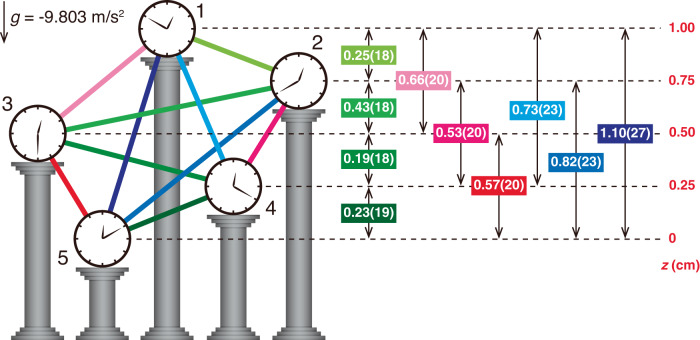
Einstein’s theory of general relativity predicts that a clock at a higher gravitational potential will tick faster than an otherwise identical clock at a lower potential, an effect known as the gravitational redshift. Here we perform a laboratory-based, blinded test of the gravitational redshift using differential clock comparisons within an evenly spaced array of 5 atomic ensembles spanning a height difference of 1 cm. We measure a fractional frequency gradient of [ − 12.4 ± 0. 7 (stat) ± 2. 5 (sys) ] × 10 −19 /cm, consistent with the expected redshift gradient of − 10.9 × 10 −19 /cm. Our results can also be viewed as relativistic gravitational potential difference measurements with sensitivity to mm scale changes in height on the surface of the Earth. These results highlight the potential of local-oscillator-independent differential clock comparisons for emerging applications of optical atomic clocks including geodesy, searches for new physics, gravitational wave detection, and explorations of the interplay between quantum mechanics and gravity.
Overview
The claims and statistics of this paper haven’t been checked yet.
Free: it reads the open-access text and checks the first 5 claims that cite a source we can check. Create a free account to check every claim.
Integrity signals
Registry
Cites
Statistics
Figures
Verification
Claims the paper makes
The claims and statistics of this paper haven’t been checked yet.
Free: it reads the open-access text and checks the first 5 claims that cite a source we can check. Create a free account to check every claim.
Claims other papers make about this one
Each is checked against this paper’s own text: does it say what the citing paper says it does?
The cited source says what the claim attributes to it.
In the citing paper
“Previously, extremely small redshifts have been resolved with optical clocks [18, 19] by differential observations in a single apparatus.”
From Long-distance chronometric leveling with a portable optical clock (2024) · cites this paper as [19]
Self-check
Percentages, sums and reported differences re-computed from the paper’s own numbers.
The self-check needs the paper’s full text.
Citations
Cites
Observation of Gravitational Waves from a Binary Black Hole Merger
Abbott, B. P., Abbott, R., Abbott, T. D., Abernathy, M. R., Acernese, F., Ackley, K., Adams, C., Adams, T., Addesso, P., Adhikari, R. X., et al. (2016) · Physical Review Letters · doi:10.1103/physrevlett.116.061102 · Cited by 14,151
The Confrontation between General Relativity and Experiment
Will, C. M. (2014) · Living Reviews in Relativity · doi:10.12942/lrr-2014-4 · Cited by 3,996
Ludlow, A. D., Boyd, M. M., Ye, J., Peik, E., & Schmidt, P. O. (2015) · Reviews of Modern Physics · doi:10.1103/revmodphys.87.637 · Cited by 2,385
Search for new physics with atoms and molecules
Safronova, M. S., Budker, D., DeMille, D., Kimball, D. F. J., Derevianko, A., & Clark, C. W. (2018) · Reviews of Modern Physics · doi:10.1103/revmodphys.90.025008 · Cited by 1,560
Observation of Gravitationally Induced Quantum Interference
Colella, R., Overhauser, A. W., & Werner, S. A. (1975) · Physical Review Letters · doi:10.1103/physrevlett.34.1472 · Cited by 1,058 · cited 2×
“These results represent an important milestone along the way to gravitational potential measurements at the sub-centimeter scale with optical atomic clocks 15,31 – 34 , and explorations of the interplay between quantum mechanics and gravity 10 – 12 .”
Dyson, F. W., Eddington, A. S., & Davidson, C. (1920) · Philosophical Transactions of the Royal Society of London. Series A, Containing Papers of a Mathematical or Physical Character · doi:10.1098/rsta.1920.0009 · Cited by 975
Chou, C. W., Hume, D. B., Rosenband, T., & Wineland, D. J. (2010) · Science · doi:10.1126/science.1192720 · Cited by 828 · cited 1×
“Recent tests of the gravitational redshift include a frequency comparison between two single-ion clocks with one of the clocks elevated by 30cm 21 , comparisons between terrestrial clocks and microwave atomic clocks in eccentric orbitswhichhaveproducedthestrongestlimitsondeviationsfromthe expected…”
A sub-40-mHz-linewidth laser based on a silicon single-crystal optical cavity
Kessler, T., Hagemann, C., Grebing, C., Legero, T., Sterr, U., Riehle, F., Martin, M. J., Chen, L., & Ye, J. (2012) · Nature Photonics · doi:10.1038/nphoton.2012.217 · Cited by 754 · cited 1×
“State-of-the-art laboratory-based optical clocks often make use of bulky and immobile reference cavities with second-scale coherence times 37 – 39 in order to achieve lower levels of clock instability and to aid in rapid systematic evaluation, limiting deployment in the fi eld.”
Atomic clock performance enabling geodesy below the centimetre level
McGrew, W. F., Zhang, X., Fasano, R. J., Schäffer, S. A., Beloy, K., Nicolodi, D., Brown, R. C., Hinkley, N., Milani, G., Schioppo, M., et al. (2018) · Nature · doi:10.1038/s41586-018-0738-2 · Cited by 727 · cited 4×
“With optical clocks now reaching instabilities and inac-curacies at the level of 10 − 18 and below 15 – 17, 26, 27 , Emerging clock applications such as relativistic geodesy require transportable optical clocks, which currently have poorer stabilities and accuracies than those of laboratory-based…”
Influential(2019) · doi:10.1103/physrevlett.123.033201 · Cited by 711
Single-Ion Atomic Clock with 3 × 10 − 18 Systematic Uncertainty
Huntemann, N., Sanner, C., Lipphardt, B., Tamm, C., & Peik, E. (2016) · Physical Review Letters · doi:10.1103/physrevlett.116.063001 · Cited by 677
Cryogenic optical lattice clocks
Ushijima, I., Takamoto, M., Das, M., Ohkubo, T., & Katori, H. (2015) · Nature Photonics · doi:10.1038/nphoton.2015.5 · Cited by 627
Around-the-World Atomic Clocks: Predicted Relativistic Time Gains
Hafele, J. C., & Keating, R. E. (1972) · Science · doi:10.1126/science.177.4044.166 · Cited by 565 · cited 1×
“Thankstorapidadvancementsintheirstability andaccuracy 13 – 19 , atomic clocks have now enabled tests of the gravitationalredshift over a wide range of length scales 20 – 25 .”
A confirmation of the general relativistic prediction of the Lense–Thirring effect
Ciufolini, I., & Pavlis, E. C. (2004) · Nature · doi:10.1038/nature03007 · Cited by 528
Hunting for topological dark matter with atomic clocks
Derevianko, A., & Pospelov, M. (2014) · Nature Physics · doi:10.1038/nphys3137 · Cited by 522
Test of general relativity by a pair of transportable optical lattice clocks
Takamoto, M., Ushijima, I., Ohmae, N., Yahagi, T., Kokado, K., Shinkai, H., & Katori, H. (2020) · Nature Photonics · doi:10.1038/s41566-020-0619-8 · Cited by 507
Geodesy and metrology with a transportable optical clock
Grotti, J., Koller, S., Vogt, S., Häfner, S., Sterr, U., Lisdat, C., Denker, H., Voigt, C., Timmen, L., Rolland, A., et al. (2018) · Nature Physics · doi:10.1038/s41567-017-0042-3 · Cited by 495 · cited 4×
“The measurement of gravitational potential differences between clocks with sub-centimeter resolution is a major goal of relativistic geodesy 15,31 – 34 .”
InfluentialDemonstration of 4.8 × 10⁻¹⁷ stability at 1 s for two independent optical clocks
Oelker, E., Hutson, R. B., Kennedy, C. J., Sonderhouse, L., Bothwell, T., Goban, A., Kedar, D., Sanner, C., Robinson, J. M., Marti, G. E., et al. (2019) · Nature Photonics · doi:10.1038/s41566-019-0493-4 · Cited by 475
Resolving the gravitational redshift across a millimetre-scale atomic sample
Bothwell, T., Kennedy, C. J., Aeppli, A., Kedar, D., Robinson, J. M., Oelker, E., Staron, A., & Ye, J. (2022) · Nature · doi:10.1038/s41586-021-04349-7 · Cited by 449 · cited 5×
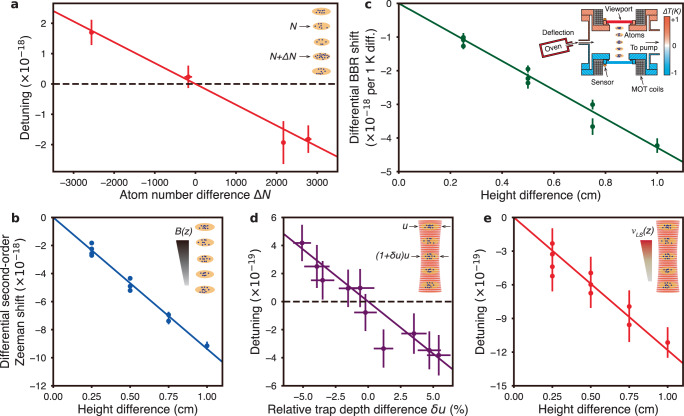
“…be accomplished by mitigating density shifts via operating at “ magic ” excitation fractions (as was recently demonstrated within a single ensemble 25 ) or through modi fi cations to the lattice geometry 19 , reducing the differential tensor lattice light shift by eliminating background magnetic fi…”
InfluentialTesting General Relativity with Pulsar Timing
Stairs, I. H. (2003) · Living Reviews in Relativity · doi:10.12942/lrr-2003-5 · Cited by 430 · cited 1×
“Einstein ’ s theory of generalrelativity 1 hasthus far been consistent with every experimental test performed 2 , including classical 3,4 , modern 5,6 and strong fi eld cosmological tests 7 – 9 .”
Quantum superposition at the half-metre scale
Kovachy, T., Asenbaum, P., Overstreet, C., Donnelly, C. A., Dickerson, S. M., Sugarbaker, A., Hogan, J. M., & Kasevich, M. A. (2015) · Nature · doi:10.1038/nature16155 · Cited by 410 · cited 1×
“…separations between ensembles on the scale of roughly 1m, a scale of laboratory atomic physics experiment that has already been demonstrated with atom interferometers 55 , which would offer an increase in the magnitude of the redshift by a factor of 100× over the separations used in this work.”
Gravitational wave detection with optical lattice atomic clocks
Kolkowitz, S., Pikovski, I., Langellier, N., Lukin, M. D., Walsworth, R. L., & Ye, J. (2016) · Physical Review D · doi:10.1103/physrevd.94.124043 · Cited by 396
Self-citationGravitational Red-Shift in Nuclear Resonance
Pound, R. V., & Rebka, G. A. (1959) · Physical Review Letters · doi:10.1103/physrevlett.3.439 · Cited by 389 · cited 1×
“Einstein ’ s theory of generalrelativity 1 hasthus far been consistent with every experimental test performed 2 , including classical 3,4 , modern 5,6 and strong fi eld cosmological tests 7 – 9 .”
Ultrastable optical clock with two cold-atom ensembles
Schioppo, M., Brown, R. C., McGrew, W. F., Hinkley, N., Fasano, R. J., Beloy, K., Yoon, T. H., Milani, G., Nicolodi, D., Sherman, J. A., et al. (2017) · Nature Photonics · doi:10.1038/nphoton.2016.231 · Cited by 385
A Fermi-degenerate three-dimensional optical lattice clock
Campbell, S. L., Hutson, R. B., Marti, G. E., Goban, A., Darkwah Oppong, N., McNally, R. L., Sonderhouse, L., Robinson, J. M., Zhang, W., Bloom, B. J., et al. (2017) · Science · doi:10.1126/science.aam5538 · Cited by 384
Spectroscopic observation of SU( N )-symmetric interactions in Sr orbital magnetism
Zhang, X., Bishof, M., Bromley, S. L., Kraus, C. V., Safronova, M. S., Zoller, P., Rey, A. M., & Ye, J. (2014) · Science · doi:10.1126/science.1254978 · Cited by 370 · cited 1×
“Einstein’s theory of general relativity [1] has thus far been consistent with every experimental test performed [2], including classical [3, 4], modern [5, 6] and strong field cosmological tests [7–9].”
JILA SrI optical lattice clock with uncertainty of 2.0 × 10 − 18
Bothwell, T., Kedar, D., Oelker, E., Robinson, J. M., Bromley, S. L., Tew, W. L., Ye, J., & Kennedy, C. J. (2019) · Metrologia · doi:10.1088/1681-7575/ab4089 · Cited by 324
Indirect Evidence for Quantum Gravity
Page, D. N., & Geilker, C. D. (1981) · Physical Review Letters · doi:10.1103/physrevlett.47.979 · Cited by 315
Mehlstäubler, T. E., Grosche, G., Lisdat, C., Schmidt, P. O., & Denker, H. (2018) · Reports on Progress in Physics · doi:10.1088/1361-6633/aab409 · Cited by 263
Quantum interferometric visibility as a witness of general relativistic proper time
Zych, M., Costa, F., Pikovski, I., & Brukner, Č. (2011) · Nature Communications · doi:10.1038/ncomms1498 · Cited by 249 · cited 2×
“These results represent an important milestone along the way to gravitational potential measurements at the sub-centimeter scale with optical atomic clocks 15,31 – 34 , and explorations of the interplay between quantum mechanics and gravity 10 – 12 .”
Geopotential measurements with synchronously linked optical lattice clocks
Takano, T., Takamoto, M., Ushijima, I., Ohmae, N., Akatsuka, T., Yamaguchi, A., Kuroishi, Y., Munekane, H., Miyahara, B., & Katori, H. (2016) · Nature Photonics · doi:10.1038/nphoton.2016.159 · Cited by 245 · cited 2×
“…now reaching instabilities and inac-curacies at the level of 10 − 18 and below 15 – 17, 26, 27 , Emerging clock applications such as relativistic geodesy require transportable optical clocks, which currently have poorer stabilities and accuracies than those of laboratory-based clocks 32,34,36 .”
Transportable Optical Lattice Clock with 7 × 10 − 17 Uncertainty
Koller, S. B., Grotti, J., Vogt, S., Al-Masoudi, A., Dörscher, S., Häfner, S., Sterr, U., & Lisdat, C. (2017) · Physical Review Letters · doi:10.1103/physrevlett.118.073601 · Cited by 238
Kennedy, C. J., Oelker, E., Robinson, J. M., Bothwell, T., Kedar, D., Milner, W. R., Marti, G. E., Derevianko, A., & Ye, J. (2020) · Physical Review Letters · doi:10.1103/physrevlett.125.201302 · Cited by 219 · cited 1×
“…as differential spectroscopy by phase-coherently linking a zero-dead-time optical lattice clock and a single ion clock 44 , allow interrogation times beyond the limit set by the local oscillators, opening up the prospects for future applications with transportable or space-based clocks 45 – 49 .”
Gravitational Redshift Test Using Eccentric Galileo Satellites
Delva, P., Puchades, N., Schönemann, E., Dilssner, F., Courde, C., Bertone, S., Gonzalez, F., Hees, A., Le Poncin-Lafitte, C., Meynadier, F., et al. (2018) · Physical Review Letters · doi:10.1103/physrevlett.121.231101 · Cited by 210 · cited 3×
“…between terrestrial clocks and microwave atomic clocks in eccentric orbitswhichhaveproducedthestrongestlimitsondeviationsfromthe expected redshift 22,23 , a frequency comparison between two synchronously linked portable 87 Sr optical lattice clocks with a 450m height difference at the Tokyo…”
A Quantum Many-Body Spin System in an Optical Lattice Clock
Martin, M. J., Bishof, M., Swallows, M. D., Zhang, X., Benko, C., von-Stecher, J., Gorshkov, A. V., Rey, A. M., & Ye, J. (2013) · Science · doi:10.1126/science.1236929 · Cited by 196 · cited 1×
“First, atomicinteractions due to p -wave collisions between on-site atoms lead to a frequency shift that scales linearly with atomic density 52 – 54 .”
Imaging Optical Frequencies with 100 μHz Precision and 1.1 μm Resolution
Marti, G. E., Hutson, R. B., Goban, A., Campbell, S. L., Poli, N., & Ye, J. (2018) · Physical Review Letters · doi:10.1103/physrevlett.120.103201 · Cited by 189
The Relativity Effect in Planetary Motions
Clemence, G. M. (1947) · Reviews of Modern Physics · doi:10.1103/revmodphys.19.361 · Cited by 187
Nuclear spin effects in optical lattice clocks
Boyd, M. M., Zelevinsky, T., Ludlow, A. D., Blatt, S., Zanon-Willette, T., Foreman, S. M., & Ye, J. (2007) · Physical Review A · doi:10.1103/physreva.76.022510 · Cited by 186 · cited 2×
“Einstein’s theory of general relativity [1] has thus far been consistent with every experimental test performed [2], including classical [3, 4], modern [5, 6] and strong field cosmological tests [7–9].”
Test of the Gravitational Redshift with Galileo Satellites in an Eccentric Orbit
Herrmann, S., Finke, F., Lülf, M., Kichakova, O., Puetzfeld, D., Knickmann, D., List, M., Rievers, B., Giorgi, G., Günther, C., et al. (2018) · Physical Review Letters · doi:10.1103/physrevlett.121.231102 · Cited by 175 · cited 3×
“When combined, such an experiment would promise constraints on α at the 10 − 4 level, indicating that laboratory-based tests of the gravitational redshift could soon be competitive with space-based tests 22,23 or tests with portable clocks 24 .”
Crystalline optical cavity at 4 K with thermal-noise-limited instability and ultralow drift
Robinson, J. M., Oelker, E., Milner, W. R., Zhang, W., Legero, T., Matei, D. G., Riehle, F., Sterr, U., & Ye, J. (2019) · Optica · doi:10.1364/optica.6.000240 · Cited by 175 · cited 1×
“State-of-the-art laboratory-based optical clocks often make use of bulky and immobile reference cavities with second-scale coherence times 37 – 39 in order to achieve lower levels of clock instability and to aid in rapid systematic evaluation, limiting deployment in the fi eld.”
Universality of free fall from the orbital motion of a pulsar in a stellar triple system
Archibald, A. M., Gusinskaia, N. V., Hessels, J. W. T., Deller, A. T., Kaplan, D. L., Lorimer, D. R., Lynch, R. S., Ransom, S. M., & Stairs, I. H. (2018) · Nature · doi:10.1038/s41586-018-0265-1 · Cited by 163
New bounds on dark matter coupling from a global network of optical atomic clocks
Wcisło, P., Ablewski, P., Beloy, K., Bilicki, S., Bober, M., Brown, R., Fasano, R., Ciuryło, R., Hachisu, H., Ido, T., et al. (2018) · Science Advances · doi:10.1126/sciadv.aau4869 · Cited by 159
Frequency comparison of optical lattice clocks beyond the Dick limit
Takamoto, M., Takano, T., & Katori, H. (2011) · Nature Photonics · doi:10.1038/nphoton.2011.34 · Cited by 154 · cited 1×
“It has recently been demonstrated that differential measurements between single ions 40 and neutral atom ensembles 41 – 43 , as well as differential spectroscopy by phase-coherently linking a zero-dead-time optical lattice clock and a single ion clock 44 , allow interrogation times beyond the limit…”
Differential clock comparisons with a multiplexed optical lattice clock
Zheng, X., Dolde, J., Lochab, V., Merriman, B. N., Li, H., & Kolkowitz, S. (2022) · Nature · doi:10.1038/s41586-021-04344-y · Cited by 150 · cited 5×
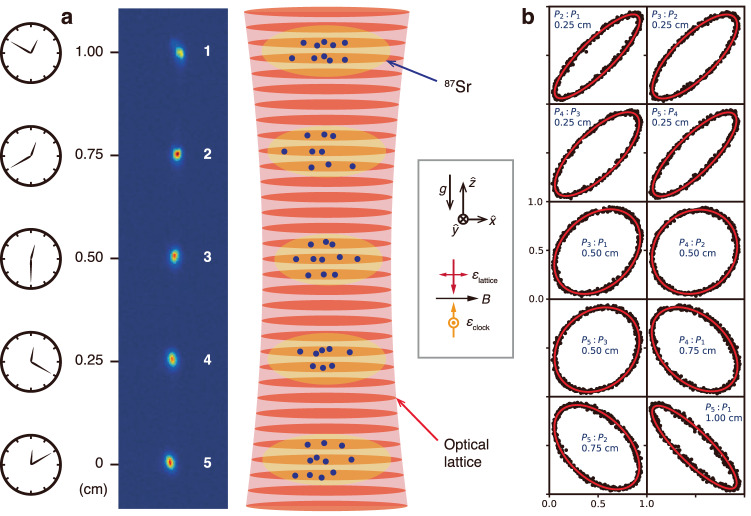
“43, fi ve ensembles of ultra-cold, spin-mixed 87 Sr atoms areloaded into a vertical optical lattice with a depth of 130 E rec , where E rec / h ≈ 3.5 kHz is the recoil energy of a lattice photon and h is the Planck constant, with an equal spacing between ensembles of 0.25 cm over a total extent of 1…”
InfluentialSelf-citationUltrastable Silicon Cavity in a Continuously Operating Closed-Cycle Cryostat at 4 K
Zhang, W., Robinson, J. M., Sonderhouse, L., Oelker, E., Benko, C., Hall, J. L., Legero, T., Matei, D. G., Riehle, F., Sterr, U., et al. (2017) · Physical Review Letters · doi:10.1103/physrevlett.119.243601 · Cited by 132
Operational Magic Intensity for Sr Optical Lattice Clocks
Ushijima, I., Takamoto, M., & Katori, H. (2018) · Physical Review Letters · doi:10.1103/physrevlett.121.263202 · Cited by 111 · cited 2×
“This allows us to extract the operational lattice detuning from the effective magic wavelength 25,51 , and to independently evaluate the lattice light shift gradient upon removal of the δ u shifts (Fig.”
Hyperpolarizability and Operational Magic Wavelength in an Optical Lattice Clock
Brown, R. C., Phillips, N. B., Beloy, K., McGrew, W. F., Schioppo, M., Fasano, R. J., Milani, G., Zhang, X., Hinkley, N., Leopardi, H., et al. (2017) · Physical Review Letters · doi:10.1103/physrevlett.119.253001 · Cited by 101 · cited 1×
“The opticallattice is operated near the magic wavelength where the differential polariz-ability between the ground ( 1 S 0 , g ) and clock ( 3 P 0 , e ) states is zero 50,51 .”
Denker, H., Timmen, L., Voigt, C., Weyers, S., Peik, E., Margolis, H. S., Delva, P., Wolf, P., & Petit, G. (2018) · Journal of Geodesy · doi:10.1007/s00190-017-1075-1 · Cited by 91
Ohmae, N., Takamoto, M., Takahashi, Y., Kokubun, M., Araki, K., Hinton, A., Ushijima, I., Muramatsu, T., Furumiya, T., Sakai, Y., et al. (2021) · Advanced Quantum Technologies · doi:10.1002/qute.202100015 · Cited by 79
Determination of a high spatial resolution geopotential model using atomic clock comparisons
Lion, G., Panet, I., Wolf, P., Guerlin, C., Bize, S., & Delva, P. (2017) · Journal of Geodesy · doi:10.1007/s00190-016-0986-6 · Cited by 66
Hamiltonian engineering of spin-orbit–coupled fermions in a Wannier-Stark optical lattice clock
Aeppli, A., Chu, A., Bothwell, T., Kennedy, C. J., Kedar, D., He, P., Rey, A. M., & Ye, J. (2022) · Science Advances · doi:10.1126/sciadv.adc9242 · Cited by 53 · cited 2×
“First, atomicinteractions due to p -wave collisions between on-site atoms lead to a frequency shift that scales linearly with atomic density 52 – 54 .”
InfluentialGeopotential measurement with a robust, transportable Ca+ optical clock
Huang, Y., Zhang, H., Zhang, B., Hao, Y., Guan, H., Zeng, M., Chen, Q., Lin, Y., Wang, Y., Cao, S., et al. (2020) · Physical Review A · doi:10.1103/physreva.102.050802 · Cited by 52
Improved interspecies optical clock comparisons through differential spectroscopy
Kim, M. E., McGrew, W. F., Nardelli, N. V., Clements, E., Hassan, Y. S., Zhang, X., Valencia, J. L., Leopardi, H., Hume, D. B., Fortier, T. M., et al. (2022) · Nature Physics · doi:10.1038/s41567-022-01794-7 · Cited by 43 · cited 1×
“…ensembles 41 – 43 , as well as differential spectroscopy by phase-coherently linking a zero-dead-time optical lattice clock and a single ion clock 44 , allow interrogation times beyond the limit set by the local oscillators, opening up the prospects for future applications with transportable or…”
Lifetime-Limited Interrogation of Two Independent Al+27 Clocks Using Correlation Spectroscopy
Clements, E. R., Kim, M. E., Cui, K., Hankin, A. M., Brewer, S. M., Valencia, J., Chen, J.-S., Chou, C.-W., Leibrandt, D. R., & Hume, D. B. (2020) · Physical Review Letters · doi:10.1103/physrevlett.125.243602 · Cited by 39
Chronometric Geodesy: Methods and Applications
Delva, P., Denker, H., & Lion, G. (2019) · Fundamental Theories of Physics · doi:10.1007/978-3-030-11500-5_2 · Cited by 28
Research works printed but not linked: 5
- Einstein A Grundgedanken der allgemeinen Relativitätstheorie und Anwendung dieser Theorie in der Astronomie. Preuss. Akad. der Wissenschaften Sitzungsberichte 1915 315 778 786
- Huang Y A compact, transportable single-ion optical clock with 7.8 × 10⁻¹⁷ systematic uncertainty Appl. Phys. B 2017 123 112
- Delva P Lodewyck J Atomic clocks: new prospects in metrology and geodesy Acta Futura 2013 7 67 78
- Halir, R. & Flusser, J. Numerically stable direct least squares fitting of ellipses. Proc. of Sixth Intl Conf. Computer Graphics and Visualization 1 (1998).
- Estey, B.V.Ph. D. thesis (2016).
Cited by
Clock with 8 × 10 − 19 Systematic Uncertainty
Aeppli, A., Kim, K., Warfield, W., Safronova, M. S., & Ye, J. (2024) · Physical Review Letters · doi:10.1103/physrevlett.133.023401 · Cited by 211
Realizing spin squeezing with Rydberg interactions in an optical clock
Eckner, W. J., Oppong, N. D., Cao, A., Young, A. W., Milner, W. R., Robinson, J. M., Ye, J., & Kaufman, A. M. (2023) · Nature · doi:10.1038/s41586-023-06360-6 · Cited by 230
Quantum networks with neutral atom processing nodes
Covey, J. P., Weinfurter, H., & Bernien, H. (2023) · npj Quantum Information · doi:10.1038/s41534-023-00759-9 · Cited by 180
Long-distance chronometric leveling with a portable optical clock
Grotti, J., Nosske, I., Koller, S. B., Herbers, S., Denker, H., Timmen, L., Vishnyakova, G., Grosche, G., Waterholter, T., Kuhl, A., et al. (2024) · Physical Review Applied · doi:10.1103/physrevapplied.21.l061001 · Cited by 33
“Previously, extremely small redshifts have been resolved with optical clocks [12, 13] by differential observations in a single apparatus.”
Reducing the Instability of an Optical Lattice Clock Using Multiple Atomic Ensembles
Zheng, X., Dolde, J., & Kolkowitz, S. (2024) · Physical Review X · doi:10.1103/physrevx.14.011006 · Cited by 27
Self-citation
Metadata
- Authors
- Zheng, X., Dolde, J., Cambria, M. C., Lim, H. M., & Kolkowitz, S.
- Affiliations
- University of Wisconsin–Madison (US)
- Corresponding author
- Kolkowitz, Shimon
- Venue
- Nature Communications
- Published
- 2023-08-12
- Volume
- 14
- Issue
- 1
- Pages
- 4886-4886
- ISSN
- 2041-1723 (ISSN-L)
- PMC
- PMC10423269
- OpenAlex
- W4385784013
- Semantic Scholar
- 013d25ddd53dbde893ff961df7b851593c3ebbe1
- Cited by
- 47
- References
- 53
- Citations by year
- 2026: 13 · 2025: 15 · 2024: 15 · 2023: 4
- FWCI
- 5.45
- Type
- journal article
- Language
- en
- Open access
- gold
- doi.org
- Licence
- cc-by
- creativecommons.org/licenses/by/4.0 (tdm)
- creativecommons.org/licenses/by/4.0 (vor)
- Locations
- Nature Communications (publishedVersion, cc-by)
- PubMed Central (publishedVersion, cc-by)
- PubMed (publishedVersion)
- arXiv (Cornell University) (submittedVersion)
- eScholarship (California Digital Library) (submittedVersion, cc-by)
- RePEc: Research Papers in Economics (submittedVersion)
- DOAJ (DOAJ: Directory of Open Access Journals) (submittedVersion, cc-by-sa)
- arXiv (Cornell University) (cc-by)
- Funders
- United States Department of Commerce | National Institute of Standards and Technology
- John Templeton Foundation
- David and Lucile Packard Foundation
- United States Department of Defense | United States Army | U.S. Army Research, Development and Engineering Command | Army Research Office (W911NF-21-1-0012)
- NSF | Directorate for Mathematical & Physical Sciences | Division of Physics (2143870)
- Alfred P. Sloan Foundation
- Northwestern University Center for Fundamental Physics Wisconsin Alumni Research Foundation
- Topics
- Physical Sciences › Physics and Astronomy › Atomic and Molecular Physics, and Optics › Advanced Frequency and Time Standards
- Physical Sciences › Physics and Astronomy › Astronomy and Astrophysics › Relativity and Gravitational Theory
- Physical Sciences › Physics and Astronomy › Astronomy and Astrophysics › Pulsars and Gravitational Waves Research
- Keywords
- gravitational redshift, general relativity, optical atomic clocks, clock distribution, frequency gradient, geodesy
About these checks
Registry, retraction, Cites and statistics results are computed, not judged, with one exception: a printed reference that no index lists is read once by a model before it counts as a citation error. Claims are extracted by a model and kept only when their quote appears verbatim in the text; each cited source is then checked, with a model’s help, for whether it says what the claim relies on. Those verdicts can be wrong — read the claim’s quote and the cited source before relying on one.
Statistics and arithmetic are recomputed, not judged.
Confidence bands are shown only for fields calibrated on our annotated test set. None is calibrated yet, so no band is shown.
What counts as a claim ›How we measure confidence ›How we check this ›
Are you an author, or do you see a problem with this page? Request a review
Data sources
Bibliographic data: Semantic Scholar, OpenAlex, Crossref.
Contains information from the Semantic Scholar Academic Graph Datasets, made available under the ODC Attribution License (ODC-BY 1.0).
Semantic Scholar’s data is described in: Kinney, R., et al. (2023). The Semantic Scholar Open Data Platform. arXiv:2301.10140.
