

A microfluidic platform integrating functional vascularized organoids-on-chip
Open accessPublished version of a preprint
The DOI matches its Crossref record; 65 of the 65 references it cites were found in a registry or an index.
Abstract
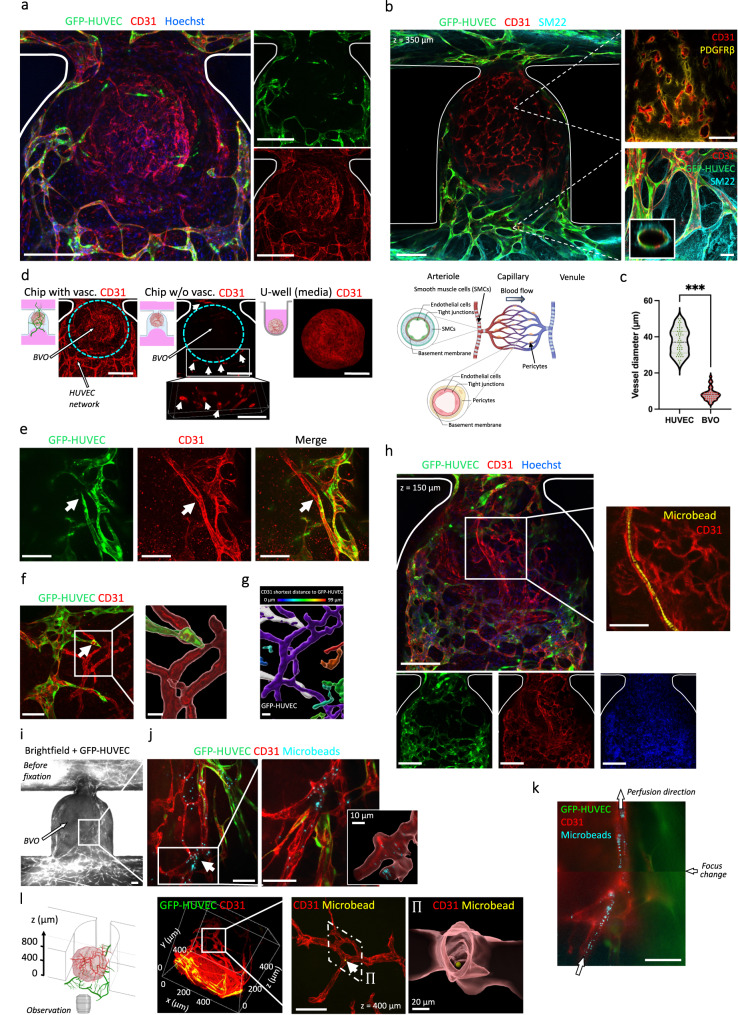
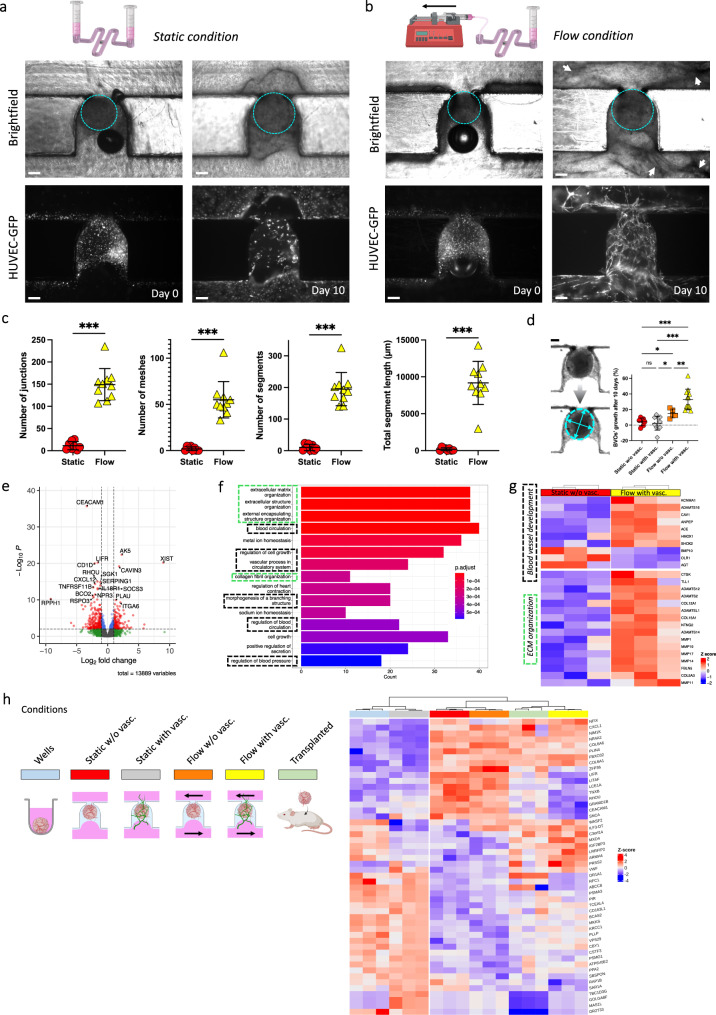
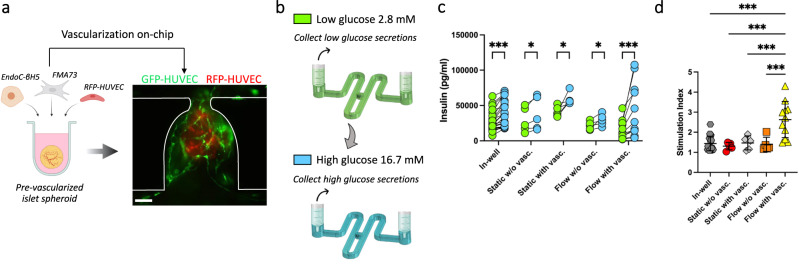
The development of vascular networks in microfluidic chips is crucial for the long-term culture of three-dimensional cell aggregates such as spheroids, organoids, tumoroids, or tissue explants. Despite rapid advancement in microvascular network systems and organoid technologies, vascularizing organoids-on-chips remains a challenge in tissue engineering. Most existing microfluidic devices poorly reflect the complexity of in vivo flows and require complex technical set-ups. Considering these constraints, we develop a platform to establish and monitor the formation of endothelial networks around mesenchymal and pancreatic islet spheroids, as well as blood vessel organoids generated from pluripotent stem cells, cultured for up to 30 days on-chip. We show that these networks establish functional connections with the endothelium-rich spheroids and vascular organoids, as they successfully provide intravascular perfusion to these structures. We find that organoid growth, maturation, and function are enhanced when cultured on-chip using our vascularization method. This microphysiological system represents a viable organ-on-chip model to vascularize diverse biological 3D tissues and sets the stage to establish organoid perfusions using advanced microfluidics.
Overview
The claims and statistics of this paper haven’t been checked yet.
Free: it reads the open-access text and checks the first 5 claims that cite a source we can check. Create a free account to check every claim.
Integrity signals
Registry
Cites
Statistics
Figures
Verification
Claims the paper makes
The claims and statistics of this paper haven’t been checked yet.
Free: it reads the open-access text and checks the first 5 claims that cite a source we can check. Create a free account to check every claim.
Self-check
Percentages, sums and reported differences re-computed from the paper’s own numbers.
The self-check needs the paper’s full text.
Citations
Cites
Ultrastructural Characterization of the Lower Motor System in a Mouse Model of Krabbe Disease
Cappello, V., Marchetti, L., Parlanti, P., Landi, S., Tonazzini, I., Cecchini, M., Piazza, V., & Gemmi, M. (2016) · Scientific Reports · doi:10.1038/s41598-016-0001-8 · Cited by 13,097
Limb proportions show developmental plasticity in response to embryo movement
Pollard, A. S., Charlton, B. G., Hutchinson, J. R., Gustafsson, T., McGonnell, I. M., Timmons, J. A., & Pitsillides, A. A. (2017) · Scientific Reports · doi:10.1038/srep41926 · Cited by 2,364
An in vivo model of functional and vascularized human brain organoids
Mansour, A. A., Gonçalves, J. T., Bloyd, C. W., Li, H., Fernandes, S., Quang, D., Johnston, S., Parylak, S. L., Jin, X., & Gage, F. H. (2018) · Nature Biotechnology · doi:10.1038/nbt.4127 · Cited by 1,211
Extracellular matrix remodelling: the role of matrix metalloproteinases
Stamenkovic, I. (2003) · The Journal of Pathology · doi:10.1002/path.1400 · Cited by 1,140 · cited 1×
“Moreover, genes of the metalloproteinase family, involved in ECM remodeling 35 , were found to be upregulated under fl ow conditions (Fig.”
Advances in organ-on-a-chip engineering
Zhang, B., Korolj, A., Lai, B. F. L., & Radisic, M. (2018) · Nature Reviews Materials · doi:10.1038/s41578-018-0034-7 · Cited by 1,017
Aminopeptidase N is a receptor for tumor-homing peptides and a target for inhibiting angiogenesis.
Pasqualini, R., Koivunen, E., Kain, R., Lahdenranta, J., Sakamoto, M., Stryhn, A., Ashmun, R., Shapiro, L., Arap, W., & Ruoslahti, E. I. (2000) · PubMed · Cited by 970
Engineering of human brain organoids with a functional vascular-like system
Cakir, B., Xiang, Y., Tanaka, Y., Kural, M. H., Parent, M., Kang, Y.-J., Chapeton, K., Patterson, B., Yuan, Y., He, C.-S., et al. (2019) · Nature Methods · doi:10.1038/s41592-019-0586-5 · Cited by 942
Flow-enhanced vascularization and maturation of kidney organoids in vitro
Homan, K. A., Gupta, N., Kroll, K. T., Kolesky, D. B., Skylar-Scott, M., Miyoshi, T., Mau, D., Valerius, M. T., Ferrante, T., Bonventre, J. V., et al. (2019) · Nature Methods · doi:10.1038/s41592-019-0325-y · Cited by 939
Engineering of functional, perfusable 3D microvascular networks on a chip
Kim, S., Lee, H., Chung, M., & Jeon, N. L. (2013) · Lab on a Chip · doi:10.1039/c3lc41320a · Cited by 872
Human blood vessel organoids as a model of diabetic vasculopathy
Wimmer, R. A., Leopoldi, A., Aichinger, M., Wick, N., Hantusch, B., Novatchkova, M., Taubenschmid, J., Hämmerle, M., Esk, C., Bagley, J. A., et al. (2019) · Nature · doi:10.1038/s41586-018-0858-8 · Cited by 803 · cited 3×
“We have previously reported the generation of such organoids 17 and demon-stratedtheirphysiologicalrelevancethroughthemodellingofdiabetic vasculopathybothinvitroandinvivo 3 .”
Self-citation
Research works printed but not linked: 1
- Carpentier, G., Martinelli, M., Courty, J. & Gascone, I. Angiogenesis analyzer for ImageJ. 4th ImageJ User and Developer Conference proceedings. (pp. 198-201). https://imagej.nih.gov/ij/macros/toolsets/Angiogenesis%20Analyzer.txt (2012).
Cited by
Items 101–200 of 409
Pan, X., Liu, S., Long, M., Peng, R., Hu, L., Liu, Y., & Huang, W. (2025) · Biomaterials Science · doi:10.1039/d5bm00734h · Cited by 8
Organoid-on-a-chip (OrgOC): Advancing cystic fibrosis research
Zheng, M., Erice, E., Wang, H., Zhang, L., & Lawrie, C. H. (2025) · Materials Today Bio · doi:10.1016/j.mtbio.2025.102148 · Cited by 10
Animal-free alternatives for Matrigel in human iPSC-derived blood vessel organoid culture
Giles, R. H., Meijer, E. M., Maas, R. G. C., van Dijk, C. G. M., Verhaar, M. C., & Cheng, C. (2025) · Scientific Reports · doi:10.1038/s41598-025-20091-w · Cited by 10
Zhang, X., Xu, F., Shi, Y., Zhang, H., Dong, X., & Bai, Y. (2025) · TrAC Trends in Analytical Chemistry · doi:10.1016/j.trac.2025.118554 · Cited by 8
Mastering Organoid Growth: A Complete Guide to Overcoming Methodological Challenges
Jiao, C., Karakaya, O. F., Dadgar, N., Wehrle, C. J., Massoud, Z., Hong, H., Fairchild, R. L., Leipzig, N. D., Aucejo, F., Ma, W. W., et al. (2026) · MedComm · doi:10.1002/mco2.70571 · Cited by 12
“Endothelial cells formed organized networks that wrapped around the tissue, enhancing perfusion and long-term survival [ 152 ].”
The role of endothelial cells in pancreatic islet development, transplantation and culture
Geng, A., Yuan, S., Yu, Q. C., & Zeng, Y. A. (2025) · Frontiers in Cell and Developmental Biology · doi:10.3389/fcell.2025.1558137 · Cited by 8
“The islet organoid growth, maturation, and function were enhanced when vascularized on-chip (Quintard et al., 2024).”
Osteochondral organoid biofabrication: construction strategies, applications and perspectives
Fu, L., Wu, J., Zhang, Z., Zhang, Z., Zheng, Y., Li, P., Long, C., Sui, X., Liu, S., & Guo, Q. (2025) · Biofabrication · doi:10.1088/1758-5090/ade740 · Cited by 9
“Furthermore, microfluidic technology provides new pathways for the functionalization of organoids, particularly vascularization, by precisely controlling the physical, chemical, and biological factors of the microenvironment [95].”
Organoid scaffold materials: research and application
Zhang, Z., Zhu, M., Luo, H., Zeng, F., & Qi, Z. (2025) · Frontiers in Bioengineering and Biotechnology · doi:10.3389/fbioe.2025.1637456 · Cited by 13
“For instance, Quintard et al. developed a micro fl uidic platform, which not only achieved ef fi cient encapsulation of organoids but also dynamically perfused to form functional vascular networks (Quintard et al., 2024).”
Srinivasan, D., Gout, J., Kleger, A., & Roger, É. (2025) · Advanced Drug Delivery Reviews · doi:10.1016/j.addr.2025.115697 · Cited by 11
Yang, S., Zhang, T., Ge, Y., Niu, Y., Chen, M., Yin, L., Pu, Y., Chen, Z., Gu, Z., & Liang, G. (2026) · The Innovation · doi:10.1016/j.xinn.2025.101252 · Cited by 19
Pediaditakis, I., Tsakali, S., Lemieux, M. R., Brennan, M., Robinson, W. H., Papapetropoulos, S., & Papapetropoulos, A. (2026) · Pharmacological Reviews · doi:10.1016/j.pharmr.2026.100118 · Cited by 10
Mechano-Organ-on-Chip for Cancer Research
Wang, L., Cheung, J. C., Zhao, X., Khoo, B. L., & Wong, S. H. D. (2026) · International Journal of Molecular Sciences · doi:10.3390/ijms27031330 · Cited by 7
The Heterogeneity and Function of Stromal Cells in the Tumor Microenvironment
Wang, X., Li, S., Xue, Y., Liang, X., Ma, X., Zhang, K., & Wang, Y. (2026) · Research · doi:10.34133/research.1183 · Cited by 10
A Vascularized Lung Tumoroid‐on‐Chip Model for the Accurate Assessment of Anti‐Invasion Agents
Wang, X., Zhu, G., Lu, J., Hu, X., Zheng, W., Yang, K., Zhang, W., Huang, Y., Hu, S., Zhao, B., et al. (2026) · Advanced Functional Materials · doi:10.1002/adfm.202526981 · Cited by 11
Integrating Human Intestinal Organoids into FDA's New Approach Methodologies for Drug Discovery
Patra, D., Sayed, I. M., Mukherjee, S., Piplani, H., Habtezion, A., Rosen, M. J., & Wu, J. C. (2026) · Advanced Science · doi:10.1002/advs.202522276 · Cited by 9
“Vascularized organoid-on-chip systems of kidney [ 178 ], liver [ 179 ], and pancreas [ 180 ], among others, have been demonstrated to overcome the diffusion limitations inherent to static organoid cultures by culturing under flow conditions.”
A Novel Microfluidic Platform for Personalized Anticancer Drug Screening Through Image Analysis
Lipreri, M. V., Totaro, M. T., Boos, J. A., Basile, M. S., Baldini, N., & Avnet, S. (2024) · Micromachines · doi:10.3390/mi15121521 · Cited by 7
“Among these, microfluidic devices are highly promising [14–20].”
Recreating the Endocrine Niche: Advances in Bioengineering the Pancreas
Fonseca, L. M., Krause, N., Lebreton, F., & Berishvili, E. (2025) · Artificial Organs · doi:10.1111/aor.14950 · Cited by 7
Strategies for fabrication of microalgae based biomaterials: Recent updates
Singh, A. K., & Mahapatra, C. (2025) · Hybrid Advances · doi:10.1016/j.hybadv.2025.100445 · Cited by 6
Ingenious integration of synthetic biology and droplet microfluidics
Zhang, P., Wu, H., Zhang, R., Zhao, D., Wei, W., Yang, Q., Wang, Z., Shi, T., & Wang, Y. (2025) · Chemical Engineering Journal · doi:10.1016/j.cej.2025.165813 · Cited by 11
Salmina, A. B., Saridis, M. R., Ryzhkov, V. V., Korsakova, S. A., Сергеевич, А. А., Bystrov, D. A., Barbasheva, A. A., Libet, P. A., Kuguk, A. K., Polynkin, L. Y., et al. (2025) · Biotechnology Journal · doi:10.1002/biot.70126 · Cited by 8
“Single-cell transcriptomics revealed new insights into autophagy-regulated sprout formation [318], while novel microfluidic traps enabled vascularization of 3D tissue spheroids [319].”
Lacombe, J., Dunn, S. E., Layac, M., Soldevila, M., Fakrudin, N. M., Duane, B., Chen, K., Barrett, M. W., Helton, J., Laiakis, E. C., et al. (2025) · iScience · doi:10.1016/j.isci.2025.114236 · Cited by 7
Tumor organoids on-a-chip and the role of AI in predictive oncology and personalized cancer medicine
Mirlohi, M. S., Hamdi, E., Karimi, M. H., Salami, S., Aref, A. R., Kohan, H. G., Ghayoor, A., Seyfoori, A., & Akbari, M. (2026) · Biofabrication · doi:10.1088/1758-5090/ae3644 · Cited by 7
“…understanding of almost all organs, including the skin [ 81], the skeletal muscles [82], the gastrointestinal system [83], the heart [84], blood vessels [85], the liver [86], the pancreas [87], the brain [88], the blood–brain barrier (BBB) [89], and other parts of the central nervous system [90].”
Grumezescu, V., & Duta, L. (2026) · Biomimetics · doi:10.3390/biomimetics11010066 · Cited by 9
Li, L., Si, W., Jin, Z., & Jin, W. (2026) · International Journal of Molecular Sciences · doi:10.3390/ijms27041808 · Cited by 7
“Organ-on-a-chip platforms address the limitations of traditional static skin models in nutrient transport and waste clearance by introducing microfluidic channels to achieve dynamic culture conditions, offering a framework for organ-on-a-chip models of multiple tissues [35–37].”
Ciliopathy organoid models: a comprehensive review
Kuzinska, M. Z., Lin, S. Y.-Y., Klämbt, V., Bufler, P., & Rezvani, M. (2024) · American Journal of Physiology-Cell Physiology · doi:10.1152/ajpcell.00343.2024 · Cited by 8
Antagonizing the S1P-S1P3 Axis as a Promising Anti-Angiogenic Strategy
Avnet, S., Mizushima, E., Severino, B., Lipreri, M. V., Scognamiglio, A., Corvino, A., Baldini, N., & Cortini, M. (2025) · Metabolites · doi:10.3390/metabo15030178 · Cited by 6
Advances in bone organoids research and future perspectives
Liu, J., Li, J. Y., Chen, Y., Xu, F., Liu, W., Deng, 志. Z. 邓., Zhong, H., & Yang, H. (2025) · Biofabrication · doi:10.1088/1758-5090/adffb9 · Cited by 6
“…[39]; microfluidic kidney organoid platforms that accelerate drug screening and reduce reliance onanimal testing [87]; neur-ovascular organoids created through 3D-printed microfluidic chip technology [88]; and vascularized organoid-on-a-chip models integrating functional microvasculature [89].”
Application of biomaterials in vascularization of cardiac organoids
Liu, J., Feng, Y., Qu, P., Luo, Y., Shi, J., Ma, C., Liang, Q., Zhao, L., Li, G., Yang, B. W., et al. (2025) · iScience · doi:10.1016/j.isci.2025.113531 · Cited by 5
“159 Furthermore, Wu et al. employed acoustofluidic techniques to spatially organize suspended endothelial cells within a microfluidic chip using standing acoustic waves.”
Advances and applications of organoid-on-a-chip in disease modeling
Yang, Y., Sheng, J., Sheng, F., Liang, X., Ma, C., Chen, R., Wang, S., & Qian, X. (2025) · The Analyst · doi:10.1039/d5an00514k · Cited by 8
Harnessing human tumor organoids for cancer modeling and precision therapy
Zhou, T., Wang, Q., Mei-li, Z., & Huang, Y. (2026) · Protein & Cell · doi:10.1093/procel/pwag007 · Cited by 7
Organoid Models: Revolutionizing Disease Modeling and Personalized Therapeutics
Xue, Z., Yang, R., Liu, Y., & Luo, H. (2026) · Organoids · doi:10.3390/organoids5010009 · Cited by 5
“Second, dynamic monitoring capabilities—vascularized organoid-on-a-chip platforms—allow for real-time tracking of drug distribution kinetics, with vascular leakage features being significantly more strongly correlated with clinical imaging data than they are in animal models [64].”
Reconstructing tumor tissues in 3D: From organoids to bioengineered niches
Kast, V., Navaee, F., Halvaei, M., Liebau, S., Azoitei, N., Breunig, M., Loskill, P., & Kleger, A. (2026) · Cell stem cell · doi:10.1016/j.stem.2026.03.005 · Cited by 7
Raguin, J., Legrand, N., Kortulewski, T., Bergiers, O., Granotier-Beckers, C., Chatrousse, L., Benchoua, A., Gauthier, L., Boussin, F. D., & Mouthon, M. (2026) · Cell Reports Methods · doi:10.1016/j.crmeth.2026.101425 · Cited by 9
Vascular and immune interactions in islets transplantation and 3D islet models
Migliorini, A., & Nostro, M. C. (2024) · Current Opinion in Genetics & Development · doi:10.1016/j.gde.2024.102237 · Cited by 7
Pan, C., Lin, X., Bian, F., Li, L., & Shen, X. (2025) · Chemical Engineering Journal · doi:10.1016/j.cej.2025.164173 · Cited by 5
A modular and reconfigurable microfluidic device for culturing spheroids under continuous perfusion
Aljayyousi, H., Sahloul, S., Orozaliev, A., Baban, N. S., Van, D.-A., Nuairi, A. A., John, P., Zam, A., Percipalle, P., & Song, Y. (2025) · APL Bioengineering · doi:10.1063/5.0262536 · Cited by 5
Okumura, A., Aoshima, K., & Tanimizu, N. (2024) · Regenerative Therapy · doi:10.1016/j.reth.2024.05.020 · Cited by 6
Ortiz-Collazos, S., Sousa-Batista, A. J., & Balbino, T. A. (2024) · Biochemical Engineering Journal · doi:10.1016/j.bej.2024.109475 · Cited by 6
Frog tongue-inspired wettable microfibers for particles capture
Guo, J., Sun, L., Zhang, H., & Zhao, Y. (2024) · 中国科学通报:英文版 · doi:10.1016/j.scib.2024.11.038 · Cited by 5
Schneider, B. M., Hamurcu, H. I., Salzbrunn, A., & von Kopylow, K. (2025) · Asian Journal of Andrology · doi:10.4103/aja20254 · Cited by 5
“While most setups have solely used chamber-based trapping methods, alternative strategies include hydrodynamic trapping, 48,49 immobilization within individual hanging drops, 50 cell adhesion by surface patterning of the MFD with biofunctional molecules ( e.g., cell antibodies or collagen),…”
Lang, S., Lin, X., Wang, S., Sun, W., Yang, Y., Chen, Y., Bao, Z., Feng, W., Wang, Y., & Luo, Y. (2025) · Environment & Health · doi:10.1021/envhealth.5c00072 · Cited by 4
Zhang, H.-B., Deng, S., Jin, F. G., Qu, J., Fan, X., Chen, P., & Fan, X. (2026) · Interdisciplinary medicine · doi:10.1002/inmd.70094 · Cited by 6
Advancing multiscale vascular engineering for regeneration and transplantation
Ju, Y., Hsiung, N., Zou, P., Zhao, H., Yang, K., Xiang, X., Feng, Y., Qiao, Z., Wang, B., Sun, Y., et al. (2026) · Chemical Engineering Journal · doi:10.1016/j.cej.2026.175126 · Cited by 6
Microfluidic manipulation of the multicellular spheroids and organoids for modeling human diseases
Zhao, L., Xiong, S., Wang, D., & Wang, X. (2025) · Microchemical Journal · doi:10.1016/j.microc.2025.113718 · Cited by 7
Zhang, Y., Yang, N., Li, Q., Tang, Y., Bai, B., & Liu, G. (2025) · Virology · doi:10.1016/j.virol.2025.110595 · Cited by 4
Vascularized Organoid-on-Chip Platforms: Expanding the Bioengineering Frontiers with Microfluidics
Konwarh, R. (2025) · Biomaterials Connect · doi:10.69709/biomatc.2025.155652 · Cited by 4
Organoids in parasitology: a game-changer for studying host–nematode interactions
Pérez, M. G., Coman, D., Neves, J. F., & Britton, C. (2025) · Parasitology · doi:10.1017/s0031182025100620 · Cited by 7
“Tissue engineering strategies, including ECM-embedded scaffolds, bioreactors and organoids-on-a-chip, have been developed as powerful tools for modelling both healthy and diseased organs (Wang et al. 2024) and can support organoid culture and better simulate the natural tissue architecture.”
Dong, Z., Li, S., Li, M., Fan, M.-Y., Chen, K., Li, A., Wang, K., & Zhang, X. (2025) · Cancer Drug Resistance · doi:10.20517/cdr.2025.157 · Cited by 20
The Potential of Phytochemicals to Overcome Multidrug Resistance in Metastatic Melanoma
Maphutha, J., Twilley, D., Dawood, M., Efferth, T., & Lall, N. (2025) · Chemistry & Biodiversity · doi:10.1002/cbdv.202502536 · Cited by 4
Mainardi, A., Barbero, A., Ehrbar, M., Rasponi, M., Martín, I., & Occhetta, P. (2025) · Journal of Orthopaedic Translation · doi:10.1016/j.jot.2025.10.009 · Cited by 11
“…and maintenance of compact vascular structures — whereas vessel regression was observed after 14 days in culture — aligns with previous reports demonstrating that fluid flow and the associated shear stresses are essential for the long-term maintenance of vascular networks in OoC systems [49,50].”
Ding, H., Lin, P., Wu, W., Zhou, G., Fu, Q., Li, G., Jin, J., Wang, Y., Meng, F., Xu, X., et al. (2026) · ACS Applied Bio Materials · doi:10.1021/acsabm.5c01879 · Cited by 4
Wang, M., Ding, X., Chen, L., Cui, Z., Ding, Y., Song, Y., Li, W., & Zhang, X. (2026) · Cell Death and Disease · doi:10.1038/s41419-026-08512-8 · Cited by 6
Decoding macrophage heterogeneity in the pulmonary fibrosis lung cancer transition
Yu, H., Zhao, M., Li, Q., & Zhang, Y. (2026) · Frontiers in Immunology · doi:10.3389/fimmu.2026.1787094 · Cited by 7
“Although breakthroughs in chip vascularization technology have recently been achieved (218), he next phase of advancement lies in integrating migratory immune cells.”
Application and prospects of organoid-on-a-chip in research on the intestinal mucosal barrier
Qian, K., Wang, Y., Li, R. Q., Zhuang, M., Zhao, Z., Meng, C., Zhou, J., Wang, W., & Sun, Y. J. (2026) · Burns & Trauma · doi:10.1093/burnst/tkag029 · Cited by 4
“Dynamic perfusion and vascularization can partly address these limitations and improve physiological relevance, although at the cost of greater technical complexity [ 79, 101– 103].”
Modular living assembly of bone organoids with in situ guided vascularization
Ju, J., Fang, H., Jie, J., Wu, Y., Wang, J., Gao, Q., Zhang, Y., Luo, C., Zheng, H., Sun, J., et al. (2026) · Bioactive Materials · doi:10.1016/j.bioactmat.2026.04.020 · Cited by 5
“However, they remain insufficient to ensure immediate perfusion, efficient mass transport, and stable integration with host tissues after transplantation [4,18].”
Self-citationDeconstructing cancer in 3D: models, mechanisms, and personalized solutions
Huang, Z., Duan, X., Ji, J., Cai, Q., Jin, P., Yu, B., & (48506), J. Z. (2026) · Molecular Cancer · doi:10.1186/s12943-026-02704-8 · Cited by 6
“…co-cultures, anti-angiogenic agents can be assessed for their capacity to promote vascular normalization phenotypes and to improve drug delivery into the tumor compartment, providing a controllable platform to quantify delivery or response changes under defined perfusion conditions [227].”
Magnetism for mechanobiology and related biomedical applications
Diény, B., Morel, R., Joisten, H., Naud, C., Nicolas, A., Visonà, A., Obeïd, P., Belin, S., & Berger, F. R. (2025) · Physical Review Applied · doi:10.1103/physrevapplied.23.010501 · Cited by 6
Combating Cellular Aging: Frontiers in Biomaterials and Therapies
Liu, S., Mou, J., Zhao, C., Du, C., Liu, J., Bao, W., Xiao, H., Huang, W., Liao, J., & Lei, Y. (2024) · ACS Materials Letters · doi:10.1021/acsmaterialslett.4c02108 · Cited by 6
Li, Y., Liao, W., & Sun, L. (2024) · PubMed Central · doi:10.11817/j.issn.1672-7347.2024.240187 · Cited by 7
“和成纤维细胞的混合物掺入类器官周围,并通过空 气注入和水凝胶的推动,实现了微流体通道的连续 灌注 [36] Chen 等 [41] 的研究发现使用 ALI 法培养的结肠癌类器 官模型中,对抗 PD-1 抗体治疗反应良好的类器官显 示出较低水平的 MDSCs 。此外,研究 [41] 还观察到活 精准打击 [43] 。然而,传统的药物评估模型在预测正常 组织对药物的反应方面往往存在局限性,尤其是在 评估细胞间相互作用的影响时。 Kroll 等 [44] [45] 通过流式细胞术分析,发现在培养 [46] [46] 及 NK 细胞疗法等 [48] 。 CAR-T 是一种细胞工程策略,通过改造患者自…”
Comparison of Measurement Protocols for Internal Channels of Transparent Microfluidic Devices
Kaal, J., Feltin, N., Lelong, M., Yin, H., Glidle, A., Romieu, K., & Batista, E. (2025) · Metrology · doi:10.3390/metrology5010004 · Cited by 5
“In recent years, the microfluidics industry has experienced remarkable growth, driven by applications such as chemical analysis, point-of-care diagnostics [6,7], and pharmaceutical research [8,9], including microphysiological systems [10,11].”
Self-citationSong, J., Lee, Y., Kim, M.-S., Ha, G., Jang, W., Batjargal, U., Kim, Y. G., Kim, H., & Lee, J. (2025) · Lab on a Chip · doi:10.1039/d4lc00950a · Cited by 5
Engineering microfluidic human liver-islet crosstalk platform for recapitulating MASLD
Li, J., Wu, Z., Gan, J., Zhi, Y., Zhao, Y., & Li, L. (2025) · Chemical Engineering Journal · doi:10.1016/j.cej.2025.165209 · Cited by 6
Li, Z., Han, X., Chen, Q., Zhang, T., & Liu, W. (2025) · Journal of Analysis and Testing · doi:10.1007/s41664-025-00393-8 · Cited by 5
Sun, X., Che, S., Wang, H., Fan, Y., Ding, Y., Tan, A., Yang, K., Hu, J., Zhang, Y., Ma, M., et al. (2025) · Developmental Cell · doi:10.1016/j.devcel.2025.10.019 · Cited by 7
Keleş, B. S., Rumman, B., Samarie, M. A. J. A., Özdemir, Y., Çakmak, Ö. Ö., Akyoldaş, G., Ertan, S., & Sokullu, E. (2025) · Cell Communication and Signaling · doi:10.1186/s12964-025-02461-z · Cited by 4
“…genome editing and single-cell omics to systematically dissect the genetic and molecular pathways underlying neuronal vulnerability; and (iv) combining 3D culture platforms with computational systems to establish predictive frameworks for disease progression and therapeutic response [196–201].”
Lee, Y., Kim, S., Koh, H., Park, Y., Han, J. Y., & Ko, J. (2026) · Lab on a Chip · doi:10.1039/d5lc00893j · Cited by 4
Tan, X., Huang, B., Yang, X., Wang, P., & Hu, L. (2026) · Frontiers in Cell and Developmental Biology · doi:10.3389/fcell.2025.1746622 · Cited by 4
“These microfluidic platforms incorporate perfusable microvascular networks that support the growth, maturation, and function of 3D models, enabling highly biomimetic and dynamic TME simulations (Quintard et al., 2024).”
Shao, H., & Young, E. W. K. (2026) · ACS Biomaterials Science & Engineering · doi:10.1021/acsbiomaterials.5c01713 · Cited by 3
Zhang, X., Zhang, C., Zhang, Z., Zhang, X., & Wang, K. (2026) · Frontiers in Immunology · doi:10.3389/fimmu.2025.1734244 · Cited by 5
Adrenomedullin-RAMP2 Enhances Lung Endothelial Cell Homeostasis Under Shear Stress
Yoon, Y., Duffy, S. R., Kirk, S. E., Promnares, K., Karki, P., Birukova, A. A., Birukov, K. G., & Yuan, Y. (2026) · Cells · doi:10.3390/cells15020152 · Cited by 3
“Current bioengineered vascular models, including organ-on-chips, and organoid-on-chips, have incorporated perfusion into their system to simulate native biophysical conditions [10,11].”
Lin, Y.-Y., Esswein, P. J., Ramirez, L. P., Warren, E. C., Nicenboim, J., & Gerecht, S. (2026) · Nature Biomedical Engineering · doi:10.1038/s41551-026-01712-9 · Cited by 6
Zhou, J., Li, N., Liu, R., Kabanov, A. V., Polacheck, W. J., Nguyen, J., & Cao, Y. (2026) · Journal of Controlled Release · doi:10.1016/j.jconrel.2026.115157 · Cited by 4
Aratake, S., & Funamoto, K. (2024) · Microfluidics and Nanofluidics · doi:10.1007/s10404-024-02768-2 · Cited by 3
“In recent years, research utilizing microfluidic devices to elucidate cell dynamics has gathered attention since they enable three-dimensional (3D) cell culture, high-resolution real-time imaging, and precise control for environmental factors for cell culture (Quintard et al. 2024 ).”
Chen, S., Li, Z., Yan, Q., Hua, C., Shang, P., Liu, K., Zhao, J., Jin, G., Li, X., & Xie, F. (2025) · Frontiers in Bioengineering and Biotechnology · doi:10.3389/fbioe.2025.1570270 · Cited by 3
“…micro fl uidic chip requires addressing several challenges, including the biocompatibility and optical properties of materials, fabrication precision, integration of necessary experimental functions, and cost (Quintard et al., 2024; Salvador-Morales and Grodzinski, 2022; Thompson et al., 2020).”
Biomimetic gender-specific human skin model based on gonads/epidermis-on-a-chip
Wu, X., Zhang, Y., Xu, Y., Cao, X., & Zhao, Y. (2025) · Bioactive Materials · doi:10.1016/j.bioactmat.2025.07.014 · Cited by 6
“Additionally, incorporating vascular or immune elements into the dermis further increases the complexity of chip design and biomaterial selection [58].”
Korbmacher, F., & Bernabeu, M. (2025) · Current Opinion in Microbiology · doi:10.1016/j.mib.2025.102585 · Cited by 3
Engineering organoids for dental pulp tissue regeneration and functional reconstruction
Gao, X.-H., Li, X., Fan, B., & Fan, W. (2025) · Regenerative Medicine · doi:10.1080/17460751.2025.2514899 · Cited by 3
Developing advanced organoids: challenges, progress, and outlook
Abilez, O. J. (2024) · BioTechniques · doi:10.1080/07366205.2024.2442825 · Cited by 5
Jian, T., Sivitilli, A., Guo, Y. E., Stirton, C., Gosio, J., Tsukahara, Y., Tkach, J. M., Lu, S., Yarmand, A., Mangos, M., et al. (2026) · bioRxiv (Cold Spring Harbor Laboratory) · doi:10.64898/2026.03.21.713033 · Cited by 4
Developing biotechnologies in organoids for liver cancer
Hu, Y., Peng, Z., Qiu, M., Xue, L., Ren, H., Wu, X., Zhu, X., & Ding, Y. (2024) · Biomedical Technology · doi:10.1016/j.bmt.2024.100067 · Cited by 2
Dasgupta, S., Adhikari, J., Das, P., Sarkar, S., Datta, P., Chowdhury, A. R., & Barui, A. (2025) · ACS Applied Bio Materials · doi:10.1021/acsabm.5c00278 · Cited by 4
Nylon mesh chip promotes three-dimensional visualization of intestinal organoids
Tan, J., Li, Y., Wang, M., Huang, H., Li, J., Ai, Y., Liu, J., Li, H., & Liu, Y. (2025) · Scientific Reports · doi:10.1038/s41598-025-12015-5 · Cited by 2
Wheelock, J. M., Pritchard, R., Kumar, S., & Lu, H. (2025) · Biophysical Journal · doi:10.1016/j.bpj.2025.09.015 · Cited by 2
Lu, C., Shen, R., & Wang, X. (2025) · Biomedical Materials · doi:10.1088/1748-605x/ae084c · Cited by 2
“Advanced fabrication techniques like microfluidics enable precise control over 3D scaffold architecture, allowing tailored pore structures and uniform cell distribution—critical factors for successful tissue regeneration [7–9].”
Hut, M., Denis, J., Bottausci, F., Cubizolles, M., Laurent, P., Kaal, J., Benessalah, M., Boizot, F., Cherradi, N., Fouillet, Y., et al. (2025) · Small · doi:10.1002/smll.202508115 · Cited by 3
Self-citationWhen microfluidics meets pharmaceutical analysis
Ai, Y., Li, L., Xie, R., Wang, P., Guo, H., Ren, F., He, M., & Liang, Q. (2025) · TrAC Trends in Analytical Chemistry · doi:10.1016/j.trac.2025.118518 · Cited by 2
Yang, Q., He, Y., Wang, S., Li, Z. T., Wang, J., Sun, Z., Yang, W., Zhong, X., Peng, B., Chen, Z., et al. (2025) · Angiogenesis · doi:10.1007/s10456-025-10010-y · Cited by 2
Self-citationTailoring human joint-on-a-chip: from biological principles, materials, to disease modeling
Wang, X., Ong, L. J. Y., Karperien, M., & Wen, C. (2025) · Materials Today Bio · doi:10.1016/j.mtbio.2025.102549 · Cited by 2
Yu, Z., Khan, A. A., Naeem, W., Borgia, J. A., Liptay, M. J., Seder, C. W., & Zhou, J. (2025) · APL Bioengineering · doi:10.1063/5.0282002 · Cited by 3
“More recently, a study cultured iPSC-derived vessel organoids on a chip, enabling the formation and spread of perfused microvascular networks, providing a new resource for vascularizing 3D tumor tissues 114 [Fig.”
Free-floating long-term vascularized mesenchymal organoids
de Janon, A., Kaza, P. S., Yoshida, K., Lee, S., DeRyckere, D., Graham, D. K., & Takayama, S. (2025) · iScience · doi:10.1016/j.isci.2025.114548 · Cited by 3
PRICE, M., & Pistollato, F. (2026) · Frontiers in Toxicology · doi:10.3389/ftox.2025.1753572 · Cited by 2
“For example, perfusion-based systems have been shown to better recapitulate in vivo vascularization by enhancing nutrient delivery, waste removal, and biomechanical cues compared with static culture (Quintard et al., 2024).”
Sati, P., Ali, R., Verma, M., Tiwari, N., Verma, S. K., & Sivakumar, S. (2026) · Advanced Healthcare Materials · doi:10.1002/adhm.202503454 · Cited by 2
“More recently, other research groups have described hydrogel-based or scaffold-integrated vascularized organ-on-chip systems that enable perfusion without polymeric membranes [34–40].”
Liver Tissueoid on‐a‐Chip Modeling Liver Regeneration and Allograft Rejection
Salih, A. R. C., Peirsman, A., Khorsandi, D., Ferrao, R., Ferreira, L., Kamaraj, M., John, J. V., Baquerizo, A., & Jucaud, V. (2026) · Advanced Materials · doi:10.1002/adma.202521178 · Cited by 5
Animal-origin-free method for generating blood vessel organoids
Hoffmann, A., Schorn, D., Thönig, J., Teng, Y.-H., Bisson, J.-F., & Yordanov, T. E. (2026) · Scientific Reports · doi:10.1038/s41598-026-42977-z · Cited by 2
“…of using AggreWell or SunBio plates for the aggregation step resulted in suboptimal growth and an unfavorable CD31:PDGFRβ ratio in our hands, it is worth noting that other groups have reported successful aggregation and BVO generation using microwell platforms such as the AggreWell system 20,21 .”
Biological patterns and textures: From formation mechanisms to biomimetic applications
Lin, S., Du, Z., Fang, X., Li, G., & Xie, Y. M. (2026) · Journal of the mechanical behavior of biomedical materials/Journal of mechanical behavior of biomedical materials · doi:10.1016/j.jmbbm.2026.107392 · Cited by 2
Mirlohi, M. S., Akar, S., Yazdani, K., Sardroud, H. A., Fardindoost, S., Taemeh, M. A., Achuthan, M., Singh, S., Tibbits, G. F., Hadjati, J., et al. (2026) · Advanced Drug Delivery Reviews · doi:10.1016/j.addr.2026.115865 · Cited by 4
Naderer, C., Priglinger, E., Ramsauer, M., Bergmayr, C., Gotterbarm, T., Danilchenko, S., Sivun, D., & Jacak, J. (2026) · Small · doi:10.1002/smll.202512037 · Cited by 3
“Valuable approaches are Organ-on-a-Chip (OoC) systems, 3D-bioprinting, and spheroid/organoid cultures for investigation of cellular development in vitro [1–7].”
Functional vasculature in tumor organoids: Enabling precision medicine in oncology
Wu, W., Yao, G., Liu, Y., Zhang, L., Li, Z., Feng, X., Tao, S., Song, J., Kong, T., & Zhou, Z. (2026) · Biochimica et Biophysica Acta (BBA) - Reviews on Cancer · doi:10.1016/j.bbcan.2026.189597 · Cited by 4
A high-throughput modular microfluidic platform for versatile functional assays at single-cell level
Shao, N., Mai, J., Godin, B., & Liu, X. (2026) · Microsystems & Nanoengineering · doi:10.1038/s41378-026-01310-4 · Cited by 2
“The half-maximal inhibitory concentration (IC 50 ) of imatinib for parental K562 cells, the clones 26, 53, 64, and three randomly chosen clones lost drug-resistance (clone 5, 39, 60) were then measured using the CCK-8 method (Fig.”
Assembloids: The next dimension in organoid research
Li, Z., Rao, Q., Ma, N., Sun, H., Zhou, D., Zhao, H., & Xu, X. (2026) · Cell Biomaterials · doi:10.1016/j.celbio.2026.100488 · Cited by 4
Metadata
- Authors
- Quintard, C., Tubbs, E., Jonsson, G., Jiao, J., Wang, J., Werschler, N., Laporte, C., Pitaval, A., Bah, T.-S., Pomeranz, G., Bissardon, C., Kaal, J., Leopoldi, A., Long, D. A., Blandin, P., Achard, J.-L., Battail, C., Hagelkruys, A., Navarro, F., Fouillet, Y., Penninger, J. M., & Gidrol, X.
- Affiliations
- University of British Columbia (CA)
- Commissariat à l'Énergie Atomique et aux Énergies Alternatives (FR)
- Institute of Molecular Biotechnology (AT)
- University College London (GB)
- Institut polytechnique de Grenoble (FR)
- Corresponding author
- Penninger, Josef M.
- Gidrol, Xavier
- ORCID
- Venue
- Nature Communications
- Published
- 2024-02-16
- Volume
- 15
- Issue
- 1
- Pages
- 1452-1452
- ISSN
- 2041-1723 (ISSN-L)
- PMC
- PMC10873332
- OpenAlex
- W4391010423
- Cited by
- 387
- References
- 63
- Citations by year
- 2026: 188 · 2025: 155 · 2024: 42
- FWCI
- 42.28
- Type
- journal article
- Language
- en
- Open access
- gold
- doi.org
- Licence
- cc-by
- creativecommons.org/licenses/by/4.0 (tdm)
- creativecommons.org/licenses/by/4.0 (vor)
- Locations
- Nature Communications (publishedVersion, cc-by)
- bioRxiv (Cold Spring Harbor Laboratory) (acceptedVersion, cc-by)
- PubMed Central (publishedVersion, cc-by)
- PubMed (publishedVersion)
- HAL (submittedVersion, cc-by)
- UCL Discovery (University College London) (submittedVersion, cc-by)
- HAL (submittedVersion, other-oa)
- RePEc: Research Papers in Economics (submittedVersion)
- DOAJ (DOAJ: Directory of Open Access Journals) (submittedVersion)
- Funders
- Faculty of Medicine, University of British Columbia
- Medizinische Universität Wien
- Vienna Science and Technology Fund
- Österreichischen Akademie der Wissenschaften
- Gouvernement du Canada | Canadian Institutes of Health Research
- Topics
- Physical Sciences › Engineering › Biomedical Engineering › 3D Printing in Biomedical Research
- Physical Sciences › Engineering › Biomedical Engineering › Microfluidic and Capillary Electrophoresis Applications
- Health Sciences › Medicine › Surgery › Tissue Engineering and Regenerative Medicine
- Keywords
- vascularization, microfluidic perfusion, blood vessel organoids, pluripotent stem cells, organ-on-a-chip, microvascular networks, 3D cell culture
- MeSH terms
- Endothelium, Islets of Langerhans, Organoids, Tissue Engineering, Microfluidics
About these checks
Registry, retraction, Cites and statistics results are computed, not judged, with one exception: a printed reference that no index lists is read once by a model before it counts as a citation error. Claims are extracted by a model and kept only when their quote appears verbatim in the text; each cited source is then checked, with a model’s help, for whether it says what the claim relies on. Those verdicts can be wrong — read the claim’s quote and the cited source before relying on one.
Statistics and arithmetic are recomputed, not judged.
Confidence bands are shown only for fields calibrated on our annotated test set. None is calibrated yet, so no band is shown.
What counts as a claim ›How we measure confidence ›How we check this ›
Are you an author, or do you see a problem with this page? Request a review
Data sources
Bibliographic data: Semantic Scholar, OpenAlex, Crossref.
Contains information from the Semantic Scholar Academic Graph Datasets, made available under the ODC Attribution License (ODC-BY 1.0).
Semantic Scholar’s data is described in: Kinney, R., et al. (2023). The Semantic Scholar Open Data Platform. arXiv:2301.10140.
